


RRAM Market Size and Overview
The global RRAM market reached an estimated US$ 0.91 billion in 2025 and is expected to reach approximately US$ 4.44 billion by 2035, growing at a CAGR of about 17.2% during the forecast period 2026-2035. The market is transitioning from research and pilot deployments into commercial embedded-memory adoption as semiconductor companies seek alternatives to embedded flash at smaller process nodes. Revenue remains early-stage and is therefore highly sensitive to licensing milestones, foundry qualification, design wins and production ramps.
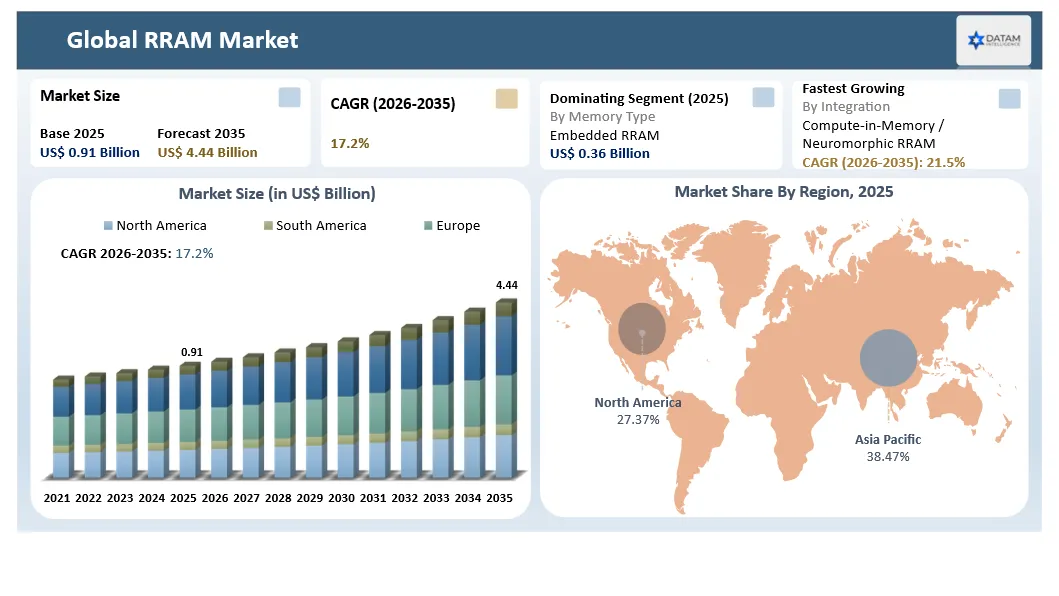
Embedded RRAM is the most commercially advanced route because it can be added to logic processes using relatively simple back-end-of-line steps. This reduces the need for external flash, shortens boot paths and enables lower-power non-volatile memory inside MCUs, SoCs and edge-AI devices. Automotive and industrial applications are particularly attractive because retention at elevated temperatures, radiation tolerance, endurance and data security can justify qualification investment.
The largest long-term upside comes from compute-in-memory, where analog or multi-level RRAM arrays perform matrix operations close to stored weights and reduce energy-intensive data movement. This opportunity remains earlier than embedded NVM because device variability, analog precision, ADC overhead, algorithm-hardware co-design and software tooling must mature before large-volume deployment.
| Metric | Details |
| 2025 Market Size | US$ 0.91 Billion |
| 2035 Projected Market Size | US$ 4.44 Billion |
| CAGR (2026-2035) | 17.2% |
| Largest Market | Asia-Pacific |
| Fastest Growing Market | North America / Asia-Pacific AI & embedded-memory clusters |
| Dominant Segment | Embedded RRAM |
| Fastest-Growing Opportunity | Compute-in-Memory / Neuromorphic RRAM |
RRAM Market Key Takeaways
- Embedded RRAM is the commercial anchor because it addresses scaling and cost challenges associated with embedded flash at advanced logic nodes.
- Weebit Nano’s licensing to Texas Instruments and onsemi materially improves industry validation and creates a path from IP qualification to product deployment.
- Asia-Pacific leads through foundry, memory and electronics manufacturing concentration, while North America is strategically important for IP, AI, automotive and domestic foundry investment.
- Automotive and industrial applications are attractive because high-temperature retention and low-power non-volatile operation create measurable system value.
- Compute-in-memory could expand RRAM beyond memory replacement into AI acceleration, but accuracy, variability and converter overhead remain key constraints.
- Commercial success depends more on qualified process availability and customer tape-outs than on headline device performance alone.
RRAM Industry Trends and Strategic Insights
- RRAM commercialization is shifting toward foundry-enabled IP rather than vertically integrated stand-alone memory, lowering capital requirements for specialist developers.
- BEOL integration is increasingly important because it allows logic processes to add non-volatile memory without complex front-end changes.
- Tier-1 semiconductor licensing agreements are validating RRAM for embedded processing and expanding customer confidence.
- AI and neuromorphic research is increasing interest in analog crossbar computing, multi-level states and in-memory matrix multiplication.
- Automotive qualification is becoming a differentiator as vendors target AEC-Q100 temperature ranges, long retention and high endurance.
- Commercial roadmaps increasingly combine binary embedded NVM with future analog AI offerings, creating platform economics across multiple use cases.
Why does this report matter in 2026?
The year 2026 marks a transition from technology qualification toward product integration. Weebit Nano entered the year with Tier-1 licensing agreements with onsemi and Texas Instruments, JEDEC-based qualification at DB HiTek and multiple product customers integrating ReRAM. In May 2026, two product customers reached tape-out and one was already demonstrating a functional prototype, indicating that the market is moving closer to product-level commercialization rather than remaining confined to test chips.
The timing also matters because AI is increasing the value of memory technologies that reduce data movement, while embedded flash becomes harder to scale economically at advanced nodes. Semiconductor customers are therefore evaluating RRAM both as a practical embedded NVM replacement and as a future compute element. Decisions made during 2026 around foundry partnerships, qualification nodes, EDA support and AI demonstrators can shape vendor positions through the next decade.
RRAM Market White Space & Investment Opportunities
- Embedded RRAM macros for 22-40 nm MCUs, mixed-signal SoCs and automotive controllers where embedded flash scaling becomes costly.
- High-temperature and high-retention products for automotive, industrial and aerospace electronics.
- Compute-in-memory IP and accelerator architectures that combine RRAM arrays, ADC optimization and software toolchains.
- Security primitives using RRAM variability for physically unclonable functions and hardware identity.
- Foundry enablement kits, compact models and EDA flows that reduce customer integration effort.
- 3D and multi-level-cell approaches that increase density without requiring conventional NAND-style scaling.
RRAM Future Market Transformation
The RRAM market is expected to evolve in stages. The first stage is embedded flash replacement in specialized MCUs and SoCs, supported by licensed process technology and foundry-qualified macros. The second stage expands adoption into automotive, industrial and edge-AI products that value lower power, instant-on capability and high-temperature retention. The third stage is compute-in-memory, where resistive arrays participate directly in AI processing.
By 2035, the most valuable RRAM companies are likely to operate as technology platforms rather than single-product suppliers. They will combine process IP, memory compilers, qualification data, design services, AI architectures and foundry relationships. This favors asset-light licensors with broad node coverage as well as foundries that can provide reliable, portable embedded NVM to multiple customers.
RRAM Market Buyer Decision-Making Criteria
Semiconductor buyers evaluate endurance, data retention, write energy, read latency, cell area, operating voltage, temperature range and process cost. Integration risk is equally important. A memory technology that performs well in a laboratory must also achieve acceptable yield, stable resistance distributions, predictable forming or forming-free behavior and qualification across process corners.
Foundry availability, IP support and EDA readiness strongly influence adoption. Product companies prefer qualified memory macros with characterized models, established test methodologies and a credible production ramp. Automotive buyers add requirements for long-term supply, AEC-Q100 qualification, functional safety, traceability and supplier change control.
RRAM Market Economic & Investment Analysis
RRAM economics are different from commodity memory. Early revenue is driven by non-recurring engineering, IP licensing, technology transfer and qualification, followed by royalties or embedded-memory value as customers enter production. This creates a long conversion cycle but potentially high operating leverage for successful licensors. Foundries benefit from differentiated process offerings that improve customer retention and wafer demand.
Investment risk is concentrated in time-to-volume, not only technical feasibility. A technology may be qualified but still take several years to move through customer architecture selection, tape-out, validation and product launch. Investors should therefore separate foundry qualification milestones from product-customer tape-outs and from recurring royalty production. AI compute-in-memory adds significant upside but requires probability-adjusted scenarios because commercial timing is less certain than embedded NVM.
RRAM Investment Trends in the Market
- Capital is moving toward commercialization, customer support and foundry transfer rather than only cell-level R&D.
- Weebit Nano raised approximately A$102 million in 2026 through placement and share purchase plan proceeds to accelerate commercialization and AI offerings.
- Foundry partnerships are strategically valuable because each qualified process can support multiple downstream product customers.
- AI-oriented RRAM companies are attracting interest around energy-efficient edge inference and analog in-memory computing.
- Public semiconductor companies are evaluating RRAM as part of broader embedded processing, automotive and industrial portfolios rather than as stand-alone memory businesses.
Strategic Indicators For RRAM Market
High Regulation Impact
Automotive, aerospace and security deployments require extensive qualification, reliability documentation and traceability. The memory cell itself is not regulated as a finished product, but semiconductor quality systems and functional-safety requirements can materially lengthen commercialization cycles.
High Investment Activity
Funding is concentrated in IP commercialization, foundry qualification, AI compute-in-memory development, compact-model support and customer tape-outs. Specialist RRAM developers remain dependent on milestone execution because production royalties lag engineering activity.
Supply Chain Disruption
RRAM benefits from compatibility with standard semiconductor equipment, yet commercial supply still depends on qualified foundry nodes, masks, specialty materials and back-end integration capacity. Geopolitical controls can affect advanced semiconductor tools and design collaboration.
Pricing Volatility
RRAM pricing is currently project-specific. IP fees, NRE, royalties and embedded-memory cost per die vary by node, macro size, customer volume and qualification scope, making direct commodity-price comparison inappropriate.
Procurement Pressure
Large semiconductor customers require long-term process stability, change control and second-source planning. RRAM vendors must show that technology transfer does not create unacceptable yield or supply risk.
New Technology Adoption
Adoption is highest where flash scaling cost, low-power requirements or temperature performance create a clear economic advantage. Compute-in-memory adoption is earlier and depends on system-level energy savings rather than memory specifications alone.
Regional Expansion Opportunity
Taiwan, South Korea, the U.S., Israel, Japan and China represent important technology clusters. Expansion is tied to local foundry access, design centers and automotive or AI ecosystems.
Government Policy Support
Semiconductor localization programs in the U.S., Europe, Japan, South Korea and other regions support foundry investment and can indirectly accelerate emerging-memory commercialization.
Pricing Intelligence
Commercial economics should be modeled as a combination of license/NRE revenue and production royalties. High-volume embedded applications can produce attractive recurring economics once qualification and tape-out costs have been absorbed.
AI Impact Analysis of RRAM Market
AI affects the market in two ways. First, edge-AI devices need non-volatile memory with low standby power, fast wake-up and high integration density, supporting embedded RRAM adoption. Second, RRAM itself can act as an analog compute element. Crossbar arrays can store neural-network weights and perform multiply-accumulate operations in memory, reducing data movement between memory and processors.
The key commercialization challenge is system accuracy. Device-to-device variation, resistance drift, limited analog precision, sneak paths and ADC energy can reduce theoretical efficiency gains. Future value will therefore come from co-design across memory cells, circuits, error correction, algorithms and software rather than from cell performance alone.
Disruption Analysis of RRAM Market
RRAM can disrupt embedded flash where scaling below mature nodes becomes costly and process-complex. A BEOL-compatible embedded memory can reduce external memory requirements, simplify boot architecture and lower active or standby power. However, flash has a large installed base and mature toolchains, so displacement will be gradual and application-specific.
RRAM may also disrupt AI architectures if compute-in-memory matures. In that scenario, memory becomes part of the compute fabric and changes the value chain for accelerator design, EDA, compiler tooling and packaging. The disruption is potentially larger than the embedded-memory opportunity but also carries higher technical and software risk.
RRAM Market BCG Matrix: Company Evaluation
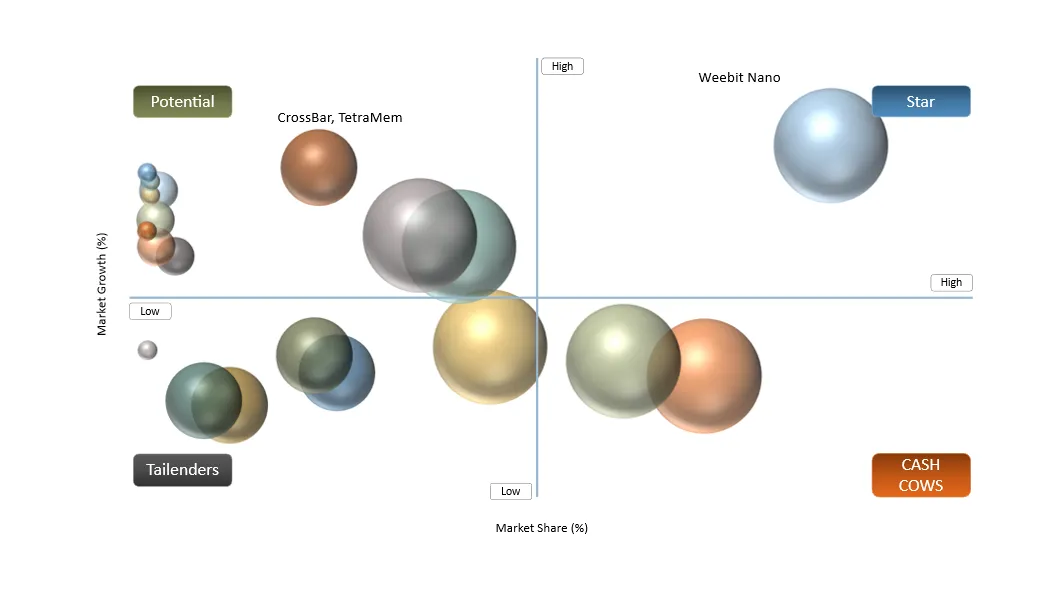
STAR
Weebit Nano is positioned as a Star because it combines dedicated RRAM IP, multiple foundry/IDM relationships, Tier-1 licenses and a rapidly expanding product-customer pipeline. Texas Instruments and onsemi are strategically important adopters because their embedded-processing scale can convert RRAM qualification into meaningful product volumes.
POTENTIAL
CrossBar, TetraMem, 4DS Memory, eMemory and other emerging-memory developers represent Potential players. Their future position depends on process portability, customer tape-outs, AI differentiation, capital availability and the ability to move from demonstrators into qualified production.
RRAM Market Dynamics
Driver Impact Analysis
| Driver | Market Growth Impact | Demand Concentration | Impacted Use Case | Strategic Impact |
| Embedded flash scaling limitations | High | Advanced MCU/SoC nodes | Embedded NVM | Creates direct replacement opportunity and foundry differentiation. |
| Low-power edge AI and IoT | High | Consumer, industrial, AI edge | Instant-on non-volatile memory | Supports low standby power and integrated memory. |
| Tier-1 licensing and foundry qualification | High | Global semiconductor ecosystem | Commercial product adoption | Reduces perceived technology risk. |
| Compute-in-memory demand | Medium-High | AI accelerators and research platforms | Analog matrix operations | Expands RRAM from memory into compute. |
Driver: Embedded Flash Scaling Limitations and Tier-1 Validation
Embedded flash becomes more difficult and expensive to integrate as logic processes scale. RRAM offers a compact back-end-compatible alternative with low write voltage and high endurance. Commercial validation has strengthened through licensing and qualification activity involving Weebit Nano, Texas Instruments, onsemi and DB HiTek, reducing the gap between technology demonstrations and customer products.
Restraint Impact Analysis
| Restraint | Drag on Market Growth | Primary Impact Area | Impacted Use Case | Strategic Impact |
| Long qualification and product cycles | High | Time to revenue | Automotive, industrial, embedded SoCs | Delays royalties after licensing milestones. |
| Resistance variability and yield | High | Manufacturing reliability | MLC and analog CIM | Requires stronger process control and error mitigation. |
| Competition from MRAM, flash and FeFET | Medium-High | Architecture selection | Embedded NVM | Raises proof burden on cost, endurance and ecosystem maturity. |
| EDA and software ecosystem gaps | Medium | Design adoption | Compute-in-memory | Slows system integration despite device-level advantages. |
Restraint: Qualification Time and Device Variability
The principal constraint is conversion speed. Qualification of a memory process does not guarantee immediate product revenue. Customers must redesign, tape out, test and qualify products, while analog compute implementations must manage resistance variability and circuit overhead. This makes RRAM a high-potential but execution-sensitive market.
RRAM Market Segment Analysis
The global RRAM market is segmented based on Memory Type, Material Type, Integration, Cell Architecture, Technology Node, Application, end-use industry, distribution model, and region.
By Memory Type
Embedded RRAM Will Continue to Lead
Embedded RRAM has the clearest commercial path because it can replace embedded flash in MCUs and SoCs. Compute-in-memory and 3D RRAM are faster-growing but start from a smaller base and require additional architecture and software maturity.
By Material Type
Oxide-Based RRAM Will Hold the Largest Share
Oxide systems are widely researched and compatible with standard semiconductor processing. Conductive-bridge and other material systems offer attractive switching characteristics but face different variability, retention and materials-integration trade-offs.
By Integration
Embedded NVM Will Dominate Near-Term Revenue
Embedded NVM creates licensing and royalty revenue through foundries and IDMs. Standalone RRAM remains more limited because NAND and other memories benefit from massive scale and established cost structures.
By Cell Architecture
1T1R Will Lead Commercial Embedded Products
1T1R provides transistor isolation and easier control, supporting reliable embedded-memory macros. Crossbar architectures improve density and are important for compute-in-memory, but require management of sneak currents and analog non-idealities.
By Technology Node
22-40 nm Will Be the Commercial Sweet Spot
This range balances large embedded MCU/SoC volumes with growing difficulty in scaling embedded flash. Below-22-nm RRAM offers significant future value but qualification and customer readiness are earlier.
By Application
Microcontrollers & SoCs Lead, AI Grows Fastest
MCUs and SoCs provide the first scalable commercial use case. AI and neuromorphic computing offer the fastest strategic growth because RRAM can reduce memory movement and support analog computation.
By End Use Industry
Automotive and Industrial Will Be High-Value Early Adopters
These sectors value long retention, temperature robustness, low standby power and secure embedded memory. Consumer electronics can provide larger volumes once process maturity and cost improve.
By Distribution Model
IP Licensing & Royalties Will Dominate Specialist Economics
Dedicated RRAM developers can scale through licensing to multiple foundries and IDMs rather than building fabs. Foundry-enabled platforms then multiply downstream product-customer opportunities.
RRAM Market Geographical Penetration
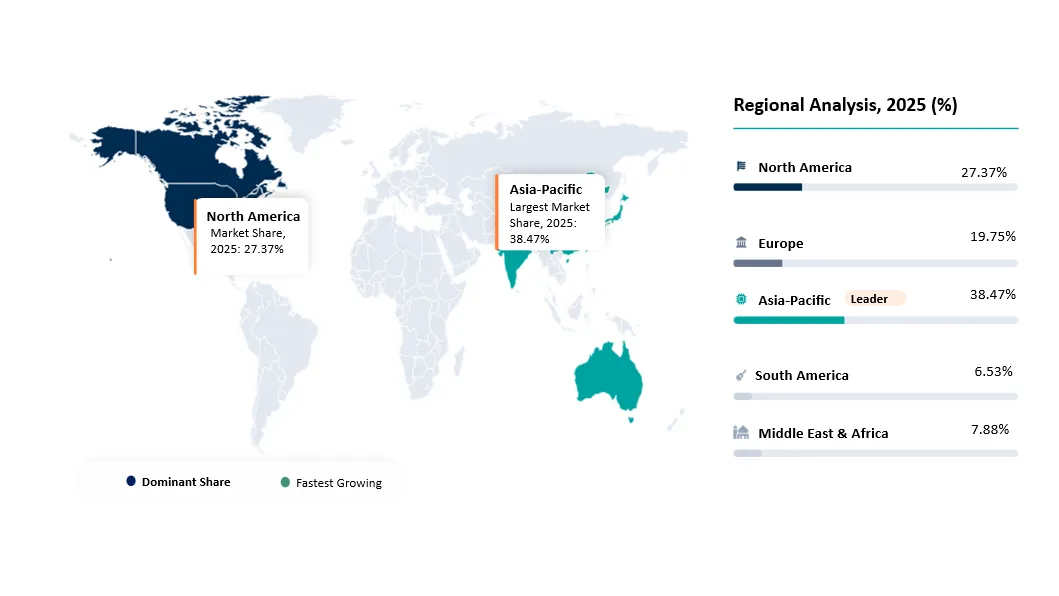
Asia-Pacific is the largest regional market because Taiwan, South Korea, China and Japan contain major foundries, IDMs, memory manufacturers and electronics supply chains. North America is strategically important through AI, embedded-processing design, semiconductor reshoring and RRAM commercialization partnerships. Europe contributes automotive and industrial demand, while Israel is notable for memory IP development.
U.S. RRAM Market Landscape
The U.S. combines embedded-processing leaders, AI architecture companies, automotive semiconductor demand and domestic foundry investment. Texas Instruments’ licensing of Weebit ReRAM and onsemi’s test-chip activity strengthen the commercial pathway. SkyWater provides an additional trusted-foundry route for emerging technologies and government-supported applications.
Taiwan RRAM Market Trends
Taiwan is central to global foundry and fabless ecosystems. Its opportunity lies in integrating RRAM into mature and advanced specialty processes, enabling customers to combine logic, analog and embedded NVM without external flash. TSMC and local IP/design ecosystems make the region strategically important even where RRAM revenue is not separately disclosed.
South Korea RRAM Market Outlook
South Korea combines memory leadership, specialty foundry capacity and AI semiconductor investment. DB HiTek’s qualification of Weebit technology provides a direct commercial link, while Samsung and SK hynix maintain advanced-memory research capabilities.
Israel RRAM Market Outlook
Israel is a key RRAM innovation center through Weebit Nano and a deep semiconductor-design ecosystem. Its role is weighted toward IP creation, architecture and technology transfer rather than high-volume wafer manufacturing.
Japan RRAM Market Outlook
Japan has strong MCU, automotive and industrial semiconductor demand, with companies such as Renesas and Fujitsu providing potential adoption channels. High-reliability requirements and long product lifecycles make embedded NVM strategically relevant.
China RRAM Market Trends
China is investing in domestic semiconductor self-sufficiency, AI accelerators and specialty memory. The market offers large potential demand but is affected by export controls, technology-access constraints and intense competition among emerging-memory approaches.
RRAM Market Competitive Landscape
- Competition is fragmented across dedicated RRAM IP companies, foundries, IDMs, memory companies and AI compute-in-memory startups. The market is not yet a commodity memory oligopoly.
- Weebit Nano currently has strong commercial momentum through licensing agreements, foundry qualification, customer tape-outs and capital raised to accelerate commercialization.
- CrossBar remains an important RRAM technology developer, while 4DS Memory and TetraMem target specialized memory and AI opportunities.
- Large semiconductor companies compete indirectly through alternative embedded NVM such as MRAM, flash and proprietary memory technologies, making ecosystem maturity a central competitive variable.
Public Company Q1-Q2 2026 Performance Comparison
| Public Company | Q1-Q2 2026 Performance | RRAM Exposure | Key Growth Drivers |
| Weebit Nano Ltd. | H1 FY26 revenue reached A$5.6M, more than 8x the prior-year period. In 2026 it also raised about A$102M through placement and SPP proceeds and reported two product-customer tape-outs in May. | Pure-play RRAM IP developer with licenses to TI and onsemi, DB HiTek qualification and multiple product customers. | Tier-1 licensing, product tape-outs, foundry enablement, AI/CIM roadmap and capital for commercialization. |
| Texas Instruments | Q1 2026 revenue US$4.83B, +19% YoY; Q2 revenue US$5.46B, +23% YoY. Embedded Processing revenue grew 12% YoY in Q1 and 16% in Q2. | Licensed Weebit ReRAM for integration into advanced process nodes for embedded processing semiconductors. | Industrial and data-center recovery, embedded-processing growth, 300mm manufacturing and future embedded-NVM differentiation. |
| onsemi | Q1 2026 revenue US$1.51B, +5% YoY; non-GAAP operating margin 19.1%. AI data-center business grew more than 30% sequentially and more than doubled YoY. | Licensed Weebit ReRAM; first test chips manufactured at onsemi were received and reported to perform as expected. | Automotive, industrial and AI data-center recovery, Fab Right strategy, embedded intelligence and future RRAM-enabled products. |
| TSMC | Q1 2026 revenue US$35.90B; Q2 revenue US$40.20B with 67.7% gross margin. First-half 2026 monthly revenue grew strongly on AI demand. | Strategic foundry exposure to emerging embedded NVM and advanced specialty processes; RRAM is relevant as customers seek scalable embedded memory. | AI/HPC demand, advanced-node leadership, specialty technology platforms and customer demand for embedded-memory integration. |
| SkyWater Technology | Latest 2026 quarterly filings were published while the company progressed its merger with IonQ. FY2025 revenue had grown 29% to US$442.1M after the Fab 25 acquisition. | U.S. trusted foundry with prior RRAM technology-development relationships and specialty process capabilities relevant to emerging memory. | Domestic semiconductor manufacturing, government programs, specialty foundry demand, quantum/advanced technology and broader process-platform utilization. |
Market Ecosystem Table
| Value Chain Sector | Representative Companies | Role in RRAM Ecosystem |
| Memory IP & core technology developers | Weebit Nano, CrossBar, 4DS Memory, eMemory, TetraMem | Develop RRAM cells, macros, compilers, process IP and compute-in-memory architectures. |
| Foundries & process integration | DB HiTek, SkyWater Technology, TSMC, Samsung Foundry, SMIC | Qualify resistive-memory stacks and provide wafer manufacturing for embedded or specialty RRAM. |
| IDMs & embedded-processing vendors | Texas Instruments, onsemi, Renesas, Infineon, Fujitsu | Integrate RRAM into MCUs, SoCs, analog/embedded processing and automotive products. |
| Memory & semiconductor research leaders | Samsung Electronics, SK hynix, Micron, Intel | Research next-generation memory, 3D integration and in-memory computing architectures. |
| AI / compute-in-memory specialists | TetraMem, academic spinouts, accelerator startups | Use RRAM crossbars for analog matrix computation, edge AI and neuromorphic processing. |
| EDA & design ecosystem | Synopsys, Cadence, Siemens EDA, foundry PDK partners | Provide compact models, verification, memory compilers, circuit simulation and integration workflows. |
| Semiconductor equipment & materials | Applied Materials, Lam Research, Tokyo Electron, ASM, specialty oxide/material suppliers | Provide deposition, etch, metrology and materials required for resistive switching layers and electrodes. |
| OSAT / packaging & test | ASE Technology, Amkor, JCET, Advantest, Teradyne | Support package integration, test methodology, reliability screening and production ramp. |
| End-product customers | Automotive OEM/Tier-1s, industrial controls, IoT device makers, AI edge companies | Create product demand for low-power embedded NVM, security and compute-in-memory. |
| Standards & research bodies | JEDEC, IEEE, imec, CEA-Leti, universities and national labs | Define qualification practices, publish research and accelerate reliability understanding. |
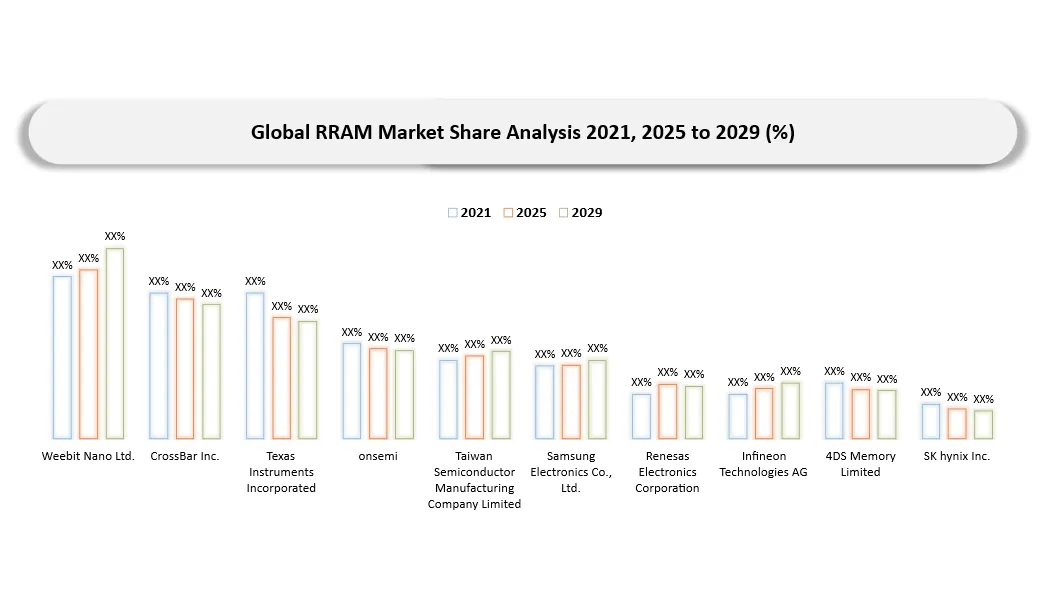
Key Companies
- Weebit Nano Ltd.
- CrossBar Inc.
- Texas Instruments Incorporated
- onsemi
- DB HiTek Co., Ltd.
- SkyWater Technology, Inc.
- Taiwan Semiconductor Manufacturing Company Limited
- Samsung Electronics Co., Ltd.
- Renesas Electronics Corporation
- Infineon Technologies AG
- eMemory Technology Inc.
- 4DS Memory Limited
- TetraMem Inc.
- Fujitsu Limited
- SK hynix Inc.
Company Profiles
Weebit Nano Ltd.
Weebit Nano is a dedicated developer and licensor of ReRAM technology. Its commercialization strategy is based on transferring IP into foundry and IDM processes, qualifying the technology, enabling product customers and collecting licensing, engineering and future royalty revenue. Tier-1 licenses with Texas Instruments and onsemi materially strengthen its market position.
Competitive priorities include proving manufacturability, expanding qualified node coverage, supporting customer tape-outs, reducing variability and integrating memory IP with established design and test workflows. Long-term leadership will depend on recurring production economics rather than one-time demonstrations.
CrossBar Inc.
CrossBar is a long-standing ReRAM technology developer focused on high-density non-volatile memory and resistive switching IP. Its competitive relevance comes from deep intellectual property, embedded-memory concepts and potential security or compute applications.
Competitive priorities include proving manufacturability, expanding qualified node coverage, supporting customer tape-outs, reducing variability and integrating memory IP with established design and test workflows. Long-term leadership will depend on recurring production economics rather than one-time demonstrations.
Texas Instruments Incorporated
Texas Instruments is a major analog and embedded-processing semiconductor manufacturer. Its license of Weebit ReRAM for advanced process nodes creates one of the strongest routes for RRAM into high-volume industrial, automotive and embedded applications.
Competitive priorities include proving manufacturability, expanding qualified node coverage, supporting customer tape-outs, reducing variability and integrating memory IP with established design and test workflows. Long-term leadership will depend on recurring production economics rather than one-time demonstrations.
onsemi
onsemi is a major automotive, industrial and intelligent-power semiconductor company. It has licensed Weebit ReRAM and produced initial test chips, giving it direct exposure to RRAM as a future embedded-memory option alongside its broader intelligent-sensing and processing portfolio.
Competitive priorities include proving manufacturability, expanding qualified node coverage, supporting customer tape-outs, reducing variability and integrating memory IP with established design and test workflows. Long-term leadership will depend on recurring production economics rather than one-time demonstrations.
DB HiTek Co., Ltd.
DB HiTek is a South Korean specialty foundry. Qualification of Weebit ReRAM to JEDEC-based standards positions the company to offer customers an embedded non-volatile memory option on specialty process technologies.
Competitive priorities include proving manufacturability, expanding qualified node coverage, supporting customer tape-outs, reducing variability and integrating memory IP with established design and test workflows. Long-term leadership will depend on recurring production economics rather than one-time demonstrations.
SkyWater Technology, Inc.
SkyWater is a U.S.-based trusted foundry focused on specialty and advanced technologies. Its emerging-memory development capabilities and domestic manufacturing position it as an important ecosystem participant for government, industrial and specialized semiconductor programs.
Competitive priorities include proving manufacturability, expanding qualified node coverage, supporting customer tape-outs, reducing variability and integrating memory IP with established design and test workflows. Long-term leadership will depend on recurring production economics rather than one-time demonstrations.
Taiwan Semiconductor Manufacturing Company Limited
TSMC is the world’s largest pure-play foundry and a central platform for specialty and advanced semiconductor processes. Even where RRAM revenue is not separately disclosed, foundry adoption of scalable embedded NVM technologies can materially influence ecosystem commercialization.
Competitive priorities include proving manufacturability, expanding qualified node coverage, supporting customer tape-outs, reducing variability and integrating memory IP with established design and test workflows. Long-term leadership will depend on recurring production economics rather than one-time demonstrations.
Samsung Electronics Co., Ltd.
Samsung combines memory leadership, foundry operations and advanced semiconductor research. Its scale in memory and AI systems makes it strategically important to next-generation non-volatile and compute-in-memory technology development.
Competitive priorities include proving manufacturability, expanding qualified node coverage, supporting customer tape-outs, reducing variability and integrating memory IP with established design and test workflows. Long-term leadership will depend on recurring production economics rather than one-time demonstrations.
Renesas Electronics Corporation
Renesas is a leading MCU, automotive and industrial semiconductor supplier. Embedded NVM is central to many of its products, making the company a potential beneficiary or competitive benchmark for RRAM-based alternatives to flash.
Competitive priorities include proving manufacturability, expanding qualified node coverage, supporting customer tape-outs, reducing variability and integrating memory IP with established design and test workflows. Long-term leadership will depend on recurring production economics rather than one-time demonstrations.
Infineon Technologies AG
Infineon is a leading automotive, industrial and power semiconductor supplier. Its MCU and security portfolios create use cases where advanced embedded non-volatile memory may become strategically relevant.
Competitive priorities include proving manufacturability, expanding qualified node coverage, supporting customer tape-outs, reducing variability and integrating memory IP with established design and test workflows. Long-term leadership will depend on recurring production economics rather than one-time demonstrations.
eMemory Technology Inc.
eMemory is an embedded-memory IP company serving foundries and fabless semiconductor customers. Its know-how in process-portable memory IP and design enablement makes it relevant to emerging-memory commercialization.
Competitive priorities include proving manufacturability, expanding qualified node coverage, supporting customer tape-outs, reducing variability and integrating memory IP with established design and test workflows. Long-term leadership will depend on recurring production economics rather than one-time demonstrations.
4DS Memory Limited
4DS Memory is an emerging-memory developer focused on Interface Switching ReRAM and high-density memory concepts. Its opportunity depends on demonstrating manufacturability, density and production economics at commercial scale.
Competitive priorities include proving manufacturability, expanding qualified node coverage, supporting customer tape-outs, reducing variability and integrating memory IP with established design and test workflows. Long-term leadership will depend on recurring production economics rather than one-time demonstrations.
TetraMem Inc.
TetraMem develops analog in-memory computing technology using memristive devices. Its relevance lies in AI acceleration and reducing data movement through compute inside resistive-memory arrays.
Competitive priorities include proving manufacturability, expanding qualified node coverage, supporting customer tape-outs, reducing variability and integrating memory IP with established design and test workflows. Long-term leadership will depend on recurring production economics rather than one-time demonstrations.
Fujitsu Limited
Fujitsu has a long history in semiconductor and emerging-memory development and remains relevant through technology research, edge computing and high-reliability electronics ecosystems.
Competitive priorities include proving manufacturability, expanding qualified node coverage, supporting customer tape-outs, reducing variability and integrating memory IP with established design and test workflows. Long-term leadership will depend on recurring production economics rather than one-time demonstrations.
SK hynix Inc.
SK hynix is a global memory leader with extensive advanced-memory research. Although its core revenue is DRAM and NAND, next-generation memory and AI-related research make it an important benchmark and potential participant in future resistive-memory commercialization.
Competitive priorities include proving manufacturability, expanding qualified node coverage, supporting customer tape-outs, reducing variability and integrating memory IP with established design and test workflows. Long-term leadership will depend on recurring production economics rather than one-time demonstrations.
RRAM Market Major Pain Points
- Long time from process qualification to recurring production revenue.
- Resistance-state variability and distribution overlap, especially for multi-level or analog operation.
- Endurance and retention trade-offs across temperature and write conditions.
- Competition from mature embedded flash and rapidly improving MRAM/FeFET alternatives.
- Limited common EDA and software infrastructure for compute-in-memory designs.
- Customer reluctance to change qualified memory architectures without clear cost or performance benefits.
- Need for multi-foundry portability and reliable yield control.
- Geopolitical restrictions affecting foundry, equipment and advanced semiconductor collaboration.
RRAM Market Recent Developments
- May 2026: Weebit Nano reported that two product customers had taped out RRAM-enabled products and one was already demonstrating a functional prototype.
- May 2026: Weebit Nano completed an approximately A$15 million share purchase plan, bringing total funds raised with its recent placement to about A$102 million for commercialization and AI development.
- March 2026: Weebit Nano announced selection of its ReRAM for a Korean national compute-in-memory program.
- February 2026: Weebit Nano reported record H1 FY26 revenue of A$5.6 million and highlighted its license to Texas Instruments.
- January 2026: Weebit Nano reported JEDEC-based technology qualification at DB HiTek and functioning test chips from onsemi.
- December 2025: Texas Instruments licensed Weebit ReRAM for integration into advanced process nodes used for embedded processing semiconductors.
Analyst View / Opinion on RRAM Market
- RRAM has moved beyond a purely experimental memory category, but the market should still be evaluated through customer-production milestones rather than laboratory benchmarks.
- Embedded RRAM offers the most credible near-term revenue path because it solves a specific scaling and power problem without requiring RRAM to compete directly with commodity NAND or DRAM.
- Tier-1 semiconductor licenses are strategically important because they validate reliability and expose the technology to high-volume industrial and automotive product portfolios.
- Compute-in-memory is the largest upside scenario but should be modeled separately from embedded NVM because commercial timing and software maturity remain uncertain.
- Foundry portability, qualification data and customer support will determine long-term leadership as much as cell endurance or speed.
- Companies able to build a multi-foundry platform and recurring royalty base are likely to capture disproportionate value as RRAM transitions into production.
RRAM Market Target Audience
| INDUSTRY | WHO SHOULD BUY THIS REPORT? | REASON TO BUY THIS REPORT |
| Semiconductor IP | Memory IP developers, design houses, EDA teams | Benchmark technology positioning, licensing models and customer-conversion pathways. |
| Foundries & IDMs | Foundry strategists, process integration, MCU and SoC teams | Assess embedded-NVM differentiation, node opportunities and qualification requirements. |
| Automotive & Industrial | Semiconductor buyers, Tier-1 engineering teams | Evaluate high-temperature NVM, endurance and supply-roadmap implications. |
| AI Hardware | Accelerator designers, edge-AI startups, research groups | Assess compute-in-memory opportunity, technical barriers and ecosystem readiness. |
| Equipment & Materials | Deposition, etch, metrology and materials suppliers | Identify process requirements and future wafer-volume opportunity. |
| Investors & Consulting | Venture capital, public-market investors, strategy consultants | Evaluate commercialization milestones, competitive risk, partnerships and scenario-based upside. |
Why Choose DATAM?
- Data-driven insights combining market sizing, foundry qualification, licensing milestones, customer tape-outs and technology benchmarking.
- Post-purchase analyst consultations for partnership, licensing, market-entry and investment questions.
- Annual updates covering qualification, new foundry nodes, tape-outs, production ramps and competitive developments.
- Specialized focus on emerging semiconductor technologies and commercialization pathways rather than only broad memory-market statistics.
- Actionable analysis connecting device physics, foundry integration and customer economics.
What DATAM Uniquely Provides
- Ten-year forecasts across memory type, materials, integration, architecture, node, application, end use and commercialization model.
- Commercialization analysis separating qualified process technology from actual product tape-outs and production royalties.
- Competitive benchmarking across pure-play RRAM developers, foundries, IDMs and AI compute-in-memory companies.
- Market ecosystem mapping from materials and equipment through foundries, EDA, IDMs and end-product customers.
- Public-company performance comparison linked to direct RRAM exposure and strategic growth drivers.


























































