


Rotating Equipment Market Size and Overview
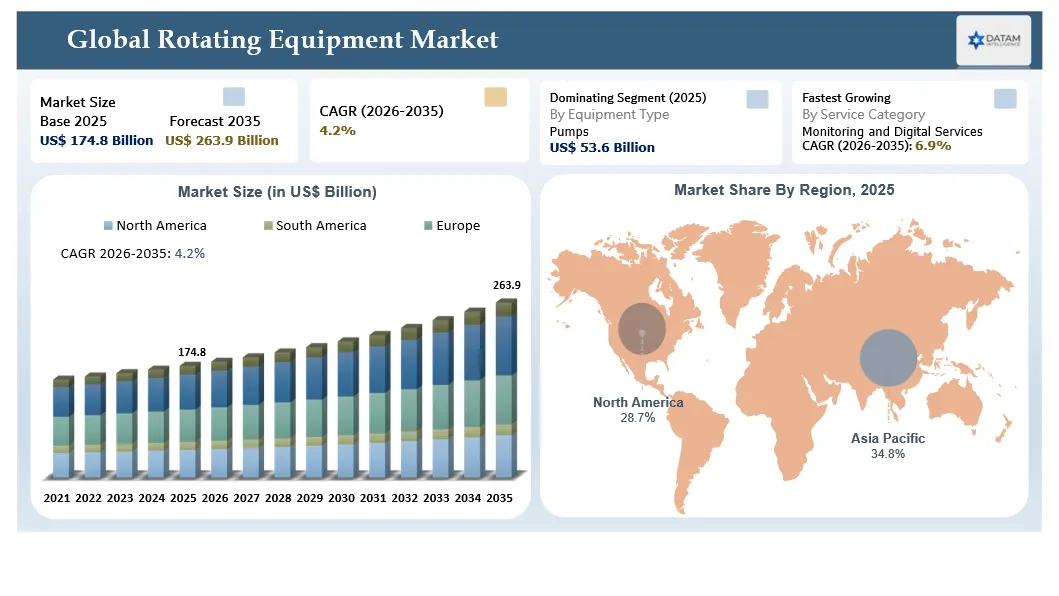
The global rotating equipment market reached an estimated US$ 174.8 billion in 2025 and is projected to reach US$ 263.9 billion by 2035, expanding at a CAGR of 4.2% during 2026-2035. Demand is supported by new industrial capacity, replacement of aging assets and higher lifecycle spending across oil and gas, chemicals, power, water, mining, metals, food processing and other process industries.
Rotating assets sit at the center of production availability because they move fluids, compress gases, generate power and drive critical processes. A pump, compressor or turbine failure can reduce throughput across an entire plant, which elevates reliability, redundancy, service response and spare-part access in procurement decisions. The market is therefore shaped by both capital investment and a large recurring aftermarket.
Growth is increasingly linked to low-carbon infrastructure. Carbon capture requires CO2 compressors, hydrogen projects need compressors, pumps and expanders, while electrification replaces some steam and gas-turbine drives with motors and variable-speed systems. Data centers and semiconductor fabs add demand for cooling pumps, ventilation equipment and backup power systems. These applications are expanding the addressable market beyond traditional hydrocarbon and heavy-industry spending.
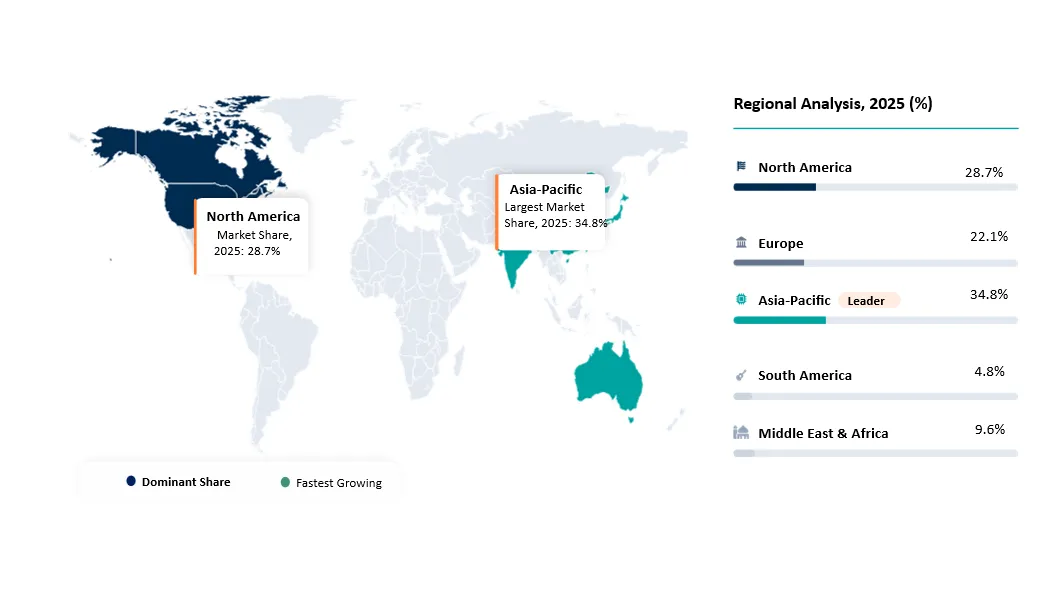
Asia-Pacific is the largest regional market due to its manufacturing base, power investment, chemical capacity and urban water infrastructure. North America maintains high aftermarket intensity and benefits from LNG, pipeline, refining and data-center projects. The Middle East combines new-build energy investment with localization of service capabilities, creating attractive opportunities for OEMs and independent providers.
| Metric | Detail |
| 2025 Market Size | US$ 174.8 Billion |
| 2035 Projected Market Size | US$ 263.9 Billion |
| CAGR 2026-2035 | 4.2% |
| Largest Region | Asia-Pacific |
| Fastest-Growing Region | Middle East and Africa |
| Largest Equipment Category | Pumps |
| Fastest-Growing Service Category | Monitoring and Digital Services |
Rotating Equipment Market Key Takeaways
- Pumps form the largest equipment category because they are used across almost every process industry, from upstream production and refining to municipal water, chemicals, food and pharmaceuticals.
- Compressors represent one of the highest-value categories due to engineered process duty, complex controls, high-pressure service and extensive aftermarket requirements.
- Maintenance, repair and overhaul remain a major revenue pool because installed fleets require planned outages, balancing, alignment, seal replacement, rotor repair, bearing service and performance restoration.
- Digital condition monitoring is the fastest-growing service area as operators connect vibration, temperature, pressure and motor-current data to predictive maintenance platforms.
- Electric-motor-driven systems are gaining share as plants pursue electrification, variable-speed control and lower direct emissions.
- Asia-Pacific leads new-equipment demand, while North America and Europe generate high aftermarket revenue from aging installed bases and modernization projects.
- Service localization is becoming a competitive requirement because customers want shorter turnaround times, regional spare-parts access and field support.
- Brownfield efficiency projects are expanding through impeller rerates, dry-gas-seal upgrades, control-system modernization, motor replacement and compressor-train electrification.
Rotating Equipment Industry Trends and Strategic Insights
- Operators are shifting from interval-based maintenance toward condition-based strategies that use vibration analysis, oil diagnostics, thermography and remote monitoring to prioritize interventions.
- OEMs are expanding multi-brand service capabilities because customers prefer fewer service partners across pumps, compressors, turbines, motors and seals.
- Long-term service agreements are moving toward risk-sharing structures with availability guarantees, remote monitoring and optimized spare-parts inventories.
- Electrification is changing rotating-train architecture in pipelines, LNG, refining and chemicals as electric motors replace selected turbine or engine drives.
- Energy efficiency has become a purchase criterion because rotating equipment can account for a significant share of industrial electricity consumption, especially in pumping, compression and ventilation systems.
- Additive manufacturing, advanced coatings and digital inspection are shortening repair cycles and extending component life.
- Regional repair centers are gaining importance in India, the Middle East and Latin America as industrial customers reduce cross-border turnaround times.
- New demand is emerging from carbon capture, hydrogen, offshore wind support infrastructure, semiconductor fabs and high-density data centers.
Rotating Equipment Market Scope
| Scope Dimension | Coverage |
| By Equipment Type | Pumps, Compressors, Turbines, Motors and Generators, Gearboxes and Mechanical Drives, Blowers, Fans and Expanders, Agitators and Others |
| By Drive Type | Electric Motor Driven, Turbine Driven, Engine Driven, Hybrid and Others |
| By Operation | Continuous Duty, Intermittent Duty, Standby and Emergency Duty |
| By Service Category | New Equipment, MRO, Retrofit and Modernization, Monitoring and Digital Services, Spare Parts and Consumables |
| By Application | Fluid Transfer, Compression, Power and Mechanical Drive, Ventilation, Mixing, Energy Recovery and Others |
| By End-Use Industry | Oil and Gas, Chemicals, Power, Water, Mining, Food, Pharmaceuticals, Pulp and Paper, Marine, Data Centers and Others |
| By Region | North America, Europe, Asia-Pacific, South America, Middle East and Africa |
Why does this report matter in 2026?
In 2026, rotating-equipment procurement is being reshaped by three simultaneous pressures: capacity expansion, aging installed assets and decarbonization. New plants still require conventional pumps, compressors and turbines, but operators are also allocating more capital to reliability upgrades, efficiency retrofits and emissions reduction. This creates a market in which original equipment, aftermarket services and digital solutions grow together.
The report helps manufacturers, service providers, EPC firms, investors and plant operators identify the most attractive equipment categories, end-use sectors and regional demand centers. It also clarifies how electrification, hydrogen, carbon capture, data-center expansion and water infrastructure influence product requirements and service models.
Competitive advantage increasingly depends on installed-base access, regional service capability, engineering references and the ability to support multiple brands. The report therefore examines equipment sales alongside MRO, modernization, monitoring and spare-parts opportunities, enabling a more complete assessment of revenue quality and customer lifetime value.
Rotating Equipment Market White Space & Investment Opportunities
- Build regional multi-brand service centers near refinery, chemical, mining and power clusters where customers currently ship rotors, compressors or large pumps across borders.
- Develop condition-monitoring platforms for mid-sized industrial users that lack enterprise reliability systems but operate critical pump, compressor and motor fleets.
- Expand retrofit offerings for brownfield electrification, variable-speed drives, dry-gas seals, low-emission packing and high-efficiency impellers.
- Create specialized rotating-equipment packages for hydrogen compression, CO2 transport, supercritical CO2, renewable natural gas and energy-storage projects.
- Offer performance-based service agreements combining monitoring, outage planning, spare-parts optimization and availability commitments.
- Localize component repair, coating, balancing and precision machining in the Middle East, India, Southeast Asia and Latin America.
Rotating Equipment Future Market Transformation
The market will move from stand-alone equipment sales toward lifecycle performance management. Sensors, edge analytics and digital twins will increasingly accompany pumps, compressors and turbines from commissioning through overhaul. Manufacturers will use operating data to recommend maintenance windows, efficiency upgrades and replacement timing, while operators will expect clearer availability and energy-performance outcomes.
Electrification will transform some mechanical-drive applications. Gas and steam turbines will remain essential where process integration or fuel availability supports them, but electric motors and variable-speed drives will gain share in pipelines, LNG, refining and chemicals. This shift will increase demand for motor systems, power electronics, grid studies and train redesign.
Service markets will consolidate around providers with broad technical capability and regional reach. Customers will favor partners able to support multiple equipment types, supply engineered replacement components and mobilize quickly during outages. Independent service providers will remain important where they combine cost advantages with strong reverse engineering and multi-brand expertise.
Rotating Equipment Market Buyer Decision-Making Criteria
Buyers evaluate rotating equipment on reliability, hydraulic or aerodynamic performance, energy efficiency, process compatibility, maintainability and lifecycle cost. Initial price remains important, but it is rarely decisive for critical assets because production losses from failure can exceed the equipment purchase cost. References in comparable duty, materials compatibility, seal technology and service access influence supplier qualification.
For service contracts, customers assess turnaround time, diagnostic capability, workshop capacity, field-service mobilization and warranty terms. The ability to repair non-OEM equipment is valuable for mixed fleets. Operators also consider spare-part lead times, digital monitoring, documentation quality and the supplier’s willingness to support performance guarantees.
Procurement is increasingly cross-functional. Engineering teams focus on technical risk, maintenance teams assess serviceability, finance teams evaluate total cost and sustainability teams examine energy use and emissions. Vendors that translate technical improvements into measurable production, energy and maintenance outcomes are more likely to secure strategic contracts.
Rotating Equipment Market Economic & Investment Analysis
Rotating equipment benefits from a diversified demand base because the same core technologies serve energy, water, manufacturing and infrastructure. New-equipment revenue is cyclical and linked to project approvals, while aftermarket revenue is more stable because installed assets require recurring maintenance, parts and upgrades. Companies with large installed bases and strong service networks generally achieve better revenue visibility.
Investment is moving toward facilities that shorten repair cycles and support complex rotors, compressors, turbines, pumps and electromechanical equipment. Precision machining, balancing, coating, additive repair, non-destructive testing and digital inspection are common priorities. Regional investment can produce attractive returns where customers face long logistics times or limited qualified service capacity.
Decarbonization creates a second investment theme. Compressor suppliers are targeting hydrogen and CO2, while pump manufacturers are improving efficiency and materials. Electrification projects generate demand for motors, drives and train integration. Investors should distinguish between commodity equipment exposure and higher-value engineered, aftermarket and digital revenue pools.
Rotating Equipment Investment Trends in the Market
- Expansion of regional service centers and precision-repair workshops in India, the Middle East and Latin America to reduce turnaround times.
- Acquisitions that add industrial gas-turbine, compressor, motor or multi-brand service capability to existing pump and flow-control portfolios.
- Investment in digital monitoring, remote diagnostics and AI-supported maintenance recommendations for installed fleets.
- Capital allocation toward electrification, variable-speed drives and compressor-train modernization for lower emissions and improved efficiency.
- Growth in advanced repair technologies including cold spray, coatings, additive manufacturing, automated inspection and rotor life assessment.
Strategic Indicators For Rotating Equipment Market
High Regulation Impact
Rotating equipment is affected by pressure-equipment rules, machinery safety, electrical standards, emissions limits, hazardous-area certification and industry-specific codes. Oil and gas, chemicals and power projects require extensive documentation, testing and material traceability. Regulations increasingly influence energy efficiency, methane leakage, fugitive emissions and worker safety, which raises demand for dry-gas seals, upgraded controls and low-emission systems.
High Investment Activity
Investment spans new manufacturing, service-center expansion, acquisitions and digital platforms. Flowserve’s 2025 acquisition of Greenray Turbine Solutions broadened its industrial gas-turbine aftermarket exposure. Sulzer expanded rotating-equipment service capacity in India, Argentina and the Middle East during 2025, demonstrating the strategic value of localized lifecycle support.
Supply Chain Disruption
Large castings, forgings, specialty alloys, bearings, seals, motors and control components can create bottlenecks. Long-lead rotors and impellers may delay projects or outages. Operators are responding with critical-spares strategies, dual sourcing, repair instead of replacement and local inventory agreements. Geopolitical restrictions and logistics disruption increase the value of regional production and service capacity.
Pricing Volatility
Equipment pricing reflects steel, nickel alloys, copper, labor, machining hours, testing and project complexity. Service pricing varies with outage urgency, rotor condition, required parts and field mobilization. Inflation and capacity constraints can raise prices for engineered compressors and turbines, while competitive pressure remains stronger for standard pumps, motors and fans.
Procurement Pressure
Procurement teams face the challenge of balancing standardized sourcing with asset-specific technical risk. Mixed fleets often involve several OEMs and legacy designs, which complicates spares and service contracting. Long-term agreements, vendor-managed inventory and multi-brand service partnerships can reduce administrative load and improve response time.
New Technology Adoption
Wireless sensors, edge analytics, digital twins, automated balancing, additive repair, advanced coatings and AI-assisted diagnostics are moving into mainstream reliability programs. Siemens Energy provides digital tools for rotating-equipment selection and modernization, while OEMs and service providers increasingly integrate remote monitoring into long-term agreements.
Regional Expansion Opportunity
Asia-Pacific offers the largest new-equipment opportunity, while the Middle East is expanding both projects and local service capacity. North America remains attractive for LNG, pipelines, data centers and installed-base modernization. Latin America and Africa offer selective opportunities where mining, oil and gas, water and power investment supports regional repair hubs.
Government Policy Support
Industrial policy, infrastructure spending, energy-security programs, water investment and decarbonization incentives support rotating-equipment demand. Hydrogen and carbon-capture funding create compressor and pump opportunities, while grid modernization and power investment support turbines, generators and auxiliary systems. Local-content rules can require in-country service and assembly.
Pricing Intelligence
Rotating-equipment pricing varies widely by equipment category, size, materials, pressure, speed, controls and qualification. Standard industrial pumps and motors may be purchased through framework agreements, while large compressors, turbines and integrated trains are engineered to order. Project pricing typically includes application engineering, testing, documentation, skids, auxiliaries and commissioning.
Aftermarket pricing is influenced by outage urgency and machine condition. Planned overhauls allow competitive sourcing and advance parts preparation, while emergency repairs command premiums because suppliers mobilize labor, machining and logistics rapidly. Performance upgrades can be priced on engineering effort, replacement components and projected efficiency or production gains.
Customers increasingly seek bundled commercial models. Long-term agreements can include monitoring, scheduled maintenance, spare-parts management and response guarantees. Volume discounts are common for multi-site contracts, but suppliers preserve margins where proprietary technology, installed-base knowledge or limited-service competition raises switching costs.
Trade Flow and Equipment Movement
| Equipment Category | Trade Pattern | Strategic Interpretation |
| Industrial Pumps | Broad global trade with strong Asian and European production | Standard products are internationally sourced, while critical pumps remain engineering and service intensive. |
| Compressors and Turbines | Concentrated exports from established engineering hubs | Complex equipment depends on references, specialist materials and proprietary design capability. |
| Motors and Generators | High-volume international trade with regional customization | Efficiency standards and hazardous-area certification influence sourcing. |
| Repair Components | Regional and expedited cross-border movement | Outage urgency supports local inventory, reverse engineering and regional repair capacity. |
DataM Intelligence expects aftermarket, modernization and digital services to grow faster than the overall market. New equipment will remain essential, but operators will increasingly extract more value from existing fleets through efficiency upgrades, condition monitoring and targeted replacement. Regional service capacity will be a decisive growth lever, particularly in India, the Middle East and Latin America. The strongest companies will combine engineering authority, multi-equipment coverage, rapid field execution and measurable lifecycle outcomes.
AI Impact Analysis of Rotating Equipment Market
AI is improving fault detection by combining vibration, temperature, acoustic, lubricant, pressure and motor-current signals. Models can identify bearing defects, imbalance, misalignment, cavitation, seal degradation and compressor instability earlier than periodic manual inspection. This supports planned intervention and reduces unplanned downtime.
AI-assisted engineering can compare equipment configurations, operating points and upgrade options. In compressor and pump applications, models help evaluate rerates, impeller changes, control adjustments and energy-saving opportunities. Service providers can use fleet data to benchmark similar machines and prioritize high-risk assets.
Adoption depends on sensor quality, historical data, cybersecurity and integration with plant maintenance systems. Operators will continue to require engineering review because false alarms or missed faults can be costly. The strongest commercial models combine AI analytics with experienced reliability engineers and accountable service delivery.
Disruption Analysis of Rotating Equipment Market
Electrification is disrupting mechanical-drive markets as electric motors and variable-speed drives replace selected steam turbines, gas turbines and engines. This changes equipment packages, control architecture and maintenance skills. Suppliers with capabilities across motors, compressors, drives and grid integration can capture a larger share of brownfield projects.
Digital service models are disrupting traditional aftermarket activity. Remote diagnostics, condition-based maintenance and performance guarantees allow suppliers to shift from transactional repairs toward recurring service revenue. Customers gain better predictability, while providers deepen installed-base relationships and improve parts planning.
Low-carbon process infrastructure creates new technical requirements. Hydrogen compression, CO2 transport, supercritical CO2 systems and renewable fuels expose equipment to different molecules, pressures and materials challenges. These niches can reward specialized suppliers but require testing, references and close collaboration with project developers.
Rotating Equipment Market BCG Matrix: Company Evaluation
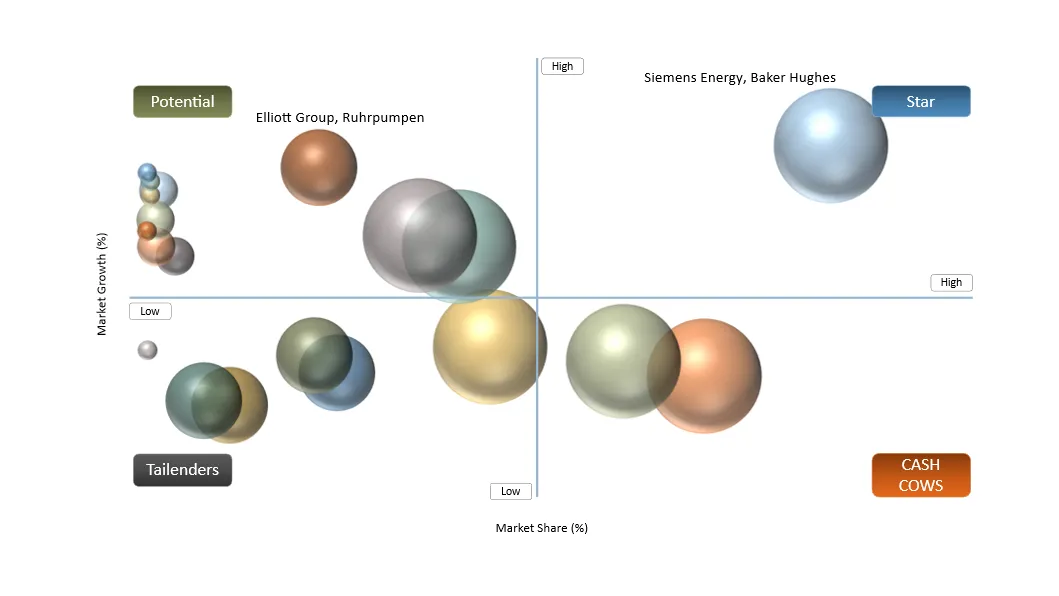
| Category | Representative Companies | Strategic Interpretation |
| Stars | Siemens Energy, Baker Hughes, Flowserve, Sulzer | Broad portfolios, large installed bases, global service networks and exposure to high-value energy and process applications. |
| Potential | Elliott Group, Ruhrpumpen, Howden, MAN Energy Solutions | Specialized technology and expansion opportunities in compressors, turbines, pumps and decarbonization projects. |
| Cash Cows | KSB, Ebara, Atlas Copco, Ingersoll Rand | Established equipment franchises with recurring industrial demand and strong aftermarket revenue. |
| Tailenders | Small regional repair and fabrication firms | Compete through local response and cost but may lack engineering depth, global references or digital capability. |
Rotating Equipment Market Dynamics
Driver Impact Analysis
| Driver | Market Growth Impact | Demand Concentration | Impacted Use Case | Strategic Impact |
| Industrial capacity expansion | High | Asia-Pacific and Middle East | Pumps, compressors, motors and turbines | Creates new-equipment and commissioning demand. |
| Reliability-centered maintenance | High | Global installed base | MRO, spares and monitoring | Supports recurring aftermarket revenue. |
| Energy and water infrastructure | Medium-High | Global | Power, LNG, pipelines and water systems | Expands large engineered equipment demand. |
| Decarbonization and electrification | Medium-High | North America, Europe and Asia | Hydrogen, CO2 and motor-driven systems | Creates premium retrofit and new-technology opportunities. |
Driver: Rising Industrial Capacity and Reliability-Centered Maintenance Spending
Industrial operators are adding capacity while managing aging equipment fleets. New refineries, chemical plants, LNG facilities, water systems, mines and manufacturing sites require pumps, compressors, turbines, motors and auxiliary systems. At the same time, existing plants are increasing reliability spending because unplanned rotating-equipment failure can interrupt production across an entire process unit.
Reliability programs increase demand for condition monitoring, alignment, balancing, seal upgrades, bearing replacement, rotor repair and planned overhauls. The resulting revenue is less dependent on new-project cycles and benefits providers with installed-base knowledge, service centers and field teams. Multi-year agreements can further improve revenue visibility.
Restraint Impact Analysis
| Restraint | Drag on Growth | Primary Impact Area | Impacted Use Case | Strategic Impact |
| High capital and qualification cost | High | Large engineered equipment | Compressors, turbines and critical pumps | Lengthens project cycles and limits new entrants. |
| Skilled labor shortage | Medium-High | Field service and workshops | Overhauls and emergency repairs | Constrains service capacity and increases labor cost. |
| Long lead times | Medium | Projects and outages | Rotors, castings and control systems | Creates schedule and inventory risk. |
| Project cyclicality | Medium | New equipment | Oil, gas, chemicals and power | Increases order volatility for capital equipment suppliers. |
Restraint: High Capital Cost and Complex Asset Integration
Large rotating equipment requires substantial engineering, manufacturing and testing. Compressors and turbines may be integrated with drivers, gearboxes, lubrication systems, seals, controls and process auxiliaries. Changes in process conditions can affect the entire train, which creates long qualification and approval cycles.
Brownfield projects add integration risk because replacement equipment must fit existing foundations, piping and control systems. Shutdown windows are limited, and unexpected site conditions can increase cost. These factors discourage rapid supplier switching and can delay investment when operators lack confidence in project scope or return.
Rotating Equipment Market Segment Analysis
By Equipment Type
Pumps Will Retain the Largest Installed Base and Revenue Contribution
Pumps lead the market because virtually every process plant uses them for feed, transfer, circulation, cooling, drainage, dosing and utility service. Compressors and turbines generate higher value per unit, while motors and generators benefit from electrification. Gearboxes, blowers, fans, expanders and agitators create additional demand across specialized process duties.
Market attractiveness is strongest where equipment criticality, engineering complexity and recurring service requirements support customer retention and higher lifecycle value. Suppliers that combine product expertise, installed-base access and regional service execution are positioned to capture both capital and aftermarket spending.
By Drive Type
Electric motor-driven systems will gain share through electrification.
Electric motors are the largest and fastest-gaining drive category because they support high efficiency, variable-speed control and lower direct emissions. Turbine-driven equipment remains essential where steam integration, process reliability or fuel availability favors it. Engine-driven equipment continues in remote pipelines, mining and backup duty.
Market attractiveness is strongest where equipment criticality, engineering complexity and recurring service requirements support customer retention and higher lifecycle value. Suppliers that combine product expertise, installed-base access and regional service execution are positioned to capture both capital and aftermarket spending.
By Operation
Continuous-Duty Equipment Will Account for the Largest Market Share
Continuous-duty assets dominate refineries, chemical plants, power facilities and water systems because production depends on sustained fluid movement and compression. These machines require redundancy, monitoring and planned maintenance. Intermittent and standby equipment is important in loading, emergency, drainage and backup applications where rapid availability is critical.
Market attractiveness is strongest where equipment criticality, engineering complexity and recurring service requirements support customer retention and higher lifecycle value. Suppliers that combine product expertise, installed-base access and regional service execution are positioned to capture both capital and aftermarket spending.
By Service Category
Maintenance, Repair and Overhaul Will Remain the Largest Recurring Revenue Pool
MRO revenue is supported by installed fleets that require inspections, balancing, machining, seals, bearings, coatings, controls and field labor. New equipment remains the largest capital category, but digital services and retrofit activity are growing faster as operators extend asset life, improve efficiency and reduce emissions.
Market attractiveness is strongest where equipment criticality, engineering complexity and recurring service requirements support customer retention and higher lifecycle value. Suppliers that combine product expertise, installed-base access and regional service execution are positioned to capture both capital and aftermarket spending.
By Application
Fluid Transfer and Circulation Will Lead, While Compression Retains Higher Unit Value
Fluid transfer and circulation account for the largest equipment volume because pumps are used across process and utility systems. Compression and pressure boosting carry higher average equipment values and service intensity. Power and mechanical-drive applications support turbines and motors, while ventilation, mixing and energy recovery expand the addressable base.
Market attractiveness is strongest where equipment criticality, engineering complexity and recurring service requirements support customer retention and higher lifecycle value. Suppliers that combine product expertise, installed-base access and regional service execution are positioned to capture both capital and aftermarket spending.
By End-Use Industry
Oil and Gas Will Remain the Largest Revenue Base as Water and Data Centers Accelerate
Oil and gas lead due to complex pumps, compressors, turbines and pipeline assets. Chemicals and power add substantial installed bases. Water and wastewater are a high-volume pump market, while data centers are increasing demand for cooling pumps, fans, motors and backup systems. Mining and metals sustain heavy-duty equipment and repair demand.
Market attractiveness is strongest where equipment criticality, engineering complexity and recurring service requirements support customer retention and higher lifecycle value. Suppliers that combine product expertise, installed-base access and regional service execution are positioned to capture both capital and aftermarket spending.
By Sales Channel
Direct OEM Sales Will Dominate Engineered and Critical Equipment
Direct sales are central to compressors, turbines, critical pumps and integrated trains because suppliers provide application engineering, testing and commissioning. EPC firms influence specifications for new projects. Distributors handle standard equipment and spares, while independent service providers are important for multi-brand repair and emergency response.
Market attractiveness is strongest where equipment criticality, engineering complexity and recurring service requirements support customer retention and higher lifecycle value. Suppliers that combine product expertise, installed-base access and regional service execution are positioned to capture both capital and aftermarket spending.
Rotating Equipment Market Geographical Penetration
U.S. Rotating Equipment Market Landscape
The U.S. market benefits from a large installed base across oil and gas, refining, chemicals, power, water and manufacturing. LNG export capacity, pipeline investment and data-center construction support new equipment, while aging plants generate strong MRO and modernization demand. Customers increasingly adopt remote monitoring, motor-driven compression and multi-site service agreements.
The regional opportunity is strongest for suppliers that pair technical references with local workshops, field teams and spare-parts availability. Market entry through distributors alone is less effective for critical rotating assets that require engineering and long-term service support.
Germany Rotating Equipment Market Outlook
Germany combines advanced manufacturing, chemicals, machinery and energy-transition investment. Demand is shaped by industrial efficiency, electrification and replacement of aging process assets. Local engineering capability supports premium equipment, precision components and service exports, while energy costs increase interest in high-efficiency pumps, compressors and drives.
The regional opportunity is strongest for suppliers that pair technical references with local workshops, field teams and spare-parts availability. Market entry through distributors alone is less effective for critical rotating assets that require engineering and long-term service support.
China Rotating Equipment Market Trends
China is the largest manufacturing and consumption base, supported by chemicals, refining, power, water, mining and industrial production. Domestic manufacturers are expanding across pumps, compressors and motors, while high-end turbomachinery remains a strategic technology area. Localization and large project pipelines support strong new-equipment demand.
The regional opportunity is strongest for suppliers that pair technical references with local workshops, field teams and spare-parts availability. Market entry through distributors alone is less effective for critical rotating assets that require engineering and long-term service support.
India Rotating Equipment Market Growth
India is expanding refining, chemicals, gas, power, water and manufacturing capacity. The market also benefits from localization policies and a growing service ecosystem. Sulzer’s expansion of turbomachinery support in Vadodara and Chennai illustrates rising demand for in-country repair, retrofit and lifecycle services.
The regional opportunity is strongest for suppliers that pair technical references with local workshops, field teams and spare-parts availability. Market entry through distributors alone is less effective for critical rotating assets that require engineering and long-term service support.
Middle East Rotating Equipment Market Opportunity
The Middle East combines new oil, gas, petrochemical, LNG, power, water and hydrogen projects with strong localization requirements. Regional operators seek shorter service turnaround and local technical capability. Sulzer’s service expansion and long-term partnership activity in Bahrain and Qatar show how suppliers are positioning near major industrial clusters.
The regional opportunity is strongest for suppliers that pair technical references with local workshops, field teams and spare-parts availability. Market entry through distributors alone is less effective for critical rotating assets that require engineering and long-term service support.
Brazil and Latin America Outlook
Latin America offers opportunities in oil and gas, mining, pulp and paper, food processing, water and power. Brazil is the largest market, while Argentina, Chile and Peru support specialized demand. Local service capacity is important because cross-border repair can extend outages and increase logistics cost.
The regional opportunity is strongest for suppliers that pair technical references with local workshops, field teams and spare-parts availability. Market entry through distributors alone is less effective for critical rotating assets that require engineering and long-term service support.
Rotating Equipment Market Competitive Landscape
- The market is fragmented across equipment categories but concentrated in high-end compressors, turbines and critical-service pumps where engineering references and installed-base knowledge matter.
- Large OEMs compete through broad portfolios, proprietary technology, global manufacturing and service networks. Independent providers compete on multi-brand flexibility, turnaround time and cost.
- Aftermarket expansion is a major strategic priority because service, spare-parts and upgrade revenue is more recurring than new-equipment orders.
- Acquisitions are used to add regional service capacity, specialized turbine or compressor expertise and access to installed fleets.
- Digital platforms are becoming a differentiation tool, but customers still value field engineering, workshop capability and accountable repair execution.
- Localization is increasingly necessary in India, the Middle East, Southeast Asia and Latin America due to customer expectations and local-content policies.
Key Companies of Rotating Equipment Market
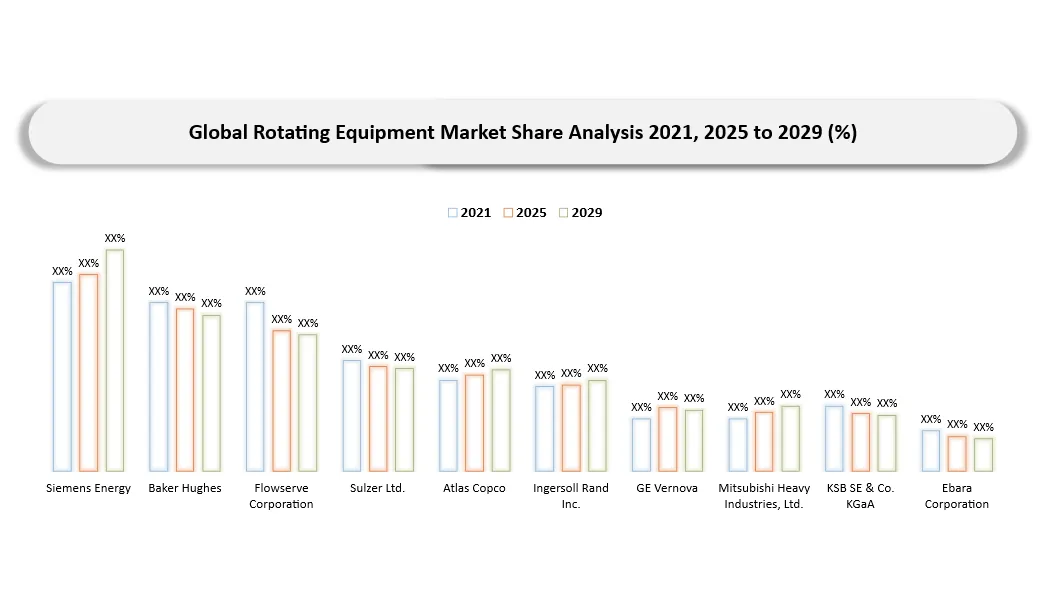
- Siemens Energy
- Baker Hughes
- Flowserve Corporation
- Sulzer Ltd.
- Atlas Copco
- Ingersoll Rand
- KSB SE & Co. KGaA
- Ebara Corporation
- Mitsubishi Heavy Industries
- GE Vernova
- MAN Energy Solutions
- Howden
- Elliott Group
- Ruhrpumpen
- Alfa Laval
- SPX FLOW
- Weir Group
- Metso
- John Crane
- SKF
Rotating Equipment Market Major Pain Points
- Long lead times for large castings, rotors, specialty alloys, motors and control systems.
- Shortage of experienced field technicians, machinists, vibration specialists and compressor or turbine engineers.
- Fragmented installed bases with legacy equipment, obsolete controls and incomplete documentation.
- High downtime cost and limited outage windows for critical assets.
- Difficult integration of new equipment into brownfield foundations, piping and control systems.
- Variability in repair quality and reverse-engineered parts across service providers.
- Cybersecurity and data-integration concerns associated with connected monitoring systems.
- Pressure to improve efficiency and reduce emissions without disrupting production.
Rotating Equipment Market Recent Developments
July 2026: Baker Hughes and Kodiak Gas Services announced a multi-year agreement supporting up to 1.8 GW of power generation capacity, with an initial award of approximately 1 GW of gas turbines and generators for U.S. data center infrastructure.
July 2026: Sapphire Technologies secured an order from Tulip Compression for its FreeSpin in-line turboexpander systems for a pressure energy recovery project supporting India’s natural gas infrastructure.
- June 2026: Kirloskar Pneumatic Company unveiled its Tezcatlipoca A800 centrifugal air compressor, an indigenously designed 600 to 980 CFM compressor featuring aerodynamic technology, intelligent monitoring, and energy-efficient operation.
- April 2026: Baker Hughes secured an order from San Matias Pipeline for three NovaLT16 gas turbines and three centrifugal compressors, supporting natural gas transportation infrastructure connected to Argentina’s LNG export development.
- February 2026: Rotating Machinery Services acquired East Coast Mechanical & Marine, adding 27 field-service professionals and strengthening its capabilities in turbomachinery outages, turnarounds, metrology, and field execution.
- January 2026: Flowserve acquired Greenray Turbine Solutions, expanding its aftermarket portfolio for industrial gas turbines and strengthening service capabilities for mission-critical rotating equipment used in power generation.
- December 2025: Flowserve acquired Greenray Turbine Solutions, adding industrial gas-turbine aftermarket products and services to its rotating-equipment portfolio.
- February 2025: Sulzer expanded its Vadodara service center in India to provide turbomachinery support near major oil and gas customers, complementing its Chennai facility.
- February 2025: Sulzer acquired Davies and Mills in Bahrain, expanding maintenance and repair services for generators, motors and pumps across the Middle East.
- April 2025: Sulzer and Manweir announced a ten-year service partnership in Qatar to provide local rotating-equipment repairs and services from Ras Laffan.
- July 2025: Sulzer opened a rotating-equipment service center in Ezeiza, Argentina, supporting oil and gas, power, pulp and paper, food and beverage and other industries.
- June 2026: Siemens Energy continued expanding digital tools for rotating-equipment selection and modernization, including its equipment selector and myAdvisor upgrade platform.
Analyst View / Opinion on Rotating Equipment Market
- Aftermarket and modernization will outgrow many new-equipment categories because operators are extending asset life and improving reliability before committing to full replacement.
- Pumps will retain the largest revenue base, while compressors and turbines continue to provide higher unit values and stronger proprietary aftermarket opportunities.
- Electrification will shift some mechanical-drive demand toward motors, drives and integrated controls, although turbine-driven systems will remain important in process-intensive facilities.
- Digital monitoring will become a standard component of strategic service agreements rather than a stand-alone software purchase.
- Regional service-center density will become a stronger competitive differentiator as customers prioritize turnaround time and local-content compliance.
- Companies that combine multi-brand service, advanced repair, engineering upgrades and measurable energy savings will gain share from transaction-focused competitors.
Rotating Equipment Market Target Audience
| Industry | Who Should Buy This Report? | Reason to Buy This Report |
| Rotating Equipment OEMs | Product leaders, strategy teams, business development | Assess equipment demand, technology shifts and competitive positioning. |
| Service Providers | Workshop owners, field-service leaders, reliability specialists | Identify aftermarket, regional expansion and acquisition opportunities. |
| Oil, Gas and Chemicals | Maintenance, engineering and procurement teams | Benchmark suppliers, service models and modernization priorities. |
| Power and Water Utilities | Asset managers and project developers | Evaluate critical equipment demand and lifecycle service requirements. |
| Mining and Manufacturing | Plant managers and reliability engineers | Understand heavy-duty equipment trends and regional service capacity. |
| EPC Contractors | Package engineers and sourcing teams | Support equipment specification, vendor selection and project planning. |
| Investors and Consultants | Private equity, strategy and transaction teams | Identify attractive equipment, service and digital revenue pools. |
Why Choose DATAM?
- Data-driven insights covering equipment demand, service revenue, installed-base trends, pricing, regional opportunity and competitive positioning.
- Post-purchase analyst support for supplier benchmarking, market entry, partner identification and investment assessment.
- Annual updates that reflect project developments, service-center expansion, acquisitions and technology adoption.
- Specialized coverage of emerging markets where localization, infrastructure investment and service gaps create attractive opportunities.
- Actionable analysis that connects market growth with procurement behavior, asset reliability and lifecycle economics.
What DATAM Uniquely Provides
- Detailed 10-year forecasts by equipment type, drive type, operation, service category, application, end-use industry, sales channel and region.
- Competitive analysis spanning OEMs, independent service providers, component specialists and digital monitoring companies.
- Assessment of MRO, retrofit, spare-parts and long-term service agreement opportunities alongside new-equipment demand.
- Country-level insights on industrial investment, installed-base intensity, localization and service capability.
- White-space analysis for hydrogen, carbon capture, electrification, data centers, water and regional repair centers.
Questions This Report Answers
- Which rotating-equipment categories will generate the largest revenue and fastest growth through 2035?
- How will electrification and decarbonization change demand for compressors, turbines, motors and drives?
- Which regions offer the strongest opportunities for new equipment, repair centers and digital services?
- How are OEMs and independent service providers competing for multi-brand aftermarket contracts?
- Which end-use industries will create the most attractive MRO and modernization opportunities?
- How will predictive maintenance, AI and remote monitoring change service business models?


























































