


Rheometer Market Size
The global Rheometer market reached an estimated US$ 0.82 billion in 2025 and is expected to reach US$ 1.38 billion by 2035, growing with a CAGR of 5.35% during the forecast period 2026-2035. The market covers laboratory and process instruments used to characterize viscosity, viscoelasticity, yield behavior, cure, gelation, melt flow and deformation across research and industrial quality-control workflows.
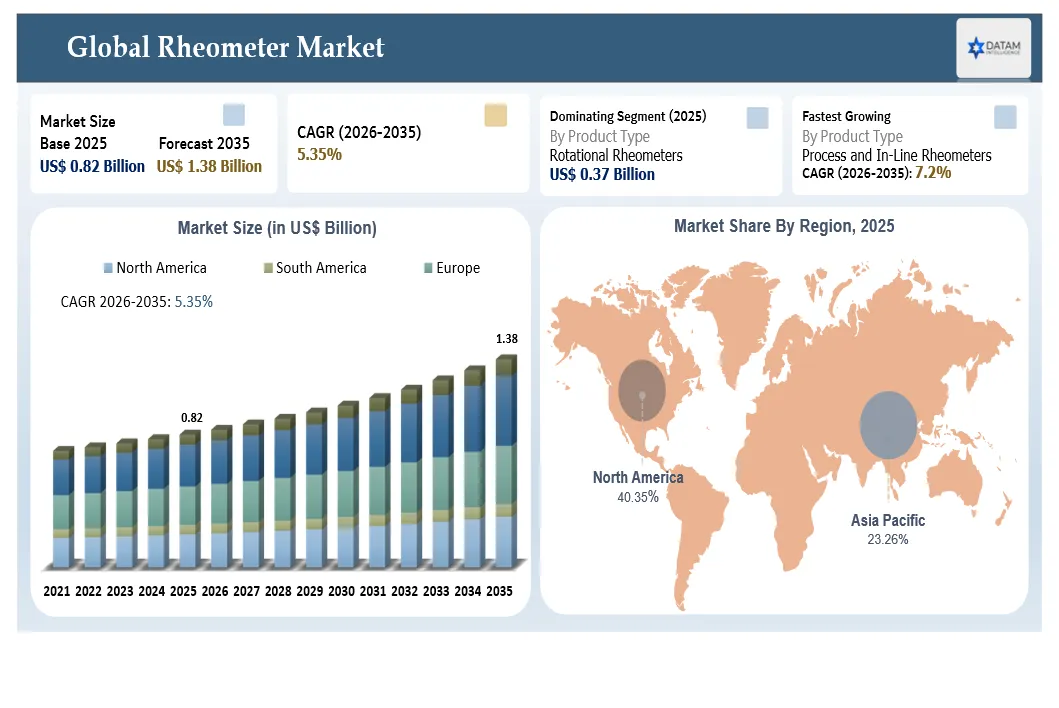
Rotational rheometers account for the largest revenue share because they serve the widest range of liquids, suspensions, emulsions, gels and soft solids. Capillary rheometers remain essential for polymer melts and extrusion applications, while process rheometers and automated platforms are expanding as manufacturers seek real-time quality assurance and lower operator variability. Demand is increasingly concentrated in battery slurries, biologics, high-solids coatings, recyclable polymers and additive-manufacturing materials.
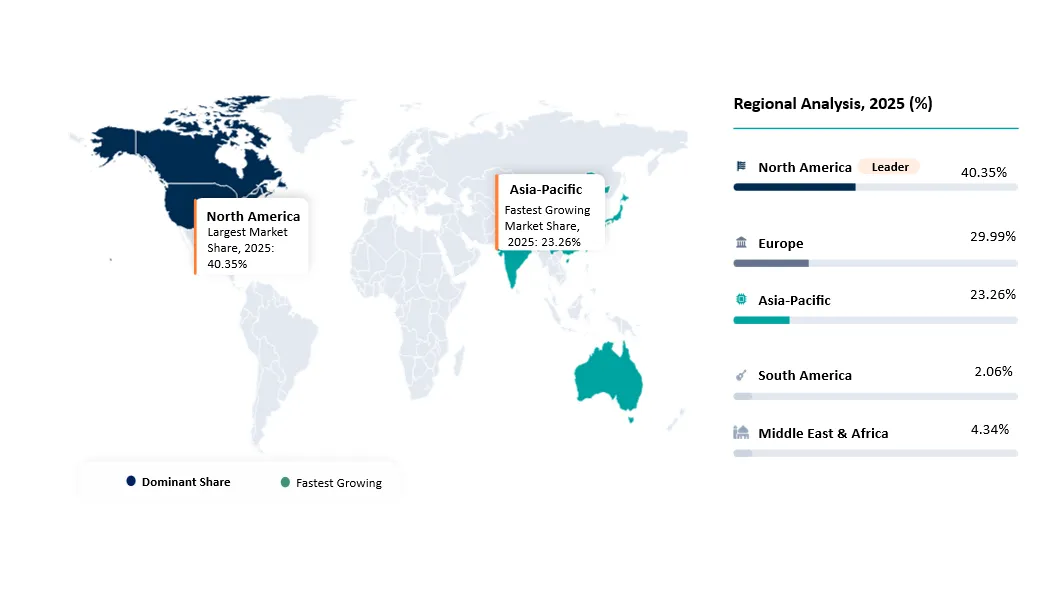
North America leads through pharmaceutical, polymer, battery and academic research spending, while Asia-Pacific is expected to grow fastest as China, India, South Korea and Southeast Asia expand advanced manufacturing and laboratory infrastructure. Competitive advantage increasingly depends on low-torque sensitivity, broad temperature control, automation, application software, service responsiveness and compatibility with microscopy, spectroscopy and process-data systems.
| Metric | Details |
| 2025 Market Size | US$ 0.82 Billion |
| 2035 Projected Market Size | US$ 1.38 Billion |
| CAGR (2026-2035) | 5.35% |
| Largest Market | North America |
| Fastest Growing Market | Asia-Pacific |
| Dominating Segment | Rotational Rheometers |
| Fastest-Growing Opportunity | Automated and Process Rheology |
| Page Count | Approximately 280 pages in full report |
Rheometer Market Key Takeaways
- Rotational rheometers held the largest share in 2025 because they support broad laboratory workflows across chemicals, pharmaceuticals, food, coatings and soft materials.
- North America led the market through high R&D intensity, regulated quality control and a large installed base of advanced analytical instruments.
- Asia-Pacific is expected to record the fastest growth as battery, polymer, electronics, pharmaceutical and specialty-chemical production expands.
- Battery slurry and electrode formulation is becoming a high-value application because rheology affects coating uniformity, settling, pumpability and electrode quality.
- Automation, robotic sample handling and standardized workflows are reducing operator dependence and improving laboratory throughput.
- Instrument software, application libraries and service contracts are becoming as important as hardware performance in buyer decisions.
- Process and in-line rheometers offer white-space opportunity by linking laboratory specifications with continuous manufacturing control.
- Future leadership will depend on sensitivity, reproducibility, modularity, thermal control, data integration and application support.
Rheometer Industry Trends and Strategic Insights
- Rheology platforms are evolving from isolated instruments into connected analytical systems that combine automated measurement, method templates, cloud-ready data and laboratory information management integration.
- Battery, pharmaceutical and personal-care developers increasingly require low-volume fixtures, solvent traps and controlled environments to test expensive or air-sensitive samples.
- Rheo-microscopy, Raman-rheology and dielectric-rheology combinations are growing because users want structural information alongside bulk mechanical response.
- High-throughput formulation laboratories are creating demand for autosamplers, disposable geometries, barcode-driven methods and automated cleaning.
- Instrument suppliers are expanding application centers and remote support to reduce training barriers and shorten method-development time.
- Sustainability is increasing demand for rheology of recycled polymers, bio-based resins, waterborne coatings and alternative-protein formulations.
Rheometer Market Scope
| Metrics | Details |
| By Product Type | Rotational Rheometers, Capillary Rheometers, Process and In-Line Rheometers, Extensional Rheometers, Specialty and Micro-Rheometers |
| By Measurement Principle | Controlled Stress, Controlled Strain, Controlled Rate, Oscillatory and Dynamic, Extensional and Other |
| By Torque Range | Ultra-Low Torque, Low Torque, Medium Torque, High Torque |
| By Sample Type | Liquids and Emulsions, Pastes and Suspensions, Polymer Melts, Soft Solids and Gels, Powders and Granular Materials |
| By Automation Level | Manual and Benchtop, Semi-Automated, Fully Automated and High-Throughput |
| By Application | Viscosity and Flow Curves, Viscoelastic Characterization, Yield Stress and Thixotropy, Cure and Gelation Analysis, Melt Flow and Processability, Interfacial and Extensional Rheology, Process Monitoring and Quality Control, Others |
| By End Use Industry | Polymers and Plastics, Chemicals and Petrochemicals, Pharmaceuticals and Biotechnology, Food and Beverages, Paints, Coatings and Inks, Cosmetics and Personal Care, Batteries and Energy Materials, Construction Materials, Academic and Research Institutes, Others |
| By Distribution Channel | Direct Sales, Scientific Instrument Distributors, Online and Digital Sales, Service and Rental Partners, Others |
| By Region | North America, Europe, Asia-Pacific, South America, Middle East and Africa |
| Report Insights Covered | Market Size, Share, Growth, Pricing, Technology, Competitive Landscape and Country-Level Opportunity |
Why does this report matter in 2026?
The year 2026 is strategically important because laboratory automation, battery-material investment and regulated pharmaceutical manufacturing are converging with rapid advances in connected instrumentation. Rheometer purchases are increasingly justified by faster formulation cycles, lower batch-failure risk and the need to create transferable specifications between development, quality control and production.
The report matters because the market is not homogeneous. A polymer processor selecting a high-force capillary system has different requirements from a biologics laboratory measuring low-viscosity protein formulations or a battery manufacturer monitoring thixotropic slurries. The study separates instrument classes, measurement principles, torque ranges, sample types, automation levels and end-use industries so suppliers and buyers can identify where premium performance creates measurable value.
Investment decisions made in 2026 around application laboratories, automation, digital services and regional service coverage will shape competitive position for the remainder of the decade. The market remains sufficiently fragmented for specialists to differentiate, but leading suppliers already benefit from installed-base service revenue, broad accessory ecosystems and strong scientific brands.
Rheometer Market White Space & Investment Opportunities
- Automated battery-slurry testing provides opportunity for instruments combining rheology, temperature conditioning, sample handling and statistical process control.
- Low-volume and microfluidic rheometry can address high-value biologics, diagnostics and research samples where material availability is limited.
- In-line rheology for coatings, adhesives, foods and polymer processing can reduce off-specification production and enable closed-loop control.
- Integrated rheo-optical and rheo-spectroscopic platforms can link structure, chemistry and mechanical behavior in a single workflow.
- Rental, leasing and managed-service models can expand access among small laboratories and emerging-market manufacturers.
- AI-assisted method development and automated quality flags can reduce dependence on expert users and improve transferability across sites.
Rheometer Future Market Transformation
The market will shift from stand-alone mechanical testing toward software-defined material intelligence. Instruments will increasingly identify optimal measurement ranges, recommend geometries, detect wall slip or sample loading errors and compare results against approved product specifications. Automated cleaning and handling will make rheology more suitable for routine high-throughput quality control.
Process integration will also expand. Laboratory methods will be translated into at-line and in-line indicators that predict coating behavior, extrusion stability, pumping performance and filling characteristics. Suppliers that connect benchtop instruments with process sensors, digital twins and manufacturing execution systems will capture recurring software and service value beyond the initial hardware sale.
Rheometer Market Buyer Decision-Making Criteria
Buyers evaluate minimum torque, maximum torque, angular resolution, normal-force sensitivity, temperature range, heating and cooling rate, geometry availability, sample volume, automation, cleaning requirements and software usability. Measurement reproducibility and the ability to transfer methods between instruments are central for regulated and multi-site organizations.
Total cost of ownership is determined by instrument uptime, calibration frequency, accessory cost, service response, training and data-system compatibility. Pharmaceutical and food laboratories also assess audit trails, user access, electronic records and validation support. Polymer and industrial buyers place greater emphasis on high-temperature capability, pressure control, ruggedness and correlation with processing behavior.
Rheometer Market Economic & Investment Analysis
The market benefits from recurring replacement and service demand because advanced rheometers remain in use for many years but require calibration, preventive maintenance, geometries, temperature accessories and software upgrades. Revenue visibility is strongest for suppliers with large installed bases and direct service networks. Premium systems generate attractive lifecycle value when application support and accessories are bundled.
Investment is concentrating in automation, battery and biopharma applications, and process analytics. The economic case is strongest where rheology prevents failed batches, accelerates formulation screening or reduces pilot-scale experimentation. Suppliers should model demand by laboratory density, regulated manufacturing intensity, installed-base age and local technical support rather than relying only on industrial output.
Rheometer Investment Trends in the Market
- Capital spending is increasing for automated material-characterization laboratories supporting batteries, polymers and specialty chemicals.
- Instrument manufacturers are investing in modular platforms that support multiple measurement modes and accessories on one base system.
- Service networks, demonstration laboratories and remote diagnostics are receiving greater investment as buyers prioritize uptime and application support.
- Software development is shifting toward guided workflows, data integrity, automated reporting and integration with laboratory systems.
- Partnerships with universities, battery institutes and formulation centers are supporting method development and customer acquisition.
Strategic Indicators For Rheometer Market
High Regulation Impact
Pharmaceutical, food, cosmetics and medical-device laboratories require traceable methods, calibrated instruments, audit trails and controlled electronic records. Compliance requirements increase software and validation value while extending qualification cycles.
High Investment Activity
Battery materials, advanced polymers and biopharmaceuticals are supporting laboratory expansion. Investment is concentrated in high-sensitivity instruments, automation, process analytics and regional application centers.
Supply Chain Disruption
Precision bearings, torque transducers, motors, electronics and temperature-control components create exposure to specialized suppliers. Long lead times for high-end instruments can delay laboratory commissioning.
Pricing Volatility
Pricing is influenced by configuration, exchange rates, electronics costs and accessory packages. High-end modular systems can cost several times more than routine instruments, while service and validation add to delivered cost.
Procurement Pressure
Large customers seek multi-year service agreements, global pricing, method transfer and fleet standardization. Suppliers must demonstrate lifetime value rather than only instrument specifications.
New Technology Adoption
Automation, micro-rheology, rheo-optics, cloud-connected data and AI-assisted workflows are expanding instrument capability and lowering the expertise barrier.
Regional Expansion Opportunity
China, India, South Korea and Southeast Asia offer strong growth through battery, polymer, pharmaceutical and food manufacturing. Local service and application support are essential for conversion.
Government Policy Support
Public funding for advanced manufacturing, batteries, biotechnology and research infrastructure supports instrument purchases, while localization policies can favor regional assembly and distribution.
Pricing Intelligence
Entry rotational systems compete on affordability, while premium platforms command higher prices for ultra-low torque, advanced thermal control, automation and integrated measurement modes.
Disruption Analysis of Rheometer Market
Automation is disrupting traditional expert-led rheology by converting complex methods into guided, repeatable workflows. This broadens adoption in quality-control laboratories but raises expectations for software reliability, automated error detection and data integrity. Smaller open-source and microfluidic systems may also expand educational and specialized research access.
Process rheology is changing the value proposition from retrospective testing to predictive control. As manufacturers link rheological signals with final-product performance, suppliers will compete on analytics, integration and process knowledge. This creates opportunity for partnerships with automation vendors, data-platform providers and manufacturing equipment companies.
Rheometer Market BCG Matrix: Company Evaluation
STAR
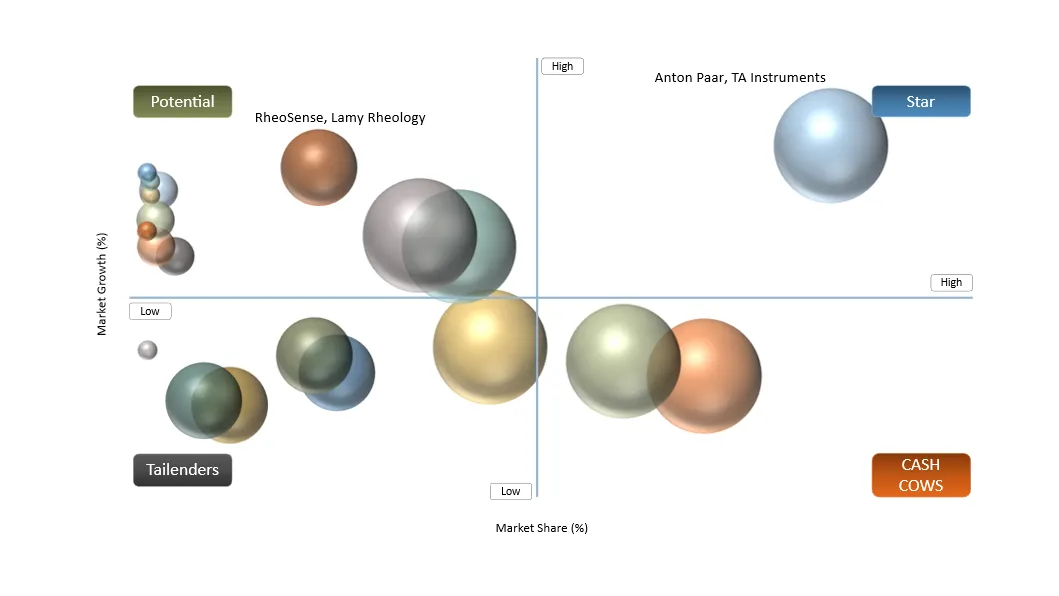
Anton Paar, TA Instruments and Thermo Fisher Scientific are positioned as Stars because they combine broad product portfolios, strong scientific brands, global service networks and continuing innovation in modular rheology, automation and application support. Their installed bases reinforce recurring service and accessory revenue.
POTENTIAL
RheoSense, Lamy Rheology, GÖTTFERT, Freeman Technology and specialized process-rheology suppliers represent Potential players. Their opportunities lie in micro-volume testing, powder rheology, polymer processing, portable systems and application-specific platforms where focused performance can outweigh breadth of portfolio.
Rheometer Market Dynamics
Driver Impact Analysis
| Driver | Market Growth Impact | Demand Concentration | Impacted Use Case | Strategic Impact |
| Advanced material formulation | High | Global R&D centers | Polymers, coatings, food and pharma | Expands need for viscoelastic and yield characterization. |
| Battery and energy-material investment | High | China, U.S., Europe, South Korea | Electrode slurries and electrolytes | Creates premium demand for automation and environmental control. |
| Regulated quality control | Medium-High | Pharma, food and cosmetics | Release testing and method transfer | Supports validated software, calibration and service revenue. |
| Process digitalization | Medium | Advanced manufacturing | At-line and in-line monitoring | Links rheology with closed-loop production control. |
Driver: Increasing Demand for Advanced Material Characterization
Formulators need to understand how materials behave during mixing, pumping, coating, filling, extrusion and end use. Simple viscosity values are often insufficient for non-Newtonian materials, creating demand for full flow curves, oscillatory testing, yield-stress analysis and time-dependent measurements. Rheometers therefore become critical in reducing scale-up risk and connecting formulation changes with processing performance.
Restraint Impact Analysis
| Restraint | Drag on Market Growth | Primary Impact Area | Impacted Use Case | Strategic Impact |
| High capital cost | High | Small and mid-sized laboratories | Advanced rotational and capillary systems | Encourages leasing, shared laboratories and tiered product portfolios. |
| Technical expertise gap | Medium-High | Emerging markets and routine QC | Method selection and interpretation | Increases value of guided software and training. |
| Method and sample variability | Medium | Cross-site reproducibility | Complex suspensions and soft solids | Requires standardized protocols and application support. |
| Long replacement cycles | Medium | Mature markets | Installed laboratory fleets | Shifts revenue toward service, upgrades and accessories. |
Restraint: High Cost and Complex Data Interpretation
Advanced rheometers require substantial capital expenditure and experienced users. Incorrect geometry, loading, temperature control or test conditions can produce misleading results. Smaller laboratories may therefore rely on routine viscometers or external testing services. Suppliers can reduce this barrier through application templates, training, automated diagnostics and financing models.
Rheometer Market Segmentation Analysis
The global Rheometer market is segmented based on Product Type, Measurement Principle, Torque Range, Sample Type, Automation Level, Application, End Use Industry, Distribution Channel and region.
By Product Type
Rotational Rheometers Will Continue to Lead
Rotational rheometers lead because they cover the widest range of liquids, gels, pastes and soft solids, support oscillatory and steady-shear testing and accept extensive temperature and application accessories. Capillary systems remain essential for polymer melts, while process and in-line platforms are expected to grow faster from a smaller base.
By Measurement Principle
Controlled-Stress and Oscillatory Testing Remain Core
Controlled-stress systems are widely used for yield behavior, creep and low-torque measurements. Oscillatory testing is central to viscoelastic characterization, cure and gelation. Multi-mode instruments that switch between controlled stress, strain and rate provide the strongest value for research laboratories.
By Torque Range
Low and Ultra-Low Torque Systems Gain Premium Demand
Low-torque sensitivity is increasingly important for dilute solutions, biologics, low-viscosity formulations and interfacial measurements. Medium-torque systems account for broad routine demand, while high-torque instruments serve polymer melts, asphalt, filled compounds and process-relevant conditions.
By Sample Type
Liquids, Emulsions and Suspensions Form the Largest Segment
Liquid and suspension testing dominates across chemicals, food, pharmaceuticals and coatings. Polymer melts generate high-value capillary and high-temperature demand. Soft solids, gels and powders are growing as formulation science expands into alternative proteins, hydrogels, cosmetics and additive manufacturing.
By Automation Level
Fully Automated Rheology Will Record the Fastest Growth
Automation reduces operator variability, increases throughput and enables overnight testing. Adoption is strongest in formulation screening and central quality-control laboratories. Cost and cleaning complexity remain barriers, but integrated autosamplers and disposable fixtures are improving the business case.
By Application
Viscoelastic Characterization Will Remain a High-Value Application
Flow curves remain the most common use, while viscoelastic, yield-stress and cure measurements generate premium demand for advanced systems. Process monitoring is expected to grow fastest as manufacturers seek early detection of formulation and mixing deviations.
By End Use Industry
Polymers and Plastics Lead, Batteries and Biopharma Grow Fastest
Polymers remain the largest industry because melt rheology determines extrusion, molding and compounding behavior. Battery and biopharmaceutical applications are growing faster due to formulation complexity, high product value and the cost of process failure.
By Distribution Channel
Direct Sales Remain Dominant for Advanced Systems
Direct sales lead because complex systems require demonstrations, application development, installation and service. Distributors remain important in emerging markets and for routine instruments. Digital channels support lead generation, accessory sales and remote configuration rather than replacing consultative selling.
Rheometer Market Geographical Penetration
U.S. Rheometer Market Landscape
The U.S. is the largest national market through pharmaceutical research, polymer and coatings development, battery investment and a dense academic laboratory base. Demand favors high-end rotational systems, automated workflows, validated software and strong service coverage. Federal and private investment in advanced manufacturing and life sciences supports continued replacement and expansion.
Germany Rheometer Market Outlook
Germany benefits from automotive, chemicals, polymers, machinery and research institutions. Buyers emphasize precision, standards compliance, high-temperature polymer testing and process correlation. Local engineering expertise and proximity to European instrument manufacturers support advanced adoption.
Japan Rheometer Market Trends
Japan is a mature premium market focused on electronics materials, automotive polymers, batteries, food texture and specialty chemicals. Laboratories prioritize reliability, compact design, high sensitivity and local technical support. Demand is stable with opportunities in next-generation batteries and bio-based materials.
China Rheometer Market Outlook
China is the fastest-expanding major market as battery, coatings, polymer, pharmaceutical and electronics manufacturing grows. Domestic suppliers are improving price-performance, while international brands retain strength in premium research and regulated applications. Local application centers and service capacity are decisive.
India Rheometer Market Outlook
India offers growth through pharmaceuticals, specialty chemicals, food processing, paints and academic research. Adoption is expanding from basic viscosity testing toward advanced rotational rheology. Financing, training and regional service remain important to conversion.
Brazil Rheometer Market Outlook
Brazil demand is concentrated in food, cosmetics, polymers, petrochemicals and universities. Currency volatility and capital budgets can extend replacement cycles, creating opportunity for distributor support, refurbished systems and service-based models.
Middle East and Africa Rheometer Market Outlook
The region is developing through petrochemicals, construction materials, food, universities and emerging pharmaceutical production. Gulf countries offer the strongest premium demand, while South Africa provides a regional research and distribution base. Training and local service remain the main adoption constraints.
Rheometer Market Competitive Landscape
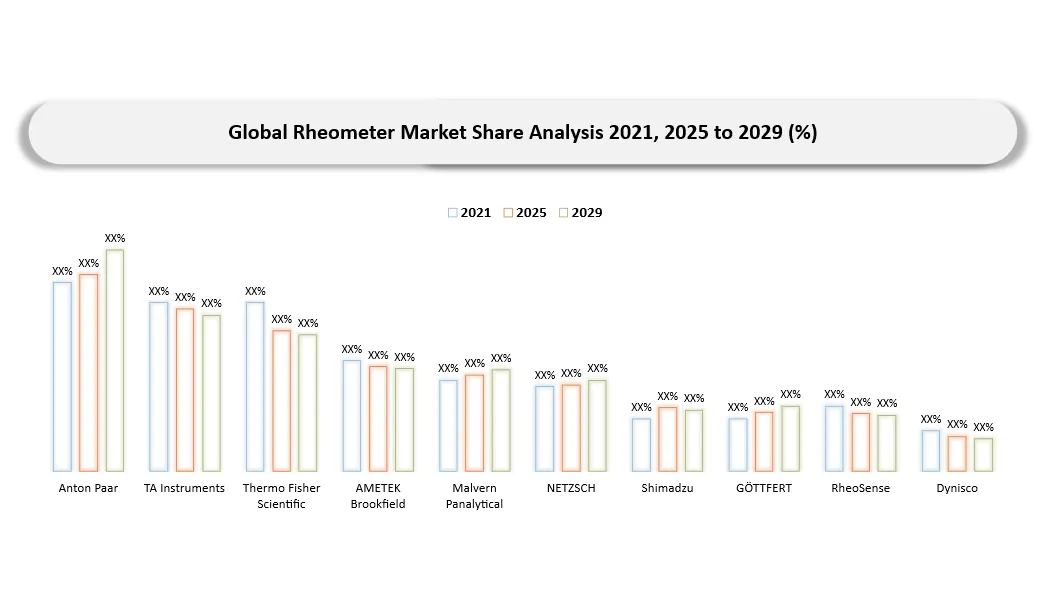
- Anton Paar, TA Instruments, Thermo Fisher Scientific, AMETEK Brookfield and Malvern Panalytical are major global participants with strong portfolios, application expertise and service networks.
- Competition is based on torque sensitivity, temperature control, modularity, software, automation, accessory breadth, method transfer and application support.
- Specialists such as GÖTTFERT and Dynisco are strong in polymer melt and process testing, while RheoSense differentiates in low-volume and microfluidic measurements.
- Regional suppliers compete through lower prices and faster local delivery, particularly in China and other Asia-Pacific markets.
- Service contracts, training, calibration and installed-base upgrades create recurring revenue and customer retention.
- Partnerships with battery centers, universities and formulation laboratories are increasingly important for method development and market access.
Key Companies
- Anton Paar GmbH
- TA Instruments (Waters Corporation)
- Thermo Fisher Scientific Inc.
- AMETEK Brookfield
- Malvern Panalytical
- NETZSCH-Gerätebau GmbH
- Shimadzu Corporation
- A&D Company, Limited
- GÖTTFERT Werkstoff-Prüfmaschinen GmbH
- CANNON Instrument Company
- RheoSense, Inc.
- Freeman Technology
- FANN Instrument Company
- Lamy Rheology
- Dynisco LLC
Company Profiles
Anton Paar GmbH
Anton Paar is a leading rheology supplier with modular rotational platforms, broad temperature-control options and extensive accessories for polymers, pharmaceuticals, food, coatings and research. Its competitive strengths are measurement sensitivity, application software, global service and a large installed base.
TA Instruments (Waters Corporation)
TA Instruments offers discovery and advanced hybrid rheometers used in materials research and industrial laboratories. The company benefits from integration with Waters, strong thermal-analysis adjacency, application support and global direct sales.
Thermo Fisher Scientific Inc.
Thermo Fisher supplies HAAKE rotational, capillary and process rheology systems. Its broad laboratory portfolio, global service organization and strong position in pharmaceutical and industrial workflows support cross-selling and enterprise procurement.
AMETEK Brookfield
Brookfield is widely recognized for viscosity and rheology instruments used in routine quality control. Its brand, broad distributor network and accessible product range provide a strong base in food, cosmetics, chemicals and manufacturing laboratories.
Malvern Panalytical
Malvern Panalytical participates through advanced material-characterization capabilities and analytical workflows. Its position is supported by customer relationships in polymers, pharmaceuticals and nanomaterials, and by integration with complementary characterization techniques.
NETZSCH-Gerätebau GmbH
NETZSCH combines rheology and thermal-analysis expertise, serving polymers, adhesives, batteries and advanced materials. Its value proposition centers on application depth, high-temperature testing and connected material-characterization workflows.
Shimadzu Corporation
Shimadzu Corporation is profiled for its role in laboratory or process rheology. Competitive position depends on portfolio breadth, measurement performance, software, service coverage, application expertise and ability to support repeatable methods across research and quality-control environments.
A&D Company, Limited
A&D Company, Limited is profiled for its role in laboratory or process rheology. Competitive position depends on portfolio breadth, measurement performance, software, service coverage, application expertise and ability to support repeatable methods across research and quality-control environments.
GÖTTFERT Werkstoff-Prüfmaschinen GmbH
GÖTTFERT specializes in capillary rheometers and polymer-testing equipment. It is well positioned in extrusion, compounding and quality control where high-pressure melt characterization and process correlation are critical.
CANNON Instrument Company
CANNON Instrument Company is profiled for its role in laboratory or process rheology. Competitive position depends on portfolio breadth, measurement performance, software, service coverage, application expertise and ability to support repeatable methods across research and quality-control environments.
RheoSense, Inc.
RheoSense focuses on microfluidic viscometry and small-volume sample testing. Its platforms are relevant for biopharmaceuticals, protein formulations and other high-value samples where conventional volumes are impractical.
Freeman Technology
Freeman Technology is profiled for its role in laboratory or process rheology. Competitive position depends on portfolio breadth, measurement performance, software, service coverage, application expertise and ability to support repeatable methods across research and quality-control environments.
FANN Instrument Company
FANN Instrument Company is profiled for its role in laboratory or process rheology. Competitive position depends on portfolio breadth, measurement performance, software, service coverage, application expertise and ability to support repeatable methods across research and quality-control environments.
Lamy Rheology
Lamy Rheology is profiled for its role in laboratory or process rheology. Competitive position depends on portfolio breadth, measurement performance, software, service coverage, application expertise and ability to support repeatable methods across research and quality-control environments.
Dynisco LLC
Dynisco LLC is profiled for its role in laboratory or process rheology. Competitive position depends on portfolio breadth, measurement performance, software, service coverage, application expertise and ability to support repeatable methods across research and quality-control environments.
Rheometer Market Major Pain Points
- High acquisition cost for advanced modular and automated systems.
- Shortage of experienced rheologists and inconsistent method design.
- Sample loading, wall slip, evaporation and temperature-control errors.
- Difficulty correlating laboratory data with manufacturing performance.
- Long lead times for specialized accessories and service parts.
- Complex validation and data-integrity requirements in regulated laboratories.
- Extended replacement cycles in mature markets.
- Limited local application support in emerging regions.
Rheometer Market Recent Developments
- 2025-2026: Leading suppliers expanded automated and modular rheology workflows for battery slurries, pharmaceuticals, polymers and high-throughput formulation laboratories.
- 2025: Research groups demonstrated compact rheo-microscopy systems capable of synchronizing bulk rheological measurements with high-resolution optical imaging, highlighting demand for integrated structure-property analysis.
- 2025: Instrument software development increasingly emphasized guided methods, automated quality checks, data integrity and easier transfer of procedures across laboratories.
- 2024-2025: Battery manufacturers and research centers increased investment in rheology for electrode slurry stability, coating behavior and processability.
- 2024-2025: High-frequency and rapid-test rheology methods gained attention for curing resins and other time-evolving materials where conventional frequency sweeps are too slow.
Analyst View / Opinion on Rheometer Market
- The Rheometer market is positioned for steady expansion because material complexity and quality requirements are increasing faster than basic viscosity testing can address.
- Rotational systems will remain the revenue center, while automated, micro-volume and process platforms provide the strongest incremental growth.
- Battery, biopharma and advanced-polymer applications will reward suppliers that combine hardware with validated methods and specialist support.
- Software will become a major competitive differentiator as laboratories seek guided workflows, automated diagnostics and integrated reporting.
- Asia-Pacific offers the greatest unit-growth opportunity, but premium conversion depends on local service, demonstrations and application expertise.
- Long-term leadership will belong to suppliers that connect laboratory rheology with production performance and recurring digital or service revenue.
Rheometer Market Target Audience
| Industry | Who Should Buy This Report? | Reason to Buy This Report |
| Scientific Instruments | Manufacturers, distributors and service providers | Benchmark portfolios, pricing, channels and regional opportunities. |
| Polymers & Chemicals | R&D, process and quality leaders | Assess instrument demand and application priorities. |
| Pharmaceuticals & Biotechnology | Formulation, analytical and manufacturing teams | Evaluate low-volume, validated and automated rheology workflows. |
| Food & Personal Care | Product developers and QC laboratories | Understand texture, stability and process-related testing demand. |
| Batteries & Energy Materials | Cell developers, slurry formulators and equipment suppliers | Identify growth in electrode-slurry and process analytics. |
| Research Institutions | Universities, institutes and shared laboratories | Plan instrument investment and emerging measurement capabilities. |
| Investors & Consulting | Private equity, venture capital and strategy teams | Evaluate market growth, competition and acquisition opportunities. |
Why Choose DATAM?
- Data-driven insights combining market sizing, installed-base modeling, pricing, technology and regional demand.
- Post-purchase analyst consultations for portfolio strategy, market entry, channel design and application prioritization.
- Annual report updates covering product launches, partnerships, acquisitions and competitive changes.
- Specialized focus on emerging markets and laboratory infrastructure rather than generalized geographic summaries.
- Actionable analysis connecting instrument capability with buyer workflows, service requirements and commercialization strategy.
What DATAM Uniquely Provides
- Ten-year forecasts across product type, measurement principle, torque range, sample type, automation, application, end use and distribution channel.
- Detailed analysis of battery slurry, biopharma, polymer, coating, food and process-rheology opportunities.
- Competitive benchmarking of instrument performance, software, accessories, service and application support.
- Country-level views linking research intensity, manufacturing, installed base and procurement behavior.
- Strategic recommendations for automation, direct sales, distributor expansion, service and application-center investment.


























































