


Recycled Polyester Market Overview
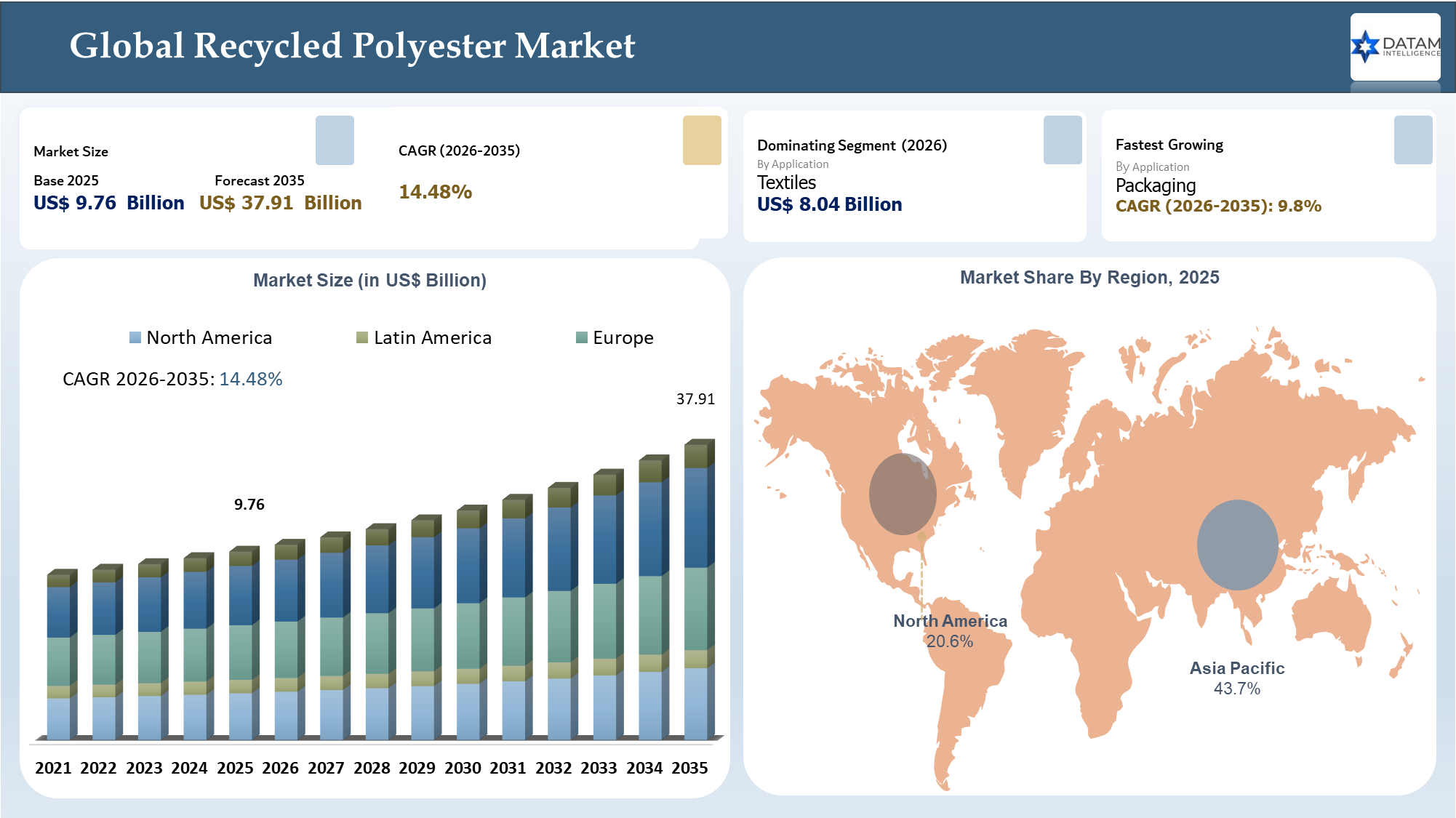
The Global Recycled Polyester Market reached US$ 9.76 billion in 2025 and is expected to reach US$ 37.91 billion by 2035, growing with a CAGR 14.48% during the forecast period 2026-2035. Recycled Polyester Market is seeing increasing business significance as fashion houses, packagers, automotive makers, and consumer goods firms move away from virgin polyester towards more sustainable materials. The manufacturing process of recycled polyester entails converting post-consumer PET bottles, utilized polyester fibers, packaging and post-industrial PET scraps to flakes, chips, pellets, staple fiber, filament yarn, and resin via mechanical and chemical recycling processes. Textiles & Apparel are currently the largest segment in demand as recycled polyester is extensively used in sports apparel, fashion clothing, home furnishings, and shoes. Packaging is also a rising application area for recycled PET bottles, trays, films, and sheets. Several factors influencing the recycled polyester market include the sustainability goal of brands, the requirement for recycled content, availability of feedstocks, certification, and quality consistency. Companies with a better capacity for collecting feedstocks, recycling technologies, traceability, food contact properties, and application-specific products are likely to have competitive advantages.
Key Takeaways
- rPET significantly reduces carbon footprint of up to 70-80% less CO2 as well as petroleum dependence compared to virgin polyester, making it a core material for circular economy goals in textiles and packaging sectors.
- The Textile industry is the largest market accounting for $8.04 Billion in revenue in 2025. While the apparel segment remains the largest part of the textile market, Technical textiles usage in automotive, home and industrial use cases in particular is driving the segment growth.
- Food-contact rPET Packaging is expanding due to regulations particularly the EU’s Single-Use Plastics Directive and brand commitments but requires super-clean recycling processes. Packaging sector accounts for the fastest growing use case for rPET and is projected to grow at 9.8% CAGR through 2035.
- Mandatory minimum rPET usages due to the EU’s Packaging and Packaging Waste regulation, the state minimum recycled content legislation in California and Washington and a number of worldwide plastic treaties. A significant example includes a 25% minimum mandated recycled PET content in beverage bottles.
- Low labor and feedstock cost have driven massive recyclers in China, India and Southeast Asia. In Europe and North America, we see a much higher bar on quality and higher, more sophisticated technologies and mandated levels.
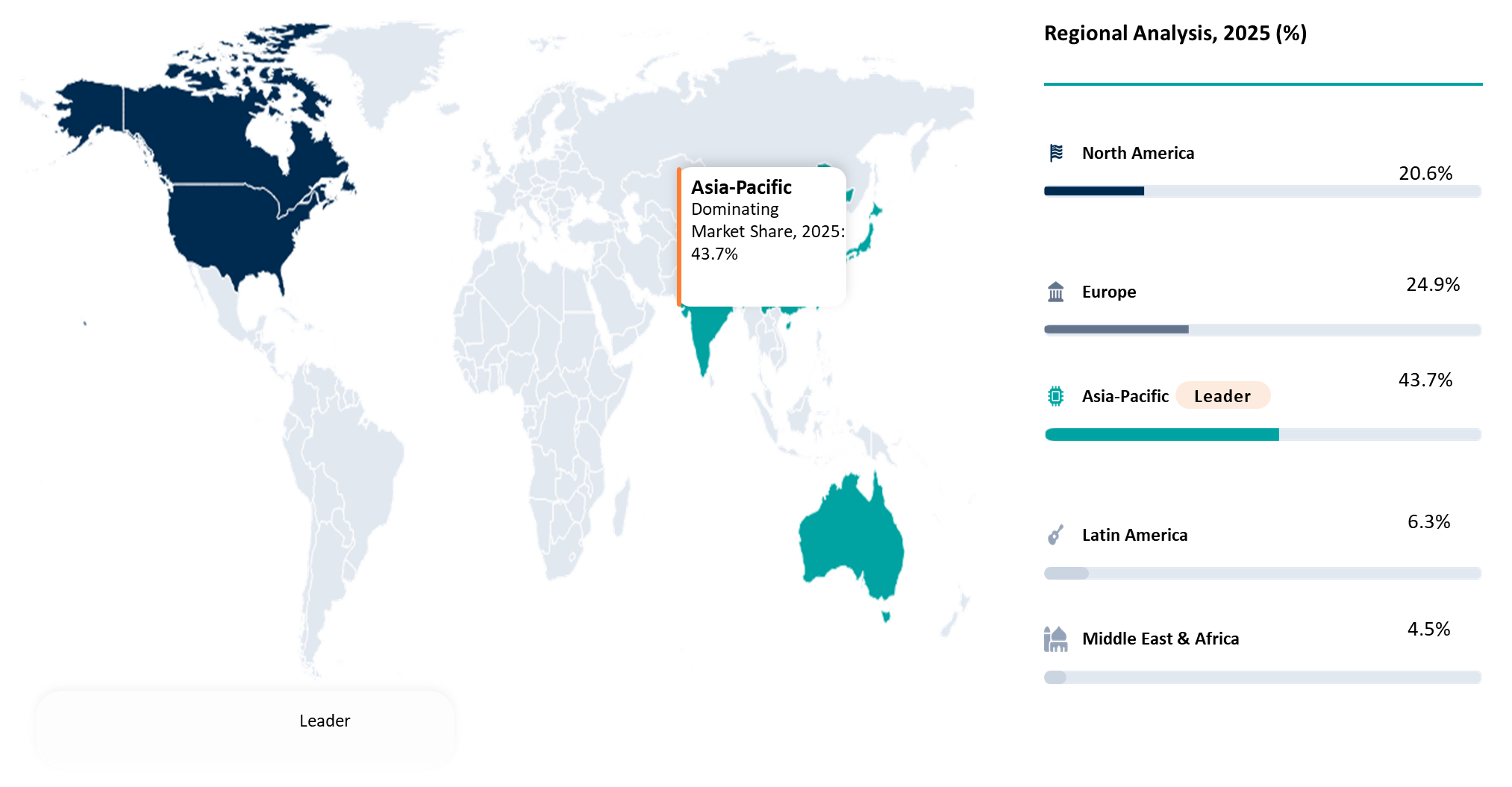
- In 2025, the Asia-Pacific region controls the market for rPET with 43.6% share in 2025 only because it processes over 80% of world plastic waste; its global position as end-points for waste imports and presence of low cost infrastructure for mechanical recycling place it in a leading position
AI Impact Analysis
Artificial intelligence can make significant contributions to the development of the recycled polyester market by increasing the quality of the feedstock, enhancing processes, and ensuring traceability of material throughout the recycling value chain. In relation to feedstock identification, artificial intelligence can enhance accuracy in recognizing various types of feedstock such as PET bottles, polyester fabric, and mixed plastic materials, thus minimizing contamination. For mechanical and chemical recycling facilities, artificial intelligence can assist in optimizing the process through monitoring of temperature, viscosity, impurities, and quality of the output.
Additionally, artificial intelligence plays an important role in supporting demand growth for recycled polyester as it can help ensure traceability and content confirmation. The latter is very crucial in view of the fact that today's consumers tend to be concerned about the origin and quality of the recycled content in their products and packaging. Over time, artificial intelligence can result in improved competitiveness of recycled polyester compared to new polyester.
Recycled Polyester Market Industry Trends and Strategic Insights
- The market is shifting from conventional bottle-to-fiber recycling toward closed-loop polyester recycling, where used textiles and polyester waste are converted back into high-value recycled fibers and yarns.
- Rising rPET demand in packaging is increasing consumption of recycled polyester resin, flakes and pellets, especially across bottles, films, trays, containers and food-contact packaging.
- Traceability, certification and recycled-content verification are becoming key buying criteria as brands require proof of origin, ESG compliance and consistent material quality.
- Chemical recycling is emerging as a premium pathway because it can process mixed, colored and lower-quality polyester waste into recycled polyester with near-virgin performance.
- Asia-Pacific remains the strategic production hub due to its strong textile manufacturing base, PET waste availability, recycling capacity and growing demand from global apparel supply chains.
Market Scope
| Metrics | Details | ||
| 2025 Market Size | US$ 9.76 Billion | ||
| 2035 Projected Market Size | US$ 37.91 Billion | ||
| CAGR (2026-2035) | 14.48% | ||
| Largest Market | Asia-Pacific | ||
| Fastest Growing Market | Asia-Pacific | ||
| By Feedstock Source | Post-Consumer PET, Post-Industrial PET | ||
| By Recycling Technology | Mechanical Recycling, Chemical Recycling | ||
| By Product Form | Recycled Polyester Staple Fiber, Recycled Polyester Filament Yarn, Recycled Polyester Chips, Recycled Polyester Flakes, Recycled Polyester Pellets, Recycled Polyester Resin | ||
| By Purity Level | High Purity Recycled Polyester, Medium Purity Recycled Polyester, Low Purity Recycled Polyester | ||
| By Application | Textiles, Packaging, Automotive, Industrial, Consumer Goods, Others | ||
| By Region | North America | U.S., Canada, Mexico | |
| Europe | Germany, UK, France, Spain, Italy, Poland | ||
| Asia-Pacific | China, India, Japan, Australia, South Korea, Indonesia, Malaysia | ||
| Latin America | Brazil, Argentina | ||
| Middle East and Africa | UAE, Saudi Arabia, South Africa, Israel, Turkiye | ||
| Report Insights Covered | Competitive Landscape Analysis, Company Profile Analysis, Market Size, Share, Growth | ||
Disruption Analysis
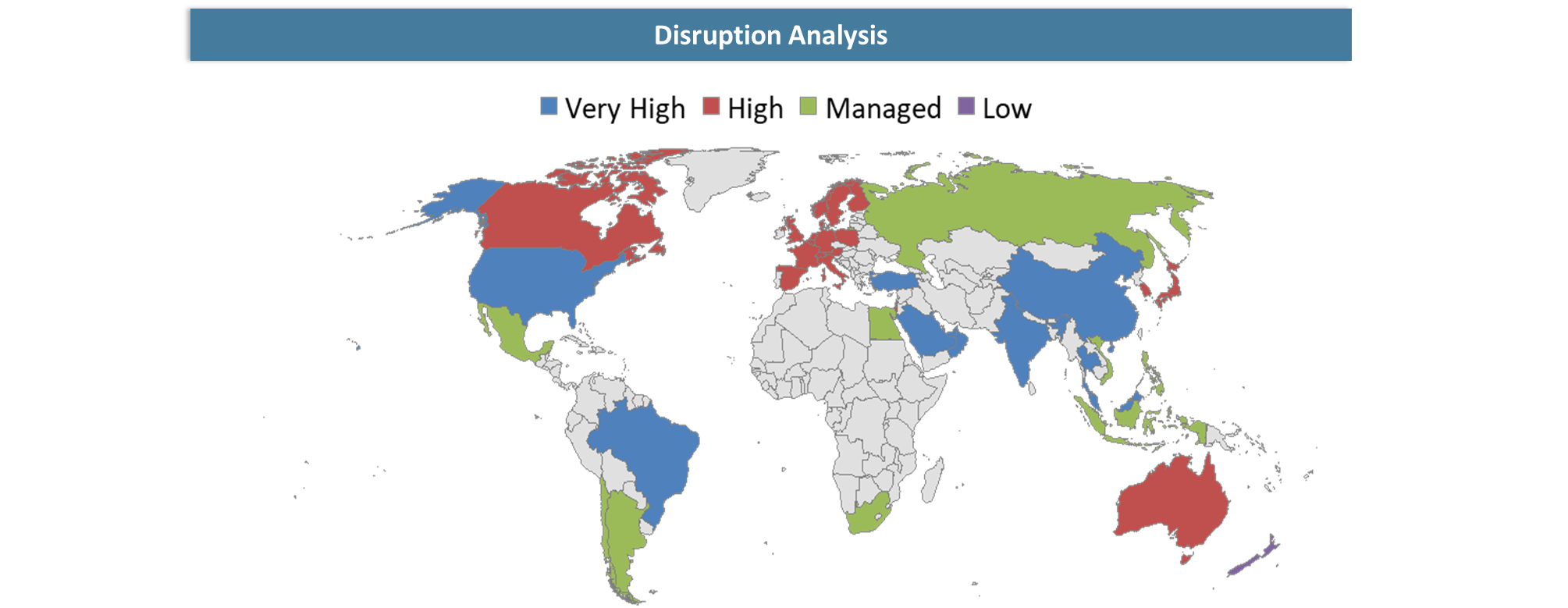
Circular Polyester Moves From Waste Recovery to High-Value Material Reinvention
Disruption in the recycled polyester market comes from the movement from basic bottle-to-fiber recycling to more advanced high-purity circular polyester production systems. Previously, the feedstock used in the production of recycled polyester consisted mainly of PET bottles for low to medium-grade applications in textiles and packaging. The commitment to sustainability from clothing, packaging, automotive, and other consumer good companies, however, is causing a move to higher-purity feedstocks, textile-to-textile recycling and food-grade PET recycling.
Another major disruption is chemical recycling, which allows the polyester waste to be broken down to monomers and creating recycled polyester similar in quality to virgin polyester materials. This creates new opportunities in premium clothing, technical textiles, film, and bottles. At the same time, advancements in automated sorting, digital product passports and traceable content are redefining supplier relationships.
Feedstock disruption is also a major factor in the recycled polyester market. There is increasing competition for feedstock from bottles, textiles and packaging waste. Those who can control the waste flow, guarantee the quality of recycled polyester products and meet brand circularity needs would see their competitive advantage increase.
BCG Matrix: Company Evaluation

The recycled polyester market includes Indorama Ventures Public Company Limited, Far Eastern New Century Corporation, Alpek, S.A.B. de C.V., Reliance Industries Limited, and Toray Industries, Inc. that can be classified as Stars, because these companies show excellent performance in polyester value chain integration, large-scale production, recycling, customer base globally and capabilities to fulfill massive demand from textiles, packaging and other industries.
On the other hand, Unifi, Inc. and Li Peng Enterprise Co., Ltd. can be classified as Cash Cows due to their strong relevance in products such as recycled polyester yarns and fabrics and their usage in the textile industry. The competitive strength of these companies is based on established customer relations, special materials for specific application and strong involvement in sustainability projects in the apparel and sportswear industry.
revalyu Recycling (India) Limited and Syre should be positioned as Question Marks, because both these companies are specialized on advanced recycling and textile to textile polyester recycling. They possess high growth potential, but their future position will depend on commercialization, feedstock sources, price competition and long-term collaborations with global brands.
The SINOPEC Yizheng Chemical Fibre Company Limited can be classified as a Selective Player with high polyester fiber manufacturing capability, but having relatively less direct recycled polyester capability as compared to circular material companies.
Market Dynamics
Rising Demand for rPET in Packaging
Increased demand for rPET in packaging is a key factor fueling the Recycled Polyester Market, considering the growing number of beverage, food, personal care, and FMCG manufacturers utilizing recycled PET resins, flakes, and pellets for bottles, trays, films, sheets, and containers. The application of packaging is among the largest uses of recycled polyester due to the need for high volume and repeatable sourcing and being directly associated with brands' sustainability initiatives. Big packaging players are faced with the challenge of reducing virgin plastic consumption and achieving their recycling targets.
Furthermore, regulatory requirements continue to stimulate the growth. The European Commission demands that there be 25% recycled content in PET bottles starting in 2025 and 30% recycled content in all plastic bottles starting in 2030, which forms the structural demand base for rPET packaging. In the United States, NAPCOR reports that the average recycled PET content in PET bottles amounted to 15.9% in 2024, exceeding the three-year average of 13.7%.
This development helps the manufacturers of recycled polyethylene terephthalate because the demand for top-notch quality material such as PET chips will rise. Investments will also be made for collecting, sorting, cleaning, decontaminating and recycling used bottles into new ones. Packaging companies looking for a steady stream of rPET will favor suppliers who have certifications, traceability and stability.
Price Sensitivity Against Virgin Polyester
The price sensitivity towards virgin polyester is another significant constraint facing the Recycled Polyester Market. Even though recycled polyester aligns with sustainability goals, many customers continue to make price comparisons between recycled polyester and virgin PET and polyester fiber. This means that once there are reductions in the prices of virgin polyester caused by cheap crude oil or petrochemical feedstock, there will be little incentive for manufacturers operating on narrow profit margins to opt for recycled polyester.
This problem is evident from fiber consumption patterns. Textile Exchange indicated that the recycled polyester produced in the period between 2023 to 2024 rose from 8.9 million tonnes to 9.3 million tonnes but lost market share from 12.5% to 12.0% due to a faster rise in virgin polyester production.
For the recycled polyester market, this implies that recycled polyester will face margin compression and reduced adoption in commodity applications. While most buyers may choose recycled polyester for environmental, social, and governance (ESG) reasons, they would not be willing to incur substantial expenses when they see no clear advantages in the material being offered by recycled polyester suppliers.
Segmentation Analysis
The Global Recycled Polyester Market is segmented based on the feedstock source, recycling technology, product form, purity level, application, and region/countries.
Textiles Lead as Recycled Polyester Becomes the Backbone of Sustainable Fiber Demand
The Textiles Application Segment is projected to retain the dominant position within the Recycled Polyester Market, owing to extensive usage in apparels, sports, household, footwear, and technical textiles. Polyester is the most commonly used fiber globally, accounting for 59% of total global fiber output in 2024, and production of polyester fiber increased from about 71 million tonnes in 2023 to 78 million tonnes in 2024. Likewise, recycled polyester production increased from 8.9 million tonnes in 2023 to 9.3 million tonnes in 2024; however, its market share dropped slightly from 12.5% to 12.0%, as virgin polyester posted higher production gains.
While these statistics reveal growing textile demand, they also point out the significant conversion challenges faced by recycled polyester producers. Fashion, sportswear, and home textiles brands are incorporating recycled polyester in their products to boost sustainability initiatives, minimize dependency on virgin materials, and cater to retailer demands. Among all opportunities in the market, certification for recycled yarns, performance fabrics, and textile-to-textile recycling holds the greatest promise.
Geographical Penetration
Asia-Pacific Converts Polyester Scale Into Recycled Polyester Leadership
The Asia-Pacific region will retain its market leadership in the recycled polyester market due to its unrivaled infrastructure for producing textiles, apparel, packaging, and polyester material. It houses key demand centers like China, India, Vietnam, Bangladesh, and Indonesia, as many global apparel and sportswear companies mandate the use of recycled polyester yarns, staple fibers, and fabrics among Asian suppliers. Availability of significant PET bottle waste, polyester conversion facilities, and cost-effective recycling facilities is another strength of the region.
The numbers don’t lie. Textile Exchange noted that the total production of polyester fiber across the world grew from 71 million tonnes in 2023 to 78 million tonnes in 2024. The total production of recycled polyester fiber grew marginally from 8.9 million tonnes to 9.3 million tonnes in 2024. Yet, the share of recycled polyester decreased to 12.0% from 12.5%. This means that the growth in demand is high but even higher for virgin polyester. In addition, China, a major player in the Asia-Pacific region, produces 74.75 million tons of chemical fibers in 2024, marking a growth of 8.8% YoY.
This makes Asia-Pacific not only the largest production hub but also the most strategic region for future growth. Suppliers with reliable feedstock sourcing, recycled yarn capacity, brand certifications and textile-to-textile recycling capabilities are likely to gain stronger traction.
Japan Recycled Polyester Market Trends
Japan is an important strategic market in recycled polyester production, as it possesses the combination of highly organized PET bottle collection and sorting and domestic material innovation. The recycle rate of PET bottles in Japan has always been higher than 80%, and according to the University of Tokyo, Japan's PET bottle recycling rate exceeds 80% significantly compared to Europe and the U.S. As a result, recycled polyester producers can get access to a clean and properly sorted PET source material that allows creating high whiteness recycled textile materials.
Another strength of Japan is company-level capability. Toray Industries Inc. started selling &+ recycled fiber made from PET bottles collected in Japan starting from January 2020; subsequently, it was rebranded by Toray to increase sustainability in textiles. Moreover, Toray emphasized that the high recycling rates of PET bottles in Japan facilitate easy access to high-quality PET bottles used for recycled fibers with properties similar to virgin petrochemical materials.
In general, Japan is a high-end recycled polyester innovation market due to its recycling capabilities and premium quality materials produced there.
U.S Recycled Polyester Market Outlook
One of the major demand markets of recycled polyester in the U.S. includes beverage containers, textiles, apparel, automobiles and consumer goods. Sustainability pressures in the U.S. have been observed on account of branding practices undertaken by FMCG, retailers and sportswear manufacturers. They tend to increase the percentage of recycled content in bottles, fibers, and yarns. According to NAPCOR, recycled rates of PET bottles were seen to reach 32.5% in 2023 and 30.2% in 2024, being above the previous decade's figure of 29.5%. This indicates that there is substantial recovery of PET in the U.S., although inefficient collection practices hinder the supply of recycled polyester feedstocks.
Increasing usage of rPET in packaging has also emerged as another factor influencing recycled polyester demand. Bottles made from PET in the U.S. hit an all-time high of 16.2% in 2023, while the total rPET use grew from 870 million pounds to 966 million pounds. This implies that there is a robust demand for recycled polyester resins, flakes, and pellets, apart from recycled polyester fiber and yarn.
Competitive Landscape
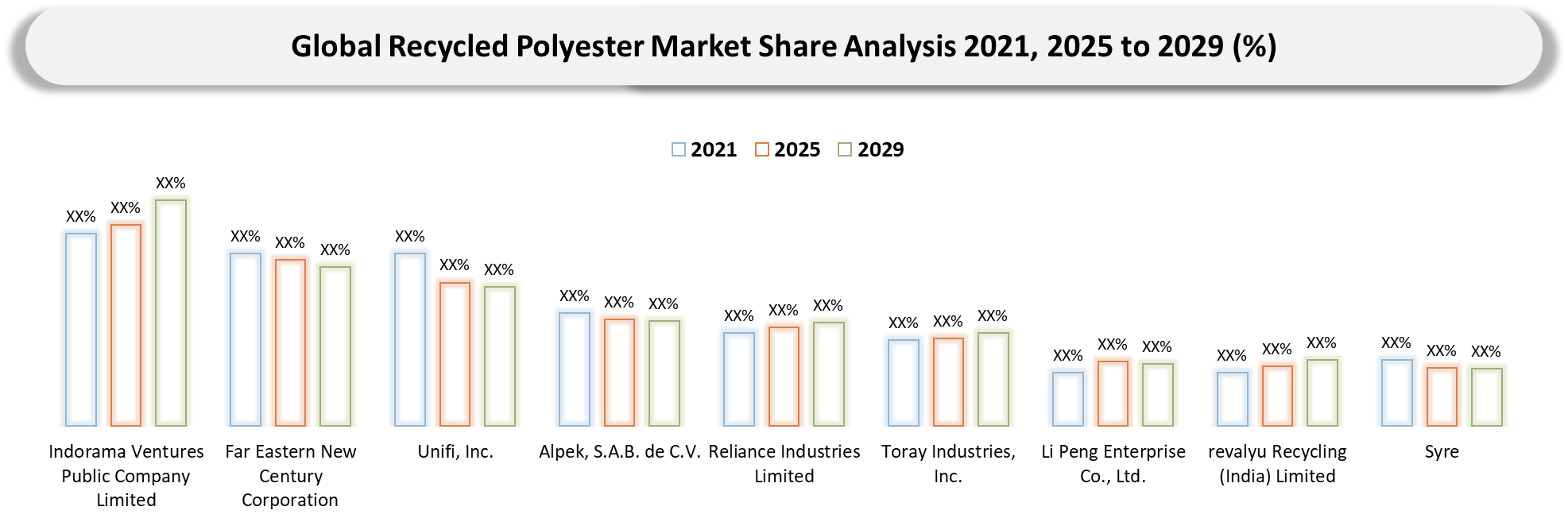
The recycled polyester market is witnessing stiff competition as the industry evolves from regular PET waste recycling to the use of traceable, quality, and specific-application-based recycled polyester products. Indorama Ventures Public Company Limited, Far Eastern New Century Corporation, Alpek, S.A.B. de C.V. and Reliance Industries Limited have an edge in the business because of their fully integrated polyester value chain operations, mass manufacturing capacities, and possession of facilities to recycle PET waste. Unifi, Inc. and Li Peng Enterprise Co., Ltd. have a definite presence in the area of recycled polyester yarns and textiles applications, thus being suitable for clothing, sports, and fashion companies. Toray Industries, Inc. has expertise in developing materials that can help develop high-end recycled fibers and textiles. revalyu Recycling (India) Limited and Syre are among the key competitors that come under the next generation of businesses based on chemical recycling, circular textiles, and quality recycled polyester products.
Key Developments
- January 2023: revalyu Recycling (India) Limited announced a major PET recycling facility in Statesboro, Georgia, designed to process post-consumer PET bottles into recycled polyester products.
- April 2023: Far Eastern New Century Corporation advanced FENC® TopGreen ChemCycle, supporting chemical recycling of polyester-containing textile waste into recycled polyester feedstock.
- September 2023: Indorama Ventures Public Company Limited achieved the milestone of recycling 100 billion post-consumer PET bottles, strengthening its global circular PET and recycled polyester position.
- March 2024: H&M Group and Vargas Holding launched Syre, a textile-to-textile polyester recycling venture backed by a USD 600 million seven-year offtake agreement with H&M Group.
- February 2025: Unifi, Inc. released its 2024 Sustainability Snapshot, highlighting progress in textile-to-textile recycling as part of next-generation REPREVE® recycled offerings.
- August 2025: Indorama Ventures Public Company Limited reached 150 billion PET bottles recycled, further strengthening its circular economy and recycled polyester supply position.
White Space Opportunities
DataM sees enormous white space opportunities available in the Recycled Polyester Market apart from traditional PET bottle to fiber recycling. While most competing players might be focusing only on traditional bottle-to-fiber PET bottle recycling, commodity flakes, staple fibers, and conventional textiles, there exist unexplored areas such as textile to textile recycling, food contact grade rPET, chemical recycling, high-performance recycled yarns, automotive grade recycled polyester, technical textiles, digital traceability, and closed loop branded recycling that have immense potential.
However, there exists an opportunity that could make a particular player very successful based on what services and products it provides to buyers. A player that has a comprehensive solution of feedstock procurement, AI enabled sorting, mechanical or chemical recycling, high-quality flakes, chips, fibers, yarns, and resins, along with traceability and certification, will succeed in the market. The ones that establish a complete recycling value chain for fashion brands, packaging brands, automotive, textile and consumer goods manufacturers will benefit immensely, more so as demand increases for more circular and application specific recycled polyester supply than low-cost recycled material procurement.
DMI Opinion
According to DataM, the expansion of the Recycled Polyester Market is not only about the availability of PET waste, but also its transformation into quality, traceable, and suitable materials for use in the manufacture of recycled polyester. The market is shifting from traditional waste bottle to fiber to more valuable circular polyester that facilitates recycling of textile to textile, food contact containers, automotive, and premium quality polyester yarns.
Based on the assessment carried out by DataM, the highest potential exists in the fields of chemical recycling, textile recycling, food-grade rPET, recycled polyester yarns, artificial intelligence sortation systems, and brand partnerships with a closed loop system. Companies that offer excellent parameters of performance in terms of feedstock purity, color, tensile strength, recyclability, contaminants, certifications, and supply chain will definitely enjoy a competitive advantage. Therefore, one of the best approaches to this market would be to view it as a circular material market and sustainable polyester value chain.
Why Choose DataM?
- Circular Polyester Value Chain Coverage: Covers the complete recycled polyester ecosystem, including PET waste sourcing, sorting, mechanical recycling, chemical recycling, flakes, chips, pellets, fibers, yarns and resins.
- Technology and Innovation Mapping: Tracks textile-to-textile recycling, chemical depolymerization, enzymatic recycling, AI-enabled sorting, advanced decontamination and traceable recycled-content certification.
- Competitive Positioning of Major Companies: Evaluates leading players based on recycling capacity, product portfolio, feedstock access, certifications, geographic presence, brand partnerships and application focus.
- Key Trends and Market Dynamics: Highlights sustainability-led demand, food-contact rPET growth, circular fashion, recycled-content regulations, feedstock competition and premium recycled yarn adoption.
- Pricing and Supply Chain Intelligence: Provides insights into recycled polyester pricing, PET scrap availability, regional supply-demand gaps, logistics challenges, quality premiums and cost comparison with virgin polyester.
Target Audience 2026
- Recycled polyester fiber, yarn, flakes, chips, pellets and resin manufacturers
- PET recycling companies, waste management firms and sorting facility operators
- Textile, apparel, sportswear and footwear brands using recycled polyester materials
- Packaging companies and FMCG brands adopting rPET bottles, films, trays and containers
- Automotive OEMs and Tier 1 suppliers using recycled polyester in interiors and insulation
- Technical textile, nonwoven, geotextile and filtration material manufacturers
- Chemical recycling technology providers and circular material innovators
- Investors, strategy teams, ESG teams and sustainability consultants tracking circular economy opportunities


























































