


Reciprocating Compressor Market Size and Overview
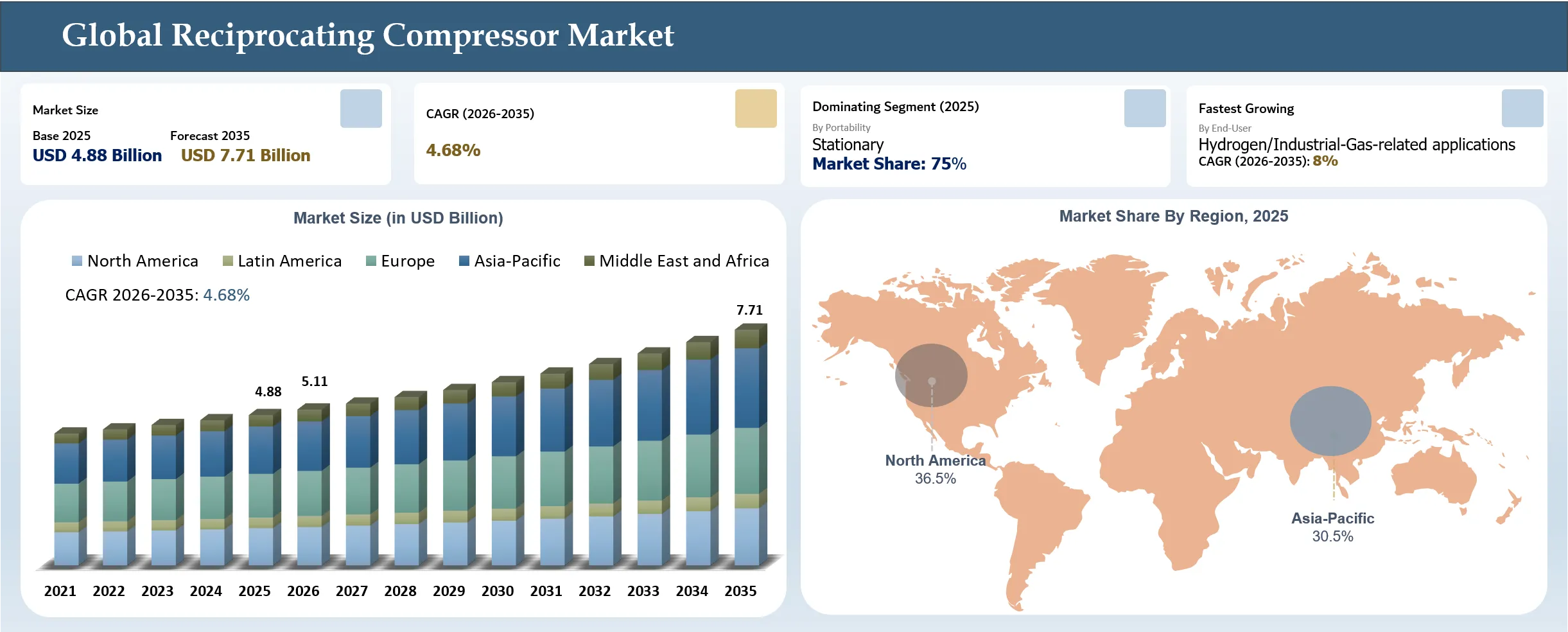
The global Reciprocating Compressor market reached USD 4.88 billion in 2025 and is expected to reach USD 7.71 billion by 2035, growing with a CAGR of 4.68% during the forecast period 2026-2035. The market is expanding due to the natural gas and LNG infrastructure, where reciprocating compressors are used for high-pressure gas processing, transportation, storage, and related industrial operations. According to the U.S. Energy Information Administration EIA), U.S. LNG gross exports are projected to increase from 12 billion cubic feet per day (Bcf/d) in 2024 to 15 Bcf/d in 2025 and 16 Bcf/d in 2026, while U.S. natural gas production is forecast to remain at approximately 13.4 million barrels of oil equivalent per day in 2025 and 13.5 million in 2026. The International Energy Agency (IEA) estimates that around 300 billion cubic meters per year (bcm/yr) of new LNG export capacity could be added globally by 2030, with more than 90 bcm/yr of additional LNG liquefaction capacity sanctioned in 2025, including over 80 bcm/yr in the United States. These capacity additions are strengthening requirements for reliable compression equipment across LNG, natural gas processing, petrochemical, and energy infrastructure, while increasing gas demand in Asia-Pacific and the Middle East is creating additional opportunities for reciprocating compressor deployment.
SIAD Group is enhancing its reciprocating compressor production through a huge capacity-building project being carried out in Italy. In March 2026, as per Gas Compression Magazine, SIAD Group announced an investment worth USD 20.9 million for the development of a new compressor manufacturing plant in Seriate, Bergamo, Italy, that is planned to be completed by mid-2026. The said plant would be exclusively meant for the compressor division of SIAD and would manufacture reciprocating compressors that are currently manufactured at its Bergamo plant.
White-Space Opportunities for Reciprocating Compressor Technology and Infrastructure
In July 2026, the U.S. Department of Energy announced USD 65.5 million in cost-shared funding, creating a wide range of opportunities for the reciprocating compressor market. The program specifically identifies compressors, valves, piping, storage tanks, coatings, and alloys as target infrastructure areas for improving oil and natural gas supply-chain reliability. Among the supported areas, oil and natural gas production, midstream infrastructure, and compressor-related equipment are expected to represent the highest direct opportunity for reciprocating compressor suppliers, as DOE is seeking advanced equipment and infrastructure components that can reduce product losses, improve efficiency, and increase the reliability of energy delivery systems. The funding also supports technologies for stranded and underutilized resources, including field testing of modular gas-conversion systems and sour-gas processing facilities, creating additional demand for high-pressure compression equipment used in gas processing and transportation. The second major opportunity is digitalization and smart oil-and-gas facilities, where continuous monitoring, AI-supported digital twins, advanced analytics, and infrastructure optimization can be integrated with compressor stations to improve operating efficiency, predictive maintenance, safety, and equipment reliability. DOE is also building on a separate USD 150 million funding opportunity focused on unconventional oil and gas recovery, hydraulic-fracture characterization, and produced-water management, expanding the addressable opportunity beyond compression into upstream production and water-management infrastructure. Additional investment areas include natural-gas pipelines, LNG infrastructure, gas processing, storage, produced-water management, digital monitoring, advanced materials, valves and piping, and modular gas-conversion systems. Recent private-sector investments reinforce this opportunity: TC Energy invested USD 500 million in its Valhalla North and Berland River projects, including a 30-MW electric-powered compressor station and 33 km of pipeline; ATCO received approval for its CAD 2.9 billion Yellowhead Pipeline, which includes a new compressor station.
The investment is creating opportunities across the reciprocating compressor and gas-infrastructure value chain, with upstream oil and gas production and midstream gas transportation/compression representing the major investment areas. Baker Hughes, USA Compression Partners, Caterpillar, Ariel Corporation, and Siemens Energy can benefit from demand for compressor packages, equipment upgrades, maintenance, and monitoring, while Kinder Morgan, TC Energy, ATCO, Williams, Energy Transfer, and Enterprise Products Partners can benefit from pipeline expansion, compressor stations, gas transportation, and storage projects. Baker Hughes also secured a 2026 order from San Matias Pipeline for three NovaLT16 gas turbines and three centrifugal compressors for Argentina’s Vaca Muerta infrastructure, while its ST LNG project includes two compressor trains for an 8.4-MTPA offshore LNG project. These investments create opportunities for compressor manufacturers, pipeline operators, engineering companies, equipment suppliers, and maintenance providers, particularly in new compressor stations, replacement of aging compressors, high-pressure gas transportation, sour-gas processing, modular gas-conversion systems, and digitally enabled compression infrastructure.
Reciprocating Compressor Market Strategic Takeaways
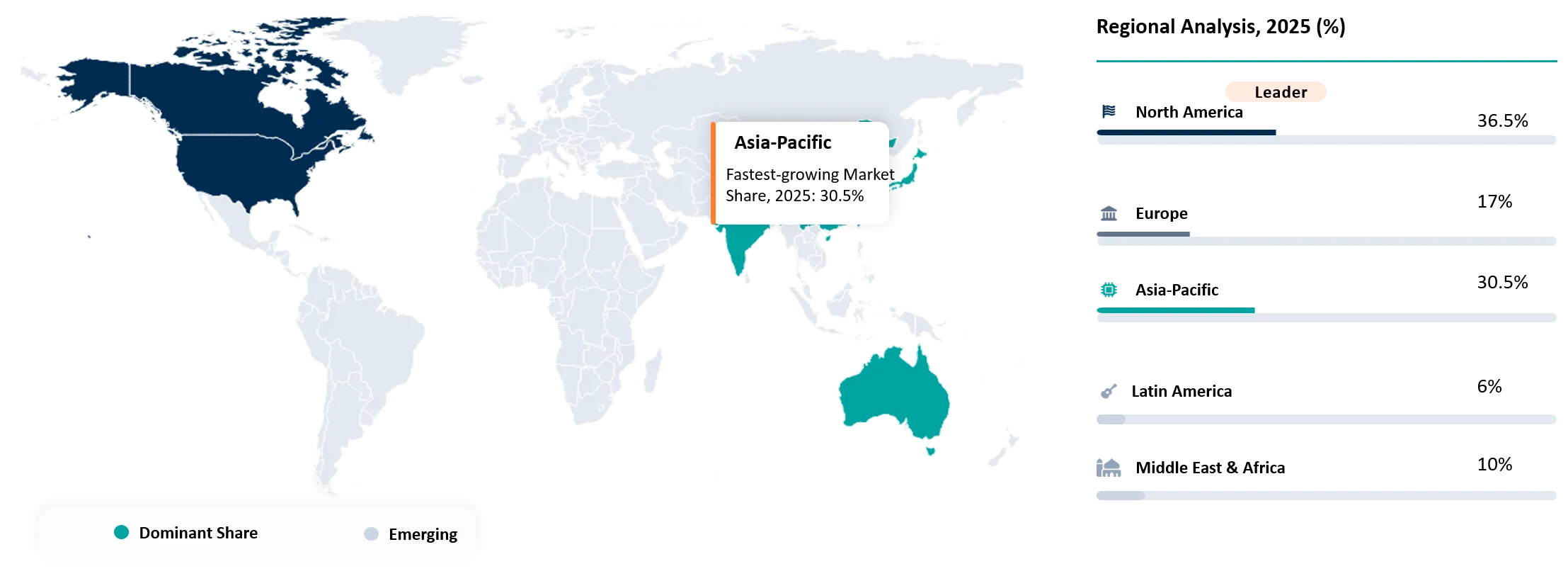
- North America held the largest regional market share at 36.5% in 2025, followed by Asia-Pacific at 30.5%.
- By portability, the stationary segment dominated the market by capturing approximately 75% of total global revenues in 2025.
- Energy security investments drive a 24% market growth impact across key gas transportation and processing networks. Conversely, geopolitical trade tariffs contributed to a 4% decline in global upstream oil and gas capital expenditures, down to USD 570 billion in 2025.
- The U.S. Department of Energy announced USD 65.5 million in funding for midstream natural gas and compressor infrastructure. This initiative builds on a separate USD 150 million program targeting unconventional oil and gas recovery technologies.
Reciprocating Compressor Market Industry Trends and Strategic Insight
- Brownfield modernization is becoming strategically important. As gas infrastructure expands while existing compressor fleets age, operators have an opportunity to replace or upgrade legacy units with higher-efficiency drivers, improved valve technology, advanced controls, condition monitoring, and automated shutdown systems, shifting demand from basic equipment replacement toward performance-oriented compressor packages.
- Compressor operators are increasingly using vibration, temperature, pressure, lubrication, and valve-performance data to identify degradation before equipment failure, enabling predictive maintenance and reducing unplanned shutdowns in continuous-process facilities.
- Rising energy consumption associated with gas compression is encouraging operators to evaluate compressor efficiency, driver selection, load management, variable-speed operation, and interstage optimization rather than selecting equipment solely on rated discharge pressure and flow.
- Operators are increasingly evaluating compressor packages based on methane emissions, leakage control, lubrication practices, energy consumption, and overall environmental performance, creating opportunities for suppliers offering low-emission packing, improved sealing systems, efficient drivers, and advanced monitoring.
- Companies that combine compressor manufacturing with engineering, controls, monitoring, aftermarket service, and hydrogen/LNG application expertise can capture a larger share of project value than suppliers competing primarily on compressor hardware.
Reciprocating Compressor Market Scope
| Metrics | Details | |
| 2025 Market Size | USD 4.88 Billion | |
| 2035 Projected Market Size | USD 7.71 Billion | |
| CAGR (2026-2035) | 4.68% | |
| Largest Market | North America | |
| Fastest Growing Market | Asia-Pacific | |
| By Product Type | Single-Acting Reciprocating Compressors, Double-Acting Reciprocating Compressors, Diaphragm Reciprocating Compressors | |
| By Lubrication | Oil-Lubricated, Oil-Free | |
| By Stage | Single-Stage, Multi-Stage | |
| By Cooling Type | Air-Cooled, Water-Cooled | |
| By Portability | Stationary, Portable | |
| By End-User | Oil & Gas, Chemical & Petrochemical, Power Generation, Manufacturing, Food & Beverage, Pharmaceutical, Mining & Metals, Automotive, Healthcare, Pulp & Paper, Water & Wastewater, Others | |
| By Region | North America | U.S., Canada, Mexico |
| Europe | Germany, UK, France, Spain, Italy, Poland | |
| Asia-Pacific | China, India, Japan, Australia, South Korea, Indonesia, Malaysia | |
| Latin America | Brazil, Argentina | |
| Middle East and Africa | UAE, Saudi Arabia, South Africa, Israel, Türkiye | |
| Report Insights Covered | Competitive Landscape Analysis, Company Profile Analysis, Market Size, Share, Growth | |
Reciprocating Compressor Market Disruption Analysis
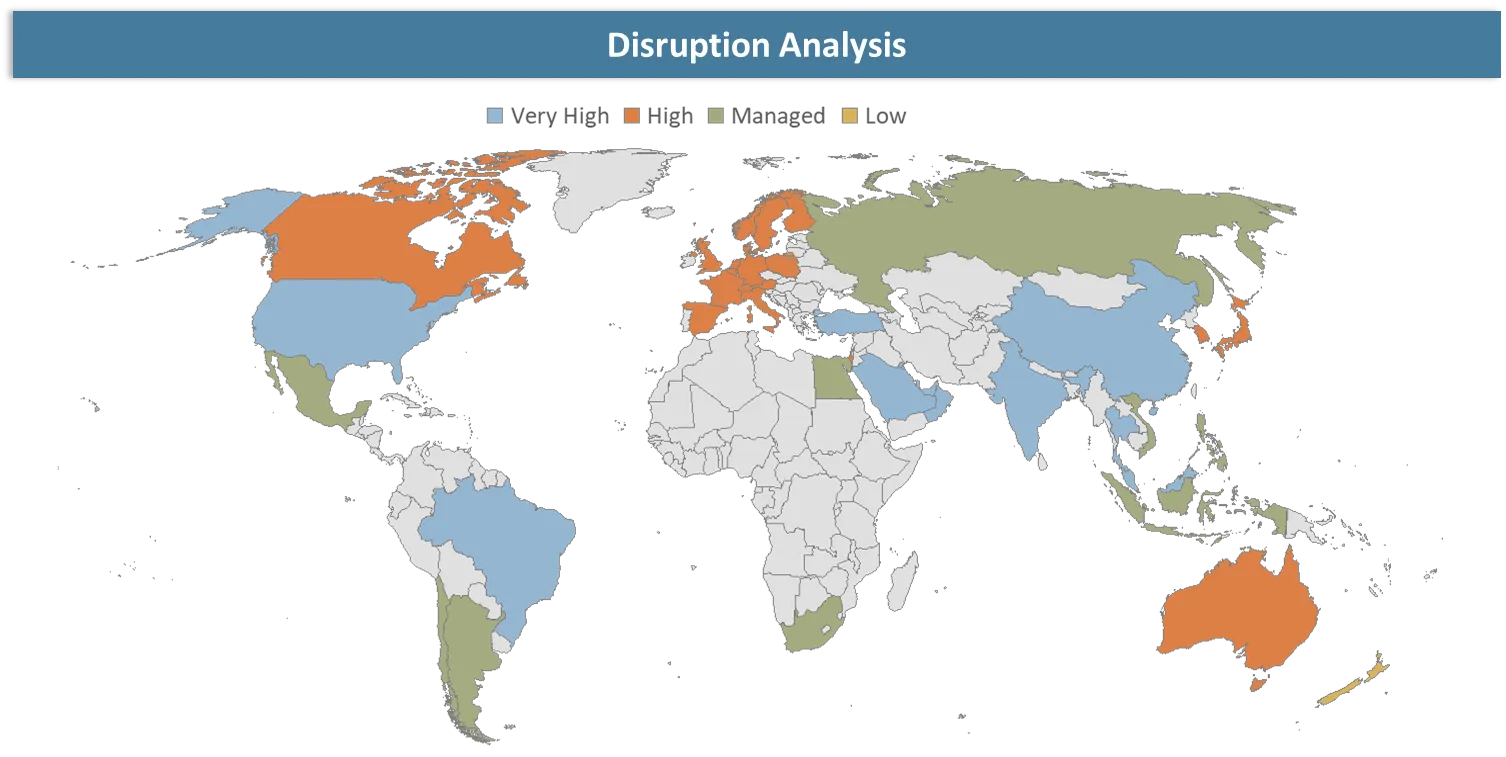
Hydrogen Compression Requirements Reshaping Reciprocating Compressor Design
The Disruption in the Reciprocating Compressor Market is increasingly associated with the expansion of hydrogen applications, which include hydrogen storage, transportation, pipeline transportation, blending, and industrial process applications. According to Ariel Corporation, reciprocating compressors are being utilized in hydrogen service in refinery, petrochemical, and industrial gas applications today, but the newer hydrogen applications are requiring new types of compression needs, especially concerning gas purity and non-lubricated service. In June 2025, Ariel noted that hydrogen applications have created the need for non-lubricated compressor designs based on factors such as hydrogen sources and operating conditions.
The shift is also evident in the development of dedicated hydrogen reciprocating compressors. Ariel’s hydrogen compressor line extends from 40 HP to 6,700 HP (30–5,000 kW) with maximum discharge pressures of up to 6,000 psig (414 barg), showing wide-ranging demands in terms of both power and pressure coming from the field of hydrogen applications. Ariel further emphasizes its KBH hydrogen fueling compressor, although, as per the specification provided by Ariel, the system can compress hydrogen up to pressures of 7,250 psig (500 barg) and at a rate of more than 250 kg/hour for hydrogen mobility, trailer filling, storage, and transportation applications. Consequently, compressor suppliers have begun to design hydrogen-compatible reciprocating technology, lubrication-free products, special materials, high-pressure multistage technology, and even sealing technologies, thus moving away from traditional natural gas compressors into hydrogen-compatible equipment.
Reciprocating Compressor Market BCG Matrix: Company Evaluation
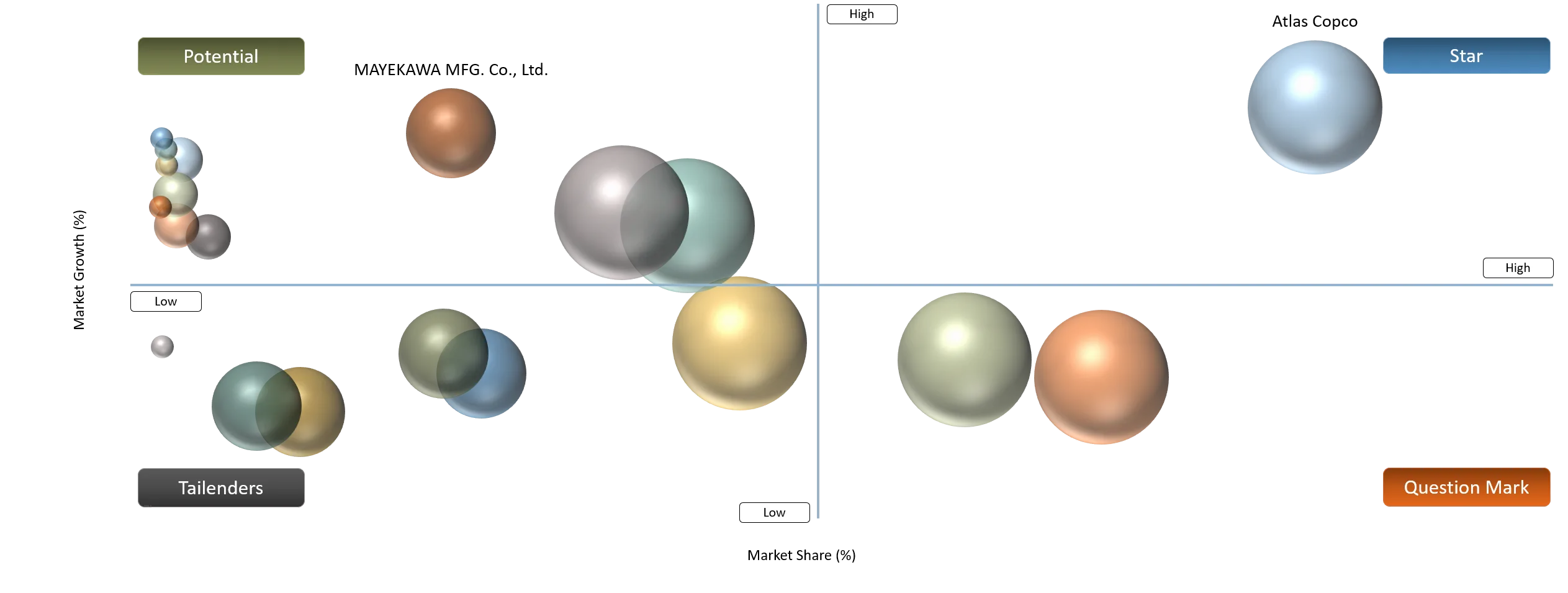
Stars include Atlas Copco, Ingersoll Rand, Burckhardt Compression, and Ariel Corporation because they have significant market positioning in reciprocating compression technology and exposure to oil and gas, industrial gases, energy, LNG, hydrogen, and other applications requiring compressors. They already possess a portfolio of compressors, a large installed base, and strong aftermarket service, and continue working on the development of higher-efficiency compressors that can be digitally monitored and application-specific. Siemens Energy and Baker Hughes fall under the star segment as well, owing to their position in the energy infrastructure and gas compression projects, although they have a compressor portfolio that is not limited to reciprocating compressors. Question Marks include Kobe Steel (KOBELCO), Neuman & Esser, Howden, Hitachi Industrial Equipment Systems, and KAESER KOMPRESSOREN. They already can manufacture industrial compressors, and they are currently growing their presence in niche areas like oil and gas, chemical, hydrogen, and industrial gases.
Potential includes MAYEKAWA MFG. Co., Ltd., SIAD Macchine Impianti, and J.P. Sauer & Sohn, which benefit from established positions in the refrigeration, industrial gases, marine, hydrogen, and high-pressure compressors segments but lack the wide market reach of top global manufacturers of compressors. Tailenders include ELGi Equipments since its range of compressors seems more relevant to industrial air compression applications, whereas its direct involvement is in the high-pressure reciprocating compressors segment.
Reciprocating Compressor Market Dynamics
Driver Impact Analysis
| Driver | Market Growth Impact (%) | Demand Concentration | Impacted Use Case | Strategic Impact |
Methane Emission Regulations Accelerating Compressor Upgrades and Retrofits
| 22% | North America, Europe; particularly existing oil & gas and pipeline compression fleets | Compressor retrofits, low-emission packing, gas gathering, pipeline compression, compressor stations | Accelerates replacement of aging equipment, low-emission sealing upgrades, methane monitoring, and aftermarket services. |
Energy Security Accelerating Gas Transport, Storage and Processing Investments
| 24% | North America, Europe, Middle East & Asia-Pacific | Gas transmission, gas storage, gas processing, LNG infrastructure | Supports new compression capacity and expansion of existing pipeline and processing networks, strengthening demand for high-pressure reciprocating systems. |
Increasing demand for energy-efficient compression is encouraging operators to replace conventional equipment with compressors offering improved driver efficiency, variable-speed operation, and optimized compression performance. | 16% | North America, Europe, Asia-Pacific; particularly mature gas-processing, pipeline, petrochemical, and industrial facilities with aging compressor fleets | Gas transmission, gas processing, LNG, petrochemical processing, refinery operations, and industrial gas compression | Accelerates replacement and retrofit of inefficient compressor fleets while increasing demand for variable-speed drives, high-efficiency drivers, advanced controls, digital monitoring, and performance-optimization services. |
Expansion of hydrogen production and infrastructure is creating demand for specialized high-pressure reciprocating compressors suitable for hydrogen compression, storage, and transportation. | 12% | Europe, North America, China, Japan, South Korea and Middle East
| Hydrogen compression, storage, refueling, pipeline transportation and industrial hydrogen | Creates a specialized growth segment for hydrogen-compatible reciprocating compressors, advanced sealing, oil-free configurations and multi-stage systems. |
Growth of petrochemical and chemical processing capacity is increasing requirements for reliable high-pressure gas compression in feedstock processing and plant operations. | 16% | Asia-Pacific, Middle East, North America
| Petrochemical processing, refinery gas compression, chemical processing and feedstock compression | Expands demand for customized high-pressure compressor packages and creates opportunities for OEMs with application-specific engineering and aftermarket capabilities. |
Methane Emission Regulations Accelerating Compressor Upgrades and Retrofits
The tightening focus on methane emissions from the oil and natural gas infrastructure is increasing the need to update and retrofit reciprocating compressors, compressor stations, and related sealing mechanisms. In 2025, the EPA in the United States continued to implement the methane regulations for new, reconstructed, modified, and existing oil and natural gas sources where the regulations have provisions for compressor and emission monitoring. According to the U.S. Environmental Protection Agency (EPA), its methane regulations apply to hundreds of thousands of oils and natural gas sources, increasing the importance of emissions-control technologies across compression infrastructure.
Methane emissions standards have increased the need for monitoring and upgrading compressor systems. In March 2026, according to Onterris, NSPS Subpart OOOOb states that all affected compressors constructed, reconstructed, or modified after December 6, 2022, must comply with methane and VOC emissions monitoring, measurement, and reporting requirements. For reciprocating compressors, operators should measure emissions, with a maximum allowed vent flow of 2 standard cubic feet per minute (SCFM) per cylinder. Operators must take three one-minute measurements per component, with measurements being no more than 10% apart from one another, and measurements should be done every 8,760 hours of operation. Where emissions exceed the respective threshold, repairs or replacement should be done within 90 days, creating demand for compressor maintenance, vent-capture systems, emissions monitoring, and retrofit or replacement solutions.
Restraint Impact Analysis
| Restraint | Drag on Market Growth (%) | Primary Impact Area | Impacted Use Case | Strategic Impact |
Geopolitical Uncertainty, Tariffs and Currency Volatility Delaying Investment Decisions
| 12% | Capital expenditure, equipment procurement, project financing and supply chains | LNG projects, gas pipelines, gas processing, refining and petrochemical projects | Delays new compressor orders, increases equipment and component costs, and encourages localized sourcing and phased investments. |
High energy consumption during continuous compression can increase operating expenditure and reduce the attractiveness of reciprocating compressors | 9% | Energy efficiency and operating costs | Gas transmission, gas processing, LNG, refining and industrial gas compression | Encourages operators to adopt high-efficiency drivers, variable-speed systems, optimized loading and energy-monitoring technologies. |
Frequent maintenance requirements for pistons, valves, piston rings, packing, bearings, and lubrication systems can increase downtime and lifecycle costs. | 8% | Maintenance expenditure, equipment availability and operational reliability | Continuous gas compression, pipeline compression, petrochemical processing and refinery operations | Increases demand for predictive maintenance, remote monitoring, improved component durability and comprehensive aftermarket service contracts. |
Mechanical vibration and pulsation can require additional dampening, foundation reinforcement, piping design, and maintenance, increasing system complexity and installation costs. | 7% | Installation complexity, infrastructure cost and equipment reliability | High-pressure gas transmission, gas processing, LNG and petrochemical compression | Favors advanced pulsation-control systems, vibration monitoring, optimized piping design and application-specific compressor engineering. |
Geopolitical Uncertainty, Tariffs and Currency Volatility Delaying Investment Decisions
Geopolitical tension, changes in trade policies, and the associated issues of higher costs due to tariff issues have made it difficult for investment in capital-intensive reciprocating compressor projects, especially within the oil and gas, LNG, refinery, and petrochemical industries. The International Energy Agency (IEA), in 2025, said that global investments in upstream oil and gas would fall by about 4% to almost USD 570 billion, as tariffs were causing increased costs of engineering projects. Some investors, the IEA further said, had adopted the policy of “wait and see” regarding project approvals.
Escalating global trade tensions and tariffs worldwide have created more uncertainties within international supply chains and procurement processes. In July 2026, according to Dunyo IA, the U.S. imposed new tariffs on imports at rates of 10% and 12.5%, affecting 60 countries and regions, and accounting for about 99.4% of US imports. The 10% tariff covers countries like Canada, the UK, India, Mexico, Malaysia, Pakistan, Indonesia, and Bangladesh, while the 12.5% tariff is placed on China, Russia, Vietnam, and another 35 countries. However, products like oil and gas, fertilizer, critical minerals, airplanes and airplane parts, among others, are not covered by the tariffs and hence will not have any effect on oil-and-gas equipment.
Reciprocating Compressor Market Segment Analysis
The global Reciprocating Compressor market is segmented based on product type, lubrication, stage, cooling type, portability, end-user, and region.
Stationary Compressors Dominating Reciprocating Compressor Demand Across Fixed Gas and Industrial Infrastructure
The Stationary segment dominates the Reciprocating Compressor Market by Portability, capturing approximately 75% of total revenues of the global market in 2025. The category enjoys a high degree of penetration in various installations of fixed facilities for natural gas processing, pipeline compression, liquefied natural gas infrastructure, refineries, petrochemical units, and industries. According to the "Gas 2025" report by the International Energy Agency (IEA), in 2025 more than 90 bcm/yr of new LNG liquefaction capacity was sanctioned, including more than 80 bcm/yr in the US, which set a record in the US LNG industry. This expansion of fixed LNG infrastructure supports continued requirements for stationary compression systems.
In addition, the IEA expects approximately 300 bcm/yr of new LNG export capacity to be added worldwide by 2030, mainly due to projects in the USA and Qatar, while according to the U.S. Energy Information Administration (EIA) Short-Term Energy Outlook published on August 11, 2026, US LNG exports are forecasted to average 16.5 Bcf/d in Q3 2026. In 2025, it is expected that the total volume of US natural gas pipeline exports will be 9.5 Bcf/d, and it is forecasted to grow to 9.6 Bcf/d in 2026 and to 10.0 Bcf/d in 2027. These developments reinforce demand for permanently installed reciprocating compressor systems used for gas transmission, processing, storage, and LNG-related infrastructure.
Reciprocating Compressor Market Geographical Penetration
Strong Natural Gas and LNG Infrastructure Investment Reinforcing North America's Dominance
The North American region dominates the Reciprocating Compressor Market, with a contribution of about 36.5% of market share in 2025, the worldwide Reciprocating Compressor Market on account of matured natural gas infrastructure, pipeline network, substantial installation of compressors, and increased investment in LNG plants, gas processing plants, refineries, and petrochemical plants in the region. The well-established oil and gas industry value chain in the region ensures continual demand for reciprocating compressors in the processes of gas gathering, transmission, processing, storage, boosting, and industrial gas production. Also, the trend of replacing old compression equipment with new and efficient ones is adding demand for reciprocating compressor packages, advanced control, low-emission sealing, and predictive-maintenance technologies.
Strategic acquisitions have enhanced after-sales support in local markets and have expanded the service network for U.S. reciprocating compressors. In September 2025, Burckhardt Compression AG, a Switzerland-based manufacturing company, successfully acquired ACT (Advanced Compressor Technology), a U.S.-based reciprocating-compressor service and parts-manufacturing company. ACT provides service and spare parts for reciprocating compressor equipment used by downstream companies such as fertilizers, industrial gases, petrochemical, and refining industries. The acquisition brought about 30 employees to the Services Division of Burckhardt Compression AG. With the addition of this division, Burckhardt Compression increased its local aftermarket support in the area of spare parts production, compressor repairs, maintenance, and services in the USA. This purchase helps to expand the Burckhardt Compression Reciprocating Compressor Market in the USA. As mentioned by the company, it will help decrease the effect of Swiss export tariffs.
U.S. Reciprocating Compressor Market Trends
U.S. holds a dominant position in the North American reciprocating compressor market due to the country’s vast natural gas reserves, pipeline network, liquefied natural gas (LNG) plants, and oil and gas processing facilities. The presence of substantial compression equipment installation in the US will continue to fuel demand for reciprocating compressors in various applications such as gas gathering, transmission, processing, storage, LNG, refining, and petrochemicals. In 2025, dry natural gas production in the US broke an all-time high of 39.0 trillion cubic feet (Tcf), up more than 4% from 2024, according to the U.S. Energy Information Administration (EIA).
International strategic alliances are contributing to the widening packaging capabilities and market reach of reciprocating compressor producers around the world. In August 2026, Knox Western, a U.S.-based manufacturer of reciprocating gas compressors, finalized a partnership with BGR Group, an India-based engineering and industrial solutions company, to act as a packager of Knox Western’s API 618 gas compressor packages for use in oil & gas, hydrogen, and oxygen industries. Knox Western’s line of reciprocating compressors covers a horsepower range of 20 to 1,800 hp (15 to 1,342 kW). This agreement adds another international packaging site to Knox Western’s network and contributes to its overall growth strategy as a Didwania Group company.
Canada Reciprocating Compressor Market Outlook
Canada is emerging as one of the major players in the North America Reciprocating Compressors Market, due to increased natural gas production, the development of LNG facilities, and the availability of gas in international markets. According to the CER, Canada’s natural gas production stood at about 19 Bcf/d in 2025, breaking the annual record. The increase has been facilitated by exploration of the Montney Formation located in northeastern British Columbia and northwestern Alberta, creating additional requirements for compression across gathering, processing, and transmission infrastructure.
The development of aftermarket services infrastructure on a local level has improved the accessibility of service for Canada’s reciprocating compressors industry. In October 2025, Burckhardt Compression, a Switzerland-based manufacturer and service provider specializing in reciprocating compressor systems, announced its latest addition of a regional service center at Sarnia, Ontario, Canada, as part of efforts to enhance their reach in the Canadian reciprocating compressor industry. The company’s 1,200 m² (about 12,916 sq. ft.) facility offers services related to sales, testing, maintenance, training, and repairs for reciprocating compressor systems, in addition to the company's other Canadian facilities in Drumheller and Edmonton. The center is designed to improve service coverage across Eastern Canada by reducing shipping time and costs, accelerating quotations and project turnaround, and providing localized maintenance and testing capabilities.
Expanding Gas Infrastructure and LNG Capacity Strengthening Asia-Pacific Reciprocating Compressor Demand
The Asia-Pacific region is a major growth center in the Reciprocating Compressor Market, accounting for approximately 30.5% of the global market in 2025, supported by expanding natural-gas infrastructure, LNG import and regasification capacity, petrochemical investments, and increasing industrial-gas consumption. The region's rapidly developing gas networks across China, India, Southeast Asia, Australia, and other emerging economies are increasing requirements for high-pressure compression equipment across gas processing, transmission, storage, LNG, refining, and chemical applications. The IEA's Gas 2025 report forecast global natural gas demand growth to slow to below 1% in 2025, compared with 2.8% growth in 2024.
Through strategic acquisitions, compressor companies are increasing their capabilities within regions and gaining market share in reciprocating compressor markets that have high growth potential. In July 2025, Atlas Copco Group, a Sweden-based equipment and compressors technology company, has acquired Arizaga Bastarrica y Compañia S.A. (ABC Compressors), a Spain-based reciprocaing compressor manufacturer, was founded in 1943 and produces reciprocating compressors for gas and air compression, and operates a wholly owned subsidiary of Abix Compressors (Suzhou) Co., Ltd., a in China, in the year 2009 for conducting research and development, manufacturing, selling, and after-sales services of reciprocating piston compressors and components. With the acquisition of ABC Compressors, Atlas Copco has integrated this company into the Air and Gas Applications Division of its Compressor Technique business segment. This has increased the portfolio of Atlas Copco in reciprocating compressors and increased its manufacturing and servicing capacity in China.
Japan Reciprocating Compressor Market Trends
Japan is a leading country within the Asia-Pacific Reciprocating Compressor Market, supported by its large LNG-import infrastructure, established gas-processing network, power-generation base, and extensive industrial manufacturing sector. Japan imported approximately 9 Bcf/d of natural gas in 2025, with LNG supplying essentially all of its natural-gas requirements, according to the U.S. Energy Information Administration (EIA). Japan also remained the second-largest LNG importer globally in 2025, creating sustained requirements for compression equipment across LNG receiving terminals, gas transmission, storage, and industrial applications.
Advancements in high-pressure CO₂ compression are creating new opportunities for compressor technology in Japan’s emerging CCUS infrastructure. In February 2026, IHI Corporation, a Japan-based industrial engineering and equipment manufacturer, and its wholly owned subsidiary IHI Rotating Machinery Engineering Co., Ltd. (IRM), successfully demonstrated a process gas compressor using CO₂ as the working fluid, achieving a maximum discharge pressure of 20 MPaG. IRM, which has JPY 1.0335 billion in capital, develops, manufactures, and sells compressors, separators, marine turbochargers, and gear devices, as well as providing plant engineering, maintenance, and after-sales services. The demonstration used a geared, multi-shaft, multi-stage turbo-type compressor and supports commercial CCUS by enabling supercritical CO₂ injection into deep geological formations.
Reciprocating Compressor Market Competitive Landscape
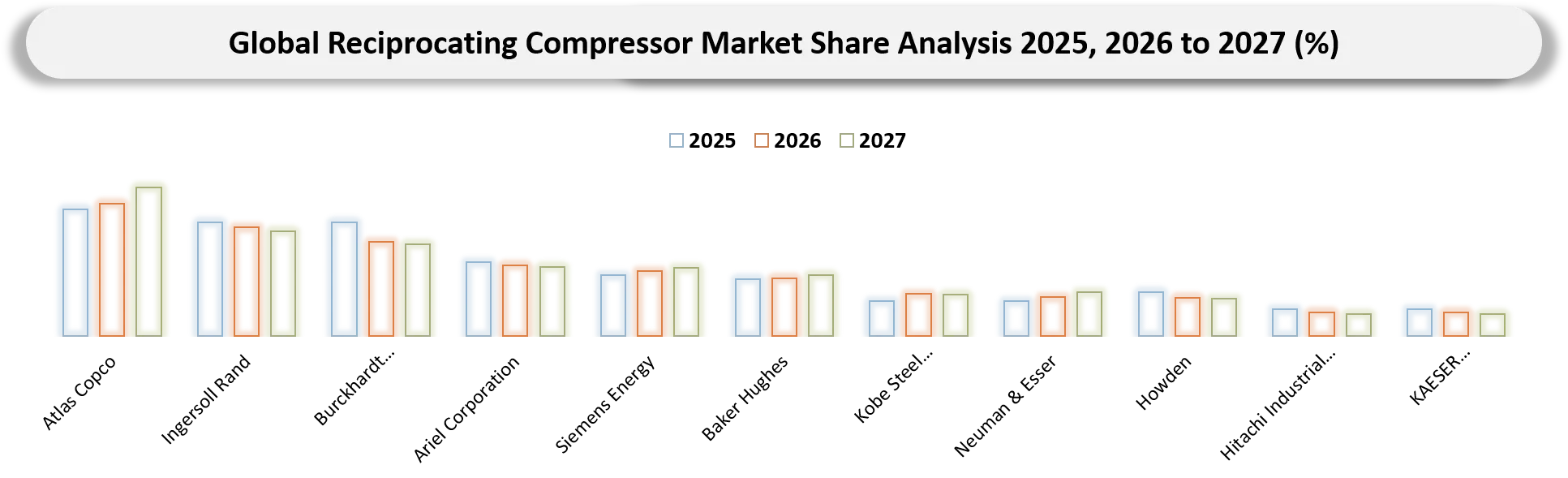
- The market is characterized by three major participant groups: diversified compressor manufacturers, specialized reciprocating-compressor OEMs, and integrated energy-equipment companies. Atlas Copco, Ingersoll Rand, KAESER KOMPRESSOREN, and Hitachi Industrial Equipment Systems compete through broad compressor portfolios, global distribution, and aftermarket services, while Burckhardt Compression, Ariel Corporation, Neuman & Esser, J.P. Sauer & Sohn, SIAD Macchine Impianti, and MAYEKAWA maintain stronger specialization in reciprocating and high-pressure gas-compression applications. Siemens Energy, Baker Hughes, Kobe Steel (KOBELCO), and Howden compete through large-scale energy, gas-processing, LNG, hydrogen, and industrial compression projects. Atlas Copco identifies Ingersoll Rand, KAESER, and Hitachi as principal competitors in industrial compressors and identifies Siemens Energy as a major competitor in gas and process compressors.
- Key players include Atlas Copco, Ingersoll Rand, Burckhardt Compression, Ariel Corporation, Siemens Energy, Baker Hughes, Kobe Steel (KOBELCO), Neuman & Esser, Howden, Hitachi Industrial Equipment Systems, KAESER KOMPRESSOREN, MAYEKAWA MFG. Co., Ltd., SIAD Macchine Impianti, J.P. Sauer & Sohn, and ELGi Equipments.
Key Developments
- July 2025: Virtuoso Optoelectronics Ltd., an India-based consumer electronics and OEM/ODM manufacturing company, through its wholly owned subsidiary Virtuoso Compressors Private Limited, commenced manufacturing reciprocating compressors at its newly established Nashik facility.
- March 2026: LG Electronics, a South Korea-based consumer electronics and home-appliance manufacturer, announced the debut of its locally manufactured rotary and reciprocating compressor solutions at ACREX 2026 in India.
- January 2025: Frick India Limited, an India-based industrial refrigeration equipment manufacturer, entered into a joint venture with Mayekawa MFG. Co. Ltd., a Japan-based industrial refrigeration and compressor manufacturer, to develop and provide energy-efficient compressor packages for applications including food and cold-chain, process gas, biogas, and heat pumps in India.
- October 2025: Svanehøj, a Denmark-based marine and gas-solutions company and subsidiary of ITT Inc., completed the acquisition of Köhler & Hörter GmbH (KOHO Kompressorsysteme), a Germany-based family-owned compressor manufacturer.
- November 2025: Dora Partners & Co., a U.S.-based compressor industry consulting and market-analysis company, established a partnership with Turbomachinery International (TMI), a U.S.-based turbomachinery industry information and publishing platform, to introduce the Annual Centrifugal & Reciprocating Compressor Market Analysis & Forecast, 2025 Edition.
Key Procurement Priorities and Buyer Evaluation Criteria
- Organizations investing in the Reciprocating Compressor Market increasingly prioritize suppliers capable of delivering high-pressure, high-reliability compression systems with stable performance across demanding oil & gas, LNG, petrochemical, hydrogen, and industrial-gas applications.
- The procurement decision-making process is increasingly influenced by energy-efficiency requirements, methane-emission regulations, compressor fleet modernization, hydrogen-readiness, and total lifecycle cost, rather than the initial equipment purchase price alone.
- Buyers evaluate compression capacity, discharge pressure, efficiency, availability, vibration and pulsation control, sealing performance, maintenance intervals, and component durability when selecting reciprocating-compressor suppliers for continuous-duty applications.
- Supplier track record, installed compressor base, compliance with applicable safety and emissions standards, delivery lead time, local service infrastructure, warranty terms, and long-term maintenance support are increasingly important evaluation criteria for large-scale compressor procurement.
Why Choose DataM?
- Technological Innovations: Explores advancements in reciprocating-compressor technologies including high-efficiency compression systems, variable-speed drives, advanced valve and sealing designs, low-emission packing, oil-free configurations, digital controls, and hydrogen-compatible compression, supporting higher efficiency, reliability, and pressure performance across demanding applications.
- Product Performance & Market Positioning: Evaluates compressor suppliers based on compression capacity, discharge pressure, energy efficiency, operating reliability, vibration and pulsation control, maintenance requirements, lifecycle cost, and application suitability, highlighting how leading OEMs differentiate across oil & gas, LNG, petrochemical, hydrogen, industrial-gas, and manufacturing applications.
- Real-World Evidence: Highlights deployment of reciprocating compressors across natural-gas pipelines, gas processing facilities, LNG infrastructure, refineries, petrochemical plants, hydrogen facilities, industrial-gas systems, and refrigeration applications, demonstrating their role in high-pressure and continuous-duty compression operations.
- Market Updates & Industry Changes: Tracks compressor fleet modernization, LNG and gas-infrastructure investments, hydrogen projects, methane-emission regulations, energy-efficiency initiatives, product launches, acquisitions, manufacturing expansions, and strategic partnerships across North America, Europe, Asia-Pacific, and other major markets.
- Competitive Strategies: Analyzes how leading companies expand through compressor portfolio development, high-pressure and hydrogen-ready technologies, acquisitions, localized manufacturing, aftermarket service expansion, digital monitoring, and strategic partnerships to strengthen their position across energy and industrial compression markets.
- Pricing & Market Access: Assesses pricing differences based on compressor capacity, pressure rating, number of compression stages, lubrication configuration, cooling system, materials, customization, auxiliary equipment, and automation requirements, while examining access through OEMs, distributors, engineering contractors, and long-term service networks.
- Market Entry & Expansion: Identifies opportunities arising from LNG infrastructure expansion, natural-gas transportation and processing, hydrogen compression, petrochemical capacity additions, industrial-gas demand, compressor fleet replacement, and methane-emission reduction requirements, while outlining strategies such as localized production, application-specific engineering, aftermarket support, and technology partnerships.
Target Audience
- Reciprocating Compressor Manufacturers & OEMs
- Oil & Gas Companies
- LNG Developers & Operators
- Petrochemical & Chemical Companies
- Hydrogen Producers & Infrastructure Developers
- Industrial Gas Producers
- EPC Contractors & Engineering Firms


























































