


Rare Earth Magnets Market Size and Overview
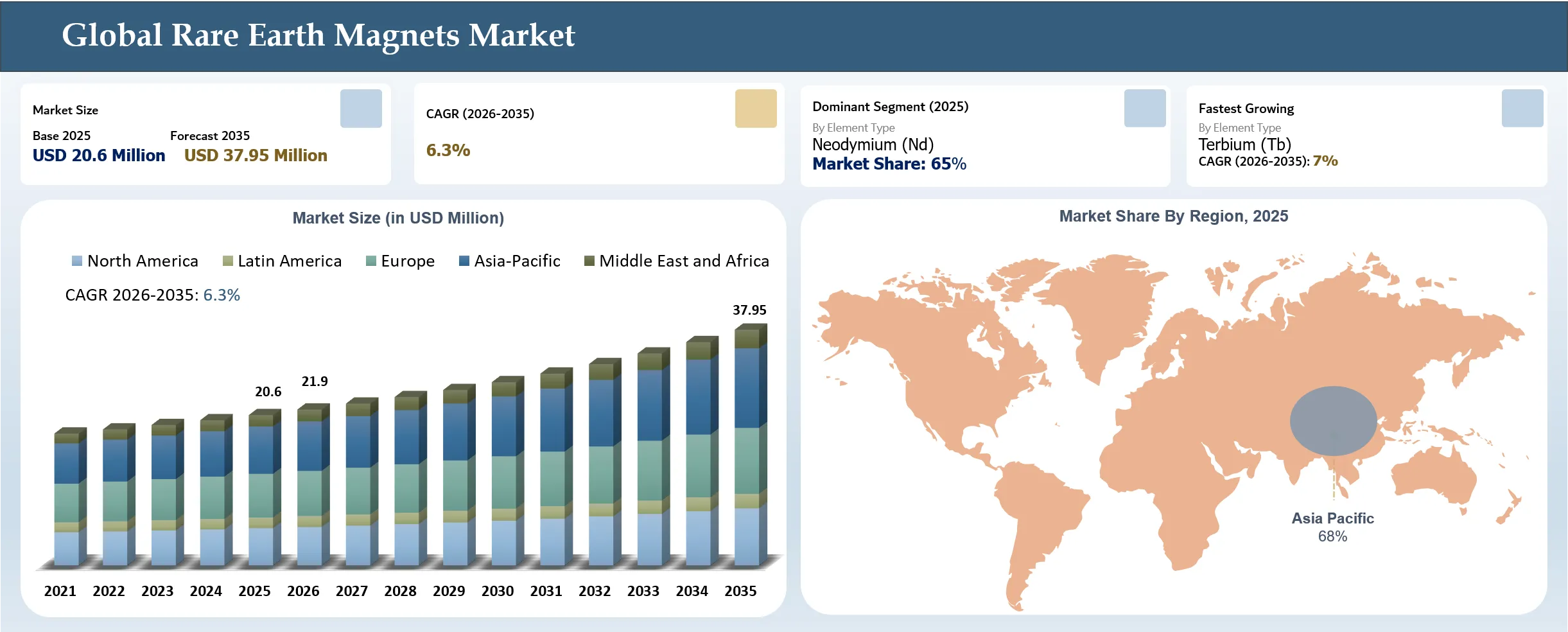
The global rare earth magnets market reached USD 20.6 million in 2025 and is expected to reach USD 37.95 million by 2035, growing with a CAGR of 6.3% during the forecast period 2026-2035. Growing demand for high-performance magnets in electric vehicles, renewable energy systems, industrial motors, and advanced electronics is shaping the global rare earth magnets market. Manufacturers are prioritizing local production capacity, reliable supply chains, and application-specific magnet technologies to meet demand from automotive and industrial customers.
In September 2026, Neo Performance Materials advanced its European magnet facility in Estonia to commercial production. They shipped its first commercial volumes of sintered rare earth magnets to a Tier 1 electric vehicle traction motor customer. This milestone highlights the expansion of European magnet manufacturing and the industry's focus on securing regional supplies for electric vehicle production.
White-Space Opportunities for Domestic Rare Earth Magnet Manufacturing and Supply-Chain Localization
In September 2026, Hyderabad-based Midwest Energy announced a ₹250 crore investment in a sintered NdFeB magnet plant, with initial annual capacity of 500 tonnes and planned expansion to 5,000 tonnes by December 2027. The facility targets electric vehicle motors, wind turbines, smartphones, defence applications and MRI equipment, creating opportunities for magnet manufacturers, component suppliers and downstream equipment producers to establish domestic supply relationships. Source: The Economic Times.
In August 2026, India's Ministry of Heavy Industries received 20 bids under its ₹7,280 crore rare earth permanent magnet manufacturing scheme, targeting 6,000 tonnes of integrated annual capacity. The programme offers capital subsidies and sales-linked incentives for domestic sintered NdFeB production, creating opportunities for manufacturers to establish facilities, develop local sourcing networks and supply magnets to automotive, renewable energy, electronics and industrial equipment companies.
Rare Earth Magnets Market Key Takeaways
- Asia-Pacific dominated the rare earth magnets market in 2025, accounting for an estimated 68% share, and is projected to remain the fastest-growing region, with an estimated 6.8% CAGR from 2026 to 2035.
- Sintered rare earth magnets dominated by manufacturing process in 2025, accounting for an estimated 87% share, and are projected to grow at an estimated 6.5% CAGR from 2026 to 2035.
- Neodymium (Nd) dominated the market by element type in 2025 with an estimated 65% share, while terbium (Tb) is projected to grow the fastest at an estimated 7.0% CAGR through 2035.
Rare Earth Magnets Market Industry Trends and Strategic Insight
- By building a domestic integrated ecosystem, the initiative is intended to enhance self-reliance in a critical input for electric vehicles, renewable energy systems, electronics, aerospace and defence, and to position India as a key player in the global REPM market. It also supports broader national objectives, including Atmanirbhar Bharat, resilient supply chains for strategic sectors, and the country’s long-term Net Zero 2070 vision.
- Despite recent efforts to expand supply capacity, experts expect a global shortage of neodymium magnets to emerge around 2030. In the US, which accounts for approximately 20% of global demand, initiatives are underway to establish a domestic supply chain and reduce import dependency. However, the risk of continued shortages remains high.
- The Government has approved the ‘Scheme to Promote Manufacturing of Sintered Rare Earth Permanent Magnet’ with a financial outlay of ₹7,280 crore. The scheme aims to establish 6,000 metric tonnes per annum (MTPA) of integrated REPM manufacturing capacity in India, covering the full chain from rare-earth oxides to finished magnets.
Rare Earth Magnets Market Scope
| Metrics | Details | |
| 2025 Market Size | USD 20.6 Billion | |
| 2035 Projected Market Size | USD 37.95 Billion | |
| CAGR (2026-2035) | 6.3% | |
| Largest Market | Asia-Pacific | |
| Fastest Growing Market | Europe | |
| By Element Type | Neodymium (Nd), Samarium (Sm), Dysprosium (Dy), Praseodymium, Terbium | |
| By Manufacturing Process | Sintered Rare Earth Magnets, Bonded Rare Earth Magnets, Other Manufacturing Processes | |
| By Application | Automotive, Electronics and Consumer Appliances, Power Generators, Renewable Energy, Industrial, Defence and Aerospace, Healthcare and Medical Devices, Information and Technology, Others | |
| By Region | North America | U.S., Canada, Mexico |
| Europe | Germany, United Kingdom, France, Italy, Spain, Netherlands, Switzerland, Sweden, Norway, Denmark, Belgium, Poland, Austria, Ireland, Portugal, Greece, Finland, Rest of Europe | |
| Asia-Pacific | China, Japan, India, South Korea, Australia, New Zealand, Singapore, Malaysia, Thailand, Indonesia, Vietnam, Philippines, Taiwan, Rest of Asia Pacific | |
| Latin America | Brazil, Argentina, Chile, Colombia, Peru, Rest of Latin America | |
| Middle East and Africa | Saudi Arabia, United Arab Emirates, Qatar, Kuwait, Oman, Bahrain, South Africa, Egypt, Nigeria, Morocco, Rest of Middle East & Africa | |
| Report Insights Covered | Competitive Landscape Analysis, Company Profile Analysis, Market Size, Share, Growth | |
Rare Earth Magnets Market Disruption Analysis
Shift Toward Supply-Chain Diversification and Alternative Magnet Designs
The rare earth magnets market is being disrupted by efforts to reduce dependence on concentrated rare earth supply chains and improve material efficiency. These changes are pushing manufacturers to reconsider magnet composition, sourcing strategies, and production locations as demand for high-performance magnets grows. Competition is shifting toward securing critical materials and delivering required magnetic performance with less exposure to supply disruptions.
The International Energy Agency reported in April 2026 that demand for magnet rare earths had doubled since 2015 and was projected to increase by more than 30% by 2030. This is intensifying the need for high-performance magnet designs that use rare earth materials efficiently, shifting competition toward magnetic strength, material optimization and application-specific engineering.
Rare Earth Magnets Market BCG Matrix: Company Evaluation
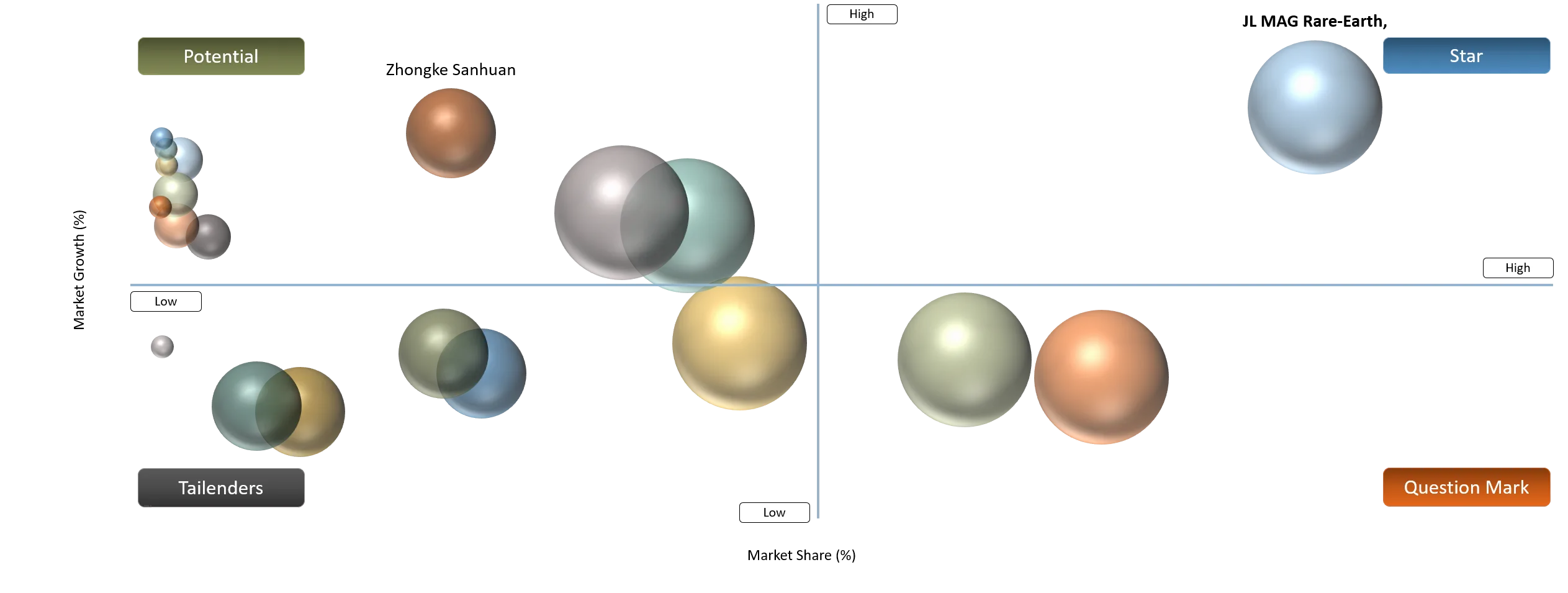
JL MAG Rare-Earth, Shin-Etsu Chemical, TDK Corporation, and Ningbo Yunsheng are positioned as Stars, supported by established rare earth magnet manufacturing capabilities, broad product portfolios, and strong exposure to high-performance magnets used in automotive, industrial, and electronic applications. Zhongke Sanhuan, Proterial, and VACUUMSCHMELZE are classified as Potential Companies, backed by established permanent magnet technologies and opportunities to expand across electric mobility, energy-efficient motors, industrial equipment, and other high-performance applications.
Earth-Panda and Arnold Magnetic Technologies are positioned as Question Marks, with specialized rare earth magnet capabilities and opportunities to strengthen their positions in advanced applications; their future positioning depends on expanding customer reach and capturing additional demand across high-growth end markets. Daido Steel is categorized as a Tailender relative to the other companies in this screen, reflecting its broader specialty steel and magnetic materials positioning rather than the same degree of direct focus on rare earth permanent magnet manufacturing. Its potential depends on expanding its role in high-performance magnet applications.
Rare Earth Magnets Market Dynamics
Driver Impact Analysis
| Driver | Market Growth Impact (%) | Demand Concentration | Impacted Use Case | Strategic Impact |
Electric vehicle production increases demand for compact, high-performance permanent magnets | 25% | Automotive manufacturers, EV motor producers, and electric drivetrain suppliers | Traction motors, drive units, power steering, and auxiliary motors | Increases demand for high-strength NdFeB magnets with compact designs, high magnetic performance, and thermal stability. |
Wind turbine installations raise demand for powerful direct-drive generator magnets | 22% | Wind turbine OEMs, generator manufacturers, and offshore wind developers | Direct-drive wind turbine generators and high-efficiency generator systems | Expands demand for high-performance permanent magnets that deliver strong magnetic output and reliable operation under demanding conditions. |
Industrial automation expands magnet requirements across robotics and precision motor systems | 20% | Industrial automation suppliers, robotics manufacturers, and precision motor producers | Robotic actuators, servo motors, factory automation, and precision motion-control systems | Drives demand for compact magnets offering high torque density, precise motion control, and consistent motor performance. |
Consumer electronics miniaturization increases demand for smaller, stronger magnetic components | 18% | Smartphone, computer, audio equipment, and electronic component manufacturers | Speakers, headphones, hard disk drives, haptic systems, and compact electronic motors | Encourages magnet designs that deliver stronger magnetic performance in smaller form factors, with tight dimensional tolerances. |
Energy-efficient motor standards accelerate adoption of high-performance permanent magnet technologies | 15% | Industrial motor manufacturers, HVAC equipment producers, and appliance manufacturers | High-efficiency motors, pumps, compressors, fans, and HVAC systems | Encourages adoption of permanent magnet motors to improve energy efficiency, reduce motor size, and lower operating electricity consumption. |
Electric Vehicle Production Increases Demand for Compact, High-Performance Permanent Magnets
Electric vehicle (EV) production is driving demand for compact, high-performance rare earth magnets, particularly neodymium-iron-boron (NdFeB) magnets used in traction motors to deliver high torque and power density. According to the International Energy Agency (IEA), global electric car sales exceeded 20 million units in 2025, growing 20% year-on-year and representing one in four new cars sold worldwide. The IEA expects sales to reach approximately 23 million vehicles in 2026, equivalent to nearly 30% of global car sales.
In September 2026, Neo Performance Materials announced that its Estonian permanent magnet facility had entered commercial production, supplying sintered rare earth magnets to a Tier 1 EV traction-motor customer, with further automotive magnet programmes planned. The expansion reflects automakers’ need for reliable supplies of high-performance magnets as EV production scales. The demand is strengthening opportunities for magnet manufacturers supplying compact, thermally stable magnets that enable efficient traction motors, while encouraging investment in automotive-qualified magnet production outside established supply hubs.
Restraint Impact Analysis
| Restraint | Drag on Market Growth (%) | Primary Impact Area | Impacted Use Case | Strategic Impact |
Rare earth price volatility creates uncertainty in magnet manufacturing costs | 25% | Raw material procurement, production costs, and profit margins | EV traction motors, wind turbine generators, industrial motors | Creates cost uncertainty and complicates pricing agreements, inventory planning, and long-term supply contracts. |
Chinese supply concentration exposes manufacturers to export restrictions and trade disruptions | 24% | Supply security, sourcing flexibility, and production continuity | Automotive magnets, electronics, wind power generators, industrial equipment | Increases dependence on alternative suppliers and regional processing capacity, potentially raising procurement costs and delivery lead times. |
High-temperature performance requirements increase dependence on costly heavy rare earth elements | 21% | Material costs, thermal stability, and magnet performance | EV traction motors, aerospace systems, high-temperature industrial motors | Raises production costs for magnets requiring dysprosium or terbium to maintain coercivity and resist demagnetization at elevated temperatures. |
Magnet production requires specialized equipment, technical expertise, and substantial investment | 17% | Capital expenditure, manufacturing capability, and market entry | Sintered NdFeB magnets, precision motor magnets, high-performance generator magnets | Creates high entry barriers and lengthens the time required for new manufacturers to establish consistent, high-volume production. |
High-Temperature Performance Requirements Increase Dependence on Costly Heavy Rare Earth Elements
High operating temperatures in electric vehicle traction motors, wind turbine generators, and industrial motors create challenges for rare earth magnets because heat reduces their resistance to demagnetization. Manufacturers add heavy rare earth elements, particularly dysprosium (Dy) and terbium (Tb), to neodymium-iron-boron (NdFeB) magnets to improve coercivity and maintain magnetic performance at elevated temperatures. The U.S. Department of Energy identifies these elements as important additives for high-temperature magnet applications, particularly in vehicle motors.
This requirement increases material costs because dysprosium and terbium are relatively scarce and their supply chains are concentrated. Magnet manufacturers face a trade-off between high-temperature performance and material efficiency, particularly in applications requiring sustained operation under demanding thermal conditions. Grain-boundary diffusion and optimized magnet compositions can reduce heavy rare earth consumption, but performance requirements limit their complete elimination in some high-temperature applications
Rare Earth Magnets Market Segment Analysis
The global rare earth magnets market is segmented by element type, manufacturing process, application, and region.
Sintered Magnets Strengthen Their Position in High-Efficiency Motor Applications
Sintered NdFeB magnets are widely used in high-performance motors because they provide high magnetic strength and energy density in compact designs. Their application in electric vehicles, industrial automation, and renewable energy equipment makes manufacturing capability and consistent magnet quality important competitive factors. Unlike bonded magnets, sintered magnets are produced by compacting and sintering rare earth alloy powders, enabling high magnetic performance in demanding applications.
In December 2025, India approved a ₹7,280 crore incentive scheme to establish 6,000 tonnes per annum of integrated sintered rare earth permanent magnet manufacturing capacity. The scheme targets the domestic production of sintered magnets and supports development of an integrated supply chain from rare earth processing to finished magnets. This directly reinforces investment in sintered magnet manufacturing and expands opportunities for suppliers serving automotive, industrial motor, and renewable energy applications.
Rare Earth Magnets Market Geographical Penetration
Asia-Pacific’s Magnet Supply Chain Expansion Strengthens Regional Market Leadership
Asia-Pacific benefits from its established rare earth processing infrastructure, specialized magnet manufacturers, and strong demand from automotive, electronics, and industrial equipment producers. In February 2026, South Korea’s Ministry of Trade, Industry and Resources introduced a comprehensive strategy covering rare earth mining, separation, refining, and permanent magnet manufacturing. The government also increased planned financing for overseas resource development loans from KRW 39 billion in 2025 to KRW 67.5 billion in 2026.
The strategy reflects regional efforts to strengthen access to critical materials and reduce exposure to supply disruptions. South Korea’s initiative complements the established manufacturing bases of China and Japan, creating additional investment opportunities across rare earth processing, magnet production, and downstream industrial applications. These developments reinforce Asia-Pacific’s strategic position in the global magnet supply chain while encouraging greater diversification within the region.
China Rare Earth Magnets Market Trends
China continues to expand high-performance rare earth permanent magnet capacity to serve electric vehicles, variable-frequency air conditioners, and emerging robotics applications. In February 2025, JL MAG Rare-Earth announced a planned investment of RMB 1.05 billion in a Baotou project designed to add 20,000 tonnes of annual high-performance magnet capacity. The company targeted total annual capacity of 60,000 tonnes by 2027.
The expansion builds on China’s existing manufacturing base and supports demand for high-performance NdFeB magnets across new-energy vehicles and energy-efficient equipment. JL MAG’s 2025 annual report subsequently stated that its actual annual rare earth permanent magnet production capacity reached 38,000 tonnes, with utilization above 90%. This demonstrates the scale of established Chinese producers and their continued investment in production capacity and manufacturing efficiency.
Japan Rare Earth Magnets Market Trends
Japan is strengthening its specialized equipment supply chain for rare earth magnet manufacturing as global producers seek diversified sources of production technology. In May 2026, ULVAC announced that orders for its continuous vacuum-melting furnaces dedicated to rare earth magnets were expected to approximately triple year-on-year, driven mainly by demand from magnet manufacturers in Europe and North America.
ULVAC established a Japan-based production system with capacity of up to 12 vacuum-melting furnaces annually, with operations planned for September 2026. The company’s equipment supports the melting and casting stage, which influences the alloy structure and final magnet performance. This investment strengthens Japan’s position in specialized magnet-manufacturing technology and provides overseas magnet producers with an additional equipment supply option outside China.
Rare Earth Magnets Market Competitive Landscape
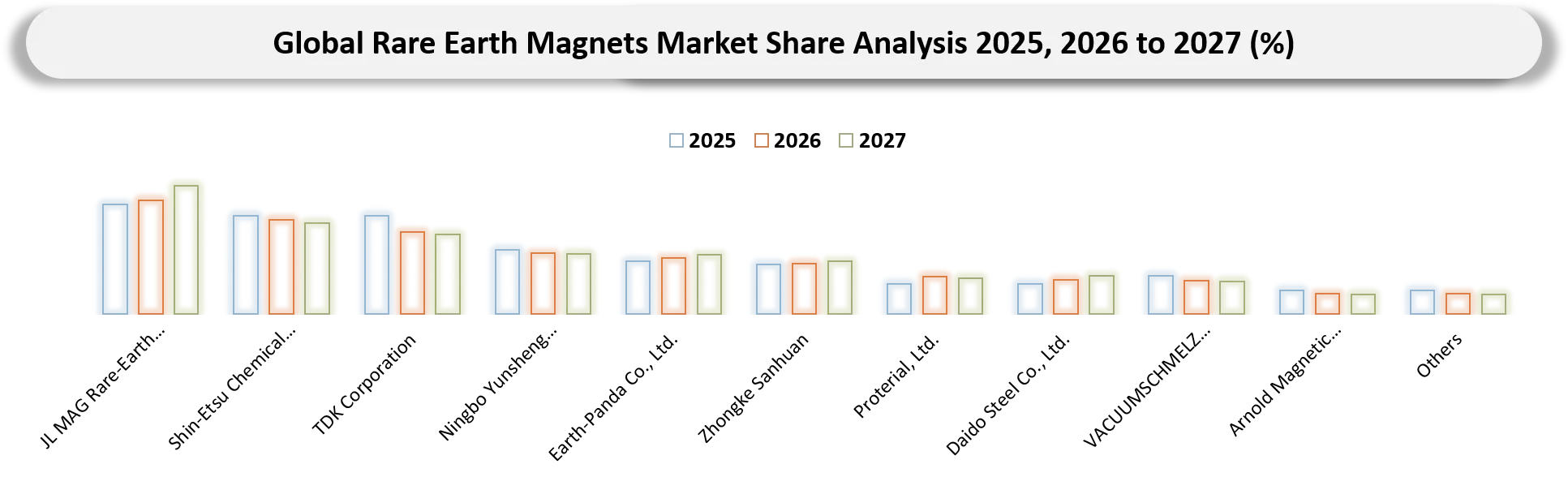
- Key players in the global Rare Earth Magnets Market include JL MAG Rare-Earth Co., Ltd., Shin-Etsu Chemical Co., Ltd., TDK Corporation, Ningbo Yunsheng Co., Ltd., Earth-Panda Advance Magnetic Material Co., Ltd., Beijing Zhong Ke San Huan High-Tech Co., Ltd., Proterial, Ltd., Daido Steel Co., Ltd., VACUUMSCHMELZE GmbH & Co. KG, and Arnold Magnetic Technologies.
Key Developments
- August 2026: India's Ministry of Heavy Industries reported receiving 20 bids under its ₹7,280 crore rare earth permanent magnet manufacturing scheme, targeting 6,000 tonnes of annual integrated capacity and expanding domestic NdFeB magnet production.
- May 2026: POSCO INTERNATIONAL and ReElement Technologies agreed to invest US$200 million in a US rare-earth separation and purification facility, advancing plans to connect rare-earth processing with domestic permanent magnet manufacturing.
- May 2026: The US Department of Energy announced US$45.7 million for 19 critical-material projects, including USA Rare Earth's pilot-scale processing project, strengthening domestic rare-earth processing capabilities relevant to permanent magnet supply chains.
- March 2026: POSCO INTERNATIONAL and POSCO INVESTMENT launched a KRW 25 billion corporate venture capital fund and made an initial KRW 8 billion investment in rare-earth separation and refining, strengthening raw-material supply for permanent magnets and electric vehicle motors. Source: POSCO Group
- March 2026: India's Ministry of Heavy Industries opened global bidding for integrated sintered NdFeB magnet manufacturing facilities under its national incentive scheme, offering capital subsidies and sales-linked incentives to accelerate domestic production.
Key Procurement Priorities and Buyer Evaluation Criteria
- Buyers prioritize rare earth magnets that deliver high magnetic strength, temperature stability, corrosion resistance, and reliable performance under demanding operating conditions.
- Procurement decisions are influenced by magnet type, magnetic grade, operating temperature, equipment design, performance requirements, production volume, and compatibility with electric motors, generators, and other applications.
- Buyers evaluate suppliers based on magnet composition, dimensional tolerances, coating quality, manufacturing consistency, customization capabilities, supply reliability, lead times, technical support, and total lifecycle cost.
Why Choose DataM?
- Technological Innovations: Explores advancements in rare earth magnet technologies, including sintered and bonded NdFeB magnets, samarium-cobalt magnets, heavy rare earth-free designs, grain boundary diffusion, and improved magnetic performance for demanding applications.
- Product Performance & Market Positioning: Evaluates rare earth magnets based on magnetic strength, temperature resistance, corrosion resistance, energy efficiency, durability, size, and application suitability, highlighting differentiation across automotive, renewable energy, industrial, electronics, and aerospace applications.
- Real-World Evidence: Highlights the use of rare earth magnets in electric vehicle traction motors, wind turbine generators, industrial automation, robotics, consumer electronics, medical equipment, and aerospace systems, demonstrating their role in compact, high-performance equipment.
- Market Updates & Industry Changes: Tracks magnet product launches, manufacturing investments, supply agreements, acquisitions, production expansions, export restrictions, recycling initiatives, and rare earth sourcing developments shaping the global magnet industry.
- Competitive Strategies: Analyzes how leading magnet manufacturers strengthen market positions through advanced magnet grades, proprietary production processes, customized magnet designs, automotive OEM partnerships, localized manufacturing, recycling capabilities, and supply chain integration.
- Pricing & Market Access: Explains pricing variations based on magnet type, rare earth composition, magnetic grade, dimensions, manufacturing process, coating, performance requirements, and order volume, alongside procurement through direct manufacturers, distributors, and magnetic assembly suppliers.
- Market Entry & Expansion: Identifies opportunities arising from electric vehicle adoption, wind energy installations, industrial automation, domestic magnet manufacturing, heavy rare earth-free technologies, magnet recycling, and regional supply chain diversification.
Target Audience 2026
- Electric Vehicle and Automotive Manufacturers
- Wind Turbine and Renewable Energy Equipment Manufacturers
- Industrial Motor and Generator Manufacturers
- Consumer Electronics and Semiconductor Equipment Manufacturers
- Aerospace and Defense Equipment Manufacturers
- Robotics and Industrial Automation Companies
- Medical Equipment Manufacturers
- Rare Earth Magnet Distributors and Magnetic Assembly Manufacturers


























































