


Quantum Processor Market Size and Overview
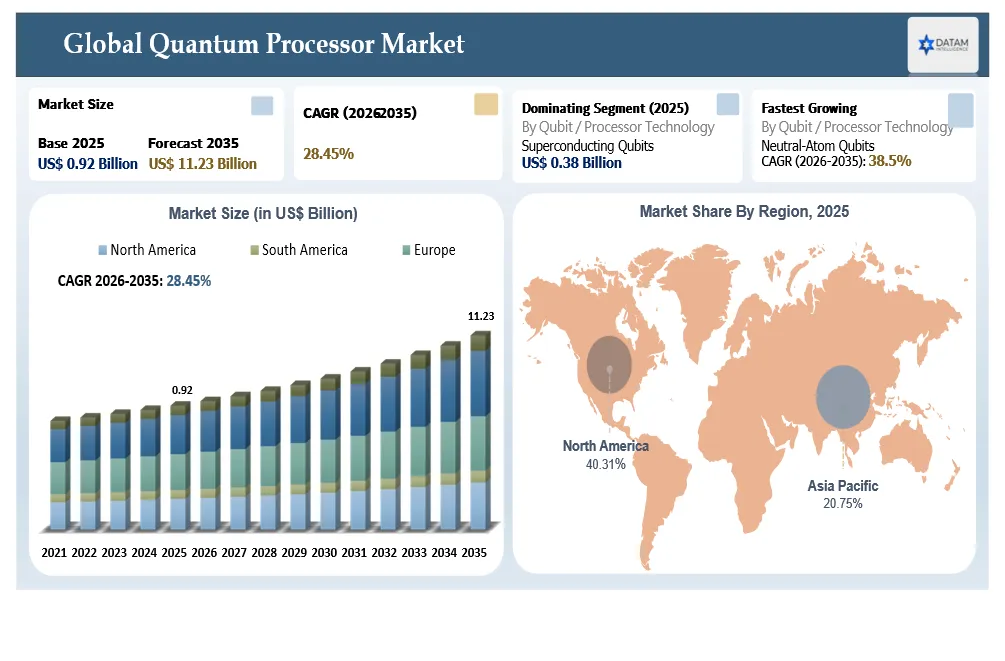
The global quantum processor market reached US$ 0.92 billion in 2025 and is expected to reach US$ 11.23 billion by 2035, growing with a CAGR of 28.45% during the forecast period 2026-2035.
The Quantum Processor Market is getting influenced by various fast-paced developments in areas such as fidelity of qubits, processor connectivity, quantum error corrections and scalability of processor architecture. As per IBM, its Heron processors possess 156 programmable qubits while its Nighthawk processors have 120 qubits and 218 couplers, indicating the move towards enhancing connectivity and computation capabilities, as opposed to concentrating only on the number of physical qubits. As per the Department of Science & Technology in India, the National Quantum Mission seeks to achieve between 50 and 1,000 physical qubits for the quantum computers in both superconducting and photonic processors, indicating an increasing trend towards scaling up the processor technology.
Moreover, the growing investments and commercialization efforts are helping build the ecosystem for quantum processors, which include cryogenic systems, quantum control electronics, advanced packaging, semiconductor manufacturing processes and quantum-classical interface systems. As per the U.S. Department of Energy, $625 million has been committed to renewing five National Quantum Information Science Research Centers that focus on quantum hardware, scaling and error correction. Likewise, as per the Government of India, National Quantum Mission has budgeted ₹6,003.65 crore till 2030-31. All these investments are contributing to the process of transitioning from lab-scale prototypes to cloud-enabled, application-focused and eventually fault-tolerant quantum processors, with optimization, molecular simulations, material sciences, financial models and cybersecurity among other fields finding applications.
Quantum Processor Market Key Takeaways
- The Superconducting Qubits held the largest market share of the Global Quantum Processor Market in 2025 with 41.2%, owing to their relatively well-established processability, fast operations and wide commercialization.
- It is expected that Neutral-Atom Qubits will register the highest CAGR of 38.5% from 2026 to 2035, more than that of the overall market which is 28.45%. This is due to the scalability of qubits, connectivity, long coherence time and increasing investment in fault-tolerant quantum computing.
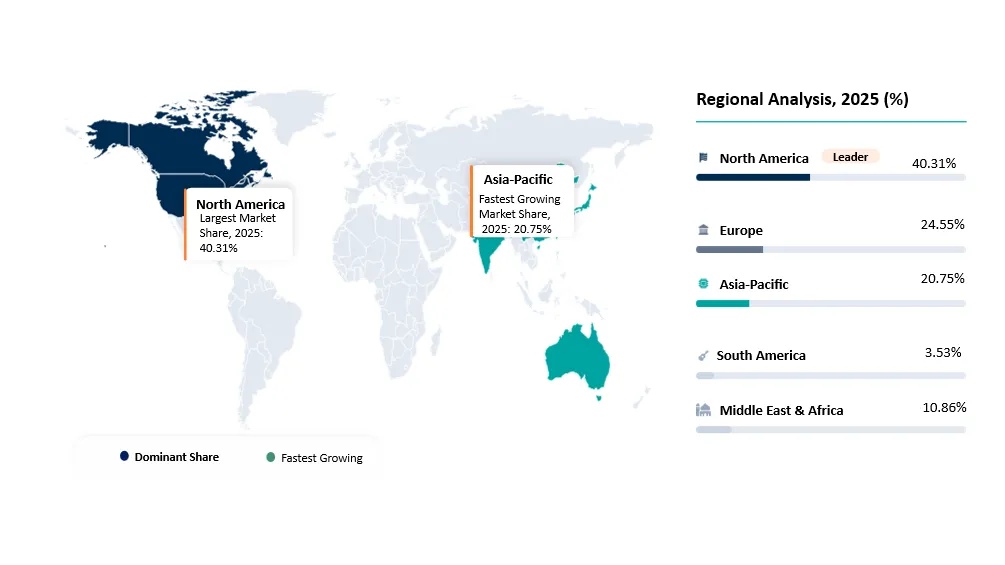
- North America led the Global Quantum Processor Market with a 40.31% market share in 2025, due to its QPU developments, semiconductor capability, government quantum programs and presence of processor companies.
- Greater investment in cryogenic technologies, quantum electronics, packaging technology and quantum processor fabrication is improving the underlying infrastructures necessary for QPU scale-up and commercialization.
- Greater demand for quantum processors tailored to applications is leading to opportunities in such areas as optimization, pharmaceuticals and molecular simulation, materials science, finance, cryptography, cybersecurity and more.
Quantum Processor Industry Trends and Strategic Insights
- Shift from Physical-Qubit Counts to Logical-Qubit Performance: Processor manufacturers are moving from focusing on physical-qubit counts to paying attention to such metrics as error correction, gate fidelity, errors and depth of the circuit.
- Rise of Modular and Chiplet-Based QPU Architectures: The modularity of processor design is becoming more strategically important since the manufacturers are trying to cope with the problems associated with yield, density of wiring, etc.
- Increasing Competition Among Qubit Architectures: Superconducting and trapped-ion processors are being challenged by other qubit technologies including neutral-atom, photonic, silicon-spin and others.
- Integration of QPUs with Classical Accelerators: The hardware vendors now design quantum systems to ensure the tight integration of the CPU/GPU and QPU processes, which allows running some targeted subroutines by quantum processors.
- Growing Focus on Application-Level Quantum Advantage: Business strategy is moving toward showing the application-specific performance advantage of the quantum processor rather than concentrating solely on the laboratory processor characteristics.
Quantum Processor Market Scope
| Metrics | Details | |
| 2025 Market Size | US$ 0.92 Billion | |
| 2035 Projected Market Size | US$ 11.23 Billion | |
| CAGR (2026-2035) | 28.45% | |
| Largest Market | North America | |
| Fastest Growing Market | Asia-Pacific | |
By Qubit / Processor Technology | Superconducting Qubits, Trapped-Ion Qubits, Neutral-Atom Qubits, Photonic Qubits, Silicon-Spin Qubits, NV-Center Qubits, Topological Qubits and Other Emerging Qubit Technologies | |
| By Quantum Processor Type | NISQ Processors, Fault-Tolerant Quantum Processors (FTQPs), Quantum Annealers and Other Quantum Processor Types | |
| By Processor Architectutre | Modular Architecture, All-to-All Connectivity, Lattice Connectivity and Nearest-Neighbor Connectivity | |
| By Computing Approach | Gate-Based / Digital Quantum Computing, Analog Quantum Computing and Digital-Analog Hybrid Quantum Computing | |
| By Qubit Scale | Less Than 50 Qubits, 50-199 Qubits, 200-999 Qubits, 1,000-9,999 Qubits and 10,000 Qubits and Above | |
| By Deployment Model | On-Premises, Cloud-Based, Quantum Computing-as-a-Service and Hybrid Quantum-Classical | |
| By Application | Optimization, Drug Discovery & Molecular Simulation, Materials Science, Financial Modeling & Risk Analysis, Cryptography & Cybersecurity, Artificial Intelligence & Machine Learning, Logistics & Supply Chain, Energy & Utilities, Chemical Simulation, Aerospace & Defense, Climate & Environmental Modeling and Other Applications | |
| By End-User | Technology Companies, Financial Institutions, Pharmaceutical & Biotechnology Companies, Automotive Companies, Aerospace & Defense, Energy & Utilities, Chemical & Materials Companies, Government Agencies, Academic & Research Institutions and Telecommunications Companies | |
| By Region | North America | U.S., Canada, Mexico |
| Europe | Germany, UK, Russia, France, Spain, Italy, Poland | |
| Asia-Pacific | China, India, Japan, Australia, South Korea, Indonesia, Malaysia, Singapore, Vietnam, Thailand, Philippines, Taiwan | |
| South America | Brazil, Argentina | |
| Middle East and Africa | UAE, Saudi Arabia, South Africa, Israel, Turkiye, Nigeria | |
| Report Insights Covered | Competitive Landscape Analysis, Company Profile Analysis, Market Size, Share, Growth | |
Why does this report matter in 2026?
The quantum processor market in 2026 is transitioning from making announcements about qubit counts to focusing on performance of processors, the creation of logical qubits, error correction and usability at the application level. The competition among quantum processor vendors is happening between superconducting, trapped ion, neutral atom, photonics and silicon spin qubit systems, while developments in processing techniques, control electronics, cryogenic engineering and modular quantum processor unit architecture are shaping up time-to-market plans.
The report is especially significant in determining areas that attract processor investments and demands in quantum computing, cloud infrastructure, pharmaceuticals, finance, materials, automotive, energy and defense. The report will help in assessing advancements in scalability of qubits, gate fidelity, coherence, connectivity, error correction abilities, processor architectures and hybridization of CPU/GPU-QPU. This way, it will enable technology companies, investors and end-users to differentiate between high-qubit processors and those making advancements in practical quantum computing performance.
Quantum Processor Market White Space & Investment Opportunities
- Logical-Qubit and Error-Correction Hardware: Technology investments are emerging around processors that diminish the overhead of physical qubits and bolster the dependability of the logical qubit, including in error correction hardware and fault-tolerant architectures.
- Modular and Chiplet-Based QPUs: Chiplet and modular processing paradigm introduces gaps for influence on single-chip scaling, wiring density, manufacturing yield and connection issues.
- Quantum Control and Readout Electronics: Technologically advanced systems ensuring low noise in control, signal generation, readout and multiplexing are attractive for investment due to the necessity of employing an increasing number of qubits in future quantum computers, which will result in a requirement for more sophisticated processor control systems.
- Photonic and Interconnect Technologies: Photonic processors, optoelectronic interfaces and communication channels for quantum networks create investment opportunities for the development of quantum computing systems involving several QPU.
- Application-Optimized Quantum Processors: The design of specific processors for different tasks such as molecular simulation or financial calculations is an attractive investment opportunity meant for the development of the performance of quantum chips.
Quantum Processor Future Market Transformation
The quantum processor market will shift from a competitive landscape where competition was based mainly on the number of physical qubits to one where performance is evaluated through logical qubits, fault tolerance, circuit depth, fidelity and quantum advantage at the application level. The development of processors will likely trend towards using architectures that support modularity and chiplets and have the ability to link more than one QPU, with concerns about manufacturing yields, wiring density and scaling. Simultaneously, different architectures like superconducting, trapped ions, neutral atoms, photons, silicon spins and even topological systems will keep vying for attention through varied criteria.
Quantum Processor Market Buyer Decision-Making Criteria
Buyers in the quantum processor market assess suppliers based on the suppliers’ capability of providing dependable, extensible and relevant quantum computing performance. Factors influencing buying and technology-choosing decisions include the number of qubits and the quality of the qubits, rate of errors and coherence time, scalability, processor design, logical-qubit and error-correcting features, application performance, compatibility of classical computing systems, requirements for cooling and control systems, technological support, pathway toward greater efficient quantum systems and cost-benefit balance. It is evident that clients are particularly interested in processors which are able to deliver considerable performance with regard to optimization, molecular technology, material technology, finance modeling and other purposes.
Major Decision-Making Criteria:
- Qubit Count and Gate Fidelity
- Error Rates and Coherence Time
- Processor Scalability and Qubit Connectivity
- Logical-Qubit and Error-Correction Capability
- Application-Level Quantum Performance
- Classical Computing and HPC Integration
- Cryogenic and Control-System Requirements
- Quantum Software and Developer Ecosystem
- Technology Roadmap and Upgradeability
- Total Cost of Ownership and ROI
Quantum Processor Market Economic & Investment Analysis
The market for quantum processors is seeing a lot of investments being made by government entities, technology firms, semiconductor players, cloud companies and venture capitalists who wish to secure their position in next-generation computing architecture. Investments are becoming increasingly focused on qubit scaling, quantum error correction, fabrication of processors, control electronics, cryogenics, modular QPU design and packaging technology. The investment allocation is diverse with different technology choices such as superconducting, trapped ions, neutral atom, photonic and silicon spin, with the focus shifting to processor quality, logical-qubits, scalability and performance.
From an economic standpoint, the market still is highly dependent on R&D investments and capital-intensive, as high costs for fabrication, specialized infrastructure needs, low production capacities and lengthy commercialization cycles entail financial risks. However, government support, partnerships, quantum computing as a service and enterprise adoption increase access to quantum processors and provide revenue opportunities. Investments will be made in favor of those companies that can prove their scalability, low errors, efficient error correction, classical systems compatibility and potential for commercially viable quantum computers; otherwise, other processor vendors will experience difficulties in gaining financial and commercial success.
Quantum Processor Investment Trends in the Market
- Capital Shifting Toward Fault-Tolerant QPUs: A growing number of investors are focusing on companies that focus on the creation of logical-qubit-based architectures and quantum error correction from fault-tolerant chips.
- Growing Investment in Modular QPU Architectures: Investment is moving toward designs with modular architecture, which allows for the limitations associated with the traditional single-chip approach to be overcome.
- Expansion of Quantum Semiconductor Manufacturing: The amount of investment in specialized manufacturers, highly advanced packaging, cryogenic electronics and control structures is increasing in order to ensure the conversion of a laboratory QPUs into a commercialized hardware.
- Rising Strategic Investment in Alternative Qubit Technologies: Neutral atoms, photonics, silicon spins and other advanced processors are proving to be worthy targets of investment as investors are trying to find an alternative to limitations that are associated with the solutions that have been already implemented.
- Increasing Funding for Application-Optimized Processors: Resources are being allocated to QPUs that will show performance benefits in real-world tasks like simulations, optimizations, material discovery and financial modeling rather than just being good at counting qubits.
Strategic Indicators For the Quantum Processor Market
High Regulation Impact
Quantum processor design is associated with significant regulatory impact due to the fact that the more sophisticated quantum computing hardware may pose risks to national security, cryptography, dual-use technologies and strategic semiconductors supply chains. The export control regime might impact the cross-border shipment of advanced quantum computing parts, processors, cryogenics systems and special controls technology. More and more governments are starting to consider quantum capability as a strategically important technology. This might have an effect on processor supply chains, international cooperation, technology licensing, equipment acquisition and market expansion.
High Investment Activity
Intense investments are influencing the quantum processor market with governments, tech companies, semiconductor companies and venture capitalists investing in scalable QPU architectures, logical-qubits, quantum error corrections, QPU manufacturing, cryogenic cooling, control circuitry and advanced packaging. Investments in the market are becoming technology-specific with superconducting, trapped ion, neutral atoms, photonics and silicon spin technologies vying for investments on the basis of scalability, fidelity, manufacturing ability and applications. Investments are also flowing into QPU modularity and quantum-classical hybrid technologies, thereby opening up avenues for those companies who are making advancements in computational capabilities and fault tolerance.
Supply Chain Disruption
A potential threat that could affect the quantum processor market strategically would be supply chain disruptions since the manufacturing of QPUs requires specialized semiconductor processing, high purity materials, cryogenic systems, microwave and control electronics, photonic devices and advanced packaging all provided by limited supplier bases. The inability to source dilution refrigerators, superconductive materials, high accuracy processing machinery and specialized control components may delay the development process and result in higher costs. There may be geopolitical constraints as well as export regulations that could disrupt the sourcing of advanced semiconductor and quantum hardware components.
Pricing Volatility
The quantum processor market will experience pricing volatility due to the nature of QPU which relies on expensive cryogenic technology, control circuits, fabrication of semiconductors and low volume processor manufacturing. Commercial dilution refrigerators may range in price from around US$150,000-US$2.5 million, with high density cryogenics ranging from US$800,000-US$1.5 million. Quantum computers would need millions of dollars worth of infrastructure depending on the processor architecture, number of qubits and other factors. The low volume production, specialized fabrication process, limited supply base and increasing complexity of control system infrastructure are some of the reasons for the high cost variation that increases with increased QPU capacity and processor complexity.
Procurement Pressure
Quantum processor market procurement pressures arise as a result of the unavailability of special components, lengthy qualification process, limited number of suppliers and heavy dependence on highly sophisticated manufacturing and cryogenics infrastructure. Quantum processor developers have to ensure steady supplies of superconducting materials, dilution refrigerators, low-noise electronic control units, precise microwave equipment, optical devices and semiconductor manufacturing equipment. With the design complexity of quantum processors growing from tens of qubits to hundreds of qubits, procurement becomes more complicated since increased qubit density requires more control lines, wiring, readout mechanisms and cooling systems.
New Technology Adoption
Adoption of new technology in the quantum processor market is becoming rapid as the market is shifting from processor scaling to more modular QPUs, quantum error correction, logical qubits, chiplet designs, advanced qubit control systems and advanced interconnection technology. Technology adoption is based on the ability of these technologies to enhance gate fidelity, coherence, connectivity, fabrication yield and scalability of processors without increasing complexity proportionately. Other alternative architectures such as neutral atoms, photonic, silicon-spin, among others, are adding new choices of technology in this market.
Regional Expansion Opportunity
The opportunities for regional growth of the quantum processor market will be found in the countries that are developing their own national programs, infrastructure and capabilities in the field of quantum computing, semiconductor technology and cloud quantum computing platforms. While North America continues to be an important region for commercialization activities, Europe will see increased processor development via coordination of quantum initiatives and advanced research infrastructures. Opportunities are also available in the Asia-Pacific region via developments in the fields of quantum hardware and semiconductors in China, Japan, South Korea, India and Australia. Emerging regions will also provide important growth due to the availability of quantum cloud computing access and research collaboration.
Government Policy Support
Government policies are contributing to the growth of the quantum processor market through quantum strategies, public R&D investments, research grants, semiconductor subsidies and quantum computing policies that are meant to enhance national capabilities in processors. Policy-driven efforts are increasingly providing support for quantum fabrication facilities, test beds, cryogenics, quantum error correction and manpower capabilities and public procurement and government-sponsored research projects have the potential to drive initial demand for quantum processing unit technology. Besides, policies promoting quantum technology security, export control measures and domestic semiconductor value chains influence where quantum processors can be designed, manufactured and commercialized.
Pricing Intelligence
In terms of Pricing Intelligence for the quantum processor market, the comparison is moving away from comparing purchase costs of processors towards the assessment of costs relative to quantum performance. Customers use comparisons between access models for quantum computing and costs for standalone systems in which the total cost of implementing a full quantum-computing system can amount to millions of US dollars. Buyers look at cost per physical qubit, cost per logical qubit, processor utilization, error rates, availability and cost per job completed. These indicators help customers assess superconducting, trapped ion, neutral atom and photon processors in terms of performance relative to price, while helping suppliers assess appropriate pricing levels based on processor maturity, reliability, scalability and performance.
| HS Code | Reporter | Trade Flow | 2025 Trade Value | Interpretation |
8471.50 (Processing Units for Automatic Data Processing Machines) | United States | Import / Export | US$240.4 Billion | Indirect Supply-Chain Indicator: Broad category covering processing units and computing infrastructure. It reflects the broader host-computing ecosystem supporting quantum-classical systems but cannot isolate QPU shipments. |
8542.31 (Electronic Integrated Circuits-Processors and Controllers) | Taiwan | Export | US$180.0 Billion+ | Indirect Semiconductor Indicator: Covers processors, controllers and related integrated circuits. It reflects the broader semiconductor manufacturing and foundry ecosystem rather than quantum processor chips specifically. |
8543.70 (Other Electrical Machines and Apparatus) | China | Export | US$43.7 Billion | Indirect Control-Electronics Indicator: Broad category covering specialized electrical and signal-processing equipment that can serve as a proxy for control and measurement hardware used in quantum systems. |
8418.69 (Other Refrigerating or Freezing Equipment) | Japan | Export | US$14.5 Billion | Indirect Cryogenic Infrastructure Indicator: Covers specialized refrigeration and cooling equipment relevant to the broader cryogenic infrastructure used by superconducting and other low-temperature quantum processor systems. |
AI Impact Analysis of Quantum Processor Market
AI technology has been playing an increasingly prominent role in the quantum processor market through its contribution to the need for quantum processors that can perform certain workloads associated with AI, including optimization, sampling, quantum machine learning and selected model training routines. On the other hand, AI is also being used to assist in the development of quantum processors to optimize qubit calibration, error mitigation, pulse control, noise analysis and quantum circuit compilation.
The most immediate influence will come from AI-quantum computing hybrid systems where the CPUs and GPUs handle classical AI processing, whereas the QPUs will perform certain computationally demanding routines. That is leading to the need for CPUs which will be able to interface well with classical computing hardware and demonstrate performance advantages for certain applications. AI assistance for calibration and control may help increase the effectiveness of the QPU and decrease its complexity of operation, while future applications of quantum machine learning may lead to specialized hardware needs.
Disruption Analysis of Quantum Processor Market
The market for quantum processors is undergoing disruption due to the move away from monolithic, many-qubit processors to modular and scalable quantum processing unit architecture. With the chiplet, modular and networked quantum processor designs, there could be ways to overcome some of the problems related to fabricability, wiring density, connectivity of the qubits and scalability of the quantum processors through the connection of multiple quantum processing units. In addition, developments in logical qubits and quantum error correction are reshaping how quantum processors are compared.
The second significant disruption is the rise of new processor architectures based on neutral atoms, photons, silicon spin and topological quantum computing in addition to existing quantum computing methods like superconducting and trapped ions. All of these may help in overcoming certain limitations that exist due to cryogenic needs, connectivity issues, fabrication scalability, or error rates. Consequently, the market is headed towards having a competitive landscape that is diverse in terms of architectures where application performance, corrected computing, scaling and integration with classical accelerators matter more than the number of qubits alone.
Quantum Processor Market BCG Matrix: Company Evaluation
STAR
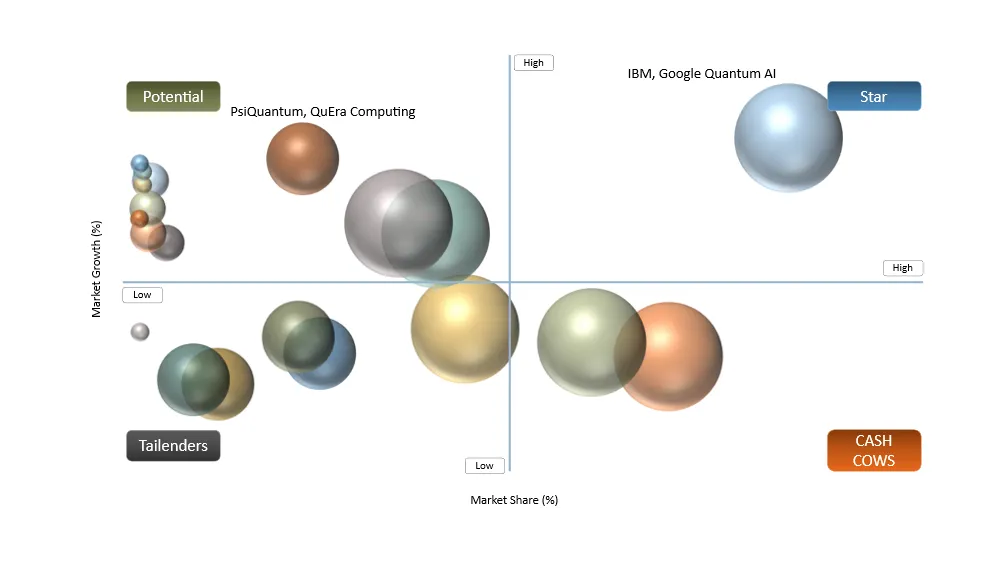
IBM, Google Quantum AI, Quantinuum, IonQ and D-Wave Quantum are considered to be the best Star performers within the Quantum Processor Market owing to their combination of strong market performance and great future growth potential. IBM and Google are improving superconducting processors and quantum error correction, whereas Quantinuum and IonQ are boosting trapped ion processors. The company D-Wave has managed to keep its differentiation within the domain of quantum annealing processors, which is facilitated by deployments and processor development.
POTENTIAL
Companies like PsiQuantum, QuEra Computing, Pasqal, Atom Computing, Infleqtion, Xanadu, Alice & Bob, IQM Quantum Computers, Oxford Ionics and Anyon Systems qualify as high-potential firms with differentiated processing technologies, which offer scope for gaining competitive advantages in the markets. These companies' approaches towards developing photonic, neutral-atom, trapped-ion, superconducting and new quantum processors can help solve some important problems related to scaling, connectivity, error corrections and fault-tolerant processing in the industry. Better performance in terms of processor fidelity, scalability of manufacturing process, logical qubits and system integration will help these firms capture more market share.
Quantum Processor Market Dynamics
Driver Impact Analysis
| Driver | Market Growth Impact (%) | Demand Concentration | Impacted Use Case | Strategic Impact |
Rising Demand for High-Performance Quantum Computing | 26% | Technology & Research | Complex Optimization and Simulation | Accelerates investment in higher-performance and scalable QPUs |
Advancements in Qubit Scalability and Fidelity | 23% | Processor Development | Fault-Tolerant Quantum Computing | Drives competition toward higher-fidelity and larger-scale processors |
Growing Quantum Computing Investments | 20% | Government & Enterprise | Quantum R&D and Commercialization | Expands processor development programs and manufacturing capacity |
Increasing Adoption of Quantum Computing-as-a-Service | 17% | Cloud & Enterprise | Cloud-Based Quantum Computing | Broadens access to QPUs and increases processor utilization |
Driver: Rising Demand for High-Performance Quantum Computing
The growing need for efficient computing to address difficult optimization, simulation and modeling challenges is fueling growth in the quantum processor market. Firms are testing quantum processors for optimizing their portfolios and modeling risks, pharmaceutical and biotech firms are using them for molecular simulation and drug discovery and automotive firms, energy firms, logistics firms and materials companies are also looking into quantum processors for complex optimization and materials modeling. All of this has resulted in an increased focus on high qubit numbers, increased gate fidelity, increased connectivity, extended coherence times and quantum error correction.
Restraint Impact Analysis
| Restraint | Drag on Market Growth (%) | Primary Impact Area | Impacted Use Case | Strategic Impact |
High Cost of Quantum Processor Development | 24% | R&D and Manufacturing | Commercial QPU Deployment | Limits investment and slows scaling of processor production |
High Qubit Error Rates | 21% | Processor Performance | Complex Quantum Algorithms | Increases error-correction requirements and reduces practical computational efficiency |
Quantum Decoherence and Limited Stability | 19% | Qubit Reliability | Long-Duration Quantum Computation | Restricts execution time and complicates reliable processor operation |
Complexity of Quantum Processor Manufacturing | 16% | Fabrication and Scaling | Large-Scale QPU Production | Creates manufacturing bottlenecks and limits rapid capacity expansion |
Restraint: High Qubit Error Rates and Quantum Decoherence
High error rate of qubits and quantum decoherence constitute the principal restrictions of the quantum processor market as they decrease the accuracy of computation and impede the implementation of complex quantum circuits. Qubits are very susceptible to noise in the environment, electromagnetic disturbances, temperature changes and inaccuracies in controlling qubits, which leads to degradation of quantum information. To overcome such problems, it is necessary to utilize quantum error correction schemes, use more physical qubits, implement a more complicated system of control and operate in a highly controlled environment.
Quantum Processor Market Segment Analysis
The global quantum processor market is segmented based on the Qubit / Processor Technology, Quantum Processor Type, Processor Architectutre, Computing Approach, Qubit Scale, Deployment Model, Application, End-User and region.
By Qubit / Processor Technology
Superconducting Qubits Lead the Market Through Established Fabrication and Cryogenic Infrastructure
The Superconducting Qubit quantum processor accounted for 41.2% of the market in the Quantum Processor Market in 2025. This dominance has been made possible through the maturity of the fabrication process, semiconductor compatible manufacturing techniques, faster gates operations and commercial availability through major processor manufacturers. Another advantage that the Superconducting Qubit has is the availability of ecosystems for cryogenics and control electronics making it the most commercially advanced QPU architecture.
By Qubit / Processor Technology
Neutral-Atom Qubits Gain Momentum Through Scalable Architectures and Flexible Connectivity
Neutral-Atom Qubits technology is expected to grow at the fastest rate at a CAGR of 38.5% during 2026-2035 owing to their capacity for scalable construction of qubit arrays along with flexible placement and interconnectivity of qubits. It has gained momentum because of its capability of developing larger processor architectures through individually controllable atoms, while their relative independence from traditional dilution refrigerator technology makes scalability easy. Increasing investments in lasers for atom manipulation, optical traps, quantum gates, error correction and networked processors make this technology ready for commercialization. Commercialization of processors by companies like QuEra, Pasqal, Atom Computing and Infleqtion is driving growth of this technology segment.
Quantum Processor Market Geographical Penetration
U.S. Quantum Processor Market Landscape
The U.S. quantum processor market is distinguished by high levels of activity on superconducting, trapped ion, neutral atoms and photonic processor architectures, backed by big tech companies, quantum startups, national labs and universities. Such progress is made possible by investing in more accurate qubits, logical qubits, quantum error correction, modular QPU architecture, cryogenics and quantum control electronics, as well as the growth of cloud access opportunities for enterprises and scientific communities. Another distinctive feature of the US market is its developed semiconductor industry, which facilitates the closer integration of QPUs with high-performance computing systems, GPUs, control electronics and quantum computing platforms.
Japan Quantum Processor Market Outlook
The Japan quantum processor market is supported by high levels of capability in electronics, semiconductors, precision engineering, cryogenics and quantum physics, forming a good atmosphere for QPUs. The market revolves around superconducting quantum processors, quantum control electronics, cryogenic systems and quantum-classical interfaces, involving more collaborations among technology firms, research institutions and industries. Japan's capability in high precision manufacturing and engineering provides the opportunity to build the national quantum hardware supply chain, while the use cases in materials science, pharmaceutical, automobile, financial services and industrial applications will drive the growth of quantum processors.
China Quantum processor market Trends
China’s quantum processor market is witnessing progress owing to government support for investments in domestic research initiatives and developments in various types of quantum processors such as superconducting, photonic and more. One of the trends that can be observed is the development of domestic abilities in areas such as fabrication of quantum chips, cooling systems, control electronics and processor packaging, which will help in cutting down reliance on foreign hardware technology. The institutes and tech firms in China are also concentrating on improving the quality of qubits, processor scalability, quantum error correction and quantum-classical computing while providing better access to QPUs via cloud systems.
Quantum Processor Market Competitive Landscape
- The rivalry in the superconducting processor category is equally tough, as IBM, Google Quantum AI, Rigetti Computing, IQM Quantum Computers and Alice & Bob are striving to make progress on qubit fidelity, processor connectivity, error correction and scalable chip architecture.
- The trapped-ion processors compete on account of their high-fidelity operations; companies like Quantinuum, IonQ and Oxford Ionics concentrate on long coherence, qubit control, gate fidelity and fault-tolerant quantum computing.
- Neutral-atom technology gains competitive traction as QuEra Computing, Pasqal, Atom Computing and Infleqtion work on large qubit arrays, reconfigurable connectivity and scalable processor architecture.
- The photonic processors have a differentiating scaling strategy that is characterized by PsiQuantum and Xanadu developing photonic integration, optical interconnects and fault tolerant architectures meant to address some of the scaling challenges of existing QPU systems.
- Differentiation is moving away from physical qubits to processor performance where competition is based on logical qubits, error rates, connectivity, processor uptime, scalability, cryogenic needs and quantum computing cloud platform access.
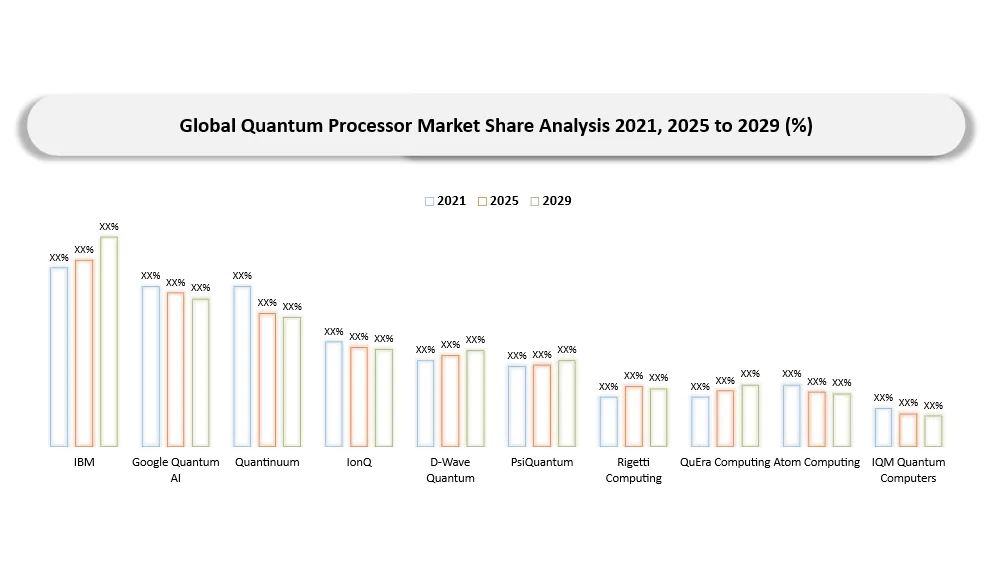
Key Companies of Quantum Processor Market
- IBM (United States)
- Google Quantum AI (United States)
- Quantinuum (United States)
- IonQ (United States)
- Rigetti Computing (United States)
- D-Wave Quantum (Canada)
- PsiQuantum (United States)
- IQM Quantum Computers (Finland)
- Intel Corporation (United States)
- Xanadu (Canada)
- QuEra Computing (United States)
- Infleqtion (United States)
- Fujitsu (Japan)
- Oxford Ionics (United Kingdom)
- Anyon Systems (Canada)
- Oxford Quantum Circuits (United Kingdom)
- Quantum Computing Inc. (United States)
- Pasqal (France)
- Atom Computing (United States)
- Alice & Bob (France)
Quantum Processor Market Major Pain Points
- High Physical-Qubit Overhead for Reliable Computation: Useful qubits can be difficult to achieve since large numbers of physical qubits may be required because of error correction needs.
- Limited Qubit Fidelity and Coherence: Errors associated with gates, noise and reduced coherence can affect the computational precision and the circuit depth that can be run on the processors.
- Difficult QPU Manufacturing at Scale: Ensuring a stable qubit performance over a greater chip surface area is not an easy task especially when it comes to manufacturing, yields, wiring density, packaging and uniformity between devices.
- Complex Cryogenic and Control Infrastructure: Superconducting and other low-temperature devices demand advanced cryogenic cooling, control and measurement equipment.
- Lack of Standardized Processor Performance Benchmarks: It is hard to compare QPUs as there are differences in architectures and ways of measuring performance of processors, which makes it hard for buyers to know which processor has better performance.
Quantum Processor Market Recent Developments
- February 2026-IBM: Reported advances towards hardware-level fault tolerance through use of qLDPC error correction protocols within its quantum computer technology platform for creation of scalable logical qubits.
- January 2026-Quantinuum: Introduced its latest H3 processor design using integrated optical waveguides to enhance connectivity and scalability of its ion trap-based quantum processors.
- March 2026-PsiQuantum: Demonstrated a cryogenic optical control technology for routing of single photons through various quantum processing units modules, a key factor for large-scale fault-tolerant photonic QPUs.
- February 2026-QuEra Computing: Developed technology for dynamic zone shuttles that allowed non-local gates to be performed on over 1,000 neutral atoms, improving the scalability and connectivity of neutral atom processors.
- January 2026-Oxford Ionics: Commercial release of their EQC systems into UK and European quantum research facilities after demonstrating 99.99% two-qubit gate fidelity on semiconductor fabricated trapped ion chips.
Analyst View / Opinion on Quantum Processor Market
- Architecture competition will remain the defining market dynamic: Superconducting, trapped ions, neutral atoms, photonic and silicon spin architectures are expected to have different performance trade-offs and are not expected to converge to any dominant architecture in the coming years.
- Logical-qubit progress will matter more than raw physical-qubit counts: In order for processor vendors to show their advancements, they will need to show lower error rates, high fidelity gates and scalable error correction, making logical-qubit advancements a better benchmark.
- Quantum processors will increasingly move toward modular architectures: Multi-chip, chiplet and interconnected QPU designs may assist in solving problems associated with fabrication, connectivity and scalability issues along with the creation of larger processor structures.
- Cloud access will accelerate processor utilization: Quantum Computing-as-a-Service is likely to continue being one of the main paths to commercial success since businesses can test QPUs without having their own cryogenic equipment and other quantum systems.
- Application-specific processors will gain strategic importance: The future of processor design seems set to focus increasingly on applications such as molecular modeling, optimization, materials search and cryptography, where market dominance will be based on application performance, not just processor specification.
Quantum Processor Market Target Audience
| INDUSTRY | WHO SHOULD BUY THIS REPORT? | REASON TO BUY THIS REPORT |
| Quantum Computing | QPU manufacturers and quantum computing companies | Evaluate processor architectures, qubit scalability, technology maturity and competitive positioning |
Semiconductors & Advanced Computing | Semiconductor manufacturers and chip designers | Identify opportunities in quantum chip fabrication, packaging and processor components |
| Cloud Computing | Cloud providers and quantum cloud platforms | Assess demand for QPU access and opportunities in quantum computing-as-a-service |
| Research & Academia | Universities and quantum research laboratories | Track emerging processor technologies, qubit development and research commercialization |
| Financial Services | Banks, investment firms and fintech companies | Assess quantum processor applications in optimization, risk analysis and financial modeling |
Pharmaceutical & Biotechnology | Drug discovery and biotechnology companies | Evaluate processor capabilities for molecular simulation and computational drug discovery |
| Automotive | Automotive and EV manufacturers | Identify opportunities in battery development, materials simulation and manufacturing optimization |
| Aerospace & Defense | Aerospace companies and defense organizations | Assess quantum processor applications in simulation, optimization and cybersecurity |
| Energy & Chemicals | Energy, utilities, chemical and materials companies | Identify applications in energy optimization, molecular modeling and materials discovery |
| Investors & Strategy Firms | Investors, consultants and corporate strategy teams | Benchmark key companies, assess growth opportunities and identify investment and partnership prospects |
Why Choose DATAM?
- Data-Driven insights: Dive into detailed analyses with granular insights such as pricing, market shares and value chain evaluations, enriched by interviews with industry leaders and disruptors.
- Post-Purchase Support and Expert Analyst Consultations: As a valued client, gain direct access to our expert analysts for personalized advice and strategic guidance, tailored to your specific needs and challenges.
- White Papers and Case Studies: Benefit quarterly from our in-depth studies related to your purchased titles, tailored to refine your operational and marketing strategies for maximum impact.
- Annual Updates on Purchased Reports: As an existing customer, enjoy the privilege of annual updates to your reports, ensuring you stay abreast of the latest market insights and technological advancements. Terms and conditions apply.
- Specialized Focus on Emerging Markets: DataM differentiates itself by delivering in-depth, specialized insights specifically for emerging markets, rather than offering generalized geographic overviews. The approach equips our clients with a nuanced understanding and actionable intelligence that are essential for navigating and succeeding in high-growth regions.
- Value of DataM Reports: Our reports offer specialized insights tailored to the latest trends and specific business inquiries. The personalized approach provides a deeper, strategic perspective, ensuring you receive the precise information necessary to make informed decisions. The insights complement and go beyond what is typically available in generic databases.
What DATAM Uniquely Provides
- Quantum Processor Technology Benchmarking: Assess the various types of quantum processor technologies: superconducting, neutral atom, ion trap technologies, photonic technologies, silicon spin and other emerging technologies according to their scalability, fidelity, coherence, connectivity and technological readiness.
- Qubit-Level Market Analysis: Evaluate qubit counts, physical and logical qubits, gate accuracies, errors and error correction results.
- Competitive Processor Intelligence: Identify leading companies and track progress according to processor architecture, technology ready, production capabilities, company strengths, technology milestones and commercialization strategies.
- Application-Specific Demand Analysis: Determines the requirement for processors across various sectors including optimization, drug creation, simulation of materials, financial modeling, cybersecurity, AI, logistics and energy.
- Quantum Hardware Supply-Chain Assessment: Studies the entire ecosystem of QPUs including semiconductor manufacturing, cryogenic systems, control electronics, photonic components, packaging and quantum-classical integration.


























































