


Quantum Computing as a Service Market Size and Overview
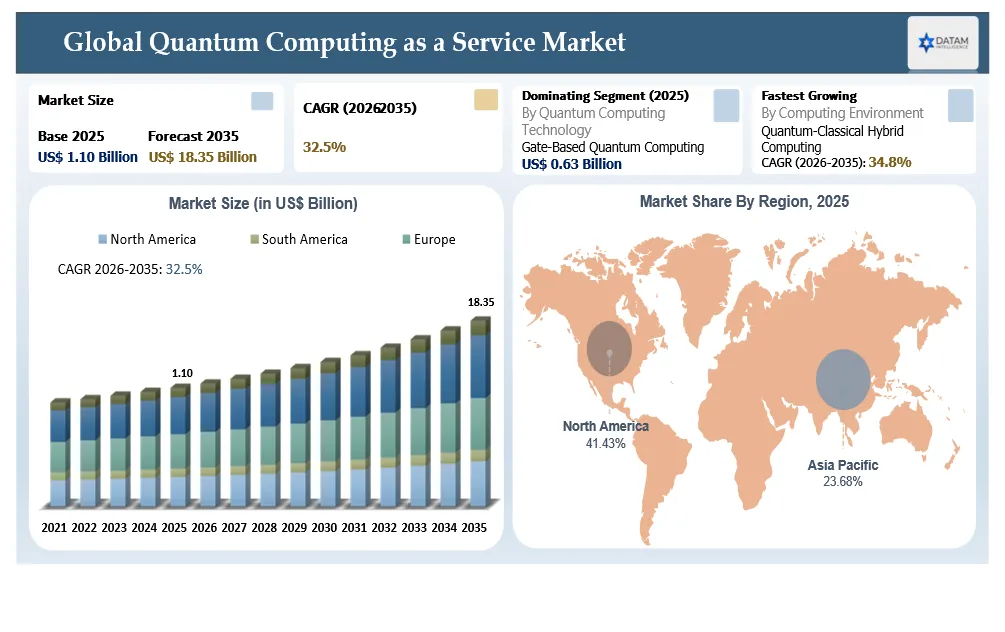
The global quantum computing as a service market reached US$ 1.10 billion in 2025 and is expected to reach US$ 18.35 billion by 2035, growing with a CAGR of 32.5% during the forecast period 2026-2035.
The market is becoming increasingly dominated by hardware agnostic QCaaS offerings, with vendors providing access to a range of QPU hardware through a single development platform. Multi-backend support ensures that enterprises can evaluate workloads on 5 different qubit technologies - superconducting, trapped ions, neutral atoms, photonic and silicon/spin-based - without having to lock themselves into any specific hardware architecture. The integration of CPU, GPU and HPC systems is becoming increasingly relevant, as quantum processors can function as accelerators within larger computing frameworks.
The commercial approach to procurement is shifting towards performance of the execution process as an aspect to be considered aside from qubits. Enterprises consider such factors as the availability of QPUs, circuit accuracy, error rate, queue time, execution delay, workload portability and price of the quantum job in the selection of QCaaS providers. This is especially true when it comes to production-type workloads since the execution reliability and proper orchestration will play a crucial role in the efficiency of quantum applications.
Quantum Computing as a Service Market Key Takeaways
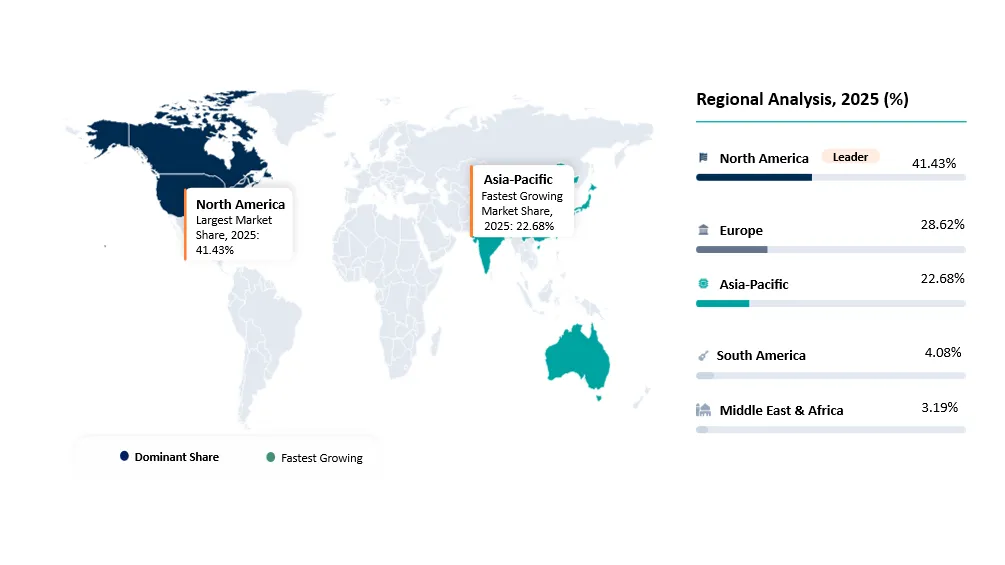
- In 2025, North America had the largest market share of 41.43% in quantum computing as a service Market owing to the contribution of major cloud providers, quantum computing hardware providers, advanced computing infrastructure and large investments of enterprises in quantum R&D.
- Gate-Based Quantum Computing dominates the market with a market share of around 57.4%. This can be attributed to the prevalence of superconducting as well as trapped-ion systems, both of which are often used in combination with leading quantum-cloud-based platforms.
- Quantum-Classical Hybrid Computing also seems to be gaining popularity in the market, which is evident from an expected CAGR of 34.8% for the period between 2026 and 2035, owing to the boom in integration of QPUs with CPUs, GPUs and HPC for high-end workloads.
- Cloud access to multi-QPUs is emerging as a huge market opportunity as businesses want to evaluate workloads against various quantum technologies without having to spend money on buying their own quantum infrastructure.
- Commercialization by businesses has been one of the key growth contributors for QCaaS providers who are already moving from basic QPU access to quantum software, application development, consulting, error correction, workload management and other managed quantum services thus helping organizations turn their experimental projects into regular quantum workloads.
Quantum Computing as a Service Industry Trends and Strategic Insights
- Multi-Hardware Cloud Access: In a bid to add more uniqueness to their offerings, QCaaS providers are enabling users to access several quantum architectures that will allow them to choose processors according to the workload, performance and errors.
- Hybrid Quantum-HPC Integration: Introducing QPU integration with CPUs and GPUs and high-performance computing infrastructure has become an important part of QCaaS strategy, allowing enterprises to execute quantum workloads alongside existing computing tasks.
- Shift Toward Application-Specific Quantum Services: QCaaS suppliers are beginning to go beyond simply providing access to QPU, offering ready-made algorithms, optimization and quantum machine learning applications, simulation environments and industry-specific applications to users.
- Usage-Based Commercialization: The market is growing with the idea of pay-per-use, subscription and dedicated-access models that enable organizations to test quantum computing without big investments in quantum hardware.
- Enterprise Ecosystem and Strategic Partnerships: QCaaS has built partnerships within cloud computing, quantum hardware, software, consulting, academia and industry, focusing on proof-of-concept projects and making experimental quantum workload ready for commercial deployment.
Quantum Computing as a Service Market Scope
| Metrics | Details | |
| 2025 Market Size | US$ 1.10 Billion | |
| 2035 Projected Market Size | US$ 18.35 Billion | |
| CAGR (2026-2035) | 32.5% | |
| Largest Market | North America | |
| Fastest Growing Market | Asia-Pacific | |
| By Quantum Computing Technology | Gate-Based Quantum Computing, Quantum Annealing, Analog Quantum Computing and Hybrid Quantum Computing | |
| By Qubit Technology | Superconducting Qubits, Trapped-Ion Qubits, Neutral-Atom Qubits, Photonic Qubits, Silicon/Spin Qubits and Others | |
| By Service Type | Quantum Infrastructure as a Service, Quantum Platform as a Service, Quantum Software as a Service and Quantum Consulting & Development Services | |
| By Access Model | Pay-as-You-Go, Subscription-Based, Dedicated Access and Others | |
| By Deployment Model | Public Cloud, Private Cloud, Hybrid Cloud and Dedicated / On-Premises | |
| By Computing Environment | Pure Quantum Computing, Quantum-Classical Hybrid Computing, Quantum-HPC Integrated Computing and Quantum-AI Integrated Computing | |
| By Application | Optimization, Quantum Simulation, Quantum Machine Learning & AI, Cryptography & Cybersecurity, Drug Discovery & Molecular Modeling, Financial Modeling, Design & Engineering, Data Analysis and Others | |
| By Industry Vertical | Healthcare, Pharmaceuticals, BFSI, IT & Telecommunications, Retail & E-Commerce, Energy & Utilities, Automotive, Manufacturing, Chemicals & Materials, Aerospace & Defense, Government, Academia & Research and Others | |
| By User Type | Enterprise, Government, Academia & Research and Others | |
| By Region | North America | U.S., Canada, Mexico |
| Europe | Germany, UK, France, Russia, Spain, Italy, Poland | |
| Asia-Pacific | China, India, Japan, Australia, South Korea, Indonesia, Malaysia, Singapore, Vietnam, Thailand, Philippines, Taiwan | |
| South America | Brazil, Argentina | |
| Middle East and Africa | UAE, Saudi Arabia, South Africa, Israel, Turkiye, Nigeria | |
| Report Insights Covered | Competitive Landscape Analysis, Company Profile Analysis, Market Size, Share, Growth | |
Why does this report matter in 2026?
Quantum Computing as a Service (QCaaS) is emerging as an essential commercialization layer that exists between quantum computing hardware vendors and end-users. Rather than spending money on costly quantum computing systems, the organization can leverage the power of QPUs, quantum computing simulators, quantum computing development environment and quantum computing-hybrid quantum-classical solutions through the cloud platform. This is especially true since the companies are transitioning from their early experimentation in quantum computing to proof of concepts with applications in optimization, finance, drug discovery, material sciences and cybersecurity.
The relevance of the report is driven by the fact that competitive positioning in QCaaS is no longer about the hardware capabilities only but rather the quality and economics of the cloud service itself. Competitiveness is demonstrated by the number of hardware options, QPU performance, software development tools, API, the ability to combine CPU-GPU and QPU, pricing and specialized applications. For venture capitalists, technology suppliers and corporate customers, it is essential to comprehend the above-mentioned criteria in 2026 in order to identify viable business models, applications and investments.
Quantum Computing as a Service Market White Space & Investment Opportunities
- Affordable Enterprise Entry Tiers: Opportunity to launch low-priced QCaaS offerings for SMEs and inexperienced business clients with a requirement for minimal QPU usage, simulators, education and testing without the obligation of a long-term contract.
- Quantum Workload Benchmarking Services: Unexplored area for independent services which perform evaluations of QPU performance, cost per job, error levels, time and applicability to various users of quantum technologies.
- Quantum Skills-as-a-Service: Investment opportunity targeting introduced QCaaS solutions combining cloud quantum access with training, algorithm development, logistics and additional services.
- Quantum Cost Optimization Platforms: Opportunities of tools that automatically choose the most cost-efficient quantum backend, simulator or classical substitute for a workload, based on the difficulty, performance specifications and usage cost.
- Quantum Readiness & Migration Services: White space for services that evaluate the existing workloads of an enterprise and specify the computational problems suited for quantum acceleration, followed by algorithm transformation, checking the algorithm and QCaaS implementation.
Quantum Computing as a Service: Future Market Transformation
The QCaaS industry is expected to transform from a stage that only provides cloud-based access to quantum processors to more sophisticated and result-focused computing services. The next-gen platforms are likely to have QPUs alongside CPUs, GPUs, HPCs, quantum simulators and workload orchestration, thus allowing the users to find out which computing platform fits best with their workloads. Therefore, the value proposition of QCaaS will move from merely accessing the quantum processor in the cloud to performance tuning, workload management, error correction, benchmarking and efficient execution. Vendor-neutral platforms will also become increasingly significant, enabling organizations to access various quantum architectures through a common cloud environment.
The market is also expected to develop in the direction of QCaaS services that would target specific applications and industries with the integration of quantum algorithms, software, data processing and technical support designed to solve a certain business problem. Portfolio optimization, drug discovery, molecular simulation, logistics scheduling, materials design and energy optimization services are some examples of those services that are likely to substitute experimentation with practical applications in the future. In this case, the future competitiveness will be based on price per workload, ease of integration with enterprise IT systems, quantum software features, business results and successful project scaling.
Quantum Computing as a Service: Market Buyer Decision-Making Criteria
The selection criteria for QCaaS platforms involve the capability of providing reliable execution of quantum tasks, the availability of the right QPUs, predictable pricing and the ability to execute quantum computing with regard to individual workloads. Since quantum processors vary in architecture, performance, error rates and availability, enterprises generally select providers based on their ability to find the right match between the workloads and quantum backends rather than by comparing hardware specs alone.
In terms of enterprise deployment, buyers take into account the ability of the platform to integrate with existing cloud and HPC systems, security and data handling considerations, scalability, technical support and the maturity of quantum computing development tools. With the increasing relevance of QCaaS for commercially viable workloads, more and more decisions will be made based on the performance and cost associated with running the workload in question.
Major Decision-Making Criteria
- QPU Performance, Error Rates and Reliability
- Cost per Quantum Workload
- Quantum Hardware and Backend Availability
- Workload Benchmarking and Performance
- Cloud, API and HPC Integration
- Quantum SDKs, Software and Development Tools
- Security and Data Protection
- Scalability and Dedicated QPU Access
- Technical Support and Quantum Expertise
- Application and Algorithm Compatibility
Quantum Computing as a Service Market Economic & Investment Analysis
The economic appeal of QCaaS will be increasingly defined by the potential of the model to lower the up-front costs and capital investments associated with deploying quantum computing. Rather than buying dedicated quantum computing hardware, businesses will be able to use QPUs and quantum software via consumption-oriented cloud delivery approaches. Consequently, from a financial standpoint, there will be less emphasis on the value generated by quantum hardware and more on subscription revenue, quantum software, workload management, developer tools, benchmarking and managed quantum services. Economic success in the space will largely rely on utilization metrics, cost per quantum workload, QPU availability, pricing for services and transitioning from experimental to recurring enterprise workloads.
The opportunities for investment are most pertinent in the software and services layer of QCaaS solutions since the developers can provide differentiated solutions without having to bear the entire cost of developing quantum hardware solutions. The investors will be able to evaluate their options through enterprise acceptance, scalability of workloads, inter-operability of the platform, revenue models and integration of the quantum capabilities with the cloud and HPC environments. However, investments in QCaaS solutions will still be contingent upon the maturity of quantum hardware technology, uncertain return on investment, low use rate of certain quantum solutions and time taken for quantum applications to become economically viable.
Quantum Computing as a Service Investment Trends in the Market
- Shift Toward Quantum Software Investment: With rising interest in QCaaS software development that comprises quantum technology systems, retrieval systems, evaluation tools, complications and algorithms, useful software revenue can have an impact on hardware investments.
- Growth of Strategic Corporate Funding: Technology organizations, quantum equipment producers and commercial consumers are instituting funding and partnership strategies to get access to quantum processes and amenities that will help them gain a foothold in the developing QCaaS system.
- Investment in Quantum Application Startups: Capital is flowing towards commercializing quantum applications and managed services focusing on optimization, molecular analysis and business modeling processes instead of investing solely in quantum hardware.
- Rising Focus on Quantum Infrastructure Economics: Investors today evaluate the feasibility of quantum computing as a service business leveraging metrics on how efficiently quantum processing units (QPUs) are utilized, workload throughput, cloud operational costs, pricing strategies and recurring revenue derived from usage.
- Expansion of Early-Stage Enterprise Validation Funding: There is rising investment towards proof-of-concept initiatives, pilot programs and enterprise quantum readiness projects, thereby aiding in identifying workloads that are able to transit from experimental usage of quantum computing as a service to commercially viable offers.
Strategic Indicators For the Quantum Computing as a Service Market
High Regulation Impact
Quantum Computing as a Service is subject to a high regulatory impact because providers offer an amalgamation of cloud infrastructure, access to quantum hardware, enterprise workloads and high-compute resources via their remotely accessible service platform. Regulations related to data residency, cross-border data transfer, cybersecurity, encryption, export controls and availability of advanced technology can affect the location where the QPUs may be installed, customers who can access certain quantum computer system and quantum workloads and data handling. There is now an increased need to comply with regulations covering not only quantum hardware but also cloud computing infrastructure, APIs, software and third-party infrastructure that can increase the cost of deployment and operation. On the other hand, regulation offers a unique opportunity for sovereignty in the QCaaS platform, region-specific quantum hardware, access-controlled services and quantum-safe security solutions.
High Investment Activity
QCaaS is seeing increasing investment activity driven by a shift from experimental access to commercial use of quantum cloud services. Investment intensity is essential in ensuring continued spending on QPU capacity as well as on cloud integration, software infrastructure, workload optimization and support.اڪવીFurthermore, investment in necessary services and technologies enables expansion of access to quantum hardware, improvement of service reliability, shortening of development cycles, as well as running customer proof of concept programs. Nevertheless, increased investments compel service providers to become more competitive not only in terms of QPU utilization and pricing, but also in terms of platform performance and conversion of experimental users into regular customers.
Supply Chain Disruption
The supply chain disruption threat for QCaaS is associated with the high dependence of quantum technologies provided as cloud services on specialized hardware infrastructure located in particular geographical regions. The availability of cryogenics, controllers, QPUs, photonic devices, special semiconductors and other precision instruments may impact the process of QPU manufacturing, maintenance, upgrading and provision. Contrary to regular cloud computing where replacement of a hardware element or migration to another processor does not cause serious complications, in case of quantum technologies, the change of the QPU architecture, control system, software stack and error profile will cause the need for reconfiguration. Thus, supply chain disruptions will influence not only the hardware supply but also the schedule of QPUs' deployment, expansion of the cloud capacities, workload execution and user access.
Pricing Volatility
The pricing structure for QCaaS exhibits considerable price dispersion and variation in costs at the workload level for different quantum architectures and access models. For instance, there is a US$0.30 per task fee charged by Amazon Braket, while prices per shot vary between US$0.000425 per shot for Rigetti Cepheus and US$0.08 per shot for IonQ Forte. This implies a factor of almost 188 times variation in cost per shot. Dedicated QPU rental costs range between US$2,500 per hour for QuEra Aquila and US$7,000 per hour for IonQ Forte, with a 2.8 times difference.
The setting of workloads may also further affect the total cost of the service. The cost of an IonQ Forte error-mitigation workload of 2,500 shots in Amazon Braket is US$200.30, whereas US$4.55 will be required to execute a 10,000-shots Rigetti workload without the same error mitigation. Therefore, QPU, number of shots, error mitigation, execution and workload complexity are all important parameters that determine the cost of QCaaS.
Procurement Pressure
There is immense pressure on procurement of QCaaS due to the fact that enterprise procurers have to rationalize expenditure on quantum computing against ambiguous benefits at the level of workload. Moreover, there are issues related to technology and vendor selection which add to the pressure of procurement. Procurement professionals require comparing cost of QPU access, limitations in execution, hardware constraints, cloud compatibility, security needs, service level agreements and portability among various quantum backend providers prior to entering into contracts. There are challenges associated with standardized metrics of performance and cost which make comparison hard between different providers especially when one provider charges on the basis of tasks and shots while other offers reservation or exclusive access. This puts immense pressure on QCaaS providers to be transparent about their pricing, workload performance measurement, flexible contract models, access for trials/proofs and interoperability.
New Technology Adoption
Adoption of emerging technologies within the QCaaS ecosystem has been fueled by the emergence of new quantum processor architectures, enhanced qubit-control mechanisms, error-mitigation solutions, quantum software stacks and hybrid quantum-classical computing platforms. For QCaaS vendors, embracing new quantum processor units does not only entail upgrading the hardware component since different architectures may necessitate different cloud interfaces, compilers, SDKs, benchmarks and workload execution processes. This need highlights the importance of the existence of platforms which are able to seamlessly integrate several quantum backend systems without affecting their customers' applications. Furthermore, technologies which make quantum resources easier to use have been adopted, such as automated circuit optimization, error mitigation, workload orchestration and integration of CPUs, GPUs and HPCs. Therefore, the capability of integrating new quantum technologies while retaining API compatibility and workload portability is becoming an essential competitive advantage.
Regional Expansion Opportunity
The regional expansion of QCaaS is paving the way for the creation of localized quantum-cloud access models by providers based on disparities in terms of data sovereignty, cloud infrastructure, quantum computing expertise, customer demand and access to QPU resources. The regional expansion is possible by leveraging regional cloud availability zones, deployment of QPU in regions, sovereign quantum-cloud environment and collaboration with local cloud service providers and research organizations, where customers can avail of quantum computing while meeting regional data and security regulations. The regions with high prospects of regional expansion include North America and Europe with a solid quantum ecosystem and enterprise cloud infrastructure and Asia-Pacific owing to quantum computing capabilities and digital infrastructure.
Government Policy Support
Government policies play an important role as a catalyst in QCaaS due to the increasing focus on quantum computing infrastructure, cloud-based research facilities, commercialization and training by the government initiatives, lowering the entry barrier for companies that do not have the opportunity to purchase the quantum computing hardware. The government-funded policies may be used to develop the deployment of shared quantum capabilities, research and industry collaboration and use of quantum technologies in the public sector, thus developing the first client base for QCaaS solutions. Furthermore, the policies may affect data sovereignty, technology access, cybersecurity, export controls and quantum-proof encryption technologies, which will directly impact the implementation and sale of QCaaS platforms in the different jurisdictions.
Pricing Intelligence
Pricing intelligence in the QCaaS industry is focused on identifying the cost incurred in performing a quantum task as opposed to comparing the initial access cost of each system. In its pricing model, Amazon Braket uses a US$0.30-per-task price in addition to shot-based pricing specific to the particular quantum device. The current shot-based prices of the quantum devices vary from US$0.000425 per shot for Rigetti Cepheus to US$0.08 per shot for IonQ Forte. The dedicated QPU reservation pricing varies between US$2,500 per hour for QuEra Aquila to US$7,000 per hour for IonQ Forte.
This implies the need for pricing intelligence at the workload level to determine the most cost-efficient way to execute the workload. In fact, the 10,000 shot workload on Riggetti’s quantum computer costs US$4.55, while the 10,000 shot workload on IonQ Forte computer costs US$800.30 without additional expenses. Pricing intelligence, hence, will increasingly become dependent on QPU choice, shots needed, batching of tasks, error mitigation requirements, whether the workload is reserved or on-demand and workload throughput. For businesses, cost per effective workload or computation will thus be a more important criterion than just the QPU price.
| HS Code | Reporter | Trade Flow | 2025 Trade Value | Interpretation |
| 8543.7 | United States | Imports | US$21.45 Billion | Indicates demand for specialized electrical equipment supporting the broader advanced-computing infrastructure relevant to QCaaS. |
| 8543.7 | China | Exports | US$32.80 Billion | Reflects China's role in supplying specialized electronic equipment within the global advanced-computing hardware ecosystem. |
| 8543.7 | Germany | Exports | US$14.10 Billion | Highlights Germany's contribution to the specialized equipment supply chain supporting advanced-computing infrastructure. |
| 8543.7 | Japan | Exports | US$11.25 Billion | Indicates Japan's role in supplying precision electronic and specialized equipment relevant to quantum-computing infrastructure. |
AI Impact Analysis of Quantum Computing as a Service Market
The introduction of AI technology in the QCaaS market is anticipated to create significant complementary value with respect to resource selection, programming, optimization and utilization in the process of working with quantum computing services through the cloud. AI solutions are capable of helping with quantum circuit synthesis, quantum circuit optimization, error-mitigation parameter selection, job scheduling and even QPU performance prediction, thus lowering the need for technical expertise for executing quantum workloads via cloud-based platforms. Furthermore, generative AI solutions may prove helpful in transforming business problems into potential quantum algorithms or workflows. As for the lower level of the stack, AI solutions may help providers with predicting QPU demand and optimizing job distribution.
The effect is especially important in cases of hybrid AI-quantum applications, where classical AI algorithms and quantum computers work together and not when the latter is seen as a separate approach. AI forecasting can be combined with quantum optimization in financial services, while in pharmaceuticals, candidate selection through AI will be followed by quantum-enhanced molecular simulations. But at the same time, AI can increase competition in the field because better algorithms of classical AI and GPU and accelerator improvements might enable some optimization tasks to become commercially viable without quantum technology. In such a way, AI is expected to boost the usage of QCaaS for those types of workloads where quantum technology adds value in terms of computations.
Disruption Analysis of Quantum Computing as a Service Market
The disruption introduced by Quantum Computing as a Service in the current paradigm of quantum computing is the move away from quantum computing systems that are owned by organizations and cost a lot of money, to access cloud-based QPU. With the use of a cloud platform, businesses can work with various quantum computing platforms without having to develop their cryostat, control electronics, special facilities and team of quantum developers. The competition shifts from ownership of quantum computing devices to accessibility of QPU, cloud, software compatibility, workload management and pricing model.
The disruption is becoming more significant as QCaaS is moving from research accessibility to hybrid and enterprise usage. The providers are increasingly differentiating themselves through their capacity to integrate QPUs with regular cloud, GPU and HPC technology, optimize circuits automatically, mitigate errors and make it easier for users to develop quantum applications. A new layer of services can emerge, which will be positioned between the manufacturers of quantum computers and end-users. It may enable software platforms and cloud companies to generate additional value without manufacturing QPUs. In addition, advances in classical computing and AI bring up another disruption, as providers of QCaaS solutions need to prove that they offer a tangible quantum advantage and efficient workload performance.
Quantum Computing as a Service Market BCG Matrix: Company Evaluation
STAR
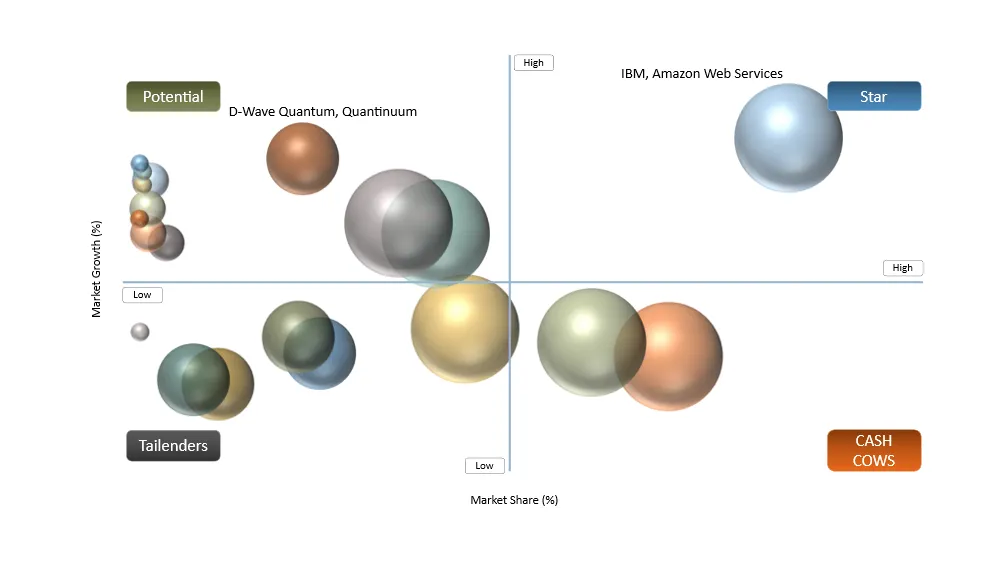
Stars include IBM, Amazon Web Services, Microsoft, Google and IonQ since they have high quantum computing capabilities, well-established cloud platforms, significant research and development investments and increased access for enterprises. They leverage their wide developer communities, various hardware options, hybrid quantum/classical computing capabilities and cloud/enterprise integration to create their QCaaS services. Such companies have a good opportunity to turn increased enterprise experimentation into quantum workloads.
POTENTIAL
D-Wave Quantum, Quantinuum, Rigetti Computing, Xanadu, Pasqal, QuEra Computing, IQM Quantum Computers, qBraid, Classiq, QC Ware, Oxford Quantum Circuits and Quantum Computing Inc. are regarded as Potential companies as they offer unique quantum hardware, software, cloud access, or application capabilities but are smaller than the main cloud service providers when it comes to the commercial scale. Their enhancement is contingent upon better QPU performance, enlargement of cloud availability, development of applications-oriented workloads, partnerships with business representatives and presence of proven efficiency.
Quantum Computing as a Service Market Dynamics
Driver Impact Analysis
| Driver | Market Growth Impact (%) | Demand Concentration | Impacted Use Case | Strategic Impact |
Growing Enterprise Adoption of Cloud-Based Quantum Access | 26% | Large enterprises, technology companies, financial institutions | Quantum algorithm development and enterprise experimentation | Expands access to QPUs without requiring organizations to purchase and maintain quantum hardware, accelerating QCaaS adoption. |
Increasing Integration of Quantum Computing with HPC and Cloud Infrastructure | 22% | Technology, research, pharmaceutical, energy and engineering sectors | Hybrid quantum-classical computing and optimization workloads | Strengthens demand for platforms capable of orchestrating QPUs alongside CPUs, GPUs and HPC resources. |
Expansion of Quantum Applications Across Optimization and Simulation | 20% | Finance, pharmaceuticals, logistics, chemicals and materials | Portfolio optimization, molecular simulation, route optimization and materials research | Increases workload diversity and supports the transition from quantum experimentation toward application-oriented QCaaS consumption. |
Growing Government and Corporate Investment in Quantum Ecosystems | 18% | North America, Europe and Asia-Pacific; research institutions and large enterprises | Quantum R&D, proof-of-concept projects and commercial application development | Expands quantum infrastructure, developer ecosystems and enterprise readiness, creating a broader customer base for QCaaS providers. |
Driver: Growing Enterprise Adoption of Cloud-Based Quantum Computing
Adoption of quantum computing through clouds by enterprises is driving the QCaaS market since it enables enterprises to gain access to quantum processing units (QPUs) through cloud technology without having to deploy cryogenic setup or any kind of quantum computer. This allows enterprises to experiment with various quantum computing architectures, create algorithms and conduct pilot studies through subscription model or reservation model. Also, integration of the quantum computing platform with CPU, GPU and high-performance computing (HPC) is also gaining traction.
With the advance of enterprises moving from experimental use to regular quantum workloads, the need for multi-QPU capability, quantum software development platforms, workload management, circuit optimization and quantum service management is rising. The move from a focus on owning hardware to cloud-based access means the cost of entry for enterprise customers decreases and the target market for QCaaS becomes larger, making cloud enterprise adoption an important driver of demand.
Restraint Impact Analysis
| Restraint | Drag on Market Growth (%) | Primary Impact Area | Impacted Use Case | Strategic Impact |
Limited Demonstration of Quantum Advantage | 27% | Enterprise adoption and ROI justification | Commercial optimization and simulation workloads | Delays migration from proof-of-concept projects to recurring production-level QCaaS usage. |
High Cost of Quantum Hardware Access and Specialized Infrastructure | 24% | Service pricing and workload economics | High-volume quantum execution and dedicated QPU access | Restricts affordability for cost-sensitive customers and places pressure on providers to improve QPU utilization and pricing models. |
Quantum Hardware Performance and Error-Rate Limitations | 21% | Workload reliability and execution quality | Complex algorithms requiring deep circuits and high computational accuracy | Limits the range of commercially viable workloads and increases dependence on error mitigation and circuit optimization. |
Shortage of Quantum Computing Skills | 16% | Enterprise implementation and application development | Quantum software development and hybrid quantum-classical workflows | Slows customer onboarding and increases dependence on managed services, consulting and provider-led technical support. |
Restraint: Limited Demonstration of Commercial Quantum Advantage
The lack of any consistent and commercially viable quantum advantage is an important obstacle for the QCaaS industry. Most business processes can be better served with conventional computers such as CPU, GPU, or HPC and this creates doubts about recurrent payments for quantum cloud solutions. The current restrictions of QPUs, including noise, error rates, restricted circuit depth, limited connectivity of qubits and application-dependent performance, additionally narrow down the number of applications that provide any tangible business benefit. In these conditions, businesses tend to stay at the experimentation level, which prevents them from long-term QCaaS usage, forcing the vendors to prove their performance and cost benefits.
Quantum Computing as a Service Market Segmentation Analysis
The global Quantum Computing as a Service market is segmented based on the Quantum Computing Technology, Qubit Technology, Service Type, Access Model, Deployment Model, Computing Environment, Application, Industry Vertical, User Type and region.
By Quantum Computing Technology
Gate-Based Quantum Computing Leads the QCaaS Market
Gate-based quantum computing was the leader in the Quantum Computing as a Service market in 2025, with a market share of approximately 57.4%. This has been made possible due to the widespread availability of gate-based QPUs on different cloud platforms and their mature programming and software ecosystem. Superconducting and ion-trap systems have achieved considerable success in the cloud-accessible segment and neutral atom systems are adding gate-based capability to quantum processors that enterprises and researchers can utilize. The technology is ideal for quantum simulations, optimizations, financial modeling, cryptography and quantum machine learning tasks as users can make use of quantum processors without having to buy any dedicated hardware.
By Computing Environment
Hybrid Quantum-Classical Computing Accelerates Enterprise Adoption
The hybrid quantum-classical computing system is expected to exhibit the highest growth, recording a CAGR of 34.8% between 2026 and 2035, as the QCaaS companies are becoming more and more inclined toward the use of quantum processors alongside the CPU, GPU and HPC computing systems. The hybrid computing approach ensures that the classical computing systems deal with the preparation, preprocessing, optimization and post-processing tasks, while the quantum processors perform the selected computational tasks. This model is highly applicable in such domains as financial modeling, molecular simulation, optimization, materials science and quantum machine learning, where the entire process cannot yet be transferred to quantum systems.
Quantum Computing as a Service Market Geographical Penetration
U.S. Quantum Computing as a Service Market Landscape
In the USA, the characteristics of the QCaaS market include strong capabilities of the cloud providers, rapid development of quantum hardware and high investments into quantum technologies both from enterprises and governments. Leading cloud and technology providers in the USA offer quantum computing via cloud environments, which makes it possible for enterprises to work with various QPUs without buying any quantum infrastructure. The demand is generated in such industries as finance, pharmaceuticals, technology, defense, logistics, energy and advanced materials, where the optimization and simulation tasks can be performed via quantum computing. Besides, the USA has many quantum hardware providers, software companies, national labs, universities and enterprise research initiatives in the field of quantum technologies.
One of the most distinguishing traits of the U.S. market is an emerging trend towards hybrid quantum-classical computing, meaning that quantum computing processors are to be combined with cloud, GPU and HPC systems. Such development forces QCaaS vendors to struggle not only in the race of quantum computing capacity but in the sphere of multi-QPU availability, software compatibility, workload management, error correction, development tools and business support as well. Nonetheless, there are still barriers in terms of achieving clear quantum advantage over classical computing in commercially valuable applications.
China Quantum Computing as a Service Market Trends
The Chinese QCaaS ecosystem is evolving due to government-driven quantum technology research and development, local cloud ecosystem and increasing quantum computing adoption in national research and enterprise technology programs. The demand emanates from research institutions, universities, financial services, telecommunications, advanced manufacturing, pharmaceuticals and energy sectors, where organizations are leveraging cloud-based quantum capabilities to develop algorithms and conduct simulations and quantum-classical experiments. Development of quantum hardware domestically is also contributing to the market by generating demand for cloud platforms that allow remote access to locally developed quantum computing hardware.
One such trend is the emergence of a domestic quantum computing ecosystem comprising quantum processors, control systems, software environments, cloud access and research facilities. It makes it imperative for QCaaS providers to make efforts in the direction of hardware interoperability, cloud access security, localization of quantum software, multi-backend management and integration with traditional HPC facilities. The Chinese market also holds great potential for government and research-led adoption, although the commercial adoption depends on improved reliability of QPUs, growth of enterprise-grade applications and quantum advantage over classical computing.
Germany's Quantum Computing as a Service Market Analysis
The German QCaaS market is being propelled by its extensive industrial sector, research application ecosystem and the need for quantum solutions in the automotive, chemicals, pharmaceuticals, manufacturing, logistics and finance industries. Companies are becoming more inclined to using cloud quantum computing in order to address scheduling problems, optimize vehicles and logistics chains, perform materials simulation, model molecules and make complex business decisions. The use of QCaaS makes sense since it enables companies from Germany to use remote quantum computing and combine it with experiments on conventional supercomputers.
The specific characteristics of the German market include the importance of industrial applications and integration into traditional manufacturing processes and engineering practices. Industrial companies, research centers, technology vendors and quantum computing developers are collaborating to create solutions for the particular industry, not just to experiment. The market outlook depends on turning the industrial examples of application into replicable workloads, which provide quantifiable performance and economic gains and interoperability, QPU reliability, data-security concerns and proof of quantum advantage continue to be crucial elements of enterprise adoption considerations.
Japan's Quantum Computing as a Service Market Outlook
The QCaaS industry of Japan is growing based on the capabilities in industrial research & development, government backing for quantum technologies and the connection of quantum computing to existing cloud, semiconductors, automotive, electronics and manufacturing ecosystems of Japan. The requirements are being created from the automotive sector, finance organizations, pharmaceutical, chemical, telecom industries and advanced manufacturing for optimization, materials simulation, logistics and industrial scheduling problems. Cloud-based access plays an important role since it allows Japanese firms to work on quantum computers without having any quantum setup.
Another notable trend is that of industry-focused quantum use cases and the cooperation between technology firms, manufacturers, research centers and quantum hardware makers. In Japan, the QCaaS suppliers are increasingly concerned about integrating quantum capabilities into the existing HPC and enterprise computing infrastructure, software accessibility and building workflows for applications as opposed to just providing access to QPUs. In this context, the future prospects are contingent on the success of Japan’s efforts to turn its robust industrial research capabilities into repeatable commercial quantum use cases.
Quantum Computing as a Service Market Competitive Landscape
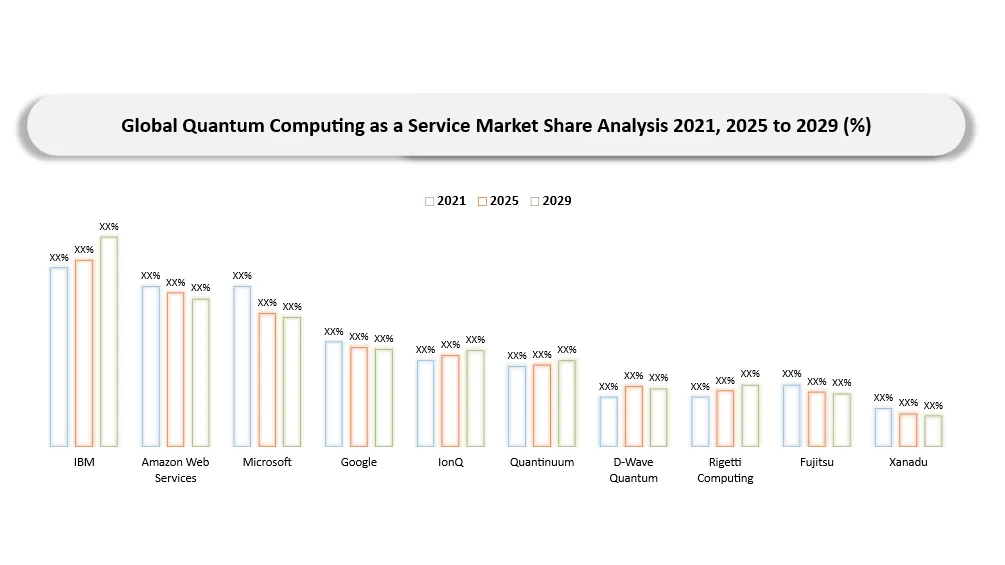
- Cloud Platform Competition: Leading cloud service providers are in a race to give access to a variety of quantum computing hardware options through their unified QCaaS offerings, thereby making multi-QPU availability, interoperability and ease of use key differentiators.
- Hardware-Agnostic Service Models: In this area, vendors are focusing on differentiation through platforms that enable customers to run tests across multiple architectures including superconducting, trapped ion, photonic QPUs, etc. and not becoming dependent on a single quantum technology.
- Hybrid Quantum-Classical Integration: Competition is shifting toward hybrid models where QPUs are integrated with CPUs, GPUs, HPC systems and other cloud services thus allowing enterprises to implement their tasks using both classical and quantum computing methodologies.
- Application-Specific Quantum Solutions: Companies are transitioning from simply providing QPU access towards offering custom advantages for areas like financial optimization, molecular modeling, logistics, material discovery and operations scheduling, thus increasing the overall commercialization prospects of QCaaS.
- Performance and Commercialization Differentiation: As physical access to QPU becomes more widespread, the emphasis on hardware accessibility transitions to competitive factors such as reliability, error correction, circuit execution, prices, software development and quantum effectiveness.
Key Companies of Quantum Computing as a Service Market
- IBM (U.S.)
- Amazon Web Services (U.S.)
- Microsoft (U.S.)
- Google (U.S.)
- D-Wave Quantum (Canada)
- IonQ (U.S.)
- Quantinuum (U.S.)
- Rigetti Computing (U.S.)
- Fujitsu (Japan)
- Alibaba Cloud (China)
- Huawei Cloud (China)
- Xanadu (Canada)
- Pasqal (France)
- QuEra Computing (U.S.)
- Quantum Computing Inc. (U.S.)
- Oxford Quantum Circuits (U.K.)
- QC Ware (U.S.)
- Classiq (Israel)
- IQM Quantum Computers (Finland)
- qBraid (U.S.)
Quantum Computing as a Service Market Major Pain Points
- Uncertain Quantum Advantage for Enterprise Workloads: It is still unclear for some organizations as to whether the implementation of quantum technology will produce any tangible results with regards to efficiency and costs compared to already existing CPU, GPU and high-performance computing solutions. This slows the transition from piloting to repeatable applications of QCaaS.
- QPU Performance Variability and Error Rates: There are tendencies of performance inconsistency due to the factors of noise and decoherence, constrained circuit depth and different designs of qubits which makes applications of quantum technology difficult for businesses that depend on predictable results.
- Fragmented Quantum Hardware Architectures: The designs of superconducting, trapped ion, photonic and other systems of QPU differ in programming environments and execution methods which complicates the process of choosing the best backend process and conducting portable workloads.
- Limited Availability of Quantum-Ready Applications: Organizations frequently have insufficient developed algorithms and processes that enable their current commercial challenges to be converted into usable quantum processes, especially outside of the primarily experimentation areas of optimization and simulation work.
- Complexity of Integrating QCaaS Into Existing IT Infrastructure: The linking of QPUs with cloud systems, GPUs, HPC environments, enterprise software and data pathways may require additional orchestration and quantum software knowledge, which makes deployment take longer and adds to operational difficulties.
Quantum Computing as a Service Market Recent Developments
- January 2025: qBraid enhanced its developer platform with unified cross-compilation capabilities for superconducting, photonic and neutral atom quantum computer hardware, which helped improve development of quantum applications in a hardware agnostic manner.
- February 2025: Microsoft worked with Atom Computing to showcase reliable logical qubits on neutral atom quantum computer hardware within Azure Quantum, which helped develop cloud-based quantum computers.
- March 2025: D-Wave launched the commercial release of its Advantage2 quantum annealing processor on its Leap cloud platform, making quantum computing available to enterprises for use in optimization applications.
- May 2025: Xanadu issued major releases to PennyLane with automated circuit compilation and compilation pipelines for fault-tolerant photonic architectures, boosting the capabilities of quantum software in the cloud.
- January 2026: IonQ declared that it would acquire SkyWater Technology, an integrated platform for quantum computers, in a deal worth about US$1.8 billion, which would provide better control over the quantum chip’s design, production and logistics.
Analyst View / Opinion on Quantum Computing as a Service Market
- The increased use of QCaaS is likely as cloud accessibility eliminates the complexities associated with acquiring and maintaining dedicated quantum infrastructure thus allowing companies to experiment with quantum workloads before investing heavily in the technology.
- The competitive landscape will evolve as the focus shifts from providing access to QPUs to the results obtained through workload execution. Companies that manage to show that their QPUs execute more complex circuits, achieve better errors correction processes and are more efficient using hybrid solutions will have a better chance to become successful in providing continuous service to experimental clients.
- Accessibility to multiple QPUs will be a key advantage. Companies will prefer vendors that will provide access to a variety of quantum architectures allowing them to evaluate the results of their attempts and avoid relying on a single type of technology.
- Commercial adoption will be driven by applications instead of technology. The main areas driving demand will be finance, pharmaceuticals, chemicals, logistics, automotive and advanced materials since there are optimization and simulation problems that can be targeted using quantum resources.
- The market evolution is likely to steer towards managed quantum solutions rather than standalone access to QPU. Providers with quantum hardware access combined with software development tools, workload orchestration techniques, error mitigation knowledge, cloud/HPC integration and application support will gain a bigger share of the market.
Quantum Computing as a Service Market Target Audience
| INDUSTRY | WHO SHOULD BUY THIS REPORT? | REASON TO BUY THIS REPORT |
| Cloud Computing & Hyperscalers | Cloud strategy leaders, platform executives, infrastructure planners | Assess QCaaS demand, competitive positioning, QPU capacity requirements, pricing models and opportunities to expand quantum-cloud offerings. |
| Quantum Technology Providers | CEOs, product managers, quantum platform teams | Evaluate market growth, hardware-access models, application demand, provider competition and opportunities to differentiate QCaaS platforms. |
| Enterprise Technology & IT | CIOs, CTOs, enterprise architects, innovation teams | Identify commercially relevant quantum workloads and evaluate when cloud-based quantum access can complement existing CPU, GPU and HPC infrastructure. |
| Financial Services | Digital transformation leaders, quantitative teams, innovation heads | Assess opportunities for portfolio optimization, risk analysis, pricing and other computationally intensive financial applications delivered through QCaaS. |
| Pharmaceuticals & Biotechnology | R&D leaders, computational scientists, technology strategists | Evaluate QCaaS opportunities for molecular simulation, drug discovery, optimization and chemistry-related workloads without investing directly in quantum hardware. |
| Logistics & Transportation | Supply-chain executives, optimization teams, technology leaders | Assess the potential of quantum optimization for routing, scheduling, fleet allocation and other complex logistics problems. |
| Chemicals & Advanced Materials | R&D directors, materials scientists, innovation managers | Identify quantum simulation opportunities and assess QCaaS providers capable of supporting materials and molecular modeling workloads. |
| Energy & Utilities | Digital innovation leaders, computational research teams | Evaluate quantum applications in grid optimization, energy portfolio management, resource allocation and complex simulation workloads. |
| Investors & Financial Institutions | Venture capital, private equity, corporate investment and strategy teams | Assess QCaaS market attractiveness, provider positioning, investment opportunities, commercialization risks and emerging revenue models. |
| Government & Research Organizations | Quantum-program managers, research directors, technology policymakers | Evaluate quantum-cloud infrastructure requirements, national ecosystem development, research access and commercialization opportunities. |
Why Choose DATAM?
- Data-Driven insights: Dive into detailed analyses with granular insights such as pricing, market shares and value chain evaluations, enriched by interviews with industry leaders and disruptors.
- Post-Purchase Support and Expert Analyst Consultations: As a valued client, gain direct access to our expert analysts for personalized advice and strategic guidance, tailored to your specific needs and challenges.
- White Papers and Case Studies: Benefit quarterly from our in-depth studies related to your purchased titles, tailored to refine your operational and marketing strategies for maximum impact.
- Annual Updates on Purchased Reports: As an existing customer, enjoy the privilege of annual updates to your reports, ensuring you stay abreast of the latest market insights and technological advancements. Terms and conditions apply.
- Specialized Focus on Emerging Markets: DataM differentiates itself by delivering in-depth, specialized insights specifically for emerging markets, rather than offering generalized geographic overviews. The approach equips our clients with a nuanced understanding and actionable intelligence that are essential for navigating and succeeding in high-growth regions.
- Value of DataM Reports: Our reports offer specialized insights tailored to the latest trends and specific business inquiries. The personalized approach provides a deeper, strategic perspective, ensuring you receive the precise information necessary to make informed decisions. The insights complement and go beyond what is typically available in generic databases.
What DATAM Uniquely Provides
- QCaaS-Specific Market Sizing: Determines the market for the quantum computing technology, which uses cloud-based solutions for quantum access technologies, as well as QPU utilization, quantum software, managed services and hybrid quantum-classical environments.
- Quantum Architecture-Level Analysis: Assesses and analyzes how various QPU technologies, such as superconducting technology and trapped-ion technology, affect market positioning of any service provider, accessibility of technology, workload suitability and the level of organizational adoption of the quantum computing solutions.
- Enterprise Use-Case Intelligence: Links demand for QCaaS with specific scenarios that can be implemented for various applications like portfolio optimization, logistics optimization and materials identification to define areas for hiking commercial interest in any quantum technology.
- Provider and Platform Benchmarking: Involves the comparison of QCaaS providers in terms of QPU accessibility, ability to support multiple backends, available software ecosystem, integration with cloud/HPC services, ability to mitigate errors, pricing mechanisms and readiness for the enterprise.
- Commercialization and Quantum-Advantage Assessment: Involves the differentiation of the following activities: research experiments, proof-of-concept activities and continuous commercial workloads in terms of the level of quantum advantage and economic return on investment associated with their adoption of QCaaS technology.


























































