


PVC Stabilizer Market Size and Overview
The global PVC Stabilizer market reached an estimated US$ 4.72 billion in 2025 and is projected to reach US$ 7.52 billion by 2035, expanding at a CAGR of 4.8% during 2026-2035. The market supports the processing and long-term durability of rigid and flexible PVC used across construction, electrical, packaging, automotive, healthcare and consumer applications. The value pool includes primary stabilizers, co-stabilizers, and formulated one-pack systems supplied with technical support, quality documentation and application-specific performance guarantees.
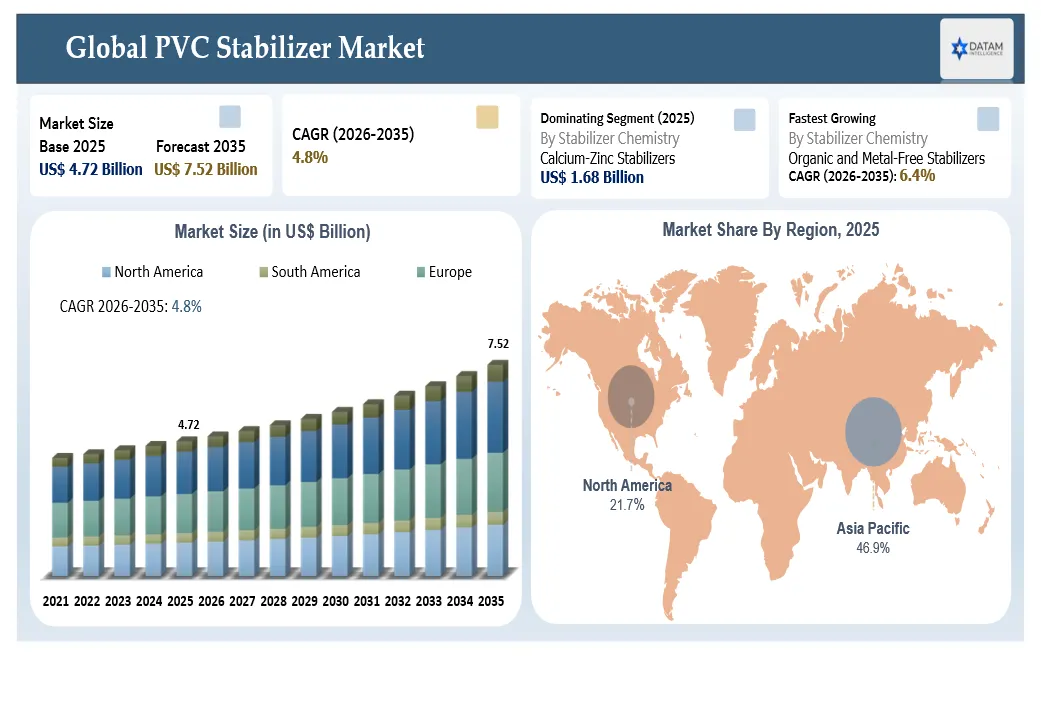
Calcium-zinc systems represent the largest and most strategically important chemistry because they have become the default lead-free option for pipes, profiles, cables and many flexible-PVC applications. Organotin stabilizers retain a high-value position in clarity-critical rigid PVC, sheet, film, bottles and selected food-contact uses, particularly in North America and parts of Asia. Organic and metal-free systems are growing from a smaller base as buyers seek lower-toxicity formulations and better compatibility with circularity goals.
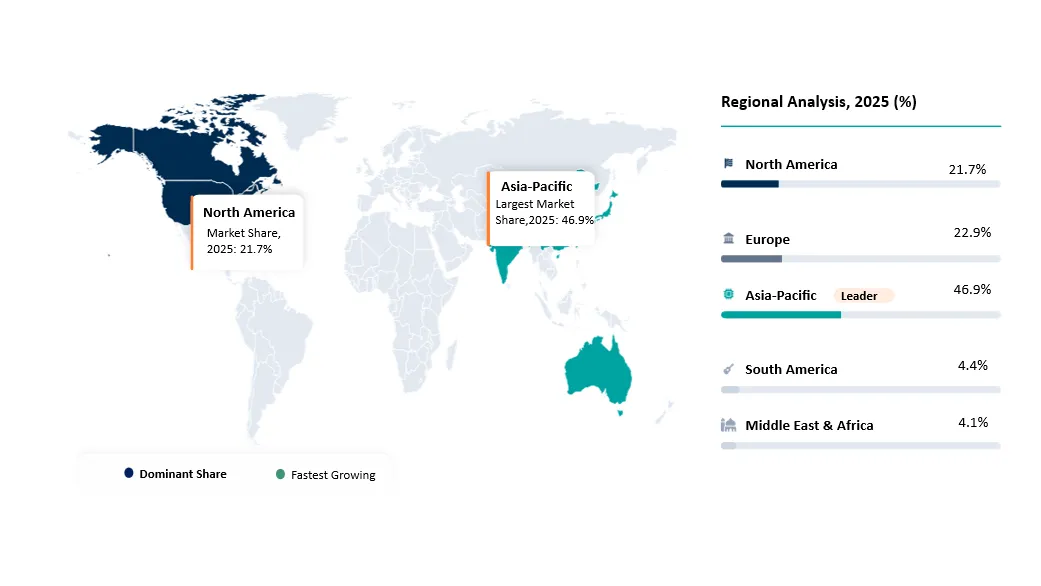
Asia-Pacific leads global consumption through large PVC production and conversion capacity in China, India, Japan, South Korea and Southeast Asia. Europe remains the most advanced market for lead-free and recycling-compatible stabilizer systems, while North America has a strong organotin and specialty-formulation base. Growth through 2035 will be determined by infrastructure spending, cable demand, construction-product specifications, medical and packaging regulation, recycled-PVC integration and the ability of suppliers to match legacy performance at competitive total cost.
PVC Stabilizer Market Key Takeaways
- Calcium-zinc stabilizers accounted for an estimated 48.6% of global revenue in 2025 and are forecast to expand at 6.0% through 2035 as lead-free specifications spread across pipes, profiles and cables.
- Asia-Pacific held approximately 46.9% of the market in 2025, supported by the region’s dominant PVC resin, pipe, profile and cable manufacturing base.
- Building and construction represented about 54.2% of end-use demand in 2025 because pipes, fittings, window profiles, flooring and membranes require stabilizer packages with long service-life performance.
- Rigid PVC applications accounted for an estimated 61.5% share in 2025, while recycled PVC compounds are expected to grow at 7.4% as traceability and formulation technology improve.
- Pipes and fittings held approximately 29.8% of application revenue in 2025 due to water, sewer, drainage, conduit and industrial-piping demand.
- Organic and metal-free stabilizers are expected to record a CAGR of 7.1% from a smaller base, driven by medical, food-contact, specialty flexible PVC and sustainability-focused applications.
- North America represented an estimated 21.7% share in 2025, supported by organotin use in rigid PVC and a mature construction-products industry.
- Integrated one-pack systems are forecast to grow at 6.5% because processors value dosing accuracy, lower formulation complexity and supplier accountability.
PVC Stabilizer Industry Trends and Strategic Insights
- The market is moving from individual additives toward application-engineered one-packs combining stabilizers, lubricants, co-stabilizers and processing aids.
- Lead-free conversion is continuing beyond Europe as multinational buyers and export-oriented processors standardize calcium-zinc specifications across global plants.
- Recycled PVC is becoming a formulation variable. Stabilizers must manage legacy additives, variable heat histories and color while supporting traceability and repeatable processing.
- Organotin remains defensible where clarity, low dosage and rigid-PVC performance justify a premium, although regulatory scrutiny encourages suppliers to improve stewardship and migration control.
- Bio-based epoxides, beta-diketones, polyols, hydrotalcites and other co-stabilizers are being used to improve long-term heat stability and reduce metal content.
- Granular and low-dust forms are gaining share because processors seek cleaner handling, improved dosing and reduced worker exposure.
- Digital quality control is improving batch consistency through inline color measurement, torque monitoring, thermal-aging analytics and predictive formulation adjustment.
- Regional technical-service centers are becoming important because stabilizer performance depends on resin grade, filler loading, equipment condition and local processing conditions.
FOR INSTANCE: European Commission Regulation (EU) 2023/923 applies a 0.1% lead limit to PVC articles from 29 November 2024. It also establishes specific conditions for recovered rigid PVC, including traceability, marking and application restrictions that become increasingly important from 2026.
PVC Stabilizer Market Scope
| Metric | Details |
| 2025 Market Size | US$ 4.72 Billion |
| 2035 Projected Market Size | US$ 7.52 Billion |
| CAGR (2026-2035) | 4.8% |
| Largest Market | Asia-Pacific |
| Fastest Growing Market | Asia-Pacific |
| By Stabilizer Chemistry | Calcium-Zinc, Organotin, Mixed Metal, Organic/Metal-Free, Hydrotalcite/LDH, Lead-Based and Other Specialty Systems |
| By Physical Form | Powder, Granules/Flakes, Liquid, Paste and Integrated One-Pack Systems |
| By PVC Type | Rigid PVC, Flexible PVC, CPVC/Specialty Vinyls and Recycled PVC Compounds |
| By Application | Pipes, Profiles, Wire and Cable, Flooring, Film/Sheet, Medical, Automotive and Other Applications |
| By End Use | Construction, Electrical, Packaging, Automotive, Healthcare, Consumer Goods, Industrial and Agriculture |
| By Sales Channel | Direct, Distributors, Compounders/Masterbatch Partners and Digital/Other Channels |
Why does this report matter in 2026?
The year 2026 is important because the PVC stabilizer market is moving from broad lead-free intent toward enforceable product, recycling and traceability requirements. European rules now combine a strict lead limit with specific conditions for recovered rigid PVC. From 28 May 2026, certain recovered rigid PVC streams are restricted to defined profile and sheet categories, increasing the need for material identification, formulation control and documentation. Export-oriented producers outside Europe must understand these requirements because non-compliant PVC articles can lose access to high-value customers.
At the same time, processors are under pressure to preserve output, color, weatherability and service life while changing chemistry. The commercial question is no longer whether lead-free conversion will occur, but which calcium-zinc, organic, tin or hybrid system offers the best total cost for a specific application. This report separates high-volume construction demand from clarity-critical packaging, flexible cable, medical and recycled-PVC opportunities so suppliers can prioritize technical development and sales resources.
The report also matters for investment planning. New stabilizer capacity must be located near PVC conversion clusters, supported by reliable metal soaps, organic co-stabilizers and specialty raw materials. Suppliers that invest in application laboratories, low-dust forms and recycling-compatible systems can capture value beyond commodity additives. Buyers can use the analysis to benchmark chemistry risk, regional regulation, supplier concentration and qualification timelines.
PVC Stabilizer Market White Space & Investment Opportunities
- High-performance calcium-zinc systems for pressure pipe, profiles, cable insulation and high-filler formulations that require stronger long-term heat stability.
- Organic and metal-free systems for sensitive medical, food-contact, consumer and sustainability-driven applications.
- Recycling-compatible stabilizers that control color, residual acidity and variable thermal history in post-consumer rigid PVC.
- Low-dust granules and integrated one-packs that improve dosing, housekeeping, worker safety and formulation consistency.
- Bio-based co-stabilizers and circular feedstocks such as epoxidized oils, polyols and waste-derived acid scavengers.
- Regional application laboratories and toll-manufacturing partnerships in India, Southeast Asia, the Middle East and Latin America.
- Digital formulation tools that connect laboratory testing with line speed, torque, color and weathering performance.
- Potable-water, medical and food-contact systems backed by migration testing, certification and traceable raw-material control.
FOR INSTANCE: A 2026 peer-reviewed review in the Journal of Vinyl and Additive Technology highlighted calcium-zinc packages supported by epoxides, beta-diketones and polyols, while also identifying rare-earth carboxylates and PET-waste-derived stabilizing compounds as emerging research directions.
PVC Stabilizer Future Market Transformation
The market will transform from chemistry substitution toward system optimization. Early lead-free conversion focused on replacing a prohibited stabilizer. Future development will optimize the full additive package for energy use, output, scrap, recycling and end-of-life compliance. Suppliers will increasingly sell formulation platforms with defined processing windows rather than standalone metal soaps.
Recycled PVC will become a larger design constraint. Stabilizer systems will need to tolerate variation in polymer history and residual additives while maintaining color and mechanical properties. This will increase demand for analytical screening, feedstock classification and targeted co-stabilizer packages. It will also strengthen partnerships between recyclers, compounders and stabilizer manufacturers.
By 2035, competition will be shaped by application specialization. High-volume pipe and profile systems will reward cost and processing efficiency, while medical, packaging and transparent rigid PVC will reward purity and migration control. Digital dosing, closed handling and predictive quality systems will improve consistency. Companies that combine scale with local formulation support will have the strongest position.
PVC Stabilizer Market Buyer Decision-Making Criteria
PVC processors prioritize thermal stability, initial color, long-term color hold, plate-out, lubrication balance, surface finish and mechanical-property retention. The stabilizer must perform with the buyer’s resin, filler, pigment, impact modifier and equipment configuration. A technically strong product can still lose adoption if it requires lower throughput or frequent cleaning.
Compliance is a second major criterion. Buyers assess heavy-metal content, food-contact or potable-water suitability, migration data, safety documentation and consistency with customer restricted-substance lists. Recycled-PVC users also require traceability and evidence that the stabilizer supports repeated processing without accelerating degradation.
Total cost and supplier support complete the decision. Processors compare dosage, scrap, line speed, energy, inventory complexity and technical-service response. Direct suppliers with regional stock, laboratory support and problem-solving capability are favored in critical applications. Smaller buyers may rely on distributors that provide local inventory and blended one-packs.
PVC Stabilizer Market Economic & Investment Analysis
The market combines commodity-volume economics with application-specific specialty margins. Standard calcium-zinc systems for construction products compete on scale, raw-material purchasing and processing cost. Higher margins are available in transparent rigid PVC, medical, food-contact, high-temperature cable and advanced recycled-PVC applications where qualification, documentation and technical support create switching barriers.
Investment economics depend on formulation flexibility. Facilities that can produce powders, granules, liquids and custom one-packs across several applications achieve better utilization than single-product plants. Capital is required for metal-soap synthesis, blending, dust control, granulation, liquid handling, quality laboratories and compliant storage. Regional plants reduce freight and response time because many stabilizers are bulky and application troubleshooting is time sensitive.
Raw-material exposure should be modeled by chemistry. Calcium-zinc systems are influenced by fatty acids, zinc compounds, calcium compounds and organic co-stabilizers. Organotin economics depend on tin prices and specialized intermediates. Liquid mixed metals require controlled sourcing of barium, zinc and other components. Companies with formulation flexibility can adjust metal content and co-stabilizer balance while preserving performance.
Investment valuation should distinguish legacy replacement from underlying PVC growth. Lead-free substitution creates higher-value demand even when PVC volume is stable, while infrastructure and electrification create incremental volume. Recycled-PVC systems represent a third growth layer. The best assets combine a broad customer base, recurring qualification, proprietary know-how and local technical service.
PVC Stabilizer Investment Trends in the Market
- Capital is moving toward calcium-zinc and organic systems that meet global lead-free requirements and customer restricted-substance lists.
- Suppliers are expanding granulation and low-dust production to improve handling and worker-safety performance.
- Application laboratories are receiving investment because customer qualification requires extrusion, weathering, migration and long-term heat testing.
- Companies are developing recycling-compatible one-packs for profiles, pipes, flooring and cable compounds containing post-consumer PVC.
- Investment is rising in bio-based epoxides, polyols and other organic co-stabilizers that reduce metal loading and improve sustainability positioning.
- Regional manufacturing and warehousing are expanding near PVC clusters in China, India, Southeast Asia, the Middle East and North America.
- Digital batch control, automated dosing and inline color analytics are being adopted to improve lot-to-lot consistency.
- Distributors and compounders are forming partnerships with stabilizer producers to offer localized formulations and smaller minimum order quantities.
Strategic Indicators for PVC Stabilizer Market
High Regulation Impact
Lead, cadmium, organotin, food-contact, potable-water and worker-exposure rules shape chemistry selection. Suppliers need robust documentation and must anticipate customer standards that can be stricter than legal minimums.
High Investment Activity
Investment is concentrated in lead-free calcium-zinc systems, low-dust granules, organic co-stabilizers, recycling-compatible formulations and regional technical centers.
Supply Chain Disruption
Tin, zinc compounds, specialty fatty acids, hydrotalcites and organic co-stabilizers can face price or logistics disruption. Dual sourcing and flexible formulation reduce risk.
Pricing Volatility
Organotin pricing is especially sensitive to tin markets. Calcium-zinc systems are influenced by metal compounds, energy and organic co-stabilizers. Buyers increasingly use formula-based or indexed contracts.
Procurement Pressure
Large pipe, profile and cable manufacturers seek lower dosage, stable output and multi-year pricing. They also require rapid technical response and regional inventory.
New Technology Adoption
Low-dust forms, metal-free systems, bio-based co-stabilizers, recycling analytics and digital formulation tools are changing product development and customer service.
Regional Expansion Opportunity
India, Southeast Asia, the Middle East and Latin America offer growth through construction, cable and infrastructure demand combined with gradual lead-free conversion.
Government Policy Support
Infrastructure programs support PVC demand, while chemical-safety and circular-economy policies accelerate stabilizer reformulation.
Pricing Intelligence
Pricing should be compared on cost per tonne of finished PVC, including dosage, line speed, scrap, cleaning and compliance costs, rather than additive price alone.
AI Impact Analysis of PVC Stabilizer Market
AI can accelerate formulation development by linking stabilizer chemistry with torque, color, heat-aging, plate-out and weathering data. Machine-learning models can predict which combinations of metal soaps, polyols, epoxides and lubricants are most likely to meet a target processing window. In production, AI supports batch-release analytics, anomaly detection and predictive maintenance for blending and granulation equipment. Customer-facing systems can recommend dosage changes based on resin grade, filler level, equipment and application requirements. Adoption will depend on high-quality experimental data and protection of proprietary formulations.
Disruption Analysis of PVC Stabilizer Market
The main disruption is the move away from lead and other high-concern substances toward calcium-zinc, organic and hybrid systems. This shift changes raw-material demand, technical-service requirements and competitive positioning. Recycling creates a second disruption because stabilizers must manage feedstock variability and legacy additives. Integrated one-packs disrupt traditional multi-component purchasing by transferring formulation responsibility to the supplier. Digital dosing and quality monitoring may further favor larger suppliers that can combine chemistry, data and regional service.
PVC Stabilizer Market BCG Matrix: Company Evaluation
| Category | Representative Companies | Strategic Position |
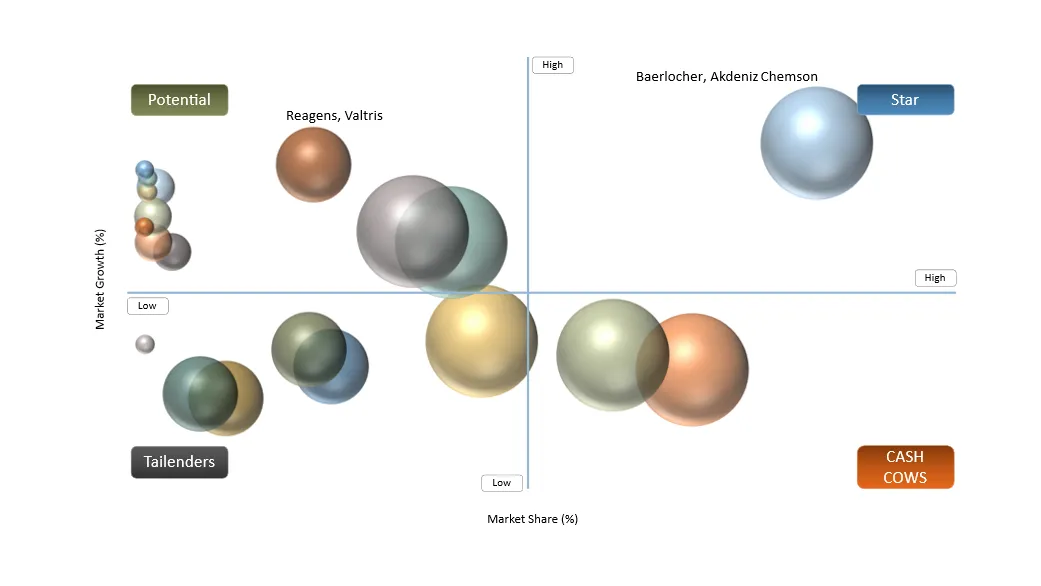
| Stars | Baerlocher, Akdeniz Chemson, SONGWON | Broad lead-free portfolios, global technical support and strong positions in construction and cable applications. |
| Potential | Reagens, Valtris, Adeka, Pau Tai | Specialty chemistry, regional growth or differentiated organotin and calcium-zinc platforms with expansion potential. |
| Cash Cows | Established regional mixed-metal and organotin suppliers | Mature customer relationships and recurring demand in legacy or application-specific segments. |
| Tailenders | Small lead-focused and undifferentiated powder suppliers | High regulatory exposure, limited application support and pressure from customer conversion. |
Baerlocher and Akdeniz Chemson are positioned as Stars because they combine scale, application breadth and established lead-free technology. SONGWON benefits from a broad polymer-additives platform and regional reach. Reagens, Valtris, Adeka and specialized Asian suppliers are Potential players where technical differentiation or regional expansion can increase share. Legacy lead-focused suppliers face declining demand unless they invest in calcium-zinc, organic or recycling-compatible systems.
PVC Stabilizer Market Dynamics
| Driver | Growth Impact | Demand Concentration | Strategic Impact |
| Lead-free conversion | High | Pipes, profiles, cables and export-oriented PVC | Accelerates calcium-zinc and organic system qualification. |
| Infrastructure and housing demand | High | Asia-Pacific, Middle East and North America | Supports pipes, fittings, profiles, flooring and conduit. |
| Electrification and cable investment | Medium-High | Wire and cable compounds | Raises demand for long-term heat and electrical performance. |
| Recycled PVC integration | Medium-High | Profiles, flooring, pipes and sheets | Creates demand for formulation control and traceability. |
Driver: Accelerating Transition Toward Lead-Free Stabilizer Systems
Lead-free conversion is being reshaped by regulatory limits, global customer standards and the need to improve recyclability. PVC stabilizers are technically essential because polyvinyl chloride begins to dehydrochlorinate under processing heat, which can cause discoloration, loss of mechanical performance and unstable extrusion. Suppliers therefore compete on initial color, long-term heat stability, plate-out behavior, weatherability, electrical properties, migration performance and compatibility with lubricants, impact modifiers, fillers and pigments. Commercial adoption also depends on whether a stabilizer can run on existing equipment without reducing line speed or increasing scrap. Buyers increasingly evaluate the total formulation and processing cost rather than the price per kilogram, creating an advantage for one-pack systems backed by application laboratories and on-site technical service. The strongest opportunities occur where regulation, durability and process efficiency align, especially in pipes, profiles, wire and cable, flooring, medical products and food-contact applications.
FOR INSTANCE: European industry sources identify calcium-based stabilizers as the most widely used stabilizer family in Europe, with major use in wires and cables, window profiles and multiple pipe categories.
| Restraint | Drag on Growth | Primary Impact Area | Strategic Impact |
| Formulation complexity | High | Qualification and process optimization | Raises development cost and slows switching. |
| Tin and specialty raw-material volatility | Medium-High | Organotin and hybrid systems | Creates price risk and inventory pressure. |
| Inconsistent recycled PVC feedstock | Medium | Recycling-compatible compounds | Increases testing and formulation variability. |
| Fragmented regulation | Medium | Global product portfolios | Requires region-specific documentation and chemistry choices. |
Restraint: Formulation Complexity and Qualification Costs
Formulation complexity is being reshaped by the need to balance stabilization, lubrication, color, weathering and end-use compliance across different PVC recipes. PVC stabilizers are technically essential because polyvinyl chloride begins to dehydrochlorinate under processing heat, which can cause discoloration, loss of mechanical performance and unstable extrusion. Suppliers therefore compete on initial color, long-term heat stability, plate-out behavior, weatherability, electrical properties, migration performance and compatibility with lubricants, impact modifiers, fillers and pigments. Commercial adoption also depends on whether a stabilizer can run on existing equipment without reducing line speed or increasing scrap. Buyers increasingly evaluate the total formulation and processing cost rather than the price per kilogram, creating an advantage for one-pack systems backed by application laboratories and on-site technical service. The strongest opportunities occur where regulation, durability and process efficiency align, especially in pipes, profiles, wire and cable, flooring, medical products and food-contact applications.
PVC Stabilizer Market Segmentation Analysis
The global PVC Stabilizer market is segmented by Stabilizer Chemistry, Physical Form, PVC Type, Application, End-Use Industry, Sales Channel and region.
By Stabilizer Chemistry
Calcium-Zinc Stabilizers Will Lead the Market
Calcium-zinc systems will remain the largest chemistry through 2035 because they provide the broadest commercially accepted replacement for lead across pipes, profiles, cable, flooring and flexible compounds. Modern one-packs use optimized metal soaps, hydrotalcites, polyols, beta-diketones and lubricants to improve initial color and long-term heat stability. Organotin retains a premium position in transparent rigid PVC and selected packaging applications, while organic and metal-free systems grow fastest in sensitive applications. Legacy lead stabilizers continue to decline because legal restrictions and customer standards increasingly prevent their use.
By Physical Form
Integrated One-Pack Systems Will Record the Fastest Growth
Integrated one-packs combine stabilizers with lubricants and co-stabilizers, reducing dosing errors and transferring formulation responsibility to the supplier. Powders remain important because they are flexible and cost effective, but dust and handling concerns support granules and flakes. Liquid stabilizers are essential in plastisol, flooring, film and other flexible-PVC applications. Product-form choice depends on plant equipment, batch size, worker exposure, storage and required dispersion.
By PVC Type
Rigid PVC Will Remain the Largest Demand Base
Rigid PVC leads because pipes, fittings, profiles, windows, doors, sheet and bottles use significant volumes of stabilizer and require long service life. Flexible PVC remains a diverse market across cables, flooring, films, medical tubing and coated fabrics. Recycled PVC compounds will grow fastest as construction products integrate more recovered material. These compounds require stabilizers that manage residual acidity, color and repeated thermal history.
By Application
Pipes and Fittings Will Retain the Largest Share
Pipes and fittings represent the largest application because municipal water, sewer, drainage, irrigation, conduit and industrial systems depend on durable PVC. Calcium-zinc systems dominate many pipe categories, while organotin and specialty systems serve specific rigid applications. Profiles and windows are another major segment with demanding weatherability and color requirements. Wire and cable will grow with electrification, renewable energy, construction and data infrastructure.
By End-Use Industry
Building and Construction Will Continue to Dominate
Construction accounts for the majority of demand through pipes, profiles, flooring, roofing membranes, wall coverings and cable conduit. Electrical and electronics is a high-value segment because insulation compounds require heat stability, electrical performance and flame-retardant compatibility. Healthcare and packaging are smaller but technically demanding because migration, purity and regulatory documentation are critical. Automotive demand is supported by wire harnesses, seals, trim and underbody components.
By Sales Channel
Direct Sales Will Control High-Value Accounts
Direct sales lead among large pipe, profile, cable and flooring manufacturers because qualification requires laboratory work, plant trials and ongoing technical service. Distributors are important for smaller converters and geographically dispersed customers. Compounder and masterbatch partnerships allow suppliers to reach processors that buy ready-to-use PVC compounds. Digital channels support repeat orders and documentation but are unlikely to replace technical selling in critical applications.
PVC Stabilizer Market Geographical Penetration
| Region | 2025 Share | 2035 Direction | Key Trend |
| North America | 21.7% | Steady growth | Organotin strength, construction demand and specialized medical/packaging formulations. |
| Europe | 22.9% | Compliance-led growth | Lead restriction, recycled-PVC traceability and advanced calcium-zinc adoption. |
| Asia-Pacific | 46.9% | Largest and fastest growing | Large PVC conversion base, infrastructure demand and gradual lead-free transition. |
| South America | 4.4% | Selective growth | Construction and cable demand with price-sensitive formulation choices. |
| Middle East and Africa | 4.1% | Emerging growth | Pipe, irrigation, cable and building-material investment. |
U.S. PVC Stabilizer Market Landscape
The U.S. is a major organotin and specialty-stabilizer market because rigid PVC sheet, film, bottles and construction products require strong heat stability and clarity. Calcium-zinc use is expanding in cable, flexible compounds and lead-free construction applications. Demand is supported by housing, infrastructure, electrical investment and medical products. Buyers emphasize FDA, NSF, UL and customer-specific compliance where applicable.
Germany PVC Stabilizer Market Outlook
Germany is a leading European market for calcium-zinc and recycling-compatible systems. Window profiles, pipes, flooring and cable producers operate under strict chemical and circularity requirements. Suppliers compete through low-emission formulations, weathering performance and support for recycled rigid PVC. Technical qualification and documentation are central to market access.
China PVC Stabilizer Market Trends
China is the largest national market because it combines extensive PVC resin, pipe, profile, cable, flooring and consumer-product production. The market includes advanced calcium-zinc and organotin systems alongside lower-cost legacy products. Export requirements, domestic environmental standards and large infrastructure demand are accelerating higher-performance lead-free adoption.
India PVC Stabilizer Market Outlook
India is one of the fastest-growing markets due to water infrastructure, irrigation, housing, electrical cable and domestic PVC capacity. The market is moving from lead-based systems toward calcium-zinc, although cost and equipment differences affect the pace of conversion. Local manufacturing, distributor networks and application service are major competitive advantages.
Japan and South Korea Market Trends
Japan and South Korea emphasize high-purity, reliable and application-specific stabilizers for automotive, electronics, medical, cable and specialty industrial PVC. Buyers favor strong documentation and consistent quality. Opportunities are concentrated in low-emission systems, specialty organotin, calcium-zinc and advanced co-stabilizers.
Brazil PVC Stabilizer Market Outlook
Brazil has meaningful demand from construction, pipe, cable, footwear and flexible PVC. Market growth depends on infrastructure and housing cycles. Suppliers that can provide cost-effective lead-free systems, local inventory and technical service can gain share as specifications improve.
Middle East and Africa Market Outlook
The region offers growth through water, sewer, irrigation, building and cable investment. Gulf markets increasingly specify internationally compliant lead-free products, while parts of Africa remain price sensitive. Regional blending, distributor partnerships and technical training can improve market penetration.
FOR INSTANCE: From 28 May 2026, the EU requires certain recovered rigid PVC streams from profiles and sheets to be used only in defined profile and sheet categories, making traceability and closed-loop recycling strategy more important for European converters and their stabilizer suppliers.
PVC Stabilizer Market Competitive Landscape
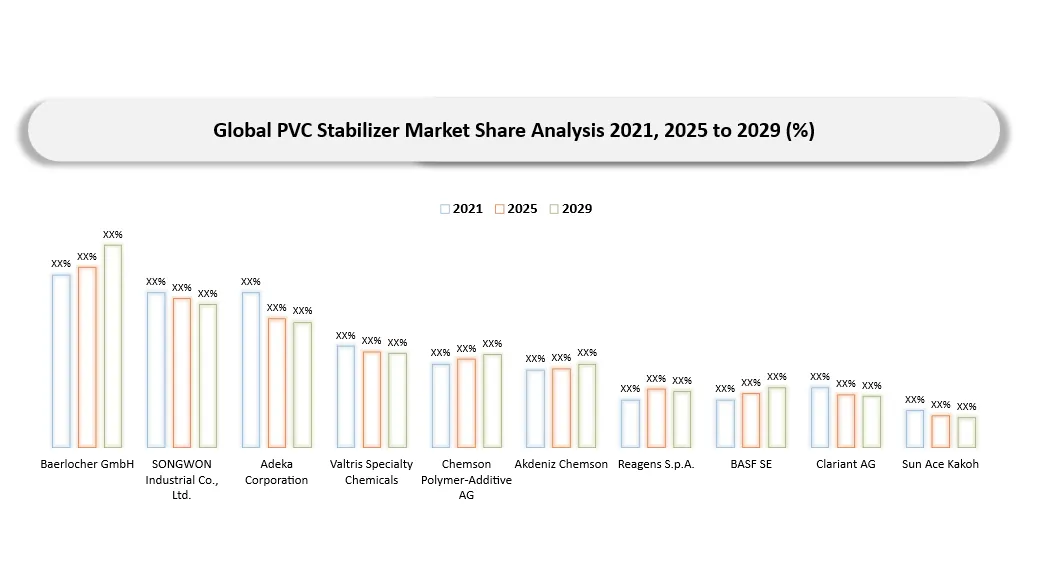
- Competition is led by global and regional specialists with proprietary calcium-zinc, organotin, liquid mixed-metal and one-pack portfolios.
- Application laboratories and field technical service are key differentiators because stabilizer performance is highly formulation and equipment dependent.
- Global suppliers compete on consistent quality and multi-region supply, while regional suppliers compete on cost, customization and faster delivery.
- Partnerships with compounders, distributors, recyclers and equipment suppliers expand market reach and accelerate qualification.
- Market share will shift toward suppliers with lead-free breadth, recycling expertise, low-dust product forms and strong regulatory documentation.
Competitive intensity differs by application. High-volume pipe and profile systems face price pressure but create large recurring demand. Transparent rigid PVC and medical applications have higher qualification barriers and premium margins. Smaller regional suppliers remain important because customers often require localized formulations. Consolidation is likely where companies seek scale, application laboratories and access to new geographies.
Key Companies of PVC Stabilizer Market
- Baerlocher GmbH
- SONGWON Industrial Co., Ltd.
- Adeka Corporation
- Valtris Specialty Chemicals
- Chemson Polymer-Additive AG
- Akdeniz Chemson
- Reagens S.p.A.
- Pau Tai Industrial Corporation
- Sun Ace Kakoh
- Nitto Kasei Co., Ltd.
- Shandong Huike Additives
- Zhejiang Jiaao Enprotech
- Jiangsu Union Chemical
- Beijing Stable Chemical
- Patcham FZC
- Galata Chemicals
- Kisuma Chemicals
- PMC Organometallix
- BASF SE
- Clariant AG
PVC Stabilizer Market Major Pain Points
- Matching lead or organotin performance in demanding formulations without reducing line speed.
- Managing raw-material and tin-price volatility.
- Qualifying new systems across multiple resin grades, fillers and processing lines.
- Controlling dust, handling and worker exposure in powder products.
- Maintaining color and thermal stability in recycled PVC with variable history.
- Navigating region-specific restrictions, migration limits and customer standards.
- Providing local technical support to geographically dispersed converters.
- Balancing additive cost with total processing economics and long-term durability.
PVC Stabilizer Market Recent Developments
- August 2026: New market analysis highlighted continued expansion of calcium-zinc, organotin, mixed-metal and lower-toxicity stabilizer systems as manufacturers respond to regulatory, sustainability and recycled-PVC requirements.
- June 2026: Industry research identified the replacement of legacy lead-based stabilizers and commercialization of higher-performance, environmentally oriented alternatives as major structural shifts in the global PVC stabilizer industry.
- May 2025: The derogation for PVC articles containing recovered flexible PVC ended under Regulation (EU) 2023/923, increasing compliance requirements for recycled flexible applications.
- May 2026: Closed-loop restrictions for specified recovered rigid PVC streams became effective, increasing the strategic value of traceability and recycling-compatible formulations.
- March 2026: A peer-reviewed industry review summarized advances in calcium-zinc packages, organic co-stabilizers, rare-earth systems and waste-derived stabilizing compounds.
- 2025-2026: Suppliers continued to emphasize low-dust calcium-zinc one-packs, organic co-stabilizers and application-specific systems for pipes, profiles, cable and recycled PVC.
- November 2024: The EU lead restriction for PVC articles became applicable at a 0.1% concentration threshold, reinforcing demand for lead-free stabilizer systems.
Analyst View / Opinion on PVC Stabilizer Market
The PVC stabilizer market is a durable specialty-additives category because every PVC processor requires thermal protection, while regulatory and performance demands create repeated reformulation. Growth will be moderate at the headline level but stronger within calcium-zinc, organic, low-dust and recycling-compatible systems. Suppliers should avoid treating the market as a single commodity. Pipes, profiles, cable, flooring, medical and packaging each have distinct performance and compliance requirements.
- Calcium-zinc will remain the central growth platform, supported by improved co-stabilizers and one-pack design.
- Organotin will retain high-value niches where clarity and rigid-PVC performance justify cost and regulatory stewardship.
- Recycled PVC will create one of the most important technical growth areas because legacy additives and heat history complicate processing.
- Investment in application laboratories and regional technical service will generate stronger returns than capacity expansion alone.
- Long-term winners will combine chemistry breadth, consistent quality, regulatory intelligence and local customer support.
PVC Stabilizer Market Target Audience
| Industry | Who Should Buy This Report? | Reason to Buy |
| Stabilizer Producers | Strategy, R&D, sales and investment teams | Prioritize chemistries, applications, regions and capacity. |
| PVC Resin and Compounders | Formulation, procurement and business leaders | Benchmark stabilizer systems and supplier risk. |
| Pipe, Profile and Cable Manufacturers | Technical, operations and procurement teams | Evaluate lead-free conversion and total processing cost. |
| Packaging and Medical Companies | Regulatory, quality and sourcing leaders | Assess migration, purity and compliance requirements. |
| Distributors and Investors | Regional distributors, PE, consultants and lenders | Identify market-entry and partnership opportunities. |
| Government and Associations | Regulators, standards bodies and sustainability programs | Understand substitution, recycling and trade implications. |
Why Choose DATAM?
- Data-driven market sizing linked to PVC applications, stabilizer dosage, chemistry mix and regional conversion capacity.
- Post-purchase analyst consultations for formulation strategy, supplier benchmarking and market entry.
- Annual updates covering regulation, investments, product launches and competitive changes.
- Detailed country-level analysis and emerging-market focus.
- Actionable recommendations connecting chemistry, processing, compliance and customer qualification.
What DATAM Uniquely Provides
- Ten-year forecasts across chemistry, form, PVC type, application, end use, sales channel and region.
- Lead-free conversion analysis separating calcium-zinc, organotin, organic and legacy systems.
- Buyer-focused assessment of performance, dosage, line speed, scrap and compliance.
- Regional views linking PVC demand, regulation, recycling and supplier presence.
- Partner-identification and go-to-market implications for producers, compounders and distributors.


























































