


Powered Wheelchair Market Overview
The global Powered Wheelchair market reached an estimated US$ 4.8 billion in 2025 and is expected to reach approximately US$ 8.7 billion by 2035, growing at a CAGR of about 6.1% during 2026-2035. The market includes standard powered chairs, complex rehabilitation systems, standing and elevation platforms, folding travel models, controls, seating, batteries, accessories and service.
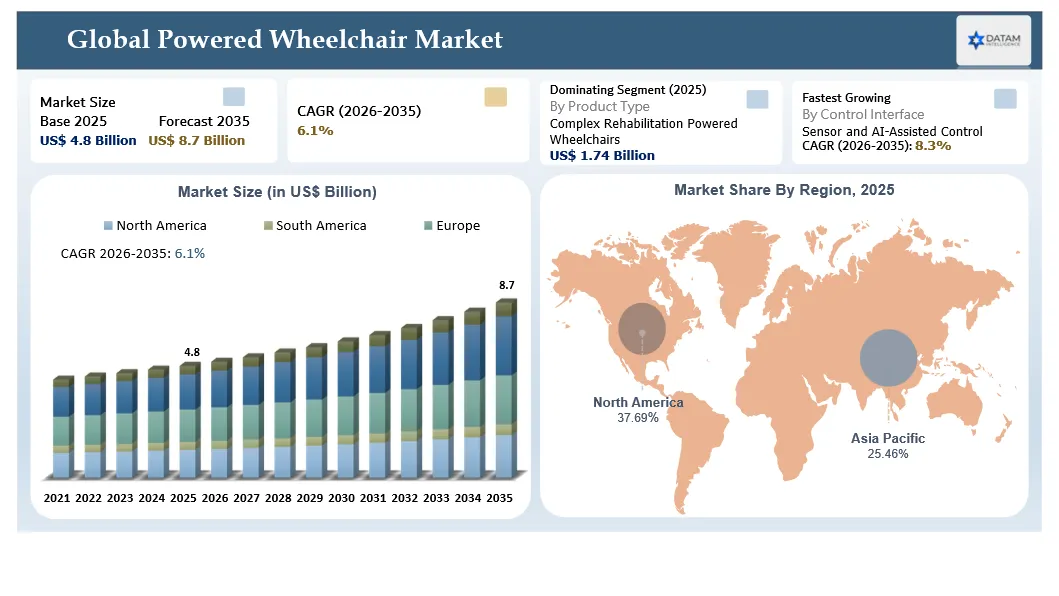
Growth is supported by population aging, chronic neurological and musculoskeletal conditions, greater emphasis on independent living and improvements in battery, seating and control technology. Complex rehabilitation power wheelchairs generate a disproportionate share of market value because they combine configurable bases, pressure management, tilt, recline, seat elevation, alternative controls and long-term clinical support.
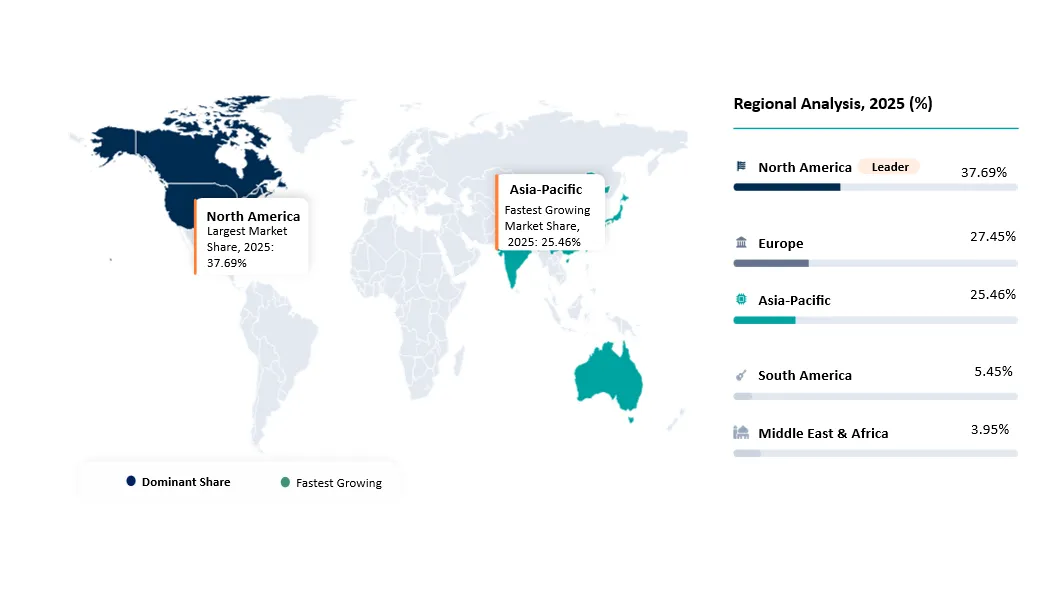
North America is the largest market through reimbursement infrastructure, specialized rehabilitation providers and established dealer networks. Europe has strong clinical assessment systems and accessibility policies. Asia-Pacific is expected to grow fastest as aging, healthcare coverage, local manufacturing and rehabilitation capacity expand.
| Metric | Details |
| 2025 Market Size | US$ 4.8 Billion |
| 2035 Projected Market Size | US$ 8.7 Billion |
| CAGR (2026-2035) | 6.1% |
| Largest Market | North America |
| Fastest Growing Market | Asia-Pacific |
| Dominant Segment | Complex Rehabilitation Powered Wheelchairs |
| Fastest-Growing Technology | Smart and AI-Assisted Controls |
| Forecast Period | 2026-2035 |
Powered Wheelchair Market Key Takeaways
- Complex rehabilitation models lead market value because of configurable seating, power functions and clinical service requirements.
- North America holds the largest share through Medicare, Medicaid, private insurance and specialized rehabilitation networks.
- Asia-Pacific is the fastest-growing region as aging and rehabilitation access expand.
- Mid-wheel drive remains important for indoor maneuverability, while rear-wheel and all-terrain platforms retain strong outdoor demand.
- Lithium batteries, folding frames, seat elevation and connected diagnostics are key product priorities.
- Alternative controls and driver-assistance features expand access for users with limited hand function.
- Repair delays, reimbursement documentation and shortage of trained providers remain major pain points.
- Market leadership depends on clinical outcomes, dealer service, customization, reliability and payer navigation.
Powered Wheelchair Industry Trends and Strategic Insights
- The category is shifting from basic powered mobility toward personalized mobility systems integrating seating, posture, pressure management and digital controls.
- Remote programming and diagnostics are gaining importance for reducing service visits and downtime.
- Travel-friendly designs are expanding, but battery transport rules and airline handling remain important constraints.
- Seat elevation and standing functions are becoming more visible because they support reach, transfers, social interaction and pressure management.
- Manufacturers are building software ecosystems around configuration, fleet management and service history.
- Smart navigation is progressing through obstacle detection, collision avoidance, path assistance and caregiver interfaces.
Powered Wheelchair Market Scope
| Metrics | Details |
| By Product Type | Standard Powered Wheelchairs, Complex Rehabilitation Powered Wheelchairs, Standing and Seat-Elevation Wheelchairs, Folding and Travel Powered Wheelchairs, Smart and Autonomous Powered Wheelchairs |
| By Drive Configuration | Rear-Wheel Drive, Mid-Wheel Drive, Front-Wheel Drive, All-Terrain and Specialty Drive |
| By Seating and Positioning | Standard Seating, Tilt and Recline, Seat Elevation and Standing, Customized Complex Seating |
| By Control Interface | Joystick Control, Head, Chin and Sip-and-Puff Control, Switch and Touch Control, Caregiver and Remote Control, Sensor and AI-Assisted Control |
| By Portability | Full-Size, Compact, Folding, Transportable and Disassemblable |
| By Age Group | Pediatric, Adult, Older Adult |
| By Application | Home and Community Mobility, Hospitals and Rehabilitation Centers, Long-Term Care, Work and Education, Travel and Outdoor Mobility |
| By Distribution Channel | DME and Rehabilitation Dealers, Hospital and Clinic Procurement, Direct Sales, Online and Retail Channels |
| By Region | North America, Europe, Asia-Pacific, South America, Middle East and Africa |
| Report Insights Covered | Market Size, Share, Growth, Pricing, Reimbursement, Competitive Landscape and Company Profiles |
Why does this report matter in 2026?
The year 2026 is a strategic point for the powered wheelchair market because aging, home-based care and pressure on rehabilitation systems are increasing demand at the same time that digital controls, lithium batteries and connected service models are changing product expectations. Manufacturers must balance innovation with reimbursement rules, repairability, battery safety and affordability.
The report matters because powered wheelchairs are not interchangeable consumer products. Clinical suitability depends on posture, pressure risk, strength, cognition, home layout, transportation, caregiver support and long-term service. The study separates standard mobility demand from complex rehabilitation, travel models and smart mobility opportunities so companies can evaluate distinct pricing, channel and evidence requirements.
Powered Wheelchair Market White Space & Investment Opportunities
- Remote diagnostics and predictive maintenance that reduce downtime and dealer travel.
- Lower-cost complex rehabilitation platforms for middle-income markets.
- Alternative control systems for users with severe upper-limb impairment.
- Compact folding chairs with safer, airline-compatible battery systems.
- Pediatric growth systems and adaptable seating that extend useful life.
- Smart obstacle detection and shared-control navigation for indoor and community use.
- Regional repair, parts and refurbishment networks to improve lifecycle access.
Powered Wheelchair Future Market Transformation
The market will evolve from isolated hardware sales toward connected mobility ecosystems. Chairs will increasingly store configuration, service and usage data, allowing dealers and clinicians to monitor performance, identify battery or motor issues and adjust controls remotely. Driver-assistance features will support users without fully replacing user control.
Commercial models will also change. Subscription service, extended maintenance, battery replacement, refurbishment and outcomes-based procurement can expand recurring revenue. Manufacturers that combine reliable hardware with clinical training, payer support and regional service will be better positioned than product-only suppliers.
Powered Wheelchair Market Buyer Decision-Making Criteria
Users and clinicians prioritize safe mobility, pressure management, posture, transfer ability, turning radius, range, terrain performance, control access and compatibility with the home and vehicle. Buyers also assess seat functions, battery charging, weight, crash testing, durability, noise and ability to obtain parts and repairs.
Payers and institutional buyers focus on medical necessity, documentation, expected useful life, repair history, total cost and availability of less costly alternatives. For complex rehabilitation, the quality of assessment, fitting, training and follow-up is as important as the chair itself.
Powered Wheelchair Market Economic & Investment Analysis
The market combines durable equipment sales with recurring service, batteries, cushions, seating components and repairs. Complex rehabilitation chairs have higher average selling prices and stronger accessory attachment, but require specialist staff, documentation and after-sales support. Standard and folding chairs provide faster private-pay conversion but face stronger price competition.
Investment is moving toward connected service, lighter batteries, modular electronics and manufacturing localization. The strongest economics are achieved by companies with established dealer networks, high parts availability and platforms that share components across multiple models.
Powered Wheelchair Investment Trends in the Market
- Investment in smart controls, obstacle detection and remote programming is increasing.
- Manufacturers are expanding regional service centers and parts inventories.
- Private equity and strategic buyers remain interested in rehabilitation distribution and durable medical equipment networks.
- Battery and electronics supply resilience is becoming a capital priority.
- Refurbishment and circular-economy models are attracting attention from payers and public programs.
Strategic Indicators For Powered Wheelchair Market
High Regulation Impact
Powered wheelchairs are regulated medical devices in major markets. Product safety, electrical systems, electromagnetic compatibility, seating functions, labeling and post-market surveillance influence launch and lifecycle management.
High Investment Activity
Investment is concentrated in smart controls, lightweight structures, connected service, seat elevation and complex rehabilitation distribution.
Supply Chain Disruption
Motors, controllers, batteries, chargers, actuators and custom seating components create exposure to specialized suppliers and long replacement lead times.
Pricing Volatility
Pricing varies widely from entry travel chairs to highly configured complex rehabilitation systems. Exchange rates, batteries, electronics and freight affect delivered cost.
Procurement Pressure
Payers and institutions demand documentation, competitive pricing, repair support and measurable functional value.
New Technology Adoption
Lithium batteries, remote diagnostics, sensor-based controls and shared-control navigation are changing product design.
Regional Expansion Opportunity
China, India, Southeast Asia, Latin America and the Gulf offer growth where rehabilitation services and reimbursement expand.
Government Policy Support
Disability rights, aging policies, universal health coverage and assistive-technology programs can increase access, although funding remains uneven.
Pricing Intelligence
Complex rehabilitation systems command substantial premiums for power functions, seating and controls, while standard chairs compete heavily on dealer margin and private-pay affordability.
Disruption Analysis of Powered Wheelchair Market
Smart mobility is gradually disrupting joystick-only control through collision avoidance, path assistance, caregiver control and alternative input. Adoption will be shaped by safety validation, user trust, affordability and the ability to customize assistance without reducing autonomy.
Connected service is another disruption. Remote diagnostics can identify battery, motor and controller faults before failure, while cloud-based configuration can shorten service time. These capabilities shift competition toward software, data governance and dealer integration.
Powered Wheelchair Market BCG Matrix: Company Evaluation
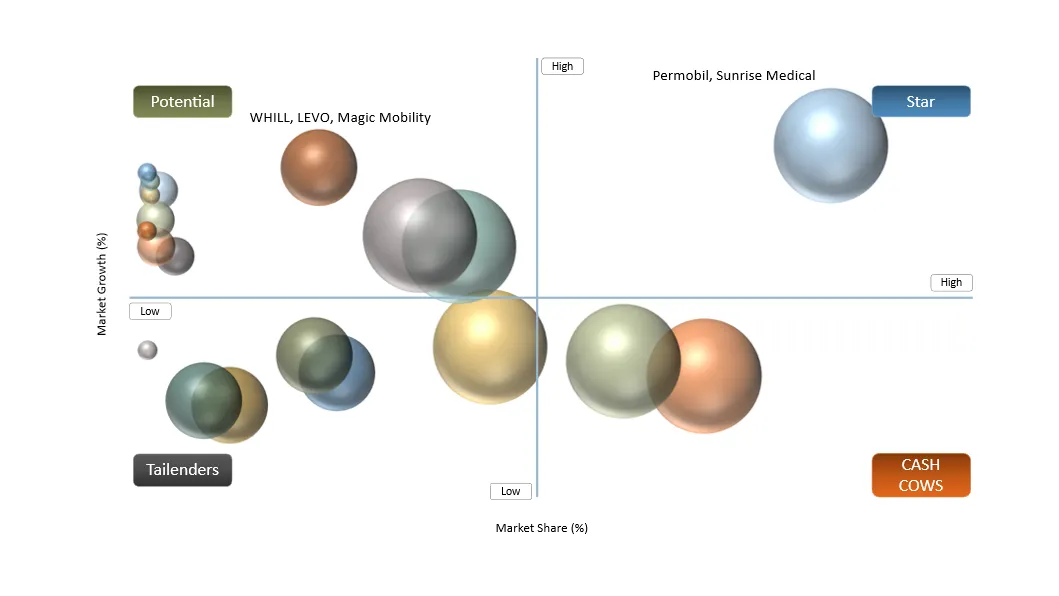
STAR
Permobil, Sunrise Medical, Pride Mobility and Ottobock are positioned as Stars because they combine broad portfolios, strong brands, complex rehabilitation capability and international dealer or clinical networks.
POTENTIAL
WHILL, LEVO, Magic Mobility, Amylior and specialized smart-mobility developers represent Potential players. Their opportunities are strongest in compact travel, standing, all-terrain and intelligent control niches.
Powered Wheelchair Market Dynamics
Driver Impact Analysis
| Driver | Market Growth Impact | Demand Concentration | Impacted Use Case | Strategic Impact |
| Population aging | High | North America, Europe, Japan, China | Home and community mobility | Expands long-term demand and replacement volumes. |
| Neurological and mobility-limiting conditions | High | Global | Complex rehabilitation | Supports higher-value seating and controls. |
| Technology improvement | Medium-High | Developed and urban markets | Smart controls, batteries and power seating | Raises average selling price and user independence. |
| Home-based care | Medium | Global | Residential mobility and caregiver support | Shifts demand toward compact, reliable and serviceable systems. |
Driver: Aging Population and Rising Need for Independent Mobility
Aging increases the prevalence of weakness, arthritis, stroke, cardiopulmonary disease and neurological conditions that limit walking or manual propulsion. At the same time, policy and user preference favor remaining at home and participating in community life. Powered wheelchairs therefore support both clinical mobility and broader independence.
Restraint Impact Analysis
| Restraint | Drag on Market Growth | Primary Impact Area | Impacted Use Case | Strategic Impact |
| High acquisition cost | High | Private-pay and underinsured users | Complex rehabilitation and standing systems | Encourages reimbursement support and tiered portfolios. |
| Reimbursement complexity | High | U.S. and regulated payer markets | Prescription and delivery | Extends sales cycle and raises administrative cost. |
| Repair and parts delays | Medium-High | Installed base | Daily mobility continuity | Creates demand for remote diagnostics and local inventory. |
| Infrastructure barriers | Medium | Emerging markets and inaccessible housing | Community use | Limits functional value despite product availability. |
Restraint: High Cost and Fragmented Reimbursement
Configured power wheelchairs can be expensive, especially when tilt, recline, elevation, standing and alternative controls are required. Coverage decisions often require detailed clinical documentation and may exclude features considered convenience rather than medical necessity. Delays can postpone discharge, education or employment participation.
Powered Wheelchair Market Segment Analysis
The global Powered Wheelchair market is segmented based on Product Type, Drive Configuration, Seating and Positioning, Control Interface, Portability, Age Group, Application, Distribution Channel and region.
By Product Type
Complex Rehabilitation Powered Wheelchairs Will Lead Market Value
Complex rehabilitation systems lead value because they integrate configurable bases, custom seating, power positioning and alternative controls. Standard and folding models lead unit volumes, while smart and autonomous platforms are expected to grow fastest from a small base.
By Drive Configuration
Mid-Wheel Drive Will Remain Important for Indoor Maneuverability
Mid-wheel systems provide a tight turning radius and intuitive pivoting for indoor use. Rear-wheel platforms retain strength in directional stability and outdoor driving, while front-wheel and specialty all-terrain systems serve distinct environments.
By Seating and Positioning
Power Tilt, Recline and Elevation Will Drive Premium Demand
Power positioning improves pressure management, comfort, reach, transfers and participation. Custom seating remains essential for users with postural asymmetry, deformity or high skin-risk.
By Control Interface
Alternative and Smart Controls Will Grow Fastest
Joystick control remains dominant, but head arrays, sip-and-puff, switches, touch interfaces and sensor-based systems expand access for users with limited hand function.
By Portability
Folding Powered Wheelchairs Will Record Strong Growth
Folding models respond to travel, storage and private vehicle needs. Their adoption depends on weight, battery safety, durability and seating comfort.
By Age Group
Older Adults Will Represent the Largest User Group
Older adults form the largest demand pool through stroke, arthritis and age-related weakness. Pediatric systems require growth, caregiver controls and long-term seating adaptation.
By Application
Home and Community Mobility Will Remain the Largest Application
Most value is created by daily mobility across the home, neighborhood, education and work. Hospitals and long-term care are important institutional buyers and referral points.
By Distribution Channel
DME and Rehabilitation Dealers Will Control Complex Rehabilitation Delivery
Specialist dealers remain central for assessment coordination, configuration, fitting, training, reimbursement and repair. Online and retail channels are more relevant for entry-level and travel products.
Powered Wheelchair Market Geographical Penetration
U.S. Powered Wheelchair Market Landscape
The U.S. is the largest national market through Medicare, Medicaid, private insurance, veterans programs and a developed complex rehabilitation dealer network. Coverage documentation and repair delays remain major market issues.
Germany Powered Wheelchair Market Outlook
Germany benefits from statutory insurance, rehabilitation centers and strong European manufacturing. Procurement emphasizes clinical fit, durability, service and compliance.
Japan Powered Wheelchair Market Trends
Japan has strong aging-driven demand, compact urban environments and advanced electronics capability. Lightweight and maneuverable designs are important.
China Powered Wheelchair Market Outlook
China combines a large aging population, expanding rehabilitation demand and significant manufacturing capacity. Access remains uneven between major cities and lower-tier regions.
India Powered Wheelchair Market Outlook
India is an emerging market where private-pay affordability, hospital rehabilitation, local assembly and service coverage shape adoption.
Middle East and Africa Powered Wheelchair Market Outlook
Demand is concentrated in Gulf countries, Israel, South Africa and major urban centers. Public procurement, charity programs and imported products play an important role.
Powered Wheelchair Market Competitive Landscape
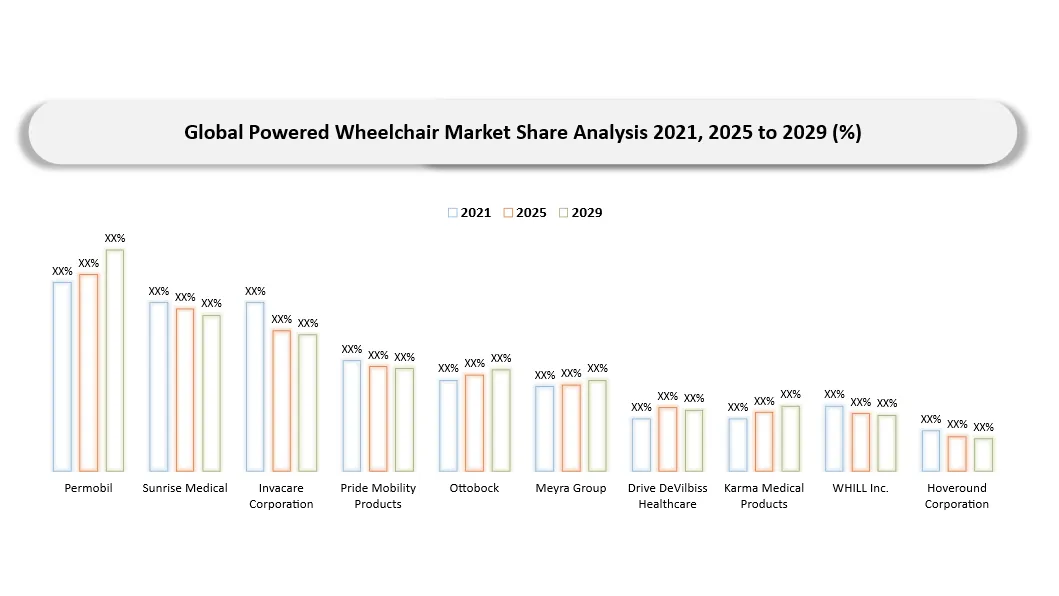
- Competition is led by manufacturers with strong complex rehabilitation portfolios, dealer networks and clinical relationships.
- Permobil, Sunrise Medical, Pride Mobility, Ottobock and Invacare are prominent international participants.
- Differentiation depends on reliability, seating integration, control options, service, parts availability and payer support.
- Specialized companies compete in standing, all-terrain, folding and smart mobility niches.
- Software, remote diagnostics and connected configuration are becoming visible competitive factors.
Powered Wheelchair Market Key Companies
- Permobil
- Sunrise Medical
- Invacare Corporation
- Pride Mobility Products / Quantum Rehab
- Ottobock
- Meyra Group
- Drive DeVilbiss Healthcare
- Karma Medical Products
- WHILL Inc.
- Hoveround Corporation
- GF Health Products
- LEVO AG
- Magic Mobility
- Amylior
- Merits Health Products
Powered Wheelchair Market Company Profiles
Permobil
Permobil is a leading complex rehabilitation mobility company with advanced power bases, seating, power positioning and digital control systems. Its strength lies in clinical integration, global dealer support and a broad ecosystem of seating and mobility products.
Sunrise Medical
Sunrise Medical offers power mobility through brands including QUICKIE and ZIPPIE. Its portfolio spans adult and pediatric rehabilitation, mid-wheel and rear-wheel platforms, seating and control options.
Invacare Corporation
Invacare has a long history in home and institutional mobility products. Its powered wheelchair business is supported by rehabilitation channels, service relationships and a broad durable medical equipment portfolio.
Pride Mobility Products
Pride Mobility and Quantum Rehab address consumer mobility and complex rehabilitation. Quantum is strong in configurable power bases, seating functions and clinician-focused distribution.
Ottobock
Ottobock combines mobility, seating and rehabilitation expertise with a global clinical network. Its portfolio includes powered wheelchairs and advanced controls for complex users.
WHILL Inc.
WHILL focuses on compact, design-led personal electric mobility and connected features. Its products target indoor and community use, travel and consumers seeking a less medical appearance.
LEVO AG
LEVO specializes in standing powered wheelchairs, serving users who need powered standing and postural support.
Magic Mobility
Magic Mobility is known for all-terrain powered wheelchairs designed for outdoor, rural and demanding environments.
Powered Wheelchair Market Major Pain Points
- Long assessment, authorization and delivery timelines.
- High out-of-pocket cost for uncovered features.
- Repair delays and limited local parts availability.
- Inconsistent fitting, training and follow-up.
- Battery range, charging and air-travel constraints.
- Weight and transport difficulty for full-size systems.
- Limited access to trained rehabilitation professionals in many regions.
- Housing, curb and transport infrastructure that reduces practical usability.
Powered Wheelchair Market Recent Developments
- 2025-2026: Manufacturers continued to expand seat-elevation, connected programming and remote service capabilities across complex rehabilitation portfolios.
- 2025: New airline and regulatory attention increased focus on lithium battery handling, device dimensions and damage prevention during travel.
- 2025-2026: Smart wheelchair research advanced obstacle detection, people-following and shared-control navigation, although broad commercial adoption remains early.
- 2025-2026: Dealer groups and manufacturers increased investment in service capacity, parts availability and digital configuration tools.
- 2025-2026: Product development emphasized lighter folding frames, travel-friendly batteries and alternative controls.
Analyst View / Opinion on Powered Wheelchair Market
- The market will expand steadily because demographic and clinical need is durable, but revenue growth will remain constrained by reimbursement and service capacity.
- Complex rehabilitation will remain the largest value pool, while folding travel chairs and smart controls will grow faster from smaller bases.
- Remote diagnostics and local repair capability will become major brand differentiators because downtime has immediate consequences for users.
- Payers should evaluate lifetime function and caregiver burden rather than focusing only on the lowest-cost base.
- Companies that integrate assessment, seating, digital controls, reimbursement support and service will outperform product-only competitors.
Powered Wheelchair Market Target Audience
| Industry | Who Should Buy This Report? | Reason to Buy This Report |
| Medical Device Manufacturers | Mobility product leaders, product managers and business development teams | Assess segment growth, technology priorities and competitive positioning. |
| Rehabilitation Providers | Physiatrists, therapists, ATPs and clinic administrators | Understand product evolution, referral pathways and service requirements. |
| DME and Dealers | Dealer owners, service managers and procurement teams | Evaluate portfolio, reimbursement, parts and regional expansion opportunities. |
| Payers and Government | Insurers, health ministries and disability programs | Assess access, reimbursement, outcomes and lifecycle cost. |
| Technology Companies | Robotics, sensors, software and battery developers | Identify smart mobility and connected-service opportunities. |
| Investors and Consultants | Private equity, venture capital and strategy teams | Evaluate market size, consolidation and investment white space. |
Why Choose DATAM?
- Data-driven insights combining market sizing, reimbursement, product technology, service infrastructure and country-level access.
- Post-purchase analyst consultations for portfolio strategy, market entry, reimbursement and partnership planning.
- Annual updates covering product launches, policy changes, partnerships and competitive developments.
- Specialized focus on emerging markets and assistive-technology access.
- Actionable analysis connecting clinical needs with commercial models and after-sales service.
What DATAM Uniquely Provides
- Ten-year forecasts across product type, drive, seating, control, portability, age, application, channel and region.
- Separation of standard, travel and complex rehabilitation demand.
- Buyer-focused analysis of assessment, reimbursement, fitting, repair and service.
- Country-level views linking aging, disability policy, healthcare funding and dealer infrastructure.
- Strategic analysis of smart controls, battery systems, remote diagnostics and refurbishment.





























































