


Potato Starch and Derivatives Market Overview
The global potato starch and derivatives market was valued at US$ 4.27 billion in 2025 and is expected to be worth US$ 6.58 billion by 2035 with a CAGR of 5.31% during 2026-2035. This growth can be attributed to the rise in demand for potato starches and derivatives for various applications. The applications include food, industrial, pharmaceutical, and specialty uses where potato starch is utilized as thickening agents, stabilizers, binders, texturizers, and moisture retention agents.
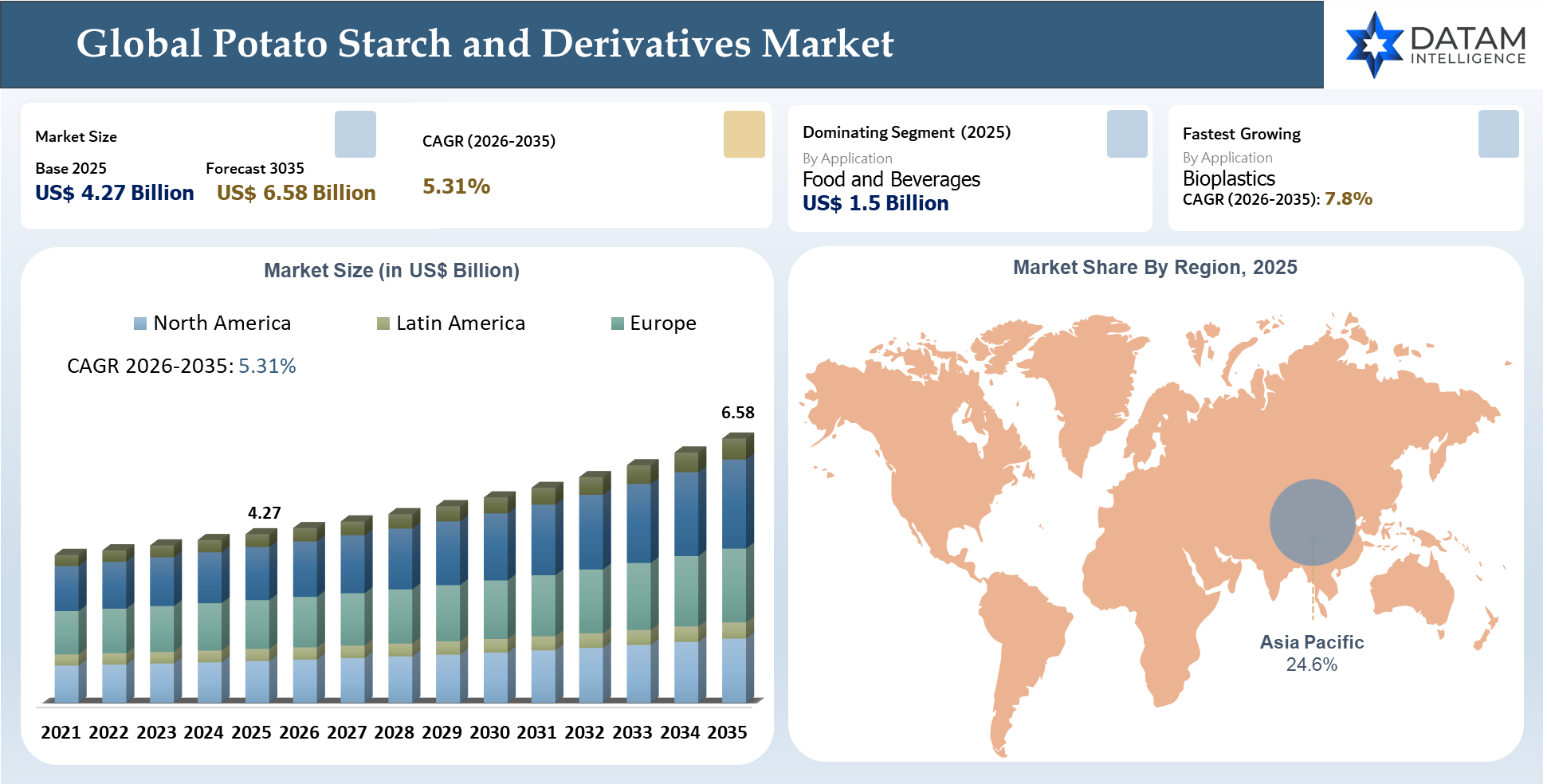
The global potato starch and derivatives market is positively impacted by rising demand for clean label products, increase in consumption of gluten-free foods, and increasing sustainable raw material demand. Modified potato starch solutions are becoming popular due to its capabilities such as improved viscosity, freeze-thaw stability, texture, and processability. There is also an increase in the use of food and industrial starch ingredients as alternatives to petroleum-based compounds. Market competitiveness has evolved from commodity starch supply to high-value starch derivatives that offer specialized functionality and performance attributes. Europe leads the market owing to the advanced infrastructure of potato processing while Asia-Pacific is set to become the fastest growing market driven by increasing food processing activities.
AI Impact Analysis
Slowly but surely, AI is changing the dynamics of the global potato starch and derivatives market by facilitating better material management, process efficiency, quality assurance, and demand prediction. The use of AI technology will assist companies in analyzing factors affecting potato yield, weather forecast, storage, price, and processing for risk mitigation and increased consistency in batches of native potato starch, modified potato starch, potato sweeteners, and their derivatives. It is critical because the starches' characteristics are affected by moisture content, viscosity, particle size, purity, and modifications of potato starch.
In terms of manufacturing processes, process controls powered by AI will aid in optimizing drying, extraction, filtration, gelatinization, and chemical or enzymatic modifications. Moreover, process control technologies will enable predictive maintenance, decrease waste, improve energy efficiency, and allow for quick quality assurance. Regarding product development, AI can be utilized to match the performance characteristics of starches in various applications, including baking aids, sauce stabilization, frozen foods, paper coating, adhesives, textiles, and bioplastics. From a commercial standpoint, AI-powered demand sensing technology can recognize opportunities within clean-label foods, gluten-free foods, sustainable packaging, and industrial starch.
Potato Starch and Derivatives Market Key Takeaways
- Applications will continue to be the most economically significant lens for assessment, revealing the pattern of distribution of demand between the end-use applications such as food and beverages, paper and packaging, pharmaceuticals, cosmetics, textiles, adhesives, bioplastics, and industrial applications.
- The demand for modified potato starch products is moving towards those that can deliver benefits like texture enhancement, viscosity regulation, freeze-thaw resistance, binding capacity, and clean labeling properties.
- Food and Beverages continues to be the largest application category owing to the widespread use of the products in baked goods, sauces, snacks, noodles, frozen foods, infant formula, gluten-free products, and ready-meals.
- Europe is currently the market leader because of its well-developed potato starch manufacturing infrastructure, robust network of producers, state-of-the-art modification techniques, and food & industrial applications.
- The winning manufacturers are those who have an edge in securing raw materials, product development, applications, sustainability, and distribution..
Market Scope
| Metrics | Details | |
| 2025 Market Size | US$ 4.27 Billion | |
| 2035 Projected Market Size | US$ 6.58 Billion | |
| CAGR (2026-2035) | 5.31% | |
| Largest Market | Europe | |
| Fastest Growing Market | Asia-Pacific | |
| By Product Type | Native Potato Starch, Modified Potato Starch, Potato Sweeteners and Derivatives, Potato Protein, Potato Fiber, and Others | |
| By Modification Type | Physical Modification, Chemical Modification, Enzymatic Modification, and Dual Modified Starch | |
| By Functionality | Thickening Agent, Stabilizer, Binder, Texturizer, Gelling Agent, Film Forming Agent, Moisture Retention Agent, Fat Replacer, and Adhesive Agent | |
| By Application | Food and Beverages, Animal Feed, Paper and Packaging, Pharmaceuticals, Cosmetics and Personal Care, Textiles, Adhesives, Bioplastics, and Others | |
| By Source Grade | Food Grade, Feed Grade, Pharmaceutical Grade, Cosmetic Grade, and Industrial Grade | |
| By Distribution Channel | Direct Sales, Distributors, Ingredient Suppliers, Online B2B Platforms, and Specialty Chemical Suppliers | |
| By End User | Food Manufacturers, Beverage Manufacturers, Animal Nutrition Companies, Paper Manufacturers, Pharmaceutical Companies, Cosmetic Companies, Textile Producers, Adhesive Manufacturers, Bioplastic Manufacturers, and Others | |
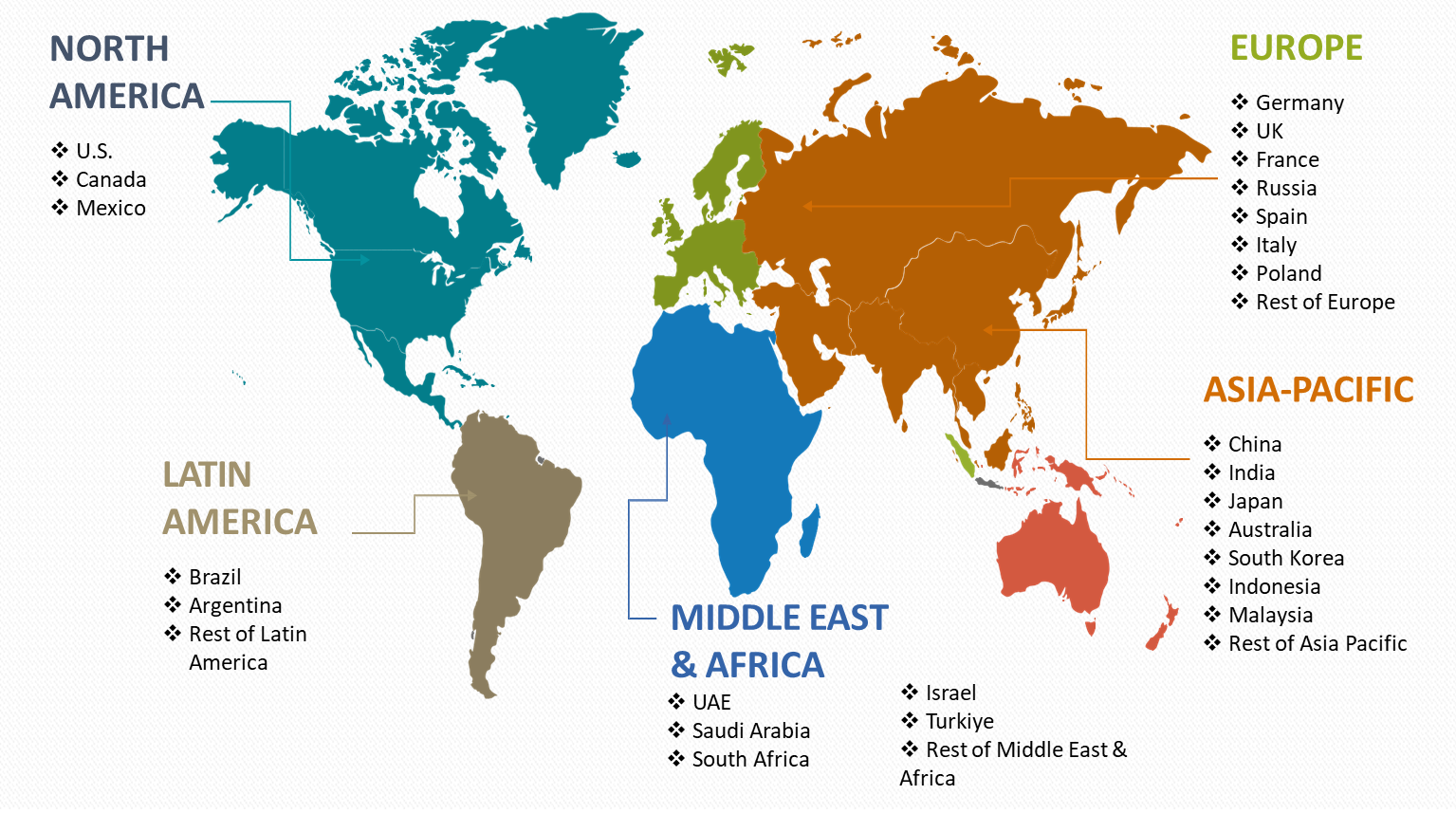
| By Region | North America | U.S., Canada, Mexico |
| Europe | Germany, UK, France, Spain, Italy, Poland | |
| Asia-Pacific | China, India, Japan, Australia, South Korea, Indonesia, Malaysia | |
| Latin America | Brazil, Argentina | |
| Middle East and Africa | UAE, Saudi Arabia, South Africa, Israel, Turkiye | |
| Report Insights Covered | Competitive Landscape Analysis, Company Profile Analysis, Market Size, Share, Growth | |
Disruption Analysis
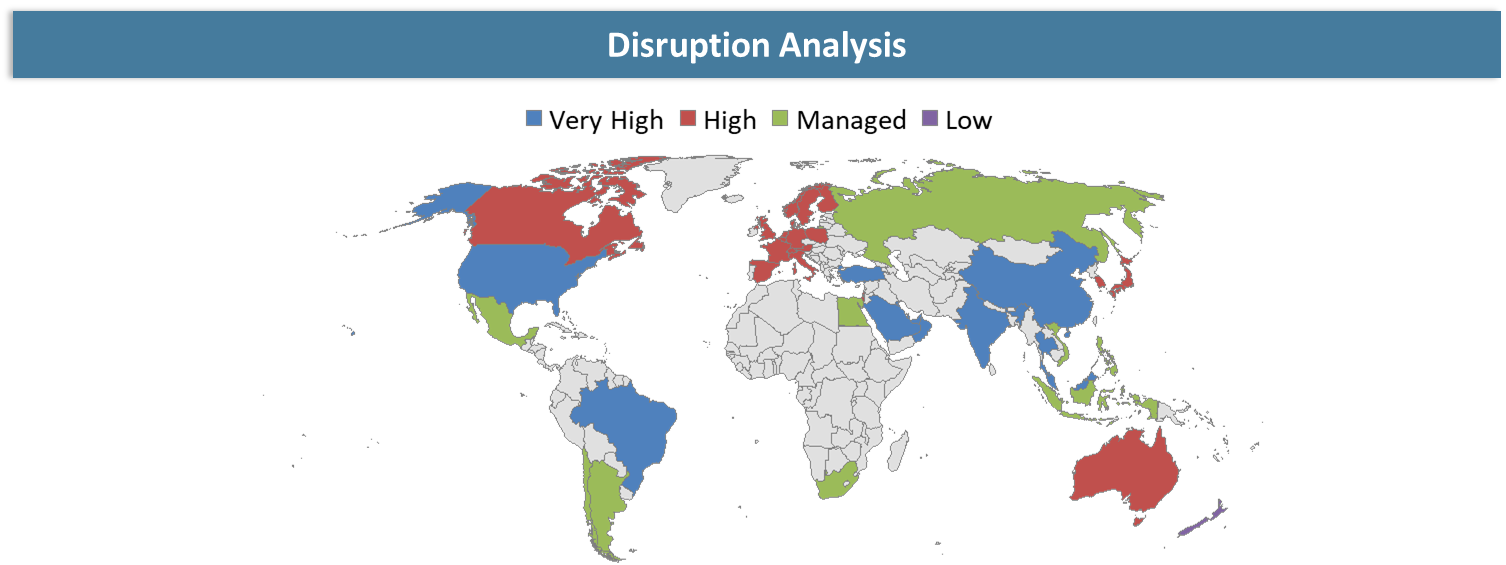
Shift from Commodity Supply to Value Added Functional Performance and Sustainable Applications
One of the primary disruptions in the market of potato starch and derivatives globally is a move away from commodity starch to functional starch designed for specific applications. Buyers consider not only the price but also the ability of the product to enhance food texture, increase freeze-thaw stability, preserve moisture, be certified as clean-label, and perform sustainably well. There is an increasing trend among food producers of requesting custom-made potato starch products that enhance food processing and increase their shelf-life through innovative formulation and modification of the product.
A further disruption in the market of potato starches and derivatives involves the increased demand for renewable and bio-sourced products used in packaging, adhesive, paper, and other industrial applications. Such products will help address some environmental problems linked to excessive use of synthetic materials and chemicals. Manufacturers of potato starch will be encouraged to develop and offer specialty products designed for particular industrial applications due to rising competition among companies involved in this business.
BCG Matrix: Company Evaluation
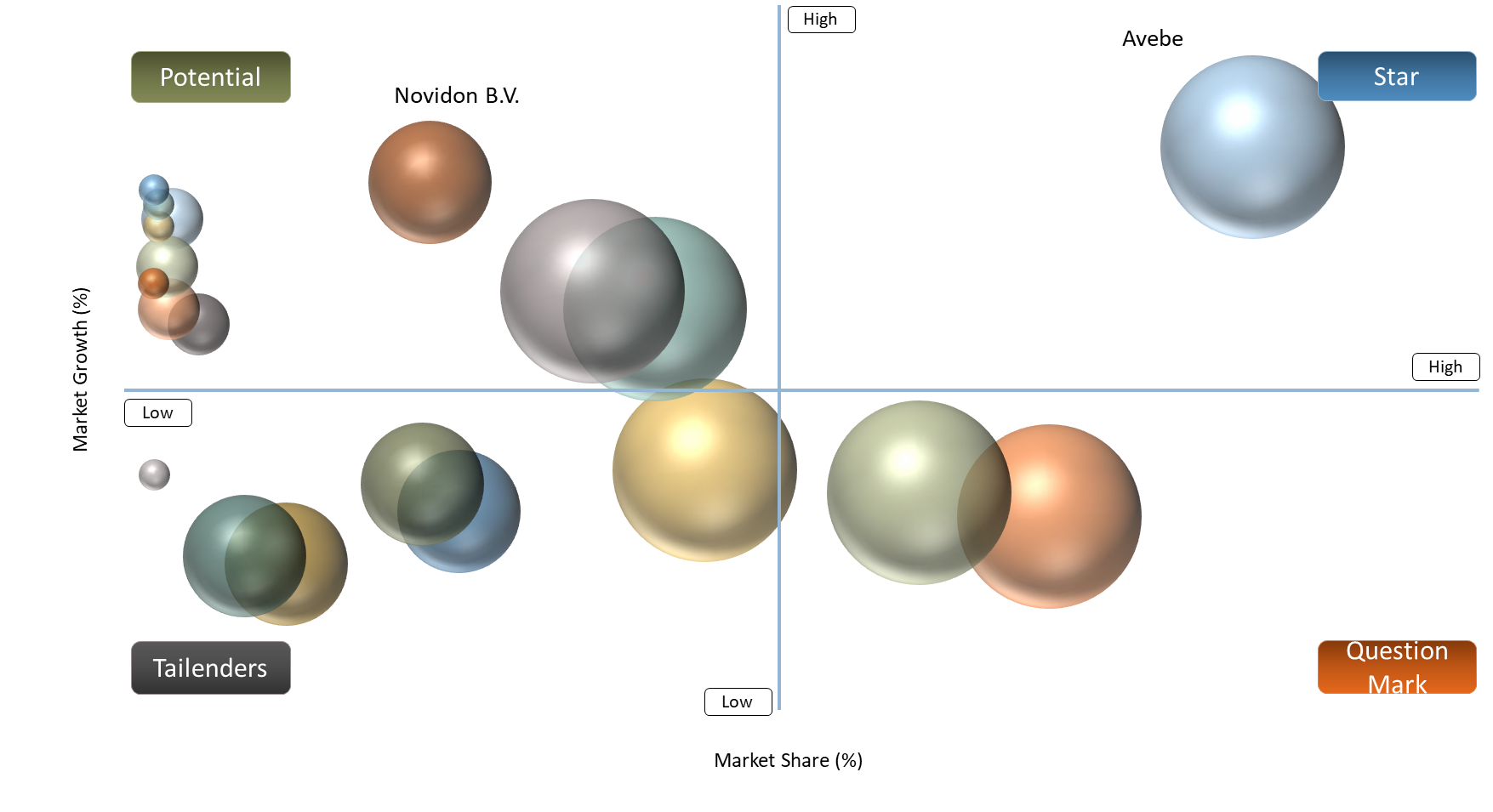
In the global potato starch and derivatives market, the Star category consists of Avebe, Roquette Frères, Ingredion, AGRANA Beteiligungs AG, Tereos Starch and Sweeteners, and Cargill, Incorporated. Companies under the Star category have a worldwide presence, extensive range of products, innovative technologies for production, and high penetration into diverse markets such as food, paper, adhesive, pharmaceuticals, and industrial uses.
The Cash Cow category consists of Emsland Group, KMC, Südstärke GmbH, Lyckeby Starch AB, and AKV Langholt AmbA. Such companies are able to maintain a steady position due to a well-developed regional supply chain, solid client base, regular supply of potato starch, and constant demand for it among food processors and industrial clients.
The Question Mark category consists of Novidon B.V., Aloja Starkelsen Ltd., VIMAL PPCE, and PEPEES S.A. Such companies possess a number of niche advantages but are less globally developed than their more integrated rivals. Growth opportunities in this category consist in further export orientation, innovation in value-added derivatives, product diversification, and development in the market segments of food, packaging, adhesive, and specialty starches..
Market Dynamics
Rising Clean Label and Gluten Free Food Demand Expanding Potato Starch Usage Across Processed Food Applications
The rise in consumer demand for clean label products and gluten-free products has resulted in an increase in demand for the Global Potato Starch Market Size, especially in bakery products, sauces, snacks, and ready-to-eat meals. Consumers today prefer simple ingredients that have undergone limited processing, leading companies to use natural ingredients instead of artificial chemicals and additives. Potato starch is extensively used because of its neutral flavor, excellent binding capabilities, water absorption capability, and texturizing properties.
As per the FDA, the maximum limit of gluten content in any food product with a gluten-free label is less than 20 parts per million, thus creating opportunities for alternative starch sources in the development of reformulated food products. The potential for potato starch utilization has been gaining momentum due to its contribution in terms of enhanced softness, viscosity, shelf-life, and mouth feel without affecting clean-label attributes. Growth in the modified potato starch market is further fueled by the rising demand for food and industrial starch products with performance under conditions of heating, freezing, and process stress.
Seasonal Potato Supply and Crop Yield Volatility Creating Cost Pressure Across the Global Potato Starch and Derivatives Market
Potato seasonal availability, variations in crop yield, and raw material price changes continue to be important limitations that influence the global potato starch and derivatives market. Potato starch manufacture is highly dependent on agricultural productivity, which makes producers subject to climatic variations such as droughts, heavy rainfall, diseases, and other factors associated with agriculture. Since potatoes have seasonal availability, an imbalance between the supply and demand of raw materials can emerge when demand from food processing, industrial starch manufacturing, and exports increases at a faster rate than production. The Food and Agriculture Organization (FAO) estimates that potato production surpassed 374 million metric tons globally, but there are considerable differences in the production rates across different regions because of climatic influences.
These variations have a direct influence on the growth rate of the modified potato starch market because the processing plants experience unstable purchasing costs and difficulties in production planning. The increasing cost of inputs such as fertilizers, water, labor, and energy in agriculture continues to squeeze the profit margins. As per starch derivatives market analysis, the instability in the supply chain could lead to uncompetitive prices when compared with alternatives like corn, tapioca, and wheat.
Segmentation Analysis
The global potato starch and derivatives market is segmented based product type, modification type, functionality, application, source grade, distribution channel, end-user, and region.
Rising Demand for Clean Label and Convenience Foods Driving Food and Beverage Dominance in Global Potato Starch and Derivatives Market
Food & Beverages is the major application sector of global potato starch and derivatives market owing to its varied applications in bakery, confectionary, snack foods, soups, sauce, dairy, noodle, pasta, ready-to-eat food, frozen food, infant nutrition, gluten-free food, and beverages. The applications of potato starch have increased over the years as manufacturers require natural ingredients for thickening agents, binders, and stabilizers for adding texture to food.
According to USDA data, the U.S. potatoes required for processing amounted to 274 million cwt in 2024, signifying the immense processed potato market environment supporting starch and derivatives demand. Here, the frozen fries, along with other frozen products, consumed 163 million cwt of potatoes in 2024. Thus, there is immense importance of modified potato starch market growth, as solutions using modified starch assist in ensuring product texture, consistency, and stability in processed food forms.
As consumer trends increasingly favor convenience foods, clean label products, gluten-free products, and plant-based ingredients, the food & beverage application segment remains the most commercially lucrative one.
Geographical Penetration
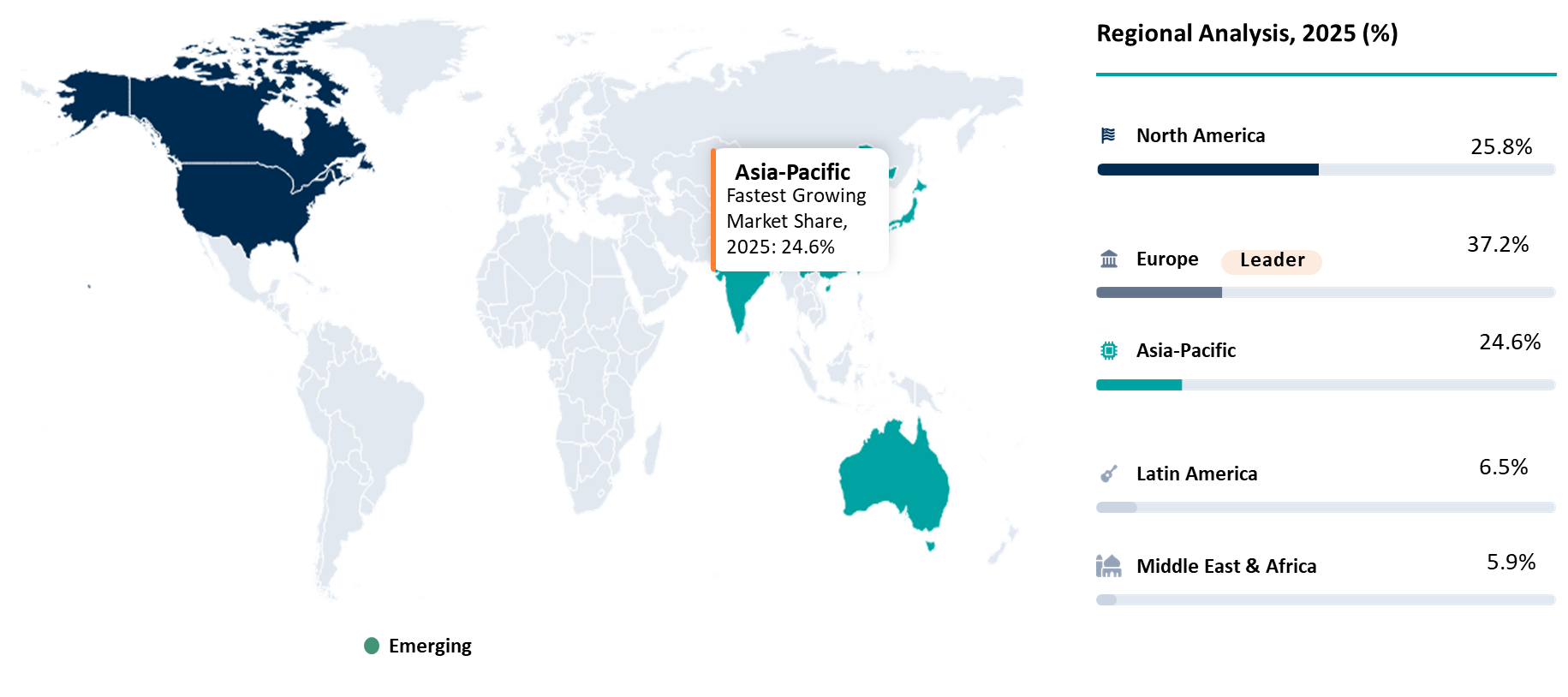
Asia-Pacific Emerging as a High-Growth Hub for Potato Starch Demand Driven by Food Processing and Industrial Expansion
Asia-Pacific is becoming a rapidly growing region in the global potato starch and derivatives market owing to an increase in demand for processed foods, food manufacturing expansion, and functional and clean-label ingredient demand. Country like China, India, Japan, South Korea, Thailand, and Indonesia have shown increased demand for potato starch usage in baked goods, noodles, snacking items, sauces, frozen foods, dairy products, and ready-to-eat foods. Increasing urbanization along with changing eating trends has boosted the demand for thickening and stabilization agents and modified potato starch solutions in various packaged food segments.
Furthermore, industrial starches are witnessing rising importance in applications like paper & packaging, textiles, adhesives, pharmaceuticals, cosmetics, and biodegradable starch derivatives. As per the statistics from the Food and Agriculture Organization (FAO), more than 188 million metric tons of potatoes were produced by Asia during 2023, contributing more than half of the world's total potato production in that year. This huge production rate of raw material will be highly beneficial for its processing and derivative manufacturing activities. With the growth of food manufacturers in the region and increasing consumer preference for convenience foods, Asia-Pacific will likely continue to serve as a significant market for potato starch products.
India Potato Starch and Derivatives Market Trends
The market for potato starch and its derivatives in India is witnessing increased traction, owing to the growing application of starch ingredients by food processors in snacks, sauces, noodles, bakery products, frozen food, instant food, and gluten-free formulations. Increasing consumer preference for ready-to-eat food products, along with the growing demand for clean label ingredients, is boosting the adoption of potato starch as an effective thickener, binder, stabilizer, and texturizing agent. Furthermore, potato starch is witnessing rising adoption in industrial applications for paper, textile, adhesives, pharmaceuticals, and biodegradable packaging.
A key factor driven by strong government support is India's Potato Production. According to the Government of India, India's Potato Production stood at around 589.94 lakh tonnes in the fiscal year 2023-24. Potato production in major states like Uttar Pradesh, West Bengal, Bihar, Gujarat, and Punjab provides adequate raw material supply for potato starch production and its derivatives. With growing demand for processed foods and ready-to-eat meals, the demand for potato starch and its derivatives will likely grow further in the coming years.
China Potato Starch and Derivatives Market Outlook
The China potato starch and derivatives market is anticipated to experience stable growth on account of the country's substantial potato output, thriving food manufacturing sector, and increasing utilization of functional starches. Potato starch is extensively utilized in noodles, sauces, soups, snacks, bakery items, frozen foods, meat products, and convenient meals for thickening, bonding, stabilization, and texture modification.
There is also significant demand in China's industries for paper, textile, adhesive, pharmaceutical, and biodegradable products, in which potato starch plays a role in binding, sizing, coating, and film formation. According to FAO, China produced approximately 95.6 million tonnes of potatoes in 2023, being the largest producer of potatoes worldwide, providing a solid foundation for starch procurement in the nation. Given that domestic companies are increasingly investing in innovative products such as modified starches, potato sugars, and derivatives, China will remain one of the key markets in Asia-Pacific for potato starch and derivatives.
Competitive Landscape
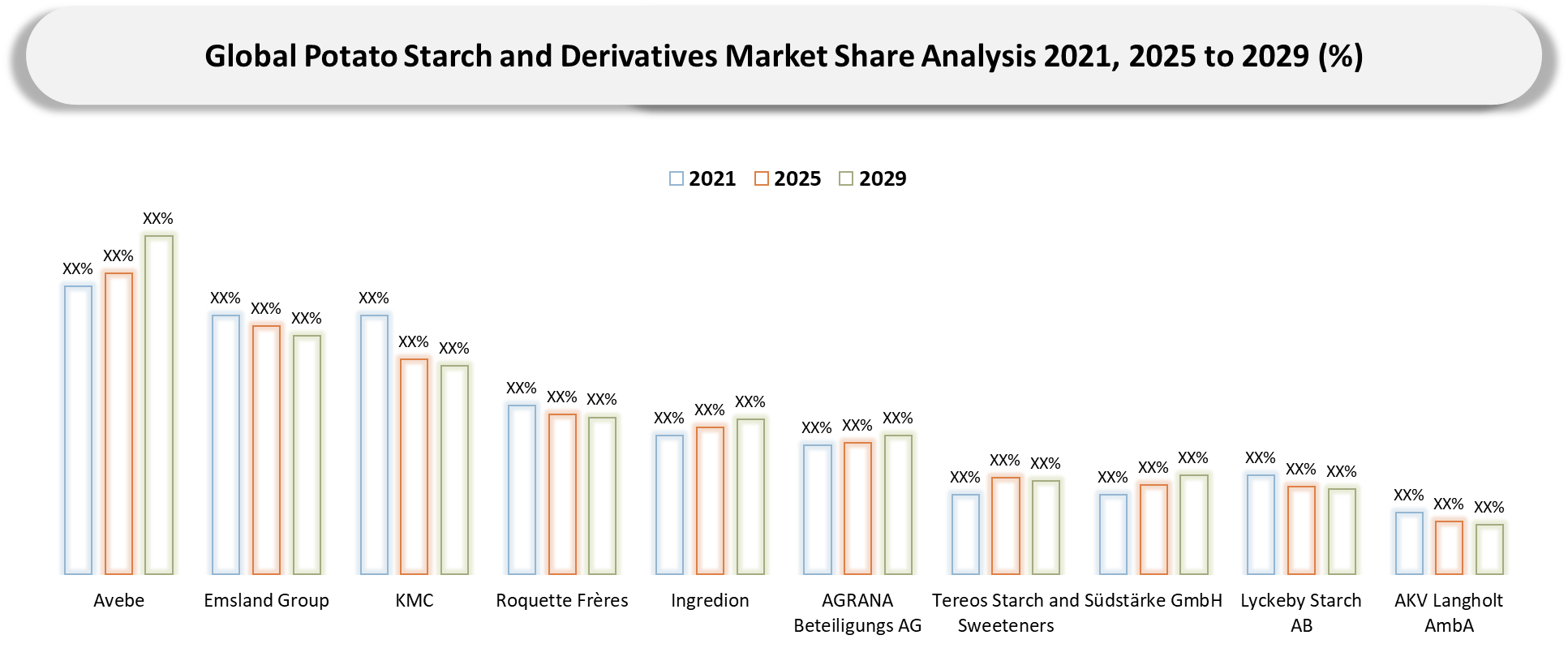
- The competitiveness of the global potato starch and derivatives industry will become more and more influenced by a dichotomy between larger companies involved in ingredients production and smaller companies focused solely on potato starch. Large companies such as Ingredion, Roquette Frères, Cargill, Incorporated, AGRANA Beteiligungs AG, and Tereos Starch and Sweeteners possess the benefit of diversified portfolios of ingredients, global reach of customers, scale of production processes, and effective logistics channels. Specialty companies including Avebe, Emsland Group, KMC, Lyckeby Starch AB, Südstärke GmbH, AKV Langholt AmbA, PEPEES S.A., Novidon B.V., Aloja Starkelsen Ltd., and VIMAL PPCE rely on their expertise in potato products, secure sources, modified potato starch products, and application-oriented innovations.
- In this industry, positioning will become more and more dependent on vendors' ability to shift their focus from commoditized native starch to more valuable potato starch applications. Vendors will need to compete by providing superior texture performance, viscosity management, freeze-thaw stability, clean label solutions, biodegradable starches, technical assistance, and supply security.
Key Developments
- In January 2026, Emsland Group launched Emjel LC 15, a functional starch solution for vegan and vegetarian jellies and gums, strengthening starch-based confectionery applications.
- In February 2026, Avebe showcased potato-based starch solutions for vegan gummies at ISM and ProSweets, focusing on faster setting, shorter drying time, and scalable plant-based confectionery.
- In August 2025, Royal Avebe acquired Solan, a Poland-based producer of potato flakes and granules, to broaden its potato-based product portfolio beyond starch, protein and fiber.
- In May 2025, KMC partnered with Daymer Ingredients to expand potato-based ingredient solutions in the UK. The partnership initially focuses on native clean-label potato starch solutions, with plans to expand into specialized and modified potato starches for UK food manufacturers.
- In May 2025, AGRANA Beteiligungs AG reported that its Gmünd potato starch factory processed about 175,100 tonnes of starch potatoes in the 2024 and 2025 campaign.
- In March 2025, KMC advanced carbon footprint and life-cycle assessment work for potato-based ingredients, strengthening sustainability positioning.
- In February 2025, KMC opened a new automated logistics center to meet rising global demand for high-quality potato starch.
- In November 2025, Lyckeby Starch AB and SolEdits developed CRISPR-edited potatoes designed to deliver storage-stable starch and reduce the need for chemical modification.
- In July 2024, KMC launched Gelamyl 625, a potato starch-based gelling agent for vegan gummy candy applications.
White Space Opportunities
There are numerous white space opportunities in the global potato starch and derivatives market, driven by the transition of consumers from commodity starch to application-specific, value-added ingredients. The biggest opportunity can be found in formulating food products according to the needs of clean label and gluten-free trends, in which applications of potato starch are able to provide texture, binding, thickening, moisture binding, and stabilization properties in baked goods, sauces, snacks, frozen foods, and prepared meals. This opens up a niche for high-end starch derivatives that work well under conditions of freeze-thaw, heat, extrusion, and high shear manufacturing.
There is another substantial opportunity related to sustainable industrial applications, where paper, packaging, adhesives, textile, and bioplastic manufacturers are seeking environmentally friendly and biodegradable materials to substitute synthetic ones. In addition to biodegradable starches, there is also room for innovation regarding food and industrial starches. It should be noted that potato protein, potato fiber, sweeteners, and other specialty derivatives may serve as valuable additions to starch sales rather than native starch itself.
DMI Opinion
As per DataM Intelligence, the global potato starch and derivatives market is gradually shifting from simple commodity starch supply towards application-oriented value creation. Not only do buyers require their volume needs to be satisfied, but they also want their demands met in terms of product functionality, processing flexibility, and sustainability orientation. Manufacturers require their suppliers of potato starch to offer them not only a continuous supply of high-quality products but also assistance in formulation development and application technology.
In the food industry, companies are looking for potato starch derivatives capable of enhancing product quality attributes such as texture, moisture binding, freeze/thaw stability, and shelf-life. Meanwhile, within industrial applications, the growing importance of biodegradability and sustainable manufacturing processes calls for the use of renewable feedstock. Thus, DataM Intelligence projects an increasing share of potato starch derivatives in the market as compared to conventional potato starch.
The key for market success seems to lie in a combination of pricing and innovation, as well as in the ability of a company to establish effective customer relationships and integrate itself within the downstream value chain.
Why Choose DataM?
- Functional Ingredient Innovation: Includes innovation in native potato starch, modified potato starch, potato sweeteners and their derivatives, potato proteins, and potato fibers.
- Performance and Market Positioning: Evaluates how top players compete on the basis of texture characteristics, viscosity management, freeze-thaw stability, binding capabilities, moisture holding capacity, label friendly, and industrial processing.
- Application Insights: Highlights application potential of potato starch for bakery, sauces, snacks, dairy products, frozen foods, paper, adhesives, textile, pharmaceutical, cosmetic, and bio-plastic applications.
- Industry Developments & Market News: Covers new product introductions, plant expansion plans, processing techniques, environmental considerations, alliances, and regional activities within North America, Europe, Asia-Pacific, Latin America, and Middle East & Africa.
- Business Models: Analyzes the strategies adopted by leading firms for growth through derivative innovation, specialty starch modification technology, regional presence, business partnerships, and value-added product lines.
- Pricing and Sales Channel Analysis: Offers information on fluctuations in prices of raw potatoes, starch products, distributors, direct sales systems, ingredients suppliers, and specialty chemicals.
- Market Penetration and Expansion Strategy: Features growth prospects available in the areas of clean label foods, gluten-free products, convenience foods, degradable starch, industrial starches, and green packaging.
Target Audience 2026
- Food ingredient manufacturers
- Modified starch and derivative producers
- Potato processors and starch extraction companies
- Food and beverage product development teams
- Paper, packaging, adhesives, and textile manufacturers
- Bioplastics and sustainable materials companies
- Procurement and sourcing teams
- Business development and export teams
- Corporate strategy and market intelligence teams
- Sales, distribution, and channel partners
- Investors and private equity firms
- Consulting and advisory teams


























































