


Post-Quantum Cryptography Market Size and Overview
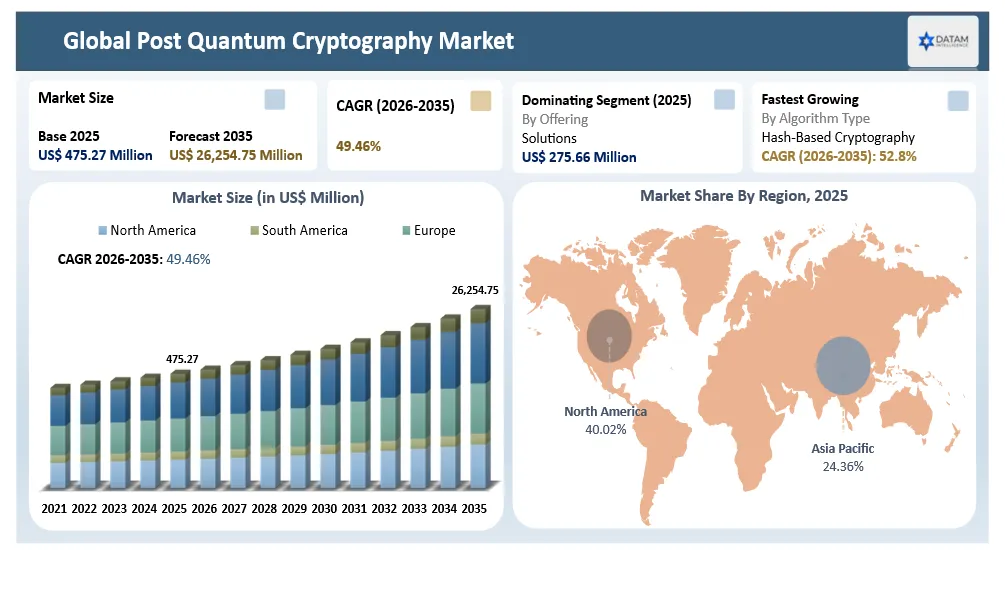
The global post-quantum cryptography market reached US$ 475.27 million in 2025 and is expected to reach US$ 26,254.75 million by 2035, growing with a CAGR of 49.46% during the forecast period 2026-2035.
The market is stepping into a decisive implementation stage aided by strong incentives to move enterprises to a new level. For instance, 84% of the companies surveyed by DigiCert in its future Quantum Readiness Outlook (2026) agree that some of their encrypted information is open to threats that use the principle "harvest now and decrypt later". Besides, 39% of the companies surveyed believe that quantum-safe cryptography will take between 3 to 5 years to be implemented. Although there is a strong desire to implement it, the gap in actual PQC adoption from the previous year turned out to be only 2%, thus prompting companies to search for technologies that will help them with cryptographic discovery, inventory management and crypto-agility, PKI modernization and automatic migration platforms.
Advancing regulations and standardization are leading to more investments. The NIST organization claims that three PQC standards have been finalized. These are FIPS 203 (ML-KEM), FIPS 204 (ML-DSA) and FIPS 205 (SLH-DSA). However, the roadmap gives the idea that some quantum-vulnerable algorithms will be put out of use after 2030 and will thus be removed from the standards in 2035. Overall, the trends in the market are transforming the competition between market players towards end-to-end capabilities in PQC algorithms, cryptographic asset discovery, interoperability testing, HSMs, PKI, secure communications and crypto-agile infrastructure.
Post-Quantum Cryptography Market Key Takeaways
- Solutions held a leading position in the post quantum cryptography market in 2025, accounting for 58% of the market, due to the rising need for quantum-resistant platforms, cryptographic asset search, crypto-agility solutions, PQC libraries, PKI upgrade and certificate security.
- The Hash-Based Cryptography is expected to witness the highest growth among algorithm types with an anticipated 52.8% CAGR between 2026-2035 owing to its growing adoption in long-lasting digital signature schemes, firmware/software signing, secure booting and critical infrastructure protection.
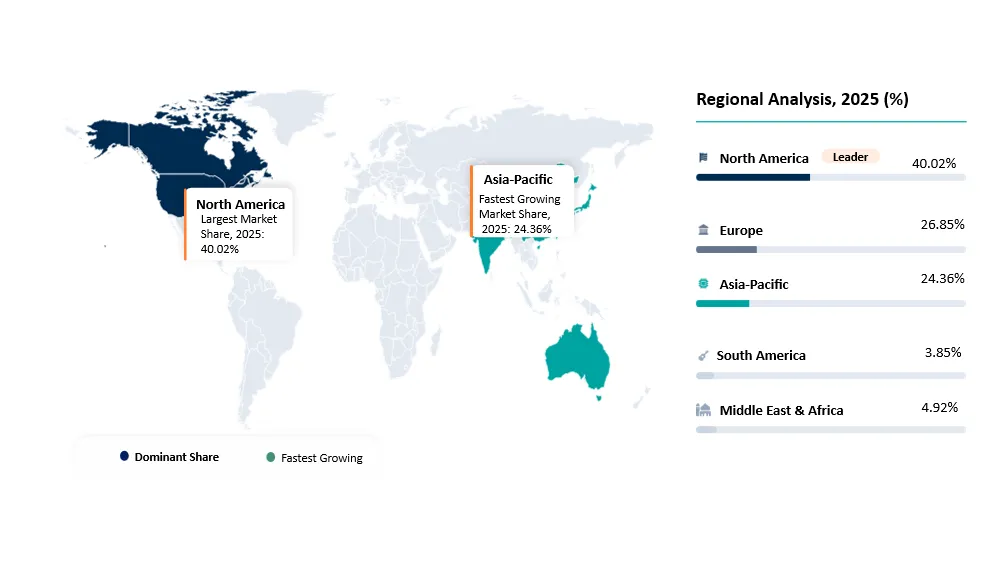
- North America held the largest share of 40.02% in the global Post-Quantum Cryptography Market in 2025 due to NIST standards, government migration efforts, hyperscale cloud architecture and vendor consolidation in PQC.
- Use of ML-KEM, ML-DSA and SLH-DSA is transforming the procurement process from traditional products for encryption to migration-ready solutions that can work in hybrid classical-PQC environments.
- Long-life-cycle infrastructures, such as those in firmware, industrial control systems, connected cars, telecommunication devices and critical infrastructure, which make cryptographic post-deployment replacement impractical and expensive, have become areas of priority for PQC product adoption.
Post-Quantum Cryptography Industry Trends and Strategic Insights
- Rapid adoption of NIST-standardized PQC algorithms like ML-KEM, ML-DSA and SLH-DSA is leading to the formation of a common technical baseline for quantum-safe security deployments.
- Crypto-agility has emerged as an important enterprise strategy, allowing businesses to swap out their vulnerable cryptography algorithms without having to redesign their systems entirely.
- Hybrid classical-PQC designs are becoming more popular as businesses evolve from legacy cryptographic designs to more advanced quantum-resistant systems.
- Adoption of PQC has been increasing in TLS, IPsec, PKI and digital identity infrastructures, leading to increased demand for quantum-resistant certificates, authentication and security.
- Discovery and migration management have become important, leading to increased demand for cryptographic inventory, risk assessment, migration management tools, interoperability testing and PQC implementation services.
Post-Quantum Cryptography Market Scope
| Metrics | Details | |
| 2025 Market Size | US$ 475.27 Million | |
| 2035 Projected Market Size | US$ 26,254.74 Million | |
| CAGR (2026-2035) | 49.46% | |
| Largest Market | North America | |
| Fastest Growing Market | Asia-Pacific | |
| By Offering | Solutions and Services | |
| By Algorithm Type | Lattice-Based Cryptography, Hash-Based Cryptography, Code-Based Cryptography, Multivariate Cryptography and Other PQC Algorithms | |
| By PQC Deployment Approach | Pure PQC, Crypto-Agile PQC and Hybrid PQC | |
| By Cryptographic Function | Key Encapsulation Mechanisms (KEMs), Digital Signatures, Encryption, Authentication, Certificate & PKI Security and Other Cryptographic Functions | |
| By Deployment Mode | On-Premises, Cloud-Based and Hybrid | |
| By Organization Size | Small & Medium Enterprises (SMEs) and Large Enterprises | |
| By Application | Network & Communications Security, Data Protection & Encryption, Application & Software Security, Identity & Access Management, Public Key Infrastructure (PKI), Code Signing, IoT & Connected Device Security, Blockchain & Digital Asset Security, Critical Infrastructure Security and Other Applications | |
| By Industry Vertical | Banking, Financial Services & Insurance (BFSI), Government & Defense, IT & Telecommunications, Healthcare & Life Sciences, Energy & Utilities, Automotive, Manufacturing, Retail & E-commerce, Transportation & Logistics, Aerospace and Other Industries | |
| By Region | North America | U.S., Canada, Mexico |
| Europe | Germany, UK, Russia, France, Spain, Italy, Poland | |
| Asia-Pacific | China, India, Japan, Australia, South Korea, Indonesia, Malaysia, Singapore, Vietnam, Thailand, Philippines, Taiwan | |
| South America | Brazil, Argentina | |
| Middle East and Africa | UAE, Saudi Arabia, South Africa, Israel, Turkiye, Nigeria | |
| Report Insights Covered | Competitive Landscape Analysis, Company Profile Analysis, Market Size, Share, Growth | |
Why does this report matter in 2026?
The post quantum cryptography market is at an important stage of implementation in 2026 as companies are moving beyond comprehending quantum threats to having an understanding of their cryptographic inventory and planning for deployment. The emergence of NIST approved algorithms such as ML-KEM, ML-DSA and SLH-DSA and concern over the harvest-now-decrypt-later attacks have pushed the need to discover quantum vulnerable systems and highlight the most vulnerable sensitive data such as long-lived data, certificates, keys, applications and internet infrastructure.
The significance of this report lies in the fact that now the implementation of PQC is not the exclusive responsibility of the cryptographic companies. Cloud computing, telecommunication networks, banking and finance, governments, the automotive industry, critical infrastructure, public key infrastructures (PKIs), hardware security modules (HSMs) and connected devices are increasingly examining quantum-safe designs. The report offers insights on the size of the market, opportunities for growth, implementation strategies, algorithm adoption, applications, demand by industry, competition and migration, among others, up until 2026.
Post-Quantum Cryptography Market White Space & Investment Opportunities
- Crypto-agility and crypto-discovery platforms form an area of high whitespace opportunity since companies must find quantum-vulnerable algorithms, certificates, keys, software programs and hardware prior to the wide-spread adoption of PQC cryptography.
- Quantum-proof PKI and certificate management form an area of investment interest due to the transition of digital certificates, identity frameworks, code-signing services and other trust architecture towards PQC-ready solutions.
- The use of PQC in HSMs, secure elements and crypto accelerators provides an emerging opportunity in cloud infrastructure, IoT, automotive, telecoms and critical infrastructure where quantum-resistant hardware is needed.
- Migration of PQC for legacy and long-lived systems is currently under-served, especially within industrial control systems, aerospace, military, healthcare devices and connected cars where cryptographic infrastructure can be expensive and disruptive to change.
- Managed PQC migration services represent a business opportunity given that enterprises need cryptographic assessment, algorithm migration, interoperability testing, compliance and quantum risk management services.
Post-Quantum Cryptography Future Market Transformation
The PQC market will transform from an advanced form of cybersecurity to a fundamental building block of digital security as enterprises progressively deploy PQC technology as a replacement for classical public key encryption algorithms. This future transformation will focus on crypto-agility, quantum safe PKI, automated cryptographic inventories and migration from hybrid to pure PQC solutions to allow businesses to change their algorithms without having to overhaul their whole security framework.
PQC will continue to move into hardware and embedded ecosystems as well, comprising HSMs, secure elements, cryptographic accelerators, connected cars, IoT devices, networking equipment and industrial control systems. With the maturation of algorithms and interoperability, the market is poised to transition from just implementing PQC to automation of migration, quantum-safe digital identity management, code signing, certificate management and cryptographic lifecycle management, thereby generating opportunities for specialized PQC players as well as incumbent security technology, semiconductor, cloud and infrastructure players.
Post-Quantum Cryptography Market Buyer Decision-Making Criteria
Organizations seeking post quantum cryptography solutions consider their exposure to quantum risks, compliance with NIST standards, crypto agility, interoperability, ease of migration, cryptographic performance and their security needs going forward. Buyers consider their ability to integrate such solutions with current PKI, HSM, cloud, networks, applications, embedded systems and legacy infrastructures in order to facilitate the migration process from current encryption to PQC. However, the ability to recognize quantum-vulnerable cryptographic resources, use standardized PQC algorithms, enable hybrid transition, preserve application efficiency and reduce business disruptions is especially critical for businesses dealing with persistent data.
Major Decision-Making Criteria
- NIST PQC Standards Alignment
- Support for ML-KEM, ML-DSA & SLH-DSA
- Cryptographic Asset Discovery & Inventory
- Crypto-Agility & Algorithm Switching
- Hybrid PQC Migration Capability
- PKI, HSM & Certificate Infrastructure Compatibility
- Legacy-System & Application Integration
- Quantum-Resistance & Security Assurance
- Cryptographic Performance & Latency
- Cloud, On-Premises & Hybrid Deployment
- Key & Certificate Lifecycle Management
- Code Signing & Digital Identity Support
- Embedded & IoT Deployment Capability
- Regulatory & Compliance Readiness
- Migration Cost & Total Cost of Ownership
- Interoperability & Vendor Support
Post Quantum Cryptography Market Economic & Investment Analysis
The market for post quantum cryptography is changing from research-oriented to commercially oriented cryptographic modernization, giving rise to investments in PQC software, cryptography libraries, crypto-agility software, quantum safe public key infrastructures, hardware security modules (HSM), secure elements and migration services. The economy will be more motivated by the necessity to discover and eliminate quantum-susceptible cryptographic resources before quantum computers become able to decrypt the data protected by those cryptographic assets. The direction of investment will thus focus on tools to minimize the migration process, utilize NIST certified protocols like ML-KEM and ML-DSA and allow migrations without complete system changes.
Cryptographic discovery and inventory, quantum-resistant certificates, PKI modernization, PQC hardware, cloud security, embedded security and migration management services present particularly promising investment opportunities. Banking institutions, government bodies, military agencies, telecommunications firms, cloud service providers, auto makers and critical infrastructure companies should emerge as major demand centers due to their extensive cryptography usage and high amount of sensitive data to protect. Competitive advantage will be determined by factors such as crypto agility, interoperability, implementation efficiency, regulatory preparedness and economical migration and will favor vendors with combined PQC and digital trust capabilities.
Post-Quantum Cryptography Investment Trends in the Market
- The focus on cryptographic discovery and inventories has become an enterprise spending trend, with businesses using solutions to discover vulnerable algorithms, certificates, keys, applications and devices ahead of migration.
- Investment in QKS and digital trust solutions continues to accelerate, especially for certificate management, digital identity, authentication and code signing platforms requiring long-term cryptographic protection.
- HSM, secure element and crypto accelerator investment in PQC hardware is growing especially in automotive, IoT, telecommunication, aerospace and critical infrastructures where long lifecycle is a key criterion.
- Cloud vendors are now stepping up investments to provide native solutions in PQC, incorporating quantum-proof cryptography in the cloud's security and network protocols, key management systems, APIs and managed security services.
- There have been significant investments being made for PQC migrations and crypto-agility solutions, such as legacy system assessment, algorithm migration, interoperability testing, compliance preparation and automatic cryptographic remediation.
Strategic Indicators for the Post-Quantum Cryptography Market
High Regulation Impact
The post quantum cryptography market sees very high regulatory impact, as governmental organizations and standardization agencies are making time frames and technology requirements for transition to quantum-safe cryptography. Finalization of NIST standards on PQC, quantum readiness programs from governments and the requirement to protect long-term sensitive data are driving enterprises to migrate to ML-KEM, ML-DSA and SLH-DSA. This regulatory landscape is especially significant in government and defense, BFSI, healthcare, telecoms, critical infrastructure and other regulated industries, where organizations need to inventory their cryptography, increase crypto-agility and prepare for future quantum attacks.
High Investment Activity
The market of post quantum cryptography is seeing heavy investment action from technology players, cloud players, semiconductor manufacturers and cybersecurity players making investments in developing products that will provide quantum resistant security solutions. These investments are in areas such as cryptographic agility platforms, cryptographic discovery, quantum safe PKI, HSM and secure elements using post-quantum cryptography, cloud native post-quantum cryptography and embedded cryptographic IP. Investments and strategic alliances are increasingly being made to support large scale migration from traditional public key cryptography, improve the performance of post-quantum cryptography and adoption of NIST standardized algorithms.
Supply Chain Disruption
Supply chain disruption risk for the post quantum cryptography industry arises from the dependency on hardware for implementing quantum-resistant encryption. Shortages of semiconductors, long qualification periods, geopolitical barriers and availability of PQC-capable hardware can lead to delays in implementation in automotive, telecommunications, aerospace, IoT, cloud infrastructure and critical infrastructure industries. Additionally, migration challenges may arise due to the need to upgrade firmware or replace legacy hardware that does not accommodate the new cryptographic algorithm. This situation will drive the need for crypto-agile designs, software-based PQC solutions, use of multi-vendor cryptographic components and early crypto inventory management.
Pricing Volatility
The post quantum cryptography market exhibits moderate price variations. This volatility is mostly due to differences in the complexity of the migration process, the types of devices used and the services offered and not so much because of the application of PQC algorithms. The fees involved in enterprise PQC programs can reach more than $100,000 for application-specific solutions and even millions of dollars for large-scale upgrades of existing cryptographic systems. PQC-ready hardware security modules (HSMs), secure elements, cryptographic accelerators and consulting services have made deployment projects significantly more expensive. Hardware-dependent and legacy system transitions remain more unpredictable when it comes to pricing, while cloud and software-based implementations will be comparatively cheaper.
Procurement Pressure
The post quantum cryptography industry will come under increasing procurement pressure due to the necessity for enterprises to upgrade vulnerable cryptographic technologies against the threat of quantum computing and the need to factor in the costs and complexities of interoperability and technology life-cycles. Buyers are increasingly expecting providers to have the ability to provide NIST-certified algorithms, crypto-agility, discovery of cryptographic assets, integration with PKI/HSM, hybrid deployment, performance and scalability and upgrade paths in order to make a purchase decision. This is especially true of BFSI, government/defense, telecoms, healthcare, aerospace and critical infrastructures industries.
New Technology Adoption
Post quantum cryptography markets are witnessing widespread adoption of NIST-approved algorithms, crypto-agile architectures and post-quantum cryptographic technologies as companies move away from conventional public key cryptography. This adoption is now going beyond just software libraries to include HSMs with PQC capabilities, secure elements, cryptographic accelerators, post-quantum key management, certificate management and even cloud-native cryptography. The use of hybrid PQC solutions is common during the migration to post-quantum cryptography solutions. New adoptions are particularly evident in the cloud computing market, telecommunication, finance, government and defense, automotive, IoT and critical infrastructure industries where cryptographic protection of data for extended periods is required.
Regional Expansion Opportunity
The market for post quanty cryptography holds a lot of potential for geographic expansion as governments, companies and operators of critical infrastructure move toward their quantum readiness programs at different speeds. North America still remains an important commercialization area owing to early governmental projects, the efforts of cloud providers and cyber security needs. The same applies to Europe, which provides good opportunities due to the coordination of digital security strategies, need for digital sovereignty and PQC migration in regulated industries. The Asia Pacific region holds high growth potential thanks to quantum safe cybersecurity development in telecommunications, banking, semiconductor manufacturing, automotive industry and government operations in Japan, South Korea, Singapore, India and other countries with developed technologies.
Government Policy Support
Government policy has been one of the key drivers of the post quantum cryptography market, with cybersecurity organizations of governments taking organizations towards migration away from classical cryptography that could be vulnerable to quantum computing. The finalization of PQC standards by NIST—ML-KEM, ML-DSA and SLH-DSA—is the technical underpinning of this development. The efforts towards quantum readiness within the U.S. federal government, Europe cybersecurity measures and quantum readiness in Japan, South Korea, Singapore and India have encouraged cryptographic inventory, crypto-agility and transition. Policy efforts are driving demand for quantum safe PKIs, HSMs, secure communication, cryptographic libraries, cryptographic discovery and post-quantum cryptography migration services.
Pricing Intelligence
The cost of post quantum cryptography can vary according to the type of solution being used and the amount of requisite cryptographic infrastructure. Pricing begins at about $25,000–$100,000 for PQC assessment and cryptographic discovery services in 2026 but can be as high as $1 million–$10 million+ for enterprise migration and crypto-agility initiatives, depending on the number of applications, certificates, keys, devices and legacy systems involved. While PQC software libraries can be relatively inexpensive in terms of incremental pricing, quantum-safe PKI, HSMs, secure elements, cryptographic accelerators and specialized migration services are charged at a higher rate because of additional integration, certification, performance testing and lifecycle management needs. Thus, pricing considerations enable the creation of different prices for different assessment solutions, migration solutions, enterprise software, hardware security products and managed post-quantum cryptography services.
| HS Code | Reporter | Trade Flow | 2025 Trade Value | Interpretation |
854370 [Electrical Machines & Apparatus with Individual Functions] | USA | Export | US$14.2 Billion | Broad proxy for specialized electrical and electronic apparatus. PQC-capable HSMs and cryptographic hardware represent only an unisolated fraction of this category. |
854231 [Electronic Integrated Circuits: Processors & Controllers] | Germany | Import | US$9.5 Billion | Broad proxy for processor and controller imports. Secure elements, TPMs and PQC-capable semiconductor components may fall within related classifications, but PQC-specific trade cannot be isolated. |
851762 [Machines for Reception, Conversion & Transmission of Data] | Japan | Export | US$8.1 Billion | Broad proxy for networking and data-communication equipment. Quantum-safe capabilities may be incorporated through hardware, firmware, or software, but PQC-specific trade is not separately identifiable. |
852351 [Solid-State Non-Volatile Storage Devices] | South Korea | Export | US$12.3 Billion | Broad proxy for solid-state storage devices. Secure storage elements and quantum-resistant security components represent only a small subset of this category. |
Note: Pure PQC software, including NIST-standardized ML-KEM and ML-DSA implementations, is generally delivered electronically and does not generate a separately identifiable physical customs trade value under a dedicated PQC HS code.
AI Impact Analysis of the Post-Quantum Cryptography Market
AI is influencing the post quantum cryptography market through speeding up cryptographic research, identification of vulnerabilities and PQC migration in large and complex technology environments. AI-based systems can scan applications, certificates, keys, protocols, libraries and inventories of devices for identification of quantum cryptography-vulnerable items, prioritization of vulnerable systems and dependency mapping prior to PQC migration. In addition, AI may facilitate automated code analysis and cryptographic modernization that will help organizations identify classical cryptography, like RSA and ECC, implementations in their systems and choose the correct replacements with ML-KEM, ML-DSA and SLH-DSA.
AI is also generating a requirement for crypto-adaptive security architectures that adapt to changes in algorithmic and threat models over time. AI can aid in detecting cryptographic misconfigurations, assessing progress of migrations, optimizing PQC performance and automating certificate and key lifecycle management for cloud, enterprise, IoT, automotive and critical infrastructure scenarios. But AI does not substitute PQC; instead, it functions as an abstraction layer over migration, discovery, optimization and governance of quantum-safe cryptographic technologies.
Disruption Analysis of the Post-Quantum Cryptography Market
Disruption of the post-quantum cryptography market is driven by the shift from static cryptography to crypto-agile and dynamic security systems. The deployment of NIST-approved algorithms including ML-KEM, ML-DSA and SLH-DSA is changing the future of PKI, HSMs, cloud security, networking protocols, code signing, digital identity and embedded security. Moreover, the threat of harvesting now and decrypting later is prompting planning for migration of critical information with extended confidentiality requirements to replace RSA and ECC vulnerable to quantum computing attacks.
The result is transforming the market from discrete cryptographic offerings to migration ecosystems that encompass cryptographic innovation, algorithms evaluation, crypto-agility, certificate management, automated remediation and interoperability testing. Cloud companies, cybersecurity firms, semiconductor manufacturers, PKI providers and dedicated PQC providers are now competing in providing end-to-end migration capabilities, while the large estate enterprises are leading the demand for such offerings that will allow them to adopt PQC without changing the hardware and applications.
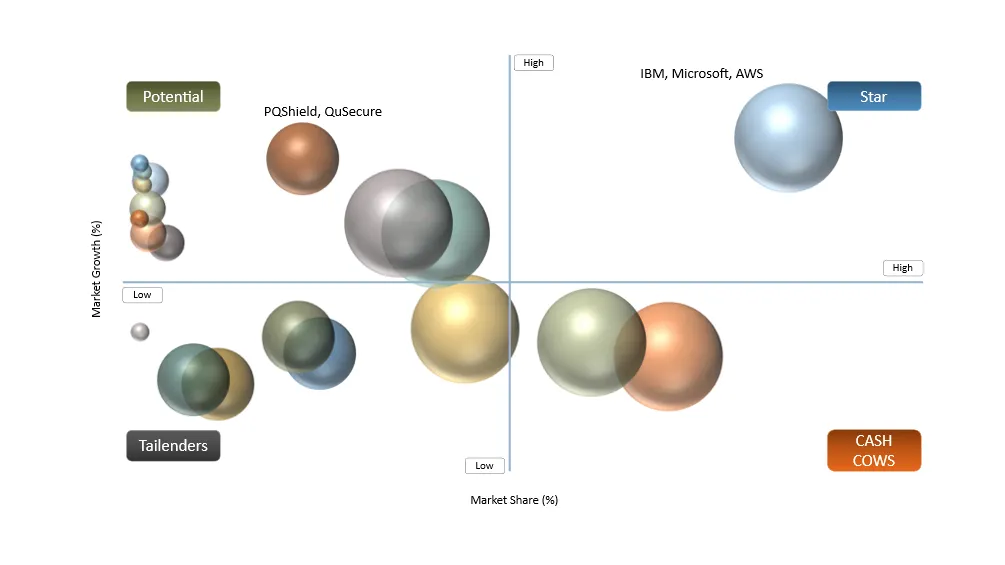
Post-Quantum Cryptography Market BCG Matrix: Company Evaluation
STAR
The stars have strong PQC capabilities, considerable presence in the market and high growth potential owing to the increasing shift from quantum-vulnerable cryptography among organizations. The companies are adopting NIST standardized algorithms like ML-KEM, ML-DSA and SLH-DSA in cloud security, networking, PKI, HSMs, crypto-discovery and enterprise security. IBM, Microsoft, AWS, Google, Cisco and Thales have an edge because they can utilize their existing enterprise ecosystem and scale their PQC capabilities.
POTENTIAL
The potential companies are specialist PQC players with unique offerings and significant opportunities to expand market share as enterprise migration accelerates. Companies such as PQShield, QuSecure, Post-Quantum, CryptoNext Security and ISARA concentrate their efforts in such areas as PQC cryptographic IPs, crypto-agility, quantum-resistant communications, migration solutions and cryptographic modernization. The key factors that will influence the ability of these companies to realize their market potential include the scalability of their unique offering, partnerships with leading technology players, interoperability with NIST standards and adoption.
Post-Quantum Cryptography Market Dynamics
Driver Impact Analysis
| Driver | Market Growth Impact (%) | Demand Concentration | Impacted Use Case | Strategic Impact |
Growing Quantum Computing Threat | 35% | Global Enterprises | Data & Network Security | Accelerates PQC adoption |
Government PQC Mandates & Regulations | 25% | Government & Defense | Secure Communications | Drives mandatory migration |
| NIST PQC Standardization | 22% | Global Technology Ecosystem | Encryption & Digital Signatures | Enables standardized deployment |
Enterprise PQC Migration & Crypto-Agility | 18% | Large Enterprises | IT & Cryptographic Infrastructure | Expands migration and implementation demand |
Driver: Growing Quantum Computing Threat
The burgeoning risks associated with quantum computing in the context of cryptography and data safety is fueling the growth of the post quantum cryptography industry, since advanced quantum computers could threaten the viability of commonly used public-key encryption algorithms like RSA and ECC. The “harvest now, decrypt later” phenomenon has led to an uptick in the use of cryptographic systems as businesses can store sensitive encrypted information that could be decrypted at a later date; it is increasing the demand for Post-Quantum Encryption methods like ML-KEM, MD-DSA, SLH-DSA, quantum-secure PKIs, HSMs, secure channels and cryptographic discoveries and other components of a crypto-agile structure in industries like government, banking and finance sector, cloud computing, telecommunications and smart services.
Restraint Impact Analysis
| Restraint | Drag on Market Growth (%) | Primary Impact Area | Impacted Use Case | Strategic Impact |
High PQC Migration Costs | 30% | Enterprise IT Infrastructure | Cryptographic Migration | Slows large-scale adoption |
Legacy System Compatibility | 27% | Enterprise & Critical Infrastructure | Legacy Encryption Systems | Increases migration complexity |
Shortage of PQC Expertise | 23% | Cybersecurity Workforce | PQC Implementation & Management | Raises implementation time and costs |
Performance & Integration Challenges | 20% | Technology Infrastructure | Encryption & Digital Signatures | Delays deployment in resource-constrained environments |
Restraint: High PQC Migration Costs
The expensive process involved in the transition from the existing cryptography infrastructure to post quantum cryptography represents a major barrier to market acceptance, especially when it comes to firms with huge cryptographic infrastructure in place. The transition to post quantum cryptography involves the identification of cryptographic assets, modifications to application code, migration of certificates and PKI, upgrade of HSMs and secure elements, procurement of new hardware, interoperability and validation across the whole range of legacy applications. This issue becomes especially relevant for banks, government bodies, telecom companies, automotive platforms, health care systems and critical infrastructure, since the components of cryptography are integral parts of their operation and cannot be switched off.
Post Quantum Cryptography Market Segment Analysis
The global post quantum cryptography market is segmented based on the Offering, Algorithm Type, PQC Deployment Approach, Cryptographic Function, Deployment Mode, Organization Size, Application, Industry Vertical and region.
By Offering
Solutions Lead the Market as Enterprises Modernize Cryptographic Infrastructure
The solutions segment was leading the post quantum cryptography market in 2025 and held 58% of the market share, due to high demand for quantum-resistant cryptographic platforms, cryptographic asset discovery, crypto agility solutions, post-quantum cryptography libraries, public key infrastructure (PKI) modernization and certificate security solutions. The services sector is forecasted to be the fastest growing segment, owing to increasing demand for quantum risk assessment, migration planning and legacy system integration.
By Algorithm Type
Hash-Based Cryptography Gains Momentum for Long-Term Digital Security
Hash-based Cryptography is anticipated to witness the highest growth rate at an estimated CAGR of 52.8% in the forecast period of 2026-2035, owing to its applicability in long term secure digital signatures. Adoption in areas such as firmware and software signing, secure booting, authentication of devices, security of public key infrastructure and critical infrastructure is boosting the demand for the technology. The importance of the technology is rising significantly in applications such as defense, aerospace, government, Internet of Things, automotive electronics and industrial control systems.
Post Quantum Cryptography Market Geographical Penetration
U.S. Post Quantum Cryptography Market Landscape
The market for post quantum cryptography in the U.S. will be influenced by robust federal cybersecurity programs, adoption of PQC algorithms under the NIST framework and presence of many cloud, cybersecurity, semiconductors, networking and cryptographic technology providers. Federal agencies and regulated industries are adopting cryptographic inventory, migration strategy, crypto-agility and quantum-safe cryptography solutions to protect against the threat posed by RSA and ECC based cryptosystems. The U.S. market is home to some of the biggest technology players such as IBM, Microsoft, AWS, Google, Cisco, Entrust, DigiCert, Keyfactor and Palo Alto Networks, along with some dedicated PQC providers, making the U.S. a front-runner in this market.
China Post Quantum Cryptography Market Trends
The China post quantum cryptography market will be defined by the country’s investment in areas such as quantum information science, cybersecurity, cryptography and indigenous security technology. The market activities will revolve around quantum communications, cryptography algorithms, security chips, PKI, identity security and government and critical infrastructure security with the help of indigenous technology development enabling greater control over cryptographic standards and supply chains. The adoption of post-quantum cryptography will be highly important for government agencies, finance, telecoms, cloud infrastructure providers, transport, energy and defense sectors, because the longer data is sensitive and systems are interconnected, the more quantum resistant solutions they require.
United Kingdom Post Quantum Cryptography Market Analysis
The United Kingdom post quantum cryptography market is emerging based on the existing UK ecosystem of cybersecurity, its quantum strategy by the government and the exposure of the financial services sector. The market is increasingly driven by topics like crypto-agility, quantum safe PKI, HSMs, digital identity, secure communications and cryptographic asset discovery, as enterprises prepare to move away from RSA and ECC solutions. The demand will be especially pertinent in BFSI, government and defense, telecom, healthcare and critical infrastructure sectors, while experts from the UK, such as Post-Quantomatic and PQShield, will be contributing to the UK PQC technologies ecosystem.
Germany Post Quantum Cryptography Market Projection
The market for post quantum cryptography in Germany is being propelled forward by its robust industrial sector, developed cybersecurity landscape and growing interest in securing its digital assets from quantum threats. Opportunities for adoption are arising in industries like automotive, manufacturing, BFSI, telecoms, governments, healthcare and critical infrastructure, in which organizations consider migrating from RSA and ECC to NIST-recommended PQC algorithms, crypto-agile infrastructure, quantum-resistant PKI, HSMs and embedded systems. The substantial manufacturing and industrial technologies market in Germany also adds more pressure for the use of PQC-based ECUs, connected vehicles, industrial control systems, Internet-of-Things components and software updates. Enterprises also need crypto inventory and life cycle management services for coordinating the transition process.
Japan Post Quantum Cryptography Market Outlook
The post quantum cryptography market in Japan is set to see robust growth due to the confluence of leading-edge telecommunication, electronic, automobile, financial services and governmental infrastructures with consistent investments in quantum and cybersecurity technologies. PQC implementation is anticipated to revolve around quantum-safe communication, cryptography migration, secure chip, PKI, HSM, code signing and crypto-agile networks, especially when it comes to applications where long-term security lifecycles are required due to long-term data retention and connection of devices. The large Japanese automobile, semiconductor, industrial automation and telecommunication sectors offer additional prospects for embedded PQC implementations, software update security and network security for IoT and other applications.
Post Quantum Cryptography Market Competitive Landscape
- PQC Integration Across Existing Security Portfolios: Leading cybersecurity, cloud, networking, PKI and HSM vendors integrate ML-KEM, ML-DSA and SLH-DSA technologies within their current offerings rather than provide PQC as a stand-alone solution.
- Crypto-Agility as a Key Differentiator: Vendors compete based on discovering quantum-vulnerable components, switching cryptographic schemes, certificate and key management and performing migrations without changing the entire infrastructure.
- Specialized PQC Vendors Target High-Value Niches: Companies like PQShield, QuSecure, Post-Quantum and CryptoNext Security create differentiation with cryptographic IP, migration platforms, quantum-safe communication and crypto-agility automation.
- Partnerships Are Accelerating Enterprise Migration: The field of PQC is seeing more and more collaboration with cloud service providers, semiconductor vendors, PKI providers, network providers and cybersecurity companies to enable quantum-safe solutions within current enterprise and embedded systems.
- Competition Is Shifting Toward End-to-End Migration: It now lies in offering an end-to-end path for migrating from cryptography risk assessment to implementing PQC, updating PKI/HSM, testing interoperability and managing cryptographic lifecycle.
Public Company Q1-Q2 2026 Performance Comparison
The below table offers a comparative analysis of five companies listed publicly and having substantial business dealings in the PQC market. Financial metrics are presented in terms of the company itself since these companies typically do not offer figures related to their PQC business independently. This analysis includes both financial performance of companies and PQC market exposure, namely, quantum-safe cryptography, crypto-agility, PKI, HSMs, secure communication and cryptographic migration. As can be seen now in the industry, PQC is transitioning from testing to migration.
| Company | Q1–Q2 2026 Performance | Post Quantum Cryptography Exposure | Key Performance Driver |
| IBM | Q2 2026 revenue: $17.2B, up 1% YoY | Highly direct through quantum-safe cryptography, IBM Quantum Safe and cybersecurity solutions | AI, software, hybrid cloud and cybersecurity modernization |
| Microsoft | Q3 FY2026 revenue: $81.3B, up 17% YoY | Highly direct through Azure, security, cryptographic modernization and PQC initiatives | Azure, AI infrastructure and cloud security |
| Cisco | Q2 FY2026 revenue: $15.3B, up 10% YoY | Highly direct through quantum-safe networking, TLS, IPsec, MACsec and SSH | Networking, AI infrastructure and enterprise network upgrades |
| Cloudflare | Q2 2026 revenue: $696.1M, up 36% YoY | Highly direct through post-quantum TLS, Zero Trust and quantum-safe network security | Cybersecurity adoption, AI-driven traffic and cloud security |
| Thales | H1 2026 revenue: $12.5B, up 7.8% organically | Highly direct through PQC-ready HSMs, PKI, crypto-agility and quantum-safe encryption | Defense, aerospace, cybersecurity and digital identity |
Note: Financial figures are company-level performance indicators and should not be interpreted as PQC-specific revenue. PQC exposure reflects each company's involvement in post-quantum cryptography, crypto-agility, PKI, HSMs, secure communications and related cybersecurity infrastructure.
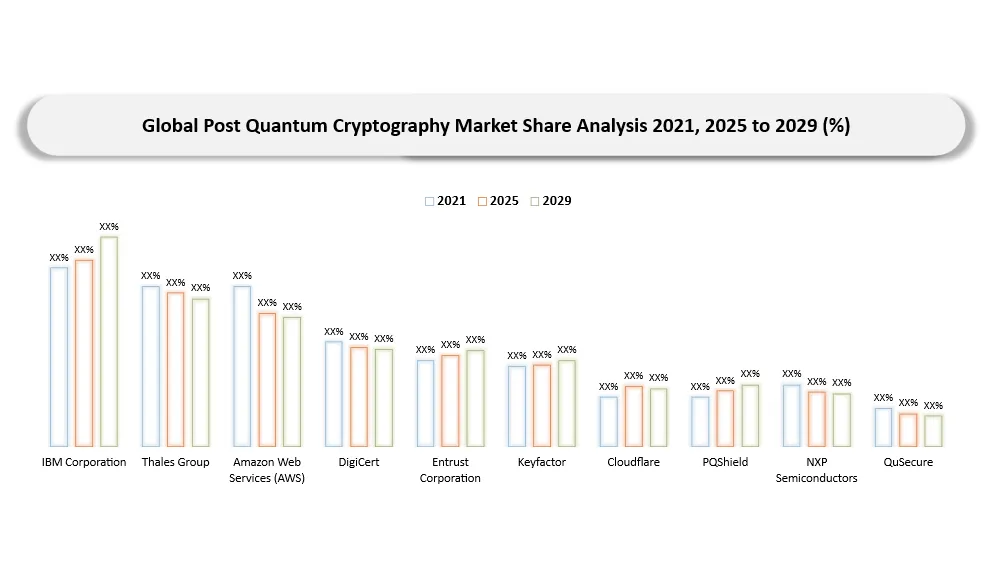
Key Companies of Post Quantum Cryptography Market
- IBM Corporation (United States)
- Microsoft Corporation (United States)
- Amazon Web Services (United States)
- Google (United States)
- Cisco Systems, Inc. (United States)
- Thales Group (France)
- NXP Semiconductors N.V. (Netherlands)
- Infineon Technologies AG (Germany)
- Keyfactor (United States)
- Palo Alto Networks, Inc. (United States)
- Cloudflare, Inc. (United States)
- PQShield Ltd. (United Kingdom)
- Entrust Corporation (United States)
- DigiCert, Inc. (United States)
- IDEMIA (France)
- Quantinuum Ltd. (United Kingdom)
- ISARA Corporation (Canada)
- Post-Quantum Ltd. (United Kingdom)
- CryptoNext Security (France)
- QuSecure (United States)
Company Profiles of Post Quantum Cryptography Market
IBM Corporation
IBM is a leading competitor in post quantum cryptography through its quantum-safe transformation services, cryptographic research, PQC algorithms and enterprise migration capabilities. The company has solutions in areas such as cryptographic discovery, application modernization, hybrid PQC implementation and quantum-safe infrastructure. In addition, IBM is working with partners like Keyfactor and Entrust for enterprise PQC migration.
Competitive priorities involve increasing quantum safe transformation services, implementing standardized NIST algorithms into enterprise settings, increasing crypto agility functionality and assisting clients to update their cryptography architecture.
Microsoft Corporation
For over a decade now, Microsoft has been involved in researching and standardizing PQC and has developed algorithms as well as implementations intended for integration with Internet protocols and enterprise environments. Its overall approach involves preparations of its cloud, software, identity and security environment for quantum-resistant cryptography.
Priorities of the competition include implementation of PQC into Azure and enterprise security products, better crypto-agility, support of standardized algorithms and capability for migration of cryptographic workloads without interrupting existing applications.
Amazon Web Services (AWS)
AWS is migrating its cloud architecture to use post quantum cryptography and has implemented post-quantum cryptography features in various services and communications. AWS uses ML-KEM for post-quantum confidentiality and ML-DSA for post-quantum digital signatures and migration is in line with the CNSA 2.0 regulations.
Key competitive priorities for AWS include migration of PQC to cloud managed services, simplification of customer migration process, quantum-proof networking communications and implementation of PQC in cloud identity and encryption services.
The company Google is one of the biggest participants in the research and application of post quantum cryptography within the Internet infrastructure, browser, cloud and cryptographic protocols. The efforts of Google in this area are primarily oriented towards protection from harvest-now-decrypt-later attacks in large scale digital communications.
Other competitive priorities involve wider use of PQC in Google Cloud and infrastructure exposed to the Internet, protocol optimization, algorithm standardization and interoperability.
Cisco Systems
Cisco has taken steps to incorporate quantum resilience in their networking and security product line by implementing PQC measures for protocols like IPsec, TLS, MACsec and SSH. Cisco’s product roadmap includes measures for quantum resistant identity, secure boot, signing, verification and software update protection.
Cisco’s competitive priorities focus on embedding PQC in enterprise networking solutions, network traffic and device identity protection, building crypto-agile infrastructure and large scale migration.
Thales Group
Thales has a broad quantum-safe security portfolio covering areas such as cybersecurity, digital identities, PKI, hardware security and critical infrastructures. Thales is actively involved in PQC migration initiatives associated with NIST and cooperates with other technology vendors for quantum-safe transition.
Among the competitive priorities are integration of PQC into digital trust and identity infrastructures, further development of quantum-safe HSM and PKI capabilities, governmental and defense needs and crypto-agile security architectures.
Keyfactor
KeyFactor focuses heavily on the cryptographic management and crypto-agility angle of PQC migration and its features include cryptographic discovery, PKI migration, certificate lifecycle management, digital signing and cryptographic automation.
The competitive considerations focus on increasing cryptographic inventory and discovery, automation of certificates and keys management, assisting organizations to find quantum-vulnerable assets and migration towards crypto-agile architectures.
PQShield
PQShield is a PQC company that specializes in providing cryptographic software, hardware IP and embedded solutions for post-quantum cryptography. Its solutions are quantum-proof and suitable for use in devices, processors, secure elements and enterprise environments.
The competitive priorities for the firm include commercializing of NIST-compatible cryptographic IP, scaling up embedded PQC, securing connected devices and semiconductors and adoption of hardware-assisted quantum-proof security solutions.
Entrust Corporation
Entrust offers PQC solutions in areas such as cryptographic security, PKI, identity, certificates and hardware security modules. The quantum-resistant approach adopted by Entrust focuses on crypto-agility and cryptographic governance at the enterprise level.
Areas that Entrust considers as part of its competitive advantage are quantum-resistance PKI and HSM solutions, automation of certificate and key management lifecycle processes, regulation compliance and enterprise digital trust migration to PQC.
QuSecure
QuSecure is an organization that specializes in post quantum cryptography and crypto-agility platforms that are aimed at helping companies identify, enhance and manage their cryptographic algorithms within their existing systems. The QuProtect platform is focused on cryptographic discovery, remediation, policy control and run-time algorithm switching.
The competitive priorities of QuSecure include scaling crypto-agility implementations, government and critical infrastructure adoption, PQC migration without disruption and automation of cryptographic discovery and remediation processes.
Post Quantum Cryptography Market Major Pain Points
- Complexity of Cryptographic Asset Discovery: Organizations do not necessarily have comprehensive visibility as to where RSA, ECC and other algorithms that can be susceptible to attack by quantum computers have been implemented in applications, certificates, devices, APIs and network protocols.
- Legacy Infrastructure Migration Constraints: PQC algorithms are not necessarily plug-and-play; businesses will have to make modifications to their protocols, software applications, encryption software libraries, hardware, certificate authorities and embedded systems.
- PQC Performance and Data-Size Overheads: The increased key size, larger ciphertexts and larger signatures that some PQC algorithms produce can impact network bandwidth, memory usage, handshake time and performance on constrained devices.
- Limited Crypto-Agility Across Existing Systems: The majority of legacy systems have not been created for switching cryptographic methods quickly, thus, companies may need to undertake considerable changes of their infrastructure and perform some manual work when transitioning from insecure algorithms to PQC standards.
- Interoperability and Validation Challenges: In order to implement PQC solutions, interoperability testing should be conducted between such components as PKI, TLS, HSMs, applications, operating systems, networking devices and other third-party providers.
Post Quantum Cryptography Market Recent Developments
- DigiCert - August 2026: DigiCert issued Recommendations for Post-Quantum TLS Migration, which provided guidelines regarding hybrid key exchange, authentication, certificate migration and separation of TLS key exchange and authentication migrations.
- DigiCert - July 2026: DigiCert launched Quantum Central, an innovative PQC readiness tool that helps enterprises manage their cryptographic assets, recognize quantum threats, prioritize and manage migration and assess migration status.
- Cloudflare - July 2026: Released a PQ migration update, highlighting the necessity to solve problems related to post-quantum authentication and digital signatures, planning to achieve post-quantum migration by 2029.
- Keyfactor - July 2026: Keyfactor enhanced the Global Partner Program in order to assist partners in developing advisory, implementation and managed services for AI, machine identity, digital trust and PQC.
- IBM - June 2026: IBM Quantum Safe Explorer version 2.3.2 added improved cryptographic analysis for Python code, improved CycloneDX mapping of cryptographic assets and improved cryptographic API detection and FIPS compliance for JavaScript/TypeScript applications.
Analyst View / Opinion on Post Quantum Cryptography Market
- Enterprise PQC migration is becoming the main market opportunity: Demand is shifting towards cryptographic research, deployment, testing and replacement of quantum-vulnerable systems.
- Crypto-agility will drive vendor differentiation: The products that provide for fast algorithm switching, certificate management and cryptography portfolio will enjoy more enterprise uptake.
- Hybrid deployment will support the transition: As organizations migrate, they will use a combination of classical and post-quantum algorithms to remain interoperable and secure.
- Embedded PQC adoption will expand: Auto ECU, Internet of Things devices, HSM, telecommunication networks, firmware signing and industrial applications offer significant opportunity.
- End-to-end platforms will gain competitive advantage: Vendors that combine PQC with PKI, HSMs, cloud security, identity management, discovery and migration will win the lion's share of enterprise investment.
Post Quantum Cryptography Market Target Audience
| INDUSTRY | WHO SHOULD BUY THIS REPORT? | REASON TO BUY THIS REPORT |
| Banking, Financial Services & Insurance (BFSI) | Risk, Compliance & Cybersecurity Teams | Evaluate quantum risks to financial data and transactions |
| Government & Defense | Defense, Intelligence & Government Security Teams | Assess PQC mandates and secure communications |
| IT & Telecommunications | CIOs, CISOs & Network Security Teams | Evaluate quantum-safe IT, cloud and network infrastructure |
| Healthcare & Life Sciences | Healthcare IT & Data Security Teams | Protect sensitive patient and research data |
| Energy & Utilities | Critical Infrastructure & OT Security Teams | Protect critical infrastructure and industrial systems |
| Automotive | Automotive Cybersecurity & Software Teams | Secure connected and software-defined vehicles |
| Manufacturing & Industrial | OT, ICS & Cybersecurity Teams | Protect industrial systems and connected equipment |
| Cloud & Data Centers | Cloud Security & Infrastructure Teams | Evaluate quantum-safe cloud and data-center security |
| Aerospace & Transportation | Aerospace, Aviation & Transportation Security Teams | Protect mission-critical communications and infrastructure |
| Retail & E-commerce | Digital Security & Payment Teams | Protect customer data and online transactions |
Why Choose DATAM?
- Data-Driven insights: Dive into detailed analyses with granular insights such as pricing, market shares and value chain evaluations, enriched by interviews with industry leaders and disruptors.
- Post-Purchase Support and Expert Analyst Consultations: As a valued client, gain direct access to our expert analysts for personalized advice and strategic guidance, tailored to your specific needs and challenges.
- White Papers and Case Studies: Benefit quarterly from our in-depth studies related to your purchased titles, tailored to refine your operational and marketing strategies for maximum impact.
- Annual Updates on Purchased Reports: As an existing customer, enjoy the privilege of annual updates to your reports, ensuring you stay abreast of the latest market insights and technological advancements. Terms and conditions apply.
- Specialized Focus on Emerging Markets: DataM differentiates itself by delivering in-depth, specialized insights specifically for emerging markets, rather than offering generalized geographic overviews. The approach equips our clients with a nuanced understanding and actionable intelligence that are essential for navigating and succeeding in high-growth regions.
- Value of DataM Reports: Our reports offer specialized insights tailored to the latest trends and specific business inquiries. The personalized approach provides a deeper, strategic perspective, ensuring you receive the precise information necessary to make informed decisions. The insights complement and go beyond what is typically available in generic databases.
What DATAM Uniquely Provides
- PQC Adoption Mapping: Traces adoption within ML-KEM, ML-DSA, SLH-DSA, crypto-agility, PKI, HSMs and quantum-resistant communications.
- Quantum-Vulnerability Migration Intelligence: Highlights areas where RSA/ECC alternatives, cryptography research, certificate migration and legacy system upgrades are driving demand.
- Company-Level PQC Benchmarking: Evaluates the leaders based on their PQC offerings, integrations, partnerships, migration solutions and strategic positioning.
- High-Value Application Mapping: Identifies the PQC use cases in BFSI, government, telecom, cloud, automotive, healthcare and critical infrastructure.
- PQC White-Space & Investment Intelligence: Points out the opportunities in crypto-agility solutions, embedded PQC, quantum-resilient networking, hardware security and digital trust infrastructure.


























































