


Physical AI Market Size and Overview
The global Physical AI market reached an estimated US$ 5.02 billion in 2025 and is expected to reach approximately US$ 82.79 billion by 2035, growing at a CAGR of about 32.8% during 2026-2035. The market is moving from task-specific automation toward AI systems that combine multimodal perception, reasoning, world modeling and action. Hardware remains the largest revenue pool because processors, cameras, sensors, actuators and robotic systems dominate initial deployment cost, while software is expected to grow faster as foundation models, simulation and fleet-level intelligence become recurring value layers.
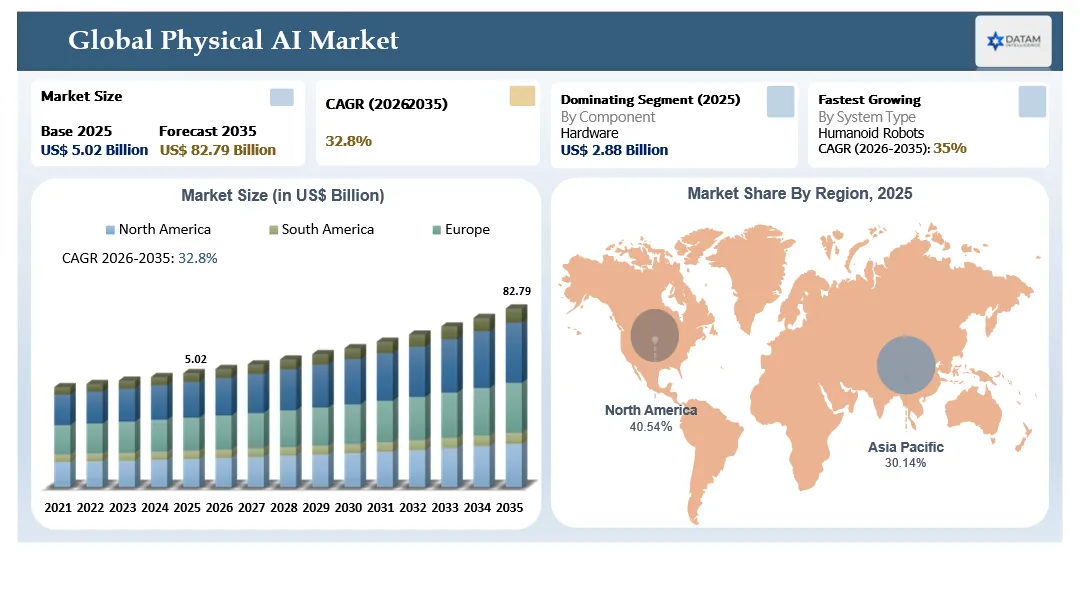
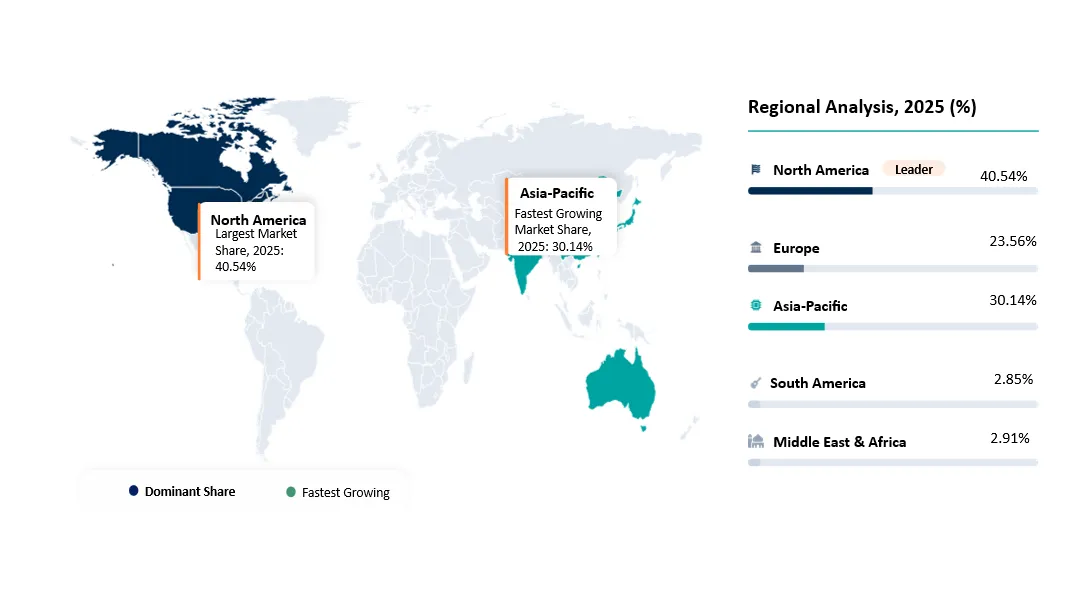
Manufacturing and logistics are the strongest near-term commercial applications because task repetition, measurable labor economics and structured environments make deployment easier. Automotive autonomy is another major revenue pool, while humanoid systems are the fastest-growing category from a small base. North America leads through AI compute, model development and venture funding, while Asia-Pacific is expected to grow fastest through large-scale robot manufacturing, electronics supply chains and national industrial-automation programs.
| Metric | Details |
| 2025 Market Size | US$ 5.02 Billion |
| 2035 Projected Market Size | US$ 82.79 Billion |
| CAGR (2026-2035) | 32.8% |
| Largest Market | North America |
| Fastest Growing Market | Asia-Pacific |
| Dominating Component | Hardware |
| Fastest Growing System Type | Humanoid Robots |
| Core Growth Engine | Multimodal models + edge compute + robotics deployment |
Physical AI Market Key Takeaways
- Physical AI is becoming the bridge between generative AI and real-world automation, moving AI from digital workflows into machines that perceive and act.
- Hardware remains the largest revenue category, but software and model platforms are capturing increasing value through recurring licensing, inference, simulation and fleet-management layers.
- Humanoid robots are the fastest-growing system category as foundation models and cheaper components reduce the programming burden for complex mobile manipulation.
- Manufacturing and logistics provide the clearest near-term ROI because tasks are repetitive, labor costs are measurable and environments can be engineered for safety.
- Edge inference is strategically important because real-time control, safety and privacy limit dependence on cloud-only AI architectures.
- World models and simulation are becoming critical infrastructure for training physical agents at scale without relying entirely on expensive real-world data collection.
- North America leads in AI platforms and capital, while Asia-Pacific combines the strongest hardware supply chain with rapidly growing domestic deployment.
- Competitive advantage will depend on integrated compute, models, simulation, safety, developer tools and OEM partnerships rather than on a single robot or model.
Physical AI Industry Trends and Strategic Insights
- Vision-language-action models are replacing narrow hand-coded behaviors with systems that translate natural-language intent and visual context into robot actions.
- Robot learning is shifting from small task datasets toward synthetic data, teleoperation, video pretraining and large-scale simulation.
- AI semiconductor vendors are expanding from data-center acceleration into edge compute, robotics and automotive to capture inference at the point of action.
- Industrial software providers are connecting digital twins with robot training so engineering data can become training and validation infrastructure.
- Physical AI safety is becoming a product layer encompassing runtime monitoring, simulation-based validation, functional safety and cybersecurity.
- General-purpose humanoids remain early, but pilots in automotive, logistics and electronics manufacturing are accelerating learning and supplier investment.
Physical AI Market Scope
| Metrics | Details |
| 2025 Market Size | US$ 5.02 Billion |
| 2035 Projected Market Size | US$ 82.79 Billion |
| CAGR (2026-2035) | 32.8% |
| By Component | Hardware, Software, Services |
| By Technology | Computer Vision, VLA Models, World Models, Reinforcement Learning, Sensor Fusion, NLP/Speech, Others |
| By Deployment | On-Device/Edge, Cloud-Connected, Hybrid |
| By System Type | Industrial Robots, Cobots, Humanoids, AMRs, Autonomous Vehicles, Drones, Healthcare Robots, Other Intelligent Machines |
| By Mobility | Fixed, Wheeled/Tracked, Legged, Aerial, Vehicle Platforms |
| By Application | Manufacturing, Logistics, Mobility, Inspection, Healthcare, Agriculture, Defense, Retail/Hospitality, Others |
| By End Use | Automotive, Electronics, Industrial, Logistics, Healthcare, Agriculture, Defense, Energy, Consumer/Services, Others |
| By Distribution Model | Direct Sales, OEM/Embedded, Integrators, Cloud Subscription, Developer Marketplaces |
| Report Insights Covered | Market Size, Share, Growth, Ecosystem, Competitive Landscape, Public-Company Performance, Country Opportunity |
Why does this report matter in 2026?
The year 2026 is a transition point for Physical AI because model capability, edge compute and robot hardware are converging fast enough to support deployment beyond controlled demos. NVIDIA has expanded Cosmos, Isaac GR00T and robotics safety tools, Qualcomm is explicitly positioning automotive, industrial IoT and robotics as Physical AI growth areas, and industrial automation companies are integrating AI into controls, digital twins and robot fleets. These developments make 2026 a key planning year for companies deciding where to build partnerships, allocate R&D and establish data and safety infrastructure.
The report matters because Physical AI is not a single robotics category. Commercial opportunity differs sharply across fixed industrial systems, mobile robots, humanoids, autonomous vehicles, healthcare robots and drones. Each requires a different combination of compute, sensors, safety, data, latency and integration. The study therefore separates platform-level spending from system-level deployments and identifies where adoption is moving from experimentation to repeatable ROI.
Physical AI Market White Space & Investment Opportunities
- General-purpose robot foundation models that transfer across multiple robot morphologies and tasks.
- Simulation and world-model infrastructure that reduces real-world training cost and accelerates validation.
- Safety middleware, runtime assurance and certification tools for adaptive AI-controlled machines.
- Low-power edge accelerators optimized for multimodal perception and robot control.
- High-quality robot data platforms, teleoperation networks and synthetic-data pipelines.
- Affordable actuators, dexterous hands and tactile sensing for humanoid and mobile-manipulation systems.
Physical AI Future Market Transformation
The market is expected to evolve from vertically engineered automation stacks toward reusable AI platforms that can be deployed across multiple machines. Today, many systems still require application-specific integration, task programming and data collection. Through 2035, multimodal models, world models, simulation and standardized robot interfaces are expected to reduce this burden and make machines more adaptable to changing tasks.
The value chain will also shift. AI model and compute providers will capture a larger share of revenue through recurring software, inference and developer ecosystems, while robot manufacturers will differentiate through hardware reliability, deployment economics and vertical integration. Large enterprises will increasingly purchase complete autonomy outcomes rather than standalone robots, creating room for robotics-as-a-service, outcome-based contracts and fleet orchestration platforms.
Physical AI Market Buyer Decision-Making Criteria
Buyers prioritize task success rate, cycle time, safety, uptime, integration effort, training-data requirements and total cost of ownership. In industrial settings, a technically impressive robot will not scale unless it can operate reliably for long shifts, recover from edge cases and integrate with existing manufacturing execution, warehouse management and safety systems. For mobile systems, navigation reliability and fleet orchestration are equally important.
Model-level criteria include latency, inference cost, adaptability, explainability, data privacy and the ability to operate offline or with limited connectivity. Procurement increasingly considers whether a vendor can provide compute, models, simulation, safety and deployment support as an integrated stack. Enterprises also assess vendor solvency and ecosystem depth because Physical AI programs may require multi-year integration and retraining.
Physical AI Market Economic & Investment Analysis
Physical AI investment is being supported by the broader AI capital cycle, but economics differ from software AI because deployments require hardware, integration and ongoing maintenance. The strongest business cases are currently found where labor cost is high, tasks are repetitive and downtime can be measured. Warehousing, automotive manufacturing, electronics assembly and industrial inspection therefore provide faster payback than unstructured consumer environments.
Capital is flowing into humanoid robotics, AI semiconductors, robot foundation models, simulation, dexterous manipulation and autonomy software. Investors should distinguish platform economics from robot-manufacturer economics. Compute and software platforms can scale across many OEMs, while robot makers face manufacturing, warranty and working-capital requirements. Companies with reusable software, proprietary data and broad OEM distribution may therefore command stronger long-term margins than hardware-only suppliers.
Physical AI Investment Trends in the Market
- Growing investment in humanoid platforms for manufacturing, warehousing and general-purpose manipulation.
- Rising spending on world models, simulation and synthetic-data generation.
- Expansion of edge AI accelerators and robotics-specific compute modules.
- Strategic partnerships between semiconductor vendors, robot OEMs and industrial software companies.
- Funding for tactile sensing, dexterous hands and advanced actuators.
- Increased corporate investment in robot data collection and teleoperation infrastructure.
Strategic Indicators For the Physical AI Market
High Regulation Impact
Physical AI combines AI governance with machinery, vehicle and workplace safety requirements. Autonomous vehicles, medical robots, defense systems and collaborative robots face particularly high certification and liability exposure. The EU AI Act, machinery safety frameworks, cybersecurity rules and sector-specific standards are increasing the need for traceable models, safety cases and controlled updates.
High Investment Activity
Investment is high across AI compute, humanoids, robotics foundation models, simulation and industrial autonomy. The largest capital pools are concentrated in companies that can combine AI capability with scalable hardware deployment or foundational infrastructure.
Supply Chain Disruption
Physical AI depends on GPUs, edge processors, cameras, lidar, motors, drives, actuators, rare-earth magnets and precision components. Export restrictions, semiconductor cycles and critical-mineral concentration can delay deployments and raise system costs.
Pricing Volatility
System pricing remains volatile as robot hardware improves quickly and early vendors compete for pilot deployments. Falling compute and sensor costs reduce hardware expense, while software and integration can remain significant portions of total ownership cost.
Procurement Pressure
Enterprise buyers increasingly demand measurable payback, uptime guarantees, cybersecurity, service coverage and integration with existing systems. Pilots that cannot demonstrate repeatable economics often fail to convert into fleet deployments.
New Technology Adoption
Adoption is accelerating around VLA models, world models, GPU-accelerated simulation, reinforcement learning, tactile sensing and edge inference. The challenge is converting benchmark gains into reliable performance in long-tail physical environments.
Regional Expansion Opportunity
North America leads model and compute innovation, China leads in robot manufacturing scale and component economics, Japan and South Korea have strong robotics and electronics ecosystems, and Europe has deep industrial automation demand.
Government Policy Support
Industrial policy increasingly supports robotics, AI infrastructure, reshoring and advanced manufacturing. China, the U.S., Japan, South Korea and Europe are funding automation and AI ecosystems for productivity and strategic resilience.
Pricing Intelligence
Physical AI pricing includes hardware acquisition, software licensing, integration, data collection, cloud/edge inference, support and maintenance. Robotics-as-a-service is growing where customers prefer operating expense and performance-based contracts over capital purchases.
Disruption Analysis of the Physical AI Market
Physical AI is disrupting conventional automation by replacing deterministic programming with systems that can interpret context and adapt to changing tasks. This lowers the programming burden for variable production environments and opens automation to tasks that were previously too complex or low-volume for traditional robotics. It also disrupts robotics business models because software, models and data become recurring sources of value.
The market is simultaneously disrupting cloud-centric AI. Real-world control requires low latency and high availability, pushing inference to edge devices and creating demand for specialized processors, optimized models and hybrid architectures. As machines gain autonomy, cybersecurity, functional safety and update governance become central commercial requirements rather than secondary engineering issues.
Physical AI Market BCG Matrix: Company Evaluation
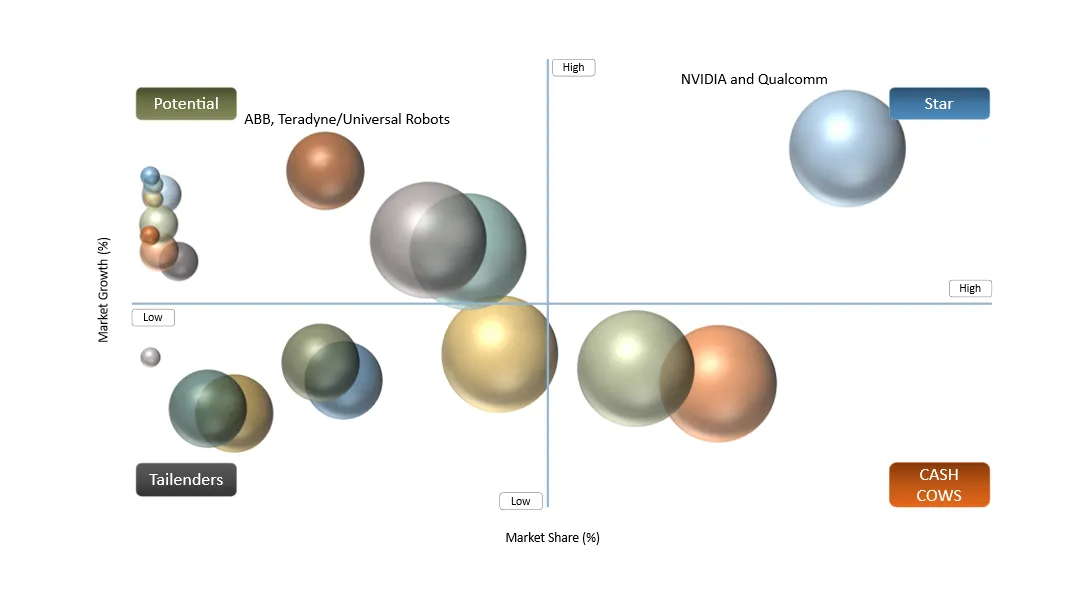
STAR
NVIDIA and Qualcomm are positioned as platform-oriented Stars because they combine AI compute, software ecosystems and broad OEM distribution across automotive, robotics and industrial edge applications. NVIDIA has the strongest integrated model-simulation-compute stack, while Qualcomm has a major opportunity in low-power edge and automotive Physical AI.
POTENTIAL
ABB, Teradyne/Universal Robots, Rockwell Automation, Siemens, FANUC, Yaskawa and leading humanoid startups represent high-potential participants. Their ability to capture value will depend on how effectively they integrate foundation models and AI-native software into installed automation and robotic hardware bases.
Physical AI Market Dynamics
Driver Impact Analysis
| Driver | Market Growth Impact | Demand Concentration | Impacted Use Case | Strategic Impact |
| Multimodal and VLA model advances | High | Robotics and autonomous systems | Perception, reasoning, manipulation | Reduces task-programming burden and improves generalization. |
| Labor shortages and automation ROI | High | Manufacturing and logistics | Assembly, picking, movement | Accelerates fleet deployment where labor economics are clear. |
| Falling edge AI compute cost | Medium-High | Automotive, robots, drones | Real-time inference | Improves economics and reduces cloud dependence. |
| Simulation and synthetic data | Medium-High | Model developers and robot OEMs | Training and validation | Lowers data cost and speeds iteration. |
Driver: Rapid Advances in Multimodal Models and Autonomous Robotics
The most important growth driver is the improvement in models that combine vision, language, spatial understanding and action. These systems enable robots to interpret natural-language goals, understand scenes and generate actions without every behavior being manually programmed. The result is a broader addressable task set and faster deployment into mixed or changing environments.
Restraint Impact Analysis
| Restraint | Drag on Market Growth | Primary Impact Area | Impacted Use Case | Strategic Impact |
| Hardware and integration cost | High | Deployment economics | Humanoids, mobile manipulation | Limits fleet rollout beyond pilots until ROI is proven. |
| Safety and reliability | High | Commercial deployment | Human-shared environments | Requires validation, monitoring and fail-safe control. |
| Insufficient real-world data | Medium-High | Model training | Long-tail tasks | Increases need for simulation and teleoperation. |
| Compute and power constraints | Medium | Edge systems | Mobile robots and drones | Drives optimized models and specialized chips. |
Restraint: Safety, Reliability and ROI Uncertainty
Physical AI must perform reliably in environments where errors can damage equipment or injure people. A model that performs well in demos may fail under lighting variation, clutter, unexpected human behavior or rare edge cases. Buyers therefore require validation, runtime monitoring and conservative deployment strategies, which can slow commercialization and increase integration cost.
Physical AI Market Segmentation Analysis
The global Physical AI market is segmented based on Component, Technology, Deployment, System Type, Mobility, Application, end-use industry, distribution model, and region.
By Component
Hardware Will Remain the Largest Revenue Pool
Hardware leads because physical AI requires processors, cameras, sensors, actuators, robot bodies and control electronics. Software is expected to grow faster as foundation models, simulation, fleet management and autonomy stacks become recurring platform layers.
By Technology
Vision-Language-Action Models Will Be the Fastest-Growing Technology
VLA models are central to the move from scripted robots toward more general-purpose systems. They connect perception and natural-language instructions with motion planning and action, making them especially important for humanoids and mobile manipulation.
By Deployment
On-Device and Hybrid AI Will Dominate Safety-Critical Systems
Physical systems need deterministic response and resilience to connectivity loss. Edge inference therefore remains central, while cloud connectivity is used for model updates, fleet learning and heavy simulation.
By System Type
Humanoid Robots Will Record the Fastest Growth
Humanoids offer the ability to operate in environments designed for people without large facility changes. Early adoption is concentrated in manufacturing and logistics, where repetitive handling tasks can justify investment.
By Application
Manufacturing & Assembly Will Lead Near-Term Revenue
Factories provide structured environments, high equipment utilization and measurable productivity, making them ideal early markets for Physical AI.
By End Use Industry
Automotive and Electronics Will Be Early Large-Scale Adopters
These industries have strong automation budgets, high labor content in selected tasks and existing robotics infrastructure that can absorb AI-native upgrades.
By Distribution Model
OEM and Integrator Channels Will Remain Critical
Physical AI deployments require hardware integration, safety engineering and workflow redesign. System integrators and OEM partnerships therefore remain essential even as software subscriptions grow.
Physical AI Market Geographical Penetration
U.S. Physical AI Market Landscape
The U.S. is the largest national market because it combines AI semiconductor leadership, frontier model development, venture capital and major robotics adopters. NVIDIA, Qualcomm, Tesla, Amazon, Google, Meta and a dense startup ecosystem are investing in physical AI infrastructure, autonomy and humanoids. Manufacturing reshoring and warehouse automation provide additional deployment demand.
China Physical AI Market Trends
China is the strongest manufacturing-scale challenger, supported by a deep robotics, electronics, battery, motor and actuator supply chain. National policy is encouraging embodied intelligence and humanoid production, while domestic robot companies are moving quickly from prototypes to industrial pilots.
Germany Physical AI Market Outlook
Germany offers strong opportunity through automotive manufacturing, machinery, logistics and industrial automation. The market emphasizes safe integration, digital twins and productivity improvement, with Siemens, Bosch, SAP-linked industrial ecosystems and major automotive OEMs supporting adoption.
Japan Physical AI Market Outlook
Japan has a mature industrial robotics base and strong component expertise in motors, reducers, sensors and factory automation. Physical AI creates an opportunity to renew this installed base with more adaptable software and AI-native controls.
South Korea Physical AI Market Trends
South Korea benefits from electronics, automotive and semiconductor manufacturing, plus growing investment in service and humanoid robotics. Large conglomerates can accelerate deployment by integrating AI, chips, manufacturing and robot hardware.
India Physical AI Market Outlook
India is an emerging market driven by warehouse automation, manufacturing investment, automotive electronics and AI engineering talent. Near-term adoption will favor lower-cost mobile robots, machine vision and industrial automation rather than expensive general-purpose humanoids.
Physical AI Market Competitive Landscape
- NVIDIA is building a full-stack Physical AI platform spanning edge compute, Isaac robotics software, Cosmos world models, Omniverse simulation and safety frameworks.
- Qualcomm is targeting low-power Physical AI through automotive, industrial IoT and robotics compute, with automotive and IoT becoming important diversification engines.
- Industrial automation leaders such as ABB, Rockwell Automation, Siemens, FANUC and Yaskawa are integrating AI into installed control and robotics ecosystems.
- Robot companies including Universal Robots, Boston Dynamics, Agility Robotics, Figure AI, Apptronik, NEURA Robotics, Unitree and UBTECH are expanding the range of commercial systems.
- Competition is shifting from hardware specifications toward data, models, developer ecosystems, simulation and deployment support.
- Partnerships between AI platform providers and robot OEMs are becoming a core go-to-market strategy because no single company controls every layer of the Physical AI stack.
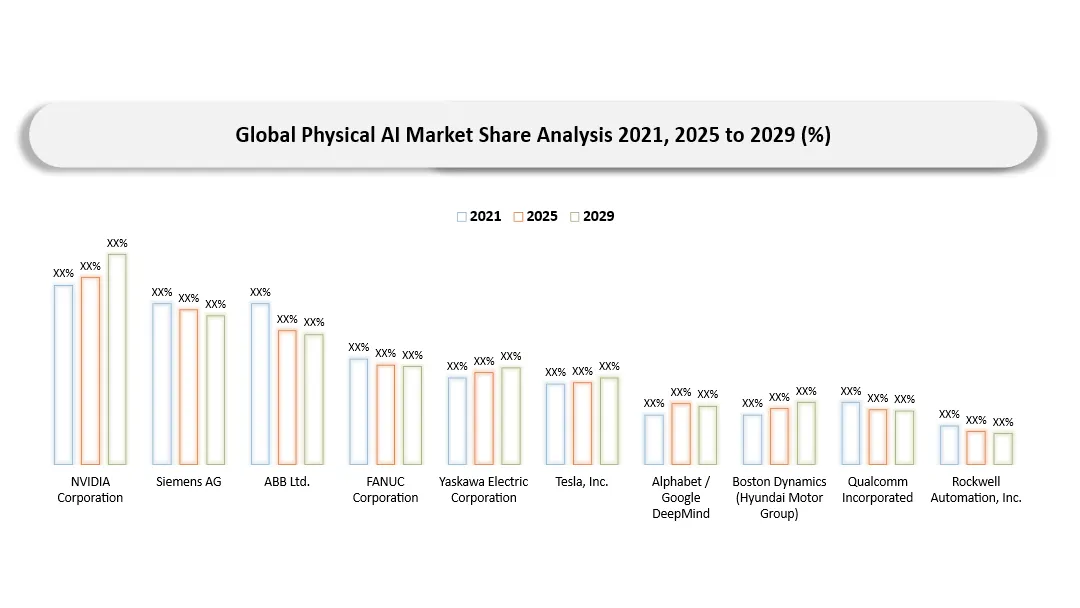
Public Company Q1-Q2 2026 Performance Comparison
| Public Company | Q1-Q2 2026 Performance | Physical AI Exposure | Growth Drivers |
| NVIDIA | Q1 FY2027 revenue US$81.6B, +85% YoY; Edge Computing revenue US$6.4B, +29% YoY. | Isaac, Cosmos, GR00T, Omniverse, DRIVE, Jetson/IGX and edge AI compute. | AI infrastructure scale, robotics foundation models, autonomous driving, industrial digital twins and growing OEM adoption. |
| Qualcomm | Q2 FY2026 revenue US$10.6B; Automotive revenue US$1.326B, +38% YoY; IoT revenue US$1.726B, +9% YoY. | Snapdragon Ride/Digital Chassis, industrial and embedded IoT, robotics and edge AI. | Automotive design wins, industrial edge AI, low-power inference and diversification beyond handsets. |
| ABB | Q2 2026 record orders of about US$12B; comparable revenue growth 12%; Operational EBITA margin 20.2%. | Industrial automation, motion, machine automation and robotics ecosystem. | Factory automation, data centers, industrial investment and AI-enhanced automation. Robotics divestment announced but automation exposure remains substantial. |
| Teradyne | Q2 2026 revenue US$1.329B; Robotics revenue US$100M. | Universal Robots cobots and MiR autonomous mobile robots. | Demand for flexible automation, higher-payload cobots, warehouse mobility and AI-assisted robot programming. |
| Rockwell Automation | Fiscal Q2 2026 sales US$2.239B, +12% YoY; Intelligent Devices +13%, Software & Control +20%. | Industrial controls, software, machine intelligence and factory automation. | Warehouse automation, semiconductor, data-center, energy and AI-enabled industrial demand. |
Physical AI Market Ecosystem
| Value Chain Sector | Role in Physical AI | Representative Companies / Organizations |
| AI Compute & Semiconductors | GPUs, NPUs, edge processors and robotics compute | NVIDIA, Qualcomm, Intel, AMD, NXP, Renesas, Texas Instruments |
| Sensors & Perception | Cameras, lidar, radar, force/tactile sensing and localization | Sony, Bosch, Ouster, Hesai, SICK, Keyence, Cognex |
| Actuators & Motion | Motors, reducers, drives, servos, hands and motion components | Harmonic Drive, Nabtesco, Maxon, Schaeffler, THK, Yaskawa |
| Foundation Models & World Models | VLA models, robot foundation models, simulation models | NVIDIA, Google DeepMind, Physical Intelligence, Skild AI, OpenAI research ecosystem |
| Simulation & Digital Twins | Synthetic data, physics simulation and virtual commissioning | NVIDIA Omniverse/Isaac Sim, Siemens, Dassault Systèmes, Ansys, Hexagon |
| Robot OEMs | Industrial, collaborative, humanoid and mobile robots | ABB, FANUC, Yaskawa, Universal Robots, Boston Dynamics, Figure AI, Agility Robotics, Unitree, UBTECH |
| Autonomous Vehicles & Mobility | Self-driving systems and intelligent vehicle platforms | Tesla, Waymo, NVIDIA DRIVE partners, Qualcomm automotive ecosystem, Mobileye |
| System Integrators | Deployment, safety integration and workflow engineering | Accenture, Capgemini, Rockwell partners, Siemens integrators, regional robotics integrators |
| Cloud & Data Platforms | Fleet data, model training, deployment and monitoring | AWS, Microsoft Azure, Google Cloud, Oracle |
| End Users | Manufacturing, logistics, healthcare, agriculture, defense and service operations | Amazon, Foxconn, automotive OEMs, 3PLs, hospitals, defense organizations |
| Standards & Regulators | AI governance, robot safety, machinery and cybersecurity | ISO, IEC, NIST, EU institutions, national workplace safety agencies |
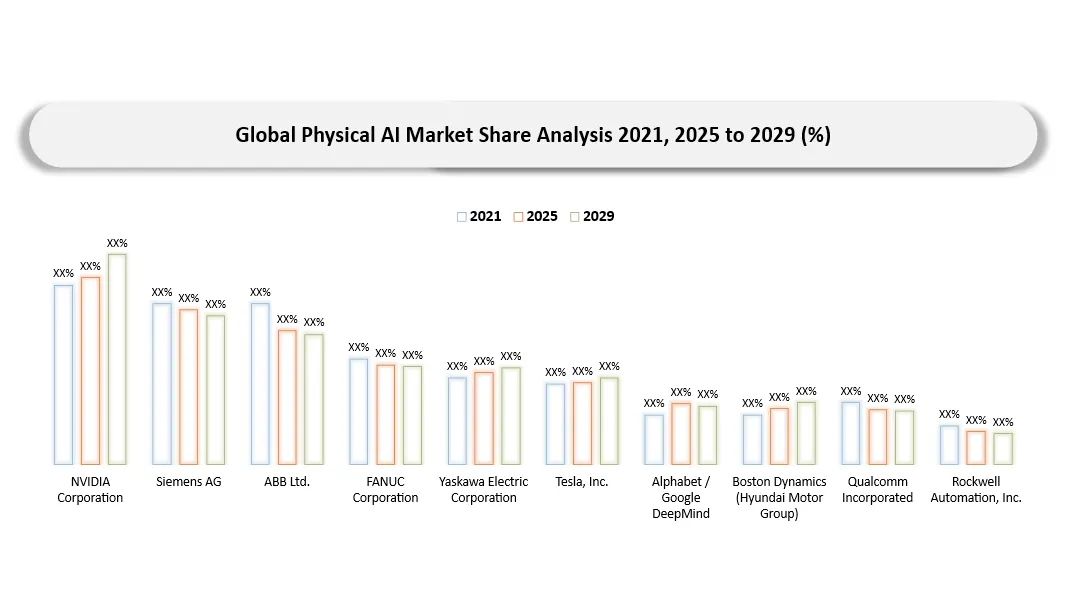
Key Companies
- NVIDIA Corporation
- Qualcomm Incorporated
- ABB Ltd.
- Rockwell Automation
- Teradyne / Universal Robots
- Siemens AG
- FANUC Corporation
- Yaskawa Electric
- Tesla, Inc.
- Alphabet / Google DeepMind
- Amazon Robotics
- Boston Dynamics (Hyundai Motor Group)
- Agility Robotics
- Figure AI
- Apptronik
- NEURA Robotics
- Unitree Robotics
- UBTECH Robotics
- Mobileye
- Cognex Corporation
Company Profiles
NVIDIA Corporation
NVIDIA is the most important horizontal platform company in Physical AI. Its portfolio combines accelerated compute, Jetson and IGX edge systems, Isaac robotics software, Omniverse simulation, Cosmos world foundation models, GR00T robot foundation models and DRIVE autonomous-vehicle platforms. This allows the company to participate across training, simulation, edge inference and deployment.
Competitive priorities include scalable edge inference, model integration, safety, developer adoption, ecosystem partnerships and measurable enterprise deployment economics.
Qualcomm Incorporated
Qualcomm is expanding from smartphones into automotive, industrial IoT and robotics. Its strategic position is based on efficient CPUs, NPUs, connectivity and edge AI. Physical AI is a logical extension of its Snapdragon platforms because mobile robots and vehicles require high-performance perception and inference within tight power envelopes.
Competitive priorities include scalable edge inference, model integration, safety, developer adoption, ecosystem partnerships and measurable enterprise deployment economics.
ABB Ltd.
ABB is a global automation and electrification company with extensive exposure to industrial motion, machine automation and robotics. Even as the company progresses with the divestment of its Robotics business, its broader automation stack remains strategically relevant to Physical AI deployment in factories and industrial environments.
Competitive priorities include scalable edge inference, model integration, safety, developer adoption, ecosystem partnerships and measurable enterprise deployment economics.
Teradyne / Universal Robots
Teradyne participates directly through Universal Robots collaborative robots and Mobile Industrial Robots. Its strength is a large installed cobot base, intuitive programming and a broad integrator ecosystem. Physical AI can increase the addressable task set by reducing programming effort and improving perception and autonomy.
Competitive priorities include scalable edge inference, model integration, safety, developer adoption, ecosystem partnerships and measurable enterprise deployment economics.
Rockwell Automation
Rockwell Automation combines controls, intelligent devices, software and lifecycle services for industrial customers. Its position in Physical AI is centered on integrating AI-enabled machines with production systems, factory data and existing automation architectures.
Competitive priorities include scalable edge inference, model integration, safety, developer adoption, ecosystem partnerships and measurable enterprise deployment economics.
Siemens AG
Siemens is positioned through industrial software, digital twins, automation controls and partnerships with AI platform providers. The company can connect product engineering, manufacturing simulation and real-world automation, which is increasingly valuable for training and validating Physical AI systems.
Competitive priorities include scalable edge inference, model integration, safety, developer adoption, ecosystem partnerships and measurable enterprise deployment economics.
Physical AI Market Major Pain Points
- High cost of humanoid and mobile-manipulation hardware.
- Insufficient long-tail real-world training data.
- Safety validation for adaptive AI behavior.
- Difficulty generalizing across sites, objects and workflows.
- Integration with legacy industrial controls and enterprise software.
- Edge compute, battery and thermal constraints in mobile systems.
- Shortage of deployment engineers with both AI and robotics expertise.
- Unclear liability and cybersecurity requirements for autonomous machines.
Physical AI Market Recent Developments
- May 2026: NVIDIA reported Q1 FY2027 revenue of US$81.6 billion and introduced an Edge Computing reporting segment that includes robotics and automotive, reflecting growing strategic importance of Physical AI.
- March 2026: NVIDIA announced expanded robotics partnerships and new Cosmos, Isaac and GR00T capabilities aimed at moving Physical AI systems from development into production-scale deployment.
- April 2026: Qualcomm reported Q2 FY2026 revenue of US$10.6 billion, with Automotive revenue up 38% year over year and IoT revenue up 9%, and highlighted Physical AI as a strategic growth opportunity.
- July 2026: ABB reported record-high orders and strong Q2 growth across electrification and automation, while preparing to redeploy proceeds from the planned Robotics divestment.
- July 2026: Teradyne reported Q2 2026 revenue of US$1.329 billion, including US$100 million from Robotics, as Universal Robots and MiR continued targeting flexible automation.
- May 2026: Rockwell Automation reported fiscal Q2 2026 sales growth of 12%, with strong gains in Intelligent Devices and Software & Control and demand momentum in warehouse automation, semiconductor and data-center applications.
Analyst View/Opinion on Physical AI Market
- Physical AI is one of the most important extensions of the generative AI cycle because it converts model intelligence into measurable physical productivity.
- The market will not scale on model quality alone. Reliability, integration, safety and hardware economics will determine which deployments move beyond pilot stage.
- Humanoids have the highest long-term optionality, but industrial and logistics applications will generate the strongest near-term commercial value.
- Platform companies that own compute, simulation, models and developer ecosystems can capture value across multiple robot OEMs and applications.
- Robot manufacturers need differentiated data and software as hardware becomes more standardized and component costs fall.
- The winning commercial model is likely to combine hardware, recurring software, fleet learning and service rather than relying on one-time equipment sales.
Physical AI Market Target Audience
| INDUSTRY | WHO SHOULD BUY THIS REPORT? | REASON TO BUY THIS REPORT |
| AI & Semiconductor | Chip vendors, AI platform leaders, edge-compute teams | Identify robotics and autonomous-system growth opportunities and partner ecosystems. |
| Robotics & Automation | Robot OEMs, controls vendors, integrators | Benchmark system categories, AI technologies and deployment trends. |
| Manufacturing | Automation leaders, plant managers, engineering teams | Evaluate use cases, ROI, vendor readiness and integration requirements. |
| Logistics & E-commerce | Warehouse operators, 3PLs, automation teams | Assess AMR, manipulation and fleet automation opportunities. |
| Automotive & Mobility | OEMs, Tier 1 suppliers, AV teams | Understand edge AI, autonomous driving and factory robotics convergence. |
| Investors & Consulting | VC, PE, institutional investors and strategy teams | Evaluate market size, public-company exposure, startup white spaces and value-chain positioning. |
| Government & Research | Industrial policy teams, labs, standards bodies | Assess safety, workforce and competitiveness implications. |
Why Choose DATAM?
- Data-driven insights combining AI models, robotics hardware, edge compute, simulation and deployment economics.
- Post-purchase analyst consultations for market entry, partnership screening, competitive benchmarking and custom forecasting.
- Annual updates covering model releases, product launches, funding, deployments and regulatory changes.
- Specialized focus on emerging Physical AI ecosystems rather than treating robotics and AI as separate markets.
- Actionable analysis linking technical capability with buyer ROI and deployment readiness.
What DATAM Uniquely Provides
- Ten-year forecasts across eight segmentation categories and five regions.
- Integrated analysis of compute, models, simulation, robot hardware and end-user deployment.
- Public-company Q1-Q2 2026 performance comparison linked to Physical AI growth drivers.
- Market ecosystem mapping from semiconductors and sensors through models, robot OEMs, integrators and end users.
- Country-level analysis of AI capability, robotics manufacturing and industrial adoption.


























































