


PFAS-Free Textiles Market Size
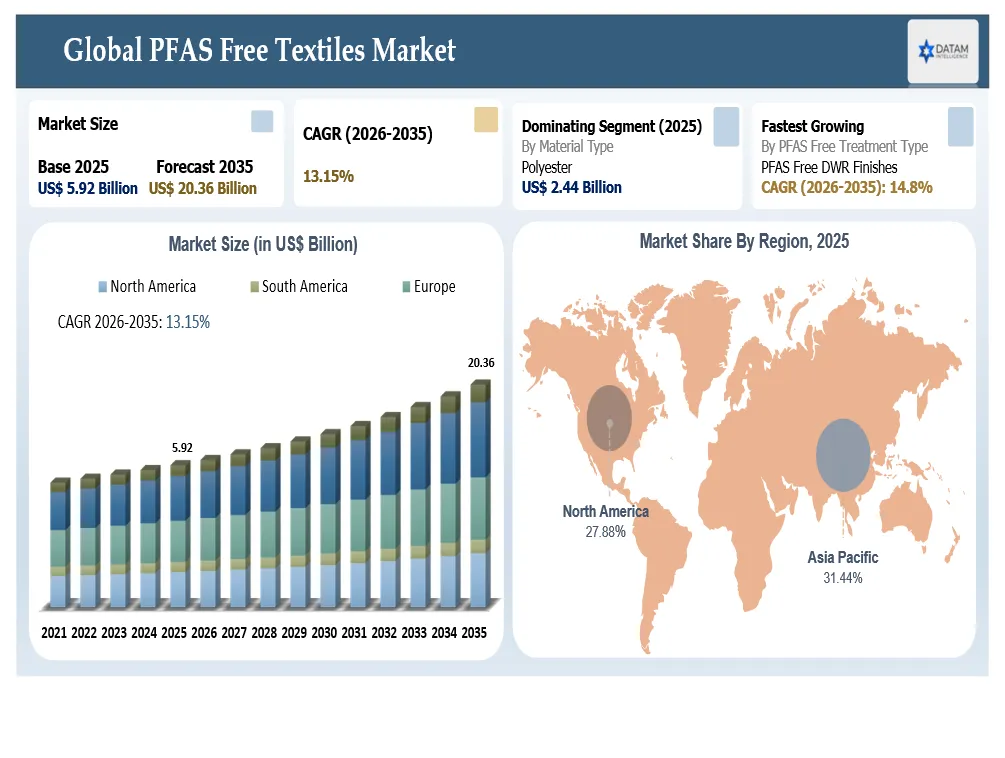
The global PFAS-free textiles market reached US$ 5.92 billion in 2025 and is expected to reach US$ 20.36 billion by 2035, growing with a CAGR of 13.15% during the forecast period 2026-2035.
The market of textiles without PFAS is moving towards a regulation-driven shift from a voluntary approach, which creates the demand for non-fluorinated products in the categories of outdoor apparel, sportswear, footwear, protective garments, home textiles and technical textiles. As per the PFAS regulations in France, restrictions on clothes and shoes containing PFAS came into force on January 1, 2026, whereas wider restrictions on other textile products are slated for implementation from January 1, 2030. These regulations set concentration limits of 25 ppb for individual PFAS compound, 250 ppb for the sum of certain PFAS compounds and 50 ppm for PFAS including polymer content. This process is motivating textile plants and finishing experts to use the alternatives of silicone, hydrocarbon, polyurethane, wax, dendrimer and plasma in place of fluorinated DWR, stain-resistant, water-repellent, and membrane technology.
According to the European Environment Agency (EEA), PFAS are used due to their hydrophobic, oleophobic, thermal resistance and chemical properties that make the textiles one of the sectors in which substitution would be difficult. Therefore, the process involves not only replacing a single compound but also changing the entire formulation of textile finishes while keeping the same properties like water resistance, waterproofness, breathability, stain resistance, abrasion resistance and washing durability. The textile market is further impacted by the procurement policies of major apparel and outdoor brands, creating a need for certified fluorine-free ingredients and finished products. As a consequence, textile chemical manufacturers such as Archroma, RUDOLF Group, CHT Group, HeiQ, BASF, Pulcra Chemicals and NICCA Chemical have an advantage due to the increased demand for fluorine-free finishes.
PFAS-Free Textiles Market Key Takeaways
- Polyester made up about 41.3% of the total PFAS-free Textiles Market in 2025 due to its wide use in outdoor clothing, sportswear, workwear, footwear and technical textiles due to the adoption of PFAS-free finishes.
- PFAS-free DWR Finishes are anticipated to experience the fastest growth among all treatments segments, at a 14.8% CAGR in 2026-2035, thanks to the elimination of fluorinated water repellent finishes in outdoor wear and footwear.
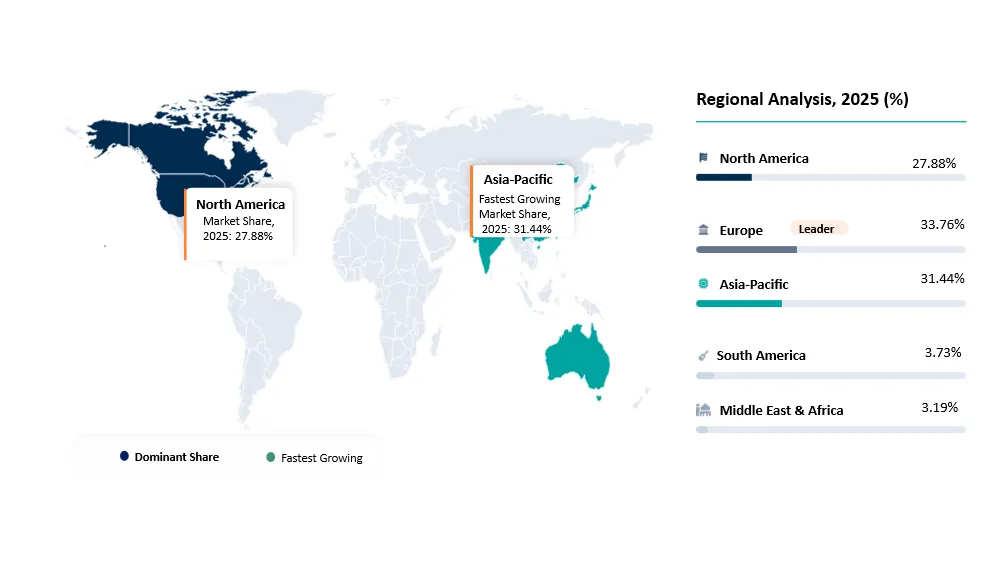
- The European region held a leading position with a 33.76% share in 2025 due to strict regulations and requirements on sustainability and adoption of fluorine-free technologies.
- Substitution driven by regulatory requirements is contributing to the acceleration of the market, which is exemplified by restrictions being imposed on French companies using PFAS-containing clothing and footwear as of January 1, 2026, with more general textile restrictions planned from 2030.
- The European Environment Agency reveals that textiles make up around 35% of total global consumption of PFAS, indicating the large potential for PFAS-free textile technology and chemistry alternatives.
PFAS-Free Textiles Industry Trends and Strategic Insights
- PFAS regulations are accelerating product conversion: Regulations regarding PFAS in textiles are compelling clothing and textile producers to redesign product lines, especially in North America and Europe.
- Outdoor and performance textiles are leading the transition: Waterproof jackets, rain gear, athletic wear, tents, backpacks and other technical products are among the primary items to have PFAS replaced because of their past reliance on water and stain resistance.
- Full portfolio conversion is replacing selective product changes: The biggest brands in the textile and outdoors industries are beginning to convert to complete PFAS-free portfolios rather than launching specific PFAS-free products.
- Performance parity is becoming a key competitive factor: Companies are striving to create PFAS-free textile products that have equal water repellency, waterproofness, strength, breathability and washability.
- PFAS-free verification is gaining importance: The finished products manufacturers require more traceability through their supply chains, material testing and certification for verifying the PFAS-free status of their materials.
PFAS-Free Textiles Market Scope
| Metrics | Details | |
| 2025 Market Size | US$ 5.92 Billion | |
| 2035 Projected Market Size | US$ 20.36 Billion | |
| CAGR (2026-2035) | 13.15% | |
| Largest Market | Europe | |
| Fastest Growing Market | Asia-Pacific | |
| By Material Type | Polyester, Nylon (Polyamide), Cotton, Wool, Rayon/Viscose, Polypropylene and Other Materials | |
| By Textile Formation | Woven Textiles and Nonwoven Textiles | |
| By Knitting Status | Knitted Textiles and Non-Knitted Textiles | |
| By Lamination Status | Laminated Textiles and Non-Laminated Textiles | |
| By Coating Status | Coated Textiles and Non-Coated Textiles | |
| By PFAS-free Treatment Type | PFAS-free DWR Finishes, PFAS-free Stain-Resistant Finishes, PFAS-free Oil-Repellent Finishes, PFAS-free Waterproof Coatings, PFAS-free Membranes, PFAS-free Soil-Repellent Finishes and Untreated / Naturally Repellent Textiles | |
| By Alternative Chemistry | Silicone-Based, Hydrocarbon-Based, Acrylic-Based, Polyurethane-Based, Wax-Based, Dendrimer-Based, Plasma-Based and Other Alternative Chemistries | |
| By Application | Outdoor Apparel, Sportswear & Activewear, Workwear & Uniforms, Protective Clothing, Fashion & Casual Apparel, Home Textiles, Automotive Textiles, Footwear & Accessories, Medical & Healthcare Textiles, Industrial Textiles and Technical Textiles | |
| By Certification & Compliance | PFAS-free Certified, OEKO-TEX Compliant, bluesign Compliant, GOTS-Compliant, ZDHC-Compliant and Other Certifications & Compliance Standards | |
| By Distribution Channel | Direct Sales, Textile Distributors & Wholesalers, Specialty Textile Suppliers, Online B2B Platforms and Agents & Trading Companies | |
| By Region | North America | U.S., Canada, Mexico |
| Europe | Germany, UK, Russia, France, Spain, Italy, Poland | |
| Asia-Pacific | China, India, Japan, Australia, South Korea, Indonesia, Malaysia, Singapore, Vietnam, Thailand, Philippines, Taiwan | |
| South America | Brazil, Argentina | |
| Middle East and Africa | UAE, Saudi Arabia, South Africa, Israel, Turkiye, Nigeria | |
| Report Insights Covered | Competitive Landscape Analysis, Company Profile Analysis, Market Size, Share, Growth | |
Why does this report matter in 2026?
The market for PFAS-free textiles will be experiencing an important phase in 2026, as the restrictions on the usage of PFAS chemicals in textile products will move from planned implementation to actual enforcement in significant markets. The market will be having a direct impact on the companies manufacturing products such as outdoor clothing, waterproof clothing, sports clothes, protective textiles, shoes, tents and technical fabrics, in which PFAS have been utilized to provide water, oil and stain resistance.
The relevance of this study is that it will help in determining which end-use applications of textile products have started using PFAS-free substitutes, where the demand for these products is concentrated and which companies can take advantage of this shift. This report will help in analyzing regulatory pressure, product development, competitive positioning, regional opportunity and international trade trends in order to assist the decision-making of textile manufacturers, brands and investors.
PFAS-free Textiles Market White Space & Investment Opportunities
- PFAS-free Waterproof Outdoor Apparel: There is an investment opportunity available regarding jackets, rainwear, hiking gear, tents and backpacks that feature durability in water repellency without the deliberate use of PFAS.
- High-Performance Sportswear: An unexplored area of the market in PFAS-free activewear combining water and stain resistance along with durability, light weight, breathability and wash performance.
- PFAS-free Protective Workwear: There is a chance available to develop ready-made garments having a PFAS-free construction along with fire resistance, protection against chemicals and resistance to abrasions.
- PFAS-free Automotive & Upholstery Textiles: Opportunities arise for non-PFAS fabrics used in automotive seating and furniture due to the decreased use of PFAS containing materials by the auto industry.
- PFAS-free Technical Textiles: Investment opportunities may exist in specialized polymer finishing that caters to health care and industrial and construction industries as there is little demand at present.
PFAS-Free Textiles: Future Market Transformation
The PFAS-free textiles market is predicted to shift from regulations-based product substitution to product development based on performance, as companies seek to create PFAS-free textiles that are waterproof, water resistant, stain resistant, durable and breathable. It is anticipated that outdoor clothing, sports wear, protective clothing, shoes, automotive interiors and technical textiles will continue to be important areas of transformation, as PFAS products are substituted.
The future market is going to be dominated by firms that can provide PFAS-free products on par with traditional options in terms of their performance and costs. Such things as product design, fabric manufacturing, PFAS-free membranes, durability, tests and traceability of supply chains will play an increasingly prominent role in competition. Also, it can be predicted that brands will apply such standards not only to particular product lines but also to the whole product ranges of brands.
PFAS-Free Textiles Market Buyer Decision-Making Criteria
Textile buyers in the PFAS-free textiles market evaluate final products by taking into consideration their performance in accordance with application requirements and compliance with PFAS regulations. In case of outdoor garments, sportswear, protective clothing, automotive textiles and technical textiles, procurement decisions have started depending on the combination of PFAS-free compliance, performance, durability, testing and price.
Major decision-making criteria:
- PFAS-free Compliance: Verified absence of intentionally added PFAS and compliance with relevant regulations.
- Performance: Performance in terms of water repellency, waterproofness, stain resistance, breathability and protective properties.
- Durability: Durability to preserve performance characteristics after washings and abrasions.
- Testing and Certification: Independent testing, certification, traceability and validity of PFAS-free claims.
- Cost Competitiveness: Cost in relation to alternative PFAS based textiles.
- Product Quality: Quality of fabric construction, consistency, comfort, aesthetics and finish.
- Supply Reliability: Capacity for manufacture, quality, time to market and availability.
- Sustainability: Sustainability profile in terms of environmental impact and production process.
- Brand & Customer Acceptance: Consistency with brand policy of eliminating PFAS and retailer and consumer preferences.
PFAS-free Textiles Market Economic & Investment Analysis
PFAS-free textile market is presenting opportunities for investments since the companies in this market will be putting money into converting their product line to PFAS-free , fabric making, alternative technologies for achieving performance criteria, test equipment and manufacturing facilities. Investment will especially matter in the markets of outdoor clothing, sportswear, protective clothing, automotive textiles and technical textiles due to strict regulations and performance demands. Whether there will be an economic opportunity will largely depend on companies ability to manufacture such products with cost-effectiveness.
In terms of investing in the company, issues like production scalability, cost efficiency, profit margins, regulatory risk and customer conversion ratios become vital. It becomes possible for companies to earn a competitive edge in case they are capable of manufacturing PFAS-free textile goods at affordable costs and meeting all the necessary requirements. Capital needs for production conversion, dependence on unique raw material, regulatory risk in certain regions and premium pricing for high performance PFAS-free textile products must be considered by investors.
PFAS-free Textiles Investment Trends in the Market
- Investment in PFAS-free production capacity: Manufacturers are modifying their facilities and production process in order to boost production of ready-to-use PFAS-free textiles, clothing and technical textiles.
- Capital allocation toward performance improvement: Companies are working on product development in order to achieve performance improvement in terms of water repellent, waterproof, stain-resistant, durable and breathable properties without PFAS.
- Portfolio-wide product conversion: Big textile and apparel corporations are allocating money for the conversion of whole product ranges into PFAS-free materials rather than maintaining limited PFAS-free collections.
- Expansion of testing and traceability infrastructure: Investments in PFAS testing, supplier verification, material traceability and certification are rising in order to ensure regulatory compliance and claims of products.
- Investment in emerging end-use segments: Capital is increasingly targeting PFAS-free automotive, protective, health-care, industrial and technical textiles, in addition to the traditional outdoor apparel segment.
Strategic Indicators For the PFAS-Free Textiles Market
High Regulation Impact
The regulation on PFAS is an important indicator for the development of the PFAS-free textiles market, as the governments impose more restrictions on the use of finished textile articles containing PFAS substances. Law No. 2025-188, being in force from January 1, 2026, bans the manufacturing, importing, exporting and selling clothing and shoes containing PFAS in France. The exemptions will apply to other textile products from January 1, 2030, when the respective prohibition comes into effect in respect to them. The ability to limit the use of PFAS products has also been defined in Decree No. 2025-1376. These regulations speed up the transition from the usage of PFAS materials to safe fabrics in the market.
High Investment Activity
Investments within the PFAS-free textiles market have become highly geared towards investment in the conversion of entire finished textile product lines, including but not limited to outdoor wear, water-resistant clothing, sportswear, protective clothing, shoes and technical fabrics. Investments will be directed at the adaptation of production lines, sourcing of PFAS-free materials, high-quality fabric design and quality control systems in an effort to produce PFAS-free products that do not reduce the efficiency of the products. Investments are now being directed towards PFAS-free membranes, durable water-repellent fabric systems, automated testing systems and supply chain traceability.
Supply Chain Disruption
The PFAS-free textiles market is affected by supply chain disruption since manufacturers will have to substitute existing textiles, finishes, membranes and components containing PFAS with PFAS-free versions that are certified. This has more effect on industries such as outdoor wear, waterproof wear, protective wear, footwear and technical textiles due to the high performance requirements. Supply chain disruption will be caused by supplier requalification, PFAS testing, lack of qualified material and textile manufacturing process changes that will increase conversion time and costs. Companies that have diversified sourcing and PFAS-free suppliers can mitigate this risk.
Pricing Volatility
The PFAS-free textiles market is affected by price fluctuations due to the high production costs and insufficient supply of PFAS-free products such as textiles, membranes and specialty components. The PFAS-free products are 5 to 15% more expensive than regular products. The high cost product is determined through small production runs, supplier qualification and additional testing. Manufacturing industries can stabilize their price fluctuations through long-term agreements and increased size of production.
Procurement Pressure
The pressure for procurement in the PFAS-free textiles market is on the rise, as apparel brands, outdoor businesses and textile manufacturers demand that their suppliers offer PFAS-free finished materials and products. More often than not, procurement departments are assessing the PFAS tests, traceability of the supplier, material declaration, regulatory compliance, minimum order quantities, prices, delivery and other criteria along with the performance of the product itself. It is especially true for waterproof outdoor apparel, sports apparel, protective clothing, footwear and technical textiles, where the buyers require commercially viable alternatives to PFAS-free textiles.
New Technology Adoption
Adoption of new technology in the PFAS-free textile market is driven by manufacturing finished textiles with properties of water repellence, waterproof, stains resistant, durable, breathable without the use of PFAS. New fluorine-free durable water repellent technology, PFAS-free waterproof membranes, bio-based performance materials, innovative textile constructions and advanced surface treatment have been adopted in outdoor apparel, sports, protective and technical textiles. The technologies have allowed for enhanced performance and durability in addition to facilitating quicker phase out of PFAS containing finished textiles.
Regional Expansion Opportunity
The PFAS-free textiles market presents significant possibilities for regional expansion due to the growing impact of PFAS regulation and brand sourcing policy on the global textile value chain. Europe presents a market of particular interest due to the increased regulatory pressure which speeds up the process of converting outdoor apparel, waterproof garments, footwear and technical textiles into PFAS-free finished goods. North America presents ample opportunities for PFAS-free sportswear, protective clothing, outdoor products and home textiles due to the increased regulatory pressure and brand sourcing policy. Asia-Pacific is a region of great production opportunity especially for China, India, Vietnam and Bangladesh as an increasing number of textile exports from these regions need to be converted into PFAS-free finished products.
Government Policy Support
Policy support from governments is enhancing growth in the PFAS-free textiles market through the introduction of policies limiting PFAS containing finished textile products and chemicals management regulations. France's PFAS Law 2025 that includes prohibitions on PFAS containing clothes and shoes starting from January 1, 2026 and prohibition of PFAS containing other textile products starting from January 1, 2030 has created a direct policy driver to move towards converting the finished product portfolio. On an EU wide level, universal PFAS restrictions under REACH are driving textile manufacturers and brands to move towards PFAS-free products and materials.
Pricing Intelligence
Pricing Intelligence in the PFAS-free textiles market concerns the comparison of buyers of the commercial value of finished textiles made free from PFAS by application and supplier. The price is determined by the type of fabric, its performance specifications, complexity of production, scale of manufacturing and verification needs. It is believed that PFAS-free outdoor and technical textiles can carry an estimated 5 to 15 percent premium price over their conventional counterparts, especially when there are special requirements for waterproof membranes and constructions.
| HS Code | Reporter | Trade Flow | 2025 Trade Value | Interpretation |
5407 (Woven Fabrics of Synthetic Filament Yarn) | China | Exports | US$24.1 Billion | Major synthetic-fabric manufacturing base supporting PFAS-free textile conversion |
5903 (Coated, Covered or Laminated Textile Fabrics) | Germany | Exports | US$1.6 Billion | Strong technical-textile industry supports PFAS-free coated-fabric adoption |
6006 (Other Knitted or Crocheted Fabrics) | Turkiye | Exports | US$1.7 Billion | Large textile and apparel supply base supports PFAS-free fabric demand |
5515 (Other Woven Fabrics of Synthetic Staple Fibers) | Italy | Exports | US$1.5 Billion | Premium textile manufacturing supports demand for higher-value PFAS-free fabrics |
AI Impact Analysis of PFAS-free Textiles Market
Artificial Intelligence is proving to be an enabling technology for the PFAS-free textiles market by helping manufacturers develop and launch finished products that would require replacement of PFAS performance properties. Material screening through AI would help manufacturers screen alternative materials needed for achieving water repellency, waterproofing, stain resistance, durability and breathability. Predictive modeling would save on testing time needed for screening different constructions of fabrics and different product designs. AI-based quality inspection will help improve the consistency of manufacturing of PFAS-free fabrics through detection of defects and performance variations. Moreover, demand forecasting and procurement analytics through AI will help manufacturers deal with alternative material sourcing and manufacturing.
Disruption Analysis of PFAS-free Textiles Market
PFAS-free textiles market is challenging conventional textile supply chain practices with regard to how finished textiles and products are specified, qualified, sourced and marketed. It is increasingly becoming a requirement for outdoor apparel, waterproof apparel, sports apparels, protective textiles, footwear and technical textiles to be specified as PFAS-free. In this way, it is becoming necessary for manufacturers to qualify new materials, change supplier networks and create new product offerings.
Moreover, the market is changing how product differentiation and procurement have traditionally worked in the past. The absence of PFAS is now a factor that is becoming a procurement criteria rather than an optional sustainability consideration, while buyers are evaluating products based on PFAS criteria in addition to performance, longevity, price and traceability. This means that companies who have been able to convert their products to PFAS-free products and test, source and establish connections with brands will be able to take market share away from competitors.
PFAS-free Textiles Market BCG Matrix: Company Evaluation
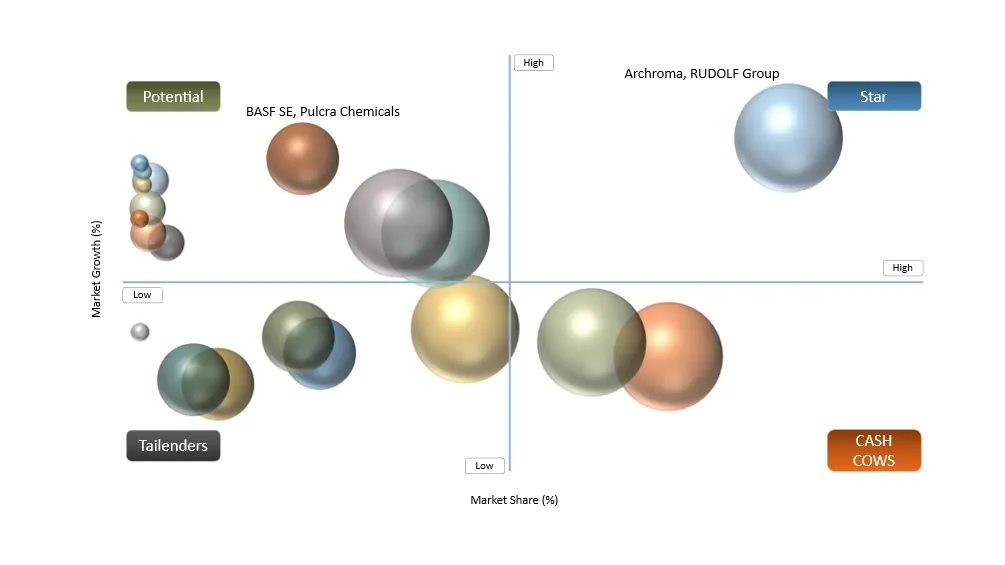
STAR
Companies such as Archroma, RUDOLF Group, CHT Group and HeiQ Materials AG have been placed under the category of Stars as they have been successful in establishing a prominent position in the textile chemicals market due to their global customer base along with their active research for developing fluorine-free finishing products. These companies have product offerings such as PFAS-free durable water repellent finishes, functional finishes, coatings and textile finishes.
POTENTIAL
BASF SE, Pulcra Chemicals, Bolger & O’Hearn, Sarex Chemicals, Rossari Biotech, Fineotex Chemical
These companies are considered potential players due to the fact that they already have textile chemicals capability and can explore the opportunity of expanding their operations due to rising PFAS regulations. The regional manufacturing facilities and sustainable formulation of the companies are expected to be used for market share expansion in the regions of Asia Pacific, Europe and North America.
PFAS-free Textiles Market Dynamics
Driver Impact Analysis
| Driver | Market Growth Impact (%) | Demand Concentration | Impacted Use Case | Strategic Impact |
| Stringent PFAS Regulations | 8.60% | North America & Europe | Outdoor Apparel & Protective Textiles | Accelerates replacement of PFAS containing textiles |
| Growing Demand for Sustainable Textiles | 7.90% | Europe & North America | Apparel & Home Textiles | Increases adoption of PFAS-free products |
| Brand Commitments to PFAS Elimination | 7.30% | Europe & North America | Outdoor & Sportswear | Drives supplier transition toward PFAS-free fabrics |
| Innovation in PFAS-free Performance Fabrics | 6.80% | North America, Europe & Asia-Pacific | Waterproof & Technical Textiles | Improves performance and commercial adoption |
Driver: Stringent PFAS Regulations and Brand Phase-Out Commitments
The most significant factor driving the expansion of the PFAS-free textiles market will be the transition from voluntary PFAS mitigation efforts to mandatory restrictions on the level of PFAS at a product level and by buyers. The PFAS law of France becomes applicable on January 1, 2026, to limit PFAS containing apparel and footwear; textile restrictions will come into effect on January 1, 2030, making it necessary for manufacturers of textiles to comply with this requirement. At the same time, leading apparel and outdoor brands are implementing PFAS-free requirements into their purchasing policy, increasing demand for PFAS-free waterproof apparel, outdoor fabrics, sportswear, footwear and protective textiles.
Restraint Impact Analysis
| Restraint | Drag on Market Growth (%) | Primary Impact Area | Impacted Use Case | Strategic Impact |
| Higher Cost of PFAS-free Alternatives | 6.40% | Production Costs | Performance & Outdoor Textiles | Limits adoption where price sensitivity is high |
| Performance Gaps in Certain Applications | 5.70% | Durability & Repellency | Waterproof & Protective Textiles | Requires continued technology development |
| Limited Availability of PFAS-free Raw Materials | 4.90% | Supply Chain | Technical & Specialty Textiles | Creates sourcing constraints for manufacturers |
| Complex Transition from Existing PFAS Based Processes | 4.30% | Manufacturing Processes | Coated & Finished Textiles | Increases conversion costs and production complexity |
Restraint: Performance and Scalability Challenges
The biggest constraint to the PFAS-free textiles market is that of providing performance of PFAS-free materials in commercial quantities. Products such as waterproof outdoor apparel, protective garments, sports fabrics and technical textiles need to have high standards of water repellence, waterproof, stain resistance, durability and breathability without using any PFAS material in them. For certain applications, PFAS-free solutions would need to employ different construction of fabric, go through development cycles, qualify suppliers and test performance of the product again and again before they can be implemented successfully.
PFAS-free Textiles Market Segmentation Analysis
The global PFAS-free textiles market is segmented based on the Material Type, Textile Formation, Knitting Status, Lamination Status, Coating Status, PFAS-free Treatment Type, Alternative Chemistry, Application, Certification & Compliance, Distribution Channel and region.
By Material Type
Polyester Remains the Preferred Material for PFAS-free Textile Applications
The Polyester emerged as the leading material category in the PFAS-free Textiles Market with 41.3% or approximately US$2.44 Billion share in 2025. The leadership of this product has been fueled by its usage in outdoor wear, sportswear, workwear, footwear and industrial fabric where waterproofing, breathable and weather-resistant characteristics have been demanded. The well-established Polyester chain allows for the incorporation of PFAS-free DWR treatments and coatings without altering the fiber system itself and therefore serves as an efficient platform for large scale adoption of fluorine-free chemistry in textile industry. The increasing demands for fluorine-free materials and stricter PFAS regulation are driving brands and textile mills towards qualification of PFAS-free treatments on Polyesters.
By PFAS-free Treatment Type
PFAS-free DWR Finishes Drive the Shift Toward Fluorine Free Textile Treatments
DWR treatments without PFAS are predicted to be the fastest growing segment of treatments which is expected to have a CAGR of 14.8% from the year 2026 to 2035. This growth is propelled by the replacement of DWR treatments that use fluorinated materials with DWR enterprise techniques as companies switch to fluorine-free treatments. The segment is getting momentum due to the advances made by suppliers in silicone, hydrocarbon, polyurethane, wax and other technologies which produce water-repellent and durable coatings in addition to being wash and breathable. Stringent regulations regarding PFAS are also speeding up the uptake and implementation of PFAS-free DWR solutions all along the textile supply process.
PFAS-free Textiles Market Geographical Penetration
U.S. PFAS-free Textiles Market Landscape
The U.S. PFAS-free textiles market is experiencing rapid growth as more states impose restrictions on PFAS, retailers set requirements regarding the use of materials and corporations make commitments towards PFAS phase-outs. Some of the states with legislation that includes restrictions on the use of PFAS in apparel, textiles or related products are California, Maine, Minnesota, Colorado, Vermont and New York. The most promising business opportunities lie within outdoor apparel, waterproof clothes, sportswear, protective apparel, footwear, home textiles and technical fabrics where PFAS-free products will need to be able to maintain high performance in functionality such as water repellency, stain resistance, durability and breathability. Furthermore, the United States has a large base of textile manufacturing companies and the demands by brands and retailers are extending the requirements for PFAS-free products throughout their supply chains.
France PFAS-free Textiles Market Analysis
The France PFAS-free textiles market will be driven by direct limitations of finished textile products containing PFAS, thus making compliance to regulations a crucial factor for product development and market entry. Since January 1, 2026, the manufacture, import, export and sale of finished textile products containing PFAS in the form of clothing and footwear as well as waterproofing agents have been banned in France. Meanwhile, broader limitations concerning other finished textile products will be enacted starting from January 1, 2030. Implementation rules of France provide certain concentration levels of PFAS in restricted finished products. This shift towards regulation stimulates the growth of the demand for PFAS-free outdoor garments, waterproof clothing, sports clothes, footwear, protective clothing and technical textiles.
Germany PFAS-free Textiles Market Landscape
The Germany PFAS-free textiles market is emerging owing to rising EU-wide PFAS restrictions that are affecting German textile producers, brands and retailers. In the EU REACH Regulation (EU) 2024/2462, restrictions on PFHxA, its salts and related substances are applicable to consumer textile products, such that clothing textiles for the general population will be under restrictions starting from October 10, 2026, whereas all other consumer textiles will be under restrictions starting from October 10, 2027, with some exceptions. Considering the prominent role of Germany in technical textiles, outdoor goods, protective clothes, footwear and performance textiles, the demand for PFAS-free materials is high in particular when it comes to durable waterproof properties.
China PFAS-free Textiles Market Trends
The emergence of China as an important supplier of PFAS-free textiles is due to its significant textile production capacity and its connections with international clothing and outdoor brands. One trend in the country is the increasing preference on the part of export-oriented factories for fluoro-free durable water repellent (DWR) coatings and waterproofing systems and for alternative surface treatments due to stricter regulations being applied in the EU and US markets. In addition, Chinese textile companies are improving their practices regarding PFAS testing, chemical tracking and supplier validation to prove their compliance with the specifications of foreign buyers. This trend is especially relevant to outdoor garments, sports clothes and footwear, household textiles and functional materials.
Japan PFAS-free Textiles Market Outlook
Japan PFAS-free textiles market is forecast to grow due to stricter chemical regulations that would enhance the demand for PFAS-free textile solutions in various performance-based applications. The regulations implemented by Japan on the import of water/oil repellent textiles incorporating certain PFHxS compounds, dated June 17, 2026, have increased the compliance standards for textile manufacturers and importers of such textiles. Other PFAS regulation measures will continue to increase the need for alternative chemistries. Being a leading producer of textiles and chemical materials, Japan's industry is in an advantageous position to produce fluorine-free water repellent finishes, PFAS-free technical fabrics and high-performance textile constructions. Growth is predicted to occur through regulatory compliance, domestic formulation change and export market demands.
PFAS-free Textiles Market Competitive Landscape
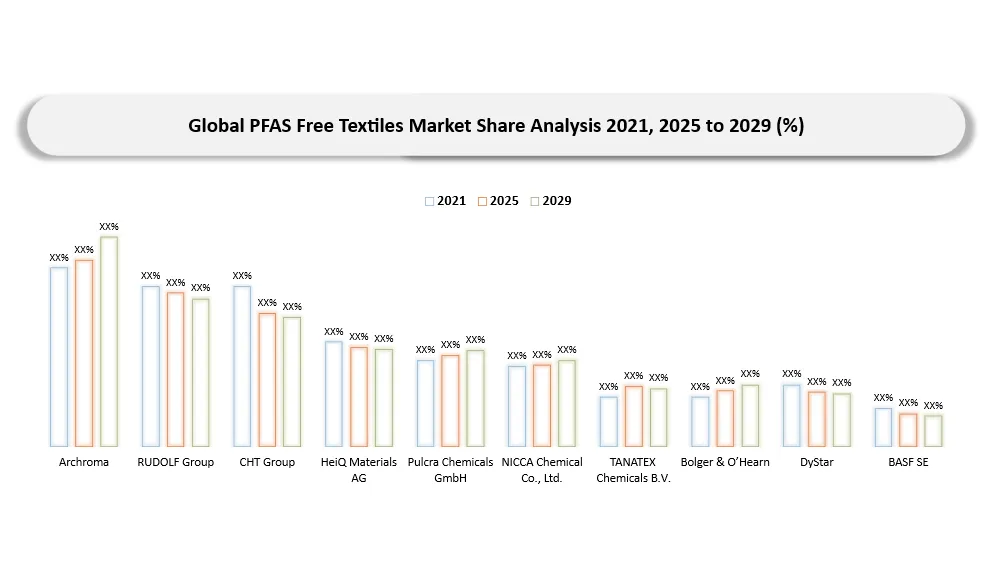
- The companies that have competitive positions in this market include Archroma, RUDOLF Group, CHT Group and HeiQ Materials AG, thanks to their experience and proven DWR formulations that are PFAS-free, as well as their textile finishing know-how and relationships with mills worldwide.
- It is increasingly becoming more about competing based on performance and not just PFAS-free. The suppliers compete through their water repellency, wash resistance, breathability, abrasion resistance, touch feel and compatibility with polyester, nylon, cotton and blends.
- The suppliers from Europe are able to take advantage of the early stage of regulation in the region, whereas Indian firms like Sarex Chemicals, Rossari Biotech and Fineotex Chemical can build up their presence with cost-efficient formulas and proximity to the big textile production centers.
- Alternative chemistry plays the key role in gaining competitive advantage and companies are busy developing silicone-free, hydrocarbon-free, polyurethane-free, wax-free, dendrimer-free and other fluorine-free products depending on performance needs in different product segments.
- The competitive pressure is building up due to product innovation, trials at textile mills, collaborations with brands, certification and expansion to regions, as chemical companies vie for inclusion of their PFAS-free products with leading clothing brands and textile companies prior to the regulation of PFAS.
Key Companies of PFAS-free Textiles Market
- Archroma (Switzerland)
- RUDOLF Group (Germany)
- CHT Group (Germany)
- HeiQ Materials AG (Switzerland)
- Bolger & O’Hearn (United States)
- Pulcra Chemicals GmbH (Germany)
- Sarex Chemicals (India)
- Rossari Biotech Limited (India)
- Fineotex Chemical Limited (India)
- TANATEX Chemicals B.V. (Netherlands)
- NICCA Chemical Co., Ltd. (Japan)
- Zschimmer & Schwarz (Germany)
- Bozzetto Group (Italy)
- Wacker Chemie AG (Germany)
- DIC Corporation (Japan)
- DyStar (Singapore)
- Goulston Technologies (United States)
- Dr. Petry (Germany)
- BASF SE (Germany)
- Setas Kimya Sanayi A.Ş. (Turkey)
PFAS-free Textiles Market Major Pain Points
- Performance Gap in PFAS-free Finishes: Matching the performance levels provided by PFAS chemistry in terms of water repellency, oil and stain resistance, wash resistance and breathability is proving to be quite challenging.
- Complex PFAS Verification: Companies will need to demonstrate the lack of PFAS chemistry in their products through suitable testing and documentation procedures, with total fluorine screening, targeted PFAS testing and supplier statements gaining increasing importance.
- Supply-Chain Traceability Gaps: Textiles can contain PFAS through their finishing, membrane, coating, processing chemicals, or upstream suppliers, making it very hard for companies to prove that they do not have PFAS in their products.
- Higher Product-Conversion Complexity: Converting from PFAS treatments might necessitate changing textile construction, reformulation, laboratory testing, performance washing testing and supplier recertification, increasing product conversion efforts and costs.
- Inconsistent Regulatory Requirements: Countries use different definitions for PFAS, as well as different thresholds for its concentrations and different rules regarding its use, which makes it difficult for manufacturers to comply with the regulations when selling finished textiles products.
PFAS-free Textiles Market Recent Developments
- November 2025: RUDOLF Group Revalidated its BIONIC FINISH ECO range to the new EN 17681-1:2025 PFAS testing standard, reinforcing PFAS-free claims for textile finishing purposes.
- April 2026: Archroma featured PHOBOTEX NTR-50 LIQ, which is partially bio-based and free of PFAS, a durable water repellency treatment for outdoor garments, activewear and workwear, as part of its portfolio of fluorine-free durable finishes.
- July 2026: NICCA Chemical Made strides towards further development of its Zelan Non-Fluorine Water Repellent product line, which complements its Botanical NEOSEED fluorine-free DWR solution.
- April 2026: CHT Group launched ECOPERL, a PFC free range of hydrophobic finishes made from bio-derived waxes and fluorine-free resins, aim-
- ed at textile finish applications needing water repellency.
- May 2026: Bolger & O’Hearn extended use of Shell-Tech Free M325 SC1, a zero VOC and wax free fluorine free DWR that can retain high spray resistance performance after 50 wash cycles on denim and heavy cotton textiles.
Analyst View / Opinion on PFAS-free Textiles Market
- PFAS-free is becoming a market-access requirement: Regulations and buyer requirements are increasingly demanding that companies be PFAS-free in order to gain access to major apparel, outdoor, footwear and textile markets instead of being an added sustainability benefit alone.
- Performance textiles will determine competitive positioning: Competitive pressure will exist in those products which need water-repellent properties, waterproofness, stain resistance, durability and breathability, where the manufacturer needs to prove that PFAS-free finishing still matches performance requirements.
- Outdoor and consumer textiles offer the clearest conversion opportunity: Evidence shows that technically viable substitutes exist for many consumer apparel, home textiles, sportswear, footwear and outdoor textiles uses, allowing for rather wide PFAS substitution.
- Specialty technical textiles will remain a differentiated segment: There are some firefighting PPE, medical textiles, high-performance membranes and other technical applications that would still be hard to substitute, providing scope for development of higher performance PFAS-free products.
- Traceability will increasingly influence supplier selection: Brands and manufacturers will have more focus on chemical disclosure, PFAS testing, tracability and documentation of the suppliers because textiles containing PFAS can pose challenges for re-use and recycling at end-of-life stages.
PFAS-free Textiles Market Target Audience
| INDUSTRY | WHO SHOULD BUY THIS REPORT? | REASON TO BUY THIS REPORT |
| Textile Manufacturers | Textile and fabric manufacturers | Assess PFAS-free textile demand, product opportunities and competitive positioning |
| Apparel & Fashion | Apparel manufacturers and fashion brands | Identify PFAS-free product trends and regulatory-driven opportunities |
| Outdoor & Sportswear | Outdoor, sportswear and performance apparel companies | Evaluate demand for PFAS-free waterproof and performance textiles |
| Protective Textiles | Protective clothing manufacturers | Understand the transition toward PFAS-free protective fabrics and technologies |
| Home Textiles | Home furnishing and textile manufacturers | Identify opportunities in PFAS-free upholstery, carpets and household textiles |
| Automotive Textiles | Automotive textile and interior suppliers | Evaluate demand for PFAS-free fabrics in vehicle interiors and components |
| Technical Textiles | Technical and specialty textile producers | Assess emerging applications and technology requirements |
| Chemical & Finishing Suppliers | Textile treatment and finishing companies | Identify opportunities to supply PFAS-free finishing technologies and materials |
| Retail & E-Commerce | Textile retailers and online marketplaces | Track consumer demand and expansion of PFAS-free product portfolios |
| Investors & Financial Institutions | Private equity firms, venture capital firms and institutional investors | Evaluate market growth, investment opportunities and competitive risks |
Why Choose DATAM?
- Data-Driven insights: Dive into detailed analyses with granular insights such as pricing, market shares and value chain evaluations, enriched by interviews with industry leaders and disruptors.
- Post-Purchase Support and Expert Analyst Consultations: As a valued client, gain direct access to our expert analysts for personalized advice and strategic guidance, tailored to your specific needs and challenges.
- White Papers and Case Studies: Benefit quarterly from our in-depth studies related to your purchased titles, tailored to refine your operational and marketing strategies for maximum impact.
- Annual Updates on Purchased Reports: As an existing customer, enjoy the privilege of annual updates to your reports, ensuring you stay abreast of the latest market insights and technological advancements. Terms and conditions apply.
- Specialized Focus on Emerging Markets: DataM differentiates itself by delivering in-depth, specialized insights specifically for emerging markets, rather than offering generalized geographic overviews. The approach equips our clients with a nuanced understanding and actionable intelligence that are essential for navigating and succeeding in high-growth regions.
- Value of DataM Reports: Our reports offer specialized insights tailored to the latest trends and specific business inquiries. The personalized approach provides a deeper, strategic perspective, ensuring you receive the precise information necessary to make informed decisions. The insights complement and go beyond what is typically available in generic databases.
What DATAM Uniquely Provides
- Finished-Product Market Mapping: Differentiates between the market for finished products without PFAS and PFAS-free chemicals, coatings, fibers and treatment processes to ensure the focus is on the actual product market.
- Application-Level Opportunity Mapping: Highlights the application level demand and substitution opportunities for outdoor apparel, waterproof clothes, sports apparel, footwear, protection apparel, home textiles and technical textiles.
- Regulation-to-Demand Analysis: Attaches distinct restrictions on PFAS and their implementation to their potential influence on finished product transition, sourcing needs and market possibilities.
- PFAS-free Performance Assessment: Examines how crucial factors such as waterproofing, stain resistance, durability, breathability and laundering are when substituting PFAS based textile treatments.
- Competitive and Supplier Positioning: Analyzes manufacturers based on finished PFAS-free offering, application scope, means of manufacture and compliance readiness.


























































