


PFAS-Free Additives Market Size and Overview
The global PFAS-Free Additives market reached an estimated US$ 229.52 Million in 2025 and is expected to reach US$ 598.03 Million by 2035, growing at a CAGR of 10.5% during 2026-2035. The market includes processing aids, lubricants, wetting and leveling agents, defoamers, release agents, slip and anti-block systems, barrier additives, water and oil repellents, surface-protection additives and multifunctional blends supplied without intentionally added PFAS. Demand is expanding as manufacturers reformulate plastics, coatings, inks, adhesives, textiles, paper packaging, electronics and industrial fluids to meet regulatory and customer requirements.
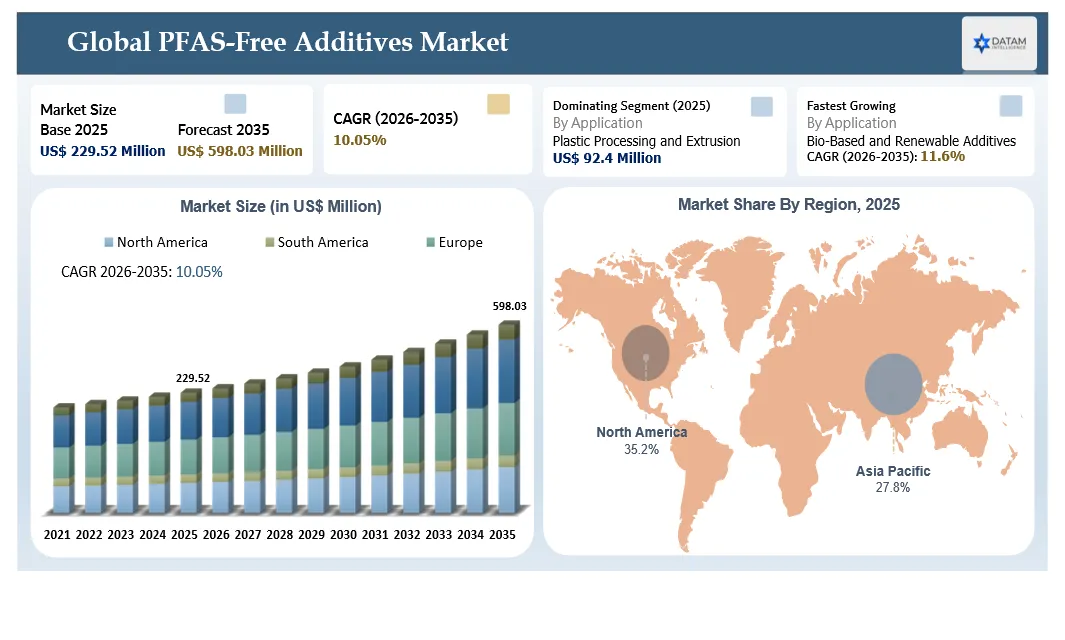
Processing aids and lubricants currently represent the largest functional segment because they are widely used in plastics, elastomers, coatings, adhesives and industrial processing. Barrier, repellent and surface-protection additives are expected to grow fastest because they replace fluorinated performance across food packaging, textiles, architectural coatings and consumer products. Adoption is rarely a simple one-for-one substitution. Formulators often need to rebalance surfactants, binders, waxes, silicones, rheology modifiers and cure conditions to achieve comparable surface energy, durability and processability.
Europe leads regulatory-driven qualification, while North America combines state product restrictions, federal reporting requirements and brand-owner elimination programs. Asia-Pacific is expected to grow fastest as export-oriented manufacturers qualify alternatives for European and North American customers and as local specialty-chemical suppliers expand formulation capabilities. Competitive advantage increasingly depends on application laboratories, analytical documentation and the ability to support customer trials across multiple substrates.
| Metric | Value |
| 2025 Market Size | US$ 229.52 Million |
| 2035 Projected Market Size | US$ 598.03 Million |
| CAGR (2026-2035) | 10.05% |
| Largest Market | North America |
| Fastest Growing Market | Asia-Pacific |
| Leading Chemistry Platform | Silicone-Based and Proprietary Organic Systems |
| Dominating Substrate and Formulation Type | Plastics and Elastomers |
| Dominating Application | Plastic Processing and Extrusion |
PFAS-Free Additives Market Key Takeaways
- Processing aids and lubricants accounted for an estimated 27.8% of market value in 2025 because of their broad use in plastics, elastomers and industrial processing.
- Plastics and elastomers represented approximately 29.6% of application demand in 2025, supported by processing, molding, cable, packaging and engineered polymer uses.
- Packaging and food-contact materials held about 24.3% of end-use demand in 2025 as grease resistance, release and processing aids moved toward PFAS-free specifications.
- Europe held an estimated 34.8% regional share in 2025, reflecting the broadest regulatory pressure and advanced brand-owner elimination programs.
- Asia-Pacific is expected to grow at approximately 12.1% CAGR through 2035 as export manufacturers, compounders and coatings producers qualify alternatives.
- Barrier, repellent and surface-protection additives are projected to grow at 13.4% CAGR as customers replace fluorinated functionality in textiles, packaging and coatings.
- Waterborne emulsions and dispersions are gaining share because they simplify low-VOC reformulation and improve dosing into coatings, paper and textile systems.
- Market leadership will depend on verifiable PFAS-free status, application performance, regulatory documentation, scalable supply and technical support during qualification.
PFAS-Free Additives Industry Trends and Strategic Insights
- Additive producers are moving from generic replacements toward substrate-specific formulations for metallocene polyethylene, polymer formulations, HDPE and polypropylene film.
- Resin suppliers are increasingly offering grades with integrated non-fluorinated additives, reducing formulator dosing complexity and supporting faster qualification.
- Multifunctional systems that combine processing improvement with slip, antiblock, stabilization or surface benefits are gaining interest, although interaction risk requires careful validation.
- Food-contact and packaging applications are becoming the commercial proving ground because brand-owner scrutiny and regulatory exposure are highest.
- Converters are evaluating alternatives through cost per kilogram of film, line-speed recovery, scrap reduction and cleaning frequency rather than additive price alone.
- Product declarations and supply-chain transparency are becoming commercial requirements as customers ask for intentional-PFAS-free specifications and supporting documentation.
PFAS-Free Additives Market Scope
| Metrics | Details |
| 2025 Market Size | US$ 229.52 Million |
| 2035 Projected Market Size | US$ 598.03 Million |
| CAGR (2026-2035) | 10.05% |
| Largest Market | North America |
| Fastest Growing Market | Asia-Pacific |
| By Chemistry Platform | Silicone-Based, Organic Non-Silicone, Mineral and Inorganic Hybrid, Wax and Lubricant-Based and Proprietary Multifunctional Blends |
| By Substrate and Formulation Type | Plastics and Elastomers, Coatings and Inks, PET, PVC, Polystyrene, Engineering Thermoplastics and Others |
| By Application | Blown Film, Cast Film, Extrusion Coating, Pipe and Profile, Paper and Packaging Barrier Treatment, Metalworking and Industrial Fluids, Electronics and Precision Manufacturing and Others |
| By Delivery and Incorporation Mode | In-Process Addition and Post-Addition and Surface Treatment |
| By Form and Supply Format | Concentrate and Concentrates, Neat Additives, Pre-Compounded Resin Grades and Liquid or Dispersed Systems |
| By End-Use Industry | Packaging, Agriculture, Building and Construction, Automotive, Electrical and Electronics, Consumer Goods, Industrial Products and Others |
| Report Insights Covered | Market Size, Share, Growth, Product Pipeline, Competitive Landscape, Company Profiles and Country-Level Opportunity |
Why does this report matter in 2026?
2026 is a critical planning year for PFAS-free additives because regulatory scrutiny is moving from individual substances toward broad product categories, supply-chain disclosure and end-use restrictions. In the United States, manufacturers and importers are preparing for revised PFAS reporting obligations under TSCA, while food-packaging suppliers have moved beyond the phase-out of PFAS grease-proofing agents. In Europe, ECHA’s scientific committees have supported EU-wide action with targeted derogations, raising the commercial value of qualified alternatives across coatings, textiles, plastics, electronics, lubricants and packaging.
The report matters because the substitution challenge extends beyond replacing one ingredient. Fluorinated additives often deliver several functions at low dosage, including wetting, release, repellency, barrier performance and processing stability. PFAS-free conversion therefore requires formulation redesign, application testing and supplier collaboration. The study separates near-term demand in packaging, coatings and textiles from technically difficult applications in electronics, automotive systems and aggressive industrial environments.
Decisions made during 2026 on chemistry platforms, laboratory capacity, supplier qualification and customer partnerships will influence market position through the remainder of the decade. Companies that establish trusted analytical documentation and application-specific performance data can become preferred suppliers before final restrictions take effect. The report supports portfolio prioritization, acquisition screening, regional expansion and commercial planning across this transition.
PFAS-Free Additives Market White Space & Investment Opportunities
- Multifunctional systems that combine wetting, release, defoaming and surface protection can reduce the number of ingredients needed in reformulated products.
- Food-contact paper, molded fiber and flexible packaging remain major white spaces for oil and grease resistance without fluorinated chemistry.
- Durable water and stain repellency for textiles, leather and outdoor products requires higher wash durability and lower curing temperatures.
- Electronics and semiconductor manufacturing offer premium opportunities for ultra-clean additives with low ionic contamination, low outgassing and strong documentation.
- Bio-based waxes, oleochemical surfactants and renewable polymer additives can align PFAS elimination with low-carbon and circular-material strategies.
- Digital formulation tools and application databases can shorten qualification by predicting compatibility, dosage and likely failure modes.
PFAS-Free Additives Future Market Transformation
The market is expected to transform from a narrow fluoropolymer-replacement category into a broader polymer-processing optimization platform. Early products focus on eliminating sharkskin and reducing equipment fouling in polyethylene film. Future systems will be differentiated by time-to-clear, energy use, line-speed improvement, optical quality, recyclability and compatibility with complex additive packages. Suppliers will increasingly use application-specific formulations rather than one universal processing aid.
The commercial model will also become more integrated. Additive producers, concentrate companies, resin suppliers and formulators will share qualification data and develop recommended dosing windows for specific resin families and equipment configurations. Digital processing monitoring can help quantify pressure, torque, surface defects and cleaning cycles, creating objective evidence for cost-in-use. This will reduce dependence on visual trial assessment and improve transfer of successful formulations across plants.
By 2035, the strongest portfolios are likely to combine multiple chemistry platforms, regional food-contact support, formulator troubleshooting and data-based processing recommendations. Brand owners may require documented absence of intentionally added PFAS and may specify approved additive families within packaging standards. This creates recurring value in documentation, technical service and reformulation support in addition to additive sales.
PFAS-Free Additives Market Buyer Decision-Making Criteria
Converters prioritize effective melt-fracture removal, stable die pressure, reduced die-lip build-up and minimal downtime. The alternative must work at practical dosage and reach steady performance quickly after a line change. Buyers also assess film haze, gloss, gels, print treatment, lamination, heat sealing, coefficient of friction and blocking. A product that improves processing but disrupts downstream converting can fail qualification.
Procurement and brand-owner teams increasingly require food-contact status, composition declarations, intentional-PFAS-free statements, regional regulatory support and supply continuity. Resin compatibility, carrier choice, pellet handling and the ability to source equivalent grades in multiple regions influence approval. Long-term decisions depend on cost per tonne of finished film, reduced scrap, cleaning frequency, line speed and technical support rather than additive price alone.
PFAS-Free Additives Market Economic & Investment Analysis
Commercial planning should distinguish theoretical resin volume from qualified addressable volume. Only a portion of polymer throughput uses additives, and adoption depends on resin rheology, line speed, die design and end-use requirements. A realistic forecast therefore applies additive-use incidence, dosage, conversion timing, qualification probability and price by chemistry and form and supply format. This is particularly important because a concentrate may have a lower active concentration than a neat additive but a higher delivered volume.
The category is attractive because regulatory pressure creates a replacement cycle across an installed base of production lines rather than demand only from new capacity. Once qualified, a processing aid can generate recurring consumption tied to resin throughput. Investment is concentrated in formulation development, application laboratories, food-contact dossiers, regional concentrate production and formulator support. Suppliers with proprietary active chemistry can capture premium margins, while concentrate companies can create value through local customization and short lead times.
Investment risk remains meaningful. Performance can vary between material grades and equipment, qualification can consume production time and customers may hesitate to change if conventional additives remain permitted. New products also face interaction risk with slip agents, antiblock, pigments, stabilizers and recycled content. Successful investment therefore requires a portfolio approach, strong technical service and clear cost-in-use evidence rather than reliance on regulatory messaging alone.
From an investment perspective, milestone-adjusted scenarios should separate commercial products, customer trials, food-contact approvals and fully qualified recurring business. Near-term value is concentrated in polyethylene film, while later growth depends on expansion into polypropylene, pipe, wire and cable and engineering polymers. Companies should model gross margin alongside technical-service cost because early adoption requires substantial application support. A product with lower active dosage and broad resin compatibility can create stronger economics even when its unit price is higher.
PFAS-Free Additives Investment Trends in the Market
- Capital is moving toward proprietary organic and silicone platforms that can match fluoropolymer performance in high-output polyethylene film.
- Additive producers are investing in application laboratories, pilot production lines and digital measurement to shorten customer qualification cycles.
- Concentrate companies are expanding regional compounding and customization so formulators can receive carrier-matched, food-contact-ready products with shorter lead times.
- Resin suppliers are integrating non-fluorinated additives into selected grades, shifting value upstream and reducing formulator formulation complexity.
- Investment is increasing in food-contact documentation, composition transparency and multi-region regulatory support because packaging is the largest early market.
- Partnerships between additive producers, resin companies, formulators and brand owners are becoming central to reference generation and commercial scale-up.
Strategic Indicators for PFAS-Free Additives Market
High Regulation Impact
PFAS definitions, reporting duties, proposed restrictions and customer substance lists strongly influence demand. Regulation does not automatically prohibit every fluoropolymer use, but uncertainty raises the strategic value of alternatives. Suppliers must support composition disclosure, food-contact compliance and region-specific statements. Converters need evidence that replacement reduces regulatory exposure without introducing new restricted substances.
High Investment Activity
Investment has accelerated around commercial PFAS-free product lines, formulator qualification and application development. Capital remains selective because performance is application-specific. Funding favors platforms with industrial-scale evidence, low dosing, broad resin compatibility and the ability to support food-contact packaging.
Supply Chain Disruption
The market depends on specialty active ingredients, carriers, compounding capacity and regional regulatory documentation. Disruption can delay trials and force formulators to revert to incumbent systems. Suppliers are qualifying alternate feedstocks, regionalizing concentrate production and maintaining safety stock for launch customers.
Pricing Volatility
Pricing varies by active chemistry, concentration, carrier resin, food-contact status and technical-service intensity. Customers compare cost-in-use, not only price per kilogram. Lower dosage, faster line clearing, reduced scrap and less line cleaning can justify a premium, while commodity concentrate competition can compress margins.
Procurement Pressure
Converters face simultaneous pressure from customers, regulators and production teams. Procurement must secure a product that meets chemical policy, performs on existing lines and remains available globally. Buyers increasingly seek dual sourcing, regional technical support, transparent composition and predictable lead times.
New Technology Adoption
Silicone concentrates, proprietary organic actives, hybrid systems, digital processing analytics and resin-integrated additive grades are changing the market. Adoption is fastest where suppliers can provide line-trial protocols and quantify pressure, surface defects, equipment fouling and downstream film performance.
Regional Expansion Opportunity
North America and Europe lead regulatory-driven conversion, while Asia-Pacific provides the largest volume expansion opportunity. Regional growth requires local carrier resins, food-contact support, formulator laboratories and partnerships with resin suppliers and concentrate distributors.
Government Policy Support
Government PFAS reporting, chemical restrictions and packaging policy increase demand for substitution planning. Policy support is strongest when rules provide clear definitions, transition periods and accepted documentation. Uncertainty can still accelerate voluntary conversion because brand owners prefer to avoid future reformulation.
Pricing Intelligence
Commercial models will differ by form and supply format. Neat additives may command higher price per kilogram but use lower dosage, while concentrates provide handling simplicity and larger delivered volume. Resin grades with integrated additive may embed the cost in polymer pricing. Value arguments should quantify throughput, scrap, cleaning and qualification support.
AI Impact Analysis of PFAS-Free Additives Market
AI can accelerate formulation design by linking resin rheology, additive chemistry, dosage, processing temperature, die pressure and film-quality outcomes. Machine-learning models can screen combinations before plant trials and identify interactions with slip, antiblock, stabilizers and pigments. This is valuable because conventional empirical development requires many processing runs and may not transfer cleanly between resins or equipment.
AI-enabled process monitoring can also support formulator adoption. Vision systems can quantify surface defects and haze, while models using pressure, torque and temperature data can estimate time-to-clear and predict equipment fouling. Suppliers can use anonymized trial data to create substrate-specific recommendations. Adoption will depend on data quality, protection of formulation IP and evidence that model recommendations remain valid across industrial lines.
Disruption Analysis of PFAS-Free Additives Market
PFAS-free technologies are disrupting a long-established market in which fluorinated additives were treated as a reliable default. The transition changes supplier relationships because formulators need more formulation and technical support. It also creates an opening for silicone specialists, organic additive developers, concentrate companies and resin producers that were not dominant in traditional fluoropolymer additive.
Resin-integrated solutions could shift value upstream by allowing polymer producers to sell grades that process effectively without separate formulator dosing. At the same time, brand-owner substance policies can pull change downstream by requiring packaging suppliers to document compliance. Digital qualification and shared performance databases may further reduce switching risk and accelerate standardization across plants.
PFAS-Free Additives Market BCG Matrix: Company Evaluation
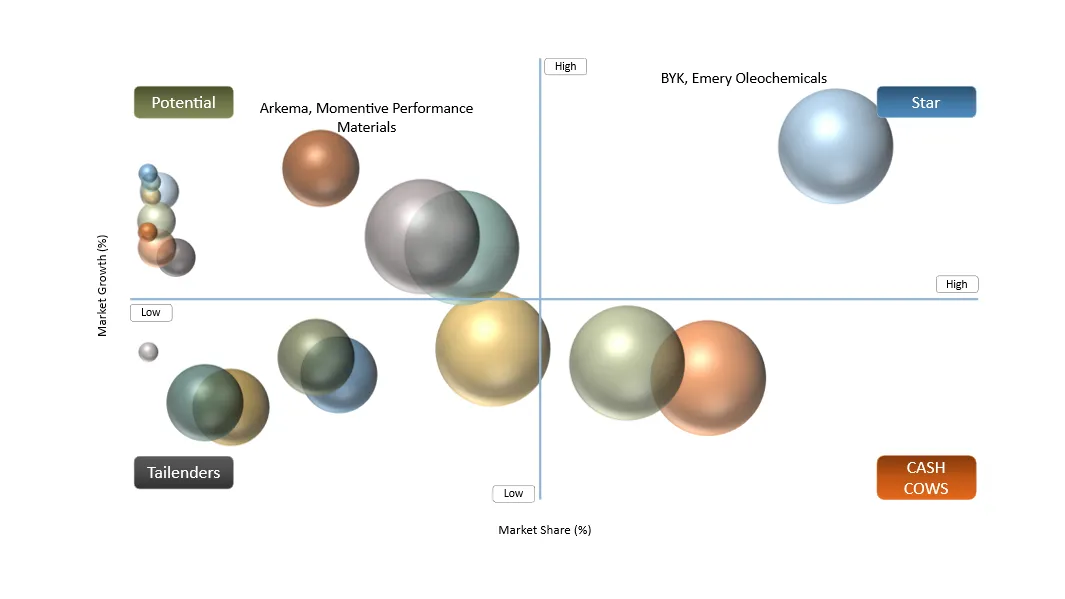
| Category | Representative Companies | Positioning Rationale |
| STAR | BYK, Emery Oleochemicals | Commercially visible PFAS-free product launches, global technical support and direct relevance to polymer film conversion. |
| POTENTIAL | Arkema, Momentive Performance Materials, MUNZING, Sukano, Kafrit | Strong concentrate capabilities and customer access, with opportunity to expand PFAS-free processing-aid portfolios and local qualification. |
| CASH COWS | Arkema, Evonik, Elementis, Momentive, Croda | Broad additive or silicone portfolios and established customer relationships that can support adjacent processing solutions. |
| TAILENDERS | Regional formulators and niche lubricant suppliers | May compete in selected local or low-temperature applications but require stronger validation, documentation and global support. |
STAR
BYK-Chemie is positioned as a Star because AddWorks additive 101 FG and AddWorks additive 122 G provide commercially available PFAS-free options for polymer processing with food-contact positioning and global market coverage. Emery Oleochemicals is also positioned as a Star through DOWSIL 5-1050 additive, which uses silicone technology in a polyethylene carrier and targets blown and stretch film. Both companies combine technology, scale, application support and direct access to global packaging customers.
POTENTIAL
Concentrate specialists such as Arkema, BYK-Chemie, Momentive Performance Materials, MUNZING, Sukano and Kafrit represent Potential players. They have regional compounding, carrier customization and close formulator relationships. Their future position will depend on proprietary chemistry access, qualification data, food-contact documentation and the ability to offer consistent products across regions.
PFAS-Free Additives Market Dynamics
Driver Impact Analysis
| Driver | Market Growth Impact | Demand Concentration | Impacted Use Case | Strategic Impact |
| PFAS regulation and customer elimination programs | High | North America and Europe | Packaging and consumer products | Accelerates substitution and creates recurring demand for qualified alternatives. |
| Need to maintain industrial processing productivity | High | Global film formulators | Blown and cast film | Makes processing performance and cost-in-use central to adoption. |
| Growth of mono-material polyethylene packaging | Medium-High | Packaging value chain | Recyclable film structures | Creates demand for additives compatible with PE-based recycling strategies. |
| Commercial product launches and technical support | Medium | Global formulator clusters | Qualification and scale-up | Reduces adoption risk and broadens access to validated solutions. |
Driver: Tightening PFAS Requirements Create a Replacement Cycle
The strongest driver is the combination of regulatory scrutiny and voluntary customer policies. Even where fluorinated additives are not immediately prohibited, reporting, supplier declarations and future restriction risk increase the cost of maintaining legacy formulations. Packaging formulators and brand owners are therefore qualifying alternatives before a hard deadline. This creates recurring demand tied to existing resin throughput and provides suppliers with an opportunity to build long-term approved-product positions.
Restraint Impact Analysis
| Restraint | Drag on Market Growth | Primary Impact Area | Impacted Use Case | Strategic Impact |
| Resin- and line-specific performance variability | High | Technical qualification | High-speed processing | Extends trial cycles and prevents universal drop-in claims. |
| Higher transition cost and downtime | Medium-High | Converter operations | Production-scale trials | Slows adoption where customers lack spare line capacity. |
| Limited long-term operating data | Medium | Procurement and quality | Multi-year supply approval | Increases demand for references and dual sourcing. |
| Interaction with other additives | Medium | Formulation stability | Printing, sealing and slip performance | Requires broader downstream testing beyond processing. |
Restraint: Qualification Complexity and Performance Variability
PFAS-free alternatives can perform differently across material grades, screw designs, dies and additive packages. A system that clears surface defects rapidly in one polymer formulations may require higher dosage or longer conditioning in another. Emery Oleochemicalsnstream effects on haze, coefficient of friction, printing and sealing can appear after the processing trial. These variables make qualification expensive and discourage rapid replacement without supplier support. Market growth therefore depends on application data, sample availability, trial protocols and technical teams that can resolve line-specific problems.
PFAS-Free Additives Market Segment Analysis
The global PFAS-Free Additives market is segmented based on Additive Function, Chemistry Platform, Application, Delivery and Incorporation Mode, Form and Supply Format, End-Use Industry and region.
By Additive Function
Silicone-Based and Proprietary Organic Systems Will Lead Commercial Adoption
Silicone-based systems are expected to hold a major share because they can provide wall slip, melt-fracture control and die-build-up reduction in polyethylene film. Proprietary organic non-silicone products will also gain rapidly where formulators or brand owners prefer formulations free of both PFAS and siloxane substances. The competitive balance will depend on dosage, thermal stability, time-to-clear and downstream film properties. Hybrid and wax-based systems will remain relevant in selected applications but require stronger evidence in high-output processing.
By Additive Function
Plastics and Elastomers Will Continue to Dominate Demand
Plastics and Elastomers will remain the largest polymer segment because blown film, cast film, stretch film, processing coating and agricultural film consume large volumes of polymer formulations, LDPE, HDPE and metallocene PE. These materials frequently use additives to control sharkskin and die pressure at high throughput. Coatings and Inks will gain as suppliers optimize products for film and fiber. PET, PVC and engineering polymers provide smaller but potentially higher-value opportunities where temperature and compatibility requirements are more demanding.
By Application
Plastic Processing and Extrusion Will Remain the Largest Application
Blown film leads because surface defects, equipment fouling and pressure instability directly affect surface and process quality and production economics. Packaging, agricultural film and industrial liners provide a large installed base of lines that can convert from conventional additive. Cast film and stretch film are also attractive due to high speed and optical requirements. Pipe, profile, wire and cable and molding applications will expand as suppliers demonstrate performance beyond thin film.
By Delivery and Incorporation Mode
In-Process Addition Will Control Market Value
Continuous processing processes account for most demand because even small additive dosage is multiplied across high resin throughput. Stable long runs create clear value from reduced line cleaning, lower scrap and higher line speed. Discontinuous processes such as injection molding may use additives for release, flow or surface quality, but adoption is more application-specific. Suppliers will prioritize continuous film and profile operations where cost-in-use benefits can be quantified quickly.
By Form and Supply Format
Concentrates and Masterbatches Will Retain the Largest Share
Concentrate and concentrate formats lead because they are easy to meter, handle and disperse on existing equipment. A polyethylene carrier can simplify film conversion and reduce exposure to fine powders. Neat active additives offer lower delivered volume and potentially lower dosage, but require accurate feeding and may be less convenient for smaller formulators. Pre-compounded material grades will grow as polymer producers integrate PFAS-free performance into selected grades.
By End-Use Industry
Packaging Will Remain the Core Revenue Pool
Packaging will dominate because it combines large film volume, food-contact requirements, brand-owner scrutiny and strong pressure to remove intentionally added PFAS. Flexible food, beverage, hygiene, stretch and e-commerce films are important demand areas. Agriculture and construction will adopt where long-run processing benefits justify conversion. Automotive, electrical and industrial applications may offer premium opportunities but require specialized thermal, mechanical and regulatory validation.
PFAS-Free Additives Market Geographical Penetration
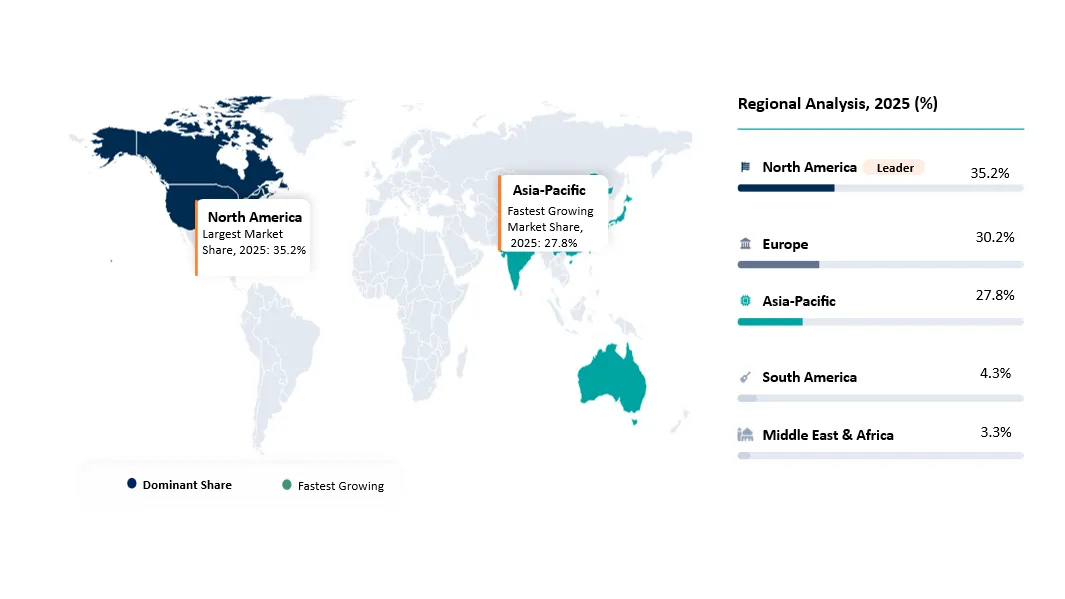
| Region | 2025 Share | Market Position | Primary Growth Logic |
| North America | 35.2% | Largest | Early commercial launches, large film capacity, brand-owner programs and resin supplier participation. |
| Europe | 30.2% | Second Largest | Broad PFAS restriction process, packaging regulation and strong additive innovation. |
| Asia-Pacific | 27.8% | Fastest Growing | Large formulator base, export packaging, resin production and qualification by multinational customers. |
| South America | 4.3% | Emerging | Packaging growth and gradual adoption through multinational formulator networks. |
| Middle East and Africa | 3.3% | Emerging | Polyolefin resin production, film conversion and export-oriented packaging investment. |
U.S. PFAS-Free Additives Market Landscape
The U.S. is the largest national market because it combines major film formulators, resin producers, additive suppliers and brand-owner chemical policies. EPA reporting requirements and state-level PFAS measures increase the need for supply-chain visibility. Commercial launches from global suppliers provide practical alternatives for blown and stretch film. Growth will depend on industrial-scale references, food-contact support and conversion across multi-plant packaging networks.
Germany PFAS-Free Additives Market Outlook
Germany is a leading European market supported by chemical innovation, packaging formulators and close attention to the EU PFAS restriction process. The country also hosts major plastics and packaging exhibitions that accelerate customer education and qualification. Demand is strongest in polymer film, food-contact packaging and export-oriented manufacturing. Suppliers need strong REACH documentation and technical support for high-performance film lines.
China PFAS-Free Additives Market Trends
China offers substantial volume potential through large polyethylene and polypropylene conversion capacity. Adoption is influenced by export requirements, multinational brand specifications and local demand for smoother film and higher throughput. Local concentrate production and technical service are important because formulator needs vary by resin source and equipment. Price sensitivity will favor products that demonstrate low dosage and rapid productivity gains.
India PFAS-Free Additives Market Outlook
India is emerging as a high-growth market through packaging, agriculture film, infrastructure and expanding polymer processing. Multinational and domestic formulators are evaluating PFAS-free additives as customer requirements strengthen. The market favors concentrate formats, local carrier resins and regional technical support. Food-contact documentation and cost-in-use evidence will be important for broad adoption.
Japan PFAS-Free Additives Market Trends
Japan has sophisticated packaging, electronics and resin industries with high quality expectations. Adoption is likely to be selective and documentation-intensive, emphasizing optics, cleanliness, food-contact status and long-term consistency. Domestic additive and concentrate companies can play an important role in qualification and customer support.
Brazil PFAS-Free Additives Market Outlook
Brazil has a significant flexible-packaging and agricultural-film base. Adoption will initially be driven by multinational customers, export packaging and local formulators seeking higher throughput. Currency volatility and price sensitivity can slow premium product uptake, increasing the importance of local compounding and inventory.
Middle East and Africa PFAS-Free Additives Market Outlook
The region combines major polymer resin production with growing film conversion, especially in Gulf countries, Turkiye and South Africa. Export-oriented resin and packaging suppliers may adopt PFAS-free processing technology to meet customer requirements in Europe and North America. Local technical capability and documentation remain uneven, creating partnership opportunities for global additive and concentrate suppliers.
PFAS-Free Additives Market Competitive Landscape
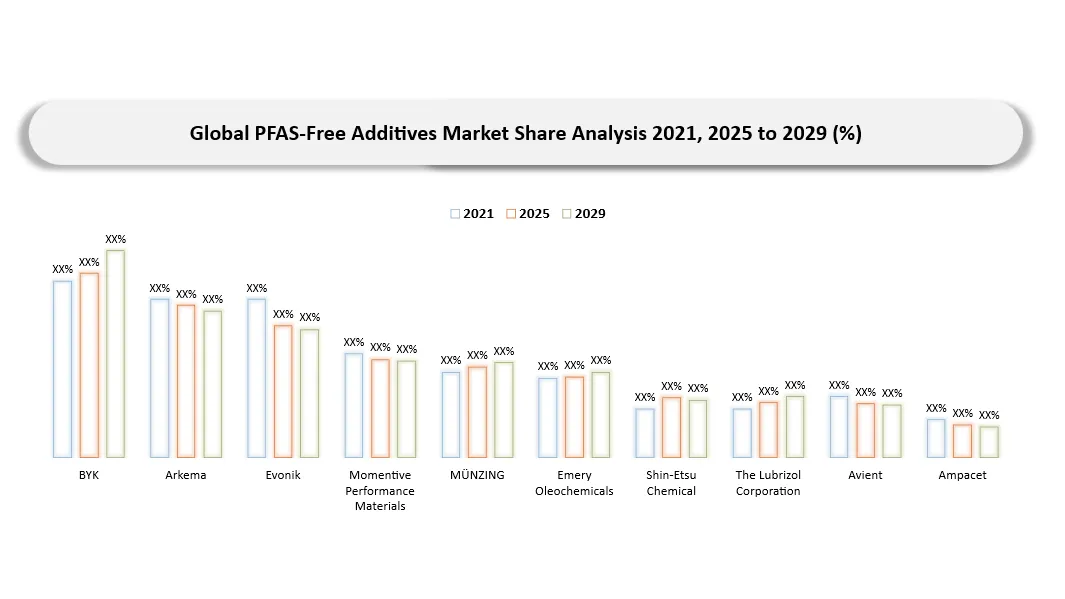
- Competition is shifting from conventional fluoropolymer performance toward validated non-fluorinated chemistry, food-contact support and formulator qualification capability.
- BYK-Chemie and Emery Oleochemicals have increased market visibility through commercial product launches focused on polymer industrial processing.
- Concentrate companies can differentiate through carrier customization, regional production, rapid sampling and close technical support for formulators.
- Resin suppliers can disrupt the market by embedding non-fluorinated additives into polymer grades, simplifying adoption and moving value upstream.
- Competitive advantage increasingly depends on time-to-clear, dosage, optical performance, die-build-up control, sealability, coefficient of friction and global regulatory documentation.
- Partnerships with resin companies, film formulators, brand owners and equipment specialists are central to reference generation and scale-up.
Key Companies of PFAS-Free Additives Market
- BYK
- Emery Oleochemicals
- Arkema
- Momentive Performance Materials
- MÜNZING
- Sukano
- Evonik
- Elementis
- Palsgaard
- Imerys
- Ampacet
- Avient
- PMC Biogenix
- The Lubrizol Corporation
- Shin-Etsu Chemical
PFAS-Free Additives Market Major Pain Points
- Resin- and line-specific performance limits prevent a universal drop-in replacement.
- Plant trials consume production time and can generate scrap during conditioning and optimization.
- Emery Oleochemicalsnstream effects on haze, printing, sealing and coefficient of friction require broad validation.
- Converters may need separate formulations for different resin suppliers or product structures.
- Food-contact and regional compliance documentation can delay commercialization.
- Limited long-term operating data increases procurement caution and dual-source requirements.
- Premium pricing can be difficult to justify without quantified throughput and cleaning savings.
- Supply continuity for proprietary active ingredients is critical during large-scale conversion.
PFAS-Free Additives Market Recent Developments
- April 2026: The U.S. EPA moved the start of the TSCA Section 8(a)(7) PFAS reporting period to 60 days after the effective date of its forthcoming rule revision, maintaining the need for manufacturers and importers to organize historical use and supply-chain data.
- March 2026: ECHA’s Risk Assessment Committee issued its final opinion and the Socio-Economic Analysis Committee issued a draft opinion supporting an EU-wide PFAS restriction with targeted derogations and emission controls.
- January 2025: The U.S. FDA determined that 35 food-contact notifications for PFAS-containing grease-proofing substances were no longer effective, with a June 30, 2025 compliance date for certain existing food packaging.
- August 2025: ECHA published an updated PFAS restriction proposal after evaluating more than 5,600 consultation comments, expanding assessment across additional sectors and uses.
- 2025-2026: Additive suppliers and downstream formulators accelerated launch and qualification work for fluorine-free wetting, release, barrier, repellent and processing technologies across packaging, coatings, textiles and plastics.
Analyst View / Opinion on PFAS-Free Additives Market
The market will not be won by regulatory messaging alone. Converters will adopt products that protect line output, surface and process quality and customer approval while lowering future chemical-policy risk. Suppliers should therefore lead with industrial performance and cost-in-use, then support the sustainability and compliance case with transparent documentation. The strongest companies will build substrate-specific data, regional application support and reference accounts across major formulator clusters.
- The PFAS-free additives market has entered a durable expansion phase because commercial alternatives are available and formulators are moving into production qualification.
- Plastics and Elastomers blown film will remain the near-term revenue center, while polypropylene, pipe, wire and cable and engineering polymers provide longer-term expansion.
- Concentrate will remain the dominant delivery format, but resin-integrated solutions can shift value upstream and simplify adoption.
- Product differentiation will depend on time-to-clear, dosage, die cleanliness, film optics and compatibility with printing, sealing and recycling.
- Companies that combine chemistry with formulator trials, regulatory documentation and local supply will outperform product-only competitors.
- Long-term leadership will depend on broad resin compatibility, cost-in-use evidence and the ability to support global packaging customers with consistent formulations.
PFAS-Free Additives Market Target Audience
| Industry | Who Should Buy This Report? | Reason to Buy This Report |
| Polymer Additives | Product leaders, R&D teams, regulatory and business development | Assess chemistry platforms, competitor launches, pricing and white-space opportunities. |
| Concentrate & Compounding | Commercial managers, formulators and plant leaders | Identify formulator demand, carrier choices, regional qualification and product-form opportunities. |
| Resin Producers | Polyolefin product managers, application development and sustainability teams | Evaluate integrated additive grades, customer conversion and differentiation strategies. |
| Film & Packaging Converters | Plant managers, process engineers, procurement and quality teams | Compare qualification criteria, performance risks and supplier positioning. |
| Brand Owners | Packaging, sustainability, chemical-policy and procurement teams | Understand PFAS elimination options, documentation and formulator readiness. |
| Equipment & Technical Services | Extrusion specialists, die suppliers and process consultants | Identify demand for line trials, monitoring, troubleshooting and optimization. |
| Investors & Consulting | Private equity, venture capital, institutional investors and consultants | Evaluate market size, growth, technology platforms and competitive positioning. |
| Government & Associations | Regulators, standards bodies and industry groups | Understand substitution pathways, compliance challenges and market readiness. |
Why Choose DATAM?
- Data-driven insights combining market sizing, polymer throughput, dosage, product qualification, regulation and cost-in-use.
- Post-purchase analyst consultations for market entry, product positioning, formulator targeting and custom scenario modeling.
- Annual updates covering product launches, regulatory changes, food-contact approvals and competitive conversion.
- Specialized focus on formulator operations and application fit rather than generalized polymer-additive summaries.
- Actionable analysis that connects chemistry, processing performance, documentation and customer adoption.
What DATAM Uniquely Provides
- Ten-year forecasts across chemistry platform, substrate and formulation type, application, delivery and incorporation mode, form and supply format, end use and region.
- Application-specific analysis separating blown film, cast film, processing coating, pipe, wire and cable and molding.
- Product and technology pipeline assessment covering commercial and emerging PFAS-free alternatives.
- Buyer-focused analysis of surface defects, equipment fouling, optics, sealing, printing, dosing and cost-in-use.
- Country-level views linking regulation, formulator capacity, resin production and technical-service requirements.
- Strategic recommendations for partnerships, qualification, channel development and market entry.


























































