


Permanent Magnet Recycling Services Market Size
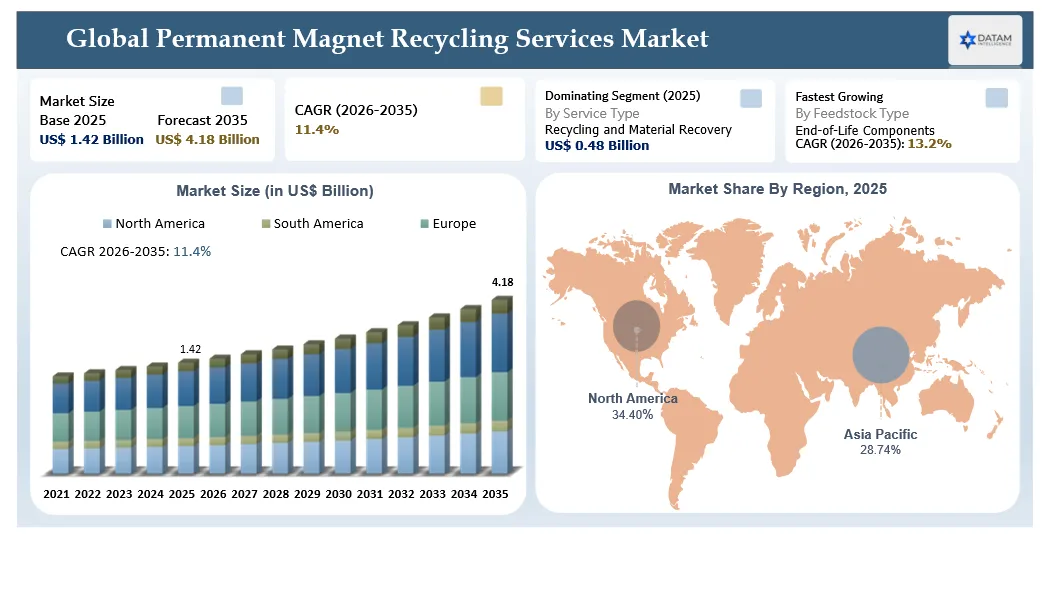
The global permanent magnet recycling services market reached an estimated US$ 1.42 billion in 2025 and is expected to reach US$ 4.18 billion by 2035, growing at a CAGR of 11.4% during 2026-2035. The market includes collection, dismantling, extraction, sorting, demagnetization, direct recycling, chemical recovery, refining and closed-loop program services associated with permanent-magnet production scrap and end-of-life products. Growth is supported by the expansion of electric mobility, wind power, industrial automation, electronics and defense systems, all of which rely on high-performance magnets and face concentrated rare-earth supply chains.
Permanent magnets contain strategically important materials such as neodymium, praseodymium, dysprosium, terbium, samarium and cobalt. Yet recovery remains limited because magnets are embedded inside motors, generators, hard drives, speakers, compressors and other assemblies. A commercial recycling service must therefore solve several operational problems before metallurgical processing begins. These include locating feedstock, proving ownership, protecting data, identifying magnet chemistry, safely dismantling equipment, preventing oxidation, separating coatings and adhesives, and aggregating sufficient tonnage for economical processing.
Market development is also shaped by the difference between theoretical and recoverable feedstock. Installed magnets can remain in service for a decade or more, and many products are exported, repaired or shredded before specialist recovery. DataM Intelligence therefore models service demand from accessible streams, announced processing capacity, collection partnerships and retirement schedules rather than applying a simple recycling rate to total magnet demand. This approach better reflects the timing of revenue creation and the operational constraints facing commercial recyclers.
The market is moving from isolated pilot projects toward contracted circular-supply programs. Production scrap and swarf provide the earliest scalable opportunity because their composition is known and collection is concentrated. End-of-life feedstock offers a much larger long-term resource but requires automated disassembly, reverse logistics and product-level information. Regulatory developments are reinforcing this transition. The EU Critical Raw Materials Act introduces permanent-magnet labelling, data-carrier and recycled-content disclosure requirements, while 2025 and 2026 policy actions have placed greater emphasis on retaining magnet scrap and recovering critical materials from electronics, vehicles and wind turbines.
| Metric | Detail |
| 2025 Market Size | US$ 1.42 Billion |
| 2035 Market Size | US$ 4.18 Billion |
| CAGR 2026-2035 | 11.4% |
| Largest Region | Asia-Pacific |
| Fastest-Growing Region | North America |
| Largest Service | Recycling and Material Recovery |
| Fastest-Growing Feedstock | End-of-Life Components |
Permanent Magnet Recycling Services Market Key Takeaways
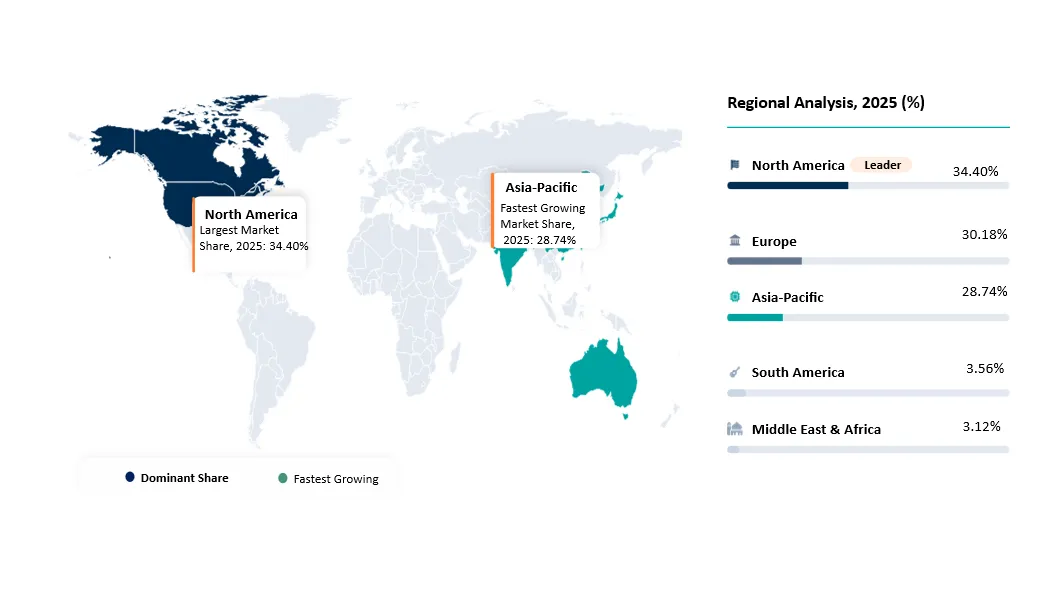
- Asia-Pacific held the largest share in 2025 due to its dominant magnet, motor, electronics and appliance manufacturing base, together with established metal-recovery infrastructure.
- North America is expected to record the fastest growth as public funding, domestic-magnet investment, defense procurement and new commercial recycling facilities improve the economics of regional circular supply.
- Neodymium-iron-boron magnets represent the principal revenue pool because they combine high rare-earth value with rapidly growing use in traction motors, wind generators, industrial drives and electronics.
- Manufacturing scrap remains the easiest feedstock to commercialize, while end-of-life motors, hard drives, speakers and wind generators create the largest future service opportunity.
- Direct or short-loop recycling is gaining attention because it can preserve alloy value and avoid a full return to separated oxides when feedstock chemistry and contamination are controlled.
- Recyclers are increasingly competing on feedstock access, automated disassembly, traceability, product qualification and offtake integration rather than on metallurgical recovery alone.
Permanent Magnet Recycling Services Industry Trends and Strategic Insights
- Hub-and-spoke networks are emerging to separate local collection and magnet extraction from centralized chemical recovery, alloy production and quality control.
- Long-term feedstock agreements with magnet plants, electronics recyclers, motor manufacturers and appliance dismantlers are becoming a critical barrier to entry.
- Closed-loop contracts increasingly specify where the recovered material will return, how recycled content will be verified and which environmental attributes can be claimed by the OEM.
- Automated identification, robotic disassembly, machine vision, digital product passports and chemistry databases are being developed to reduce the high labor content of magnet recovery.
- Magnet-to-magnet and alloy-to-alloy routes are attracting investment because they can retain more embedded value than mixed-metal recovery when feedstock purity is sufficient.
- Providers are combining recycling services with recycled alloy, oxide or finished-magnet supply agreements, creating tighter integration between waste management and strategic-material procurement.
Permanent Magnet Recycling Services Market Scope
| Dimension | Coverage |
| By Service Type | Collection and reverse logistics, identification and dismantling, magnet extraction, recycling and material recovery, refining and qualification, toll processing and closed-loop management |
| By Magnet Type | NdFeB, SmCo, alnico and ferrite |
| By Recycling Route | Direct or short loop, hydrometallurgical, pyrometallurgical, hybrid and emerging routes |
| By Source Industry | Automotive, wind, electronics, industrial motors, medical, aerospace and defense, appliances and HVAC |
| By Feedstock | Manufacturing scrap, end-of-life components, mixed assemblies and legacy stockpiles |
| By Output | Reusable magnets, alloy and powder, mixed rare-earth oxides, separated oxides and metals |
| By Region | North America, Europe, Asia-Pacific, South America, Middle East and Africa |
Why does this report matter in 2026?
In 2026, permanent-magnet recycling is moving into a strategic implementation phase. New plants are being commissioned, commercial feedstock contracts are being signed and policy is shifting from broad critical-minerals ambition toward product-specific circularity requirements. The EU is developing calculation and verification rules for recycled content in permanent magnets, while its recovery-potential framework explicitly identifies magnets in electrical equipment, wind turbines and vehicles. In the United States and Canada, public funding and private investment are supporting domestic separation, magnet manufacturing and recycling capacity. These changes create a requirement for market intelligence that links policy, feedstock availability, processing technology and customer qualification.
The report helps recyclers identify which waste streams can support profitable services, helps OEMs design closed-loop programs and helps investors distinguish scalable operations from technology demonstrations. It also supports magnet manufacturers and refiners that need secondary feedstock, waste managers seeking higher-value outlets, and governments evaluating domestic supply-chain resilience. The central commercial question is no longer whether magnets can be recycled. It is whether feedstock can be contracted, extracted and processed at repeatable cost while producing an output that customers will qualify for demanding motor, generator, electronics and defense applications.
Permanent Magnet Recycling Services Market White Space & Investment Opportunities
- Automated extraction of magnets from hard-disk drives, speakers, traction motors, compressors and industrial drives remains a high-value white space because manual dismantling limits throughput.
- Regional aggregation services can connect fragmented dismantlers and repair shops with centralized processors while providing chain-of-custody records and chemistry screening.
- Closed-loop production-scrap services for magnet grinding swarf, off-cuts and rejected components offer predictable chemistry, recurring volume and faster qualification.
- End-of-life wind turbines and electric vehicles will create larger magnet recovery opportunities as installed fleets mature and decommissioning schedules become more visible.
- Digital product passports, recycled-content verification and environmental-attribute reporting can become paid compliance services alongside physical recycling.
- Specialized recovery of samarium-cobalt magnets from aerospace, defense and high-temperature industrial systems offers attractive value despite lower volumes.
- Partnerships between recyclers, motor repair networks, electronics recyclers and magnet manufacturers can create defensible feedstock and offtake positions.
Permanent Magnet Recycling Services Future Market Transformation
The market will evolve from a fragmented waste-processing activity into a managed circular supply chain. Early contracts focus on production scrap and easily accessible magnets. By the end of the forecast period, service providers will increasingly manage product identification, collection, disassembly, chemistry control, processing, material certification and reintegration into new products. The strongest business models will combine local feedstock access with centralized processing and long-term offtake.
Technology will alter where value is captured. Better product design, detachable magnet assemblies and digital product information will reduce recovery cost. Direct recycling will expand for segregated feedstock, while hydrometallurgical routes will remain important for mixed or contaminated material. Customers will expect evidence of recycled content, carbon performance, origin and mass balance. This creates a market for quality laboratories, digital traceability providers and assurance services in addition to physical processors.
Permanent Magnet Recycling Services Market Buyer Decision-Making Criteria
Buyers evaluate recyclers on feedstock acceptance, recovery yield, chemistry capability, output specification, traceability, environmental compliance, security and continuity. Magnet manufacturers require tight control of oxygen, carbon, coatings and alloying elements. OEMs need evidence that recycled content will not compromise coercivity, remanence, temperature performance, corrosion resistance or part-to-part consistency. Waste holders prioritize safe handling, data destruction, convenient collection and transparent settlement of material value.
Long-term contracts increasingly examine the provider’s financial capacity, permitting, technology maturity, emergency response, insurance, data systems and ability to scale across multiple regions. Closed-loop customers may also require segregation of their material, audited mass balance and priority access to recovered output. Price remains important, but buyers place greater weight on predictable service, qualification support and supply-chain resilience when rare-earth markets are volatile.
Permanent Magnet Recycling Services Market Economic & Investment Analysis
Investment is shifting toward commercial-scale separation, processing and magnet manufacturing. The economics depend on feedstock cost, magnet concentration, rare-earth price, recovery yield, reagent and energy use, labor intensity and output qualification. Production scrap offers lower collection and identification cost, whereas end-of-life products can require substantial dismantling before the magnet is available. Facilities that integrate extraction with downstream processing can retain more value but require more capital and technical capability.
Recent investments illustrate the transition. Cyclic Materials announced more than US$20 million for a 25,000-tonne-per-year end-of-life component processing facility in Arizona and US$25 million for a Kingston centre designed to produce recycled mixed rare-earth oxide. In January 2026, the company announced more than US$82 million for a South Carolina campus with initial capacity to process 2,000 tonnes of magnet material and produce 600 tonnes of mixed rare-earth oxide annually, with planned expansion. These projects show that capital is moving toward vertically connected spoke-and-hub systems supported by feedstock and offtake agreements.
Capital planning should include working capital for feedstock purchases, inventory segregation and customer qualification. Recycled outputs may remain in testing for months before routine acceptance, particularly in automotive, aerospace and defense applications. Developers can reduce this exposure by securing toll-processing income, staged offtake and interim outlets for mixed oxide or lower-grade alloy. Lenders and investors increasingly require evidence of feedstock contracts, commissioning milestones, environmental permits and downstream qualification before assigning value to announced nameplate capacity.
Permanent Magnet Recycling Services Investment Trends in the Market
- Expansion of commercial dismantling and magnet-separation facilities close to electronics, automotive and motor-manufacturing clusters.
- Investment in direct-recycling technologies that recover alloy powder or remanufacture magnets without fully separating every rare-earth element.
- Public funding for domestic critical-material processing, pilot plants and magnet manufacturing that can absorb recycled feedstock.
- Long-term agreements for production scrap, grinding swarf and end-of-life products to reduce feedstock risk before capacity is built.
- Integration of laboratories, digital traceability and product qualification into recycling platforms.
- Partnerships between recyclers and alloy or magnet manufacturers to secure offtake and accelerate customer approval.
Strategic Indicators For Permanent Magnet Recycling Services Market
High Regulation Impact
Permanent-magnet recycling is increasingly influenced by product-specific regulation. The EU Critical Raw Materials Act requires labelling and data carriers for products containing certain permanent magnets and provides a pathway for recycled-content disclosure. Recovery programmes now focus on magnet-rich products such as vehicles, electrical equipment and wind turbines. Providers that can document origin, chemistry, recovery route and recycled content will be better positioned for regulated supply chains.
High Investment Activity
Commercial investment is rising in North America and Europe as governments and manufacturers seek alternatives to concentrated rare-earth supply. New facilities combine local separation, centralized chemical recovery, alloy production and magnet manufacturing. Funding is also directed toward automation, hydrogen processing, selective leaching and lower-impact separation.
Supply Chain Disruption
The market responds directly to export restrictions, geopolitical tension, price spikes and long lead times in primary rare-earth supply. Disruption can improve recycled-material economics, but it can also raise equipment and reagent costs. Recyclers with domestic feedstock, diversified offtake and flexible output routes are more resilient.
Pricing Volatility
Service pricing is linked to magnet content, accessibility, chemistry, contamination and rare-earth value. Revenue-sharing contracts expose both parties to commodity movements, while fixed processing fees provide stability but can misprice unusual feedstock. Transparent assay, settlement and metal-accounting procedures are essential.
Procurement Pressure
OEMs are under pressure to secure magnets with known origin, lower carbon intensity and reduced exposure to single-country supply. Procurement teams increasingly examine recycled content, chain of custody, delivery continuity and qualification evidence alongside unit price.
New Technology Adoption
Hydrogen decrepitation, automated disassembly, robotics, machine vision, selective leaching, electrochemical separation and digital material passports are moving from research into commercial deployment. Adoption will depend on feedstock consistency and customer qualification.
Regional Expansion Opportunity
North America and Europe offer rapid growth because policy, funding and magnet-manufacturing investment are creating local demand for secondary feedstock. Asia-Pacific remains the largest processing and manufacturing base and will continue to generate high volumes of production scrap.
Government Policy Support
The EU Critical Raw Materials Act, national recycling programmes and U.S. critical-minerals funding strengthen the investment case. Policy support increasingly covers both material recovery and downstream magnet production, which is important because recycled output needs a qualified customer.
Pricing Intelligence
Commercial models include gate fees, toll-processing charges, metal-value sharing, long-term feedstock supply, closed-loop service fees and finished-material offtake. Premium pricing is available for complex dismantling, certified segregation, sensitive data destruction and tight output specifications.
AI Impact Analysis of Permanent Magnet Recycling Services Market
AI can improve the economics of magnet recycling by identifying products, predicting magnet location and chemistry, optimizing robotic disassembly and selecting the most suitable recycling route. Computer-vision systems can classify motors, hard drives, speakers and assemblies, while machine-learning models combine product databases, x-ray or spectral data and production records to estimate magnet content before processing. These tools reduce manual inspection and improve feedstock routing.
AI also supports plant operations through predictive maintenance, reagent optimization, process control and anomaly detection. In quality assurance, models can relate feedstock composition and processing conditions to magnetic performance, helping recyclers maintain consistent powder, alloy or magnet output. Digital chain-of-custody systems can use automated reconciliation to verify mass balance and recycled content across collection, processing and manufacturing sites.
Disruption Analysis of Permanent Magnet Recycling Services Market
The largest disruption is the shift from long-loop commodity recovery toward short-loop preservation of magnet value. Traditional recycling often shreds equipment and disperses rare earths into mixed fractions. New approaches aim to extract magnets before shredding, remove coatings, recover alloy powder or directly manufacture new magnets. This changes the economics by reducing process steps and preserving material quality.
A second disruption is the integration of waste management with strategic procurement. OEMs are signing closed-loop agreements that treat end-of-life products and production scrap as future raw-material supply. As recycled-content disclosure and product passports expand, traceability can become a commercial differentiator. Recyclers that cannot provide verified chemistry, mass balance and output qualification may be confined to lower-value mixed recovery.
Permanent Magnet Recycling Services Market BCG Matrix: Company Evaluation
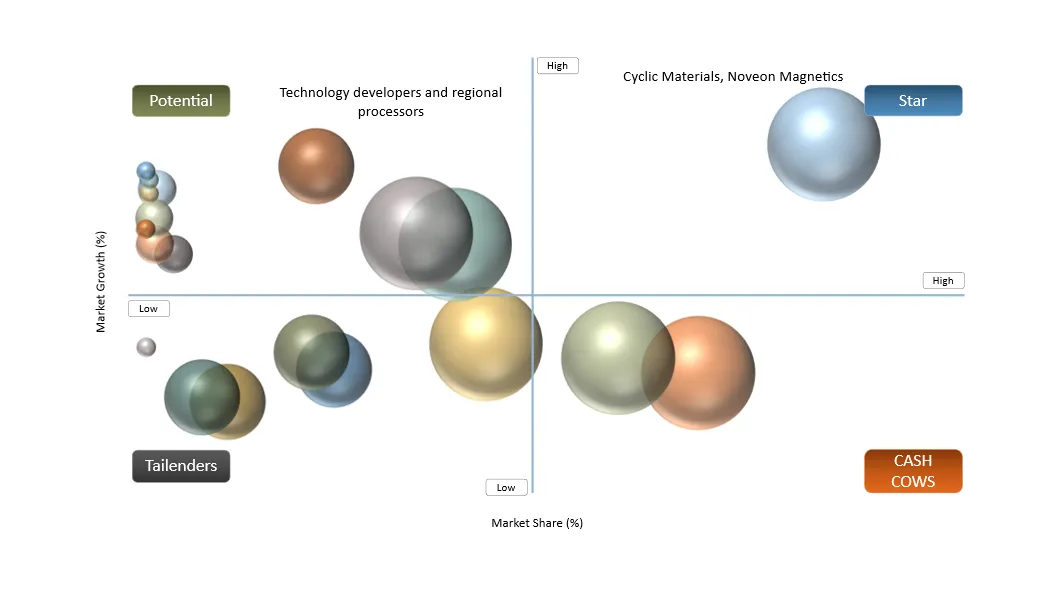
STAR
Cyclic Materials, Noveon Magnetics, HyProMag and leading integrated rare-earth processors are positioned as stars because they combine differentiated technology, commercial capacity, feedstock partnerships and clear routes to qualified output. Their growth depends on executing planned facilities and converting announcements into reliable throughput.
POTENTIAL
Technology developers and regional processors with selective leaching, electrochemical separation, automated disassembly or specialized samarium-cobalt capabilities occupy the potential category. They can grow rapidly if they secure feedstock and offtake, but face qualification and financing risk.
Permanent Magnet Recycling Services Market Dynamics
Driver Impact Analysis
| Driver | Growth Impact | Demand Concentration | Impacted Use Case | Strategic Impact |
| Rare-earth supply security | 27% | North America, Europe, Japan | Closed-loop magnet supply | Supports domestic recovery and long-term contracts |
| EV, wind and automation growth | 23% | Global | Traction motors and generators | Expands future magnet-bearing feedstock |
| Recycled-content and traceability rules | 20% | Europe | Product passports and reporting | Creates compliance-linked service revenue |
| Commercial recycling technology | 16% | North America and Europe | Direct and chemical recycling | Improves yield and output quality |
Driver: Rising Demand for Secure and Circular Rare-Earth Supply
Permanent magnets are central to efficient electric motors, wind generators, robotics, medical devices and defense systems. Supply is concentrated across mining, separation, alloy and magnet manufacturing, creating exposure to policy changes and export restrictions. Recycling services provide a domestic or regional feedstock source and can shorten lead times when coupled with local alloy and magnet capacity. The commercial value is strongest when the recovered material is contracted back into a defined product chain.
Regulation reinforces demand. The EU Critical Raw Materials Act establishes permanent-magnet labelling and data requirements and requires public disclosure of recycled content for covered products after implementing rules take effect. In 2026, EU recovery-potential guidance explicitly included magnets in electronics, vehicles and wind turbines. These measures improve product visibility, encourage design for removal and make it easier to aggregate feedstock.
Restraint Impact Analysis
| Restraint | Drag on Growth | Primary Impact Area | Impacted Use Case | Strategic Impact |
| Fragmented collection and low magnet accessibility | 22% | Feedstock logistics | End-of-life products | Raises unit recovery cost |
| Chemistry variability and contamination | 18% | Output qualification | Mixed assemblies | Limits direct recycling |
| High capital and scale-up risk | 15% | Processing capacity | Commercial plants | Delays investment decisions |
| Volatile rare-earth prices | 12% | Project economics | Metal-value contracts | Creates margin uncertainty |
Restraint: Fragmented Feedstock Collection and Difficult Magnet Extraction
Magnets are frequently small relative to the host product and are attached by adhesives, press fits, coatings or complex assemblies. Manual extraction can cost more than the contained material value, particularly for low-grade products. Collection is also fragmented across repair shops, dismantlers, recyclers and owners with different handling systems. These factors restrict throughput and make automated pre-processing a strategic priority.
Chemistry uncertainty adds cost. Mixed neodymium-iron-boron grades may contain different levels of dysprosium, terbium, cobalt, aluminum and other elements. Ferrite or alnico contamination can make direct recycling unsuitable. Providers therefore need product databases, analytical screening and routing rules that separate reusable, short-loop and long-loop feedstock.
Permanent Magnet Recycling Services Market Segment Analysis
The global market is segmented by service type, magnet type, recycling route, source industry, feedstock type, output form, customer type and region. One leading or strategically important subsegment is discussed under each category in line with the report-description format.
By Service Type
Recycling and Material Recovery Will Lead Value Creation
Recycling and material recovery represents the largest service category because it captures the central processing step that converts prepared magnet feedstock into commercially useful powder, alloy, oxide or metal. Revenue includes direct-recycling treatment, chemical recovery, separation, refining and associated quality control. Growth is supported by new commercial facilities and by OEM demand for verified secondary material. Collection and dismantling remain essential, but they are often bundled into a broader processing contract.
By Magnet Type
Neodymium-Iron-Boron Will Dominate Revenue
NdFeB magnets dominate because they offer high magnetic performance and contain valuable neodymium and praseodymium, with some grades also containing dysprosium or terbium. Their use in traction motors, wind generators, industrial drives, speakers and electronics creates multiple feedstock streams. The combination of material value, supply risk and rapid demand growth makes NdFeB the main target for both direct recycling and rare-earth recovery.
By Recycling Route
Direct and Short-Loop Recycling Will Grow the Fastest
Direct recycling preserves alloy value by recovering magnet material as powder, alloy or remanufactured magnet rather than returning every element to a separated oxide. It can reduce process steps and energy demand when feedstock chemistry is controlled. Growth will be strongest in production scrap and segregated end-of-life magnets. Hydrometallurgical routes will remain essential for mixed or contaminated material and for producing standardized oxide outputs.
By Source Industry
Automotive and E-Mobility Will Become the Largest Source Opportunity
Electric and hybrid vehicles use permanent magnets in traction motors, auxiliary motors, sensors and actuators. Manufacturing scrap creates near-term feedstock, while vehicle retirement will expand end-of-life availability later in the forecast period. Automotive programs can support closed-loop contracts because OEMs have large, traceable fleets and strong recycled-content objectives. The challenge is efficient motor removal and magnet extraction.
By Feedstock Type
Manufacturing Scrap Will Retain the Largest Share
Grinding swarf, off-cuts, rejected magnets and production residues provide concentrated material with known chemistry. These streams are easier to collect and qualify than end-of-life products, supporting higher recovery yields and lower processing cost. Long-term contracts with magnet plants and motor manufacturers are therefore central to early commercial facilities. End-of-life components will grow faster as collection systems mature.
By Output Form
Magnet Alloy and Powder Will Gain Strategic Importance
Recovered alloy and powder support short-loop remanufacturing and can retain more embedded value than mixed oxide. Customers require tight control of oxygen, carbon, particle size and alloy composition. Providers that can deliver repeatable powder and support magnet qualification can earn higher margins, while mixed rare-earth oxide remains an important outlet for heterogeneous feedstock.
By Customer Type
Magnet Manufacturers Will Be the Core Offtake Customer
Magnet manufacturers convert recycled output into qualified products and therefore determine whether secondary material can re-enter high-performance applications. Their acceptance criteria shape feedstock segregation, processing and laboratory controls. Partnerships or joint ventures with magnet producers reduce offtake risk and give recyclers direct feedback on composition and performance.
Permanent Magnet Recycling Services Market Geographical Penetration
U.S. Permanent Magnet Recycling Services Market Landscape
The U.S. is a high-growth market because critical-minerals policy, defense demand, domestic magnet manufacturing and commercial recycling investment are expanding together. DOE funding supports rare-earth recovery and magnet production, while companies are building collection, separation and processing capacity. Cyclic Materials announced facilities in Arizona and South Carolina, and Noveon operates a magnet-to-magnet platform in Texas. The market opportunity includes production scrap, hard drives, industrial motors, appliances, vehicles and defense systems.
Germany Permanent Magnet Recycling Services Market Outlook
Germany combines a large automotive and industrial-motor base with strong EU circularity regulation. It is a logical market for production-scrap recycling, traction-motor recovery, wind-generator processing and short-loop technologies. The EU CRMA will improve visibility of magnet type and recycled content, while Germany’s manufacturing ecosystem can provide both feedstock and qualified offtake. HyProMag’s German activities and European magnet investments strengthen the regional platform.
China Permanent Magnet Recycling Services Market Trends
China remains the largest magnet-manufacturing and processing base, generating substantial production scrap and benefiting from established separation and metal-processing infrastructure. Domestic recycling is important for resource efficiency and supply security. The market is competitive and integrated, but international customers may seek alternative regional supply chains because of geopolitical concentration.
Japan Permanent Magnet Recycling Services Market Opportunity
Japan has advanced magnet, electronics, automotive and appliance industries and a long history of resource-efficiency initiatives. Feedstock includes motors, hard drives, air conditioners and industrial equipment. High quality requirements favor specialized recovery and close integration with materials producers. Japanese companies also possess refining and recycling capabilities that can support overseas partnerships.
Canada Permanent Magnet Recycling Services Market Outlook
Canada is emerging as a North American hub for rare-earth recycling technology and processing. Cyclic Materials is developing a Kingston centre of excellence and has secured partnerships across the magnet value chain. The country benefits from critical-minerals policy, engineering capability and proximity to U.S. automotive and electronics markets.
United Kingdom Permanent Magnet Recycling Services Market Trends
The UK is a leading location for hydrogen processing of magnet scrap and short-loop recycling research. HyProMag is commercializing technology developed from University of Birmingham work, with applications across motors, speakers and hard drives. The opportunity depends on feedstock partnerships, commercial ramp-up and integration with magnet manufacturing.
France and Benelux Market Outlook
France, Belgium and the Netherlands combine chemical-separation capability, automotive and electronics activity, major ports and European waste-management networks. Solvay’s rare-earth separation capabilities and regional circularity policy support development of integrated oxide and magnet supply chains.
India Permanent Magnet Recycling Services Market Trends
India’s expanding electric-mobility, appliance, electronics and motor industries create future demand for domestic magnet recycling. Near-term opportunities are concentrated in manufacturing scrap, e-waste sorting and imported equipment. Growth requires specialized dismantling, quality control and downstream magnet or alloy capacity.
Australia Market Opportunity
Australia’s critical-minerals strategy and mining expertise create opportunities to combine primary and secondary rare-earth supply. The domestic end-of-life magnet pool is smaller than in major manufacturing regions, so projects may focus on technology development, specialized feedstock and integration with regional processing.
Brazil Market Opportunity
Brazil offers long-term potential from wind energy, automotive production, industrial motors and appliances. Collection and processing infrastructure for high-value magnets remains limited, creating an opportunity for partnerships with existing metals and e-waste recyclers.
Middle East and Africa Market Outlook
The region is at an early stage. Opportunities are linked to industrial motors, defense equipment, appliances, wind projects and electronics. UAE and Saudi Arabia may support strategic-material investment, while South Africa offers mining and metallurgical expertise. Commercial scale will depend on aggregation and regional hubs.
Feedstock access, operating reliability and customer qualification will determine the pace of consolidation. Strategic buyers may acquire specialist dismantling, chemistry or traceability capabilities rather than build them internally. Partnerships between waste-management groups and magnet manufacturers are likely to increase because each side contributes a capability the other lacks. This creates a competitive environment in which commercial alliances can matter as much as owned processing technology.
Permanent Magnet Recycling Services Market Competitive Landscape
- Competition is shifting from isolated recovery technologies toward integrated platforms combining feedstock access, extraction, processing, qualification and offtake.
- Commercial credibility depends on operating capacity, contracted feedstock and customer-approved output rather than laboratory recovery rates alone.
- Hub-and-spoke operators compete with direct magnet-to-magnet producers, integrated chemical refiners, electronics recyclers and magnet manufacturers developing internal loops.
- Partnerships are central because no single company controls enough end-of-life products, disassembly capability, separation technology and magnet qualification across all regions.
- Providers differentiate through lower energy use, reduced reagent demand, recovery of heavy rare earths, automated pre-processing, traceability and ability to process complex assemblies.
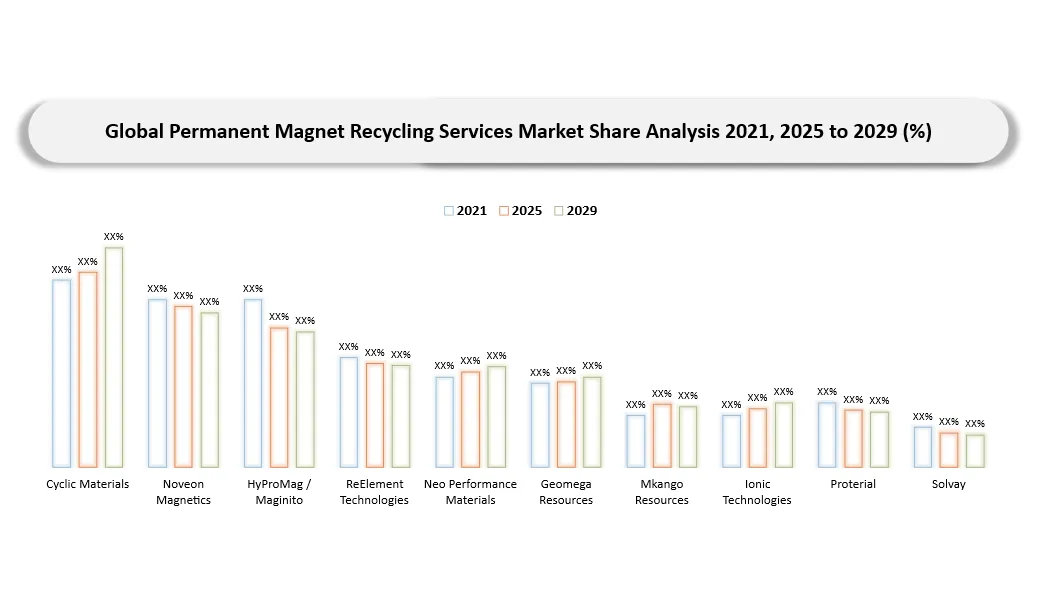
Key Companies of Permanent Magnet Recycling Services Market
- Cyclic Materials
- Noveon Magnetics
- HyProMag / Maginito
- ReElement Technologies
- Solvay
- Neo Performance Materials
- Geomega Resources
- Heraeus Remloy
- Less Common Metals
- Mkango Resources
- Momentum Technologies
- Ionic Technologies
- Carester
- Proterial
- Mitsubishi Materials
- DOWA Holdings
- Umicore
- Veolia
- VACUUMSCHMELZE
- Bunting Magnetics
Selected Company Profile Analysis
Cyclic Materials
Cyclic Materials is developing a hub-and-spoke rare-earth recycling network using MagCycle separation and REEPure recovery. Its announced facilities in Arizona, Ontario and South Carolina target magnet-bearing end-of-life components, production scrap and mixed rare-earth oxide output. Strategic strengths include feedstock processing, chemical recovery, partnerships with magnet producers and large-scale North American investment.
Noveon Magnetics
Noveon operates a magnet-to-magnet model that uses production scrap and end-of-life magnetic material to manufacture high-performance magnets. The company has announced a closed-loop initiative with LG Electronics and Kangwon Energy and a five-year offtake agreement with Nidec for more than 1,000 tonnes of finished magnets. Its position combines recycling, magnet manufacturing and domestic U.S. supply.
HyProMag / Maginito
HyProMag commercializes hydrogen processing of magnet scrap, which extracts and demagnetizes NdFeB alloy powder from magnets embedded in products. Activities are being developed in the UK, Germany and the U.S. The short-loop model targets hard drives, speakers, motors and other assemblies and can feed new magnet production.
Solvay
Solvay provides rare-earth separation and refining capability in Europe and has entered supply and offtake relationships that connect recycled mixed rare-earth material with magnet production. Its chemical expertise and European footprint make it an important partner for long-loop recycling.
Neo Performance Materials
Neo produces specialty chemicals, magnetic alloys and magnets. Its European manufacturing platform creates a potential downstream outlet for recycled rare-earth materials. The 2026 MOU with Cyclic Materials targets a trans-Atlantic circular supply chain.
Geomega Resources
Geomega has developed hydrometallurgical rare-earth recycling technology and focuses on recovering valuable elements from magnet waste. Its opportunity lies in modular processing and North American supply-chain development.
Heraeus Remloy
Heraeus Remloy focuses on recycling rare-earth magnets and providing recycled magnetic material. The company benefits from Heraeus materials expertise and relationships with European manufacturers.
Momentum Technologies
Momentum Technologies commercializes rare-earth recovery technology associated with Oak Ridge National Laboratory. The platform targets magnet-containing waste such as hard drives and can support domestic U.S. material recovery.
Ionic Technologies
Ionic Technologies develops hydrometallurgical separation and refining processes for magnet recycling. Its relevance is strongest where mixed feedstock requires recovery to high-purity oxides rather than direct alloy reuse.
Veolia
Veolia participates through e-waste collection, dismantling and resource recovery. Its scale in waste logistics can support feedstock aggregation and partnerships with specialized magnet processors.
Permanent Magnet Recycling Services Market Major Pain Points
- Low recovery rates for magnets embedded in complex products.
- Limited product-level information about magnet location, type and chemistry.
- High labor cost for manual dismantling and safe extraction.
- Chemistry variability that limits direct recycling and complicates qualification.
- Difficulty securing enough feedstock before building commercial capacity.
- Rare-earth price volatility that changes the value of recovered material.
- Long customer qualification cycles for high-performance magnets.
- Environmental permitting, wastewater and residue-management requirements.
- Insufficient downstream alloy or magnet capacity in some regions.
- Competition between reuse, remanufacture, recycling and export routes for the same feedstock.
Permanent Magnet Recycling Services Market Recent Developments
- January 2026: Cyclic Materials announced an investment of more than US$82 million for a South Carolina rare-earth recycling campus designed to process 2,000 tonnes of magnet material initially and produce 600 tonnes of recycled mixed rare-earth oxide per year, with planned expansion.
- March 2026: Neo Performance Materials and Cyclic Materials signed a non-binding MOU to develop a trans-Atlantic circular rare-earth supply chain connecting recycled material with Neo’s European alloy and magnet manufacturing.
- June 2025: Cyclic Materials announced a US$25 million centre of excellence in Kingston, Ontario, including a commercial hub designed to process 500 tonnes of magnet-rich feedstock annually into recycled mixed rare-earth oxide.
- April 2025: Cyclic Materials announced more than US$20 million for a Mesa, Arizona facility expected to process 25,000 tonnes of end-of-life components containing permanent magnets annually.
- January 2025: Noveon Magnetics, Kangwon Energy and LG Electronics announced a closed-loop initiative to recover magnets from end-of-life LG products and produce new high-performance magnets.
- February 2025: Nidec and Noveon announced a five-year binding offtake agreement with potential supply of more than 1,000 tonnes of finished sintered NdFeB magnets.
- October 2025: Cyclic Materials and VACUUMSCHMELZE signed a 10-year exclusive agreement to recycle magnet-production byproducts from VAC’s South Carolina facility.
- 2025: HyProMag USA advanced feedstock agreements, engineering and stockpiling activities for commercial deployment of hydrogen processing of magnet scrap.
Analyst View / Opinion on Permanent Magnet Recycling Services Market
- The market is transitioning from technology validation toward feedstock and offtake execution. Investors should test whether announced plants have secured both sides of the commercial equation.
- Production scrap will remain the most bankable feedstock in the near term, but end-of-life products will determine the long-term scale of the industry.
- Direct recycling can produce attractive economics for segregated NdFeB material, while long-loop chemical recovery will remain necessary for mixed and contaminated streams.
- Automated magnet extraction is one of the most important unresolved bottlenecks and could become a valuable standalone service.
- Regulation will improve traceability, but recycled-content requirements will only create value when customers can verify mass balance and qualify the output.
- Long-term leaders will integrate collection, processing, quality control and downstream magnet or alloy manufacturing through ownership, joint ventures or binding partnerships.
Permanent Magnet Recycling Services Market Target Audience
| Industry | Who Should Buy This Report? | Reason to Buy |
| Recycling Services | Recycling executives, plant managers, technology teams | Assess feedstock, route selection, capacity and competition |
| Magnet Manufacturing | Procurement, operations, R&D and strategy teams | Evaluate recycled alloy and oxide supply |
| Automotive and Motors | OEM procurement, sustainability and engineering teams | Develop closed-loop traction-motor programs |
| Wind Energy | OEMs, owners, repowering and decommissioning teams | Plan generator-magnet recovery |
| Electronics and E-Waste | Recyclers, data-center operators and device manufacturers | Capture hard-drive and speaker magnet value |
| Government and Defense | Policy, procurement and industrial-base teams | Assess domestic supply-chain resilience |
| Investors and Consultants | Private equity, venture capital, lenders and advisors | Evaluate scalable technologies and projects |
Why Choose DATAM?
- Data-Driven Insights: Granular market sizing, service segmentation, feedstock analysis, pricing structures and country-level opportunity assessment.
- Post-Purchase Support and Expert Analyst Consultations: Direct access to analysts for clarification, scenario development and custom cuts.
- White Papers and Case Studies: Follow-on analysis connected to customer strategy and technology priorities.
- Annual Updates on Purchased Reports: Refreshed policy, capacity, investment and company developments, subject to terms and conditions.
- Specialized Focus on Emerging Markets: Detailed evaluation of developing circular supply chains rather than broad regional generalization.
- Value of DataM Reports: Commercially actionable interpretation of technology, policy, feedstock and customer qualification.
What DATAM Uniquely Provides
- Detailed 10-year forecasts by service, magnet chemistry, recycling route, source industry, feedstock, output, customer and region.
- Commercial capacity tracking that distinguishes planned, funded, under-construction and operating facilities.
- Feedstock analysis covering production scrap, hard drives, speakers, motors, vehicles, wind turbines, appliances and specialized equipment.
- Assessment of direct recycling, hydrogen processing, hydrometallurgy, pyrometallurgy and hybrid routes.
- Competitive benchmarking of recyclers, refiners, magnet manufacturers and waste-management partners.
- Country-level strategy connecting policy, industrial base, feedstock density and downstream offtake.
Questions This Report Answers
- How large is the permanent magnet recycling services market and how fast will it grow through 2035?
- Which service, magnet, feedstock, route, source industry and output categories offer the strongest revenue potential?
- How will EU permanent-magnet labelling and recycled-content rules influence recycling demand?
- Which announced recycling facilities have the strongest feedstock and offtake foundations?
- Where do automated extraction, hydrogen processing and direct recycling create the greatest disruption?
- Which regions and countries offer the most attractive opportunities for new recycling capacity?


























































