


Parametric Insurance Market Overview
The global parametric insurance market is estimated at US$ 18.24 billion in 2025 and is expected to reach US$ 59.75 billion by 2035, expanding at a CAGR of 12.63% during 2026-2035. The market is moving from a specialist catastrophe-risk product toward a broader liquidity and revenue-protection platform. Adoption is being supported by climate volatility, increasing uninsured losses, higher deductibles in conventional insurance and the need for transparent payout rules. Parametric structures are gaining relevance where physical damage is difficult to assess quickly or where the main financial loss is lost revenue, emergency spending or business interruption.
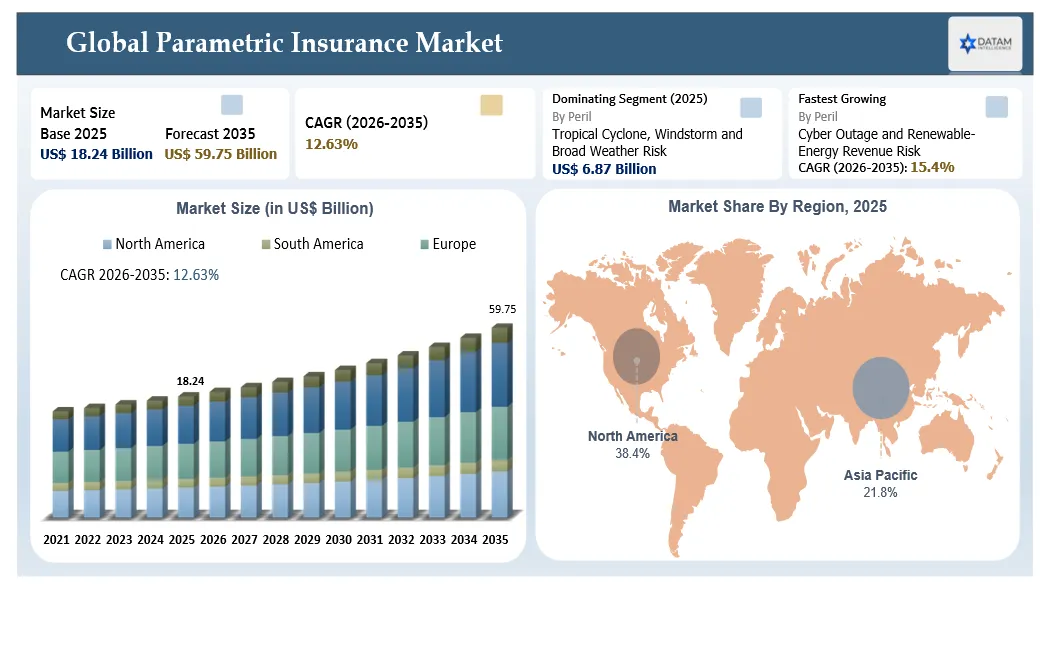
Swiss Re Institute reported US$ 220 billion in global economic losses from natural catastrophes during 2025, with US$ 107 billion insured across 190 events. Nearly half of economic losses were covered, which was a record share, but the uninsured portion remained substantial. The same research indicates that insured natural-catastrophe losses could reach US$ 186 billion by 2030 if the long-term real growth trend continues. These figures provide a strong demand signal for products that can add rapid liquidity and cover exposures excluded or underinsured by conventional policies.
The market is also diversifying beyond weather. Parametrix raised US$ 27 million in 2025 to expand parametric protection for cloud and digital-service outages. Adaptive Insurance raised US$ 5 million to develop AI-supported climate-risk products for U.S. businesses. Descartes Underwriting launched a sensor-supported flood-at-location solution for U.S. commercial customers. These developments show that investment is moving toward data infrastructure, event verification, automated underwriting and broker-distributed platforms.
| Metric | Details |
| 2025 Market Size | US$ 18.24 Billion |
| 2035 Projected Market Size | US$ 59.75 Billion |
| CAGR 2026-2035 | 12.63% |
| Largest Region | North America |
| Fastest Growing Region | Asia-Pacific |
| Largest Peril Segment | Tropical cyclone, windstorm and broad weather risk |
| Fastest Growing Peril Segment | Cyber outage and renewable-energy revenue risk |
| Largest Buyer Group | Large enterprises and governments |
| Fastest Growing Distribution Model | Digital platforms and embedded APIs |
Parametric Insurance Market Key Takeaways
- The market is estimated at US$ 18.24 billion in 2025 and is projected to reach US$ 59.75 billion by 2035, with a CAGR of 12.63% during 2026-2035.
- Natural catastrophes generated US$ 220 billion in economic losses and US$ 107 billion in insured losses during 2025, leaving a large liquidity gap for businesses, households and governments.
- North America is the largest regional market because of catastrophe exposure, sophisticated insurance buyers, advanced data infrastructure and strong broker and reinsurance capacity.
- Asia-Pacific is expected to grow fastest because agriculture, flood, typhoon and earthquake exposure remain high while conventional insurance penetration is uneven.
- Weather and catastrophe products remain the largest market layer, while cyber outage, renewable-energy generation and travel disruption are the fastest-growing emerging applications.
- Satellite imagery, IoT sensors, automated weather stations and cloud-service monitoring are improving trigger precision and expanding insurable use cases.
- Basis risk remains the central buyer concern because a trigger can miss a real loss or produce a payout that differs from actual financial damage.
- The strongest platforms combine underwriting capacity, independent data, model transparency, broker Distribution and automated policy administration.
Parametric Insurance Market Scope
| Scope Item | Coverage |
| By Peril | Windstorm, flood, drought, earthquake, wildfire, freeze, hail, cyber outage and other emerging risks |
| By Trigger Type | Meteorological, hydrological, seismic, satellite, sensor, revenue, production and technology availability |
| By Coverage Structure | Standalone policy, endorsement, portfolio cover, captive layer, sovereign facility and embedded cover |
| By End-Use Industry | Agriculture, energy, tourism, construction, manufacturing, real estate, finance and technology |
| By Buyer Type | Large enterprises, SMEs, farmers, governments, development institutions and consumers |
| By Distribution Model | Brokers, direct insurer sales, banks, affinity groups, digital platforms and government programs |
| By Region | North America, Europe, Asia-Pacific, South America, Middle East and Africa |
Why Does This Report Matter in 2026?
The report matters because insurance buyers are entering a period in which traditional capacity, affordability and claims structures are under pressure. Catastrophe-exposed property markets are seeing higher deductibles and tighter terms, while climate-sensitive industries need protection for revenue losses that may occur without physical damage. A hotel can lose occupancy because of a cyclone warning, a solar farm can miss revenue because of persistent cloud cover and a manufacturer can face downtime when a cloud provider fails. Parametric insurance can address these gaps through pre-agreed event metrics and payout schedules.
The report supports buyers in selecting triggers, setting payout ladders, evaluating basis risk and identifying suitable providers. It supports insurers and MGAs in prioritizing peril models, data partnerships and Distribution channels. It also supports investors assessing underwriting platforms, climate-data companies, sensor networks and policy-administration technology. The commercial opportunity is concentrated where buyers have measurable exposure, reliable event data and a clear need for liquidity within days rather than months.
Parametric Insurance Market White Space and Investment Opportunities
- SME flood and severe-weather cover distributed through banks, accounting platforms and commercial property ecosystems.
- Cyber outage products that trigger on cloud-service availability, payment-network disruption or defined system downtime.
- Renewable-energy revenue cover based on wind speed, solar irradiation, rainfall and hydrological inflow.
- Municipal and sovereign disaster-liquidity programs linked to cyclone, earthquake, rainfall or drought thresholds.
- Embedded travel, event and logistics protection delivered through booking platforms and supply-chain software.
- Multi-trigger policies combining hazard intensity, location exposure and revenue impact to reduce basis risk.
- Sensor and satellite infrastructure that provides independent, auditable and near-real-time trigger verification.
- Broker tools that allow buyers to model payout ladders and compare trigger performance against historical loss records.
Parametric Insurance Future Market Transformation
The market will move toward hybrid products that combine the speed of parametric settlement with the loss alignment of indemnity insurance. A policy may provide an immediate parametric payment for emergency liquidity and a later indemnity payment for verified physical damage. This structure can reduce buyer concern about basis risk while preserving the operational benefit of rapid settlement. Multi-trigger contracts will also become more common, using several weather stations, satellite-derived measures or a combination of hazard and revenue indicators.
Technology will transform product creation. AI will allow insurers to test trigger performance across historical events, estimate basis risk by location and price smaller policies efficiently. Satellite data and connected sensors will expand coverage into flood, wildfire, agriculture and infrastructure. APIs will allow event protection to be embedded in travel, lending, energy procurement and logistics platforms. The market will increasingly resemble a data and risk-orchestration ecosystem rather than a narrow insurance product category.
Parametric Insurance Market Buyer Decision-Making Criteria
Buyers evaluate parametric insurance based on trigger relevance, data independence, basis risk, payout certainty, premium, limit, waiting period and contract clarity. A trigger must be strongly correlated with the buyer’s financial loss. The data source must remain available during the event and should be independent of the insurer and policyholder. Payout ladders need to reflect the cost of business interruption, emergency response or revenue shortfall. Buyers also assess whether the policy complements conventional insurance, whether the trigger can be audited and whether the provider has sufficient underwriting and reinsurance capacity.
Procurement is often cross-functional. Risk managers focus on coverage design, finance teams focus on liquidity and return on insurance spending, operations teams focus on exposure and brokers focus on placement feasibility. Public-sector buyers also evaluate legal authority, budget treatment and donor alignment. Providers that translate model outputs into clear scenarios and historical back-testing will have a stronger sales position than providers that offer complex technical structures without buyer-ready explanation.
Parametric Insurance Market Economic and Investment Analysis
Investment is being directed toward underwriting platforms, catastrophe analytics, satellite data, connected sensors and automated policy administration. Parametrix raised US$ 27 million in 2025 to scale cyber and digital-service outage insurance, while Adaptive Insurance raised US$ 5 million for an AI-powered climate-resilience platform. These transactions illustrate investor interest in products that combine proprietary data, repeatable underwriting and digital Distribution. Capital is also flowing into catastrophe bonds and insurance-linked securities, which can supply capacity for indexed and event-based risk transfer.
The investment case is strongest where platforms can reuse models across many customers, maintain low claims-administration expense and distribute through brokers or embedded channels. Risks include adverse selection, inadequate trigger calibration, data-provider dependency and regulatory uncertainty. Companies with diversified peril exposure, strong reinsurance relationships and transparent basis-risk analysis will be more defensible than single-peril platforms with limited geographic scale.
Strategic Indicators for Parametric Insurance Market
High Regulation Impact
Policy wording, insurance licensing, consumer protection and public procurement rules influence product design. Regulators may require clear disclosure that payment depends on an index rather than actual loss.
High Investment Activity
Funding is moving into cyber parametrics, climate analytics, embedded Distribution and data infrastructure. Catastrophe-bond capacity also supports broader event-risk transfer.
Data Dependency
Product performance depends on reliable weather stations, satellite feeds, sensors, seismic networks and technology monitoring. Data gaps can prevent trigger verification.
Pricing Volatility
Premium is affected by catastrophe-model updates, reinsurance capacity, event frequency and geographic concentration. Buyers may face material repricing after major disasters.
Procurement Pressure
Commercial buyers want coverage that produces measurable liquidity and can be justified against uninsured loss, deductible exposure and business-interruption risk.
New Technology Adoption
AI, remote sensing, IoT and APIs are lowering policy design and administration costs while improving trigger precision.
Regional Expansion Opportunity
Emerging markets offer significant potential because agriculture and disaster protection gaps remain high, but affordability and Distribution require partnerships.
Public-Private Potential
Governments and development institutions can use pooled facilities and premium support to extend coverage to municipalities, farmers and vulnerable communities.
Parametric Insurance Market BCG Matrix: Company Evaluation
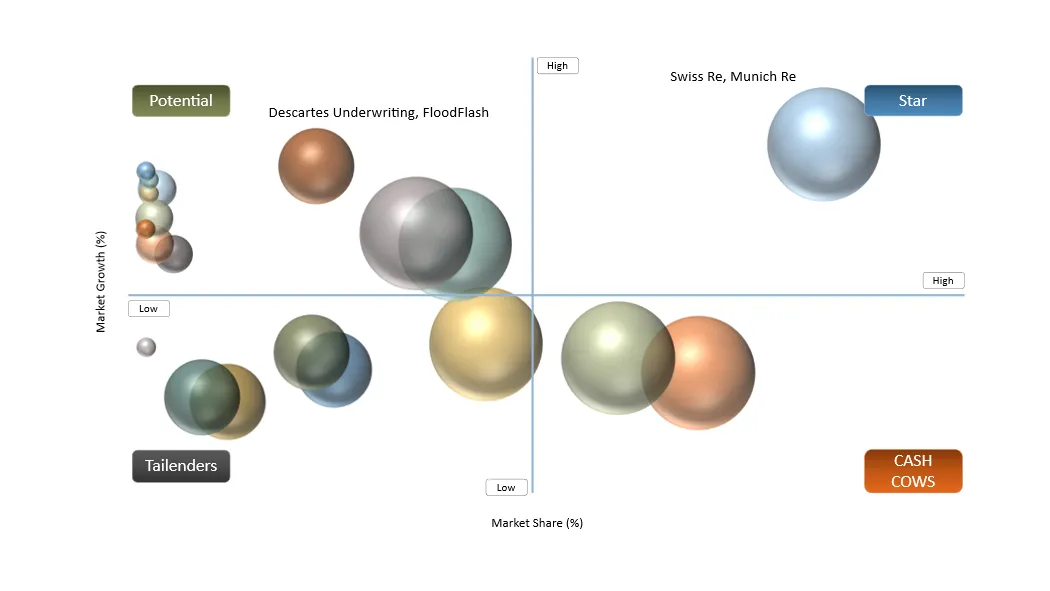
STAR
Swiss Re, Munich Re, AXA Climate, Marsh and Howden belong to the Star quadrant of the Parametric Insurance Market due to their strong presence in the market, robust parametric insurance offering and global Distribution networks. These firms provide diversified offerings in the areas of climate risks, catastrophes and business interruption coverages, while at the same time consistently developing their risk modeling and underwriting. Their existing clientele and innovation in parametric products have helped these companies sustain their leadership in the market.
POTENTIAL
Descartes Underwriting, FloodFlash, Arbol, CelsiusPro and Parametrix Insurance are placed in the Potential category owing to their innovative product offerings and increasing relevance in specialized parametric insurance uses. The companies are concentrating on the newer frontiers of cyber outage insurance, flood risk insurance, renewable energy insurance and automated payouts. The importance of technology-driven underwriting, real-time risk assessment and innovative insurance models will enable them to leverage the rising demand for fast and seamless risk transfer products. As market awareness and acceptance increases, the players will gain a competitive edge in the coming years.
Parametric Insurance Market Dynamics
Driver Impact Analysis
| Driver | Market Growth Impact | Demand Concentration | Impacted Use Case | Strategic Impact |
Widening climate and disaster protection gap | 27% | Global, coastal and catastrophe-exposed regions | Catastrophe, flood and public-sector liquidity | Creates demand for rapid event-based cover where traditional insurance is unavailable or expensive |
Need for rapid and transparent payouts | 23% | SMEs, governments, tourism and agriculture | Emergency liquidity and business interruption | Reduces claims friction and supports recovery spending |
Growth in independent data and remote sensing | 19% | Agriculture, flood, energy and infrastructure | Satellite and sensor triggers | Improves trigger verification and expands insurable locations |
Higher deductibles and coverage exclusions | 17% | Commercial property and catastrophe programs | Deductible buy-down and gap cover | Positions parametric insurance as a complementary layer |
Digital Distribution and embedded insurance | 14% | Travel, logistics, lending and platform ecosystems | Small-ticket event protection | Reduces acquisition cost and enables high-volume Distribution |
Driver: Widening Climate and Disaster Protection Gap
The widening protection gap is the strongest structural driver. Swiss Re Institute reported US$ 220 billion in economic losses from natural catastrophes in 2025, while insured losses reached US$ 107 billion across 190 events. The insured share improved, but more than half of the economic impact remained outside insurance. The institute also estimates that insured losses could rise to US$ 186 billion by 2030 if the long-term 5% to 7% real annual trend continues. This creates demand for additional layers of protection, especially where conventional property insurance is constrained by high deductibles, exclusions or limited capacity.
Parametric insurance is attractive because it can protect financial consequences that are difficult to document through conventional claims. A government may need cash for evacuation and emergency shelters before physical damage assessments are complete. A tourism business may lose revenue from a storm warning even if its property is not damaged. A farmer may suffer yield loss across many small plots that are costly to inspect. Trigger-based payment can address these needs when the event metric is correlated with the financial loss.
The strongest commercial opportunities are in regions where climate exposure is high and insurance penetration is low. Public-private pools, premium subsidies and development-finance support can improve affordability. For commercial buyers, parametric cover can sit above a retention, cover an excluded peril or provide a working-capital layer. Providers should focus on transparent trigger design, historical event back-testing and clear payout scenarios because buyer confidence is critical to adoption.
Driver: Demand for Rapid, Transparent and Pre-Agreed Liquidity
Conventional claims can require site inspection, documentation, adjustment and negotiation. Parametric products can provide payment after an independent data source confirms that the threshold has been reached. This is valuable when buyers need liquidity for repairs, payroll, temporary relocation or supply replacement. The benefit is operational certainty rather than speed alone. Finance teams can understand the payout schedule before the event and integrate the product into contingency planning.
The commercial value is especially high for SMEs, public bodies and industries with seasonal cash flow. FloodFlash has demonstrated sensor-based flood products that use water depth at the insured location. Descartes Underwriting introduced a customizable flood-at-location product for U.S. commercial customers in 2025, showing that the market is moving toward location-specific triggers supported by sensors and flood models. Such products can address areas where conventional flood cover is unavailable or carries large deductibles.
Rapid liquidity also supports lenders and investors. A renewable-energy project can use a parametric policy to protect debt-service capacity during low-resource periods. A hotel portfolio can protect cash flow during cyclone disruption. A municipality can secure funds for debris removal and emergency procurement. Providers that connect trigger design to a documented use of proceeds will improve the buyer’s internal business case and reduce the perception that parametric insurance is speculative.
Restraint Impact Analysis
| Restraint | Drag on Growth | Primary Impact Area | Impacted Use Case | Strategic Impact |
Basis risk and trigger mismatch | 25% | Product design and buyer trust | All parametric covers | Can produce no payout despite loss or payout without corresponding damage |
Limited data quality and geographic coverage | 19% | Emerging markets and localized perils | Agriculture, flood and wildfire | Restricts accurate trigger calibration and independent verification |
Buyer understanding and procurement complexity | 17% | SMEs and first-time buyers | Commercial and embedded products | Extends sales cycles and requires education |
Reinsurance capacity and concentration risk | 15% | Catastrophe portfolios | Windstorm, earthquake and flood | Can raise premium or limit available capacity |
Regulatory and accounting uncertainty | 11% | Consumer and public-sector products | Microinsurance and sovereign facilities | Can delay approvals and complicate budget treatment |
Restraint: Basis Risk and Trigger Design Complexity
Basis risk is the difference between the policy payout and the buyer’s actual financial loss. It is the central restraint because the product may fail to pay when damage occurs below the trigger threshold or because the measured index does not reflect conditions at the insured location. The opposite can also occur, where the trigger pays despite limited actual loss. Academic research published in 2025 continued to focus on payment schemes that minimize basis risk, which confirms that this issue remains central to product design.
Basis risk is influenced by station distance, spatial variability, model error, event timing, asset characteristics and the shape of the payout ladder. Rainfall measured at a regional station may not represent a farm’s actual rainfall. Wind speed at a reference point may differ from wind at a hotel site. A cloud outage metric may not capture the customer’s specific service architecture. The problem becomes more significant when triggers are simplified to reduce cost.
Providers can reduce basis risk through location-specific sensors, gridded satellite products, multiple trigger points and hybrid coverage. Historical back-testing should show how the proposed structure would have performed during past events. Buyers should receive examples of false negatives, false positives and partial payouts. The market will grow more sustainably when providers disclose basis risk clearly and design policies as complements to indemnity insurance rather than substitutes for every loss scenario.
Restraint: Limited Data Quality and Buyer Understanding
Parametric insurance requires reliable and independent data throughout the policy period. Weather stations can be sparse or poorly maintained, river gauges can fail during floods and satellite data can be affected by cloud cover or resolution limits. In cyber insurance, the trigger may depend on external monitoring of service availability, which must distinguish a provider-wide outage from a customer-specific incident. Data contracts, backup sources and dispute protocols therefore become part of the insurance product.
Buyer understanding is another barrier. Many procurement teams are familiar with indemnity cover and expect payment to correspond directly to documented damage. Parametric policies require buyers to evaluate probability, trigger correlation and payout schedules. A product that appears simple can involve complex modelling. Brokers and providers must explain how the trigger works, what data source is used, when payment occurs and what losses remain uncovered.
Sales cycles can be shortened through standardized products for common use cases, digital quotation tools and clear scenario analysis. The greatest adoption opportunity lies in products where the trigger is intuitive, such as flood depth, rainfall deficit, flight delay or cloud outage. Complex catastrophe structures will continue to require specialist brokers and risk-management support. Providers that invest in buyer education and transparent documentation will convert more opportunities than firms relying on technical sophistication alone.
Parametric Insurance Market Segment Analysis
By Peril: Tropical Cyclone and Windstorm Remain the Largest Segment
Tropical cyclone and windstorm cover remains the largest peril segment because storms can create correlated losses across property, tourism, utilities, ports and public infrastructure. Wind speed, central pressure and storm-track proximity are common trigger variables. The segment benefits from mature catastrophe models, global satellite observation and established reinsurance capacity. Buyers use parametric cover to protect deductibles, non-damage business interruption, emergency spending and revenue loss. The 2025 Los Angeles wildfires showed that secondary perils can also generate extreme losses, with Swiss Re estimating US$ 40 billion in insured losses from that event, but tropical cyclone programs remain the most established large-ticket parametric structures. Growth will come from multi-location portfolios, public-sector facilities and products that combine storm intensity with geographic exposure. Providers need to manage concentration across coastlines and hurricane seasons. Pricing depends on location, attachment threshold, payout limit, historical frequency and reinsurance cost.
By Peril: Flood and Excess Rainfall Are Moving Toward Location-Specific Coverage
Flood and excess-rainfall products are expanding because conventional flood coverage is limited in many markets and post-event loss assessment can be difficult. Trigger options include river gauge height, rainfall accumulation, modeled flood depth and sensor-measured water level at the insured property. Descartes Underwriting launched a flood-at-location solution for U.S. commercial customers in 2025, supported by flood modelling and sensors. FloodFlash has demonstrated the use of installed water sensors to automate event verification. The segment is attractive for commercial property, healthcare, hospitality, municipal infrastructure and SMEs. Its challenge is high spatial variability. A nearby gauge may not reflect actual water depth at the insured site. Location-specific sensors can reduce basis risk but add hardware, maintenance and connectivity requirements. Growth will be strongest where insurers are withdrawing from high-risk zones or applying large deductibles. Partnerships with banks, property managers and municipal programs can improve Distribution.
By Peril: Drought and Heat Drive Agriculture and Energy Demand
Drought and heat products are central to agriculture-index insurance and are increasingly relevant to hydropower, power demand, tourism and industrial operations. Triggers include cumulative rainfall deficit, soil moisture, vegetation indices, temperature days and reservoir levels. Agriculture programs can cover large numbers of small farms without individual loss adjustment, which reduces administration cost. Development institutions and governments often support premium or Distribution. Basis risk remains significant because crop outcomes depend on planting date, seed variety, soil condition and farm practices as well as rainfall. Heat products can also protect energy retailers from demand spikes or renewable projects from resource volatility. The segment will benefit from higher-resolution satellite data and farm-management integration. Commercial success depends on simple products, trusted local Distribution and payout schedules aligned with input costs or seasonal cash flow.
By Trigger Type: Satellite and Remote-Sensing Indices Are the Fastest-Growing Data Layer
Satellite and remote-sensing indices are gaining share because they can provide consistent coverage across regions with limited ground infrastructure. Applications include rainfall estimation, vegetation health, soil moisture, flood extent, wildfire perimeter and crop condition. Satellite data can reduce dependence on individual weather stations and support portfolio-scale underwriting. The strongest opportunity is in agriculture, flood, wildfire and public-sector disaster programs. Providers must manage resolution, revisit frequency, cloud interference and model validation. Buyers also need confidence that the data source will remain available and that the calculation method will not change during the policy. Partnerships between insurers, geospatial companies and analytics platforms are becoming a competitive advantage. As data costs decline, smaller policies and emerging-market programs will become more economical.
By Coverage Structure: Standalone Policies Lead, Hybrid Structures Gain Preference
Standalone parametric policies remain the largest structure because they provide a clear limit and trigger for a defined peril. They are common in sovereign programs, agriculture, renewable energy and catastrophe-exposed commercial portfolios. Hybrid structures are gaining preference because they combine an immediate trigger-based payment with later indemnity settlement. This design can provide working capital while reducing the buyer’s concern that a trigger will not match the final loss. Parametric endorsements can also be attached to property, travel or cyber policies. Captives use parametric reinsurance to transfer peak exposure while retaining smaller losses. Portfolio and aggregate covers are attractive for multi-site businesses because they can use several event locations or annual cumulative thresholds. Product innovation will focus on layered payout schedules and multiple triggers rather than binary payment.
By End-Use Industry: Agriculture Remains the Largest Volume Opportunity
Agriculture is the largest volume opportunity because weather risk affects yield, input recovery and farmer income across large populations. Index-based insurance can be distributed through banks, cooperatives, seed companies and mobile platforms. It avoids field-level loss adjustment, which is important where farms are small and dispersed. Products can cover rainfall deficit, excess rain, temperature, vegetation condition or area yield. Public support is often needed because smallholder premiums are limited. Pula, Oko and other specialist platforms have demonstrated scalable models that combine underwriting, farmer registration and mobile payments. The opportunity is strongest where insurance is linked to credit or inputs, because payout protects both the farmer and the lender. Providers must invest in local agronomy, farmer education and complaint handling to maintain trust.
By End-Use Industry: Energy and Utilities Create High-Value Revenue Protection
Energy and utilities are a high-value segment because revenue can depend on weather and system availability. Wind farms can face low-wind periods, solar projects can face reduced irradiation and hydropower plants can face low rainfall or reservoir inflow. Utilities can also experience heat-driven demand, freeze events or storm disruption. Parametric products can stabilize cash flow, support debt service and complement business-interruption cover. Triggers can be based on measured resource levels, production indices or weather variables across a defined period. The segment requires careful calibration because asset performance also depends on equipment availability and operating efficiency. Products will increasingly combine weather indices with production data. Renewable-energy investors and lenders are likely to support adoption where coverage improves revenue predictability.
By End-Use Industry: Technology Outage Is an Emerging Premium Pool
Technology outage parametrics protect against defined service unavailability rather than physical damage. Parametrix raised US$ 27 million in 2025 to expand products for cloud, data and digital-service interruption. Triggers can use independent monitoring of cloud regions, payment networks, software platforms or telecommunications availability. The product can provide rapid payment for lost revenue, service credits, incident response and customer compensation. Demand is increasing because many businesses depend on third-party technology providers that are difficult to control. Conventional cyber policies may have waiting periods, exclusions or complex causation requirements. Parametric cover can provide a separate, transparent layer. The main design challenge is defining the affected service, outage duration, geographic scope and proof source. Growth will be strongest among e-commerce, fintech, travel and software-dependent companies.
By Buyer Type: Governments and Municipalities Need Pre-Arranged Disaster Liquidity
Governments and municipalities use parametric insurance to secure funds before disasters occur. Regional facilities such as the Caribbean Catastrophe Risk Insurance Facility and African Risk Capacity demonstrate how pooled programs can provide rapid budget support after hurricanes, earthquakes, droughts and floods. Sovereign buyers value payment certainty and the ability to finance emergency response without waiting for external aid. Premium affordability, donor support and legal authority are important procurement factors. Municipal products are emerging for flood, wildfire and infrastructure disruption. Trigger design must align with emergency spending needs and geographic exposure. Public buyers also require transparent governance, independent verification and clear use-of-proceeds planning. The market opportunity includes state governments, cities, utilities and public transport systems.
By Distribution Model: Brokers Remain Central, Embedded APIs Expand Reach
Brokers and reinsurance intermediaries remain central for complex commercial and sovereign placements because they help buyers quantify exposure, negotiate capacity and compare structures. Direct MGA sales are growing for standardized commercial products. Banks, cooperatives and affinity groups are important for agriculture and SME Distribution. Embedded APIs are the fastest-growing channel because event protection can be offered within travel booking, logistics, energy procurement or lending workflows. Embedded products reduce acquisition cost and can use transaction data to configure the policy automatically. Consumer protection and disclosure are critical because customers must understand that payment depends on a specific event metric. The strongest platforms will offer modular APIs, real-time data and automated settlement while retaining licensed underwriting capacity.
By Technology Platform: AI-Based Underwriting Improves Trigger Calibration
AI is being used to analyze historical events, simulate payout performance and identify combinations of triggers that reduce basis risk. It can process satellite imagery, weather data, claims history and asset information at scale. AI also supports portfolio aggregation, pricing and fraud monitoring. Adaptive Insurance raised US$ 5 million in 2025 to develop an AI-powered climate-resilience platform, highlighting investment interest in this capability. The value of AI depends on data quality and model governance. Buyers and regulators need explanation of trigger logic and confidence that models will not change after policy inception. The most valuable use cases are automated quotation for SMEs, multi-location portfolio design and near-real-time event validation. Human underwriting remains important for complex exposures and public-sector programs.
By Business Model: MGA and Platform Models Are Attracting Capital
MGAs and technology platforms can develop products, access reinsurance capacity and distribute through brokers without carrying the full balance-sheet burden of a traditional insurer. This model supports faster product launches and specialized peril expertise. Revenue comes from underwriting fees, commissions, data services and profit participation. Investors favor platforms with proprietary data, repeatable product templates and strong capacity relationships. The model also carries dependency risk because capacity providers can change appetite or terms. Platforms need diversified insurer and reinsurer partners, disciplined portfolio management and transparent loss performance. As the market matures, some platforms may seek carrier licenses or deeper balance-sheet partnerships to control product economics.
Parametric Insurance Market Geographical Penetration
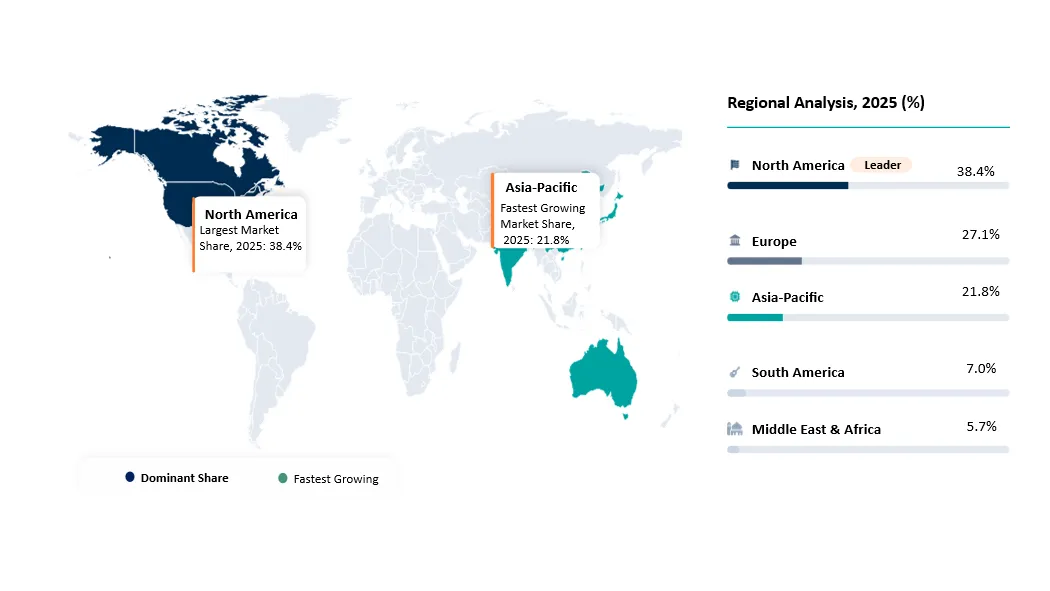
| Region | 2025 Share | Market Position | Primary Opportunity |
| North America | 38.4% | Largest market | Commercial catastrophe, cyber outage, flood and municipal liquidity |
| Europe | 27.1% | Mature innovation market | Climate adaptation, renewable energy and embedded travel |
| Asia-Pacific | 21.8% | Fastest growing | Agriculture, typhoon, earthquake, flood and SME protection |
| South America | 7.0% | Emerging growth market | Agriculture, drought, flood and renewable energy |
| Middle East and Africa | 5.7% | High protection-gap opportunity | Drought, agriculture, sovereign risk and infrastructure |
North America Parametric Insurance Market Outlook
North America leads because the region combines high catastrophe exposure, advanced insurance markets, sophisticated corporate buyers and strong data infrastructure. The U.S. market is expanding across hurricane, wildfire, flood, severe convective storm and cyber outage. Swiss Re reported that 2025 natural catastrophes generated US$ 107 billion in global insured losses, with record wildfire losses from Los Angeles contributing materially. Commercial buyers use parametric cover to fill deductibles, protect non-damage interruption and secure rapid liquidity. Canada offers opportunities in wildfire, flood, agriculture and freeze. Mexico has demand for hurricane, earthquake, agriculture and tourism cover. Distribution is led by brokers, MGAs and insurers, while embedded platforms are gaining relevance for SMEs. The region will remain the largest market because underwriting capacity and buyer budgets are deeper than in most other regions.
Europe Parametric Insurance Market Outlook
Europe is a mature market for climate risk, renewable energy, agriculture and travel disruption. The UK has a strong parametric ecosystem, including FloodFlash and specialist brokers. France is important through AXA Climate and Descartes Underwriting. Switzerland and Germany contribute reinsurance, catastrophe modelling and industrial demand. Southern Europe has growing exposure to heat, drought, wildfire and flood, creating opportunities for agriculture, tourism and municipal products. European buyers focus on model transparency, data privacy and sustainability. Renewable-energy projects use weather derivatives and parametric structures to stabilize production revenue. Embedded travel protection is also expanding through digital platforms. Growth will be supported by climate-adaptation spending and higher demand for business-interruption protection.
Asia-Pacific Parametric Insurance Market Outlook
Asia-Pacific is expected to grow fastest because typhoon, flood, earthquake and agriculture exposure are high while insurance penetration remains uneven. Japan and Australia have developed insurance markets and strong catastrophe-data infrastructure. India, Indonesia, the Philippines and Vietnam offer large opportunities for agriculture, flood and microinsurance distributed through banks, cooperatives and digital platforms. China has significant agriculture and catastrophe exposure but product expansion depends on regulatory partnerships. Public-sector and development-finance programs will remain important. Satellite data can support coverage where weather-station density is limited. The region’s commercial opportunity includes ports, tourism, renewable energy and supply chains. Providers need local Distribution , regulatory approval and products that match affordability constraints.
South America's Parametric Insurance Market Outlook
South America offers growth in agriculture, drought, flood, renewable energy and mining. Brazil is the largest opportunity because of its agriculture scale, hydropower exposure and commercial insurance market. Argentina has demand for drought and crop-yield protection. Chile has earthquake, drought, mining and renewable-energy exposure. Colombia has flood, agriculture and infrastructure needs. Parametric products can complement crop insurance and provide working capital after events. Distribution through banks, agribusiness companies and cooperatives is important. Currency volatility and premium affordability can affect uptake. Local weather data and agronomic calibration are essential because basis risk can undermine farmer trust. Public-private programs and reinsurance partnerships can accelerate scale.
Middle East and Africa Parametric Insurance Market Outlook
Middle East and Africa have some of the largest protection gaps and strong need for drought, agriculture and sovereign disaster finance. African Risk Capacity has demonstrated pooled parametric risk transfer for governments. Kenya, Morocco, Nigeria and South Africa offer agriculture and weather opportunities, while Gulf countries can use parametric cover for heat, rainfall, renewable energy, construction and event cancellation. The region requires partnerships with governments, development institutions, mobile platforms and local insurers. Satellite data is valuable where ground networks are limited. Premium support may be required for smallholder and public-sector programs. Commercial products can expand in tourism, energy and infrastructure. The opportunity is significant, but providers need patient capital, local trust and transparent payout mechanisms.
Country Opportunity Matrix
| Country | Priority Opportunity | Buyer Intent |
| U.S. | Cyber outage, wildfire, flood, hurricane and SME weather cover | Buyers seek deductible protection, rapid liquidity and non-damage interruption cover |
| UK | Flood, renewable energy, agriculture and embedded travel | Strong broker ecosystem and acceptance of sensor-based products |
| France | Climate risk, agriculture and corporate weather protection | Demand supported by specialist underwriting and climate analytics |
| India | Agriculture, rainfall, flood and heat products | Scale depends on banks, government programs and mobile Distribution |
| Japan | Earthquake, typhoon and corporate supply-chain risk | High data quality supports sophisticated triggers |
| Australia | Drought, wildfire, flood and renewable energy | Commercial and agriculture buyers need revenue protection |
| Brazil | Agriculture, drought, hydropower and flood | Opportunity tied to agribusiness and bank Distribution |
| Kenya | Smallholder agriculture and drought | Partnerships with cooperatives, mobile payments and development institutions are critical |
| UAE | Heat, rainfall, construction and event protection | Corporate and public-sector buyers value balance-sheet certainty |
| Mexico | Hurricane, earthquake, tourism and agriculture | Strong opportunity for sovereign, hotel and regional commercial programs |
Parametric Insurance Market Competitive Landscape
- Competition is moving from bespoke catastrophe transactions toward repeatable product platforms for flood, agriculture, cyber outage, renewable energy and travel disruption.
- Global reinsurers compete through balance-sheet capacity, catastrophe models and sovereign relationships, while MGAs compete through speed, data partnerships and specialized Distribution.
- Data quality is becoming a competitive moat. Companies with exclusive sensor networks, geospatial analytics or service-availability monitoring can design more precise triggers.
- Broker relationships remain critical for large commercial and public-sector programs because buyers require modelling, contract comparison and reinsurance placement support.
- Embedded Distribution is opening smaller-ticket markets, but providers must manage consumer disclosure, API reliability and automated settlement.
- Funding rounds for Parametrix and Adaptive Insurance show investor interest in cyber and AI-enabled climate products.
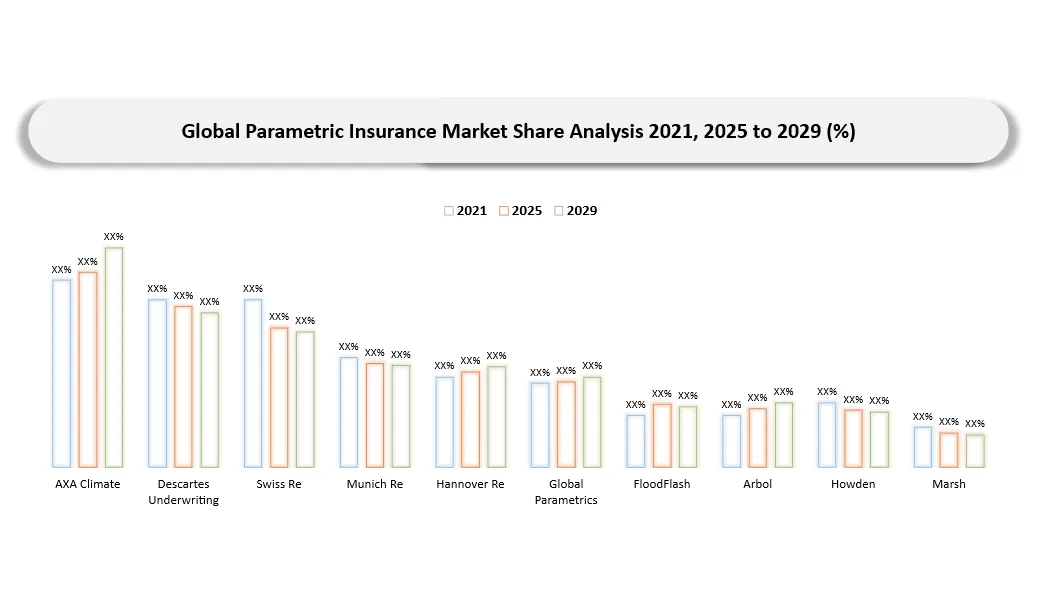
Key Companies
- AXA Climate
- Descartes Underwriting
- Swiss Re
- Munich Re
- Hannover Re
- Global Parametrics
- FloodFlash
- Arbol
- CelsiusPro
- Skyline Partners
- African Risk Capacity
- CCRIF SPC
- Pula
- Oko
- Jumpstart Insurance
- Adaptive Insurance
- Parametrix Insurance
- Howden
- Marsh
- Guy Carpenter
Parametric Insurance Market Major Pain Points
- Basis risk can create buyer dissatisfaction when actual loss and payout differ materially.
- Sparse or unreliable data infrastructure limits trigger precision in emerging markets and localized perils.
- Complex modelling can make products difficult for procurement teams and regulators to understand.
- Reinsurance capacity can become expensive after major catastrophe years, affecting price and limit availability.
- Distribution costs remain high for small commercial and agriculture policies unless products are embedded or bundled.
- Public-sector procurement cycles and donor approvals can delay sovereign and municipal programs.
- Sensor maintenance, satellite licensing and data-provider dependency create operational risk.
- Some buyers compare parametric cover directly with indemnity insurance without recognizing the different purpose and loss basis.
Parametric Insurance Market Recent Developments
- In 2025, Parametrix raised US$ 27 million in Series B funding to expand cyber and data-outage insurance, strengthen underwriting and broaden broker Distribution.
- In February 2025, Adaptive Insurance announced a US$ 5 million seed round to launch an AI-powered climate-resilience platform and expand engineering and data capabilities.
- In June 2025, Descartes Underwriting introduced Flood-at-Location for U.S. commercial customers, using flood modelling and sensor-supported triggers.
- Swiss Re Institute reported that natural catastrophes generated US$ 107 billion in insured losses during 2025 across 190 events, while economic losses reached US$ 220 billion.
- Swiss Re projects that insured natural-catastrophe losses could reach US$ 186 billion by 2030 if the long-term real growth trend continues.
- Insurance-linked securities capacity remained an important source of catastrophe-risk capital, supporting event-based and indexed risk transfer.
Analyst View and Opinion
The Parametric Insurance market is expected to remain one of the fastest-growing segments of alternative risk transfer because it addresses liquidity, uninsured exposure and non-damage financial loss. Growth will be driven by climate volatility, higher conventional insurance retentions, better data and digital Distribution. The market will not replace indemnity insurance across most commercial risks. Its strongest role is as a complementary layer that provides pre-agreed cash when an event occurs.
The competitive advantage will shift toward platforms that can demonstrate low basis risk, transparent historical performance and reliable claims settlement. Cyber outage and renewable-energy revenue protection will attract more investment because their triggers can be measured digitally and products can be distributed to technology-dependent businesses. Agriculture will remain the largest volume opportunity, while sovereign and municipal programs will remain important for protection-gap reduction.
Long-term market leadership will depend on underwriting discipline. Rapid growth without adequate model validation can create adverse loss experience and damage buyer trust. Providers should prioritize data redundancy, independent verification, clear disclosure and portfolio diversification. Brokers will remain important for complex transactions, while APIs and affinity Distribution will expand the addressable market for standardized products.
Parametric Insurance Market Target Audience
| Industry | Who Should Buy This Report? | Reason to Buy |
| Insurers and Reinsurers | Strategy heads, product leaders, underwriters and innovation teams | To identify attractive perils, data needs, capacity partners and regional expansion opportunities |
| MGAs and Insurtechs | Founders, underwriting teams and product managers | To benchmark product structures, funding trends and Distribution models |
| Insurance Brokers | Alternative risk teams and corporate advisors | To compare providers, triggers, buyer needs and placement opportunities |
| Commercial Buyers | Risk managers, CFOs and treasury teams | To evaluate parametric cover for deductibles, business interruption and emergency liquidity |
| Governments | Finance ministries, disaster agencies and municipalities | To design pre-arranged disaster-finance and public-sector liquidity programs |
| Agriculture Ecosystem | Banks, cooperatives, agribusiness firms and development agencies | To assess rainfall, drought, yield and index-insurance opportunities |
| Data and Technology Providers | Satellite, weather, sensor and API companies | To identify insurance partnerships and high-value trigger applications |
| Investors and Consultants | Private equity, venture capital and strategy advisors | To screen platforms, data assets and regional white spaces |
Why Choose DATAM?
- Data-driven market sizing by peril, trigger, coverage structure, industry, buyer, Distribution model, technology platform and region.
- Buyer-focused analysis of trigger design, basis risk, data independence, payout certainty and procurement criteria.
- Post-purchase analyst support for product strategy, market entry, partner identification and competitor benchmarking.
- Country-level opportunity analysis covering mature insurance markets and high-protection-gap emerging economies.
- White-space analysis across cyber outage, renewable energy, SME flood, public-sector liquidity and embedded event protection.
- Competitive assessment covering insurers, reinsurers, MGAs, brokers, catastrophe pools and technology platforms.
What DATAM Uniquely Provides
- Ten-year forecasts using a 2025 base year and 2026-2035 forecast period.
- Detailed segmentation that connects market value with buyer use cases and underwriting requirements.
- Assessment of data sources, technology platforms and Distribution partnerships required for scalable products.
- Analysis of public-private risk pools, development-finance programs and commercial insurance structures.
- Strategic recommendations for capacity providers, brokers, technology firms and investors.
- Recent-development tracking for product launches, funding, catastrophe losses and regulatory change.
Questions This Report Answers
- How will parametric insurance demand evolve from 2025 to 2035?
- Which perils and end-use industries will generate the strongest premium growth?
- How can insurers reduce basis risk through trigger design and data selection?
- Which regions offer the best opportunities for commercial, agriculture and public-sector products?
- How are AI, satellite data, sensors and APIs changing underwriting and Distribution ?
- Which companies are best positioned across catastrophe, cyber, agriculture and embedded insurance?
- Where are the most attractive investment opportunities for MGAs, data providers and Distribution platforms
- How should buyers evaluate parametric cover alongside indemnity insurance and captives?


























































