


Packaging Polymer Market Size and Overview
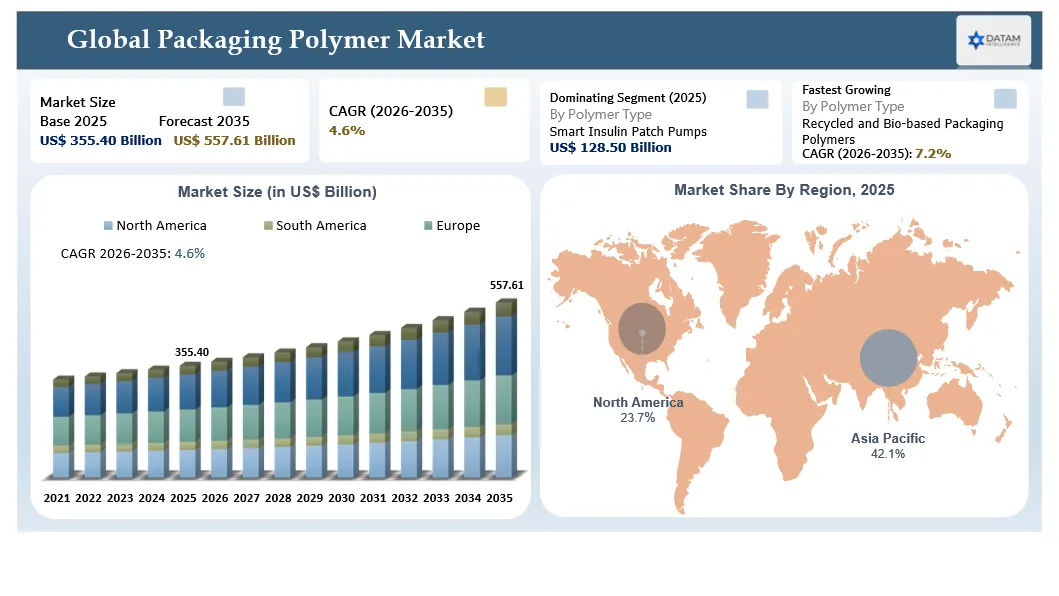
The global packaging polymer market is estimated at US$ 355.40 billion in 2025 and is projected to reach US$ 557.61 billion by 2035, expanding at a CAGR of 4.6% during 2026 to 2035. Packaging remains the largest practical demand platform for several major thermoplastics because it combines high unit volumes, short replacement cycles and broad use across food, beverages, healthcare, household goods, personal care, industrial products and e-commerce. Growth is increasingly determined by the mix of resin, format and compliance position rather than polymer tonnage alone.
The market is entering a difficult transition. Brand owners require lower material use and higher recycled content, while converters still need consistent sealability, clarity, barrier performance, machinability and food-contact safety. The EU Packaging and Packaging Waste Regulation entered into force in February 2025 and generally applies from August 2026. It requires all packaging on the EU market to become recyclable in an economically viable way by 2030 and introduces minimum recycled-content requirements for plastic packaging. These rules are changing resin qualification, packaging design and procurement contracts.
The August 2026 resin environment demonstrates why procurement resilience has become central. ChemAnalyst reported that China HDPE injection moulding grade remained 41.4% above its February level in July 2026, HDPE film grade remained 37.9% higher and polypropylene injection grade remained 30.7% higher. The indicative BOPP film-over-PP spread moved from positive US$89 per tonne in February to negative US$15 per tonne in July, a US$104 per tonne deterioration for converters. Such volatility rewards buyers with indexed contracts, multi-region sourcing, inventory visibility and the ability to redesign structures when specific grades become scarce.
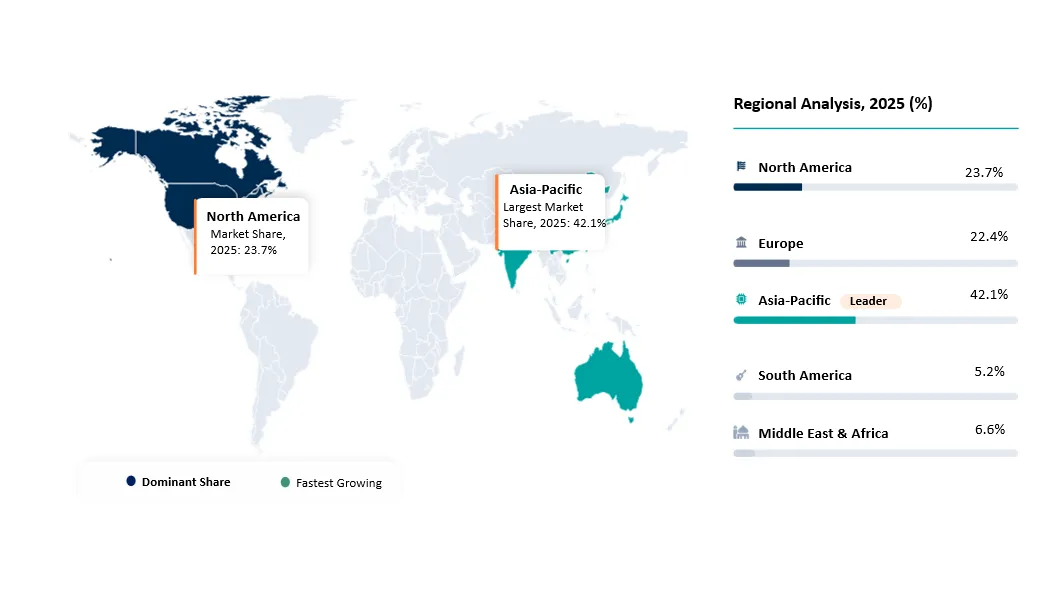
Asia-Pacific is the largest regional market because China, India, Japan, South Korea and Southeast Asia combine resin production, packaging conversion and large consumer-goods manufacturing bases. North America remains a high-value market for healthcare packaging, barrier systems, e-commerce films and recycled-content platforms. Europe is the regulatory and circularity benchmark, while the Middle East is strategically important as a resin export base. Through 2035, the strongest opportunities will occur in food-grade recycled PET and polyolefins, mono-material flexible packaging, high-barrier recyclable structures, lightweight rigid packaging, digital quality control and closed-loop supply agreements.
| Metric | Details |
| 2025 Market Size | US$ 355.40 billion |
| 2035 Projected Market Size | US$ 557.61 billion |
| CAGR 2026-2035 | 4.6% |
| Largest Region | Asia-Pacific |
| Fastest Growing Region | Asia-Pacific |
| Largest Polymer Segment | Polyethylene |
| Fastest Growing Segment | Recycled and bio-based packaging polymers |
| Largest End Use | Food and beverage |
Packaging Polymer Market Key Takeaways
- The market is estimated at US$355.40 billion in 2025 and projected to reach US$557.61 billion by 2035.
- Asia-Pacific holds an estimated 42.1% share in 2025 because it combines resin capacity with food, beverage, consumer-goods and export packaging demand.
- Polyethylene remains the largest polymer family through HDPE bottles and closures, LDPE films and LLDPE stretch, sealant and pouch layers.
- PET retains a strong position in beverage bottles, thermoformed trays and high-clarity food packaging, with recycled PET benefiting from established bottle-collection systems.
- Polypropylene is central to caps, closures, tubs, microwaveable containers, retort formats and BOPP film, but converter economics are highly exposed to propylene and resin-price movements.
- EU PPWR requires 30% recycled content for contact-sensitive PET packaging and single-use plastic beverage bottles by 2030, 10% for contact-sensitive non-PET packaging and 35% for other plastic packaging.
- Packaging accounts for around 40% of plastics used in the EU, which makes the sector the primary target for polymer circularity rules and producer-responsibility programs.
- ChemAnalyst reported HDPE injection grade at US$1,285 per tonne in China on 10 July 2026, 41.4% above the February average.
- The BOPP-over-PP indicative spread turned negative in July 2026, illustrating how converters can face losses when film prices adjust more slowly than resin costs.
- Recycled-content mandates increase demand for reliable post-consumer feedstock, decontamination, odor control, color management, chain-of-custody and food-contact approvals.
- Mono-material structures are gaining attention because they improve sortability and recycling compatibility, although matching the barrier performance of multi-layer laminates remains difficult.
- Digital printing, machine vision and AI-assisted process control are improving short-run economics, defect detection, gauge control and changeover performance.
Packaging Polymer Industry Trends and Strategic Insights
Pricing and supply security have returned to the centre of strategy. The 2026 disruption showed that resin availability can change within weeks, while packaging contracts often adjust more slowly. Buyers are therefore qualifying second sources, increasing visibility into upstream feedstock exposure and negotiating transparent pass-through mechanisms.
Circularity is moving from voluntary commitment to regulated specification. Recyclability, recycled content, labeling and EPR obligations will influence resin selection. Packaging that performs well but cannot meet future recycling criteria may face redesign cost, higher fees or loss of shelf space.
Lightweighting remains important because it lowers material and logistics cost. The next stage requires better resin, geometry and process control because easy gauge reductions have already been captured in many formats. AI-assisted simulation, machine vision and digital twins will help identify where weight can be removed without increasing damage or seal failure.
Refill and reuse models will expand selectively in beverages, household products, food service and transport packaging. Their success depends on return rates, washing, consumer convenience and asset tracking. Durable PP and HDPE compounds, pooled crates and smart closures create new service-based revenue opportunities.
Why Does This Report Matter in 2026?
The report matters in 2026 because packaging polymer buyers face simultaneous price, supply and regulatory pressure. Resin prices can reprice rapidly when crude oil, naphtha, ethylene, propylene, freight or war-risk insurance changes. At the same time, brand owners must redesign packaging for recyclability, document recycled content and prepare for EPR fees. A buyer that focuses only on the lowest quoted resin price can create greater downstream cost through line instability, downgauging failure, quality claims, product loss or non-compliance.
The report converts these pressures into actionable decisions. Resin suppliers can identify which polymer grades require food-contact recycled content, converters can prioritize equipment and structure investments, recyclers can evaluate demand for higher-purity output and brand owners can compare redesign pathways. Investors can screen opportunities in mechanical recycling, chemical recycling, barrier coatings, mono-material films, refill systems, digital traceability and regional compounding. The analysis also clarifies how the August 2026 polymer price shock affects procurement, converter margins and contract structures.
Packaging Polymer Market White Space and Investment Opportunities
Food-grade recycled polyolefin capacity is becoming a strategic decision because brand owners have fewer approved options for recycled PE and PP than for bottle-grade rPET. European rules require minimum recycled content across several packaging categories from 2030, while food-contact safety requires tight control of feedstock and decontamination This shifts the discussion from nominal resin price to total packaging-system performance, including material yield, conversion uptime, product protection, logistics efficiency, regulatory exposure and end-of-life outcomes. Investment is attractive in dedicated collection, advanced sorting, de-inking, deodorization and super-clean recycling systems that can provide consistent food-contact or sensitive-application grades. Companies that combine polymer science, application testing, regional supply and auditable sustainability data are positioned to capture higher-value contracts, while suppliers competing only on spot price remain exposed to rapid margin compression and customer switching.
Mono-material high-barrier flexible packaging is becoming a strategic decision because conventional laminates combine PET, PE, PA, EVOH, aluminium and adhesives in structures that are difficult to recycle. Retailers and regulators increasingly favor structures compatible with PE or PP recycling streams This shifts the discussion from nominal resin price to total packaging-system performance, including material yield, conversion uptime, product protection, logistics efficiency, regulatory exposure and end-of-life outcomes. The opportunity lies in oriented PE, metallized mono-PP, thin barrier coatings, compatible tie layers and sealing systems that preserve shelf life without creating non-recyclable combinations. Companies that combine polymer science, application testing, regional supply and auditable sustainability data are positioned to capture higher-value contracts, while suppliers competing only on spot price remain exposed to rapid margin compression and customer switching.
Reusable packaging polymer systems is becoming a strategic decision because durable crates, refill bottles, transport totes and pooled containers require different resin economics from one-way packaging. Reuse programs can reduce packaging units but increase requirements for impact strength, washability, tracking and reverse logistics This shifts the discussion from nominal resin price to total packaging-system performance, including material yield, conversion uptime, product protection, logistics efficiency, regulatory exposure and end-of-life outcomes. Suppliers can develop high-durability compounds, RFID-enabled assets, washing validation and packaging-as-a-service models that generate recurring revenue. Companies that combine polymer science, application testing, regional supply and auditable sustainability data are positioned to capture higher-value contracts, while suppliers competing only on spot price remain exposed to rapid margin compression and customer switching.
Regional resin and film conversion capacity is becoming a strategic decision because geopolitical disruptions expose the fragility of long-distance resin and film supply. The 2026 Strait of Hormuz disruption affected Middle East resin flows, Asian naphtha supply and converter inventory strategies This shifts the discussion from nominal resin price to total packaging-system performance, including material yield, conversion uptime, product protection, logistics efficiency, regulatory exposure and end-of-life outcomes. Regional compounding, toll conversion, recycled resin hubs and flexible inventory models can capture buyers seeking shorter lead times and reduced single-region dependence. Companies that combine polymer science, application testing, regional supply and auditable sustainability data are positioned to capture higher-value contracts, while suppliers competing only on spot price remain exposed to rapid margin compression and customer switching.
AI-assisted polymer and packaging design is becoming a strategic decision because millions of possible polymer structures and package combinations exceed the practical capacity of conventional trial-and-error development. Recent research used machine-learning models to screen approximately 7.4 million candidate polymers for recyclable food-packaging performance This shifts the discussion from nominal resin price to total packaging-system performance, including material yield, conversion uptime, product protection, logistics efficiency, regulatory exposure and end-of-life outcomes. Commercial opportunity exists in materials informatics, digital twins, formulation optimization and package-level simulation that shorten development cycles and reduce pilot-line waste. Companies that combine polymer science, application testing, regional supply and auditable sustainability data are positioned to capture higher-value contracts, while suppliers competing only on spot price remain exposed to rapid margin compression and customer switching.
Packaging Polymer Future Market Transformation
The market will move from selling generic resin grades toward selling verified performance and circularity outcomes. Resin producers will increasingly supply application-specific compounds with documented recycled content, food-contact status, carbon data, odor performance and processing windows. Converters will be expected to demonstrate downgauging, recyclability and filling-line reliability. Brand owners will use packaging scorecards that combine cost, product loss, consumer convenience, EPR fees and carbon exposure.
Resin volatility will also change commercial models. The August 2026 price upswing shows that fixed-price packaging contracts can become unsustainable when resin and converted-film prices move in opposite directions. Contracts will increasingly use transparent indices, pass-through formulas, floor and ceiling mechanisms, and shared inventory rules. Digital procurement platforms will integrate benchmark prices, shipment visibility, supplier risk, recycled-content certificates and forecast demand.
Technology will transform both materials and operations. Machine vision will detect gels, contamination, print defects and seal problems. AI will optimize extrusion conditions, gauge profiles and recycled-resin blending. Digital watermarks and traceability systems will support sorting and compliance. Advanced coatings will replace some multi-layer structures. Chemical recycling will provide complementary feedstock where mechanical recycling cannot meet purity or performance requirements, although economics and environmental claims will remain closely scrutinized.
Packaging Polymer Market Buyer Decision-Making Criteria
Polymer selection begins with product protection and filling-line performance. Food buyers evaluate oxygen and moisture barrier, seal integrity, migration, aroma retention and shelf life. Beverage buyers focus on clarity, top-load strength, carbonation retention and closure compatibility. Healthcare buyers require extractables, leachables, sterilization stability and traceability. E-commerce buyers prioritize puncture resistance, downgauging and damage reduction.
Procurement teams also evaluate supply security, price formula, minimum order quantity, lead time, regional availability and supplier credit. During 2026, buyers with a single resin source or inflexible film specification faced greater exposure to shortages and rapid price increases. Dual qualification and design flexibility are therefore becoming standard risk controls for critical packaging.
Sustainability criteria now include design-for-recycling compatibility, verified post-consumer content, mass-balance methodology, renewable feedstock claims, compostability certification, packaging-to-product ratio and EPR fee exposure. Buyers increasingly require technical files that connect resin certificates, converter production records and finished-pack declarations. Suppliers able to provide consistent data and audit support can defend a premium even when commodity resin markets soften.
Packaging Polymer Market Economic and Investment Analysis
The investment case is strongest where performance barriers and regulation protect margins. Food-grade recycled PET, high-purity recycled HDPE, recycled PP, barrier coatings, compatibilizers, de-inking and odor-removal technologies can command premiums because they solve a documented compliance problem. Commodity virgin resin capacity can generate scale but remains exposed to feedstock cycles and regional overcapacity.
Capacity decisions must account for resin-converter economics. ChemAnalyst reported a US$104 per tonne deterioration in the indicative BOPP-over-PP spread between February and July 2026. Negative conversion spreads cannot persist without film price increases, lower operating rates or contract renegotiation. Investors should assess not only installed tonnes but also contract structure, customer concentration, energy exposure, working-capital requirements and the ability to pass through resin movements.
Circular packaging investment requires coordinated feedstock and offtake. A recycling plant without secure bale supply can run below capacity, while a brand commitment without qualified recycled resin can create price spikes. The most bankable projects combine long-term feedstock agreements, quality-control technology, guaranteed offtake and regulatory demand. Partnerships among municipalities, waste companies, recyclers, resin producers, converters and brand owners are becoming more important than stand-alone assets.
AI Impact Analysis of Packaging Polymer Market
AI is changing polymer development, conversion and procurement. Materials informatics can screen large candidate libraries for barrier, thermal and recyclability properties. A 2025 research program evaluated approximately 7.4 million ring-opening polymer candidates for food-packaging applications and experimentally validated a chemically recyclable polymer with 95% monomer recovery. This shows how computational screening can reduce the number of laboratory iterations needed to identify viable materials.
Converters can use AI for gauge control, defect detection, extrusion stability, color consistency and predictive maintenance. Recycled resin introduces more variation than virgin resin, making real-time process adjustment valuable. Machine vision can detect gels, black specks, print registration errors and seal contamination. Digital twins can model bottle top-load, drop performance, pouch sealing and thermoform wall distribution before tools are finalized.
Procurement teams can use AI to forecast resin prices, identify supplier risk and optimize inventory. However, models must account for geopolitical events, force majeure, freight and contract terms. The August 2026 market showed that regional price behavior diverged materially, so a single global index can mislead buyers. The strongest systems combine market data with plant-level demand, inventory and approved-grade constraints.
Disruption Analysis of Packaging Polymer Market
The first disruption is the shift from multi-material performance optimization toward design for circular systems. Packaging engineers must now consider how structures are collected, sorted and recycled. This favors mono-material PE and PP systems, bottle-to-bottle PET, removable labels and compatible inks and adhesives.
The second disruption is feedstock diversification. Virgin fossil resin will remain important, but recycled, bio-based, mass-balance and chemically recycled feedstocks will gain share. Buyers will compare physical recycled content, carbon intensity, chain-of-custody and price. Claims without traceable evidence will face regulatory and reputational risk.
The third disruption is commercial. Resin-indexed contracts, capacity reservations and closed-loop agreements will become more common. Converters that cannot pass through rapid resin movements may reduce operating rates or exit low-margin categories. Integrated companies with resin, conversion and recycling assets can capture more value and manage volatility across the chain.
Packaging Polymer Market BCG Matrix: Company Evaluation
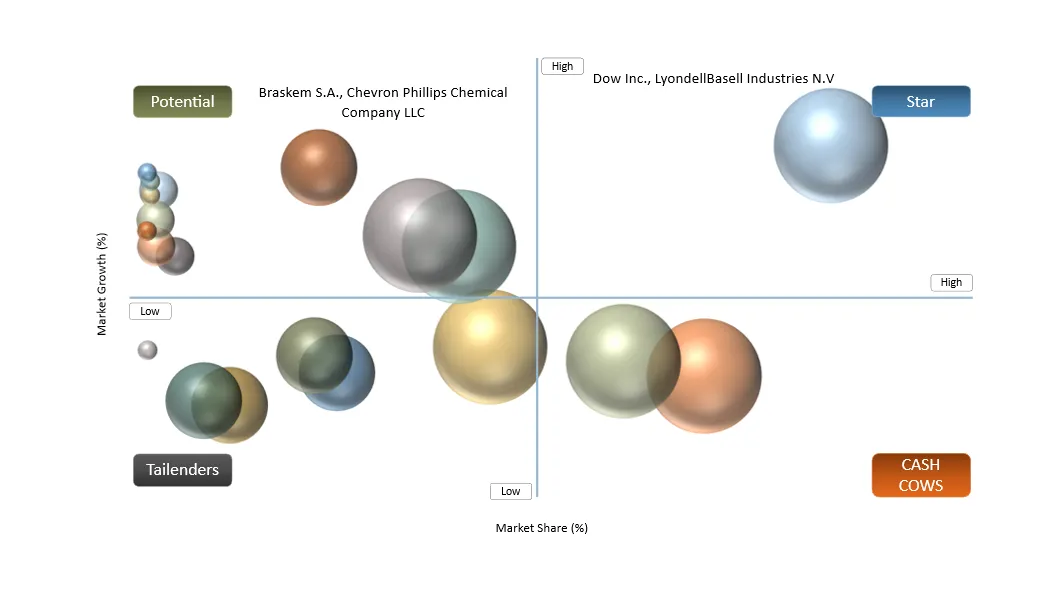
STAR
Dow Inc., LyondellBasell Industries N.V., SABIC, Exxon Mobil Corporation, and Borealis AG find themselves in the Star segment because of the breadth of their packaging polymers range, extensive manufacturing presence, and further development of their sustainable packaging products. They have a good position in polyethylene, polypropylene, and specialty resins markets and at the same time continuously expand their sustainable polymers portfolio.
POTENTIAL
Braskem S.A., Chevron Phillips Chemical Company LLC, TotalEnergies SE, Mitsui Chemicals, Inc., and INEOS Group are considered as Potential players because of their rising interest in producing bio-based polymers and recycled content products along with advanced applications in packaging solutions. Strategic initiatives by these companies in sustainable polymer technologies, capacity building, and collaborations along the packaging value chain are anticipated to boost their position in the coming years.
Packaging Polymer Market Dynamics
| Driver | Impact | Demand Concentration | Strategic Effect |
Packaged food, beverages and healthcare demand | 27% | Global, especially Asia-Pacific | Sustains high-volume demand for films, bottles, containers, closures and barrier packaging. |
Circularity regulation and recycled-content mandates | 23% | Europe, North America, Japan | Accelerates rPET, recycled PE and PP, redesign and compliance documentation. |
E-commerce and retail logistics | 17% | North America, China, India, Europe | Expands mailers, protective films, returnable totes and lightweight transit packaging. |
Lightweighting and material efficiency | 15% | Global brand owners and converters | Drives downgauging, stronger resins, foamed structures and process control. |
Healthcare and product safety requirements | 13% | North America, Europe, Japan | Supports high-purity polymers, sterile barrier systems and validated supply chains. |
Driver: Circular Packaging Regulation and Recycled-Content Procurement
Circularity regulation is becoming a strategic decision because packaging is a visible waste stream and a major use of plastic. The European Commission states that packaging accounts for 40% of plastics used in the EU. PPWR requires all packaging to become recyclable in an economically viable way by 2030 and sets recycled-content requirements for plastic packaging This shifts the discussion from nominal resin price to total packaging-system performance, including material yield, conversion uptime, product protection, logistics efficiency, regulatory exposure and end-of-life outcomes. This creates a multi-year investment cycle in sorting, washing, decontamination, recycled-resin compounding, mono-material design and traceability. Suppliers with verified chain-of-custody and stable quality can gain preferred status with multinational brand owners. Companies that combine polymer science, application testing, regional supply and auditable sustainability data are positioned to capture higher-value contracts, while suppliers competing only on spot price remain exposed to rapid margin compression and customer switching.
The 2030 recycled-content thresholds create differentiated demand. Contact-sensitive PET packaging and single-use beverage bottles require 30% recycled content, contact-sensitive non-PET packaging requires 10%, and other plastic packaging requires 35%. The 2040 thresholds rise further. These targets increase the strategic value of food-grade rPET, recycled polyolefin purification, and designs that tolerate higher recycled-content variability without sacrificing appearance or process performance.
| Restraint | Drag | Primary Area | Strategic Effect |
| Resin price volatility and feedstock disruption | 24% | PE, PP, PET and films | Compresses converter margins and raises working-capital requirements. |
| Recycling quality and feedstock scarcity | 20% | Food-contact recycled polymers | Limits consistent recycled-content supply and raises qualification cost. |
| Multi-layer and contamination complexity | 17% | Flexible packaging | Reduces recycling yield and slows mono-material conversion. |
| Regulatory fragmentation and claim risk | 14% | Global brand portfolios | Creates multiple labels, EPR rules and documentation requirements. |
| Capital intensity and qualification timelines | 12% | Converters and recyclers | Delays return on investment and customer conversion. |
Restraint: Polymer Price Volatility and Converter Margin Compression
Polymer pricing is linked to crude oil, natural gas, naphtha, ethylene, propylene, paraxylene, PTA, MEG, electricity, freight and plant operating rates. The 2026 Middle East disruption showed how quickly these variables can combine. ChemAnalyst reported that 84% of Middle East polyethylene capacity depends on Strait of Hormuz access and that 80% of Asia seaborne naphtha demand had been supplied from the Middle East. Partial reopening did not immediately normalize inventories, which left HDPE substantially above pre-crisis levels.
Converters are vulnerable because customers may resist immediate packaging price increases. In July 2026, the indicative BOPP film-over-PP spread moved below zero in China, while a German plastics processor survey cited by ChemAnalyst found 99% of packaging manufacturers facing supplier price increases. Inventory protection also consumes cash. Amcor reduced FY2026 free-cash-flow guidance by approximately US$300 million, partly reflecting higher inventory held at higher cost to protect customer service. Smaller converters with limited credit face even greater pressure.
The restraint encourages indexed contracts, resin pass-through clauses, flexible specifications and financial hedging. Buyers may also maintain strategic inventory or qualify alternative grades. However, excessive inventory can create losses when prices reverse. The best commercial model combines transparent indices, agreed adjustment timing, inventory-sharing rules and rapid technical approval of substitute resins.
Packaging Polymer Market Segment Analysis
By Polymer Type: Polyethylene Remains the Largest Material Platform
PE combines low density, toughness, moisture resistance, sealability and broad processing flexibility. HDPE is used for milk and household bottles, caps, crates and industrial containers. LDPE supports coatings, squeezable bottles and liquid-packaging films. LLDPE is central to stretch film, sealant layers, heavy-duty sacks and pouches. The 2026 price shock showed the risk of this concentration, with China HDPE film grade still 37.9% above February levels in July. Buyers are investing in downgauging, metallocene grades and recycled-content blends to reduce material use and volatility exposure. The segment remains attractive because new catalyst and bimodal technologies can deliver higher stiffness or puncture resistance at lower gauge.
Strategically, this segment should be evaluated through buyer qualification, supply concentration, regulatory exposure and the ability to create measurable cost-in-use benefits. Companies that provide technical data, pilot trials, line support and post-consumer content verification can convert a commodity transaction into a longer-term specification position. Regional capacity and inventory support are especially important when freight lanes or feedstock markets are disrupted.
By Polymer Type: Recycled and Bio-based Polymers Form the Fastest-Growing Value Pool
Recycled PET, recycled HDPE and recycled PP benefit from regulation, EPR fees and brand commitments. Bio-based PE and PET provide renewable feedstock while remaining compatible with established recycling. PLA, PHA and other compostable polymers serve selected food-service and organic-waste applications. The strongest growth comes from verified performance rather than green positioning alone. Buyers require food-contact documentation, odor control, color consistency and dependable supply. Circular plastics accounted for only 15.4% of European plastics production in 2024, showing that substantial investment is still required to meet future packaging targets.
Strategically, this segment should be evaluated through buyer qualification, supply concentration, regulatory exposure and the ability to create measurable cost-in-use benefits. Companies that provide technical data, pilot trials, line support and post-consumer content verification can convert a commodity transaction into a longer-term specification position. Regional capacity and inventory support are especially important when freight lanes or feedstock markets are disrupted.
By Packaging Format: Films and Pouches Dominate Material Efficiency
Flexible films use less material per packaged unit than many rigid formats and provide strong sealing and barrier performance. PE, PP, PET and PA are combined through coextrusion, orientation, metallization and lamination. Demand is supported by snacks, frozen food, personal care, pharmaceuticals and e-commerce. The core challenge is recycling. Mono-material PE and PP structures, MDO-PE, BOPE and coated films are expanding because they can reduce multi-material complexity. Converters must balance recyclability with printing, stiffness, seal initiation and shelf-life requirements. Volatile resin prices create significant working-capital exposure because high-volume film lines consume large resin tonnage.
Strategically, this segment should be evaluated through buyer qualification, supply concentration, regulatory exposure and the ability to create measurable cost-in-use benefits. Companies that provide technical data, pilot trials, line support and post-consumer content verification can convert a commodity transaction into a longer-term specification position. Regional capacity and inventory support are especially important when freight lanes or feedstock markets are disrupted.
By Packaging Format: Bottles, Jars and Closures Retain Strong Circular Potential
Rigid bottles and jars use HDPE, PET and PP across beverages, dairy, household chemicals, personal care and healthcare. These formats are compatible with automated filling and can achieve high collection when deposit systems or established curbside programs exist. Lightweighting has reduced average bottle weight over time, but further reduction requires stronger resin and design optimization. Closures are increasingly tethered or redesigned for compatibility with bottle recycling. The opportunity is in high-PCR bottles, refill concentrates, reusable dispensing systems and digital watermarks that support sorting and brand engagement.
Strategically, this segment should be evaluated through buyer qualification, supply concentration, regulatory exposure and the ability to create measurable cost-in-use benefits. Companies that provide technical data, pilot trials, line support and post-consumer content verification can convert a commodity transaction into a longer-term specification position. Regional capacity and inventory support are especially important when freight lanes or feedstock markets are disrupted.
By Processing Technology: Film Extrusion and Orientation Drive High-Volume Investment
Blown and cast film extrusion remain core processes for PE and PP packaging. Biaxial orientation produces BOPP and BOPET films with improved stiffness, clarity and barrier. Jindal Poly Films announced an INR700 crore expansion that includes 42,000 tonnes of new BOPP capacity, 55,000 tonnes of PET film capacity and 18,000 tonnes of CPP capacity. Such investments show continuing demand, but returns depend on utilization and spread management. New lines increasingly include automatic gauge control, energy recovery, machine vision and faster changeovers to handle shorter runs and higher recycled-content variability.
Strategically, this segment should be evaluated through buyer qualification, supply concentration, regulatory exposure and the ability to create measurable cost-in-use benefits. Companies that provide technical data, pilot trials, line support and post-consumer content verification can convert a commodity transaction into a longer-term specification position. Regional capacity and inventory support are especially important when freight lanes or feedstock markets are disrupted.
By Application: Primary Packaging Captures the Highest Value
Primary packaging directly contacts the product and therefore carries the highest requirements for migration, barrier, seal integrity and product compatibility. Food and pharmaceutical applications require detailed technical files and controlled manufacturing. This segment supports premium polymers and high-purity recycled content because packaging failure can destroy product value or create safety risk. PPWR recycled-content rules distinguish contact-sensitive packaging, reflecting the difficulty of safely introducing recycled polymers. Suppliers with food-contact approvals, clean production and traceable feedstock will capture stronger margins than commodity-grade producers.
Strategically, this segment should be evaluated through buyer qualification, supply concentration, regulatory exposure and the ability to create measurable cost-in-use benefits. Companies that provide technical data, pilot trials, line support and post-consumer content verification can convert a commodity transaction into a longer-term specification position. Regional capacity and inventory support are especially important when freight lanes or feedstock markets are disrupted.
By End Use: Food and Beverage Remain the Largest Demand Base
Food and beverage packaging uses films, pouches, bottles, caps, trays, cups and barrier structures. Demand is linked to packaged consumption, shelf-life extension, cold-chain distribution and convenience. Material choice is highly application-specific. Fresh produce needs breathability, meat requires oxygen barrier and leak resistance, beverages require top-load and carbonation performance, while frozen food requires low-temperature toughness. Packaging costs can affect food inflation when resin prices rise. ChemAnalyst reported broad 2026 increases across PE, PP and PET-related materials, while industry sources warned that some packaging categories experienced cost increases above 20% during the supply shock.
Strategically, this segment should be evaluated through buyer qualification, supply concentration, regulatory exposure and the ability to create measurable cost-in-use benefits. Companies that provide technical data, pilot trials, line support and post-consumer content verification can convert a commodity transaction into a longer-term specification position. Regional capacity and inventory support are especially important when freight lanes or feedstock markets are disrupted.
By Sustainability Position: Mechanically Recycled Polymers Lead Near-Term Circular Demand
Mechanical recycling is the most established route for packaging polymers. PET bottle recycling can produce high-quality food-grade resin when collection and decontamination are controlled. HDPE and PP recycling serve bottles, crates, closures and non-food applications, with food-contact capacity expanding more slowly. The economics depend on bale quality, yield, washing cost and the spread versus virgin resin. Mandates can support demand even when virgin prices fall. Investment is moving toward advanced sorting, hot washing, de-inking, deodorization, melt filtration and blending systems that stabilize recycled-content performance.
Strategically, this segment should be evaluated through buyer qualification, supply concentration, regulatory exposure and the ability to create measurable cost-in-use benefits. Companies that provide technical data, pilot trials, line support and post-consumer content verification can convert a commodity transaction into a longer-term specification position. Regional capacity and inventory support are especially important when freight lanes or feedstock markets are disrupted.
By Sustainability Position: Chemical Recycling Targets Difficult Feedstock
Pyrolysis, depolymerization and solvent-based purification aim to recover value from mixed or contaminated packaging that mechanical recycling cannot handle. PET depolymerization can return monomers, while polyolefin pyrolysis can generate feedstock for new polymers under mass-balance systems. The segment may support food-contact applications when output re-enters petrochemical production, but energy use, yield, emissions, accounting methods and cost remain debated. Buyers require transparent chain-of-custody and credible lifecycle evidence. The strongest projects are integrated with secure waste feedstock, refinery or cracker assets and long-term brand-owner offtake.
Strategically, this segment should be evaluated through buyer qualification, supply concentration, regulatory exposure and the ability to create measurable cost-in-use benefits. Companies that provide technical data, pilot trials, line support and post-consumer content verification can convert a commodity transaction into a longer-term specification position. Regional capacity and inventory support are especially important when freight lanes or feedstock markets are disrupted.
By Sales Channel: Direct Contracts Gain Importance During Volatility
Large converters and brand owners increasingly use direct contracts with resin producers to improve volume security, technical support and price transparency. Distributors remain important for smaller buyers, specialty grades and regional inventory. The 2026 price shock highlighted the value of allocation priority and credit strength. Direct contracts may use monthly indices, feedstock formulas or negotiated pass-through. Digital procurement platforms add benchmark visibility and shipment tracking, but technical qualification still requires close supplier-converter collaboration. Successful sellers combine commercial flexibility with application engineers who can approve substitutes or downgauged grades quickly.
Strategically, this segment should be evaluated through buyer qualification, supply concentration, regulatory exposure and the ability to create measurable cost-in-use benefits. Companies that provide technical data, pilot trials, line support and post-consumer content verification can convert a commodity transaction into a longer-term specification position. Regional capacity and inventory support are especially important when freight lanes or feedstock markets are disrupted.
Packaging Polymer Market Geographical Penetration
Asia-Pacific leads the market with an estimated 42.1% share in 2025, followed by North America at 23.7%, Europe at 22.4%, Middle East and Africa at 6.6% and South America at 5.2%. Regional differences are shaped by resin capacity, converter scale, consumer-goods manufacturing, packaging regulation, collection systems and trade exposure.
Asia-Pacific Packaging Polymer Market Landscape
Asia-Pacific combines the world’s largest polymer production base with fast-growing packaged-consumption demand. China has extensive PE, PP, PET and film capacity, but the 2026 shock demonstrated dependence on imported naphtha and regional trade routes for some feedstocks. India offers growth through packaged food, pharmaceuticals, e-commerce and domestic polymer production. Japan and South Korea lead high-performance films and recycling technology. Southeast Asia is attractive for conversion capacity but exposed to imported resin and infrastructure gaps. Buyers prioritize price, scale and lead time, while global brands increasingly require traceability and design-for-recycling compliance.
The commercial opportunity is strongest for suppliers that align resin or packaging capacity with regional customer clusters, local compliance requirements and reliable after-sales support. Country entry should consider tariffs, logistics, energy availability, recycled-feedstock quality, currency exposure and access to technical labor. A regional warehouse or compounding partnership can materially reduce lead times and improve customer retention.
North America Packaging Polymer Market Outlook
North America is a high-value market for food, beverage, healthcare, personal care and e-commerce packaging. The U.S. has strong resin production, large converter networks and growing state-level EPR and recycled-content rules. EPA data show that plastic containers and packaging had a 13.6% recycling rate in 2018, highlighting the gap between packaging use and recovery. Investment is moving toward rPET, recycled HDPE, advanced sorting and retailer-led circular programs. Mexico is important for nearshore conversion and consumer-goods manufacturing, while Canada supports EPR and recycled-content initiatives.
The commercial opportunity is strongest for suppliers that align resin or packaging capacity with regional customer clusters, local compliance requirements and reliable after-sales support. Country entry should consider tariffs, logistics, energy availability, recycled-feedstock quality, currency exposure and access to technical labor. A regional warehouse or compounding partnership can materially reduce lead times and improve customer retention.
Europe Packaging Polymer Market Outlook
Europe is the regulatory benchmark. PPWR generally applies from August 2026, requires economically viable recyclability by 2030 and sets recycled-content targets by packaging category. Packaging uses around 40% of plastics in the EU, while packaging waste exceeded 186 kg per person in 2022. The region offers strong demand for certified recycled polymers, mono-material films, refill systems and compliance services. European plastics production has lost global share, falling from 22% in 2006 to 12% in 2024, which raises concerns about import dependence and industrial competitiveness during the circular transition.
The commercial opportunity is strongest for suppliers that align resin or packaging capacity with regional customer clusters, local compliance requirements and reliable after-sales support. Country entry should consider tariffs, logistics, energy availability, recycled-feedstock quality, currency exposure and access to technical labor. A regional warehouse or compounding partnership can materially reduce lead times and improve customer retention.
Packaging Polymer Market Competitive Landscape
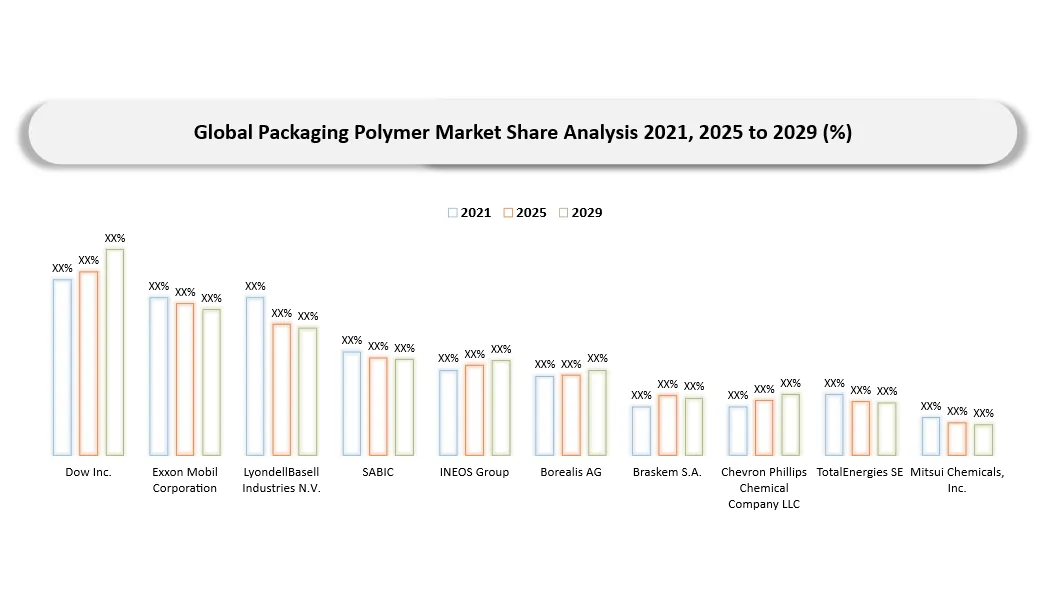
Competition spans upstream resin producers, specialty compounders, recyclers, film manufacturers, rigid packaging converters and integrated packaging groups. Resin leaders compete through scale, feedstock integration, catalyst technology and regional supply. Converters compete through design, printing, barrier structures, customer qualification and manufacturing footprint. Circular specialists compete through feedstock access, purification and certification.
Major resin companies are investing in circular polymers, advanced recycling partnerships and application development. Converters are expanding mono-material films, recycled-content packaging and digital printing. Jindal Poly Films’ planned BOPP, PET and CPP expansion shows that conventional film capacity remains investable, but profitability depends on utilization and resin spreads. Integrated players can use long-term customer contracts and procurement scale to manage volatility better than small converters.
The market will consolidate where capital requirements, regulation and customer qualification increase. Attractive acquisition targets include food-grade recyclers, specialty barrier-film companies, healthcare packaging converters, closure producers and digital traceability platforms. Partnerships among resin producers, recyclers and brand owners will be necessary to secure both feedstock and offtake.
Key Companies of Packaging Polymer Market
- LyondellBasell
- ExxonMobil Chemical
- SABIC
- Dow
- Borealis
- Braskem
- INEOS
- Reliance Industries
- Sinopec
- Indorama Ventures
- Eastman
- TotalEnergies
- Amcor
- Berry Global
- Sealed Air
- ALPLA
- Jindal Poly Films
- UFlex
- Mitsubishi Chemical Group
- NatureWorks
Packaging Polymer Market Major Pain Points
- Rapid PE, PP, PET and film price movements that outpace converter price adjustments.
- Feedstock and freight disruption linked to crude oil, naphtha and petrochemical trade routes.
- Limited food-grade recycled PE and PP availability relative to future regulatory demand.
- Quality variability in recycled resin, including odor, color, contamination and mechanical performance.
- Difficulty replacing multi-layer laminates without reducing shelf life or filling-line reliability.
- Fragmented EPR, labeling, recycled-content and food-contact requirements across markets.
- High working-capital needs when converters build inventory during supply shocks.
- Overcapacity risk in commodity films and resins, creating weak margins during demand slowdowns.
- Consumer confusion and greenwashing risk around recyclable, recycled, bio-based and compostable claims.
- Insufficient collection and sorting infrastructure for flexible packaging in many countries.
Packaging Polymer Market Recent Developments
- July 2026: ChemAnalyst reported renewed upward pressure on packaging polymer prices for August 2026, with HDPE remaining materially above pre-crisis levels and converter spreads under pressure.
- August 2026: The EU Packaging and Packaging Waste Regulation became generally applicable, accelerating packaging redesign, recycled-content planning and compliance documentation.
- May 2025: Jindal Poly Films announced an INR700 crore expansion covering additional BOPP, PET and CPP film capacity at Nashik.
- 2025: PlasticsEurope reported global plastics production increased 4.1% in 2024, while Europe’s global production share declined to 12%.
- 2025-2026: Brand owners and converters expanded mono-material PE and PP packaging trials to improve recyclability and reduce multi-layer complexity.
- 2025-2026: Investment increased in food-grade rPET, advanced sorting, de-inking, deodorization and recycled polyolefin compounding.
Analyst View and Opinion on Packaging Polymer Market
The market will continue growing because packaging provides essential product protection and distribution efficiency, but value will shift away from undifferentiated virgin resin. The most attractive positions are in materials and systems that solve a compliance, shelf-life or operational problem.
Polyethylene will remain the largest polymer family, while recycled polymers and bio-based materials grow fastest. PET will retain an advantage in closed-loop bottle recycling. PP will remain critical for closures, tubs and heat-resistant packaging. Barrier polymers will remain valuable even as converters reduce layer complexity.
The August 2026 price environment confirms that procurement and working-capital capability are competitive differentiators. Converters need transparent pass-through, multi-source qualification and strong balance sheets. Suppliers that can combine price intelligence with technical substitution support will capture customer loyalty.
Long-term leadership will depend on integrating polymer design, conversion, recycling and data. Companies that demonstrate physical recycled content, maintain food-contact safety and provide measurable package performance will be better positioned than those relying on broad sustainability claims.
Packaging Polymer Market Target Audience
| Industry | Who Should Buy | Reason to Buy |
| Resin Producers | Strategy, sales, product and investment teams | Identify packaging demand by polymer, format, region and circularity position. |
| Packaging Converters | CEOs, procurement, operations and R&D teams | Assess resin risk, equipment priorities, customer qualification and redesign opportunities. |
| Brand Owners and Retailers | Packaging, sustainability and sourcing teams | Benchmark material options, compliance exposure, recycled content and supplier capability. |
| Recyclers and Waste Companies | Plant developers, commercial heads and investors | Evaluate feedstock, technology, offtake and food-grade recycled resin opportunities. |
| Machinery and Technology Suppliers | Extrusion, moulding, sorting and digital-platform providers | Identify capacity additions, process-control needs and circularity technology demand. |
| Investors and Consultants | Private equity, infrastructure funds and advisors | Screen resin, conversion, recycling and packaging-technology targets. |
Why Choose DATAM?
- Data-driven insights: detailed market sizing, segment analysis, pricing intelligence, regulatory assessment and buyer criteria.
- Post-purchase analyst access: direct support for market-entry, product prioritization, supplier screening and assumptions.
- Annual updates: refreshed coverage of polymer prices, regulation, capacity and competitive developments.
- Emerging-market depth: specific analysis of India, China, Southeast Asia, Middle East, Africa and Latin America.
- Commercial orientation: analysis focuses on buyer decisions, investment opportunities, qualification barriers and practical go-to-market actions.
What DATAM Uniquely Provides
- Detailed 10-year forecasts by polymer type, packaging format, processing technology, application, end use, sustainability position, sales channel and region.
- Buyer decision intelligence covering performance, food contact, price pass-through, recycled content, supply security and documentation.
- Pricing analysis connecting resin, feedstock, film spreads, converter margins and contract structures.
- White-space analysis across food-grade recycled polymers, mono-material barriers, refill systems, bio-based materials and digital traceability.
- Country-level recommendations for resin producers, converters, recyclers, brand owners and investors.
- Competitive intelligence covering integrated petrochemical companies, specialty resin suppliers, film producers, rigid converters and recycling platforms.
Questions This Report Answers
- How will packaging polymer demand evolve from 2025 to 2035?
- Which polymer types and packaging formats offer the strongest value growth?
- How will PPWR recycled-content and recyclability requirements change procurement?
- How should converters respond to volatile PE, PP and PET pricing?
- Where are the largest gaps in food-grade recycled polymer capacity?
- Which regions offer the best opportunities for new resin, film or recycling capacity?
- How will mono-material design, AI and advanced recycling disrupt existing packaging structures?
- Which companies are best positioned across virgin, recycled and bio-based packaging polymers?


























































