

Overhead Conductor Market Size and Overview
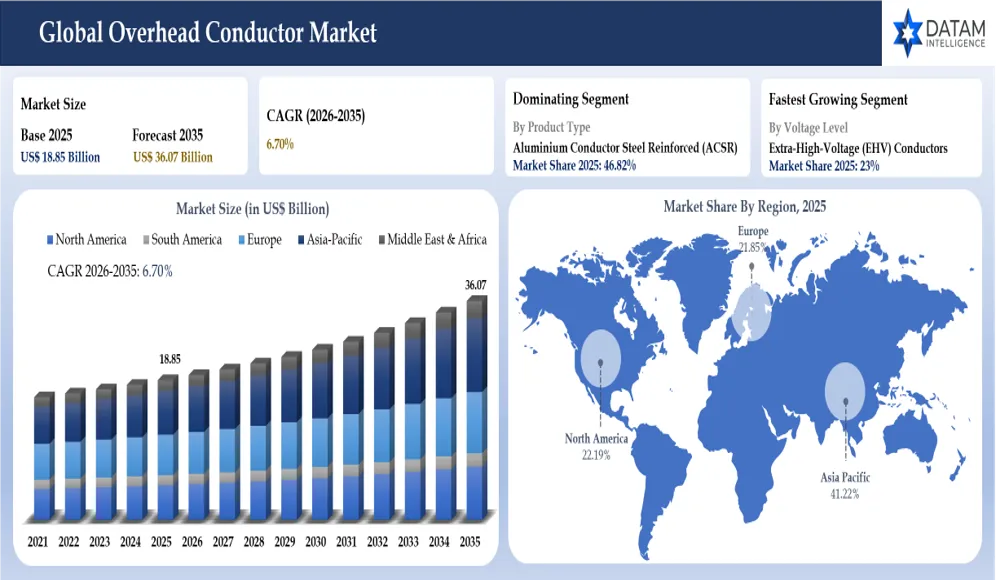
The global overhead conductor market reached US$ 18.85 billion in 2025 and is expected to reach US$ 36.07 billion by 2035, growing with a CAGR of 6.70% during the forecast period 2026-2035.
The market for overhead conductors is influenced by rising demand for electricity and the construction of high voltage transmission systems and renewable energy sources into the grid. There are investments being made in new transmission lines linking distant wind farms and solar plants with industry centers and metropolitan areas, whereas the need for replacing aging conductors and upgrading transmission network capacity is created due to old infrastructure. In June 2026, National Grid launched an estimated US$1.5 billion project for reconstructing and updating more than 1,000 km of overhead line routes in England and Wales, demonstrating the scale of investment in reconductoring and existing network capacity.
Technological innovation is making way for HTLS, advanced aluminum alloys and composite core conductors that will allow increased current carrying capacity and handling sag at higher temperatures. Such innovations are highly useful in areas where it becomes hard to establish new transmission corridors due to the problem of right of ways, delays in land acquisition and permits. The development of renewable energy evacuation corridors, electrification of urban areas and increased demand for electricity from industries have increased the significance of effective grid infrastructure. Yet the changing price of aluminum, installation needs and high capital cost are important.
Overhead Conductor Market Key Takeaways
- In 2025, Aluminium Conductor Steel Reinforced (ACSR) was the key player in the global overhead conductors market with 46.82% market share owing to the high tensile strength and well-defined utilities specifications of aluminium conductor steel reinforced wires.
- Extra-High Voltage (EHV) Conductors were projected to be the fastest-growing voltage level, growing at a rate of 8.4% CAGR over the forecast period owing to long-distance transmission of electricity, evacuation of renewable energy and development of high capacity transmission network.
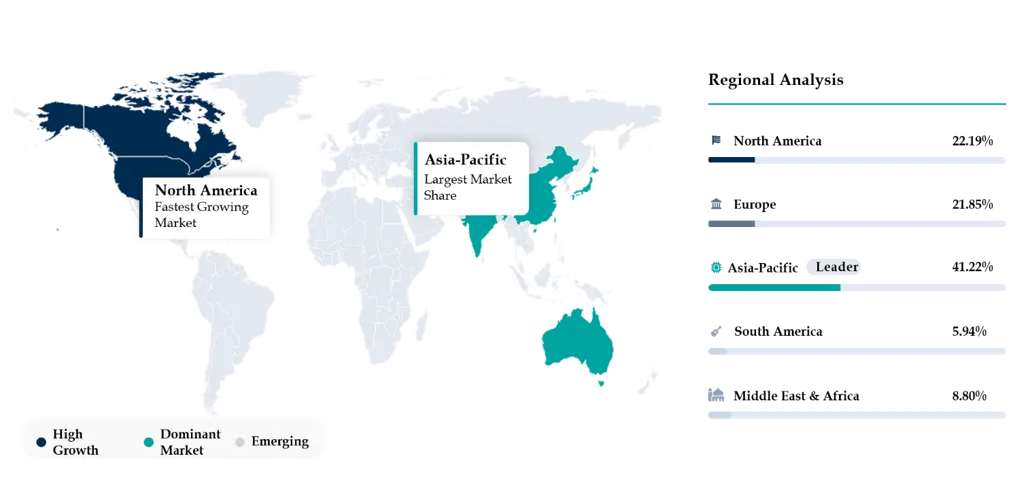
- In 2025, Asia-Pacific dominated the global overhead conductors market, recording 41.22% market share because of the developments in transmission network, renewable energy installation, grid modernization and electricity consumption in China, India and Southeast Asia.
- The increasing use of HTLS (high-temperature low-sag) and composite core conductors has allowed power companies to enhance their current carrying capacity and thermal performance without resorting to building additional transmission lines. These innovations are especially useful in reconductor projects with right-of-way restrictions that hinder the building of new lines.
- The rising investments in transmission development, renewable energy integration and reconductors have opened up avenues for the use of innovative aluminum alloy conductors, high ampacity conductors and special conductor technologies. Yet, the volatility in aluminum prices, qualification criteria by power companies, difficult installation processes and increased initial costs should be considered.
Overhead Conductor Industry Trends and Strategic Insights
- There is an increased use of HTLS and composite-core conductors as utility companies work on upgrading their transmission line networks to increase power-carrying capacity with minimal installation of new facilities.
- Increasing installations of solar and wind energy projects have created a need for overhead conductors capable of carrying power from such projects to the substations and electric power grids.
- There is continued improvement of aluminium alloys, conductor designs and geometries to enhance conductivity, mechanical properties and material utilization at controlled costs.
- Extremely hot or cold climate, high wind speeds and coastal corrosion are making the requirement for suitable thermal and mechanical properties and environmental resistance even greater.
- The utilities are putting emphasis on dependable supply of conductors, cost efficiency and quality assurance, which will lead the manufacturers to improve their raw material availability, production facilities and procurement relations.
Overhead Conductor Market Scope
| Metrics | Details | |
| 2025 Market Size | US$ 18.85 Billion | |
| 2035 Projected Market Size | US$ 36.07 Billion | |
| CAGR (2026-2035) | 6.70% | |
| Largest Market | Asia-Pacific | |
| Fastest Growing Market | North America | |
| By Product Type | Aluminium Conductor Steel Reinforced (ACSR), All Aluminium Conductor (AAC), All Aluminium Alloy Conductor (AAAC), Aluminium Conductor Alloy Reinforced (ACAR), Aluminium Alloy Conductor Steel Reinforced (AACSR), Aluminium Conductor Steel Supported (ACSS), Other Conventional Conductors | |
| By Material | Aluminium, Aluminium Alloys, Aluminium-Steel Composite, Copper, Composite-Core Materials, Other Materials | |
| By Voltage Level | Low Voltage (LV) (up to 1 kV AC), Medium Voltage (MV) (above 1 kV to approximately 52 kV AC), High Voltage (HV) (above the medium-voltage range to 245 kV AC), Extra-High Voltage (EHV) (above 245 kV to 800 kV AC), Ultra-High Voltage (UHV) (above 800 kV AC) | |
| By Application | Power Transmission, Power Distribution, Renewable Energy Evacuation, Grid Reconductoring and Capacity Upgrades, Industrial Power Supply, Rural Electrification | |
| By Conductor Technology | Conventional Conductors, High-Temperature Conductors, High-Temperature Low-Sag (HTLS) Conductors, Composite-Core Conductors, Advanced Conductor Designs | |
| By End-User | Transmission Utilities and System Operators, Distribution Utilities, Renewable Energy Developers, Engineering, Procurement and Construction (EPC) Contractors, Government Electrification Agencies, Industrial and Mining Companies | |
| By Region | North America | U.S., Canada, Mexico |
| Europe | Germany, UK, Russia, France, Spain, Italy, Poland | |
| Asia-Pacific | China, India, Japan, Australia, South Korea, Indonesia, Malaysia, Singapore, Vietnam, Thailand, Philippines, Taiwan | |
| South America | Brazil, Argentina | |
| Middle East and Africa | UAE, Saudi Arabia, South Africa, Israel, Turkiye, Nigeria | |
| Report Insights Covered | Competitive Landscape Analysis, Company Profile Analysis, Market Size, Share, Growth | |
Why does this report matter in 2026?
The overhead conductor market becomes significant in the year 2026 due to the rise in electricity consumption along with an increase in the transmission capacity of the utilities as a means of integrating renewable energy and meeting the growing power needs of industries as well as data centers. This report will help stakeholders to evaluate the demand for traditional conductors, HTLS and composite-core conductors where there is a need to increase power transfer capacity from the current transmission network infrastructure.
The report also reinforces investment and procurement strategies by assessing conductor technology adoption, exposure of aluminium and steel costs, manufacturing capabilities and regional infrastructure. The insights are essential for utilities as well as manufacturers, EPC contractors and investors to find opportunities in the field of grid reconductoring, renewable energy evacuation and transmission expansion while considering the supply chain risks and competition.
Overhead Conductor Market White Space & Investment Opportunities
- Capital investments in production of HTLS and composite-core conductors present business opportunities for meeting the requirements of utilities which are looking for innovative products that would allow them to increase current carrying capacity and improve thermal performance and sag.
- With the rise in solar and wind power projects, there is an opportunity to produce special conductors for the evacuation corridor of renewable energy and long-range transmission network systems linking far-away energy generation facilities with large-scale energy-consuming centers.
- Improvements in aluminium alloys and conductor geometry designs along with enhanced anti-corrosive properties will allow manufacturers to distinguish themselves in terms of conductivity, structural strength, efficiency and longevity of their products.
- Replacement of old conductors and improvements in existing transmission line systems present possibilities for suppliers of reconductoring services which enhance power transmission capacity and, possibly, save the utilities from building extra rights-of-way and erecting new towers.
- Manufacturing plants and sourcing of quality aluminium for conductor use as well as alloying and reinforcement materials within the region will make manufacturers more competitive and provide for more reliable deliveries.
Overhead Conductor Future Market Transformation
The overhead conductor market would gradually shift to high capacity, low sag and highly durable conductor types in accordance with the changing dynamics of power transmission and generation, as well as the growing needs of transmission. The use of HTLS and composite core technologies would enable better use of current transmission lines. Improvements in aluminium alloy and corrosion resistance properties, among others, would contribute towards making conductors efficient even under harsh operating conditions. In the long run, the effect of improved materials, increased capacity of grid infrastructure and smart grid management will affect conductor choice, drive the modernization of existing transmission grids and change manufacturers product development strategies.
Overhead Conductor Market Buyer Decision-Making Criteria
The key criteria by which the buyers of overhead conductor market judge the products are their electrical properties, mechanical properties, operating conditions and life cycle cost. The main criteria that are considered while choosing products by the transmission and distribution companies include the capacity to conduct electricity, conductor sag under high temperature operating conditions, tensile strength and compatibility with current towers and line structures. In addition, the main criteria that are used for renewable energy transmission and grid reconductoring projects include voltage, transmission capacity, corrosion resistance and installation considerations. Technical standards, field experience, delivery timetables, material cost consistency and production consistency will also play a major role in selecting suppliers, especially in cases where tenders are being made for utilities and large infrastructures projects.
Major Buyer Decision-Making Criteria
- Electrical Performance
- Mechanical Strength and Sag
- Conductor Technology
- Total Lifecycle Cost
- Standards and Compliance
- Environmental Durability
- Infrastructure Compatibility
- Supplier Reliability
Overhead Conductor Market Economic & Investment Analysis
The overhead conductor market depends greatly on the capital investment in the transmission and distribution networks, growing power consumption and use of renewable energy. Investment opportunities arise from the expansion of power networks, conductor replacements and reconducting to increase transmission capability while at the same time decreasing the requirement for a new transmission network. On the other hand, aluminium and steel price fluctuations, capital investment in manufacturing, long procurement times for utilities and limited right-of-way can have an impact on the cost of the project and profitability. The manufacturers who are able to build up their strength in terms of raw material availability, production efficiency and high-temperature low-sag (HTLS) as well as composite-core conductors will have competitive edge.
Overhead Conductor Investment Trends in the Market
- There is investment in HTLS and composite core conductor manufacturing in order to meet the demands of utilities that require higher power transfer capacity using their existing transmission lines without requiring new transmission lines.
- Investment in manufacturing capability, modern stranding equipment and quality control processes provide opportunities for meeting the needs that arise as a result of grid expansion, transmission upgrade and replacement of overhead conductors that have aged.
- The growth of the solar and wind energy projects presents an opportunity for investment in conductor manufacturing and supply of the transmission lines to substations and electricity consumption centers.
- Investments in new aluminum alloys, optimal strand designs and better production methods may help to increase the conductivity, strength and efficiency of the cables while enabling manufacturers to deal with the cost of raw materials.
- Setting up manufacturing plants and improving the logistics network may help to increase the dependability of the logistics and enable manufacturers to fulfill the requirements of the local markets for power transmission and distribution.
Strategic Indicators for Overhead Conductor Market
High Regulation Impact
The overhead conductor market is greatly impacted by technical and safety standards related to electricity, clearance rules and approvals for power grid construction projects. Manufacturers have to comply with relevant IEC, ASTM and local standards as well as with specific utility guidelines regarding electrical resistance, tensile strength and other features of the product. Project level obstacles include the process of acquiring right of way for the construction of transmission lines which adds cost to the project and time to its completion. Such regulatory requirements have an impact on conductor designs, testing, certifications, selections and purchases and they also motivate manufacturers to come up with solutions that comply with such standards and are capable of performing highly.
High Investment Activity
Investment in the overhead conductor market depends heavily on the extension of the transmission network, upgrading of old lines and increasing grid capacity for renewables. Some key areas for investment include the development of sophisticated stranding and manufacturing machines, HTLS conductors and composite core conductors, which would cater to the utilities' needs for greater current-carrying capacity and minimal sag. The manufacturers can also improve their position in the market through the expansion of production plants in various regions, availability of good supplies of conductor-grade aluminium and steel and improved quality control in case of utility orders. Investment decisions are affected by transmission pipeline project developments, capital investments by utilities, material cost fluctuations and technical considerations involved in grid modernization projects.
Supply Chain Disruption
The overhead conductor market can be subject to supply chain risks as production relies greatly on aluminium for overhead conductors, steel reinforcing wires, alloy materials and production facilities. The price volatility of aluminium and steel, delays in raw material shipments, trade and logistics issues could result in higher manufacturing expenses and delays in the availability of conductors for transmission and distribution projects. HTLS and Composite Core conductors could be further at risk if certain materials and facilities are required for production but in limited quantities. Producers can reduce such risks by ensuring diversity in raw material sourcing, long-term contracts, strategic inventories and regional manufacturing capacity.
Pricing Volatility
In the overhead conductor market, price instability is mainly dependent on variations in the prices of steel and aluminium that affect conductor production costs as well as quotations from suppliers. According to available information on metal prices, aluminium’s average price has risen from about US$2,632 in 2025 to US$3,331 for January - September 2026, which is an increase of approximately 26.6%. This rise leads to increased production expenses for aluminium-based conductors (AAC, AAAC, ACSR), whereas the changes in steel prices only increase uncertainty with respect to the costs related to reinforced projects. Thus, it is a must for manufacturers and utilities to adjust their tender pricing, procurement budgets and profit margins by means of metal price adjustment clauses, long-term supply contracts and rational raw material purchasing.
Procurement Pressure
Procurement Pressure in the overhead conductors industry results from competition in tender processes, technical specifications, large volumes of business and tight project schedules. Procurement in transmission and distribution utilities is normally based on compliance with conductor specifications, production capabilities, certification, prior experience and the capability to deliver within the scheduled period of time. The long qualification process for suppliers, design of conductors for each project and penalties for late delivery may escalate costs of bidding and diminish profits for manufacturers. Manufacturers may gain competitive advantage through better production planning, quality, technically sound conductor products and business contracts with utilities and EPC contractors.
New Technology Adoption
The trend of adoption of technology for the overhead conductor segment revolves around high-temperature low-sag (HTLS) conductors, innovative composite core conductor technology and aluminum alloy conductors which offer greater capacity for carrying current and efficient operation in tough conditions. The application of such technologies is highly useful for utilities that are involved in reconductoring of their existing transmission lines as increasing power transfer capability without changing towers and rights of way is possible using this technology. Strand geometry, performance related to heat and even corrosion resistance are some other areas where manufacturers have been working on to improve the efficiency of conductors and their life span. However, the adoption is subject to investment cost at the outset, compatibility with the existing power transmission network, special installation needs and utility qualification and therefore technical validation and field experience become critical.
Regional Expansion Opportunity
The regional growth in the overhead conductor market is characterized by variations in electricity infrastructure requirements in developing countries and mature electricity markets. The emerging opportunities in India and Southeast Asia lie in the provision of overhead conductors for new transmission lines as well as rural electrification and renewable energy installations, while opportunities in the Middle East exist in utility-scale electricity infrastructure and long-distance transmission systems. Expansion in North America and Europe will be limited to the replacement of aged conductors and reconductoring of existing transmission lines to enhance power transfer capacity and integration of renewable energy in the electricity networks. Regional presence of manufacturers can be improved by producing locally, adhering to national and utility requirements, partnering with EPC contractors and ensuring availability of aluminum and reinforcing steel suitable for conductors.
Government Policy Support
The policy measures which encourage transmission line extension, renewable energy inclusion and rural electrification also affect the demand in the overhead conductor market. The transmission oriented policy programs such as the India’s Green Energy Corridor generate prospects for the manufacturers of conductors due to transmission lines and infrastructure for renewable energy evacuation. The distribution oriented policy measures such as the Revamped Distribution Sector Scheme may indirectly help in increasing the demand. In the regional markets, public infrastructure development, domestic production requirements and environmental approval processes impact the purchasing decisions of the suppliers.
Pricing Intelligence
Overhead conductor pricing is determined by factors such as the conductor type, size, material, manufacturing difficulty and quantity ordered. Regular conductors like AAC, AAAC and ACSR are generally priced depending on the amount of aluminium used, strength required and project specifications, whereas HTLS and composite core conductors could be expensive owing to the use of special materials and manufacturing process along with improved performance capability. The utility tenders also influence pricing through bulk discount offers, qualification criteria, delivery schedules and warranty terms. It thus becomes essential for the buyer to evaluate not only the cost of the conductor per kilometer but also other related considerations including installation costs, compatibility with existing power transmission facilities, expected durability and cost of transferring the desired power.
| HS Code | Reporter | Trade Flow | 2025 Trade Value | Interpretation |
| 761410 | China | Export | US$490 million | Major exporter of aluminium-steel stranded conductors used in overhead power transmission and distribution. |
| 761410 | Bahrain | Export | US$217 million | Significant exporter of aluminium-steel stranded conductors for international utility markets. |
| 761410 | United States | Import | US$252 million | Major importing market for overhead conductors supporting grid maintenance and expansion. |
| 761410 | Germany | Import | US$150 million | Important European import market for aluminium-steel stranded conductors. |
Note: HS Code 761410 covers stranded wire, cables, plaited bands and similar products of aluminium with a steel core, excluding electrically insulated products. It is relevant to overhead power conductors such as Aluminium Conductor Steel Reinforced (ACSR). However, this code does not cover all overhead conductor types, as other products may be classified under HS Code 761490 or other applicable tariff codes.
AI Impact Analysis of Overhead Conductor Market
Artificial Intelligence could benefit the overhead conductor manufacturing process through optimizing strand dimensions, material utilization, tensile strength and electrical performance based on data analysis. Machine learning algorithms could be applied to production data in order to reveal strand anomalies, dimensional errors and material defects. Additionally, predictive maintenance using AI could be employed to monitor various equipment used in the production process such as wire drawing machines and stranding machinery in order to prevent failures and minimize downtime. Such applications could help manufactures to avoid material wastage and maintain product quality standards required for their projects.
AI is also enhancing the inspection, monitoring and maintenance of overhead transmission lines. Utilities can employ AI image analysis using drone images and inspection camera data together with weather, temperature and load data to detect conductor damage, corrosion, sag and possible line failures. AI predictive analytics could help in prioritizing maintenance, analyzing conductor condition and finding suitable transmission lines for reconductoring with high-temperature low-sag or composite core conductors. Though AI cannot substitute engineering guidelines, physical testing and utilities' processes of approving equipment for use, its integration into monitoring system of grids could enhance maintenance planning and conductor selection.
Disruption Analysis of Overhead Conductor Market
Advancement in conductor technology are changing the overhead conductor market scenario by helping utilities raise their transmission capacities without depending only on ACSS cables or building new transmission paths. HTLS conductors as well as composite core conductors are capable of withstanding higher temperatures and offer improved sag performance under certain conditions, making them other options for upgrades of the existing transmission infrastructure. This change is leading to the growing significance of specialized material usage, thermal characteristics and engineering skills, along with the necessity for utility companies to assess their compatibility with current tower structures and clearance requirements before implementing modern conductors.
A second disruption factor comes from the trend towards the application of dynamic line rating, improved monitoring techniques and data analytics-based management of assets that can increase the efficiency of using current grid infrastructure assets. In turn, these approaches allow utilities to evaluate current transmission capability and make a decision about conducting reconductoring operations or other grid upgrades. Under these circumstances, purchasing decisions in the power conductor market become more dependent on product lifecycle capabilities, flexibility, compatibility with grid monitoring tools and total cost of the upgrade, rather than the cost of the product itself. Manufacturing companies that utilize dependable traditional conductors, along with a advanced product line, will be able to better respond to the changing needs of utilities.
Overhead Conductor Market BCG Matrix: Company Evaluation
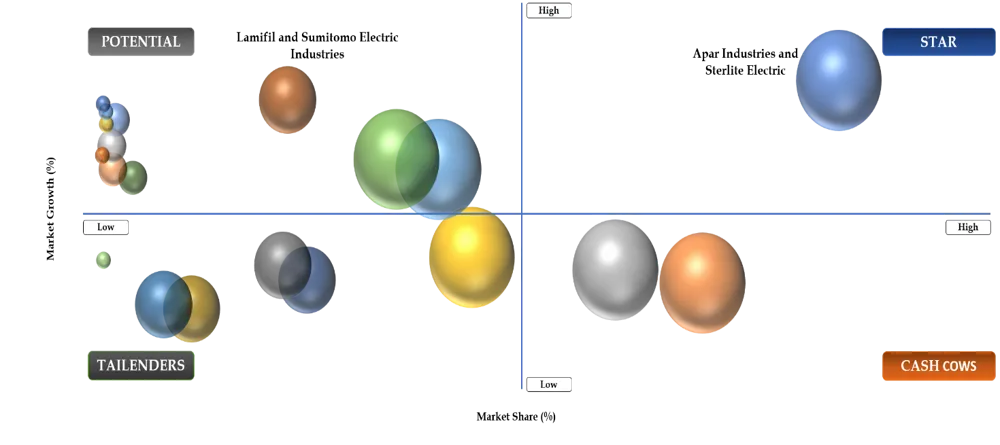
STAR
Apar Industries and Sterlite Electric are good companiess for the Star segment of the Indian overhead conductors market due to their already existing conductor business, large order book and their presence in more advanced conductors like HTLS and AL-59. The revenue earned by APAR from conductors increased by 32.7% in FY2025–26, whereas premium products contributed 45.8% towards their conductor revenue owing to increasing demand for better performing products. The positioning of the company is aided by grid extensions and investments in evacuation of renewable energy and reconductoring.
POTENTIAL
Potential growth opportunities exist in terms of specialisation within overhead conductors through Lamifil and Sumitomo Electric Industries, which offer advanced aluminium conductors and high-temperature low sag conductors. Transmission expansion, renewables incorporation and enhancement of current lines may present opportunities for these technologies.
Overhead Conductor Market Dynamics
Driver Impact Analysis
| Driver | Market Growth Impact (%) | Demand Concentration | Impacted Use Case | Strategic Impact |
Expansion and Modernization of Transmission and Distribution Networks | 32% | Asia-Pacific, North America and Europe | New overhead transmission lines, distribution network expansion and aging-grid replacement | Strengthens demand for ACSR, AAAC and other conventional conductors through utility infrastructure investments |
| Rising Renewable Energy Integration | 26% | China, India, United States and Europe | Grid connections for solar parks, wind farms and renewable energy evacuation corridors | Creates demand for high-capacity conductors and transmission infrastructure connecting remote generation to consumption centers |
| Reconductoring and Grid Capacity Upgrades | 24% | North America, Europe and India | Replacement of existing conductors and capacity enhancement on constrained transmission corridors | Supports adoption of HTLS and advanced composite-core conductors to increase power transfer capacity while limiting the need for new rights-of-way |
| Increasing Electricity Demand and Electrification | 18% | Asia-Pacific, North America and the Middle East | Urban distribution, industrial power supply, data center connections and electrification projects | Encourages utilities to expand network capacity and procure conductors suited to higher loads and long-term grid reliability |
Driver: Increasing Demand for Transmission Capacity Expansion and Grid Reconductoring
The growing consumption of electricity by data centers, industrial electrification and renewables integration is driving up the requirement for increased capacity in overhead transmission systems. The utility companies have been expanding their existing transmission facilities and also reconductoring their lines to relieve network congestion and handle the changes in power flow. HTLS and composite core conductors are especially useful where the utility companies require more power flow capacity, but they are restricted from building additional transmission structures or gaining more right-of-ways. This leads to an increase in the need for traditional conductors in the construction of new grids as well as the development of new conductor technologies for the improvement of existing transmission networks.
Restraint Impact Analysis
| Restraint | Drag on Market Growth (%) | Primary Impact Area | Impacted Use Case | Strategic Impact |
Volatility in Aluminium and Steel Raw Material Prices | 28% | Manufacturing costs, profit margins and procurement budgets | ACSR, AAC, AAAC and other aluminium-based conductor projects | Increases pricing uncertainty, complicates long-term tenders and pressures manufacturers to optimize sourcing and inventory management |
Right-of-Way Acquisition Challenges and Regulatory Approval Delays | 27% | Project timelines, route availability and infrastructure deployment | New transmission corridors and interregional grid expansion | Delays conductor procurement and commissioning, encouraging utilities to consider reconductoring existing lines where feasible |
High Initial Investment and Long Utility Procurement Cycles | 24% | Capital expenditure, tender approvals and project financing | Large-scale transmission projects and grid modernization programs | Can postpone orders, extend sales cycles and increase the importance of cost competitiveness, financing access and reliable delivery |
Environmental Constraints and Community Opposition to Transmission Projects | 21% | Route planning, permitting and social acceptance | Overhead transmission lines near populated areas and environmentally sensitive locations | Can trigger rerouting, additional mitigation costs or alternative infrastructure choices, affecting project feasibility and conductor demand timing |
Restraint: Right-of-Way Constraints and Transmission Project Approval Delays
Right-of-way acquisition, land use restrictions and extensive environmental approval processes may delay construction of overhead transmission lines. Projects in populated areas, agricultural areas, forests or ecological areas may have additional permitting requirements, landowner consultations and modifications that may increase costs and timelines of development. Such a situation may complicate the planning process of manufacturers involved in producing equipment for large utility companies. Although reconductoring an already existing line may decrease the requirement for additional transmission corridors, this is contingent upon the strength of towers, electrical clearances, loading capacity and compatibility of existing facilities with the conductor.
Overhead Conductor Market Segment Analysis
The global overhead conductor market is segmented based on the product type, material, voltage level, application, conductor technology, end-user and region.
By Product Type
Aluminium Conductor Steel Reinforced (ACSR) conductors Hold the Largest Share
Aluminium Conductor Steel Reinforced (ACSR) conductors had a market share of approximately 46.82% in the overhead conductors market in 2025 because of their high tensile strength, electrical conductivity and wide applicability in overhead transmission and distribution lines. Their steel reinforcement makes them ideal for large spans and tough mechanical requirements, while proven production techniques and compatibility with the grid make them cost-efficient to buy.
By Voltage Level
Extra-High-Voltage (EHV) conductors Outpace Overall Market Growth
Conductors of Extra High Voltage (EHV) are anticipated to witness around 8.4% CAGR in the forecast period, which will be higher than that of overall overhead conductor market CAGR of 6.70%. The drivers include investments made for development of long distance power transmission corridors and evacuation of power from solar & wind parks across regions. With utilities looking to transport power at larger distances, there is need for conductors having advanced electrical, mechanical & thermal properties.
Overhead Conductor Market Geographical Penetration
China Overhead Conductor Market Trends
The China overhead conductor market can be influenced by the development of ultra-high voltage (UHV) transmission systems, the incorporation of renewable energy sources and continued investments in electricity grid infrastructure. The transmission corridors that link renewable energy generation facilities located in western and northern China to the electricity-consuming centers provide demand for conventional aluminium conductors, such as ACSR and AAAC. Grid renewal and expansion of transmission capabilities can give rise to HTLS and composite-core conductors when there is a need for increased power transmission capability of existing grid infrastructure. China’s existing infrastructure of conductor manufacturers provides for large-scale production within the country and competition in standard conductors pushes producers to enhance their productivity and improve conductors technology.
India Overhead Conductor Market Analysis
The Indian overhead conductor market will see growth as a result of expansion of the transmission network, evacuation of renewable energy and upgrade of existing power infrastructure. During the financial year 2025-26, India constructed 12,139 circuit kilometers of transmission lines and in the conductors segment of the larger electrical equipment industry, growth was recorded at 18.4%. The government plan is geared towards expansion of the transmission network from about 5.09 lakh circuit kilometers of transmission network in June 2026 to 6.48 lakh circuit kilometers in 2032. This will present opportunities for growth in the use of conventional ACSR and AAAC conductors along with high-capacity ones. Development of renewable energy in Rajasthan and Gujarat as well as wind energy production in Tamil Nadu will see an increase in transmission line construction to evacuate power from the generators to the national grid. Upgrading older lines and using high temperature and low sag (HTLS) conductors will also assist utility companies in increasing their power transfer capacity where there are problems with right-of-way access.
U.S. Overhead Conductor Market Landscape
U.S. overhead conductor market is becoming more influenced by the age of transmission systems, growth of electricity consumption by data centers and high-tech industries and needs to integrate new energy production to current grids. In September 2026, the U.S. Department of Energy stated its plans to invest US$1.9 billion in federal funds for 31 grid enhancement projects in 26 states via SPARK program along with US$3.35 billion cost share from project recipients. Selected projects will re-conduct or reconstruct more than 1,500 miles of transmission lines, thus providing an opportunity to use higher capacity conductors and innovative transmission systems. These events promote conventional ACSR conductors as well as HTLS and composite core conductors, especially in the cases when current towers and ROW could be used. Nevertheless, the adoption of advanced overhead conductors is influenced by their costs, compatibility with infrastructure, utility procurement strategy and economic assessment of specific project, which makes feasibility, performance and lifecycle value of installations the key competitive parameters.
Japan Overhead Conductor Market Outlook
The overhead conductors market in Japan is driven by the replacement of old transmission systems, grid strengthening and requirements to interconnect renewable sources of energy that are far away from the major centers of electricity consumption. Reinforcement of the connection between Hokkaido and Honshu in the form of an extra 300 MW of capacity expected to be operational in March 2028 will include overhead-line portions as well. Increasing development of renewable energy in Hokkaido, Tohoku and Kyushu regions will require additional upgrades of the transmission systems and improvement of connections from those regions in order to increase electricity delivery to the centers of consumption. This creates an opportunity for the conventional ACSR conductors and HTLS conductors to be used in appropriate reconductoring and upgrading projects. However, considering Japan’s mountainous topography, lack of right of way, strict requirements of utilities and expensive installation costs, these elements become an important aspect in the choice of conductors.
Overhead Conductor Market Competitive Landscape
- Market for overhead conductors has a presence of international electrical goods companies, specialized conductors producers and regional vendors that compete in conventional as well as modern conductor types. The competitive position is determined by the range of products, production capacity, technology and meeting demands of transmission and distribution projects.
- There is tough competition among the standard products, such as ACSR, AAC and AAAC, as there are many vendors that can fulfill the technical requirements. The vendors distinguish themselves by efficient production, good material quality and delivery to utility companies for major contracts.
- Advanced conductor technology is another key differentiator for companies. Suppliers of HTLS, Gap-type and composite core conductors offer differentiation by virtue of their high thermal capability, low sag, engineering capabilities and performance in the field for reconductoring and high capacity transmission projects.
- Market access and utility contacts will be important for contract wins by suppliers. Suppliers that manufacture in regions, adhere to national standards, have partnerships with EPC contractors and understand the qualification processes of utilities will have higher chances of success.
- Competition is taking place through R&D, technology licensing and strategic alliances. Manufacturers are working on improving the material of conductors, strand configuration and manufacturing process and developing high-end products for network modernization and enhanced capacity in partnership with advanced core technology developers.
Public Company Q1-Q2 2026 Performance Comparison
The table below compares five publicly listed companies with direct or strategically relevant exposure to the overhead conductor market. Financial metrics are company-wide or segment-level because overhead conductor revenue is not consistently disclosed as a separate category. Performance drivers therefore distinguish overall financial results from direct conductor-market exposure.
| Company | Q1–Q2 2026 Performance | Overhead Conductor Exposure | Key Performance Driver |
| Prysmian S.p.A. | US$12.93 billion revenue; US$1.53 billion adjusted EBITDA; US$671.6 million net profit | Supplies overhead transmission solutions and power-grid products; reported financials also include substantial cable businesses. | Growth in digital solutions and power-grid infrastructure, supported by electricity transmission investment and the integration of Encore Wire. |
| Nexans S.A. | US$5.45 billion revenue; US$445.9 million adjusted EBITDA; US$121.8 million net profit | Relevant through power-transmission and electrification solutions; group results are not specific to bare overhead conductors. | Electrification demand, grid investment and expansion of its North American footprint. |
| Sumitomo Electric Industries, Ltd. | US$8.28 billion revenue; US$375.3 million operating profit; US$413.1 million net profit | Relevant through energy and power infrastructure products, although disclosed financials include businesses beyond overhead conductors. | Demand for power infrastructure, grid-related products and execution of domestic and international projects. |
| APAR Industries Limited | US$791.0 million revenue; US$97.6 million EBITDA; US$50.0 million net profit | Direct manufacturer of overhead conductors, including conventional and advanced conductor products. | Conductor demand, product mix and utility infrastructure investment, alongside growth in its cable and other businesses. |
| LS Eco Energy Ltd. | US$478.6 million revenue; US$34.1 million operating profit; US$20.7 million net profit | Strategically relevant to power-grid infrastructure, though reported results include products beyond overhead conductors. | Demand for power infrastructure and exports of extra-high-voltage cables, including growth linked to data-center and grid investment. |
Note: Financial periods differ by company and fiscal calendar. Revenue and profit figures are company-wide unless a specific segment is identified; they should not be interpreted as overhead conductor market revenue.
Key Companies of Overhead Conductor Market
- APAR Industries Limited (India)
- Southwire Company (United States)
- Prysmian Group (Italy)
- Nexans (France)
- Sumitomo Electric Industries (Japan)
- Lamifil NV (Belgium)
- Midal Cables Limited (Bahrain)
- Sterlite Electric (India)
- ZTT Group (China)
- Hengtong Group (China)
- Furukawa Electric Co., Ltd. (Japan)
- Elsewedy Electric (Egypt)
- Far East Cable Co., Ltd. (China)
- Jiangsu Dongfeng Cable Co., Ltd. (China)
- KEI Industries Limited (India)
- Polycab India Limited (India)
- Taihan Cable & Solution (South Korea)
- LS Cable & System (South Korea)
- Riyadh Cables Group (Saudi Arabia)
- Yifang Electric Group (China)
Company Profiles of Overhead Conductor Market
APAR Industries Limited
APAR Industries is an Indian company that deals with the manufacturing of overhead conductors, cables and specialty oils. The company's conductors are composed of conventional conductors such as AAC, AAAC, ACSR and ACAR and also high-temperature low-sag (HTLS) conductors. It also offers its clients turnkey reconductoring solutions to assist them in upgrading their current lines.
The company's competitive advantages include growth of export markets, increased production efficiency, enhanced advanced-conductor range and high capacity transmission line and renewable energy evacuation.
Southwire Company
Southwire is a US company producing cables and wires that serves electric utilities, transmission and distribution networks and industries. The relevant products are aluminum bare conductors used for transmission and distribution networks and aerial covered conductor systems used for distribution networks.
Priorities that can be competitive advantages include building strong relationships with utilities, increasing production efficiency, providing high-quality products and expanding the grid and reconductoring projects in North America.
Prysmian Group
Prysmian is an Italian company that produces cables for energy and telecommunications. The company has a much wider range of power transmission and distribution solutions than just the production of cables. In the market of overhead conductors, it needs to be estimated by its verifiable products of bare conductors and its applications in transmissions.
The competitive priorities would include improving on its portfolio of power grid, provision of reliable solutions for the transmission infrastructure and use of engineering expertise to meet rising demands for electricity. The cable-related operations of the company must be separated from production of overhead conductors.
Nexans
Nexans is an electrification company based in France that caters to the power transmission, distribution and other electrical infrastructure industries. While the products and services range across grid development and electrification, the company’s exposure to the overhead conductor industry must be proven through the availability of bare-conductor products.
Competitive focus areas for the company are expansion of electrification solutions, manufacturing efficiency, utility infrastructure projects and grid modernization. For market share analysis, its exposure to the overhead conductors market needs to be segregated from its overall cable business.
Sumitomo Electric Industries
Sumitomo Electric Industries Ltd is an electric utility product manufacturing company based out of Japan that manufactures various specialized types of overhead transmission conductors. Sumitomo Electric specializes in the production of such advanced conductor technologies like high-temperature low-sag and Invar core conductors which allow utility companies to upgrade line capacity while controlling conductor sag at elevated temperatures.
Competitive priorities include conductor performance enhancement, reduction in transmission losses, solutions for tough operating conditions and specialized conductor engineering for high capacity grid up-grades.
Lamifil NV
Lamifil is a company located in Belgium that specializes in manufacturing high-quality overhead conductors and aluminum conductor materials. Their product line includes traditional aluminum conductors as well as special technologies designed for use in transmissions in order to enhance current carrying capacity and sag management.
The areas of competitiveness include increasing the usage of advanced conductor technologies, delivery of high capacity conductors for existing grid networks, conductor efficiency enhancement and technical support for utilities in qualification and installations.
Overhead Conductor Market Major Pain Points
- Variability in aluminium and steel prices hampers efforts by conductor makers to stabilize their tender prices and procurement budgeting in order to protect their profitability margins in case of fluctuation in price of raw materials from the time of bidding to actual implementation of the contract.
- The long process involved in the technical testing, validation and utility qualification of HTLS conductors and composite core conductors can hamper the adoption of such new technology and increase the costs associated with their qualification process.
- Issues with land acquisition, getting environmental approvals and other right-of-way concerns can postpone construction activities and cause delays in ordering conductors as well as uncertainties in subsequent manufacturing activities or the timing of delivery.
- When existing transmission lines are to be upgraded, a full assessment of tower strength, conductor sag, electrical clearances, fittings and infrastructure compatibility must be carried out. If existing facilities cannot accommodate the new conductor, structural enhancement will be required which will add costs and make matters more complicated.
- The transport of the large drums of the conductor to remote project sites and its proper handling and stringing pose an additional challenge. Complex design of conductors may necessitate specialized equipment and labor to complete the installation task.
Overhead Conductor Market Recent Developments
- Diamond Power Infrastructure Ltd. - September 2026: Won an order valued at approximately ₹263.25 crore for power cables and overhead conductors for an urban electricity infrastructural project of the Maharashtra State Electricity Distribution Company Limited (MSEDCL).
- Transrail Lighting Ltd. - September 2026: Has won orders exceeding ₹574 crore, largely in the domestic transmission and distribution sectors, including substantial business for transmission-line reconductoring using HTLS conductors made by its Silvassa factory.
- APAR Industries Limited - August 2026: Entered into a strategic alliance with AssetCool for commercialization of photonic coated overhead conductors. This technology can lead to a capacity increase of up to 30%, or a reduction of about 10% in power losses under certain operational conditions.
- APAR Industries Limited - July 2026: Received orders from its conductor business of ₹5,245 crore in Q1 FY2026–27, with most orders coming from overseas, showing high demand for overhead conductors internationally.
- Diamond Power Infrastructure Limited - July 2026: Awarded an order of approx. ₹185.16 crore by Adani Energy Solutions for AL59 Moose and AL59 Zebra conductors for Tuticorin and Pune-III transmission projects.
Analyst View / Opinion on Overhead Conductor Market
- There is great potential for the overhead conductor industry owing to the need for increased capacity of utility grids to be able to accommodate renewable energy production and meet increasing energy demands.
- Upgrading the existing power transmission lines is an important strategy due to the fact that utilities can increase power transfer capacity without necessarily having to acquire new rights-of-way or construct new corridors. This is however contingent upon tower conditions and conductor performance.
- Traditional conductor types such as ACSR, AAC and AAAC will continue to have significance in conventional transmission and distribution projects, while HTLS and composite-core conductors can be utilized in projects where high-thermal capacity, low-sag, or high-capacity is needed within limited transmission corridors.
- A balance will always be necessary for manufacturers in terms of competitive pricing for tenders against profit. The cost of aluminum and steel, bulk purchases and stringent delivery dates necessitate that manufacturers are effective in their operations and processes.
- Competitive edge over the long term is contingent upon production reliability, quality of goods, qualifications and capability of carrying out complex infrastructure contracts. Suppliers who have both proven track record of conductors along with technological abilities can more effectively deal with the varying demands of both grid expansion and reconductoring.
Target Audience of Overhead Conductor Market
| INDUSTRY | WHO SHOULD BUY THIS REPORT? | REASON TO BUY THIS REPORT |
| Power Transmission and Distribution | Transmission system operators and distribution utilities | Evaluate conductor demand, grid expansion plans, reconductoring opportunities and procurement trends. |
| Overhead Conductor Manufacturing | Bare overhead conductor manufacturers and advanced conductor technology providers | Assess competitive positioning, product demand, manufacturing capacity and opportunities for portfolio expansion. |
| Renewable Energy | Solar and wind power developers | Identify conductor requirements for renewable energy evacuation, grid connections and new transmission infrastructure. |
| Power Grid Infrastructure | Transmission infrastructure developers and grid operators | Identify investment opportunities related to new transmission corridors, grid expansion and capacity upgrades. |
| Electrical Equipment and Accessories | Manufacturers of conductor fittings, connectors, clamps, insulators and line hardware | Evaluate demand for complementary overhead line components and identify utility procurement opportunities. |
| Engineering, Procurement and Construction (EPC) | Power transmission EPC contractors and engineering firms | Support project bidding, technical planning, conductor selection, sourcing and cost estimation. |
| Aluminium and Metal Production | Aluminium producers, alloy manufacturers and steel suppliers | Assess downstream demand for conductor-grade aluminium, aluminium alloys and reinforcing steel. |
| Energy and Infrastructure Investment | Infrastructure investors, private equity firms and investment funds | Evaluate market growth prospects, investment opportunities, competitive dynamics and emerging technologies. |
| Government and Energy Policy | Energy ministries, electricity authorities and infrastructure planning agencies | Assess grid expansion requirements, electrification priorities and transmission infrastructure investment needs. |
| Research and Consulting | Market research firms, strategy consultants and industry analysts | Access market segmentation, competitive intelligence, regional demand trends and growth opportunity assessments. |
Why Choose DATAM?
- Data-Driven insights: Dive into detailed analyses with granular insights such as pricing, market shares and value chain evaluations, enriched by interviews with industry leaders and disruptors.
- Post-Purchase Support and Expert Analyst Consultations: As a valued client, gain direct access to our expert analysts for personalized advice and strategic guidance, tailored to your specific needs and challenges.
- White Papers and Case Studies: Benefit quarterly from our in-depth studies related to your purchased titles, tailored to refine your operational and marketing strategies for maximum impact.
- Annual Updates on Purchased Reports: As an existing customer, enjoy the privilege of annual updates to your reports, ensuring you stay abreast of the latest market insights and technological advancements. Terms and conditions apply.
- Specialized Focus on Emerging Markets: DataM differentiates itself by delivering in-depth, specialized insights specifically for emerging markets, rather than offering generalized geographic overviews. The approach equips our clients with a nuanced understanding and actionable intelligence that are essential for navigating and succeeding in high-growth regions.
- Value of DataM Reports: Our reports offer specialized insights tailored to the latest trends and specific business inquiries. The personalized approach provides a deeper, strategic perspective, ensuring you receive the precise information necessary to make informed decisions. The insights complement and go beyond what is typically available in generic databases.
What DATAM Uniquely Provides
- In-depth study of standard conductors like ACSR, AAC, AAAC and ACAR as well as HTLS and composite core conductors, with a description of the differences between these conductors in terms of their application and relevance to transmission and distribution systems.
- Study of demand for conductors in new transmission lines, distribution systems, renewable energy and reconductoring, differentiating those opportunities created by new constructions from those created by existing system upgradation.
- Competitive analysis involving manufacturers products line, superior conductor performance, manufacturing advantages and position to determine possibilities for differentiation that do not solely depend on price in standardized conductors.
- Regional opportunities assessment for China, India, USA, Japan and other power major markets, taking into account priorities of investment in transmission, renewable energy interconnection, procurement activities of utilities, domestic manufacturing requirements and execution issues.
- Assessment of investments and risks with respect to advanced conductors manufacturing, efficiency of materials utilization and regional manufacturing growth along with risks associated with aluminum and steel prices, utility qualification periods and supply chain infrastructure compatibility.