


Organ Supplements Market Size and Overview
The global organ supplements market reached an estimated US$ 1.36 billion in 2025 and is expected to reach US$ 3.98 billion by 2035, growing at a CAGR of 11.3% during the forecast period 2026-2035. The market includes single-organ capsules, multi-organ complexes, organ and botanical blends, powders, tablets and food-based formats prepared primarily from bovine, ovine and porcine tissues. Growth is being driven by rising demand for nutrient-dense whole-food supplements, expansion of direct-to-consumer wellness brands, consumer interest in ancestral nutrition and increasing use of organ products among fitness, healthy-ageing and women’s-health consumers.
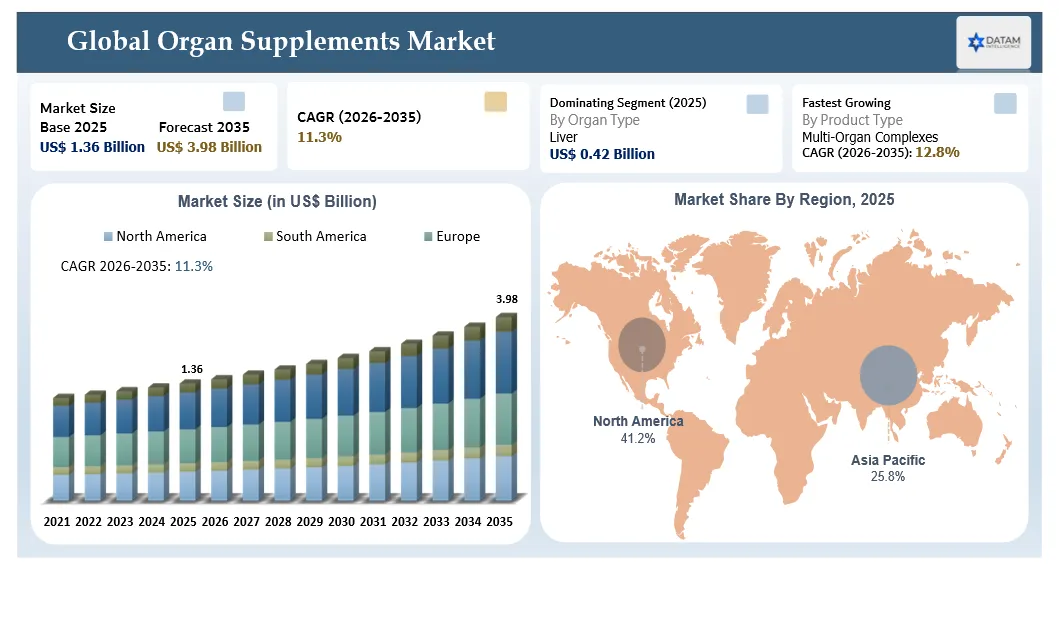
Liver supplements represent the largest organ segment because liver is widely associated with iron, vitamin B12, vitamin A, folate, copper and choline. Multi-organ blends are expanding faster as brands offer liver, heart, kidney, spleen and pancreas in one product and position the formulation as a convenient alternative to eating organ meat. Bovine sourcing dominates because cattle supply chains can provide larger volumes, recognizable grass-fed claims and established rendering or food-processing infrastructure. Capsules remain the leading form because they mask taste and odor, support precise serving sizes and fit subscription-led e-commerce models.
North America leads the market through high supplement use, strong direct-to-consumer distribution and a large community interested in paleo, carnivore and whole-food nutrition. Europe benefits from premium livestock traceability and specialty wellness demand, while Asia-Pacific is expected to grow fastest as cross-border e-commerce, sports nutrition and premium imported supplements expand. The category remains commercially attractive but requires careful quality positioning. Brands must manage microbiological safety, heavy metals, vitamin A exposure, allergens, species verification, origin claims and regulatory limits on disease-related marketing.
| Metric | 2025 / Forecast Indicator |
| 2025 Market Size | US$ 1.36 Billion |
| 2035 Projected Market Size | US$ 3.98 Billion |
| CAGR, 2026-2035 | 11.3% |
| Largest Region | North America, 41.2% |
| Fastest-Growing Region | Asia-Pacific |
| Largest Organ Type | Liver |
| Fastest-Growing Product Type | Multi-Organ Complexes |
| Leading Form | Capsules |
Organ Supplements Market Key Takeaways
Liver supplements lead commercial value because consumers readily understand their nutritional positioning and brands can offer both standalone and blended products.
North America held the largest share in 2025, supported by mature e-commerce, subscription purchasing, influencer-led education and premium supplement spending.
Multi-organ complexes are expected to record the fastest growth as buyers seek broad nutrient coverage through one convenient capsule regimen.
Bovine products dominate through scale, availability and the marketing value of grass-fed, pasture-raised and New Zealand or Australian sourcing claims.
Capsules remain the preferred form because they reduce sensory barriers, enable consistent dosing and fit direct-to-consumer fulfillment.
Third-party testing, species verification and batch traceability are becoming decisive competitive factors as the category moves beyond early adopters.
Limited product-specific clinical evidence constrains medical positioning and increases the importance of compliant structure/function claims.
Future leadership will depend on sourcing transparency, contaminant control, nutrient standardization, consumer education and credible practitioner engagement.
Organ Supplements Industry Trends and Strategic Insights
The category is moving from niche ancestral nutrition toward a broader whole-food supplementation proposition centered on convenience and nutrient density.
Brands are shifting from single liver capsules toward targeted complexes that combine organs with minerals, botanicals or digestive-support ingredients.
Sourcing stories increasingly emphasize grass-fed animals, pasture access, hormone-free claims, geographic origin and low-temperature processing.
Direct-to-consumer subscriptions are strengthening repeat purchase and giving brands first-party data on serving frequency, retention and product combinations.
Consumer skepticism is increasing demand for certificates of analysis, independent laboratory testing and clear nutrient or contaminant disclosures.
Practitioner channels are becoming more relevant for iron status, pregnancy planning, sports recovery and healthy ageing, although claims require careful substantiation.
Organ Supplements Market Scope
| Metrics | Details |
| 2025 Market Size | US$ 1.36 Billion |
| 2035 Projected Market Size | US$ 3.98 Billion |
| CAGR, 2026-2035 | 11.3% |
| Largest Market | North America |
| Fastest-Growing Market | Asia-Pacific |
| By Organ Type | Liver, Heart, Kidney, Spleen, Pancreas, Adrenal and Thyroid, Bone Marrow, Other Organs and Multi-Organ Blends |
| By Product Type | Single-Organ Supplements, Multi-Organ Complexes, Organ and Botanical Blends, Organ and Vitamin/Mineral Blends |
| By Animal Source | Bovine, Ovine, Porcine, Marine and Other Sources |
| By Form | Capsules, Powders, Tablets, Softgels/Liquids and Food-Based Formats |
| By Health Positioning | General Wellness, Energy, Iron/Blood Support, Sports Recovery, Healthy Ageing, Digestive/Metabolic and Other Positioning |
| By Distribution Channel | Online/DTC, Specialty Stores, Pharmacies, Mass Retail and Practitioner Channels |
| Report Insights Covered | Market Size, Share, Growth, Regulation, Consumer Trends, Competitive Landscape and Country-Level Opportunity |
Why does this report matter in 2026?
The year 2026 is an important transition point for the Organ Supplements market because the category is moving from a highly specialized ancestral-wellness niche into a more visible segment of mainstream supplementation. Consumer interest in whole-food nutrition, healthy ageing, iron status, energy and protein-rich dietary patterns is increasing the number of first-time buyers. At the same time, mainstream attention brings greater scrutiny of product claims, ingredient identity, vitamin exposure, microbiological safety and sourcing transparency. Companies that built early growth through social media must now develop quality systems and evidence practices that can support wider retail and practitioner adoption.
The report matters because organ supplements are not a uniform category. Demand differs by organ, source species, processing method, dosage form, health positioning and consumer group. Liver has broad recognition, while heart, kidney, spleen and glandular products depend on more specialized education. Multi-organ products can simplify purchase decisions but also create challenges in nutrient standardization and labeling. The study separates these opportunities and evaluates how channel strategy, price, testing and origin claims influence conversion and retention.
Strategic decisions made in 2026 will shape brand positioning for the remainder of the decade. Companies are deciding whether to remain premium direct-to-consumer specialists or pursue practitioner, pharmacy and mass-retail channels. Ingredient suppliers are evaluating dedicated freeze-drying and traceability systems, while retailers are tightening quality requirements. This report supports portfolio prioritization, sourcing partnerships, manufacturing planning, market entry, claims governance and investment assessment across the value chain.
Organ Supplements Market White Space & Investment Opportunities
Women’s nutrition products with controlled iron, vitamin B12, folate and choline positioning can address demand while providing clear warnings for pregnancy and high vitamin A intake.
Sports and active-ageing formulations can combine organ ingredients with creatine, electrolytes or protein-support nutrients while avoiding exaggerated performance claims.
Batch-level certificates of analysis, QR-code traceability and species authentication can create a premium trust proposition.
Odor-controlled powders, smaller capsules and lower-pill-count concentrates can reduce adherence barriers associated with existing products.
Practitioner education and laboratory-linked nutrition programs can move the category beyond influencer-led discovery toward more informed use.
Regional sourcing platforms in Australia, New Zealand, Europe and Latin America can convert underutilized edible organs into higher-value supplement ingredients.
Organ Supplements Future Market Transformation
The market is expected to transform from a collection of niche glandular products into a more structured whole-food supplement category. Standardized specifications for moisture, protein, vitamin content, species identity and contaminants will become more important as retailers and consumers compare products. Leading brands will use traceability and testing as core marketing assets rather than back-office compliance. Ingredient processors may offer standardized organ powders with documented origin, low-temperature processing and validated pathogen controls, allowing brands to scale without compromising consistency.
Product architecture will become more targeted. General multi-organ blends will remain important, but formulations for women, athletes, older adults and consumers following restrictive diets will expand. Companies will need to balance nutrient density with safe serving levels, especially for vitamin A, copper and iron. Digital questionnaires, subscription data and laboratory partnerships may support more personalized recommendations, although brands must avoid crossing into diagnosis or treatment claims.
By 2035, the strongest franchises are likely to combine trusted sourcing, transparent testing, compliant education and omnichannel distribution. Direct-to-consumer channels will continue to generate data and recurring revenue, while specialty retail and practitioner channels will provide credibility. Private-label manufacturing will also expand as established supplement companies enter the category. Competitive advantage will depend less on novelty and more on repeatable quality, consumer tolerance, evidence and responsible communication.
Organ Supplements Market Buyer Decision-Making Criteria
Consumers prioritize animal source, country of origin, grass-fed or pasture-raised claims, processing method, capsule count, serving size, odor, price and perceived nutrient coverage. Buyers often compare single liver products with multi-organ complexes and evaluate whether a product provides transparent milligram quantities for each ingredient. Reviews, practitioner recommendations and social-media education influence discovery, but repeat purchase depends on tolerance, convenience and confidence in product quality.
Retailers and practitioners apply additional criteria. They assess current good manufacturing practice, allergen controls, microbiological testing, heavy metals, species identity, certificates of analysis, claim compliance and adverse-event procedures. Procurement decisions also consider supply continuity, shelf stability, packaging integrity and margin. Brands that provide clear specifications, batch documentation and conservative claims are better positioned for professional channels and international expansion.
Organ Supplements Market Economic & Investment Analysis
Organ supplements convert a relatively low-value animal-processing by-product into a premium consumer-health product. The economic model depends on access to food-grade organs, rapid chilling or freezing, transport to processing facilities, freeze-drying or dehydration, milling, testing, encapsulation and branded distribution. Raw material cost is only one component of final price. Yield loss during drying, quality controls, small production runs, packaging, digital customer acquisition and subscription fulfillment can materially influence gross margin. Premium brands may achieve strong unit economics, but marketing costs and consumer churn can offset attractive product-level margins.
Investment analysis should distinguish between brand-led and infrastructure-led opportunities. Brand-led investments focus on customer acquisition, content, product development and retail expansion. Infrastructure investments include dedicated low-temperature drying, food-safety controls, species verification, contaminant testing and traceable livestock sourcing. Contract manufacturers with validated organ-handling capabilities can serve multiple brands and reduce the capital required for new entrants. Ingredient processors can create defensible positions through long-term supply agreements with slaughterhouses and ranch networks.
Forecasts should separate awareness from sustainable demand. Social-media attention can generate rapid trial, but long-term revenue depends on repeat purchase and consumer confidence. Investors should model acquisition cost, subscription retention, return rates, product complaints, average daily serving and the effect of capsule burden. They should also evaluate the regulatory risk of aggressive claims, because warning letters or marketplace removals can damage a brand and increase retailer caution.
Geographic expansion creates both opportunity and cost. Imported products may face tariffs, veterinary documentation, food-safety rules, language-specific labeling and different treatment of animal-derived ingredients. Companies with regionally diversified sourcing can reduce disruption, but each supplier requires qualification. The strongest investment cases combine recurring direct-to-consumer revenue with quality infrastructure, conservative claims and a credible path into retail or practitioner channels.
Organ Supplements Investment Trends in the Market
Capital is moving toward premium direct-to-consumer brands that combine subscription revenue, strong content communities and high repeat-purchase potential.
Ingredient processors are investing in low-temperature drying, milling and pathogen-control capabilities suitable for food-grade organ materials.
Brands are allocating more resources to third-party testing, certificates of analysis, traceability and quality communication as consumer scrutiny increases.
Private-label and contract-manufacturing capacity is expanding as established supplement companies test the category without building dedicated plants.
Investment is increasing in targeted formulations for women, athletes, healthy ageing and carnivore or paleo consumers rather than undifferentiated multi-organ blends.
Strategic partnerships are linking livestock suppliers, freeze-drying specialists, testing laboratories, e-commerce operators and nutrition practitioners.
Strategic Indicators for Organ Supplements Market
High Regulation Impact
Dietary supplements are regulated as foods in the U.S., and manufacturers are responsible for safety, identity, labeling and compliant claims before sale. FDA can act against adulterated or misbranded products after marketing. Disease-treatment claims can cause a product to be regulated as a drug. Animal-derived ingredients also require food-safety, import and species documentation. Regulatory discipline is therefore central to channel access and brand durability.
High Investment Activity
Investment is concentrated in consumer brands, contract manufacturing, traceable sourcing and quality testing. The category attracts founders because products can be launched through e-commerce, but scalable growth requires working capital for inventory, customer acquisition and batch testing. Investors increasingly favor brands with repeat revenue and defensible supply relationships.
Supply Chain Disruption
Organ materials are linked to livestock slaughter volumes, regional food-safety rules, cold-chain timing and processing capacity. Drought, animal disease, trade restrictions or plant closures can reduce supply. Freeze-drying slots may also be limited. Companies are diversifying suppliers and holding safety stock of stable powders.
Pricing Volatility
Premium sourcing, low-temperature processing, capsule count and testing can create wide price differences. Promotional intensity in online marketplaces increases pressure on smaller brands. Consumers may compare products by price per serving without understanding organ quantity or quality. Transparent specifications help defend premium pricing.
Procurement Pressure
Retailers and practitioners increasingly request cGMP documentation, certificates of analysis, contaminant limits, allergen controls and substantiation for claims. Brands seeking wider distribution must support vendor audits and consistent supply. Procurement pressure is likely to increase as the category becomes more visible.
New Technology Adoption
Freeze-drying, DNA-based species authentication, rapid microbiological testing, QR-code traceability and improved encapsulation are changing product quality. E-commerce analytics and subscription platforms help brands forecast demand and personalize communication. Adoption is fastest among premium brands using transparency as differentiation.
Regional Expansion Opportunity
North America remains the largest market, while Europe and Australia provide premium sourcing and wellness demand. Asia-Pacific offers growth through cross-border e-commerce and sports nutrition. Expansion requires country-specific labeling, import documentation, cultural acceptance and channel partners.
Government Policy Support
The category does not rely on direct government reimbursement, but food-safety systems, livestock traceability and export promotion can support supply development. Clear dietary-supplement guidance and enforcement against misleading products can improve confidence in compliant brands.
Pricing Intelligence
Single liver capsules compete at lower price points, while multi-organ and specialty glandular products command premiums. Brands should track price per daily serving, organ mass, capsule count, testing disclosure and subscription discount. Product architecture and retention matter more than list price alone.
AI Impact Analysis of Organ Supplements Market
AI can support demand forecasting, subscription-retention analysis, customer-service triage and product recommendation. Brands can use purchase history, dietary preferences and reported goals to suggest appropriate products while maintaining clear boundaries between general wellness education and medical advice. Natural-language tools can identify recurring questions about serving size, sourcing and tolerance, helping companies improve product pages and reduce returns.
AI can also strengthen quality and regulatory operations. Systems can review labels and advertising for risky disease claims, detect inconsistencies between specifications and marketing copy and analyze adverse-event or complaint data for emerging signals. Computer vision may support raw-material inspection, while predictive models can improve inventory planning around livestock supply and drying capacity. Human review remains essential because recommendations involving pregnancy, iron status, vitamin A exposure or medical conditions require professional judgment.
Disruption Analysis of Organ Supplements Market
Direct-to-consumer commerce has disrupted the traditional supplement value chain by allowing small brands to educate consumers, sell subscriptions and build communities without national retail placement. Influencer-led content has accelerated awareness, but it has also increased the risk of unsupported claims. As the category matures, retailers, practitioners and testing organizations are becoming more important, shifting competitive advantage toward brands that can prove quality rather than relying only on narrative.
Traceability technology is another source of disruption. Batch-level origin records, digital certificates of analysis and species verification can reduce information asymmetry and expose weak sourcing claims. Improved dehydration and odor-control methods may make powders and food formats more acceptable. At the same time, personalized nutrition and laboratory-guided supplementation may fragment the market into narrower use cases, rewarding companies that can explain product suitability and limits responsibly.
DataM Intelligence expects double-digit growth through 2035, but category expansion will be uneven. Liver and multi-organ capsules will capture most revenue, while specialist glandulars remain smaller practitioner-led niches. The market can become a durable segment of whole-food supplementation if companies improve evidence, quality transparency and safety communication. Aggressive claims and opaque marketplace products remain the greatest threats. Strategic value is strongest where brands combine traceable supply, repeat-purchase economics and a pathway into trusted retail or practitioner channels.
Organ Supplements Market BCG Matrix: Company Evaluation
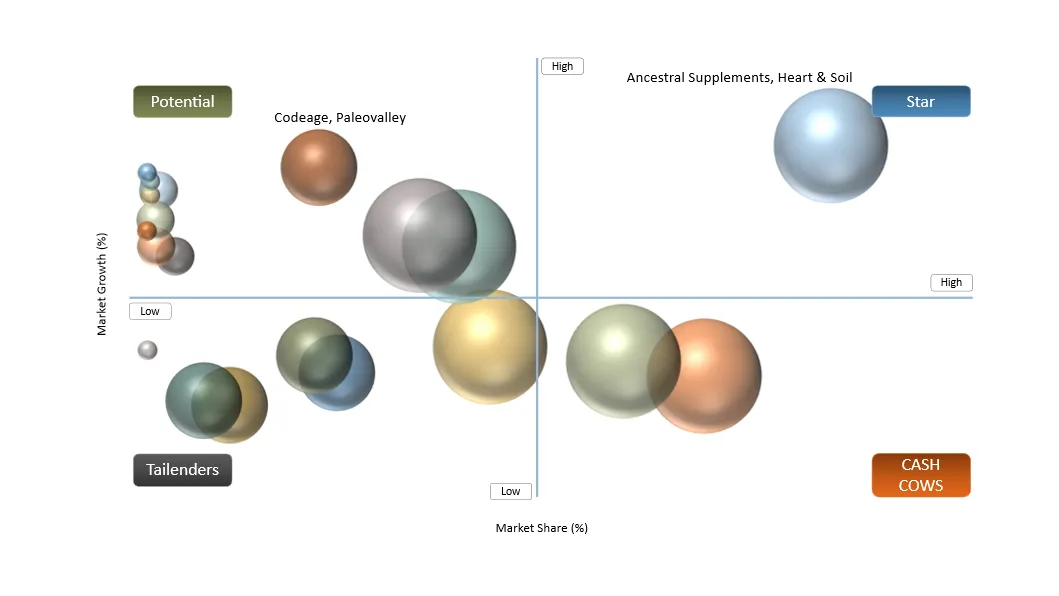
| Quadrant | Representative Companies / Offerings | Strategic Interpretation |
| Stars | Ancestral Supplements, Heart & Soil | High category recognition, broad product portfolios and strong direct-to-consumer communities support growth and repeat purchase. |
| Potential | Codeage, Paleovalley, Ancient Nutrition, Perfect Supplements | Established supplement capabilities and growing organ-product visibility create share-gain potential through retail expansion and formulation innovation. |
| Cash Cows | Large multivitamin and specialty supplement brands with liver or glandular lines | Existing distribution, manufacturing and customer bases support steady revenue, although organ supplements may remain a small portfolio category. |
| Tailenders | Small marketplace-only brands with limited testing disclosure | Low differentiation and weak trust signals make retention difficult as consumers and retailers demand stronger quality evidence. |
Ancestral Supplements and Heart & Soil are positioned as Stars because they have strong category association, broad organ-based portfolios and education-led direct-to-consumer models. Potential players include Codeage, Paleovalley and other established wellness brands that can use existing distribution and customer acquisition capabilities to expand the category. Market position will depend on quality transparency, retention, pricing and the ability to enter professional channels without relying on aggressive claims.
Organ Supplements Market Dynamics
Driver Impact Analysis
| Driver | Market Growth Impact | Demand Concentration | Impacted Use Case | Strategic Impact |
Demand for nutrient-dense whole-food supplements | High | North America and Europe | General wellness and energy | Expands the category beyond carnivore and paleo early adopters. |
Growth of direct-to-consumer wellness brands | High | Online channels | Subscription and repeat purchase | Reduces entry barriers and enables data-driven commercialization. |
Interest in ancestral and high-protein diets | Medium-High | Fitness and lifestyle consumers | Multi-organ and liver products | Improves awareness but can create trend-driven volatility. |
Improved sourcing a nd testing transparency | Medium | Premium brands | Retail and practitioner adoption | Builds trust and supports higher prices. |
Driver: Nutrient-Dense Whole-Food Supplementation Expands the Addressable Market
Consumers seeking less synthetic or more food-derived supplementation are turning to organ capsules as a convenient way to obtain nutrients associated with liver, heart and other tissues. The category benefits from awareness of vitamin B12, heme iron, choline and coenzyme Q10, although nutrient content varies by raw material and processing. Brands can expand demand by providing transparent composition, realistic serving guidance and education that complements rather than replaces balanced diets and professional care.
Restraint Impact Analysis
| Restraint | Drag on Growth | Primary Impact Area | Impacted Use Case | Strategic Impact |
| Limited product-specific clinical evidence | High | Claims and practitioner confidence | Health-specific positioning | Restricts disease-related messaging and requires conservative education. |
| Quality and traceability concerns | High | Consumer trust and retail access | All products | Increases testing cost and disadvantages opaque supply chains. |
| High capsule burden and sensory concerns | Medium | Adherence | Daily use | Can reduce repeat purchase and encourage concentrated formats. |
| Vitamin A, iron and copper exposure concerns | Medium-High | Safety communication | Liver-rich products | Requires clear serving guidance and warnings for sensitive users. |
Restraint: Evidence and Safety Communication Limit Mainstream Medical Adoption
Organ foods are nutrient dense, but evidence for specific branded supplement outcomes remains limited. Consumers may assume that an organ product will treat fatigue, anemia, thyroid disease or other conditions, creating regulatory and safety risk. Liver-rich products can provide substantial vitamin A, iron or copper, and suitability differs by diet, pregnancy status, medication use and medical history. Companies must avoid disease claims, provide responsible warnings and encourage professional consultation when appropriate. Transparent testing and conservative communication are essential for long-term category credibility.
Organ Supplements Market Segment Analysis
The global organ supplements market is segmented based on organ type, product type, animal source, form, health positioning, distribution channel, and region.
By Organ Type
Liver Supplements Will Continue to Lead Commercial Value
Liver supplements are expected to remain the largest segment through 2035 because liver has the strongest consumer recognition and the broadest nutritional narrative. It is used in standalone products and as the foundation of multi-organ blends. Heart, kidney, spleen and pancreas products serve narrower use cases and require more education. Multi-organ blends will grow faster because they reduce decision complexity and provide a broader ancestral-food proposition. Competitive differentiation in liver products will increasingly depend on source origin, nutrient disclosure, capsule burden and contaminant testing.
By Product Type
Multi-Organ Complexes Will Record the Fastest Growth
Single-organ supplements lead current value, with beef liver as the entry product for many consumers. Multi-organ complexes are expected to grow fastest because they combine liver, heart, kidney, spleen and pancreas in one regimen. This format supports premium pricing and subscription bundles, but brands must disclose ingredient quantities and avoid implying tissue-specific therapeutic effects. Organ and botanical blends will expand in targeted wellness products, while vitamin or mineral combinations can improve consumer familiarity and allow more explicit nutrient-content positioning.
By Animal Source
Bovine Sources Will Remain Dominant
Bovine ingredients dominate because cattle processing generates scalable organ volumes and because grass-fed or pasture-raised beef has strong consumer recognition. New Zealand, Australia, the U.S., Argentina and selected European countries are important sourcing locations. Ovine products may appeal to consumers seeking alternative ruminant sources, while porcine glandulars have a history in practitioner channels but face religious and cultural restrictions. Marine and other sources remain small and require careful allergen and species disclosure.
By Form
Capsules Will Retain the Largest Share
Capsules lead because they mask taste and odor, provide a clear daily serving and support e-commerce fulfillment. The main limitation is pill burden, as many products require four to six capsules per day. Powders can offer larger serving sizes and use in smoothies or savory foods, but sensory acceptance is more difficult. Tablets and softgels remain limited by formulation constraints. Food-based seasonings and snack formats may attract new buyers by integrating organ ingredients into ordinary meals.
By Health Positioning
General Nutrition and Wellness Will Remain the Largest Positioning
General wellness leads because it allows brands to communicate broad nutrient density without relying on narrow medical claims. Energy and vitality, iron and blood health support and sports recovery are commercially important but require careful substantiation and warnings. Healthy-ageing positioning is expected to grow as consumers seek protein, choline, B vitamins and coenzyme Q10. Future success will depend on matching the product to a credible nutrient rationale while avoiding unsupported claims that an organ supplement directly improves the corresponding human organ.
By Distribution Channel
Online and Direct-to-Consumer Will Control Market Growth
Online and direct-to-consumer channels lead because category education, subscription purchasing and product comparison occur digitally. Brands can explain sourcing, processing and use through long-form content, while marketplaces provide rapid reach. Specialty stores and practitioner channels add credibility and allow guided selection. Pharmacies and mass retailers represent long-term expansion opportunities but require stronger vendor qualification, stable supply, compliant claims and evidence that the category can generate repeat sales beyond online trend cycles.
Organ Supplements Market Geographical Penetration
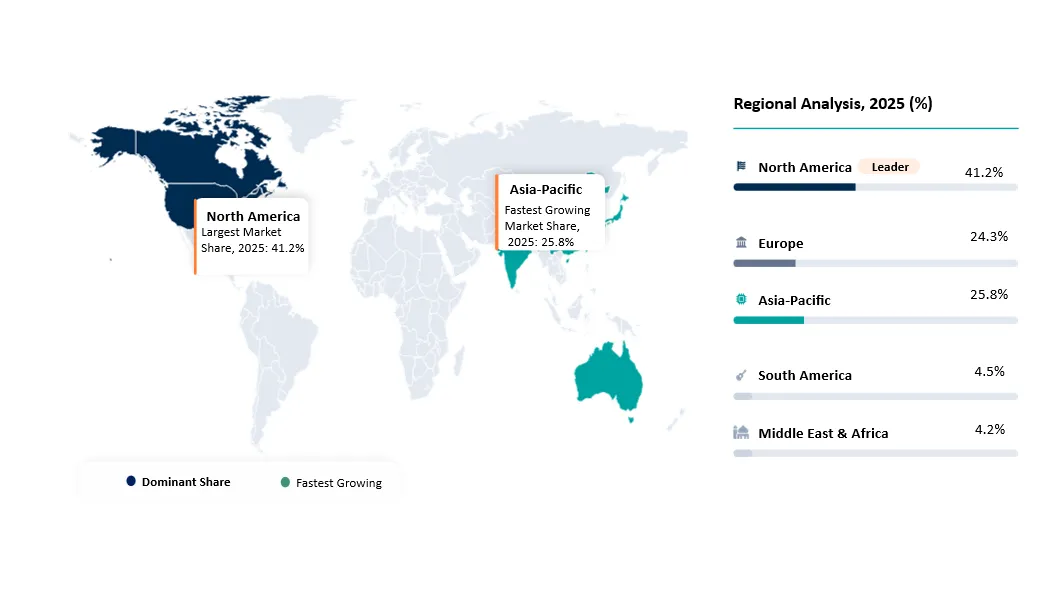
| Region | 2025 Share | Market Position | Key Growth Factors |
| North America | 41.2% | Largest | High supplement use, DTC brands, subscription commerce and ancestral-diet communities |
| Europe | 24.3% | Established | Premium livestock sourcing, specialty wellness and quality-focused consumers |
| Asia-Pacific | 25.8% | Fastest Growing | Cross-border e-commerce, sports nutrition, premium imports and expanding middle class |
| South America | 4.5% | Emerging | Livestock supply, urban wellness demand and export potential |
| Middle East and Africa | 4.2% | Emerging | Premium Gulf demand, practitioner channels and online retail |
Middle East and Africa Organ Supplements Market Outlook
Demand is concentrated in the UAE, Saudi Arabia, Israel and South Africa, where premium supplements and e-commerce are expanding. Halal requirements and species transparency are important in Muslim markets. Affordability and limited category awareness constrain broader adoption. Partnerships with specialty retailers and practitioners can improve trust and education.
Europe Organ Supplements Market Outlook
Europe offers a quality-focused supplement market with strict expectations for labeling, composition and consumer protection. Demand is concentrated in specialty wellness, practitioner and online channels. Products must navigate European rules on food supplements, novel foods, animal-derived ingredients and health claims. Opportunity is strongest for traceable products with clear specifications and conservative communication.
U.S. Organ Supplements Market Landscape
The U.S. is the largest national market because it combines high supplement penetration, mature e-commerce, strong direct-to-consumer brands and active paleo, carnivore and functional-nutrition communities. Consumers have access to a wide range of liver, multi-organ and glandular products at premium price points. Growth will depend on broader retail adoption, responsible claims, third-party testing and differentiation beyond social-media marketing.
China Organ Supplements Market Outlook
China is an emerging market for imported premium supplements, although cultural familiarity with organ foods creates a different value proposition. Cross-border e-commerce can support trial among wellness and sports consumers. Regulatory registration, import rules and product education are important. Brands must explain convenience and quality without implying medicinal effects.
Organ Supplements Market Competitive Landscape
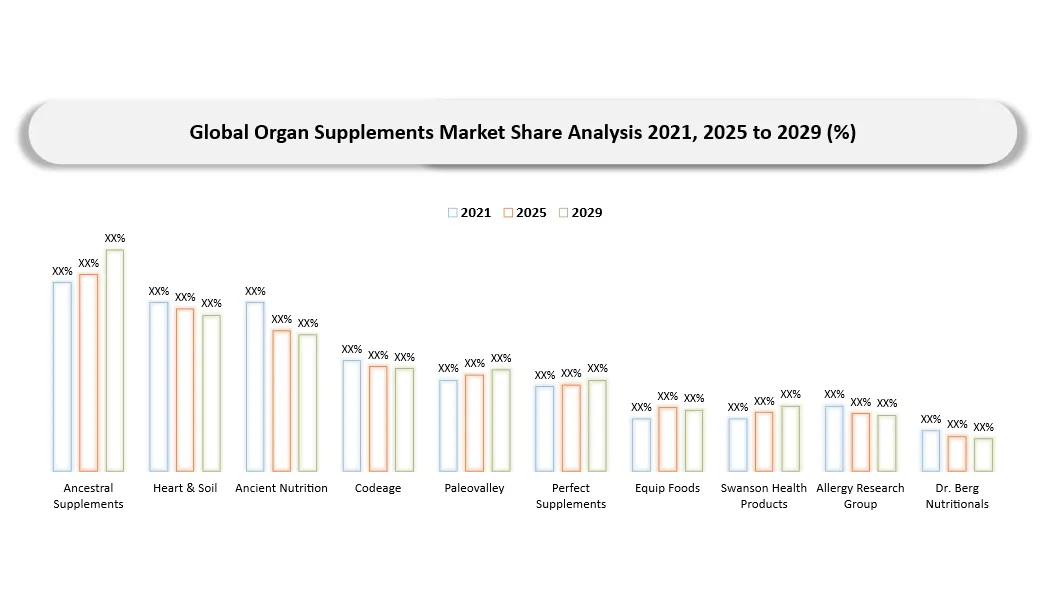
Competition is fragmented, with specialist ancestral-nutrition brands competing against broader supplement companies and marketplace private labels.
Ancestral Supplements and Heart & Soil have strong category association, while Codeage, Paleovalley and other diversified wellness brands can use existing customer bases and retail relationships.
Differentiation is shifting toward source origin, grass-fed claims, testing transparency, capsule burden, ingredient quantities and subscription value.
Large supplement manufacturers can enter through private-label partnerships, but they must build consumer education and secure reliable organ supply.
Online marketplaces increase price comparison and imitation risk, making brand trust, community and quality documentation important defenses.
Partnerships with livestock suppliers, freeze-drying specialists, laboratories, practitioners and retailers are central to scalable growth.
Competitive intensity will increase as the category moves beyond early adopters. Specialist brands benefit from authenticity and community, while diversified supplement companies can offer broader distribution and lower acquisition costs. Market share will depend on repeat purchase, quality consistency and the ability to communicate benefits without regulatory overreach. Retailers may rationalize product ranges around a smaller number of well-documented suppliers, increasing the value of cGMP systems, certificates of analysis and reliable inventory.
Key Companies of Organ Supplements Market
Ancestral Supplements
Heart & Soil
Codeage
Paleovalley
Perfect Supplements
Ancient Nutrition
ForestLeaf
Wholesome Wellness
Peak Performance
Carlyle Nutritionals
Allergy Research Group
NXGEN Wholefoods
Hunter & Gather
Pluck
Enviromedica
Mitolife
Dr. Berg Nutritionals
Swanson Health Products
Nutriest
Equip Foods
Organ Supplements Market Major Pain Points
Limited product-specific clinical evidence and high risk of consumer overinterpretation.
Variation in nutrient content by organ, animal diet, processing and serving size.
Microbiological, heavy-metal, allergen and species-identity quality requirements.
High capsule burden and potential taste or odor concerns.
Risk of excessive vitamin A, iron or copper intake in some users.
Fragmented livestock and freeze-drying supply chains.
Claims compliance challenges across social media, affiliates and international markets.
Difficulty moving from influencer-led trial to durable mainstream repeat purchase.
Organ Supplements Market Recent Developments
March 2026: FDA announced a public meeting on dietary-supplement innovation and the scope of dietary ingredients, highlighting continued regulatory attention to category definitions and modern wellness products.
December 2025: FDA issued an industry letter addressing the DSHEA disclaimer, reinforcing the importance of compliant presentation of structure/function claims.
June 2025: FDA released educational materials on the New Dietary Ingredient notification process, increasing attention to ingredient history and premarket responsibilities.
2025-2026: Premium supplement brands expanded use of grass-fed sourcing, freeze-dried processing, subscription bundles and multi-organ formulations across direct-to-consumer channels.
2025-2026: Retailers and consumers increased demand for third-party testing, certificates of analysis and transparent sourcing in animal-derived supplement categories.
Analyst View/Opinion on Organ Supplements Market
The organ supplements market has credible growth potential because it connects several durable consumer themes: whole-food nutrition, convenience, healthy ageing, high-protein diets and demand for products with recognizable ingredient stories. The category will remain attractive to direct-to-consumer brands, but sustainable expansion requires a transition from narrative-led marketing to documented quality. The strongest companies will standardize specifications, verify species and origin, disclose realistic serving quantities and communicate limitations clearly.
Liver will remain the commercial anchor, while multi-organ complexes provide the strongest portfolio expansion opportunity.
North America will retain leadership, but Asia-Pacific and premium export markets can generate faster growth from a smaller base.
Third-party testing and traceability will become as important as formulation innovation.
Practitioner and specialty-retail channels can improve credibility, but they require stronger documentation and conservative claims.
Consumer safety communication around vitamin A, iron, copper and pregnancy will influence long-term trust.
Companies that integrate sourcing, manufacturing, testing, education and subscription analytics will outperform product-only marketplace competitors.
Organ Supplements Market Target Audience
| Industry | Who Should Buy This Report? | Reason to Buy This Report |
| Supplement Brands | Portfolio, product, commercial and business-development teams | Assess segments, product architecture, channel strategy and competitive positioning. |
| Ingredient Suppliers | Livestock processors, organ-powder suppliers and freeze-drying companies | Evaluate demand, quality requirements, sourcing regions and partnership opportunities. |
| Contract Manufacturers | Capsule, powder and private-label manufacturers | Understand capacity needs, specifications and customer requirements. |
| Retail and E-commerce | Category managers, marketplaces and specialty retailers | Assess product selection, vendor qualification, pricing and consumer trends. |
| Testing and Certification | Laboratories, auditors and traceability providers | Identify demand for species, contaminant and quality verification. |
| Investors and Consulting | Private equity, venture capital, lenders and strategy consultants | Evaluate growth, risks, business models and acquisition opportunities. |
| Regulators and Associations | Food authorities, trade groups and consumer organizations | Understand category development, claims risks and safety priorities. |
Why Choose DATAM?
Data-driven insights combining market sizing, product-level pricing, channel availability, consumer adoption and sourcing analysis.
Post-purchase analyst consultations for market entry, portfolio design, partner identification and custom country analysis.
Annual report updates covering regulation, product launches, channel expansion, partnerships and competitive changes.
Specialized focus on emerging wellness categories and regional commercialization rather than generalized supplement summaries.
Actionable analysis connecting consumer demand with ingredient sourcing, quality systems, claims governance and distribution.
What DATAM Uniquely Provides
Ten-year forecasts across organ type, product type, animal source, form, health positioning, distribution channel and region.
Product-specific analysis separating liver, multi-organ, glandular and targeted blend opportunities.
Buyer-focused analysis of sourcing, processing, testing, serving size, price and trust signals.
Country-level views linking supplement use, e-commerce, regulation and animal-protein supply.
Strategic recommendations for supplier partnerships, manufacturing, retail expansion and market entry.
Competitive assessment covering specialist brands, diversified supplement companies and private-label participants.
Questions This Report Answers
How will the global Organ Supplements market evolve from 2025 through 2035?
Which organ types, product formats and consumer positions offer the strongest opportunity?
How will multi-organ complexes reshape competition with standalone liver supplements?
Which quality, testing and claims requirements constrain mainstream adoption?
Where are the strongest sourcing and contract-manufacturing opportunities?
How should companies balance direct-to-consumer growth with retail and practitioner expansion?
Which regions offer the best combination of consumer demand, supply and regulatory feasibility?


























































