


Optical Circuit Switches Market Size and Overview
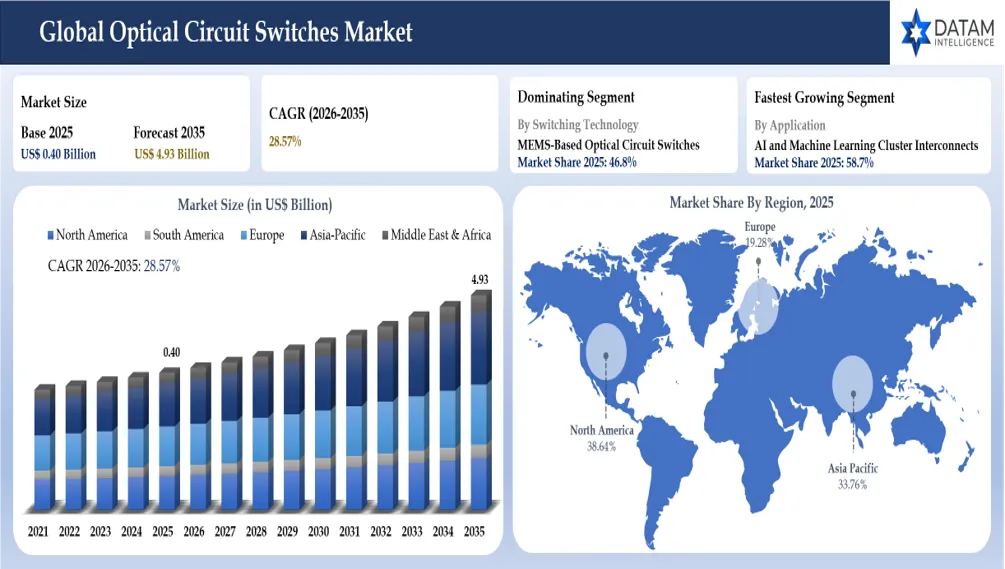
The global optical circuit switches market reached US$ 0.40 billion in 2025 and is expected to reach US$ 4.93 billion by 2035, growing with a CAGR of 28.57% during the forecast period 2026-2035.
The market is getting momentum because of increased demand from hyperscale data centers and AI infrastructure providers for scalable and power-efficient connectivity of GPU and accelerator clusters. Optical circuit switches provide an optical connection path that is reconfigurable as per network needs without relying on optical to electrical to optical conversion at the switch. As per Cignal AI’s July 2026 prediction, the OCS market is expected to cross US$ 8 billion by 2030 with GPU scale-up networking as yet another growth area in addition to existing TPU implementations.
Commercial market success would be contingent upon the capability of suppliers to develop OCS technologies that can support higher port densities, lower insertion losses, reliable switching, and network reconfigurations controlled by software. There are currently three leading approaches being developed to cater to varying needs, which are the MEMS, liquid-crystal, and silicon-photonics solutions. These are evaluated based on various considerations by hyperscale companies, such as network management and total cost of ownership. Thus, the move from dedicated deployments to more widespread use will hinge on showing the benefits in terms of performance, maturity of the ecosystem, and qualification of the OCS system in AI data centers.
Optical Circuit Switches Market Key Takeaways
- MEMS-based optical circuit switches held a dominant position in the global optical circuit switches market in 2025, holding 46.8% market share, owing to their high port density, low insertion loss, reliable optical path switching capability, and ability to be used in hyperscale data centers.
- AI and Machine Learning cluster interconnects will be among the fastest-growing application segments due to the rise of GPU clusters, growth in AI processing tasks, and the requirement for flexible optical connections.
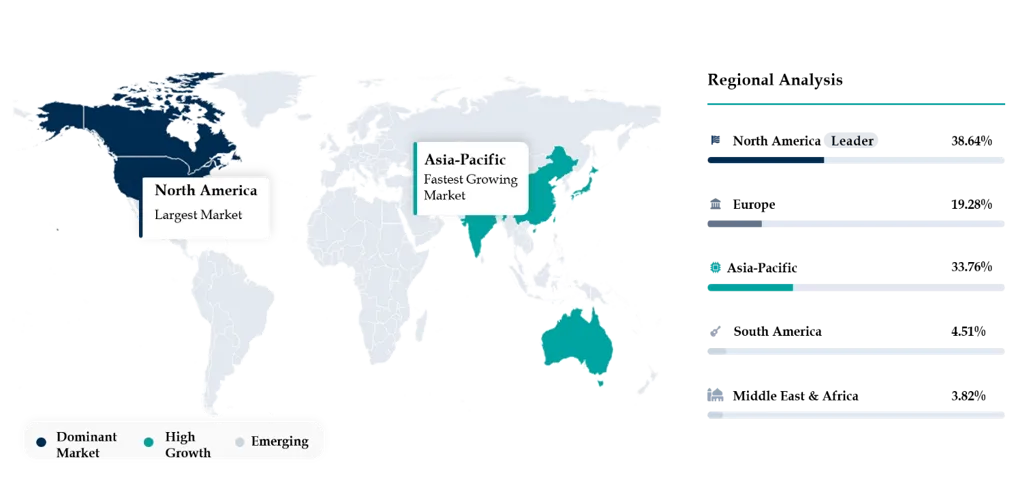
- North America contributed 38.64% to the global market share in 2025, which was led by the demand from hyperscale cloud providers, infrastructure for artificial intelligence, and the emergence of optical circuit switching in data centers.
- Strategic Importance of High Port Count OCS Configurations is becoming apparent as the scale of AI clusters increases, driving up requirements for optical switches capable of connecting a large number of accelerators with minimum loss and reliability.
- Network Reconfigurability and Power Efficiency are key motivators for adoption of OCS, as OCS configurations have the ability to provide direct optical path connectivity without the need for optical to electrical to optical conversions during switching.
Optical Circuit Switches Industry Trends and Strategic Insights
- Optical circuit switches continue to be shaped by their incorporation in artificial intelligence (AI) architecture in which reconfigurable optical links connect GPU clusters and accelerator arrays to enable network topologies that evolve in response to training traffic patterns.
- Optical switching systems with large port counts are being designed to meet the increasing number of accelerators and servers while keeping optical insertion loss and signal quality, reliability, and rack space usage minimal.
- OCS technology is being considered by operators of hyperscale data centers to make the network more energy efficient through eliminating optical-electrical-optical conversions in selected architectures of the network, yet it depends on traffic patterns, architecture, and control considerations.
- OCS systems are now being used in combination with programmable network controllers and traffic engineering programs that help the operator to optimize the optical path in light of load conditions.
- Competitiveness exists among the traditional MEMS-based switching systems and the upcoming photonic-based solutions, where scalability, optical losses, speed of reconfiguration, reliability, and cost of implementation are some of the key issues.
Optical Circuit Switches Market Scope
| Metrics | Details | |
| 2025 Market Size | US$ 0.40 Billion | |
| 2035 Projected Market Size | US$ 4.93 Billion | |
| CAGR (2026-2035) | 28.57% | |
| Largest Market | North America | |
| Fastest Growing Market | Asia-Pacific | |
| By Switching Technology | MEMS-Based Optical Circuit Switches, Liquid Crystal-Based Optical Circuit Switches, Integrated Photonic Optical Circuit Switches, Other Switching Technologies | |
| By Port Configuration | Low-Port Configuration (Up to 64 × 64 ports), Medium-Port Configuration (Above 64 × 64 up to 320 × 320 ports), High-Port Configuration (Above 320 × 320 ports) | |
| By Application | AI and Machine Learning Cluster Interconnects, General Data Center Networking, Data Center Interconnect (DCI), High-Performance Computing (HPC), Telecommunications Networks, Optical Testing and Monitoring, Other Applications | |
| By End-User | Hyperscale Data Center Operators, Cloud Service Providers, Telecommunications Service Providers, Colocation and Data Center Infrastructure Providers, Enterprise IT Organizations, Research Institutions and Government Organizations, Other End-Users | |
| By Region | North America | U.S., Canada, Mexico |
| Europe | Germany, UK, Russia, France, Spain, Italy, Poland | |
| Asia-Pacific | China, India, Japan, Australia, South Korea, Indonesia, Malaysia, Singapore, Vietnam, Thailand, Philippines, Taiwan | |
| South America | Brazil, Argentina | |
| Middle East and Africa | UAE, Saudi Arabia, South Africa, Israel, Turkiye, Nigeria | |
| Report Insights Covered | Competitive Landscape Analysis, Company Profile Analysis, Market Size, Share, Growth | |
Why does this report matter in 2026?
Optical circuit switches market in 2026 will be highly valued as a result of efforts made by hyperscale data centers and artificial intelligence infrastructure providers to deal with increased networking requirements of GPU clusters. Increased east-west data flows, power restrictions, and necessity to have scalable accelerators interconnect are leading to an increase in the evaluation of reconfigurable optical networks. This report assists stakeholders in determining where OCS can provide practical benefits, especially in high bandwidth AI training applications, and in comprehending how port scalability, insertion loss, reconfigurability, and interfacing with electronic packet switches affect deployment choices.
The report is also valuable in gauging investment opportunities related to technology priorities as the OCS technologies begin transitioning towards greater commercialization in AI-powered data centers. This report analyzes the competition between the existing MEMS technologies and emerging integrated photonics, in addition to the investment opportunity areas related to optical component, software, and network orchestration. Through evaluation of technology readiness, adoption issues, positioning of the supply side, and possible economic gains, the report helps manufacturers, investors, and data center operators distinguish between immediate business opportunities and long-term technological possibilities.
Optical Circuit Switches Market White Space & Investment Opportunities
- There are opportunities for investment in the creation of optical circuit switches that will be able to cater to the demands of a cluster of AI training computers and GPUs with dynamic and reconfigurable optical connections.
- The creation of intelligent control systems and orchestration software for OCS could serve as an area of opportunity to merge hardware for OCS with AI scheduler applications, traffic monitoring systems, and network controller applications to automatically reconfigure optical circuits.
- Manufacturers can cater to cost-sensitive implementations by creating modular optical circuit switching devices that would enable the data centers to increment their port capacity gradually without the need for switching fabrics replacement.
- The combination of innovative photonic switch technology, optical components, and packaging systems provides avenues for investment with regards to minimizing footprint and integrating components and making scalable optical switch architectures for the next generation of data center networks.
- Expanding applications of OCS in other sectors such as inter-data center links, high-performance computing centers, and some optical transport networks provide further opportunities whereby high bandwidth optical links and circuit reconfigurability provide benefits.
Optical Circuit Switches Future Market Transformation
Future generations of optical circuit switches are projected to transform from being optical networking-specific components to becoming an integrated part of the AI data center infrastructure, powered by increasing numbers of GPU clusters, growing complexity of interconnects, and the need for power efficient network architecture. The coming generation of products would feature higher port density, lower insertion loss, modularity, scalability, and better integration with AI workload schedulers and SDN controllers, which will allow reconfiguration of optical paths based on the demands of data traffic. Improvements in MEMS technology, integrated photonics, and network orchestration may contribute to the wider adoption of OCS in the hyperscale data centers and HPC segments, although its commercial success would depend on reliability and reduced total cost of ownership.
Optical Circuit Switches Market Buyer Decision-Making Criteria
Buyers of optical circuit switches market products consider performance based on the capability of the products to facilitate large-scale AI clusters, preserve optical signal integrity, and work seamlessly with the current networks of the data centers. Hyperscale operators and artificial intelligence infrastructure vendors consider switching capacity, operability, energy efficiency, and network orchestration system compatibility, along with total cost of ownership and the ability to deploy and maintain their technology solutions.
Major Buyer Decision-Making Criteria
- Port Capacity and Scalability
- Optical Performance
- Switching Performance
- Reliability and Availability
- Power Efficiency
- Network Integration
- Software and Automation
- Total Cost of Ownership
- Vendor Expertise and Support
- Deployment Flexibility
Optical Circuit Switches Market Economic & Investment Analysis
The economic environment in which OCS operates is strongly tied to capital expenditure spending on artificial intelligence data centers, hyperscale computing facilities, and high-performance networking. With growing GPU clusters, the choice of investment will have to include the factor of whether or not OCS has the capability of reducing the power consumption of networks, increasing bandwidth efficiency, and reducing costs in appropriate systems. Nevertheless, factors such as high initial costs of equipment, integration needs, testing of optical performance, and interoperability with existing packet-switching infrastructure may affect the decision-making process and delay deployments. The best opportunities for investments will be found in places where high volumes of bandwidth and interconnects are expected.
There are other investment opportunities apart from OCS technology, including MEMS switching technologies, integrated photonics, optical packaging, software for controlling, and network orchestration. Investors and suppliers of technology are looking at technologies that have high port density, low insertion losses, good reliability, and ease of deployment in large AI computing infrastructures. There could be collaboration among OCS manufacturers, optical component manufacturers, cloud infrastructure providers, and network technology providers to qualify products faster and to scale up commercially. However, profits will come from adoption in data centers, scalability of manufacture, maturity of technology, and reductions in the total cost of ownership rather than just AI infrastructure development.
Optical Circuit Switches Investment Trends in the Market
- The purchase of high-port-count optical circuit switching devices has become an important investment strategy for the developers of AI infrastructures and hyperscale data centers that need scalable optical switching fabrics to interconnect clusters of GPUs, handle east-west communications, and accommodate increased bandwidth demands.
- OCS vendors have directed their R&D efforts toward the optimization of MEMS-based optical switching systems in terms of port capacity, optical insertion losses, reliability, and switching performance in order to fulfill the needs of large-scale AI and HPC systems.
- Investments in OCS control software and network orchestration have made possible coordination of optical circuit reconfiguration with traffic engineering and workload scheduling through AI, which would allow optical circuits to be modified according to computing and bandwidth requirements.
- Investments in photonic integrated circuit technology and advanced optics are generating opportunities that allow OCSs to be made more scalable and easier to integrate with other components.
- Strategic collaborations between optical switching companies, photonics manufacturers, and data center technology companies have become essential for qualifying products and validating interoperability, while investments in manufacturing scalability could enable suppliers to cater to the needs of hyperscale customers.
Strategic Indicators for Optical Circuit Switches Market
High Regulation Impact
Regulatory and compliance issues such as laser safety, electromagnetic compatibility, electrical safety, and product certification apply to the optical circuit switches market. This is especially in regards to OCS that have been implemented into data center operations and telecommunication infrastructures. The optical switching products and their control devices must satisfy the regulatory requirements of the region where they will be installed, taking into account the relevant IEC standards and country-specific safety requirements. Furthermore, requirements of data center energy efficiency, telecommunication purchasing regulations, and restrictions on the international movement of advanced photonic components may have an impact on qualification, sourcing, and installation time. OCS do not have any specific regulations, but compliance requirements may impact cost and implementation.
High Investment Activity
OCS investment is increasingly driven by the growth of AI data centers, high-performance computing, and new generation optical interconnects. Key focus areas for investment will be high port count MEMS switching architectures, developments in integrated photonics, optical packaging, and intelligent software for reconfigurable circuitry. OCS vendors, photonics components companies, and data center solutions vendors are increasingly forming alliances around technology development to validate and scale up. The investment trend will require validation of network efficiency, power savings, and cost savings in order to convince hyperscalers and to scale up manufacturing.
Supply Chain Disruption
The optical circuit switches market is subject to possible supply chain interruptions from precision MEMS parts, optical switching devices, photonic integrated circuits, fiber optic parts, and packaging technology. The dependency on a small number of vendors of optical parts can have an impact on manufacturing time, manufacturing cost, and scalability of high port count optical switches. A delay in product qualification and deployment may occur due to any disruptions in the process of semiconductor manufacturing, precision manufacturing or international components. The OCS vendors are currently trying to mitigate such risks by concentrating on supplier diversification, standardization of components wherever possible, strategic relationships in sourcing, and improving manufacturing capabilities.
Pricing Volatility
The fluctuations in prices in the optical circuit switches market is being primarily fueled by port capacity, MEMS technology, precision optical components, manufacturing complexity, and the characteristics of production volumes obtained. As an approximation, the industry estimates that a 128 × 128 OCS system costs about US$30,000 to 40,000, while older OCS systems were being sold at prices ranging from US$50,000 to 60,000. In terms of pricing, the 300 × 300 OCS systems are now being sold at around US$150,000. The figures represent variations of pricing depending on the technology generation and configuration rather than price parameters in the OCS market.
Procurement Pressure
The procurement pressures in the OCS market are becoming stronger as providers of AI data centers look for switching solutions with a large number of ports that would satisfy their demands concerning optical performance, reliability, and scalability. While trying to weigh the price of the initial investment against possible savings on power consumption and bandwidth usage, buyers should take into consideration such factors as insertion loss, reconfiguration capabilities, and the ability of an OCS to work with packet switches already installed. Supplier constraints for specific OCS platforms and qualification cycles could also play a role in the purchase time frame, leading the owners of data centers to consider tested technology, availability of components, and strong supplier relationships prior to any expansion.
New Technology Adoption
The adoption of technology in the optical circuit switches OCS market is driven by the requirement of scalability and efficiency in terms of power consumption in AI data centers and computing networks. The MEMS OCS devices have gained popularity for the provision of optical circuit switching with high port counts, whereas there are further possibilities in integrated photonics and optical packaging that can result in better efficiency in terms of integration. However, the adoption of technology is also driven by the adoption of software-defined systems that manage optical circuit switching alongside GPU workload and electronic packet switches. On the other hand, the insertion loss, switching capabilities, optical paths, and interoperability must be proven through testing under realistic operational conditions before using these technologies in practice.
Regional Expansion Opportunity
Expansion in OCS in different regions is tied with the development of the infrastructure for AI computing, hyperscale data centers, and optical networking capabilities. There is an opportunity in North America due to investments in AI infrastructure and hyperscalers presence, as well as opportunities in China and Japan due to developments in optical technologies, photonics know-how, and data centers. Europe and other Asia-Pacific countries might represent future opportunities due to operators increasing their HPC capacities and modernizing their data centers. For successful expansion, it will be necessary to qualify customers locally, have reliable supply of components, integrate with network architecture, and show performance improvements and reductions in operating costs.
Government Policy Support
The impact of government policy on the optical circuit switches market is driven by the development of policies aimed at the development of infrastructure for AI, semiconductor manufacturing in-country, photonics research, and energy-efficient data centers. In the U.S., semiconductor and advanced computing initiatives may help the OCS market develop indirectly via funding of the optical infrastructure and data centers. In China, the government policies aimed at the development of technologies in country can assist in the development of the optical communication and photonics component industry in the country. In Japan, the policies related to semiconductor and photonics research can be helpful in developing optical switching technologies. While such policies may not necessarily be designed specifically for OCS technologies, investment in advanced computing, research collaborations, and domestic supply chain development could enhance technology readiness and manufacturing.
Pricing Intelligence
Pricing analysis in the OCS sector involves the examination of costs of the system in relation to the number of ports, switching technology, optical capability, and installation needs, rather than unit price comparisons. The buyer evaluates the cost per optical port, number of connections supported, insertion loss, control software, integration services, and maintenance needs to establish the overall worth of the OCS solution. A high port count system may be costly but more economical in cost per connection when used on a large scale. Analyzing quotations of various vendors, their hardware specifications, warranties, and lifetime operating costs allows to find out systems which are suitable for AI networking applications and cost-effective.
| HS Code | Reporter | Trade Flow | 2025 Trade Value | Interpretation |
| 853670 | China | Exports | US$ 767 million | Indicates China's role in global optical-fibre connector manufacturing and supply. |
| 853670 | United States | Exports | US$ 748 million | Reflects the country's participation in international optical-fibre connector trade. |
| 853670 | United States | Imports | US$ 1.20 billion | Indicates substantial demand for imported optical-fibre connectors and connectivity components. |
| 853670 | China | Imports | US$ 336 million | Reflects demand for imported optical-fibre connectors and related components. |
Note: HS Code 853670 covers connectors for optical fibres, optical fibre bundles or cables and does not specifically identify optical circuit switches. The 2025 trade values are used as an indicator of the broader optical connectivity supply chain and should not be interpreted as direct OCS market trade values.
AI Impact Analysis of Optical Circuit Switches Market
The development of artificial intelligence technologies has raised the importance of OCS through creating large clusters for training of artificial intelligence algorithms that need high-speed, low-latency connections between GPUs and other accelerators. With the emergence of east–west traffic flows between the servers due to distributed training, the Optical Circuit Switches allow data center operators to be able to reconfigure optical connections based on communication flow patterns. Infrastructure vendors of AI technologies can use OCS to create optical circuits between specific sets of accelerators. This can help to optimize network performance and minimize power usage caused by conversion from optical to electrical signal back into optical form in certain architectures. The effect becomes especially important in large AI systems in which traffic behavior is predictable enough to warrant the use of circuit switching technology.
AI technology further amplifies the significance of intelligent orchestration software for OCS implementations. Traffic prediction and load profiling using machine learning can be used to schedule optical path setup, updates, or deletion, taking into consideration the connection between circuit management and GPU scheduling as well as regular packet switches. There is an opportunity for the companies to distinguish themselves with the help of programmable OCS solutions, network management software, and AI integration with data center infrastructure. Yet the AI-powered optimization process has to consider switching times, optical connection limitations, variability of the traffic, and service continuity. As a result, OCS is the most suitable technology to enhance electronic packet switching, not to substitute it. Adoption by industry will hinge on showing measurable improvement in terms of accelerator communication performance, network performance, and cost of ownership in practical AI applications.
Disruption Analysis of Optical Circuit Switches Market
The optical circuit switches market is revolutionizing the conventional data center network architecture by offering dynamically reconfigurable optical links for connecting GPUs, AI accelerators, and servers in order to achieve high-speed communication. The difference between the OCS and other electronic packet switches is that in the former, a dedicated link is created for the purpose of communication while in the latter packets are processed to transfer information. This is especially applicable to AI training systems where a lot of data needs to be exchanged through the accelerators in the system, which puts a strain on the bandwidth, energy, and scalability of the networking. Hence, the OCS is encouraging the operators of data centers to review the topology of their networks and adopt hybrid switching technology.
With the advent of technological advancements in the design and fabrication of MEMS switches with high port counts, integrated photonic devices, and intelligent optical network management, the competition is being further reshaped. The current switch designs need to offer high port density, low loss, increased reliability, and effective integration with artificial intelligence-based workload management systems. In addition, new photonic technologies could possibly offer compact and scalable optical switch designs as manufacturing processes become more refined. But this would not happen evenly throughout all data centers as the performance of OCS will depend on traffic flow characteristics, reconfigurability needs, optical link budget considerations, and system integration issues. Network vendors who show concrete evidence of their progress toward becoming more efficient, affordable, and reliably scalable can become better suited for promoting their commercial use.
Optical Circuit Switches Market BCG Matrix: Company Evaluation
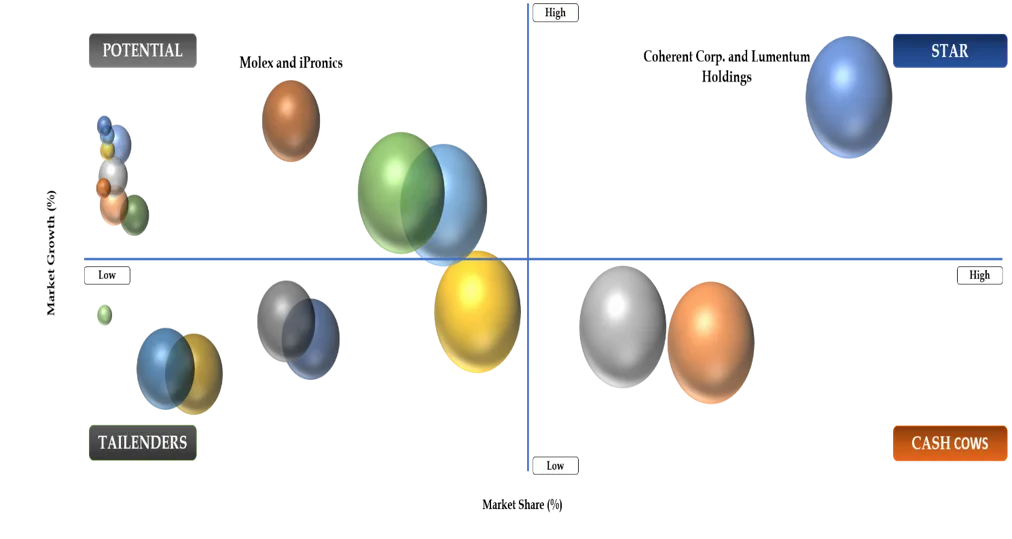
STAR
As Coherent Corp. and Lumentum Holdings Inc. have OCS product lines, which are well-suited for the increasing needs for AI data center networking, both of them can be identified as Stars. Coherent Corporation offers liquid crystal switches, while Lumentum's OCS products can support high bandwidth and low latency in AI and machine learning clusters. The future success of both companies will be determined by their ability to get hyperscale customers on board, have adequate manufacturing capabilities, ensure product reliability, and provide efficient optical switching technology.
POTENTIAL
Molex, iPronics, Accelink Technologies, and DiCon Fiberoptics belong to Potential players who have the opportunity to improve their market standing with the increasing adoption of OCS technology. Molex is building OCS platforms for AI clusters based on high radix, iPronics is working on developing programmable photonic switches, Accelink aims at high port count data centers applications, while DiCon increases its line of MEMS-based OCS devices. The success of the companies in gaining market share will be determined by production, cost, performance, and integration capabilities.
Optical Circuit Switches Market Dynamics
Driver Impact Analysis
| Driver | Market Growth Impact (%) | Demand Concentration | Impacted Use Case | Strategic Impact |
Rapid expansion of AI and generative AI infrastructure | 30% | North America, Asia-Pacific | AI training clusters, GPU-to-GPU connectivity | Accelerates adoption of high-port-count OCS systems to improve network utilization and reduce power consumption |
Rising hyperscale data center investments | 25% | North America, Asia-Pacific, Europe | Data center interconnects, large-scale cloud networks | Creates demand for scalable optical switching fabrics and reconfigurable network architectures |
Growing demand for energy-efficient optical networking | 20% | North America, Europe, Asia-Pacific | High-performance computing, AI data centers | Encourages replacement or augmentation of conventional electrical switching with optical circuit switching |
Increasing bandwidth requirements and dynamic network reconfiguration | 15% | North America, Asia-Pacific, Europe | Optical transport, cloud networking, HPC clusters | Drives investment in low-latency optical paths, network flexibility, and high-capacity switching systems |
Driver: Rising Demand for Scalable AI Data Center Interconnects
The exponential growth in generative AI model training and inference is creating a growing need for high bandwidth, reconfigurable interconnect between GPUs and accelerator nodes within high performance computing environments. The ability of optical circuit switches to provide optical path reconfiguration without any electrical layer being involved between the two optical layers at the switching phase creates the potential for reduced network power consumption and better utilization of the optical links in certain architectures. Hence, hyperscale companies are examining the use of OCS in large-scale AI clusters where traffic behavior, networking, and energy savings can support the added complexity that is involved. The force behind this driver depends upon performance improvements and ease of fit with existing data center network configurations.
Restraint Impact Analysis
| Restraint | Drag on Market Growth (%) | Primary Impact Area | Impacted Use Case | Strategic Impact |
High upfront investment and deployment complexity | 25% | Capital expenditure | Hyperscale data centers, HPC clusters | Raises adoption barriers and extends investment payback periods |
Limited flexibility for fine-grained, rapidly changing traffic | 20% | Traffic management | General-purpose data centers, dynamic workloads | Requires complementary packet-switching infrastructure and intelligent traffic scheduling |
Reliability, optical alignment, and maintenance requirements | 15% | Operational reliability | Large-scale AI clusters, mission-critical networks | Increases qualification, monitoring, and maintenance requirements |
Interoperability and vendor ecosystem limitations | 15% | Network integration | Multi-vendor data centers, telecom networks | Increases integration effort and can create vendor-dependency risks |
Restraint: Integration Complexity and Uncertain Total Cost of Ownership
The implementation of OCSs is limited by the engineering burden involved in implementing optical switching in networks engineered for traditional packet switches. While OCSs can offer power and latency efficiencies under appropriate conditions, they do not substitute packet switching at all networking levels and might need additional mechanisms for routing, traffic management, and recovery from failures as well as network management. The optical insertion loss, switching reliability, port scalability, and interface with transceivers and networking architectures also have to meet stringent criteria in a data center environment. Such integration challenges and the associated risks may hinder deployment where the merits of OCSs are not clearly proved against the cost of ownership of alternative switch solutions.
Optical Circuit Switches Market Segment Analysis
The global optical circuit switches market is segmented based on the switching technology, port configuration, application, end-user and region.
By Switching Technology
MEMS Switching Platforms Lead Hyperscale Data Center Deployments
MEMS-based optical circuit switches accounted for an approximated market share of 46.8% in 2025 due to their well-established technology maturity, low insertion losses, and capacity to accommodate high-port count optical connections. They have relevance in applications such as hyperscale data centers and artificial intelligence architecture where there is a need for interconnection between high-performance computing clusters.
By Application
AI and Machine Learning Networking Becomes a Key OCS Growth Engine
AI and machine learning cluster interconnects that leverage GPUs are anticipated to grow at a fast pace as the need for high-speed, dynamically reconfigurable optical interconnects rises due to GPU-intense workloads. OCS is capable of establishing direct optical links between chosen endpoints in the network, which could enhance power efficiency and utilization of networks that have a compatible AI cluster design. The growth will be dependent on its integration with the current network fabric and traffic management system.
Optical Circuit Switches Market Geographical Penetration
U.S. Optical Circuit Switches Market Landscape
Market drivers of the optical circuit switches in the United States include the fast growing infrastructure related to AI, hyperscale data centers, and high-performance computing networks, where growth of GPU clusters drives the demand for scalable and high-port-count optical switching solutions. Presence of large cloud service providers and optical technology players, such as Lumentum, Coherent, and Molex, provides an additional boost to product development and commercialization. Opportunities within the market are limited to reconfigurable optical fabric, AI workload-aware networking orchestration, and efficient connectivity, while the success of commercialization will depend on the performance, compatibility with packet-based switching infrastructures, and lower total cost of ownership.
China Optical Circuit Switches Market Trends
The Chinese market for optical circuit switches is being fueled by developments in the space of AI computing infrastructure, hyperscale data centers, and development of optical technology in the country itself. With rising demands for bandwidth-intensive connections between AI accelerators, there exists an opening for high-port count OCS switches, MEMS switching solutions, and next-gen integrated photonics. The well-established ecosystem of optical communication manufacturing in China and the focus on development of the local supply chain will ensure that innovation and manufacture take place locally. However, success in the marketplace will be dependent on reliability, optical performance, interoperability, and qualification for deployment in large AI data centers.
Japan Optical Circuit Switches Market Outlook
The OCS industry in Japan is well-positioned to capitalize on the modernization of hyperscale data centers, the rising need for AI computing, and the strong presence of optical communication technology and precision manufacturing in the country. Rising demand for high-capacity connections between AI accelerators presents possibilities for high-port-count OCS solutions capable of configuring the optical paths and minimizing the need for multiple optical-electrical-optical conversions within appropriate network topologies. Existing capabilities of Japan in terms of optics, photonics, robotics, and precision engineering can serve as an ideal base for creating a reliable OCS hardware and subsystems, whereas collaboration with data center players and technology companies around the world can ensure commercialization of the product. Nevertheless, adoption of the technology will require showing tangible advantages in terms of power consumption and utilization of network resources, providing reliable OCS operations on a large scale, and combining OCS and packet-switching solutions.
Optical Circuit Switches Market Competitive Landscape
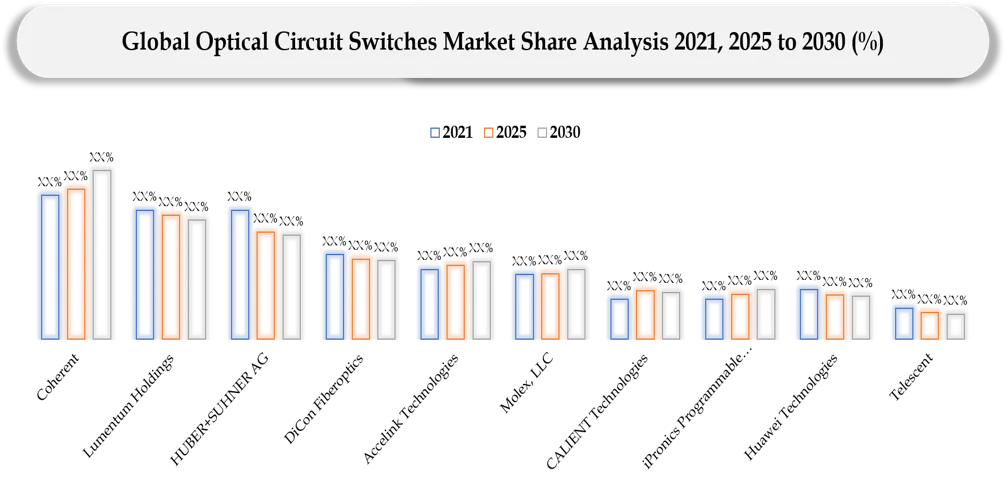
- The competitive environment of the optical circuit switches market includes well established providers of optical components, dedicated providers of optical switches, and nascent photonics providers, with competition focused around switching technology, port count, optical performance, reliability, and scalability.
- Competitors compete with each other to provide OCS solutions with large numbers of ports for use in artificial intelligence training clusters and hyperscale data centers, in which reconfigurable optical interconnects for GPU clusters and accelerators have become a key differentiation factor.
- Technology differentiation is largely based on established MEMS-based solutions and nascent integrated photonic solutions, with the emphasis made on minimizing optical insertion loss, increasing switching reliability and scalability, as well as reducing the complexity and total cost of system implementation.
- Qualification, interoperability, and readiness for manufacturing are key competitive considerations in light of the need for reliable OCS technology to support reliable connectivity amid AI load and network architecture compatibility required by hyperscalers.
- Increasing competition is evolving from the entry of different vendors in the market with alternate switching approaches and architectures, making competitive analysis more critical in the areas of application performance, control compatibility, reliability, and manufacturability. But competitive evaluations need to differentiate between OCS manufacturers and other companies that provide optical components or networking technology.
Public Company Q1-Q2 2026 Performance Comparison
The table below compares five publicly listed companies with direct or strategically relevant exposure to the optical circuit switches market. Financial metrics represent company-wide performance, as standalone OCS revenue is generally not separately disclosed.
| Company | Q1–Q2 2026 Performance | Optical Circuit Switches Exposure | Key Performance Driver |
| Lumentum Holdings Inc. | Q1 revenue: US$533.8 million; Q2 revenue: US$665.5 million; H1 total: US$1.199 billion | Direct OCS systems and optical networking products; OCS backlog exceeded US$400 million in Q2 FY2026. | Accelerating AI and cloud infrastructure demand, alongside optical switching and transceiver growth. |
| Coherent Corp. | Q1 revenue: US$1.58 billion; Q2 revenue: US$1.69 billion; H1 total: US$3.27 billion | OCS platform shipments and photonics technologies supporting AI data center connectivity. | Data center demand, optical communications growth, and capacity expansion. |
| HUBER+SUHNER AG | H1 revenue: US$573.6 million | Direct OCS solutions and optical connectivity; manufacturing investments supported OCS production expansion. | Order intake growth, OCS commercialization, and investment in production capacity. |
| Accelink Technologies Co., Ltd. | H1 revenue: approximately US$914 million, up 26.07% year over year. | Optical communications components and systems relevant to data center networking; standalone OCS revenue not separately disclosed. | Growth in optical communications demand and overseas sales. |
| Santec Holdings Corporation | Calendar Q1 revenue: approximately US$62.4 million; calendar Q2 revenue: approximately US$62.4 million; H1 total: approximately US$124.8 million. | Optical switching-related technologies and optical testing equipment. | Demand for optical measurement, testing, and advanced photonics technologies supporting data center infrastructure. |
Note: Reporting periods differ because companies follow different fiscal calendars. Currency conversions are approximate and based on the exchange rates. Lumentum and Coherent figures reflect their fiscal Q1 and Q2 FY2026 results. HUBER+SUHNER and Accelink figures cover H1 2026. Santec's Q1 calendar 2026 revenue is estimated from its full-year financial results rather than reported quarterly data.
Key Companies of Optical Circuit Switches Market
- Coherent Corp. (USA)
- Lumentum Holdings Inc. (USA)
- HUBER+SUHNER AG (Switzerland)
- DiCon Fiberoptics, Inc. (USA)
- Accelink Technologies Co., Ltd. (China)
- Molex, LLC (USA)
- Calient Technologies, Inc. (USA)
- iPronics Programmable Photonics, S.L. (Spain)
- Agiltron Inc. (USA)
- Shenzhen HTFuture Co., Ltd. (China)
- Guilin HYGJ Communication Technology Co., Ltd. (China)
- GEZHI Photonics Co., Ltd. (China)
- Telescent Inc. (USA)
- nEye Systems, Inc. (Norway)
- Huawei Technologies Co., Ltd. (China)
- Fujitsu Limited (Japan)
- Sercalo Microtechnology Ltd. (Liechtenstein)
- Santec Holdings Corporation (Japan)
- O-Net Technologies (Group) Limited (China)
- HYC Co., Ltd. (China)
Company Profiles of Optical Circuit Switches Market
Lumentum Holdings Inc.
Lumentum Holdings is an important provider of optical and photonic technologies that has direct access to the Optical Circuit Switches (OCS) industry. Its product line consists of MEMS-based OCS technologies intended for use in AI data centers, cloud systems, and high-performance computing. It provides R64 and R300 OCS solutions that allow implementing optical connectivity of GPU clusters and data center connections, allowing for direct optical transmission and decreased necessity for numerous optical-electrical-optical transformations.
The main competitive advantages are the ability to increase OCS production capacities, port density, low insertion losses, and high reliability of switching systems as well as integration with software-defined network systems.
Coherent Corp.
Coherent is an international photonics and optical communications firm that offers an OCS system based on digital liquid-crystal switching technologies. It offers solutions aimed at setting up high-bandwidth optical connections for AI and machine learning data centers, providing solutions with port counts ranging from 64x64 to 512x512. The additional capabilities of the photonics and optical communications company help place it into the emerging market for AI network infrastructures.
Competitive considerations include growing OCS deployment, increasing the reliability and optical performance of switching, manufacturing capacities, and meeting the increased connectivity demands of hyperscale data centers and AI accelerator clusters.
HUBER+SUHNER AG
HUBER+SUHNER is a company offering connectivity solutions based on technology and is directly exposed to OCS through its POLATIS product portfolio. It makes use of DirectLight beam steering technology to create optical connections, which can even be over unlit fiber optic cables. The product portfolio allows for configuration in small matrices up to 384×384 ports and caters to hyperscale data centers, telecommunication networks, optical transport, and test automation.
Competitive priorities will include increasing POLATIS production capacity, reducing optical loss, maintaining robust switching performance, enhancing software-defined network integration, and satisfying the increased demand for automated optical connectivity in AI networks.
DiCon Fiberoptics, Inc.
DiCon Fiberoptics is an American photonics firm that provides direct OCS products suitable for AI-based data centers. DiCon Fiberoptics' OCS platforms rely on proprietary MEMS mirror technology to enable high-density optical connectivity without blocking for GPU clusters and data center fabric applications. The firm is also known to provide optical switching solutions for network management and testing of photonic components, exposing it to the market segments of AI networking and photonic test automation.
Competitive strengths lie in offering scalable OCS platforms with high-port count, low insertion loss, good connection repeatability, reliable performance in dark fiber configurations, and affordable switching solutions for large AI training clusters.
Molex, LLC
Molex is an international supplier of electronic and connectivity solutions that has ventured into the OCS market by introducing its High-Radix Optical Circuit Switch system. This system makes use of MEMS mirrors to establish optical connections with a capacity of 544x544 ports, and the roadmap includes support for more than 1,000 ports. The system's application is mainly geared toward AI training and inference networks that require high-bandwidth and reduced optical-electrical-optical conversions.
Priorities in competing within the market involve scalable manufacturing for large AI implementations, high-port density and low-insertion loss, increased serviceability by using modular parts, and software-defined network management capability. As Molex is privately held, its OCS capabilities do not contribute to public financial results.
CALIENT Technologies, Inc.
CALIENT Technologies is an American firm which develops all-optical switching technology in the optical networking domain. The CALIENT S320 system is capable of setting up, managing, and reconfiguring connections between single mode fiber optic cables regardless of the rate of the data transfer or the protocol used. The application of this technology is widespread in data centers interconnects, cloud & colocation networks, optical transport and other optical connectivity fields.
Competitive priorities includes ensuring non-blocking switch performance, enhancing optical path monitoring and diagnostic capability, developing integration with automated control systems for the network, and increasing deployments in data centers and telecommunications networks.
Optical Circuit Switches Market Major Pain Points
- High initial cost is a key limitation to the implementation of OCS since the switching systems that support high port counts depend on the use of specific optical components, precision engineering, system integration, and testing, leading to increased deployment cost.
- The incorporation of the OCS into data center networks is highly complex since optical circuit switches create optical circuits that carry packets of data, as opposed to routing individual packets.
- There is a great challenge in maintaining reliable optical performance in a switching fabric due to various factors such as insertion losses, cross talk, connector performance, optical alignment, and signal variations along different paths.
- Speed constraints and difficulty in managing traffic may limit the use of OCS in scenarios where network configuration needs to happen often since operators will have to coordinate the circuit adjustments with workload scheduling using AI and standard packet switches for efficient data transfer.
- Another challenge of deploying it on a large scale is that there will be a need to verify numerous fiber connections, monitor optical link performance, and have redundancy of paths to minimize the risk of switching or connection failures in the workloads.
Optical Circuit Switches Market Recent Developments
- September 2026 - Coherent Corp.: Presented optical circuit switching and other optical connectivity solutions for AI infrastructure in ECOC 2026, focusing on the advancements in scale-out data center networking.
- September 2026 - Optical Circuit Switching Market Outlook: According to Cignal AI, growth in OCS was seen as Google transitioned to third-party vendors, and GPU scale-out networking was found to be an emerging source of demand.
- September 2026 - iPronics: Received Series B funding of US$125 million, including NVIDIA, to expand its optical circuit switching platform using silicon photonics technology into AI data centers.
- August 2026 - HUBER+SUHNER: Announced net sales for first half of CHF 457.4 million and order intake of CHF 542.8 million; investment in optical circuit switching capacity impacted profit margins of Communication segment.
- July 2026 - Cignal AI: Increased prediction of the value of the OCS market to above US$8 billion by 2030 due to the emergence of scale-up networking using GPUs together with existing applications using TPUs.
Analyst View / Opinion on Optical Circuit Switches Market
- The optical circuit switches market will become increasingly relevant due to demand from AI training clusters and hyperscale data centers for high-speed, power-efficient interconnect solutions. The highest adoption rates are expected for the use cases in which traffic requires dedicated optical circuits and can be coordinated with computing loads.
- High port count OCS products are an important factor in product differentiation since operators want to connect large-scale accelerator clusters while keeping network complexity in mind. Companies able to achieve a good balance between the number of ports, optical insertion losses, reliability, and cost will be able to satisfy the needs of hyperscale data centers.
- The commercial success of OCS will be determined by its capability to complement traditional packet switching rather than replace it everywhere. Successful implementations will require proper network design, load-aware traffic management, and control software capable of coordinating optical circuit switches with packet-switched networks.
- MEMS-based switching is still the proven solution for large-scale optical switching fabrics, whereas integrated photonic solutions have prospects for additional miniaturization. The competitive advantage will be ensured through performance and manufacturing readiness, reliability, and applicability to practical data center environments.
- For investors, promising areas are AI-based OCS systems, intelligent network management, optical switching elements, and integration into the data center ecosystem. Nevertheless, the commercial success will depend not only on bandwidth requirements but also on energy efficiency and cost-effectiveness of network management.
Target Audience of Optical Circuit Switches Market
| INDUSTRY | WHO SHOULD BUY THIS REPORT? | REASON TO BUY THIS REPORT |
| Data Centers and Hyperscale Cloud | Hyperscale Data Center Operators | Evaluate OCS adoption for AI clusters, high-bandwidth connectivity, network scalability, and energy efficiency. |
| Artificial Intelligence and Machine Learning | AI Infrastructure Providers and GPU Cloud Operators | Assess optical interconnect opportunities for large-scale AI training and accelerator clusters. |
| Telecommunications | Telecom Operators and Network Service Providers | Identify opportunities in optical network reconfiguration, capacity expansion, and network modernization. |
| Optical Networking Equipment | Optical Network Equipment Manufacturers | Analyze technology trends, competitor positioning, and product development opportunities. |
| Photonics and Optical Components | Photonics Manufacturers and Optical Component Suppliers | Identify demand for MEMS switches, optical switching components, and integrated photonic technologies. |
| Semiconductor Industry | Semiconductor Companies and Photonic Chip Developers | Evaluate opportunities in silicon photonics, photonic integration, and advanced optical switching devices. |
| High-Performance Computing | Supercomputing Centers and HPC Infrastructure Providers | Assess OCS applications in scientific computing, large-scale computing clusters, and high-performance network fabrics. |
| Data Center Infrastructure | Data Center Developers and Operators | Evaluate infrastructure requirements, deployment costs, scalability, and potential operational benefits. |
| Investment and Financial Services | Venture Capital Firms, Private Equity Firms, and Institutional Investors | Identify growth opportunities, emerging vendors, competitive risks, and potential investment returns. |
| Consulting and Market Intelligence | Strategy Consultants, Market Research Firms, and Technology Advisors | Support market entry strategies, competitor benchmarking, technology assessments, and investment planning. |
Why Choose DATAM?
- Data-Driven insights: Dive into detailed analyses with granular insights such as pricing, market shares and value chain evaluations, enriched by interviews with industry leaders and disruptors.
- Post-Purchase Support and Expert Analyst Consultations: As a valued client, gain direct access to our expert analysts for personalized advice and strategic guidance, tailored to your specific needs and challenges.
- White Papers and Case Studies: Benefit quarterly from our in-depth studies related to your purchased titles, tailored to refine your operational and marketing strategies for maximum impact.
- Annual Updates on Purchased Reports: As an existing customer, enjoy the privilege of annual updates to your reports, ensuring you stay abreast of the latest market insights and technological advancements. Terms and conditions apply.
- Specialized Focus on Emerging Markets: DataM differentiates itself by delivering in-depth, specialized insights specifically for emerging markets, rather than offering generalized geographic overviews. The approach equips our clients with a nuanced understanding and actionable intelligence that are essential for navigating and succeeding in high-growth regions.
- Value of DataM Reports: Our reports offer specialized insights tailored to the latest trends and specific business inquiries. The personalized approach provides a deeper, strategic perspective, ensuring you receive the precise information necessary to make informed decisions. The insights complement and go beyond what is typically available in generic databases.
What DATAM Uniquely Provides
- The DATAM report provides a comprehensive analysis of the optical circuit switches market through an evaluation of different switching technologies, port types, architecture, and requirements specific to the usage of these switches for AI Infrastructure, hyperscale Data Centers, and High Performance Computing applications.
- The competitiveness of leading optical switch providers and emerging technologies is evaluated through comparison of architectures, port density and flexibility, optical parameters, functionalities, and commercialization of products.
- DATAM highlights growth opportunities for AI cluster interconnect, high port counts OCS systems, network intelligence, and photonic switch integration, separating commercial opportunities from technologies in development.
- DATAM considers adoption hurdles in different markets. These hurdles include capital costs, the complex process of network integration, added optical loss, need for circuit redesign, and operational reliability factors that have an impact on purchasing and implementation decisions.
- DATAM includes market size estimation, evaluation of technology, competitive analysis, consideration of obstacles to adopting different technologies, and estimating investment opportunities associated with market entry decisions, product creation, partnerships, and investments.


























































