


OPC UA Market Size and Overview
The global OPC UA market is estimated at approximately US$ 2.75 billion in 2025 and is projected to reach about US$ 6.85 billion by 2035, representing an estimated CAGR of around 9.5% during 2026-2035. The estimate covers monetized OPC UA software, embedded functionality, gateways, edge connectors, SDKs, integration and support services rather than the value of all automation equipment that happens to support OPC UA.
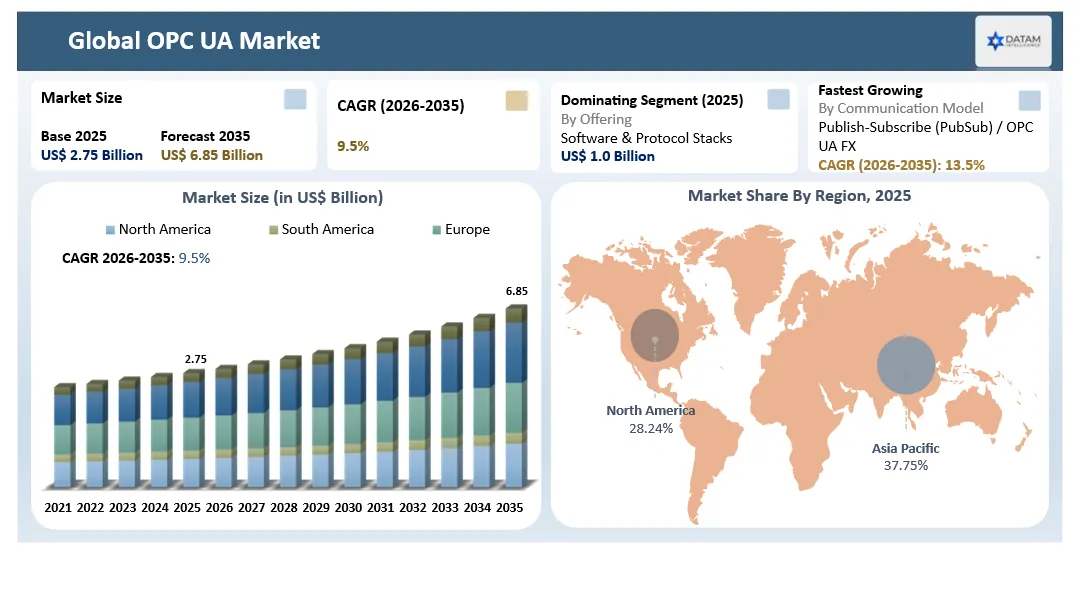
Growth is being automationn by the shift from proprietary point-to-point integration toward vendor-neutral industrial data architectures. OPC UA combines transport, security and semantic information modeling, allowing production assets to expose contextualized data from field devices and controllers through SCADA, MES, edge systems and cloud applications.
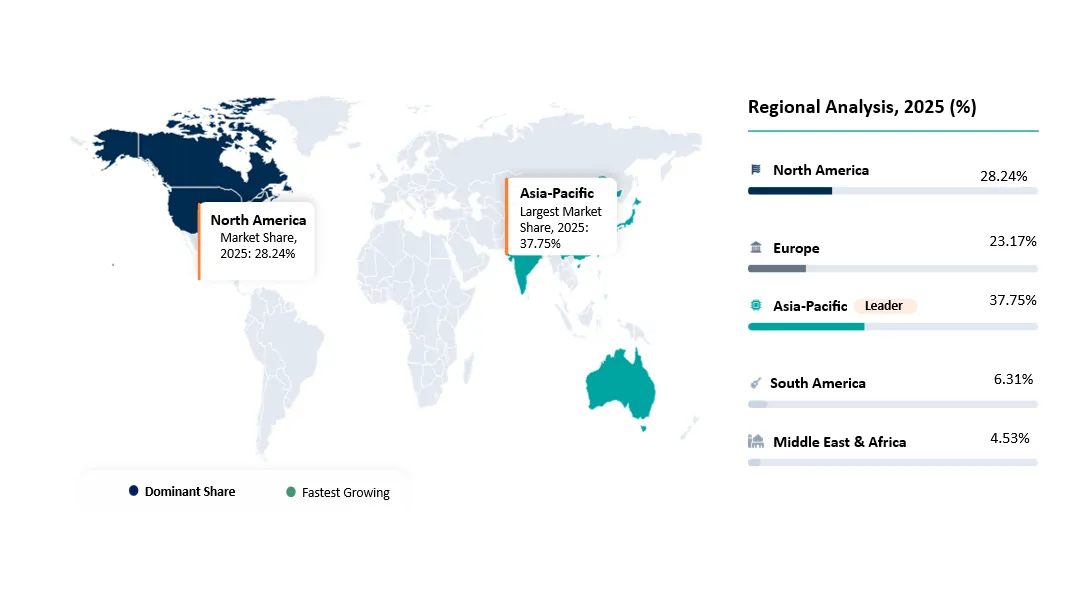
North America and Europe remain important software, automation and standards-development markets, while Asia-Pacific is expected to post the fastest absolute growth as smart-factory, automotive, electronics, semiconductor, machinery and energy investment expands. Adoption increasingly centers on secure IT/OT integration, industrial AI data pipelines, digital twins, PubSub, TSN and cloud-to-edge interoperability.
| Metric | OPC UA Market Insight |
| 2025 Market Size | ~US$ 2.75 billion (modeled estimate) |
| 2035 Market Size | ~US$ 6.85 billion (modeled estimate) |
| 2026-2035 CAGR | ~9.5% |
| Core Standard | IEC 62541 / OPC Unified Architecture |
| Largest Revenue Pool | Software, protocol stacks, servers, clients and integration |
| Fast-Growth Areas | OPC UA PubSub, OPC UA FX, TSN, edge/cloud connectors, semantic models |
| Primary Demand Driver | IT/OT convergence, industrial AI, smart factories and brownfield modernization |
| Strategic Constraint | Legacy integration, certificate lifecycle, skills and semantic inconsistency |
OPC UA Market Key Takeaways
- OPC UA is evolving from a supervisory interoperability layer into a broader industrial data architecture spanning devices, controllers, edge systems, enterprise software and cloud platforms.
- Industry 4.0 programs and industrial AI increase the value of standardized contextualized data because analytics models require consistent tags, asset semantics and machine-readable metadata.
- OPC UA PubSub and OPC UA FX expand the addressable market toward deterministic controller-to-controller and field-level communication, particularly when combined with TSN.
- Brownfield modernization remains a major opportunity as users connect Modbus, PROFIBUS, proprietary PLC protocols and OPC Classic systems to newer OPC UA architectures through gateways and wrappers.
- Cybersecurity is both a automationr and deployment challenge. Certificate-based authentication, encryption and identity management support secure architectures but require disciplined certificate lifecycle management.
- Companion specifications and information models are becoming strategic because semantic interoperability can reduce custom engineering between machines, MES, digital twins and analytics platforms.
- Cloud and edge vendors increasingly support OPC UA connectors, creating a route for industrial data to feed AI, historian, digital-twin and fleet-management services without replacing core control systems.
- Competitive advantage depends on interoperability quality, protocol breadth, cybersecurity, engineering tools, lifecycle support and participation in standards ecosystems rather than raw data-transfer performance alone.
OPC UA Industry Trends and Strategic Insights
- Automation vendors are embedding OPC UA servers directly into PLCs, automation platforms, robots, I/O systems and edge devices, reducing the need for standalone middleware for basic connectivity.
- Industrial edge platforms are moving from simple protocol conversion toward data normalization, information modeling, buffering, security policy enforcement and cloud routing.
- OPC UA PubSub is increasingly important for one-to-many data distribution and scalable event-automationn architectures, while OPC UA FX is extending standardized interoperability toward controller and field communication.
- TSN is being evaluated as a deterministic transport foundation for converged industrial Ethernet, enabling time-sensitive traffic and OPC UA data to share infrastructure under standardized profiles.
- Companion specifications for machines, robotics, energy, process equipment and other domains are expanding semantic interoperability and improving plug-and-produce potential.
- Cloud initiatives are creating reference architectures for moving OPC UA data from industrial assets into cloud services while preserving context, security and governance.
OPC UA Market Scope
| Segmentation | Subsegments |
| Offering | Software & Protocol Stacks; Hardware / Embedded OPC UA; Services & Integration; SDKs & Toolkits; Gateways & Edge Connectors |
| Deployment Architecture | On-Premise Industrial; Edge / Fog; Cloud-Connected; Hybrid Edge-Cloud; Embedded / Device-Level |
| Communication Model | Client-Server; Publish-Subscribe; OPC UA over TSN / Field-Level; Cloud Broker Integration; Hybrid |
| Solution Type | Servers & Clients; Gateways / Protocol Conversion; Information Modeling; Security / Certificate Management; Cloud & Edge Connectors |
| Application | M2M; SCADA/HMI/DCS; MES/ERP; Edge Analytics & AI; Digital Twin; Cloud Data Integration; Condition Monitoring |
| End Use Industry | Discrete Manufacturing; Process Industries; Automotive; Oil & Gas; Power; Food & Life Sciences; Mining; Industrial data; Data Centers |
| Organization Size / User Type | Large Enterprises; SMEs; OEMs & Machine Builders; System Integrators; Utilities; Research / Test |
| Integration Model | Direct Vendor; Distributors; System Integrators & EPCs; OEM / Machine Builder Partners; Cloud Marketplace |
| Region | North America; Europe; Asia-Pacific; South America; Middle East & Africa |
| Study Period | 2025 base year; forecast through 2035 |
Why does this report matter in 2026?
In 2026, industrial AI, software-defined automation, connected edge platforms and cybersecurity regulation are converging around a common requirement: trusted, contextualized operational data. OPC UA is positioned at this intersection because it combines platform-independent communication with security and standardized information modeling.
The market is also entering a new phase beyond conventional client-server use. OPC UA PubSub, OPC UA FX, TSN, cloud reference architectures and edge connectors are widening the technology’s scope. For vendors and investors, the key question is where value will accrue: embedded stacks, gateways, engineering software, cloud connectors, semantic models, cybersecurity tooling or lifecycle integration services.
OPC UA Market White Space & Investment Opportunities
- Brownfield migration gateways that connect legacy PLC, fieldbus and OPC Classic assets to secure OPC UA architectures.
- OPC UA certificate lifecycle and identity-management tools designed for large fleets of industrial devices.
- OPC UA FX and TSN-enabled controllers, I/O, automation platforms and networking components for deterministic multi-vendor automation.
- Cloud and edge connectors that preserve OPC UA information models while routing selected data into AI and analytics platforms.
- Industry-specific companion specifications, semantic mapping tools and digital-twin integration services.
- Managed interoperability testing, conformance, cybersecurity hardening and lifecycle support for multi-vendor plants.
OPC UA Future Market Transformation
By 2035, OPC UA is expected to become a foundational semantic layer across many industrial architectures rather than a standalone protocol selected project by project. The highest-value deployments will connect engineering data, machine state, quality information, energy use and maintenance context across the lifecycle of industrial assets.
Field-level interoperability will be an important transformation vector. OPC UA FX and TSN can reduce proprietary controller-to-controller interfaces and enable converged industrial networks. At the same time, cloud and edge architectures will use OPC UA information models as a consistent data contract for industrial AI, digital twins and autonomous operations.
OPC UA Buyer Decision-Making Criteria
Buyers prioritize interoperability, supported profiles, information-model capabilities, security, certificate management, scalability, deterministic performance, gateway breadth, engineering simplicity, diagnostics, high availability and lifecycle support. In brownfield projects, compatibility with legacy protocols and the ability to map existing tag structures without extensive re-engineering are critical.
Machine builders emphasize embedded footprint, SDK quality, conformance and ease of integration. Large enterprises place greater weight on multi-vendor interoperability, centralized identity, data governance, cloud integration and long-term support. Procurement increasingly includes proof-of-concept testing and conformance validation before plant-wide rollout.
OPC UA Market Economic & Investment Analysis
The economic case for OPC UA is primarily based on lower integration engineering, reduced vendor lock-in, faster data access, reusable information models and lower lifecycle cost. The value becomes more attractive in multi-site organizations where standardized connectivity can be reused across many machines, plants and software platforms.
Investment is shifting toward edge platforms, software-defined automation, industrial AI infrastructure and secure data architectures. These programs increase spending on protocol stacks, gateways, semantic modeling, integration services and certificate-management tools even when OPC UA itself is embedded within broader automation products.
OPC UA Investment Trends in the Market
- Investment in embedded OPC UA stacks, edge gateways and industrial connectivity modules for new automation platforms.
- Expansion of cloud connectors, industrial data brokers and edge software that route contextualized OPC UA data into analytics and AI environments.
- R&D in OPC UA PubSub, OPC UA FX, TSN, deterministic networking, semantic information models and automated certificate lifecycle management.
- Growth of brownfield migration solutions that bridge Modbus, PROFIBUS, EtherNet/IP, proprietary PLC protocols and OPC Classic environments.
- Acquisitions and partnerships linking automation vendors with industrial software, edge computing, digital twin and OT cybersecurity capabilities.
- Investment in interoperability testing, conformance laboratories, developer ecosystems and lifecycle integration services.
Strategic Indicators For OPC UA Market
High Regulation Impact
Cybersecurity regulation, critical-infrastructure requirements and industrial interoperability standards raise expectations for secure identity, encrypted communications, auditability and lifecycle support. OPC UA benefits from built-in security capabilities, but deployments must align with plant cybersecurity policies and certificate governance.
High Investment Activity
Capital spending on smart factories, industrial AI, semiconductor and battery plants, data centers, energy infrastructure and software-defined automation is increasing demand for interoperable OT data architectures and edge connectivity.
Supply Chain Disruption
OPC UA deployments depend on compatible firmware, industrial networking, edge hardware, software stacks and cybersecurity tooling. Supply disruption is less about a single physical component and more about lifecycle support, legacy compatibility and vendor roadmap continuity.
Pricing Volatility
Pricing varies from embedded no-additional-cost functionality to licensed servers, SDKs, gateways, enterprise connectors and integration services. Value-based pricing is strongest where solutions reduce custom engineering or enable multi-site standardization.
Procurement Pressure
Large users increasingly request conformance evidence, supported security profiles, certificate-management capability, redundancy, performance benchmarks, companion-model support, cloud/edge interoperability and long-term vendor support.
New Technology Adoption
OPC UA PubSub, OPC UA FX, TSN, cloud reference architectures, semantic models, automated discovery and industrial AI integration are expanding beyond pilot deployments into production architectures.
Regional Expansion Opportunity
Asia-Pacific offers strong greenfield growth through new manufacturing capacity, while North America and Europe combine large brownfield installed bases with high industrial software and cybersecurity spending.
Government Policy Support
Government programs supporting advanced manufacturing, critical infrastructure, industrial digitalization, sovereign cloud and cybersecurity indirectly support OPC UA adoption by accelerating open, secure and interoperable automation architectures.
Pricing Intelligence
Pricing intelligence requires separating basic embedded OPC UA support from paid software, SDKs, gateways, security tools, cloud connectors and professional services. Enterprise deals increasingly bundle connectivity into wider automation or digital-transformation contracts.
Disruption Analysis of OPC UA Market
The market is being disrupted by the convergence of automation, industrial software, edge computing and cloud AI. OPC UA is moving from point-to-point tag access toward a reusable semantic data layer that supports machine integration, analytics, digital twins and enterprise data products. This increases the importance of namespace governance, information models and secure lifecycle management.
A second disruption is the extension of OPC UA toward deterministic controller and field communication through PubSub, OPC UA FX and TSN. If multi-vendor field-level interoperability scales commercially, value could shift from proprietary controller networks toward standards-based hardware, software and certification ecosystems.
OPC UA Market BCG Matrix: Company Evaluation
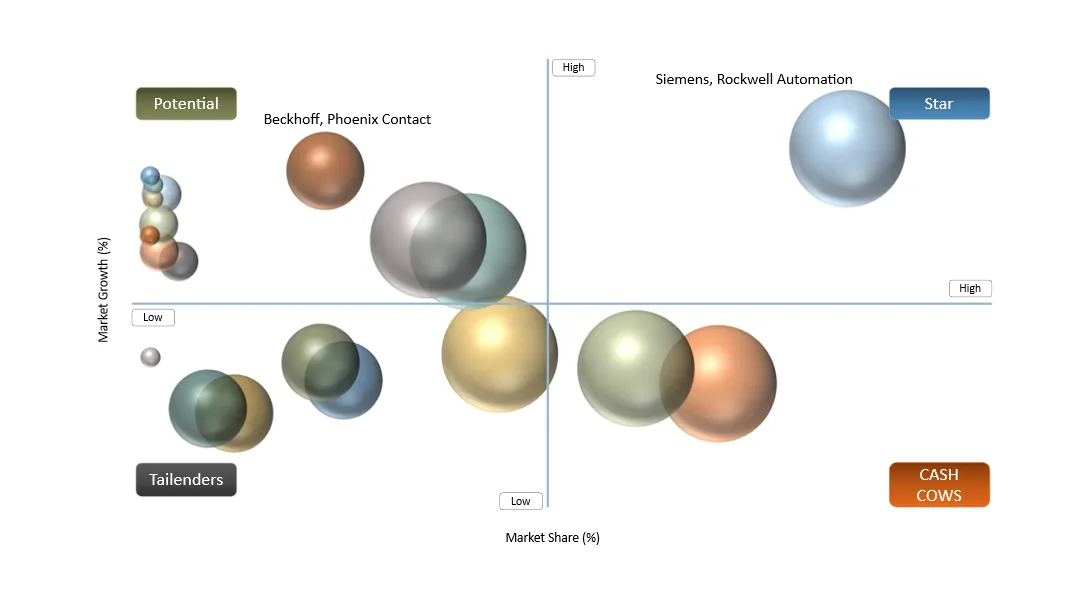
STAR: Siemens, Rockwell Automation, ABB, Schneider Electric and Honeywell are positioned strongly because they combine large installed automation bases, industrial software, embedded OPC UA support and global service ecosystems. Their ability to connect control, edge and enterprise layers supports continued influence over architecture decisions.
POTENTIAL: Beckhoff, Phoenix Contact, Bosch Rexroth, PTC/Kepware, Softing, Unified Automation and Prosys OPC can capture attractive niches through developer tooling, protocol breadth, edge gateways, embedded stacks and heterogeneous brownfield integration.
OPC UA Market Dynamics
Driver Impact Analysis
| Driver | 2026-2028 Impact | 2029-2032 Impact | 2033-2035 Impact | Strategic Meaning |
| Industry 4.0 & IT/OT convergence | Very High | Very High | High | Standardized multi-vendor data access becomes a baseline architecture requirement |
| Industrial AI & edge/cloud adoption | High | Very High | Very High | Contextualized data and semantic models gain strategic value |
| Brownfield modernization | Very High | High | Medium-High | Gateways and integration services remain major revenue pools |
| OPC UA FX / PubSub / TSN | Medium-High | High | Very High | Expands OPC UA toward deterministic controller and field communication |
Driver: Industry 4.0, Industrial AI and IT/OT Convergence
Manufacturers increasingly need trusted operational data outside the control layer for analytics, AI, MES, quality, maintenance and digital twins. OPC UA reduces dependence on proprietary point-to-point interfaces by providing a standardized, secure and semantically richer mechanism to expose plant data. The benefit compounds when a common architecture is reused across many machines and sites.
Restraint Impact Analysis
| Restraint | 2026-2028 Impact | 2029-2032 Impact | 2033-2035 Impact | Strategic Meaning |
| Legacy protocol complexity | High | Medium-High | Medium | Migration requires gateways, mapping and plant-by-plant engineering |
| Certificate & cybersecurity lifecycle | High | High | High | Identity automation and governance become essential for scale |
| Semantic inconsistency | Medium-High | High | High | Companion specifications and namespace governance are required |
| OT/IT skills gap | High | Medium-High | Medium | Services, tooling and simplified engineering gain value |
Restraint: Brownfield Complexity, Security Administration and Skills
Brownfield plants can contain decades of legacy controllers, custom drivers and inconsistent tag structures. OPC UA migration may require gateways, namespace redesign, certificate infrastructure, network segmentation and application changes. Suppliers can reduce this barrier through automated discovery, protocol conversion, managed PKI, reusable companion models and migration services.
OPC UA Market Segmentation Analysis
The global OPC UA market is segmented based on Offering, Deployment Architecture, Communication Model, Solution Type, Application, End Use Industry, Organization Size / User Type, Integration Model and region.
By Offering
Software & Protocol Stacks Remain the Core Monetized Layer
Software stacks, servers, clients, SDKs and engineering tools account for the most directly monetized OPC UA value. Embedded hardware and services expand the addressable market as OPC UA moves into controllers, gateways and edge devices.
By Deployment Architecture
Hybrid Edge-Cloud Architectures Gain Momentum
On-premise deployments remain essential for control reliability, but edge and cloud-connected architectures are growing faster as users route contextualized plant data into historians, AI services and enterprise applications.
By Communication Model
Client-Server Dominates, PubSub and FX Grow Faster
Client-server remains the installed-base foundation for supervisory connectivity. PubSub, OPC UA FX and TSN are expected to grow faster as users seek scalable event distribution and deterministic multi-vendor communication.
By Solution Type
Gateways and Semantic Modeling Address Brownfield Complexity
Servers and clients form the base market, while gateways, protocol conversion, information modeling and certificate management provide higher-value layers for heterogeneous enterprise environments.
By Application
IT/OT Integration and Edge Analytics Are Key Growth Pools
SCADA/HMI connectivity remains large, but MES/ERP integration, edge analytics, digital twins, industrial AI and cloud data pipelines are expanding the strategic role of OPC UA.
By Organization Size / User Type
Large Enterprises Lead Standardization Programs
Large multi-site operators have the strongest incentive to standardize connectivity, namespaces and security policies across heterogeneous assets. OEMs and machine builders are strategically important because embedded OPC UA capability can influence downstream installed-base adoption for many years.
By End Use Industry
Discrete and Process Manufacturing Anchor Demand
Automotive, machinery, electronics, chemicals, oil and gas, power, food and life sciences use OPC UA to connect multi-vendor control systems, machines and enterprise software. Data centers and infrastructure create newer opportunities.
By Integration Model
Integrator and OEM Channels Are Strategically Important
Direct vendor sales dominate large automation platforms, while system integrators, distributors and machine builders drive heterogeneous brownfield deployments and embedded adoption. Cloud marketplaces are emerging for connectors, developer tools and industrial data services.
OPC UA Market Geographical Penetration
U.S. OPC UA Market Landscape
The U.S. market is supported by industrial software investment, reshoring of advanced manufacturing, data-center and semiconductor expansion, energy infrastructure modernization and broad adoption of cloud and edge platforms. Large multi-site manufacturers increasingly standardize OPC UA for cross-vendor data access, while system integrators use gateways to connect legacy PLC and SCADA estates.
Germany OPC UA Market Outlook
Germany is a core OPC UA ecosystem because of its automation industry, Industry 4.0 programs, machine-building base and strong standards participation. Adoption is high across automotive, machinery, process industries and research environments, with growing attention to companion specifications, Asset Administration Shell integration and field-level interoperability.
Japan OPC UA Market Trends
Japan combines large automation suppliers with advanced automotive, electronics, robotics and process industries. OPC UA is increasingly used to connect heterogeneous machinery, production management systems and edge analytics, while local users emphasize reliability, cybersecurity and long lifecycle support.
China OPC UA Market Outlook
China offers strong growth through smart manufacturing, electronics, EV, battery, machinery and industrial digitalization investment. Domestic automation vendors are expanding OPC UA support while multinational suppliers compete in premium multi-vendor and export-oriented factories. Localization requirements and cybersecurity governance shape architecture decisions.
India OPC UA Market Outlook
India is an emerging growth market supported by automotive, pharmaceuticals, chemicals, metals, electronics manufacturing, data centers and smart-infrastructure investment. Brownfield integration creates demand for protocol gateways and system-integration services, while new plants increasingly specify OPC UA-ready controllers and edge connectivity.
Middle East and Africa OPC UA Market Outlook
The region is seeing OPC UA adoption in oil and gas, chemicals, power, industrial data, mining and new industrial projects. Gulf countries lead digital plant and cloud-connected infrastructure investment, while broader regional growth depends on modernization budgets, integrator capability and cybersecurity readiness.
OPC UA Market Competitive Landscape
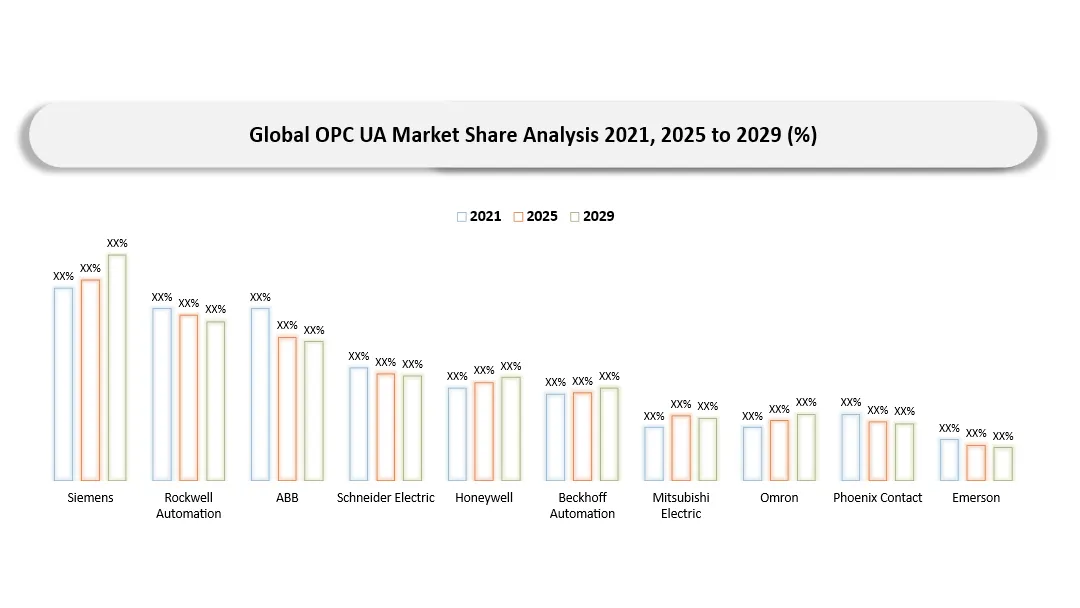
- Competition spans global automation vendors, industrial software companies, specialist OPC stack providers, gateway vendors and system integrators. Siemens, Rockwell Automation, ABB, Schneider Electric and Honeywell bring large installed bases and broad control portfolios, while Beckhoff, Mitsubishi Electric, Omron, Phoenix Contact and Bosch Rexroth compete through embedded automation and machine-control ecosystems.
- Specialist vendors such as PTC/Kepware, Softing, Unified Automation and Prosys OPC provide protocol connectivity, SDKs, servers, clients and developer tooling across heterogeneous environments.
- Market share is difficult to measure because OPC UA revenue is frequently embedded in PLC, DCS, SCADA, edge and software platforms rather than disclosed separately. Competitive positioning is therefore better assessed through installed base, supported products, standards participation, developer ecosystem, interoperability and services reach.
- System integrators remain strategically important because enterprise OPC UA programs often require namespace design, legacy mapping, security architecture, redundancy, network engineering and MES/cloud integration.
- Long-term differentiation will move toward semantic interoperability, edge orchestration, secure lifecycle management and support for OPC UA FX / TSN architectures.
- Market share will increasingly depend on the ability to document real operating efficiency rather than catalogue efficiency at a single duty point.
Public Company Q1-Q2 2026 Performance Comparison
| Public Company | Q1-Q2 2026 Performance | Growth Factors Relevant to OPC UA | Direct OPC UA Exposure |
| Siemens | Q2 FY2026 revenue €19.8B; comparable revenue +6%. Digital Industries and Smart Infrastructure drove growth; digital business grew 19% in H1. | Industrial software, automation recovery, AI, digital twins and software-defined automation increase interoperable OT data demand. | OPC UA embedded across SIMATIC and industrial connectivity portfolios; market-specific revenue not disclosed. |
| Rockwell Automation | Q2 FY2026 sales US$2.239B, +12%; Software & Control sales US$684M, +20%. | Software & control growth, data center, semiconductor, warehouse automation and energy demand support connected automation architectures. | OPC UA supported across FactoryTalk/control ecosystems; standalone OPC UA revenue not disclosed. |
| ABB | Q2 2026 revenues US$9.475B, +14%; comparable +12%; orders +30%. | Automation demand, digital connectivity and software expansion support OPC UA use in DCS, automations, robotics and edge integration. | OPC UA forms part of multiple automation products and Automation Extended architecture; revenue not separately disclosed. |
| Schneider Electric | 2026 H1 results reflected continued growth, with Industrial Automation recovery and digital/AI-enabled technologies highlighted as structural automationrs. | EcoStruxure, Modicon, edge apps and open automation increase demand for secure device-to-enterprise interoperability. | OPC UA Server Expert, Modicon OPC UA modules and Edge Apps connector; revenue not separately disclosed. |
| Honeywell Technologies | Q2 2026 Process Automation & Technology sales US$1.679B; Industrial Automation sales US$1.501B. | Process automation, autonomy, connected operations and installed-base modernization support open industrial connectivity. | OPC UA used within industrial/process connectivity environments; market-specific revenue not disclosed. |
Market Ecosystem Table
| Value Chain Sector | Representative Organizations | Role in OPC UA Market | Value Creation |
| Standards & Conformance | OPC Foundation, IEC, VDMA and industry working groups | Specifications, companion standards, certification and interoperability testing | Reduces fragmentation and establishes trust |
| Protocol Stacks / SDKs | Unified Automation, Prosys OPC, Softing, PTC/Kepware and open-source ecosystems | Servers, clients, SDKs, developer tools and protocol libraries | Accelerates product development and heterogeneous integration |
| Automation Platforms | Siemens, Rockwell Automation, ABB, Schneider Electric, Honeywell, Mitsubishi Electric, Omron | PLCs, DCS, SCADA, automations, robots and embedded OPC UA endpoints | Scales installed base and device-level adoption |
| Edge / Gateway Vendors | Phoenix Contact, Advantech, Softing, HMS Networks and industrial PC vendors | Protocol conversion, edge aggregation, buffering and security | Enables brownfield and edge-cloud deployments |
| Industrial Software | AVEVA, PTC, Siemens, Rockwell, Emerson and MES/historian vendors | SCADA, MES, historian, digital twin and analytics integration | Turns OPC UA data into operational applications |
| Cloud & Data Platforms | Microsoft, AWS, Google Cloud and industrial cloud providers | Cloud ingestion, data lakes, AI, fleet analytics and digital twins | Extends OPC UA data into enterprise and AI workloads |
| System Integrators | Accenture, Capgemini, Tata Consultancy Services, regional automation integrators | Architecture, migration, namespace design, cybersecurity and deployment | Transforms standards into production systems |
| End Users | Automotive, chemicals, energy, food, pharma, machinery, semiconductor, utilities | Specify interoperability requirements and deploy multi-vendor architectures | Automation scale, standardization and recurring services |
Key Companies
- Siemens (Germany)
- Rockwell Automation (U.S.)
- ABB (Switzerland)
- Schneider Electric (France)
- Honeywell (U.S.)
- Beckhoff Automation (Germany)
- Mitsubishi Electric (Japan)
- Omron (Japan)
- Phoenix Contact (Germany)
- Bosch Rexroth (Germany)
- PTC / Kepware (U.S.)
- Emerson (U.S.)
- Softing (Germany)
- Unified Automation (Germany)
- Prosys OPC (Finland)
Company Profiles
Siemens
Siemens integrates OPC UA across SIMATIC controllers, industrial PCs, edge systems and software environments. Its strength comes from a very large automation installed base, Digital Industries software, industrial networking and participation in open automation and standards initiatives.
Competitive priorities include software-defined automation, industrial AI, digital twins, edge integration, secure connectivity and broader developer-oriented engineering workflows.
Rockwell Automation
Rockwell Automation supports OPC UA within its control and FactoryTalk ecosystem and has strong positions in discrete manufacturing, process hybrid applications and industrial software. Its Software & Control growth supports expansion of interoperable plant-data architectures.
Competitive priorities include connected enterprise architectures, FactoryTalk software, edge analytics, cybersecurity, OEM partnerships and high-growth automation verticals.
ABB
ABB supports OPC UA across PLCs, drives, robotics and automation architectures. Its Automation Extended strategy uses an OPC UA backbone within a cloud-native, container-based approach to industrial operations.
Competitive priorities include autonomous operations, industrial AI, control-system modernization, robotics connectivity, edge software and lifecycle services.
Schneider Electric
Schneider Electric offers OPC UA Server Expert, Modicon OPC UA modules and OPC UA connectivity in EcoStruxure Edge Apps and automation platforms. Its broad energy-management and industrial-automation footprint supports cross-domain deployments.
Competitive priorities include open automation, secure edge connectivity, software-defined control, industrial intelligence and integration between energy and automation data.
Honeywell
Honeywell provides process and industrial automation platforms used in complex mission-critical environments where secure interoperability, historian access and enterprise integration are important.
Competitive priorities include autonomous operations, process optimization, cybersecurity, industrial AI, lifecycle modernization and connected installed-base services.
Beckhoff Automation
Beckhoff Automation combines PC-based control, EtherCAT and OPC UA capabilities across controllers and industrial PCs. It is influential in machine building and high-performance automation where open software and engineering are important.
Competitive priorities include machine connectivity, edge computing, deterministic networking, engineering productivity and OEM ecosystem expansion.
Mitsubishi Electric
Mitsubishi Electric supports OPC UA across factory-automation controllers and connectivity products for automotive, electronics, machinery and other industrial environments.
Competitive priorities include smart manufacturing, integrated factory automation, edge processing and broader open-protocol interoperability.
Omron
Omron integrates OPC UA into industrial automation and edge environments serving manufacturing, robotics, inspection and machine-control applications.
Competitive priorities include autonomous production, data-driven quality, integrated machine control, edge analytics and simplified factory connectivity.
Phoenix Contact
Phoenix Contact supplies PLCs, industrial PCs, gateways, networking and edge products that support open industrial communication including OPC UA. Its role is especially important at the device, gateway and edge layer.
Competitive priorities include secure edge connectivity, software-defined control, industrial networking, IEC 62443-aligned cybersecurity and machine-builder adoption.
Bosch Rexroth
Bosch Rexroth supports open automation through ctrlX AUTOMATION and related software ecosystems, with OPC UA used as part of machine and factory connectivity architectures.
Competitive priorities include app-based automation, edge connectivity, developer ecosystems, motion/control integration and OEM adoption.
PTC / Kepware
PTC / Kepware is a major industrial connectivity software provider. Kepware products aggregate heterogeneous industrial protocols and expose standardized data to SCADA, MES, cloud and enterprise applications, including OPC UA environments.
Competitive priorities include protocol breadth, edge-to-cloud integration, industrial data contextualization, SaaS connectivity and digital-thread integration.
Emerson
Emerson deploys OPC UA within process automation, control, industrial software and modernization projects across energy, chemicals, life sciences and other process industries.
Competitive priorities include software-defined automation, process data integration, edge analytics, digital twins and lifecycle modernization of installed control systems.
Softing
Softing specializes in industrial communications, OPC UA connectivity, protocol conversion and edge/gateway products for brownfield and heterogeneous automation environments.
Competitive priorities include secure connectivity, embedded OPC UA, migration from legacy protocols, industrial edge and machine-builder partnerships.
Unified Automation
Unified Automation is a specialist provider of OPC UA SDKs, servers, clients and development services used by automation OEMs and software companies to embed standards-compliant OPC UA functionality.
Competitive priorities include SDK performance, standards conformance, security, developer productivity and early support for evolving OPC UA specifications.
Prosys OPC
Prosys OPC develops OPC UA SDKs, servers, clients, simulation tools and professional services with a strong focus on standards-compliant industrial interoperability.
Competitive priorities include developer tools, information modeling, conformance, PubSub, cloud integration and specialist OPC UA consulting.
OPC UA Market Major Pain Points
- Legacy industrial networks and proprietary controller protocols increase migration complexity and gateway requirements.
- Certificate provisioning and renewal can become operationally difficult across thousands of industrial assets.
- Inconsistent namespace design and vendor-specific information models can limit semantic interoperability even when transport is standardized.
- Plant engineers may lack skills spanning OT networking, PKI, information modeling and cloud integration.
- Performance expectations differ between supervisory data access and deterministic field/control communication.
- Cybersecurity teams can restrict plant-to-cloud connectivity unless identity, segmentation and data-governance controls are clear.
- Brownfield systems may use outdated firmware or operating systems that cannot support modern OPC UA security profiles.
- ROI can be difficult to isolate because OPC UA is often an enabling layer inside broader digital-transformation programs.
OPC UA Market Recent Developments
- June 2026: Siemens expanded its software-defined automation portfolio with new Simatic AX capabilities and broader controller support, reinforcing demand for open, IT-like engineering and interoperable industrial data architectures.
- 2026: Schneider Electric published an updated EcoStruxure Edge Apps OPC UA Connector manual and continues to expand OPC UA-based connectivity across Modicon and edge products.
- 2026: ABB continued to position an OPC UA backbone within its Automation Extended architecture and supports OPC UA across automation platforms, robotics, PLCs and industrial connectivity products.
- 2026: The OPC Foundation marked 20 years of OPC UA availability, highlighting the standard’s evolution from classic industrial connectivity toward cloud, semantic and field-level interoperability.
- 2026: OPC Foundation cloud initiatives continued to advance reference architectures for secure industrial data exchange between OPC UA environments and cloud platforms.
Analyst View / Opinion on OPC UA Market
- OPC UA is likely to remain one of the most influential industrial interoperability standards through 2035 because it addresses both secure transport and semantic information modeling.
- The most durable value pools are likely to be integration software, edge connectivity, information modeling, cybersecurity lifecycle tools and services rather than basic protocol licensing alone.
- OPC UA FX and TSN can materially expand the market if multi-vendor controller and field-level interoperability reaches broad commercial adoption.
- Cloud integration will increase the strategic value of OPC UA as industrial AI systems require trusted and contextualized operational data from heterogeneous assets.
- Automation vendors with large installed bases have distribution advantages, but specialist vendors can retain strong positions in protocol breadth, developer tooling and heterogeneous brownfield integration.
- Enterprises that standardize namespaces, security policies and companion models across sites will capture more value than those that deploy OPC UA only as another point-to-point protocol.
OPC UA Market Target Audience
| INDUSTRY | OPC UA REQUIREMENT | PRIORITY |
| Discrete Manufacturing | Multi-vendor machine connectivity, robotics, MES, digital twins | Very High |
| Process Industries | DCS/SCADA integration, asset data, historians, secure enterprise access | Very High |
| Automotive & Machinery | Machine standardization, OEM integration, condition data | Very High |
| Oil, Gas & Chemicals | Secure process data access, brownfield gateways, remote analytics | High |
| Power & Utilities | Asset monitoring, grid/plant integration, cybersecurity | High |
| Food & Life Sciences | Traceability, batch context, validated integration | High |
| Data Centers / Infrastructure | Equipment telemetry, edge integration, energy monitoring | Medium-High |
Why Choose DATAM?
- Data-driven insights combining market sizing, industrial interoperability architecture, standards analysis, competitive intelligence and country-level opportunity.
- Post-purchase analyst support for market entry, segmentation, partner identification and competitive benchmarking.
- Annual updates covering product launches, acquisitions, public-company performance, regulatory change and technology adoption.
- Specialized focus on emerging markets and infrastructure-linked demand rather than generalized regional commentary.
- Actionable analysis connecting OPC UA software, embedded endpoints, gateways, semantic models, edge/cloud platforms and end-user procurement criteria.


























































