


Next Generation Advanced Batteries Market Size
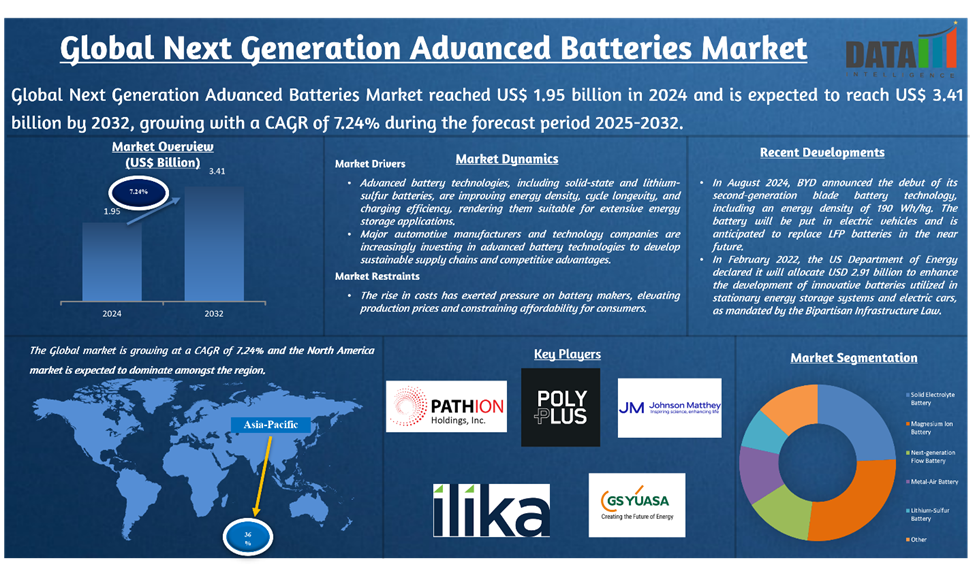
Global Next Generation Advanced Batteries Market reached US$ 2.09 billion in 2025 and is expected to reach US$ 3.78 billion by 2033, growing with a CAGR of 7.24% during the forecast period 2026-2033, according to DataM intelligence research.
The next-generation advanced batteries industry is seeing an important revolution as manufacturers transition from traditional lithium-ion technology to more inventive alternatives. This advancement is driven by increasing demand for improved energy density, superior safety and more sustainable battery solutions. The sector has experienced significant expenditures in the research and development of diverse technologies, including solid-state, lithium-sulfur and metal-air battery technologies, as per our analysis.
Asia-Pacific is a major region for battery manufacture, dominated by nations including China, Japan and South Korea. China leads the next-generation battery market, possessing significant production capabilities and considerable governmental backing for electric vehicles and renewable energy storage. The area advantages from a robust supply network and the existence of prominent battery manufacturers.
Executive Summary
For more details on this report – Request for Sample
Market Scope
| Metrics | Details |
| CAGR | 7.24% |
| Size Available for Years | 2025-2033 |
| Forecast Period | 2026-2033 |
| Data Availability | Value (US$) |
| Segments Covered | Technology, Application, End-User and Region |
| Regions Covered | North America, South America, Europe, Asia-Pacific, Middle East and Africa |
| Fastest Growing Region | Asia-Pacific |
| Report Insights Covered | Competitive Landscape Analysis, Company Profile Analysis, Market Size, Share, Growth, Demand, Recent Developments, Mergers and Acquisitions, New Product Launches, Growth Strategies, Revenue Analysis, Porter’s Analysis, Pricing Analysis, Regulatory Analysis, Supply-Chain Analysis and Other key Insights. |
Next Generation Advanced Batteries Market Dynamics
Driver 1 – Integration of next-generation advanced batteries with renewable energy systems
The integration of next-generation advanced batteries with renewable energy systems is an essential driver for market expansion. With the increase in global energy demands, the necessity for effective energy storage systems to stabilize the grid and regulate intermittent renewable power sources has become critical. Advanced battery technologies, including solid-state and lithium-sulfur batteries, are improving energy density, cycle longevity and charging efficiency, rendering them suitable for extensive energy storage applications.
Moreover, advancements in battery chemistry and production are facilitating cost reductions, hence expediting adoption. With governments and industry emphasizing decarbonization, investments in next-generation batteries for renewable energy integration are anticipated to increase, reinforcing their significance in promoting global energy sustainability.
Driver 2 - Technological advancements
The commercialization landscape is swiftly transforming, propelled by smart alliances and ongoing innovation. Major automotive manufacturers and technology companies are increasingly investing in advanced battery technologies to develop sustainable supply chains and competitive advantages.
The growing collaboration among battery makers, automotive firms and research institutes is cultivating a strong innovation ecosystem. The collaborations enhance developments in battery chemistry, production scalability and energy efficiency, hence accelerating market expansion. As corporations persist in improving battery performance and production capacities, next-generation advanced batteries are anticipated to be crucial in the future of energy storage and electrification.
Restraint: Rising cost of raw materials
The cost of lithium carbonate escalated from US$5,180 per metric ton in 2010 to US$17,000 per metric ton in 2021, indicating considerable fluctuation. The rise in costs has exerted pressure on battery makers, elevating production prices and constraining affordability for consumers. The restricted availability of lithium exacerbates the problem, generating supply chain concerns and hindering the widespread adoption of sophisticated battery technologies that depend on lithium-based chemistries.
The industry has escalated initiatives to create alternative battery technologies, including sodium-ion, magnesium-ion, and lithium-sulfur batteries, which utilize more plentiful and economical ingredients. Although these alternatives provide intriguing options, their commercialization and scalability are still in nascent phases, hindering their effectiveness in reducing lithium dependency.
The persistent price volatility and supply limitations of lithium present a significant obstacle to the extensive adoption and economic viability of next-generation advanced batteries, hindering market expansion in the short to medium term.
Next Generation Advanced Batteries Market Segment Analysis
The global next generation advanced batteries market is segmented based on technology, application, end-user and region.
Metal-Air batteries high energy density for future applications
Metal-air batteries, especially those using zinc and aluminum, are emerging as potential options for stationary energy storage and electric vehicle (EV) applications. Its elevated potential energy density, along with attributes like safety, affordability and sustainability, makes them a compelling choice for next-generation energy storage. Despite its benefits, metal-air batteries encounter significant technological obstacles, particularly concerning rechargeability and the stability of the air electrode.
Research and development (R&D) initiatives are actively addressing these limitations by investigating innovative electrode materials and sophisticated electrolyte formulations. Advancements in anode materials (zinc, aluminum, lithium) and cathode catalysts seek to optimize oxygen reduction processes, thereby enhancing battery efficiency and lifespan. Improvements in electrolyte composition—spanning from aqueous to solid-state electrolytes aim to reduce deterioration, dendrite formation and side reactions, hence boosting battery safety and performance.
Next Generation Advanced Batteries Market Geographical Share
Government support and innovation propel Asia-Pacific’s battery market
Asia-Pacific Next Generation Advanced Batteries Market is experiencing significant growth, driven by the rapid growth of electric vehicles (EVs), increasing investments in renewable energy infrastructure and ongoing improvements in battery technology. Countries including China, Japan and South Korea are at the top of the industry, utilizing their robust battery production capabilities, research endeavors and governmental backing.
China remains to be the dominant influence in the next-generation batteries market, with the biggest share of both production and consumption. The nation's strategic emphasis on electric vehicle adoption and renewable energy initiatives has placed it at the vanguard of battery innovation. Prominent Chinese firms like CATL and BYD are spearheading innovations in solid-state batteries and lithium-ion substitutes, solidifying China's dominance in the industry.
Moreover, governmental incentives for electric vehicle acquisitions and significant investments in battery manufacturing facilities are propelling market growth. The existence of prominent battery makers, along with favorable government regulations throughout Asia-Pacific, is anticipated to maintain the area's supremacy in the global market. With the increasing demand for high-performance, energy-efficient batteries, the Asia-Pacific region is poised to significantly influence the development of next-generation battery technology.
Next Generation Advanced Batteries Market Major Players
The major Global players in the market include Pathion Holding Inc., GS Yuasa Corporation, Johnson Matthey PLC, PolyPlus Battery Co. Inc., Ilika PLC, Sion Power Corporation, LG Chem Ltd, Saft Groupe SA, BYD Company Ltd. and Contemporary Amperex Technology Co. Ltd.
Key Developments
- March 2026 – GS Yuasa Corporation announces pilot-scale solid-state battery production
GS Yuasa expanded its solid-state battery pilot line, targeting automotive and aviation applications, with expected commercialization by 2027–2028, aiming for higher energy density and enhanced safety. - March 2026 – Johnson Matthey PLC develops lithium-sulfur battery cathodes
Johnson Matthey achieved breakthroughs in lithium-sulfur cathode technology, increasing energy density and cycle life for next-generation EV batteries - February 2026 – PolyPlus Battery Co. Inc. advances protected lithium electrode (PLE) technology
PolyPlus demonstrated commercial viability of PLE-based lithium-metal batteries, enabling higher energy densities (>500 Wh/kg) while improving safety and cycle stability for aerospace and EV applications. - February 2026 – Ilika PLC completes larger-format SSB prototype testing
Ilika successfully tested automotive-sized solid-state battery prototypes, showing promising thermal stability and charge/discharge rates suitable for electric vehicle deployment. - January 2026 – LG Chem Ltd invests in next-generation lithium-metal batteries
LG Chem expanded R&D facilities to accelerate development of lithium-metal and high-voltage cathode chemistries, aiming to extend EV driving range and reduce charging times. - January 2026 – BYD Company Ltd. announces dual-ion battery research progress
BYD is developing dual-ion batteries capable of higher charge-discharge rates and longer cycle life for electric buses and commercial EVs, highlighting the diversification of next-gen battery chemistries.
Why Purchase the Report?
- To visualize the global next generation advanced batteries market segmentation based on product technology, application, end-user and region, as well as understand key commercial assets and players.
- Identify commercial opportunities by analyzing trends and co-development.
- Excel data sheet with numerous data points of the next generation advanced batteries market with all segments.
- PDF report consists of a comprehensive analysis after exhaustive qualitative interviews and an in-depth study.
- Product mapping available as excel consisting of key products of all the major players.
The global next generation advanced batteries market report would provide approximately 62 tables, 60 figures and 202 pages.
Target Audience 2026
- Manufacturers/ Buyers
- Industry Investors/Investment Bankers
- Research Professionals
- Emerging Companies



























































