


Neuromodulation Devices Market Size
The global neuromodulation devices market was valued at US$ 111.56 Billion in 2025 and is expected to reach US$ 203.45 Billion by 2033, growing at a CAGR of 7.0% during the forecast period 2026-2033.
Neuromodulation Devices Market Overview
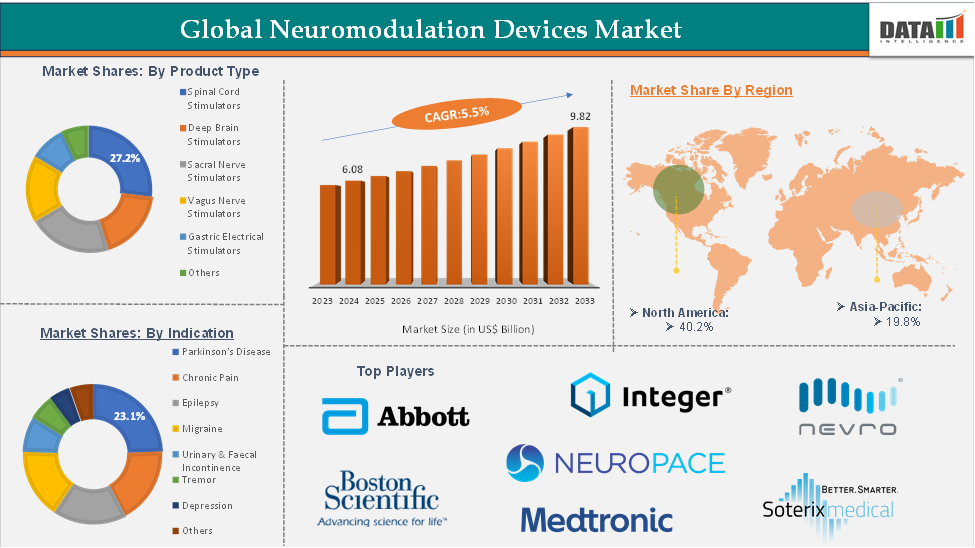
The neuromodulation devices market is experiencing strong growth driven by rising cases of chronic pain, neurological disorders, and treatment-resistant conditions. Key innovations are transforming patient care and enabling personalized therapy. North America leads the market due to robust reimbursement and advanced infrastructure, while Asia-Pacific is the fastest-growing region, fueled by rising healthcare access and neurological disease awareness. Spinal cord stimulators dominate applications, especially for pain management, with hospitals as the main end-users, though specialty clinics and home-use devices are gaining traction.
Neuromodulation Devices Market Executive Summary
Neuromodulation Devices Market Dynamics: Drivers & Restraints
Drivers:
Rising technological advancements are significantly driving the neuromodulation devices market growth
Technological advancements have significantly transformed the global neuromodulation devices market, enhancing both treatment modalities and patient outcomes. Key innovations include the miniaturization of devices, which has led to the development of smaller, rechargeable implantable pulse generators capable of delivering complex stimulation patterns with greater precision. Additionally, the evolution of electrode designs and stimulation waveforms has broadened the clinical applications of neuromodulation, allowing for more targeted modulation of specific neural pathways.
The integration of digital health technologies has further elevated the field by enabling real-time patient monitoring and personalized treatment plans. This shift toward connected, patient-centric care supports continuous engagement and improves long-term treatment outcomes beyond traditional clinical settings.
For instance, in April 2024, Medtronic launched the NeuroSmart portable microelectrode recording (MER) navigation system in India. Designed for use in deep brain stimulation (DBS) procedures for Parkinson’s disease, this system enhances surgical precision by accurately targeting affected brain areas. DBS is commonly used to treat motor symptoms such as tremors, rigidity, and gait disturbances, and the NeuroSmart system allows for real-time brain signal capture, contributing to improved surgical outcomes and greater therapeutic efficacy.
Rising prevalence of neurological disorders is expected to boost the neuromodulation devices market growth
The rising prevalence of neurological disorders is a key driver expected to significantly boost the growth of the neuromodulation devices market. Conditions such as Parkinson’s disease, epilepsy, chronic pain, depression, and Alzheimer’s are increasingly affecting populations worldwide, particularly as the global population ages.
For instance, according to the Alzheimer's Association, over 7 million Americans are living with Alzheimer's. By 2050, this number is projected to rise to nearly 13 million. Nearly 4 in 5 Americans would want to know if they had Alzheimer’s disease before having symptoms, or before those symptoms interfered with their activities. These disorders often require long-term, non-pharmacological interventions due to limited efficacy or side effects of medications.
Neuromodulation therapies, including spinal cord stimulators, deep brain stimulation (DBS), vagus nerve stimulators (VNS), and non-invasive techniques like transcranial magnetic stimulation (TMS), offer targeted and effective symptom management. As the burden of these conditions grows, demand for advanced and minimally invasive neuromodulation solutions is increasing, driving investment, innovation, and adoption across both developed and emerging markets.
Restraint:
High cost of devices is expected to hamper the growth of the neuromodulation devices market
The high cost of neuromodulation devices remains a significant barrier to market growth, particularly in low- and middle-income countries. Implantable systems such as spinal cord stimulators and deep brain stimulation (DBS) devices can cost between USD 25,000 to 60,000 per patient, excluding surgical, hospitalization, and post-operative maintenance expenses.
These high upfront and recurring costs limit access for many patients, especially where reimbursement systems are inadequate or non-existent. In regions with constrained healthcare budgets or limited insurance coverage, healthcare providers may prioritize more cost-effective treatment options over neuromodulation.
Opportunity:
Expansion into psychiatric and gastrointestinal disorders is expected to create significant opportunities for the growth of the neuromodulation devices market
The expansion of neuromodulation therapies into psychiatric and gastrointestinal disorders is opening significant new avenues for market growth. Conventionally used for conditions like chronic pain and Parkinson’s disease, neuromodulation is now gaining traction in treating psychiatric disorders such as treatment-resistant depression, obsessive-compulsive disorder (OCD), and post-traumatic stress disorder (PTSD), where conventional therapies often fall short.
Simultaneously, the use of vagus nerve stimulation (VNS) and sacral nerve stimulation is showing promising results in managing gastrointestinal conditions like irritable bowel syndrome (IBS), functional dyspepsia, and fecal incontinence. As research continues to validate these applications and clinical outcomes improve, the neuromodulation devices market is poised to capture a larger share of the mental health and GI disorder segments.
For more details on this report – Request for Sample
Neuromodulation Devices Market, Segment Analysis
The global neuromodulation devices market is segmented based on product type, indication, end-user, and region.
The spinal cord stimulators from the treatment type segment are expected to hold 62.1% of the market share in 2024 in the neuromodulation devices market
The spinal cord stimulators segment holds a major portion of the neuromodulation devices market share and is expected to continue to hold a significant portion of the neuromodulation devices market share during the forecast period.
Spinal Cord Stimulation (SCS) implantation involves a minor device implanted under the skin that conducts low-voltage electrical currents into the spinal cord to interrupt pain signals before they reach the brain. This technique really works by alleviating pain and restoring motion to those patients who suffer from ongoing pain. This implantable neurostimulator functions according to the principle of gate control theory, whereby the pain signals are modulated by electrical impulses so that escape is possible from a painful burden- chronic pain that might be found in the back, hands, and feet. In such an innovative idea, it shall allow the affected to bring their lives back to what is almost considered normal.
For instance, in September 2024, Nevro Corp. revealed the FDA approval and limited market release of HFX iQ with HFX AdaptivAI, which is part of a responsive, personalized pain management platform powering the HFX iQ spinal cord stimulation (SCS) system.
Moreover, in February 2024, Boston Scientific Corporation announced an expanded indication by the US Food and Drug Administration (FDA) for the WaveWriter SCS Systems in the treatment of chronic low back and leg pain with no prior back surgery, popularly known as non-surgical back pain (NSBP).
Neuromodulation Devices Market, Geographical Analysis
North America is expected to dominate the global neuromodulation devices market with a 40.2% share in 2025
North America is expected to maintain its dominance in the global neuromodulation devices market due to a combination of high disease burden, technological leadership, and a favorable regulatory environment. The region benefits from a growing prevalence of neurological and psychiatric disorders.
For instance, according to the Parkinson’s Foundation, approximately 1.1 million people in the U.S. are currently living with Parkinson's disease (PD), a number projected to increase to 1.2 million by 2030. As the second-most common neurodegenerative disorder after Alzheimer's disease, Parkinson’s continues to see rising incidence, with nearly 90,000 new diagnoses annually across the country. This rising incidence is significantly driving demand for deep brain stimulation (DBS) and other neuromodulation therapies. Additionally, North America boasts an advanced healthcare infrastructure, strong reimbursement frameworks, and a high level of awareness and acceptance of neurotechnology.
A surge in product launches is also contributing to market growth, with companies like Medtronic, Abbott, and Boston Scientific rolling out next-generation devices such as closed-loop spinal cord stimulators and adaptive DBS systems. For instance, in April 2024, Magnus Medical, Inc., commercially launched its SAINT neuromodulation system, a breakthrough, fast-acting therapy designed for individuals with treatment-resistant major depressive disorder (MDD).
Similarly, in January 2024, GrayMatters Health officially launched Prism for PTSD in the United States. This marks the debut of the first self-neuromodulation device to receive FDA clearance as a prescribed adjunct to standard care for post-traumatic stress disorder (PTSD). The device is currently available at two U.S. clinics, with several additional clinics in the process of installation and staff training.
Asia-Pacific is growing at the fastest pace in the neuromodulation Devices market, holding 19.8% of the market share
Asia-Pacific is emerging as the fastest-growing region in the neuromodulation devices market, driven by a surge in neurological disorders, increasing healthcare investments, and expanding access to advanced therapies. Countries like China, India, and South Korea are witnessing a rising prevalence of chronic pain, Parkinson’s disease, epilepsy, and depression.
Government support for medical technology innovation and favorable regulatory reforms is accelerating device approvals and local manufacturing. For instance, in 2024, the NMPA granted innovation approval to Boston Scientific Neuromodulation’s DBS directional lead and issued a review report.
Key Developments
February 2026: Rising adoption of AI-enabled neuromodulation systems and closed-loop stimulation technologies across North America and Europe improved treatment precision for chronic pain, Parkinson’s disease, and epilepsy. Major companies, including Medtronic, Abbott, and Boston Scientific Corporation, accelerated the development of advanced spinal cord and deep-brain stimulation devices.
January 2026: Increasing investments in minimally invasive neurostimulation procedures across the United States, Germany, Japan, and South Korea strengthened demand for implantable neuromodulation devices. LivaNova PLC, Nevro Corp., and Saluda Medical expanded innovation in chronic pain and neurological disorder treatment platforms.
December 2025: The growing prevalence of neurological disorders, including Parkinson’s disease, epilepsy, depression, and chronic pain across the Asia-Pacific, has accelerated the adoption of advanced neuromodulation therapies. Hospitals and neuroscience centers in China, India, and Japan increased deployment of spinal cord stimulation and vagus nerve stimulation systems.
November 2025: Expansion of wearable neuromodulation technologies and non-invasive brain stimulation platforms across Europe and North America increased accessibility to neurological treatment solutions. Nexstim and electroCore Inc. strengthened portfolios supporting migraine management, depression therapy, and neurorehabilitation applications.
October 2025: Rising advancements in temporal interference stimulation, AI-guided therapy programming, and wireless neurostimulation technologies improved precision and patient outcomes in neuromodulation procedures globally. Research institutions in the United States accelerated the development of next-generation non-invasive deep-brain stimulation platforms.
September 2025: Increasing healthcare infrastructure modernization initiatives across India, Southeast Asia, and the Middle East regions accelerated the installation of advanced neuromodulation systems in tertiary hospitals and specialty neuroscience centers. Biotronik and Mainstay Medical expanded neuromodulation device portfolios targeting emerging healthcare markets.
August 2025: Growing government funding and research support for brain-computer interface technologies strengthened innovation in neuromodulation and neurostimulation systems globally. China accelerated investments in brain implant technologies and clinical trials through companies including NeuroXess and NeuCyber NeuroTech.
July 2025: Rising collaborations between medical device companies, neuroscience institutes, and hospitals accelerated the development of AI-integrated neuromodulation platforms and remote patient monitoring systems worldwide. Medtronic and Boston Scientific strengthened strategic investments in chronic pain and peripheral nerve stimulation technologies.
June 2025: Increasing focus on minimally invasive neurological therapies and expansion of neurological care infrastructure supported strong growth in neuromodulation device adoption worldwide. North America maintained market leadership, while Asia-Pacific emerged as the fastest-growing regional market driven by rising neurological disease burden and healthcare investments.
Neuromodulation Devices Market Competitive Landscape
Top companies in the neuromodulation devices market include Medtronic, Abbott, Boston Scientific Corporation, Integer Holdings Corporation, ElectroCore, NeuroPace, Inc., Nevro Corp, BrainsVVay, Neuronetics, Soterix Medical Inc., among others.
Neuromodulation Devices Market Scope
Metrics | Details | |
CAGR | 7.0% | |
Market Size Available for Years | 2023-2033 | |
Estimation Forecast Period | 2026-2033 | |
Revenue Units | Value (US$ Bn) | |
Segments Covered | Product Type | Spinal Cord Stimulators, Deep Brain Stimulators, Sacral Nerve Stimulators, Vagus Nerve Stimulators, Gastric Electrical Stimulators, Others |
Indication | Parkinson’s Disease, Chronic Pain, Epilepsy, Migraine, Urinary & Faecal Incontinence, Tremor, Depression, Others | |
End-User | Hospitals, Ambulatory Surgery Centers (ASC), Clinics & Physiotherapy Centers, Others | |
Regions Covered | North America, Europe, Asia-Pacific, South America, and the Middle East & Africa | |
The global neuromodulation devices market report delivers a detailed analysis with 60+ key tables, more than 60+ visually impactful figures, and 178 pages of expert insights, providing a complete view of the market landscape.


























































