


Near Packaged Optics Market Size and Overview
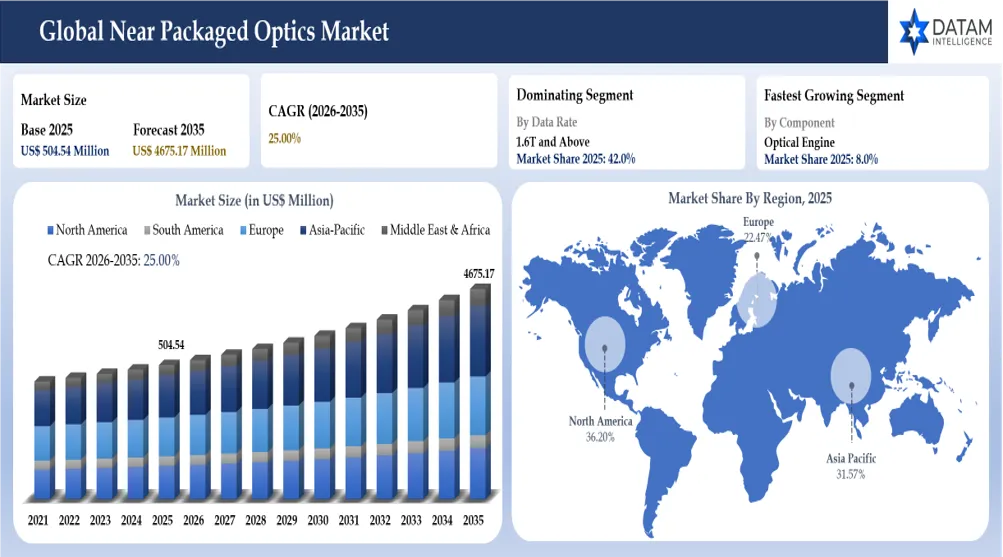
The global near packaged optics market reached US$ 504.54 million in 2025 and is expected to reach US$ 4675.17 million by 2035, growing with a CAGR of 25.00% during the forecast period 2026-2035.
The global near packaged optics market is being transformed by the rapid shift of AI networking from 800G towards 1.6T and even faster connections. By 2026, 1.6T optical modules will be in full production, while 3.2T and faster options will be moving through the evaluation stage. The attention for NPO is increasing because it allows making the optical engine closer to the switch ASIC, minimizes electrical paths, solves issues related to signal integrity and decreases power needs for traditional front panel connectivity methods.
The competitive environment is gradually shifting to silicon photonics with high density and socket optical engines, with vendors coming up with 3.2T, 6.4T and even higher capacity NPO solutions for AI clusters. Accelink rolled out a 6.4T NPO optical engine that had 32×200G lanes and NewPhotonics and Tower Semiconductor started mass production of laser integrated optical engines which had 800G to 1.6T NPO socket pluggable capabilities in September 2026. Also, Eoptolink has seen a rise in shipments of 1.6T, as well as advancements in cooperation with customers of NPO, signaling that commercialization efforts have shifted to qualification and future deployment.
Near the Packaged Optics Market Key Takeaways
- 1.6T and Above has become an important high-speed segment with the development of AI cluster and hyperscale data center scaling towards high bandwidth connectivity. Optical technologies 1.6T are being deployed, while 3.2T and 6.4T are being developed via demonstrations and commercialization.
- Silicon Photonics and Linear-Drive NPO architectures are becoming increasingly relevant as optical engines approach switch ASICs to minimize electrical path loss and power consumption as well as signal integrity issues.
- Development of 6.4T NPO architecture is advancing as suppliers demonstrate optical engines at 32×200G using silicon photonics and packaging for next generation AI networking.
- AI Scale-up Networking will be a key driver of demand because of the increasing limitations posed by higher switch bandwidth and 200G per lane architectures on traditional electrical interconnects.
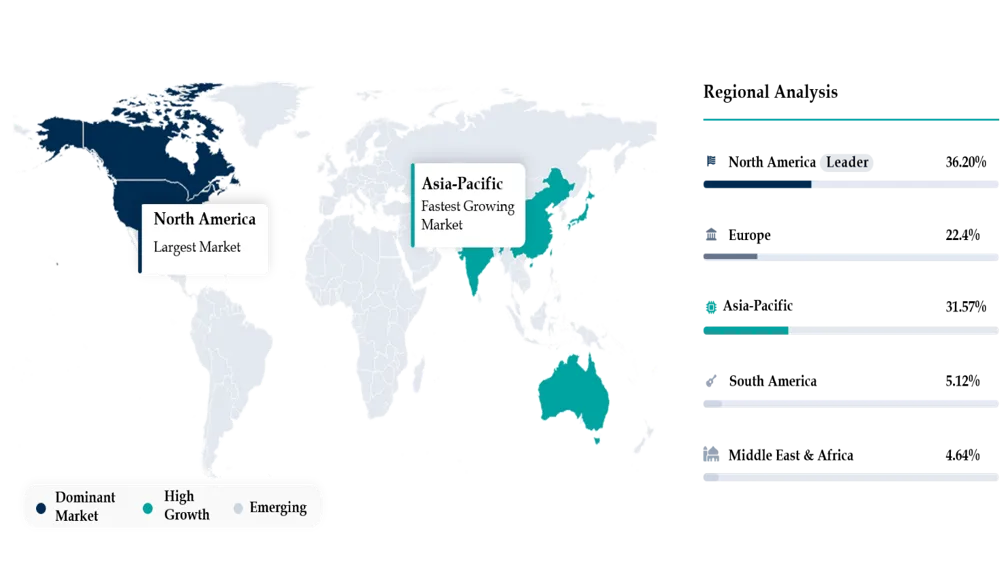
- North America held the largest share of the global near packaged optics market, with a 36.20% share in 2025, due to hyperscale cloud infrastructures, AI datacenter investments and optical networking advancements.
Near Packaged Optics Industry Trends and Strategic Insights
- AI-driven switch bandwidth is accelerating NPO adoption: The transition to switch designs such as 800G, 1.6T and above is putting additional stress on the electrical interface between the switch ASIC and the optics, thus making it more critical to have the optical engine nearer the higher bandwidth ASIC.
- NPO is emerging as an intermediate architecture for next-generation data centers: NPO is being looked at by system architects as a potential means of reducing electrical reach but offering better serviceability and modularity compared with co-packaged optics during the migration to higher-radix AI networks.
- Optical engine placement is shifting closer to the ASIC: Development within the industry is progressively emphasizing reducing PCB trace length and loss in the electrical channel through compact optical engines, enhanced optical coupling and denser packaging technologies which are able to support more stringent SerDes interfaces.
- Thermal and power efficiency are becoming design-level priorities: With rising power dissipation due to increased bandwidth requirements in the switch ASICs, NPO topologies are designed using shorter electrical channels and efficient optical conversion.
- Ecosystem collaboration is becoming strategically important: NPO integration is achieved through coordination between switch ASIC suppliers, optical components suppliers, PIC suppliers, semiconductor packaging suppliers and DC systems suppliers, with interoperability, optical interconnect standards and manufacturability being key competitive aspects.
Near Packaged Optics Market Scope
| Metrics | Details | |
| 2025 Market Size | US$ 504.54 Million | |
| 2035 Projected Market Size | US$ 4675.17 Million | |
| CAGR (2026-2035) | 25.00% | |
| Largest Market | North America | |
| Fastest Growing Market | Asia-Pacific | |
| By Component | Optical Engine, Thermal Management, Control Electronics, Optical Fiber and Other Components | |
| By Optical Engine Technology | Silicon Photonics, VCSEL-Based, InP-Based, Heterogeneous Photonic Integration and Other Technologies | |
| By Optical Engine Configuration | Single Optical Engine, Dual Optical Engine, Multi-Optical-Engine and Co-Packaged Optical Engines | |
| By Packaging Approach | Socketed NPO, Board-Level NPO, Substrate-Based NPO and Multi-Optical-Engine NPO | |
| By Data Rate | 400G, 800G, 1.6T and 3.2T & Above | |
| By Lane Speed | 56G/lane, 100G/lane, 112G/lane, 200G/lane and 400G/lane & Above | |
| By Optical Interface / Fiber Configuration | DR4, DR8, DR16, FR4, 2×FR4 and Other Configurations | |
| By Modulation Technology | PAM4, Higher-Order PAM and Other Modulation Technologies | |
| By Application | AI Networking, AI Training Clusters, AI Inference Clusters, High-Performance Computing, Hyperscale Data Centers, Cloud Data Centers, Ethernet Switching, GPU/Accelerator Interconnects and High-Speed Data Center Interconnects | |
| By End-User | Hyperscale Cloud Providers, AI Data Center Operators, Networking Equipment Manufacturers, Switch ASIC Manufacturers, AI Accelerator Manufacturers, HPC Operators, Cloud Service Providers and Telecommunications Operators | |
| By Region | North America | U.S., Canada, Mexico |
| Europe | Germany, UK, Russia, France, Spain, Italy, Poland | |
| Asia-Pacific | China, India, Japan, Australia, South Korea, Indonesia, Malaysia, Singapore, Vietnam, Thailand, Philippines, Taiwan | |
| South America | Brazil, Argentina | |
| Middle East and Africa | UAE, Saudi Arabia, South Africa, Israel, Turkiye, Nigeria | |
| Report Insights Covered | Competitive Landscape Analysis, Company Profile Analysis, Market Size, Share, Growth | |
Why does this report matter in 2026?
The near packaged optics market is experiencing strategic importance in 2026. The switch and accelerator networks are evolving towards connectivity speeds of 800 Gbps, 1.6 Tbps and even more as AI facilities become more advanced. This report focuses on the other optical engines that are near ASIC, high-density fiber coupling, silicon photonics and advanced photonic packaging in order to understand how NPO structures can contribute to the development of these technologies in AI and hyperscale data centers.
This report will be highly valuable for 2026 due to the fact that NPO eco-system is now progressing from the individual development of components to standardization, interoperability and scalable commercialization. The industry efforts in terms of NPO multi-source agreements are focused on solving mechanical, electrical, optical and management interfaces, whereas the efforts of the suppliers aim at overcoming problems related to thermal proximity, optical alignment, manufacturing yield and system integration issues. From the perspective of technology adoption, ecosystems, investments, barriers to commercialization and new applications, the report offers a snapshot of where NPO technology currently stands and where the white spaces lie within the technology and marketplace.
Near Packaged Optics Market White Space & Investment Opportunities
- AI cluster optical interconnects: Potential investment areas include NPO technology for use in switch-to-network connectivity for 800G and 1.6T for AI training and inference clusters, which are facing increasing bottlenecks due to the limitations of electrical interconnects.
- High-density optical engine integration: There is a white space for optical engines that incorporate lasers, modulators, photodetectors and photonics integrated circuits in smaller sizes but with manufacturing and high volume deployment capability.
- Advanced optical coupling technologies: There are potentials in the area of lossless and alignment tolerant coupling of the ASIC adjacent optical engines and fiber arrays, one of the major challenges in moving the optics near silicon.
- Thermally optimized NPO architectures: There is investment potential in package technologies and heat-management solutions that allow optical engines to work in conjunction with more power-intensive switch ASICs without compromising optical performance or reliability of the system.
- Open and interoperable NPO ecosystems: There is significant white space in standardization of electrical, optical, mechanical and management interfaces to allow integration of NPO modules and optical engines by different vendors into AI networking systems.
Near Packaged Optics Future Market Transformation
It is anticipated that the near packaged optics market will evolve as artificial intelligence and hyperscale networking continue to progress towards dense 1.6T and advanced optical connectivity, which will bring optical conversions much closer to high-speed switch ASICs and accelerators. The future NPO architecture will involve a smaller optical engine, combined photonic-electronic packaging, automation of fiber alignment, better thermal insulation, higher optical coupling efficiency and the use of standards-based interface that will allow widespread usage across multiple vendors. With the development of the manufacturing process, the competition will evolve beyond optical components' characteristics to include bandwidth density, power consumption, packaging yield, serviceability and scalability of the integration, which may make the NPO architecture a key player in the transition to optical interconnects from traditional pluggable optics.
Near Packaged Optics Market Buyer Decision-Making Criteria
Buyers in the near packaged optics market are using various evaluation criteria to assess solutions. These criteria include the success of an equipment's ability to combine optical engines with high-speed switches or compute ASICs. Systems known for their reliability in terms of signal integrity, optical efficiency, thermal stability and manufacturability are generally preferred. When purchasing equipment for AI data centers and hyperscale networking facilities, buyers are becoming more concerned about not only optical throughput but also other factors when making a purchase decision. These factors include the reduction of electrical reach, level of power consumption, fiber coupling efficiency, packaging density, interoperability with various systems and serviceability.
Major Buyer Decision-Making Criteria
- Bandwidth and Data Rate Support
- Electrical Reach and Signal Integrity
- Optical Coupling Efficiency
- Power Consumption per Bit
- Thermal Performance
- Optical Engine Density
- ASIC and Switch Compatibility
- Fiber Interface and Connectivity
- Packaging Reliability and Mechanical Tolerance
- Manufacturing Yield and Scalability
- Interoperability and Standard Compliance
- System Integration Complexity
- Serviceability and Field Replaceability
- Supplier Qualification and Reliability
- Total Cost of Ownership
- Long-Term Supply Capacity
- Technology Roadmap for 1.6T and Beyond
Near Packaged Optics Market Economic & Investment Analysis
The near packaged optics market is showing emergence in terms of economic benefits because the development of AI data-centers is resulting in enormous expenditure upon high speed switching, optical fabrication and advanced semiconductor packaging. Due to various limitations in terms of power and signal integrity related to 800G, 1.6T and the development of advanced networks, the investments are now directed towards ASIC-related optical engines, silicon photonics, high density optical fiber coupling and photonics packaging. The economic aspects of implementing NPO will be dependent upon a variety of different variables such as reducing electrical reach, increasing system- level efficiency, achieving high optical coupling yields and lowering costs of manufacturing.
From an investing standpoint, the opportunities exist along the NPO value chain and not just within optical modules. Money is going into the development of optical engines, photonic integrated circuits, laser and modulator technologies, packaging equipment, automated optical alignment, thermal management and high-volume manufacturing. Working with partnerships involving ASIC vendors, optical vendors, packagers and the data center systems players may be able to reduce development cost and speed up qualification. But the investor must be mindful of the manufacturing challenges, the thermal challenge, the need for interoperability, the qualification cycle for customers and the emerging competitive landscape between NPOs and plug-in optics and co-packaged optics.
Near Packaged Optics Investment Trends in the Market
- Capital is shifting toward NPO optical-engine development: Increasing investment into the miniaturized optical engines comprising of laser, modulator, photodetector and photonic ICs to enable fast switching technology.
- Funding is targeting AI-networking optical infrastructure: Investment into NPO technologies that can enable 800G, 1.6T and future switch-to-optical connectivity is driven by growth in AI data centers.
- Advanced photonic packaging is attracting strategic investment: High-density packaging, optical coupling and heterogeneous integration are getting investments from companies for enabling optical conversion closer to fast-switch ASICs.
- Thermal-management technologies are becoming an investment priority: Investment is now moving into low-loss electrical designs, optics engine thermal technologies and packaging technologies that will coexist alongside more power-hungry switch ASICs.
- Strategic partnerships are strengthening the NPO supply chain: Increasing investment is focusing on partnerships between ASIC suppliers, photonic IC providers, optical components makers, packaging companies and data center equipment providers for faster NPO commercialization.
Strategic Indicators for Near Packaged Optics Market
High Regulation Impact
Regulations and standards impact the near packaged optics market through rules about high-speed optical communication systems, semiconductor production, laser safety, electromagnetic compatibility, computer reliability and data centers. The compliance of NPO technology with regulations will impact the design of optical engines, the management of heat, the electrical interfaces, fiber connection and the qualification of systems for integration of lasers or photonic components with high-power switch ASICs. Additionally, the development of multi-source agreements and interoperability standards will influence the adoption of providers’ products and reduce the time necessary for qualification and product deployment in the industry.
High Investment Activity
There are investments going into the entire value chain of NPO as more demand arises in the data-center network for AI with 800G, 1.6T and higher bandwidth optical interconnects. Investments are also flowing into ASIC-related optical engines, silicon photonics, photonic integrated circuit, laser & modulator integration, fiber coupling technology and high density photonic packaging. There are investments also going into optical alignment automation, thermal management technology and scalable manufacturing process as successful NPO commercialization relies on consistency in coupling efficiency, packaging yield and functionality in close proximity of power hungry switching silicon. Collaboration among switch ASIC designers, optical components providers, photonic packaging firms and data center equipment vendors is further facilitating technology advancement and implementation.
Supply Chain Disruption
The near packaged optics market faces a risk of supply chain disruption since near packaged optics assemblies require a highly synchronized supply chain including optical engines, lasers, modulators, photodetectors, photonic integrated circuits, fiber arrays, couplers, novel packaging technologies and assembly machines. Any disruptions in these raw materials may impact optical alignment, yield rates, qualification and delivery of ASIC adjacent optics. Limited sourcing due to specialization in photonics and semiconductor packaging by only a few suppliers is another risk factor, as well as the rapid transition from 800G to 1.6T, etc. Hence, near packaged optics providers and optical systems makers have been focusing on multiple sources, localized packaging, component agreements and standardization of designs.
Pricing Volatility
The near packaged optics market is subject to pricing variability as NPO devices consist of several specialized elements such as optical engines, lasers, modulators, photodetectors, photonic integrated circuits, fiber arrays and high-end photonic packaging, all of which are under different cost pressures. In the switch from 800G to 1.6T and even higher throughput architectures, pricing premiums can arise since earlier generation solutions often have smaller volume of production, greater tolerance for optical alignment and more complex packaging process. Since manufacturing efficiencies improve with increased manufacturing, there can be changes in the economics of the product; as such, early NPO solutions can have double digit percent price variances between qualification quantities and volume manufacturing, depending on component availability, packaging efficiencies, number of suppliers and customer quantities.
Procurement Pressure
The near packaged optics industry is experiencing procurement pressure as AI data-computing company and network equipment producers look for reliable access to ASIC-related optical engines, silicon photonics parts, lasers, modulators, photodetectors, fiber arrays and advanced packaging capacity. Procurement departments need to acquire components that satisfy strict 800G, 1.6T, signal integrity, thermal, optical coupling and reliability standards while at the same time dealing with small number of qualified suppliers and long validation cycles. Making sure that ASIC, optical engine and packaging and fiber interface will be available at the same time may increase supply time and inventory strain, especially in situations of quick launching of AI clusters making buyers pay more attention to dual sources, long-term capacity agreements, supplier approvals, component standardization and secured possibility to produce components in huge volumes.
New Technology Adoption
Near packaged optics market progress can be attributed to the implementation of various technologies that facilitate optical conversion proximity to high-speed switches and compute ASICs, especially in 800G, 1.6T and future high-speed interconnects. Such adoption includes technologies such as silicon photonics, compact optical engines, co-packaging of laser sources, high density fiber coupling, photonic packaging, optical alignment and more thermal isolation structures. More utilization of AI accelerators and high-radix switches is driving the need for such technologies since electrical distances could solve signal integrity and power issues. On the other hand, adoption will be dependent on developments in terms of packaging yield, optical coupling efficiency, thermal stability, interoperability and mass production capability, which is an important consideration in the move from deployment phase to NPO commercialization.
Regional Expansion Opportunity
The near packaged optics industry have chances for expanding in areas where centers for AI data, infrastructure for hyperscale cloud computing, implementation of advanced semiconductor packaging and efficient ecosystems for optical networking exist at the same time. The U.S. is characterized by high maturity of switch ASICs, photonics and hyperscale ecosystems that create the opportunity for deployment of AI clusters; China has good prospects being able to pursue the NPO standardization process domestically along with establishing intelligent computing infrastructure; and Japan is taking advantage of its well-established experience in the field of precision photonics, optical components, semiconductor production and advanced packaging. New opportunities appear in South Korea, Taiwan and Singapore that can create local supply chains for NPO and help deployment in the regions.
Government Policy Support
Government policy support is driving the near packaged optics market through public initiatives aimed at supporting semiconductor packaging technologies, AI computing infrastructure, photonic integration and optical interconnects. In particular, China’s 2026-2028 policy on AI + information and communications explicitly focuses on developing and validating high speed optoelectronic chips, optoelectronic co-packaged devices and optical interconnects for AI supernodes, which provide an explicit policy tailwind to technologies that are near NPO. Optical packaging for advanced semiconductor backend operations is similarly being encouraged by Japan under its Post-5G R&D project, helping build up the necessary technology platform for compact photonic-electronic integration.
Pricing Intelligence
The near packaged optics market necessitates pricing intelligence at both architectural and component levels as the economics of the NPO depends on the total cost of the optical engines, lasers, modulators, photodetectors, PICs, fiber arrays, coupling mechanisms and advanced packaging and not on the price of an individual transceiver. It is imperative that the buyers and sellers keep a tab on price differentials among 800G and 1.6T class solutions, qualification volumes versus high volume production, optical coupling yield, packaging complexity and capacity of the supplier. The pricing considerations should also include costs involved in ASIC adjacencies, thermal management, fiber attachment methods, yield and qualification costs due to interoperability issues to arrive at the cost per optical port and cost per bit of transmission. These make the cost-per-bit, optical engine yield, packaging cost, vendor concentration and economies of scale curves significant metrics for NPO procurement and investment decisions.
| HS Code | Reporter | Trade Flow | 2025 Trade Value | Interpretation |
| 8517.62 | China | Exports | US$39.40 billion | Large export base for data-transmission and networking equipment supporting the broader optical-connectivity ecosystem. |
| 8517.62 | Mexico | Exports | US$11.74 billion | Significant manufacturing and export base for data-transmission equipment, particularly relevant to North American electronics supply chains. |
| 8517.62 | Malaysia | Exports | US$5.98 billion | Indicates Malaysia's role in electronics and data-networking equipment manufacturing within the Asian supply chain. |
| 8517.62 | South Korea | Exports | US$951.9 million | Reflects Korea's broader networking-equipment export activity and semiconductor/electronics ecosystem relevant to high-speed optical connectivity. |
Note: HS Code 8517.62 is used as a broad trade proxy for the near packaged optics market because there is no dedicated HS code for NPO. The reported trade values cover a wider range of data-transmission, switching and routing equipment and should not be interpreted as NPO specific trade values.
AI Impact Analysis of Near Packaged Optics Market
The fast-growing infrastructure of AI model training and inferencing is driving up the demand for high bandwidth and low latency interconnects between GPUs, AI processors and high-radix switches. In case of adoption of 800G, 1.6T and beyond Ethernet by AI clusters, traditional electrical connections between switch ASICs and optical transceivers will experience increased challenges related to insertion loss, signal integrity and power consumption. By moving optical engines close to the switching silicon, NPO can alleviate these restrictions and enable higher-density optical connections. As a result, the deployment of AI data centers has become an important catalyst for demand in NPO optical engines, silicon photonics, fast modulators and high-performance fiber couplers.
The influence of AI on the design and commercial path of the NPO market cannot be ignored either. The higher the power density of switch-ASICs, the more difficult the challenges of thermal insulation, small-scale optical packaging, good operation of lasers and optical to electrical interface close to the ASIC. In addition, AI infrastructures need scalable and interoperable solutions which can be used in large cluster formations, making multi-source deals, standard interfaces, automated optical alignment and high-volume photonic packaging of NPO important. Thus, the NPO development process moves from single component optics to the system-level optimization for AI network performance and scalability.
Disruption Analysis of Near Packaged Optics Market
The near packaged optics market is changing traditional optical interconnect designs through the use of optics that are nearer to high-speed switch and compute ASICs. With increasing electrical channel loss and energy requirements with 800G, 1.6T and higher rate designs, NPO technology is decreasing the distance over which high-speed electrical signals need to be transferred before being converted into optical signals. This architectural trend is driving demand for ASIC-related optical engines, silicon photonics, miniaturized fiber coupling and dense photonic packaging solutions, at the same time questioning the traditional front panel pluggable optics approach for high-bandwidth AI and hyperscale network architectures.
The disruption has implications even for the manufacturing and supply chain ecosystem. For NPO, there is a need for more collaboration between switch-ASIC designers, optical-engine suppliers, PIC providers, fiber-attach suppliers, packaging firms and system integrators, which will influence the design and qualification of optical connectivity. In order to address optical alignment, thermal management of high-power ASICs and scalable assembly and interoperable interfaces, novel packaging techniques and multi-vendor ecosystem efforts have been enabled. This disruption means that competitive advantage will be less about transceiver performance and more about optical integration, power efficiency, manufacturability and deployment scalability.
Near Packaged Optics Market BCG Matrix: Company Evaluation
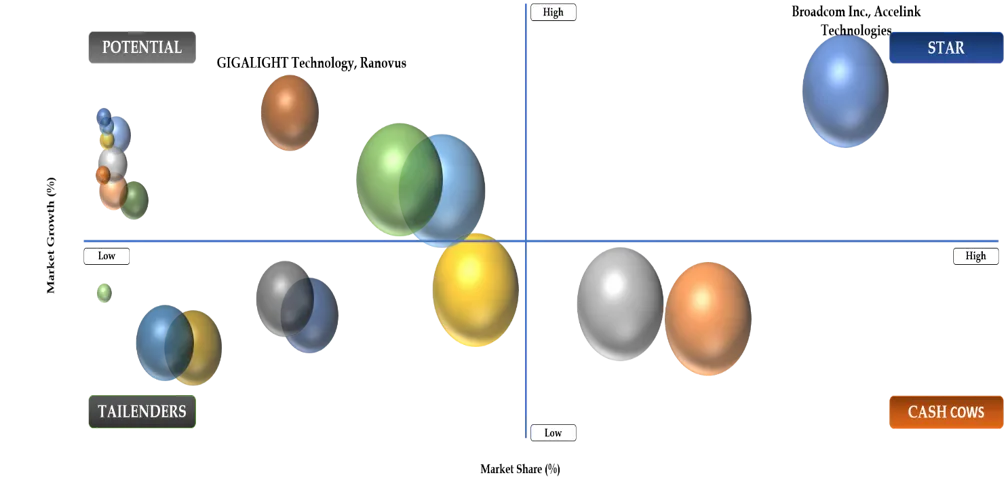
STAR
Broadcom Inc., Accelink Technologies, Eoptolink Technology and InnoLight Technology are the representatives of the Star category, as they have excellent NPO positioning in technology combined with active development of optical engines of high capacity for AI networks. While Broadcom is working on a 3.2T VCSEL-based NPO technology, Accelink has moved from 3.2T to a 6.4T NPO full stack technology. Eoptolink has developed a 6.4T silicon photonics NPO module, while InnoLight developed 6.4T NPO technology. Their competitive advantage lies in fast move to higher capacity, silicon photonics, 200G/lane architecture and increasing AI cluster’s demands.
POTENTIAL
GIGALIGHT Technology, Ranovus, NewPhotonics, Lightmatter, Coherent, Lumentum, Huawei and Ciena fall into the Potential category, due to the presence of their NPO technologies, optical engines, external laser technologies and involvement in the ecosystem, which can be used as channels for growth in terms of NPO development. The chances of success of the companies mentioned above have to do with the evolution towards high speed AI interconnects, socketed optical engines, silicon photonics, external laser architectures, thermal management and NPO/CPO standards. The market is still in the beginning stages of commercialization and there is ample opportunity for those companies that have differentiation in terms of optical-engine technology and manufacturing capability.
Near Packaged Optics Market Dynamics
Driver Impact Analysis
| Driver | Market Growth Impact (%) | Demand Concentration | Impacted Use Case | Strategic Impact |
Rapid Growth of AI Data-Center Networking Bandwidth | 32% | Hyperscale & AI Data Centers | AI Training and Inference Clusters | Accelerates adoption of ASIC-adjacent optical engines for 800G and 1.6T connectivity |
Increasing Switch ASIC SerDes Speeds | 27% | High-Radix Ethernet & AI Switches | Switch-to-Optical Interconnects | Strengthens the need to shorten electrical paths and reduce signal-integrity losses |
Rising Power Constraints in High-Speed Electrical Interconnects | 23% | High-Density Data-Center Racks | Energy-Efficient Network Fabric | Drives investment in optical conversion closer to high-power switching silicon |
Advancement of Silicon Photonics and Photonic Packaging | 18% | Advanced Networking & Computing Platforms | High-Density Optical Engine Integration | Improves integration density, coupling efficiency, scalability and NPO commercialization |
Driver: Escalating Electrical Bottlenecks in AI Switch Architectures
The rapid growth of AI cluster switch bandwidth to 800G, 1.6T and above creates a particular architectural driver for the near packaged optics market. As switch ASIC SerDes speeds increase, longer electrical connections between the ASIC and regular front-panel optical modules suffer from higher insertion loss, signal degradation and power loss. The NPO addresses this problem by placing optical engines closer to the switch ASIC, thus minimizing electrical distance but enabling more dense optical connections. Thus, NPO is of particular interest to AI network platforms where bandwidth density and energy efficiency are ever more significant limiting factors in system design.
Restraint Impact Analysis
| Restraint | Drag on Market Growth (%) | Primary Impact Area | Impacted Use Case | Strategic Impact |
High Precision Requirements for Optical Alignment and Coupling | 30% | Manufacturing Yield | ASIC-Adjacent Optical Engines | Increases assembly complexity and qualification costs, slowing high-volume NPO deployment |
Thermal Challenges Near High-Power Switch ASICs | 26% | System Reliability & Packaging | AI Data-Center Switches | Requires advanced thermal isolation and packaging designs, increasing engineering and deployment costs |
Limited High-Volume Manufacturing Maturity | 24% | Production Scalability | 800G/1.6T Networking Platforms | Constrains rapid capacity expansion and can extend customer qualification cycles |
Evolving NPO Standards and Interoperability | 20% | Ecosystem Integration | Multi-Vendor AI Networking Systems | Creates compatibility and qualification uncertainty until electrical, optical, mechanical and management interfaces become more standardized |
Restraint: Precision Packaging and Thermal Integration Near High-Power ASICs
One of the important constraints is the challenge of integrating optical engines into the thermal and mechanical environment surrounding high-power ASIC switches. NPO requires strict fiber alignment, low-loss optical coupling and mechanical tolerances and temperature management. An increasing power density of ASICs can introduce thermal load affecting laser and optical stability, while strict alignment requirements can limit the yield and increase costs. These difficulties slow down high-volume production and complicate deploying NPO compared to conventional pluggable optical architecture.
Near Packaged Optics Market Segment Analysis
The global near packaged optics market is segmented based on the component, optical engine technology, optical engine configuration, packaging approach, data rate, lane speed, optical interface / fiber configuration, modulation technology, application, end-user and region.
By Data Rate
1.6T and Above Established Leadership in High-Speed NPO Deployments
In 2025, the segment of 1.6T and above was the largest segment in near packaged optics market, contributing to 42.0% market share. The leading position can be justified with the rise in the growth of the AI training and inference clusters in the hyperscale data centers and high-performance computing infrastructure, where the connectivity of traditional 800G is replaced by connectivity with higher capacity architectures. The deployment of 1.6T and the new technology of optical interconnects of 3.2T and 6.4T led to the increase in the demand for optical engines which are closer to the ASIC switches, allowing solving the problem with the signal integrity and electricity consumption.
By Component
Optical Engine Poised for the Highest Growth Across NPO Components
Optical Engine will be the fastest growing segment with a growth rate of 28.6% CAGR from 2026 to 2035. The surge in optical-engine development is due to further assimilation of lasers, modulators, photodetectors, photonic integrated circuits and electronic interfaces into compact optical-engine designs located close to high-speed ASICs. The shift from 1.6T to 3.2T and 6.4T NPOs, together with the increasing uptake of silicon photonics, linear-drive designs and breakthroughs in optical coupling and thermal management technologies will fuel the growth of the Optical Engine market in the contexts of AI and hyperscale networking.
Near Packaged Optics Market Geographical Penetration
U.S. Near Packaged Optics Market Landscape
The U.S. near packaged optics market is being driven by a quick rollout of AI cluster, hyperscale data centers and high-radix Ethernet switches, where greater switch-ASIC bandwidth is fueling the need for shorter electrical distance between the compute or switch silicon and the optical interfaces. The U.S. based technology companies are progressing with NPO centric designs for connectivity in the 800G and 1.6T range, while the optical and semiconductor vendors are coming up with smaller form-factor optical engines, silicon photonics, higher density fiber integration and advanced packaging solutions. The U.S. based eco system is also positively impacted by the high levels of participation in switch ASICs, GPUs, photonics components, semiconductor packaging and hyperscale data-center architecture that facilitate cooperation among chip makers, optical component providers and system integrators for NPO’s commercialization efforts.
Japan Near Packaged Optics Market Outlook
Near packaged optics market in Japan represents an emerging market for technologies which are leveraging Japan’s strong expertise in photonics and optical components, semiconductor processes and precision packaging, as NPO architectures become more relevant because of the increasing demands on bandwidth and low electrical reach requirements driven by data centers and artificial intelligence workloads. Japanese corporations and research institutes are working on silicon photonics, optical engines, high density optical fiber coupling and optical/electrical integration for the transition from 800G and 1.6T and towards future high bandwidth interconnects. Existing competencies of Japan in the field of precision optics and semiconductor packaging provide an opportunity to use NPOs which require high tolerance, optical integration and thermal management close to high power silicon switches.
China Near Packaged Optics Market Trends
The China near packaged optics market is growing quickly as the need for high-speed, low-latency and power-efficient optical interconnects arises from the adoption of AI supernodes and hyperscale intelligent computing clusters. In July 2026, companies such as Huawei, China Mobile Research Institute, JD Cloud, Baidu and more than 20 other industry partners established the OPEN NPO program as well as the first NPO optical interconnect Multi-Source Agreement (MSA) in China focusing on establishing standardization across mechanical, electrical, interface, management and test aspects. Also, China is working on standardizing NPO through CAICT-led group that includes cloud service providers, telecom carriers, hardware suppliers, optical components makers, package suppliers and research institutes. The combination of expanding AI infrastructure, homegrown optical-engine technology development and ecosystem-based standardization is laying a good base for the commercial success of NPOs in China.
Near Packaged Optics Market Competitive Landscape
- Competition is now moving towards 1.6T, 3.2T, 6.4T and higher capacity NPO, with 3.2T and 6.4T offerings maturing through demonstrations, customer qualification and initial deployments. Competitive differentiation is now based on bandwidth density, lane speed, power efficiency, thermal performance and optical engine integration.
- Leading optics and semiconductor suppliers are offering CPO-adjacent optical engines based on silicon photonics, VCSELs, linear drivers and advanced packaging technologies to achieve the shortest possible electrical links from the high-performance ASICs to optical conversion in AI networking equipment.
- Open standards are becoming a key competitive differentiator, with the Open CPX MSA standardizing on sockets and modules for 6.4T/7.2T interconnects at 200G/lane, eliminating reliance on vendor-specific proprietary solutions.
- Serviceability is an important factor that differentiates NPO from its competitors, where socketed optical engines make it possible to replace the engine without the need to replace the optical engine along with the ASIC package.
- Competition is focusing on system-level NPO design, which includes optical engines, external laser sources, fiber management blocks, thermal solution, high speed electrical I/O and link testing, as opposed to only optical components. Accelink’s 3.2T/6.4T architecture is a prime example of the above mentioned system-level architecture.
Public Company Q1-Q2 2026 Performance Comparison
Table I below shows a comparison of five public companies that have direct or strategic relevance to the near packaged optics market. Financial ratios used are overall company-wide or at the business segment level since NPO revenues alone are typically not reported separately. Growth drivers therefore distinguish corporate financial performance from direct NPO exposure.
| Company | Q1–Q2 2026 Performance | Near Packaged Optics Exposure | Key Performance Driver |
| Broadcom Inc. | US$41.50 Billion revenue across Q1-Q2 FY2026 | NPO optical-engine development, including 3.2T NPO architectures for AI networking | AI semiconductor and networking demand; Q2 AI semiconductor revenue reached US$10.8 billion, up 143% YoY |
| Marvell Technology, Inc. | US$5.16 Billion revenue across Q1-Q2 FY2027 | NPO solutions for AI scale-up networks, including optical-engine and silicon-photonics architectures | Strong AI/data-center demand; Q2 FY2027 data-center sales increased 46% YoY |
| Coherent Corp. | US$3.27 Billion revenue across Q1-Q2 FY2026 | NPO optical engines, silicon photonics, lasers and advanced optical-interconnect technologies | Datacenter & Communications demand; Q2 FY2026 segment revenue increased 34% YoY |
| Lumentum Holdings Inc. | US$1.20 Billion revenue across Q1-Q2 FY2026 | Optical components and engines supporting advanced AI interconnects, including CPO/NPO-related architectures | AI-driven optical demand; Q2 FY2026 revenue increased 65.5% YoY and the company reported major CPO/optical-system orders |
| Ciena Corporation | US$3.00 Billion revenue across Q1-Q2 FY2026 | NPO/CPO optical-engine technologies and high-speed optical interconnects for AI/data-center networking | AI-driven high-speed connectivity demand; Q2 revenue increased 39.5% YoY, while Optical Networking revenue reached US$1.10 billion |
Note: Company-level revenue should not be interpreted as NPO revenue unless separately disclosed. NPO remains an emerging product category, so financial results primarily reflect broader semiconductor, photonics, optical networking and data-center businesses. Financial periods also differ across companies because of different fiscal calendars.
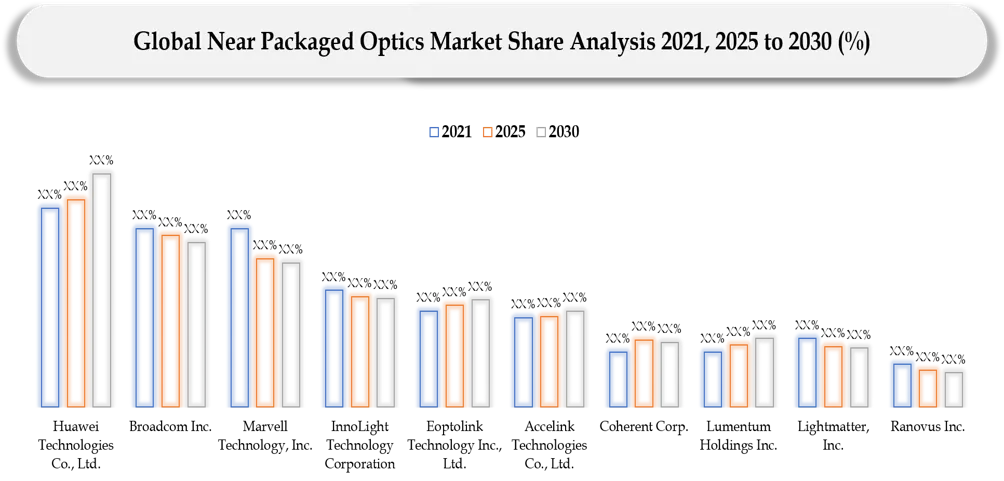
Key Companies of Near Packaged Optics Market
- Broadcom Inc. (U.S.)
- Marvell Technology, Inc. (U.S.)
- Accelink Technologies Co., Ltd. (China)
- InnoLight Technology Corporation (China)
- Eoptolink Technology Inc., Ltd. (China)
- GIGALIGHT Technology Co., Ltd. (China)
- FIBERSTAMP Technology Co., Ltd. (China/Singapore)
- HG Genuine (China)
- Ranovus Inc. (Canada)
- Lightmatter, Inc. (U.S.)
- NewPhotonics Ltd. (Israel)
- Rayleigh Vision Intelligence (RVi) (Taiwan)
- Lumentum Holdings Inc. (U.S.)
- Coherent Corp. (U.S.)
- Huawei Technologies Co., Ltd. (China)
- POET Technologies Inc. (Canada)
- Ciena Corporation (U.S.)
- Source Photonics, Inc. (U.S.)
- TeraHop Networks, Inc. (U.S.)
- O-Net Technologies (Group) Limited (China)
Company Profiles of Near Packaged Optics Market
Broadcom Inc.
Broadcom is an NPO supplier, providing semiconductor solutions as well as optical interconnect technologies. In 2026, Broadcom demonstrated its 3.2T VCSEL-based NPO, along with its other 200G/lane optical, SerDes, DSP and CPO technologies. The NPO strategy of Broadcom seeks to achieve reductions in the length of high speed electrical paths along with offering high bandwidth density and efficiency in AI networking systems.
The competitive objectives of the firm include scaling 200G/lane optical technologies, enhancing NPO efficiency and density in terms of bandwidth, optical engine integration, open interoperability via MSA standards within the industry and optical reach to future generation AI clusters.
Marvell Technology, Inc.
NPO solutions for AI scale-up networks have been developed by Marvell using its silicon-photonics and optical-DSP technology. As part of the 2026 presentation, Marvell emphasized that NPO architecture is an efficient way to minimize the electrical distance between ASICs and optical engines while not having to redesign the whole XPU package. Marvell's strategy uses silicon-photonics, optical-engine electronics and packaging to solve the problems with power and signal integrity.
Competitive priorities of Marvell include the scalability of NPO optical-engine architecture, optimization of ASIC-to-optics electrical channels, improvement of the power-per-bit performance, enhancement of silicon-photonics integration and support for AI accelerators and switches at data rates beyond 1.6T.
Accelink Technologies Co., Ltd.
NPO is being developed by Accelink as a full-stack optical interconnect solution for large AI computing clusters. In September 2026, the company launched the first generation 6.4T NPO optical engine, which is 32×200G architecture based on silicon-photonics technology, linear-driven EICs, 2.5D flip-chip package, optical interconnection, external light source and fiber management technologies.
Competitive considerations focus on moving from 3.2T NPO to 6.4T NPO, improving high-density optical alignment, thermal management and signal integrity, integration of external light source and fiber management technologies, as well as NPO architectures for next generation AI supernodes.
InnoLight Technology Corporation
InnoLight is an optical interconnect provider focused on manufacturing of NPO in addition to its silicon photonics and 1.6T optical product lines. In 2026, the company showed its 6.4T 4xDR8 NPO module at OFC, while simultaneously working on the customization of NPO solutions and further refinement of its research and development. Its 1.6T silicon photonics solutions were also in the process of volume ramp up within the first half of 2026.
Competitive priorities will be to transform NPO demonstrations to customer-ready products, increase silicon photonics integration, improve NPO architecture density and help manage the transition from 1.6T optical modules to NPO solutions for scaling up AI scale-up networks.
Eoptolink Technology Inc., Ltd.
Eoptolink is working on high-density NPO solutions for AI data center interconnects with its 2026 portfolio reaching 6.4T NPO. At OFC 2026, the company unveiled a 6.4T NPO optical module based on silicon photonics and 32 lanes running at 200G per lane. The company has also made innovations in NPO, which includes a VCSEL-based NPO optical engine patent technology, focusing on thermal efficiency and optical stability.
The competitive priorities are scaling 6.4T NPO, enhancing optical engine density and thermal properties, increasing silicon photonics integration, exploring other optical engine solutions like VCSEL NPO and designing solutions for high-bandwidth AI data center architecture.
GIGALIGHT Technology Co., Ltd.
GIGALIGHT is a manufacturer that has developed an NPO products line with special emphasis on next generation AI computing interconnects. Specifically, in 2026, it introduced 1.6T DR16 NPO linear silicon photonics engine featuring socket-based technology, 16 x 100G PAM4 and transmission up to 500 m. Moreover, in September 2026, it completed an engineering shippable sample of its 1.6T socket-based NPO products line.
The competitive priorities include transitioning from 1.6T to 3.2T NPO, developing socket-based production reliability, lowering power dissipation through DSP-free linear technology, improving optical coupling and thermal characteristics and scaling NPO from engineering samples to the commercial level.
Near Packaged Optics Market Major Pain Points
- Optical-to-ASIC integration complexity: The optical engines' proximity to high-speed switching ASICs makes fiber coupling, optical alignment, electrical interfacing and mechanical tolerance difficult.
- Thermal interference from high-power ASICs: NPO parts have to work near more and more power-dense switching silicon, which causes difficulties in terms of thermal management, laser stabilization, optical performance and reliability of NPO devices.
- High-speed signal-integrity constraints: High-speed signals, at 800 G, 1.6 T and above, even for shorter electrical channels suffer from insertion loss, crosstalk, reflection and impedance mismatches, making high-speed signal integrity challenging.
- Limited manufacturing scalability: NPO requires accurate photonic assembly, fiber coupling, optical alignment and heterogeneous integration, making manufacturing less scalable than traditional pluggable optical transceivers.
- Immature interoperability and supply-chain ecosystem: Disparities in optical engine architectures, electrical interfacing, mechanical design, control techniques and packaging technologies could make integration with multiple vendors problematic.
Near Packaged Optics Market Recent Developments
- September 2026 - Accelink Technologies: Accelink introduced the 6.4T NPO solution at ECOC 2026, employing a 32×200G design using silicon photonics, linear-drive EICs, 2.5D integration with a pluggable socket. The solution targets high-density AI compute-cluster interconnect applications.
- September 2026 - Huawei Technologies: Huawei unveiled a 7.2T NPO module at CIOE 2026 and stated that it would be implemented in next-generation SuperPOD AI platforms. The technology employs 200G per lane and integrates the optical engine close to the switch ASIC while remaining serviceable.
- September 2026 - Coherent Corp.: Coherent introduced PhotonLink, a multi-function integrated optics platform supporting NPO, CPO and chip-to-chip connections. The company claimed more than 10 NPO customers and indicated that PhotonLink revenues would begin growing in Q4 2026.
- September 2026 - Eoptolink Technology: Eoptolink continued progressing on its 6.4T NPO platform after the launch of its 32×200G silicon-photonics NPO module in March 2026. Reports in the industry in September revealed that the use of NPO was increasing even as Eoptolink scaled up its optical offerings.
- September 2026 - InnoLight Technology: InnoLight was said to be mass-producing 1.6T optical modules while working on 6.4T NPO and 12.8T XPO solutions for sampling. This represents the progression in the industry from 1.6T volume manufacturing to larger capacity NPO systems.
Analyst View / Opinion on Near Packaged Optics Market
- With switch bandwidth increasing much faster than traditional electrical interconnections are able to support in an efficient manner, especially in terms of AI and data centers that are scaling to speeds of 800G, 1.6T and beyond, NPO is becoming increasingly relevant.
- The most promising application area for NPO may well be one where optical-engine integration takes precedence over optics per se, so technologies in such areas as compact photonic packaging, fiber coupling, thermal management and integration would be key differentiators.
- NPO can also be used as a stepping stone towards greater optical integration in architecture, allowing designers to extend their reach using optics while preserving some level of modularity.
- Manufacturing precision will be an important commercialization consideration: Optical alignment, coupling loss, thermal effect, assembly tolerance and mass production have to be solved together for economically viable commercialization.
- Ecosystem standardization and customer qualification will be crucial market considerations: Switch ASIC compatibility, optical engine compatibility, optical interface compatibility, packaging compatibility and systems platform compatibility will affect how fast NPO is evaluated and deployed to more wide-scale use in data centers.
Target Audience of Near Packaged Optics Market
| INDUSTRY | WHO SHOULD BUY THIS REPORT? | REASON TO BUY THIS REPORT |
| AI & Hyperscale Data Centers | Data Center Infrastructure Heads, Network Architects | Assess NPO adoption for 800G/1.6T AI networking and high-density optical connectivity. |
| Switch ASIC & Networking Equipment | CTOs, ASIC Architects, Product Managers | Evaluate ASIC-to-optics integration, electrical reach, signal integrity and NPO architectures. |
| Optical Transceivers & Optical Engines | Product Strategy Heads, R&D Leaders | Identify opportunities in ASIC-adjacent optical engines and next-generation optical connectivity. |
| Silicon Photonics & Photonic ICs | R&D Managers, Technology Directors | Assess demand for PICs, modulators, photodetectors, lasers and photonic integration. |
| Semiconductor Packaging | Advanced Packaging Heads, Engineering Directors | Evaluate opportunities in photonic packaging, fiber coupling, thermal management and heterogeneous integration. |
| Cloud Computing & AI Infrastructure | Infrastructure Strategy Teams, Procurement Leaders | Analyze NPO requirements for AI clusters, bandwidth density, power efficiency and scalable connectivity. |
| Fiber Optics & Connectivity | Optical Engineering Heads, Component Suppliers | Assess demand for fiber arrays, optical coupling, connectors and high-density interconnects. |
| Electronic & Photonic Component Manufacturing | Supply Chain Managers, Strategic Sourcing Teams | Understand component demand, manufacturing capacity, supplier concentration and procurement risks. |
| Venture Capital & Private Equity | Technology Investors, Investment Analysts | Identify NPO investment opportunities, technology white spaces, commercialization risks and ecosystem developments. |
| System Integrators & Data Center Equipment | System Architects, Product Strategy Leaders | Evaluate NPO integration, interoperability, thermal constraints, reliability and deployment scalability. |
Why Choose DATAM?
- Data-Driven insights: Dive into detailed analyses with granular insights such as pricing, market shares and value chain evaluations, enriched by interviews with industry leaders and disruptors.
- Post-Purchase Support and Expert Analyst Consultations: As a valued client, gain direct access to our expert analysts for personalized advice and strategic guidance, tailored to your specific needs and challenges.
- White Papers and Case Studies: Benefit quarterly from our in-depth studies related to your purchased titles, tailored to refine your operational and marketing strategies for maximum impact.
- Annual Updates on Purchased Reports: As an existing customer, enjoy the privilege of annual updates to your reports, ensuring you stay abreast of the latest market insights and technological advancements. Terms and conditions apply.
- Specialized Focus on Emerging Markets: DataM differentiates itself by delivering in-depth, specialized insights specifically for emerging markets, rather than offering generalized geographic overviews. The approach equips our clients with a nuanced understanding and actionable intelligence that are essential for navigating and succeeding in high-growth regions.
- Value of DataM Reports: Our reports offer specialized insights tailored to the latest trends and specific business inquiries. The personalized approach provides a deeper, strategic perspective, ensuring you receive the precise information necessary to make informed decisions. The insights complement and go beyond what is typically available in generic databases.
What DATAM Uniquely Provides
- NPO architecture-level market mapping: DATAM differentiates between near packaged optics and traditional pluggable optics and co-packaged optics, providing a better understanding of the newly emerged NPO market landscape.
- AI and high-speed networking opportunity analysis: The analysis links the adoption of NPO with 800G, 1.6T, high-radix switch ASICs, AI clusters and hyperscale data center architectures.
- Optical-engine and packaging ecosystem analysis: Value chain analysis by DATAM on optical engines, PICs, lasers, modulators, photodetectors, fiber coupling and photonic packaging technologies.
- Technology and commercialization gap assessment: The report analyzes the unique set of issues facing NPO technologies such as heat proximity to ASICs, optical alignment, signal integrity, manufacturability and interoperability.
- Strategic opportunity and competitive landscape assessment: Through the use of DATAM, gaps in the technology space are identified along with investment themes, potential partnering and new competitive positioning for the NPO space.


























































