


Natural Fragrance Extracts Market Size and Overview
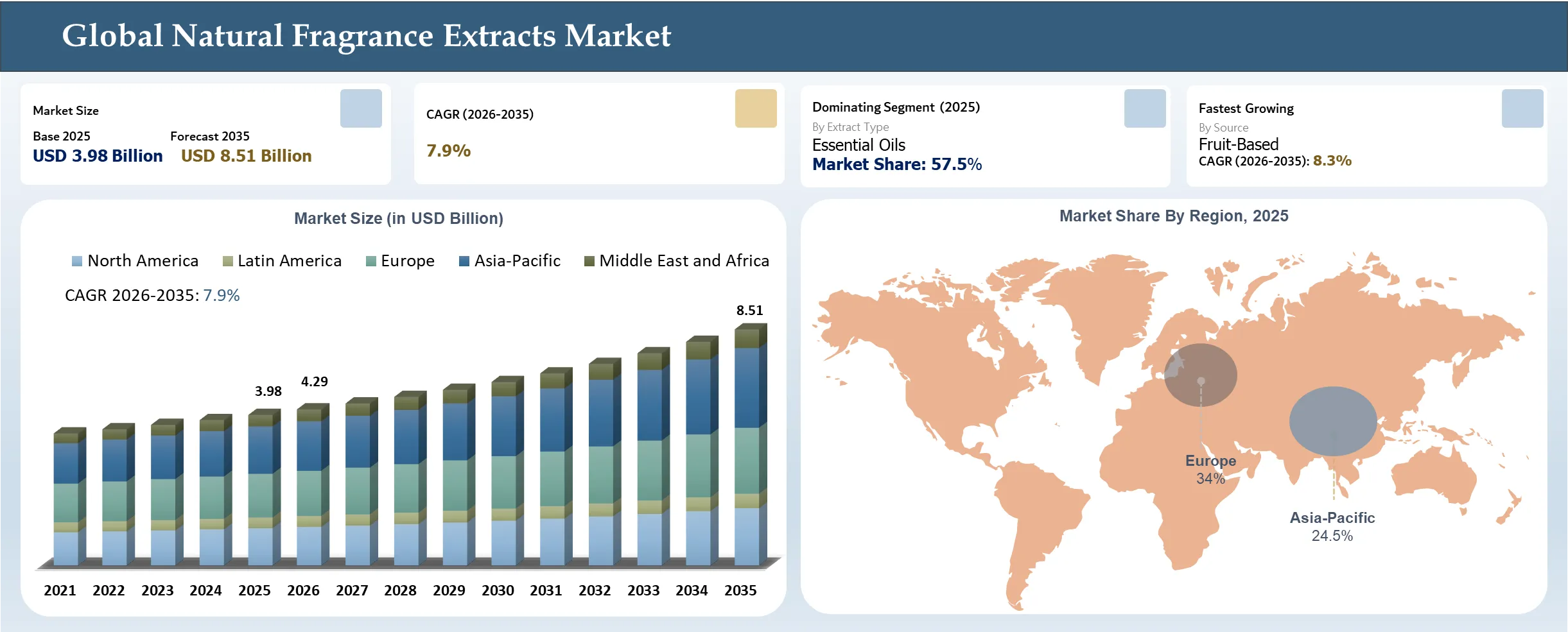
The global natural fragrance extracts market reached USD 3.98 billion in 2025 and is expected to reach USD 8.51 billion by 2035, growing with a CAGR of 7.9% during the forecast period 2026-2035. The market is expanding as fragrance manufacturers increase the use of essential oils, absolute, botanical extracts, and other natural sources of aroma substances by the fragrance industry in fine fragrances, cosmetics, personal care products, home care products, and well-being products. The IFRA Transparency List identifies 1,021 Natural Complex Substances (NCS) among the total 3,691 ingredients listed in the fragrance and functional ingredient list.
Investment in extracting and producing natural ingredients is rising in the market. In February 2026, Givaudan announced an investment of CHF 55 million (around USD 66.3 million) in Grasse, France, to develop Campus 52, a new centre of excellence for the House of Naturals company of Givaudan. The campus will house both a production plant and an innovation laboratory, with emphasis being placed on agronomy, innovation, operations, and perfumery involving advanced extraction technology for natural fragrance ingredients.
White-Space Opportunities for Natural Fragrance Extracts through Bio-Based Feedstock, Extraction and Ingredient Innovation
In January 2025, the Circular Bio-based Europe Joint Undertaking (CBE JU) allocated €197.5 million (USD 221.2 million) across 30 projects involving 416 beneficiaries in 33 countries, creating an opportunity for the natural fragrance extracts market through the expansion of bio-based feedstocks, sustainable extraction, biorefinery processing, and natural-ingredient production. The highest-funded area was the 15 Innovation Actions, which received €109.5 million (USD 122.6 million), representing more than half of the total programme funding and creating the largest opportunity for commercial-scale development and scale-up of bio-based products.
Other investment areas included nearly €40 million (USD 44.8 million) for two Flagship Innovation Actions to establish first-of-their-kind industrial biorefineries, more than €38 million (USD 42.6 million) for 10 Research and Innovation Actions focused on laboratory and controlled-environment technology development, and almost €10 million (USD 11.2 million) for three Coordination and Support Actions.
The investment creates opportunities across multiple company and technology areas rather than providing direct grants specifically for natural fragrance-extract manufacturers. In bio-based chemicals and biorefinery processing, companies such as Versalis S.p.A., Novamont S.p.A., Corbion N.V., Avantium N.V., and NatureWorks LLC can benefit from technologies that convert renewable biomass, vegetable oils and other feedstocks into higher-value bio-based chemicals and ingredients.
In natural and cosmetic ingredients, companies including Givaudan, dsm-firmenich, Symrise AG, BASF SE, and Croda International Plc can benefit from the development of sustainable plant-, algae-, oil- and biomass-derived ingredients that can be incorporated into fragrance, personal-care and cosmetic formulations.
In biotechnology and fermentation, Biosyntia ApS, LanzaTech, Amyris, Inc., and Evonik Industries AG can benefit from biological conversion platforms for producing speciality ingredients and bio-based compounds. In algae and biomass extraction, companies such as Algatec Eco, AlgaEnergy, Corbion, and Roquette can benefit from technologies for recovering oils, proteins, pigments and other high-value compounds from renewable biological feedstocks.
Natural Fragrance Extracts Market Key Takeaways
- Europe held the largest regional market share at 34% in 2025, supported by an established ecosystem in France, Germany, Italy, the UK, and Switzerland. Asia-Pacific is positioned as the fastest-growing market during the forecast period.
- The essential oils segment dominated the natural fragrance extracts market with a 57.5% share in 2025. Its dominance is fueled by high versatility across fine fragrances, cosmetics, soaps, detergents, and aromatherapy.
- In June 2026, IFRA noted the European fragrance, cosmetics, and personal care sector reached a value of €180 billion (USD 201.70 billion). The sector generated €30 billion (USD 33.62 billion) in exports and supported 3.5 million jobs.
- In January 2025, the Circular Bio-based Europe Joint Undertaking allocated €197.5 million (USD 221.2 million) across 30 projects involving 416 beneficiaries in 33 countries. The initiative supports white-space opportunities in bio-based feedstocks and sustainable extraction processing.
Natural Fragrance Extracts Market Industry Trends and Strategic Insight
- Advanced extraction is becoming a core differentiation strategy, with fragrance producers moving beyond conventional extraction toward cleaner and more selective technologies that can preserve delicate aromatic profiles while improving ingredient quality.
- Integrated “seed-to-scent” supply chains are gaining strategic importance, as leading producers increasingly connect botanical cultivation, sourcing, extraction, processing, and perfumery to improve control over natural ingredient quality and provenance.
- Upcycling is emerging as a commercial route for natural fragrance development, with producers converting agricultural and processing by-products such as citrus peels and wood residues into higher-value aromatic ingredients.
- Supply resilience is becoming a strategic priority for natural extract producers because geographic origin, plant part, seasonality, and extraction method can materially influence the composition and consistency of natural complex substances.
- Supply resilience is becoming a strategic priority for natural extract producers because geographic origin, plant part, seasonality, and extraction method can materially influence the composition and consistency of natural complex substances.
Natural Fragrance Extracts Market Scope
| Metrics | Details | |
| 2025 Market Size | USD 3.98 Billion | |
| 2035 Projected Market Size | USD 8.51 Billion | |
| CAGR (2026-2035) | 7.9% | |
| Largest Market | Europe | |
| Fastest Growing Market | Asia-Pacific | |
| By Extract Type | Essential Oils, Absolutes, Botanical Extracts, Oleoresins, Tinctures & Infusions, Resins & Balsams, Others | |
| By Source | Flower-Based, Fruit-Based, Herb & Leaf-Based, Spice-Based, Wood-Based, Root-Based, Seed-Based, Others | |
| By Application | Fine Fragrances & Perfumes, Personal Care & Cosmetics, Household Care, Soaps & Detergents, Aromatherapy & Wellness, Candles & Home Fragrance, Other Applications | |
| By Region | North America | U.S., Canada, Mexico |
| Europe | Germany, UK, France, Spain, Italy, Poland, Netherlands, Switzerland | |
| Asia-Pacific | China, India, Japan, Australia, South Korea, Indonesia, Malaysia | |
| Latin America | Brazil, Argentina | |
| Middle East and Africa | UAE, Saudi Arabia, South Africa, Israel, Türkiye | |
| Report Insights Covered | Competitive Landscape Analysis, Company Profile Analysis, Market Size, Share, Growth | |
Natural Fragrance Extracts Market Disruption Analysis
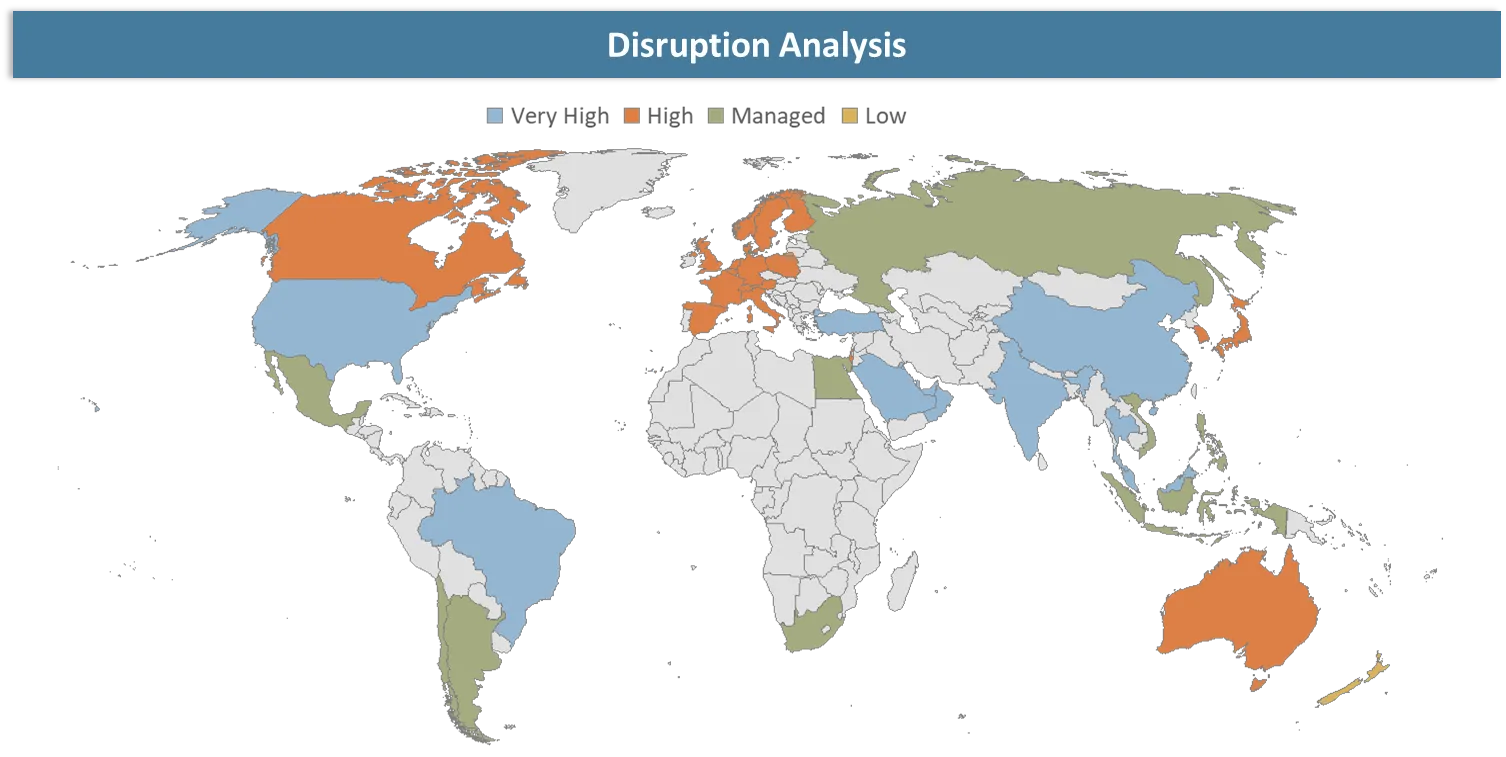
Shift Toward Technology-Enabled and Sustainable Natural Extraction Reshaping the Natural Fragrance Extracts Landscape
The disruption in the natural fragrance extracts market is mostly associated with the rapid transition from conventional, crop-dependent extraction toward technology-enabled, sustainable, and traceable natural fragrance production. Modern methods of extraction, advanced botanical cultivation, biotech-based processing of the extracts and better traceability have been affecting how the natural fragrances and their extracts are sourced, extracted and marketed. With regard to rising demands for consistency in ingredients and sustainable sourcing, producers are going away from conventional extraction approaches towards more integrated production systems that bring together botanical know-how, extraction technologies and research.
Also, the incorporation of sophisticated extraction techniques, direct plant research, and mass production of natural ingredients is undermining the existing dependency on the crop-to-extracts value chain process. In September 2025, according to International Flavors & Fragrances (IFF), the extended LMR Naturals facilities process an average of 85,000 tons of biomass per year, extract roughly 2,000 tons of extracts, and provide more than 850 ingredients sourced from 130 botanical families. Furthermore, the facility is bringing together more than 30 experts for research and development and aims to produce four to six new natural ingredients per year with a waste valorisation rate of at least 98%. The ability to incorporate botanical sourcing, sophisticated extraction, research, waste valorisation, and development is evident.
Natural Fragrance Extracts Market BCG Matrix: Company Evaluation
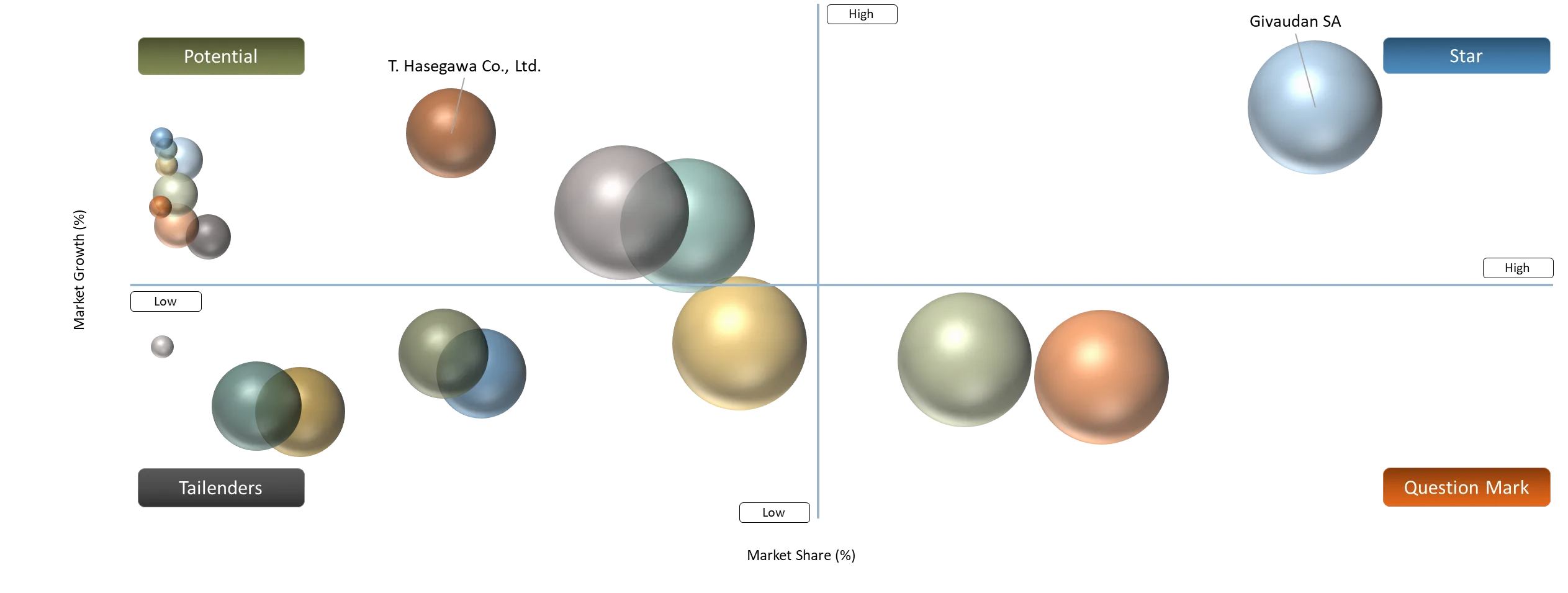
Stars include Givaudan SA and dsm-firmenich AG are placed there because of their strong positions in natural fragrance ingredients, extensive botanical portfolios, advanced extraction and biotechnology capabilities, and continued investment in natural-ingredient innovation. Robertet Group, MANE SA, and Takasago International Corporation are placed in the Question Mark category.
Potential include T. Hasegawa Co., Ltd. and Bell Flavors & Fragrances, Inc. are categorised because they possess established fragrance-development capabilities and natural ingredient portfolios but have a comparatively smaller global presence in natural fragrance extracts than the leading multinational suppliers. Lebermuth, Inc. is positioned in the Tailenders category because its business is more specialised around essential oils and natural ingredients, giving it a focused position rather than the broad global fragrance-and-extract platform of the leading companies.
Natural Fragrance Extracts Market Dynamics
Driver Impact Analysis
| Driver | Market Growth Impact (%) | Demand Concentration | Impacted Use Case | Strategic Impact |
Rising demand for natural and organic cosmetics and personal-care products is expanding the use of natural fragrance extracts. | 28% | Europe & North America | Natural skincare, organic cosmetics, haircare, body care, toiletries | Fragrance suppliers are prioritizing certified, traceable and sustainably sourced botanical extracts to meet clean-beauty formulation requirements and strengthen partnerships with cosmetics manufacturers. |
Growing consumer preference for natural and clean-label products is increasing demand for fragrance extracts. | 24% | Europe, North America & Asia-Pacific | Clean-label personal care, natural soaps, shampoos, lotions and deodorants | Producers are expanding botanical portfolios, improving traceability and developing recognizable plant-derived fragrance profiles to differentiate products from conventional synthetic fragrance formulations. |
Increasing consumer focus on wellness and sensory experiences is driving demand for botanical fragrances associated with relaxation. | 18% | Asia-Pacific & Europe | Aromatherapy, wellness products, bath and body products, candles, spa products | Suppliers are developing fragrance extracts with wellness-oriented positioning and expanding portfolios around lavender, citrus, sandalwood, rose, chamomile and other botanicals associated with sensory and relaxation experiences. |
Expansion of natural fragrance applications beyond fine perfumes into cosmetics, haircare, bodycare, household care, and wellness products is broadening market demand. | 22% | North America, Europe & Asia-Pacific | Household cleaners, laundry care, air care, haircare, skincare, body care and wellness products | Companies are reducing dependence on fine fragrance applications by developing scalable extracts suitable for multiple consumer-product categories, increasing volume opportunities and broadening customer bases. |
Rising demand for natural and organic cosmetics and personal-care products is expanding the use of natural fragrance extracts
The rising preference for natural and organic cosmetics and personal-care products is leading to an increase in the application of natural extracts of fragrance in the formulas of skincare, haircare, body care, toiletries, and other personal-care products. With consumers increasingly demanding information on the origin of the ingredients used and the safety of the products, it becomes necessary for companies to use botanical sources of fragrances, like essential oils, absolutes, CO₂ extracts, and botanical distillates.
In parallel, the expansion of natural and organic cosmetics is strengthening the commercial base for natural fragrance extracts as regulatory clarity and consumer-safety requirements increasingly influence ingredient selection. In June 2026, according to the International Fragrance Association (IFRA), the European fragrance, cosmetics, and personal-care industry was valued at €180 billion (USD 201.70 billion) in 2026, generated €30 billion (USD 33.62 billion) in export revenue, and supported 3.5 million jobs. The provisional EU Omnibus VI agreement also established a more predictable regulatory framework for cosmetics, fragrance, and essential oils while maintaining consumer-safety requirements. The agreement specifically recognises the particular characteristics of natural complex substances, including essential oils, and introduces clearer transitional and regulatory mechanisms.
Restraint Impact Analysis
| Restraint | Drag on Market Growth (%) | Primary Impact Area | Impacted Use Case | Strategic Impact |
Increasing regulatory restrictions on fragrance allergens are raising compliance, testing, labeling, and formulation requirements for products containing natural extracts. | 26% | Europe & North America | Natural perfumes, skincare, cosmetics, soaps, personal-care products | Strengthen allergen screening, regulatory documentation, safety assessment, and compliant labeling; prioritize extracts with well-characterized compositions. |
Complex chemical composition of natural extracts makes reformulation difficult when individual constituents face safety or regulatory restrictions. | 22% | Europe, North America & Asia-Pacific | Fine fragrances, cosmetics, haircare, body care, aromatherapy | Develop standardized extracts, maintain constituent-level composition data, and establish alternative botanical materials to support faster reformulation. |
Limited availability of sustainably sourced botanical ingredients can constrain the consistent supply of certain natural fragrance materials. | 24% | Europe, Asia-Pacific & Latin America | Essential oils, absolutes, specialty botanical extracts, premium fragrances | Diversify botanical sourcing regions, establish long-term supplier partnerships, invest in regenerative cultivation, and develop alternative raw-material sources. |
Increasing traceability and sustainability requirements add supply-chain complexity and compliance costs for manufacturers sourcing natural fragrance ingredients globally. | 19% | Europe & North America | Certified natural cosmetics, premium perfumes, personal care, household fragrances | Implement digital traceability, supplier auditing, sustainability certification, and origin-level documentation to improve supply-chain visibility and protect premium positioning. |
Increasing regulatory restrictions on fragrance allergens are raising compliance, testing, labelling, and formulation requirements for products containing natural extracts
The increasing regulatory restrictions on fragrance allergens are raising compliance, testing, labelling and formulation requirements for products using natural fragrance extracts. Natural extracts like essential oils, absolutes, and botanical extracts have several naturally occurring fragrance ingredients, which include some allergens that require disclosure. Manufacturers have to do an evaluation of the extract ingredients, identify the regulated allergens, have the right documentation, and formulate accordingly. The above requirement presents another challenge to manufacturers of natural fragrance extracts because the botanical composition varies depending on where it was harvested, cultivation methods, extraction process, and production batch, among others.
In addition, regulatory restrictions on fragrance allergens are increasing compliance, testing, labelling, and formulation requirements for manufacturers using natural fragrance extracts. According to the European Commission, Regulation (EU) 2023/1545 introduced individual labelling requirements for 56 additional fragrance allergens, with allergens required to be identified when their concentration exceeds 0.001% in leave-on cosmetic products or 0.01% in rinse-off products. From July 2026, cosmetic products that do not comply with the new fragrance-allergen labelling requirements can no longer be placed on the EU market, while products placed on the market before this date can continue to be made available until July 2028.
Natural Fragrance Extracts Market Segment Analysis
The global natural fragrance extracts market is segmented based on extract type, source, application, and region.
Adoption of Essential Oils Across Fragrance, Personal Care, and Wellness Applications Driving Segment Dominance
The essential oils segment dominates the natural fragrance extracts market, with around 57.5% market share in 2025, due to their wide application in fine fragrances, personal care and cosmetics, home care products, soaps and detergents, aromatherapy, home fragrances, etc. Essential oils offer high concentrations of aromatic profiles of plants and are often used in the composition of products that require natural-origin aromas. The extraction processes well-developed in the industry, wide variety of sources (flowers, citrus fruits, herbs, spices, woods, etc.) and versatility of applications make them dominate the extract market.
The continued introduction of new essential-oil-based materials is strengthening their role in modern fragrance development. In May 2026, MANE, in its SIMPPAR showcase, presented a Bergamot Rectified Essential Oil from Calabria, specifically developed to combine a fresh citrus profile with regulatory compliance, alongside new natural ingredients produced using advanced extraction technologies such as supercritical CO₂ extraction. MANE also highlighted that its Ingredients division has more than 150 years of expertise in natural extraction, demonstrating the depth of established industrial capabilities surrounding natural fragrance materials.
Natural Fragrance Extracts Market Geographical Penetration

Strong Natural-Ingredient Ecosystem and Advanced Extraction Capacity Strengthening Europe’s Dominance
The Europe region is dominating the natural fragrance extracts market, accounting for a 34% market share in 2025, supported by the region’s established perfume and cosmetics industry, strong concentration of natural-ingredient manufacturers, advanced extraction capabilities, and stringent demand for traceable and sustainably sourced botanical ingredients. France, Germany, Italy, the United Kingdom, and Switzerland provide a well-developed ecosystem spanning botanical sourcing, extraction, fragrance creation, cosmetics manufacturing, and premium perfumery.
European fragrance manufacturers are strengthening the supply of premium natural ingredients through regionally sourced botanical materials and specialised extraction capabilities. In September 2025, Givaudan SA, a Switzerland-based multinational fragrance and beauty ingredients company, launched Labdanum Absolute SIGNature, a natural fragrance ingredient developed by its House of Naturals in Grasse, France. The ingredient is extracted from Cistus ladaniferus plants hand-harvested in Andalusia, Spain, and processed at Givaudan’s facility near Seville into a refined labdanum absolute for fine fragrance and personal-care applications.
France Natural Fragrance Extracts Market Trends
France holds a dominant position in the European natural fragrance extracts market owing to its established perfumery and cosmetics ecosystem, strong essential-oil sourcing and processing capabilities, concentration of global fragrance manufacturers, and long-standing expertise in natural ingredient development. The country combines major fragrance houses, specialized natural-ingredient suppliers, perfume manufacturers, and the Grasse fragrance cluster, enabling close integration between botanical sourcing, extraction, fragrance formulation, and commercialization.
France is strengthening its position in nature-derived fragrance innovation through biotechnology, fermentation, and the development of high-purity natural aroma ingredients. In April 2025, MANE (V. MANE FILS), a France-based fragrance and flavour manufacturer, introduced ANTILLONE, a 100% natural fragrance and flavour molecule produced from natural fatty acids through a patented fermentation process. MANE developed the molecule using nearly 40 years of biotechnology expertise, while its natural-molecule facilities in Le Bar-sur-Loup industrially process more than 40 natural molecules.
Germany Natural Fragrance Extracts Market Outlook
Germany is a major country in the European natural fragrance extracts market because of its established fragrance and cosmetic-ingredient manufacturing base, strong R&D capabilities, sophisticated processing infrastructure, and presence of major global fragrance companies. The country provides an integrated ecosystem covering natural raw-material sourcing, extraction, formulation, fragrance creation, and personal-care applications.
The European natural fragrance industry is consolidating premium botanical sourcing and extraction capabilities to strengthen access to high-value, traceable natural ingredients. In September 2026, Symrise AG, a Germany-based global fragrance, flavour and cosmetic ingredients company, completed the acquisition of 100% of Floral Concept, a France-based premium natural fragrance ingredients company, strengthening its Premium Naturals portfolio. Founded in 2002, Floral Concept specialises in sourcing, transforming and supplying natural fragrance ingredients, including premium extracts derived from jasmine, rose, orange blossom, ambrette and blackcurrant, and will join Symrise’s Maison Lautier 1795 to form a dedicated Naturals cluster in the Grasse region.
U.S. Natural Fragrance Extracts Market Trends
The U.S. holds a dominant position in the North America natural fragrance extracts market owing to its large fragrance and personal-care industry, advanced botanical research capabilities, strong presence of global fragrance companies, and established commercialisation infrastructure for natural ingredients. The country combines fragrance creation, botanical research, extraction technologies, ingredient formulation, and large-scale consumer-product manufacturing, supporting the use of essential oils, botanical extracts, absolutes, and other natural fragrance materials across fine fragrances, cosmetics, personal care, home care, and wellness products.
The U.S. natural fragrance ingredients industry is expanding its use of renewable feedstocks to produce terpene-based aroma materials for fragrance and flavour applications. In September 2026, Mutares SE & Co. KGaA, a Germany-based listed private equity holding company, acquired AmeriTerpenes LLC, the U.S. terpene ingredients business of Symrise AG, a Germany-based global fragrance, flavour and cosmetic ingredients company. AmeriTerpenes is a U.S.-based natural terpene ingredient producer manufacturing renewable pine-based ingredients such as Dihydromyrcenol, Linalool and Anethole for perfumes, household products, and food and beverage flavourings.
Japan Natural Fragrance Extracts Market Outlook
Japan is a major country in the Asia-Pacific natural fragrance extracts market because of its established fragrance and aroma-ingredient industry, advanced R&D capabilities, sophisticated processing technologies, and strong consumer preference for high-quality natural and sustainable products. The country has a well-developed ecosystem connecting fragrance manufacturers, aroma-ingredient producers, cosmetics companies, and natural-material suppliers, supporting the use of essential oils, botanical extracts, natural aroma ingredients, and speciality fragrance materials across perfumes, cosmetics, personal care, household products, and wellness applications.
Japan is advancing biotechnology-based routes for producing nature-derived fragrance ingredients from renewable and underutilised biomass resources. In November 2025, Takasago International Corporation, a Japan-based fragrance and flavour manufacturer, together with the Research Institute of Innovative Technology for the Earth (RITE), a Japan-based research organisation, and Green Earth Institute Co., Ltd. (GEI), a Japan-based biotechnology company, successfully produced a rose fragrance through fermentation using unused woody biomass. The project achieved its three-year NEDO-supported development target, with scale-up activities continuing at GEI’s biofoundry facility in Mobara, Chiba, and the partners are advancing productivity and purification research toward commercial production.
Natural Fragrance Extracts Market Competitive Landscape
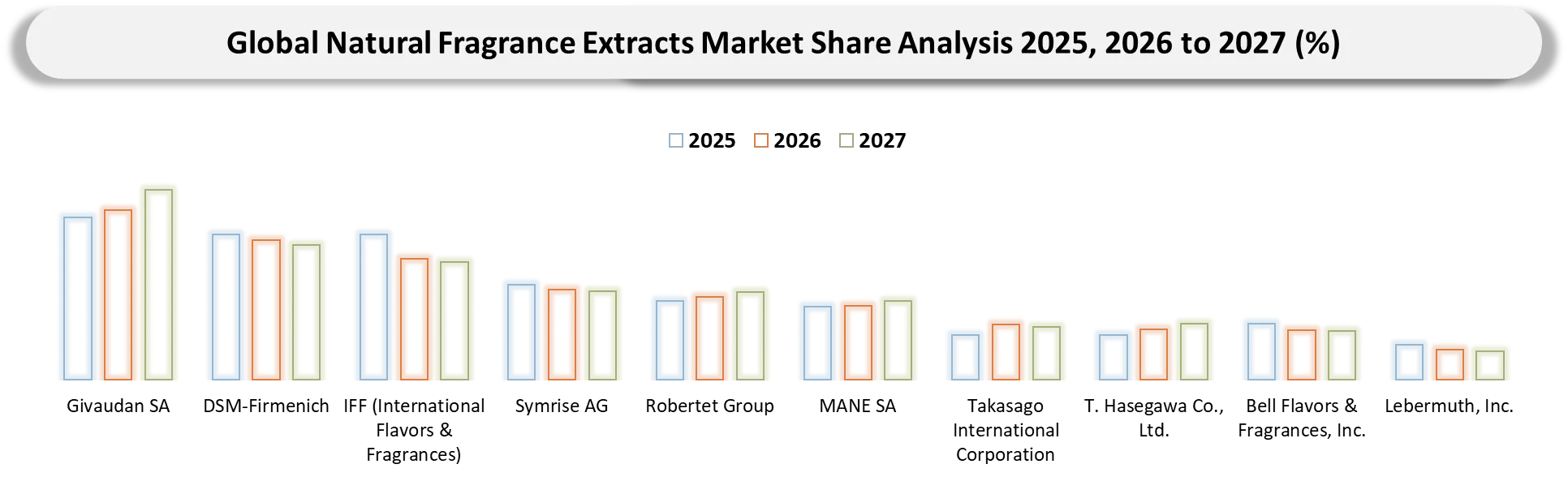
- The market is characterised by three key participant groups: integrated global fragrance and beauty companies, natural-ingredient and botanical specialists, and established regional fragrance manufacturers. Givaudan SA, DSM-Firmenich, IFF (International Flavors & Fragrances), and Symrise AG form the leading integrated group, supported by broad fragrance portfolios, global manufacturing networks, natural-ingredient development, and strong customer relationships. Robertet Group and MANE SA have particularly strong positions in natural raw materials and botanical extraction, while Takasago International Corporation and T. Hasegawa Co., Ltd. provide established fragrance and aroma-ingredient capabilities across Asia and international markets. Bell Flavors & Fragrances and Lebermuth, Inc. compete through specialised fragrance, essential-oil, and natural-ingredient offerings.
- Key players include Givaudan SA (Switzerland), DSM-Firmenich (Netherlands), IFF (International Flavors & Fragrances) (U.S.), Symrise AG (Germany), Robertet Group (France), MANE SA (France), Takasago International Corporation (Japan), T. Hasegawa Co., Ltd. (Japan), Bell Flavors & Fragrances, Inc. (U.S.), and Lebermuth, Inc. (U.S.).
Key Developments
- February 2026: International Flavors & Fragrances Inc. (IFF), a U.S.-based global flavours, fragrances, food ingredients and biosciences company, through its LMR Naturals business, introduced Tonka Bean CO₂ Absolute, a natural fragrance extract produced using renewable and recycled supercritical CO₂ at its extraction facility in Aubrac, France.
- October 2026: Givaudan SA, a Switzerland-based multinational fragrance and flavour manufacturer, launched its first Blossom Lab, a mobile laboratory designed to develop natural fragrance ingredients directly at botanical sources.
- December 2025: Givaudan SA, a Switzerland-based global fragrance and beauty company, completed the acquisition of Belle Aire Creations, a U.S.-based full-service fragrance manufacturer founded in 1982 and serving local and regional customers across North America.
- October 2025: Symrise AG, a Germany-based global fragrance, flavour, cosmetic and functional ingredients company, made a strategic equity investment in Cellibre Inc., a U.S.-based biotechnology and sustainable biomanufacturing company.
- July 2026: Symrise AG, a Germany-based global fragrance, flavour and cosmetic ingredients company, announced plans to acquire Floral Concept, a France-based premium natural fragrance ingredients company.
Key Procurement Priorities and Buyer Evaluation Criteria
- Organisations procuring natural fragrance extracts increasingly select suppliers based on their ability to provide consistent, high-quality botanical extracts with controlled aroma profiles, reliable batch-to-batch composition, and suitability for fine fragrances, cosmetics, personal care, household care, and wellness applications.
- The procurement decision-making process is increasingly influenced by natural and clean-label formulation requirements, sustainable sourcing expectations, regulatory compliance, traceability, and consumer demand for plant-derived ingredients, making origin transparency and responsible botanical sourcing important supplier-selection criteria.
- Buyers evaluate factors such as extract purity, botanical origin, active aromatic constituents, batch consistency, extraction method, allergen profile, stability, certification status, and contaminant controls when selecting essential-oil, absolute, botanical-extract, and other natural-fragrance suppliers.
Why Choose DataM?
- Technological Innovations: Explores advancements in natural extraction technologies, including steam distillation, solvent extraction, supercritical CO₂ extraction, cold pressing, and biotechnology-assisted processes, highlighting their role in improving extract quality, consistency, yield, sustainability, and development of differentiated natural fragrance ingredients.
- Product Performance & Market Positioning: Evaluates natural fragrance extracts based on aroma quality, purity, botanical origin, batch consistency, extraction method, stability, allergen profile, certification, and application suitability, highlighting how leading suppliers differentiate through premium natural ingredients, traceable sourcing, and specialised extract portfolios.
- Real-World Evidence: Highlights commercial adoption of essential oils, absolutes, botanical extracts, oleoresins, CO₂ extracts, and other natural fragrance materials across fine fragrances, cosmetics, personal care, household care, aromatherapy, wellness, candles, and home-fragrance applications, demonstrating their expanding role beyond traditional perfumery.
- Market Updates & Industry Changes: Tracks key developments such as natural-ingredient facility expansions, advanced extraction investments, sustainable botanical sourcing initiatives, biotechnology developments, regulatory changes, and new natural ingredient launches across Europe, North America, and Asia-Pacific, supporting the transition toward more sustainable and traceable fragrance supply chains.
- Competitive Strategies: Analyses how leading companies expand through botanical sourcing networks, extraction-capacity development, sustainable procurement, biotechnology partnerships, portfolio expansion, vertical integration, and investments in natural-ingredient research to strengthen their positions across premium fragrance, beauty, personal care, and wellness markets.
- Pricing & Market Access: Evaluates pricing variations according to botanical origin, rarity of raw materials, cultivation method, extraction technology, concentration, certification, processing complexity, and supply availability, while examining market access through fragrance houses, natural-ingredient specialists, cosmetics manufacturers, distributors, and direct supplier relationships.
- Market Entry & Expansion: Identifies growth opportunities driven by clean-label cosmetics, natural and organic personal care, premium perfumery, aromatherapy, wellness, sustainable home care, upcycled ingredients, and biotechnology-derived fragrance materials, while outlining strategies such as localised botanical sourcing, traceability systems, sustainable extraction, application-specific product development, and partnerships with fragrance and beauty manufacturers.
Target Audience 2026
- Fragrance Manufacturers and Fragrance Houses
- Cosmetics and Personal-Care Manufacturers
- Natural and Organic Beauty Brands
- Essential-Oil and Natural-Ingredient Suppliers
- Household and Home-Care Companies
- Aromatherapy and Wellness Companies
- Ingredient and Raw-Material Procurement Teams


























































