


Nanocarbon Market Size and Overview
The global nanocarbon market reached US$ 3.42 billion in 2025 and is expected to reach US$ 10.57 billion by 2035, growing with a CAGR of 11.30% during the forecast period 2026-2035.
The market is progressively shifting from the use of nanocarbon in laboratories and now it is moving towards the use of engineered materials like battery-grade carbon nanotube (CNT) dispersion, graphene nanoplatelets, conductive masterbatch, etc. Thus, carbon nanotubes have begun to be used in lithium batteries so that their electrical conductance improves and less conductive additive is being used. Graphene-based materials are also making an entry into energy storage, semiconductor dies and conductors’ films.
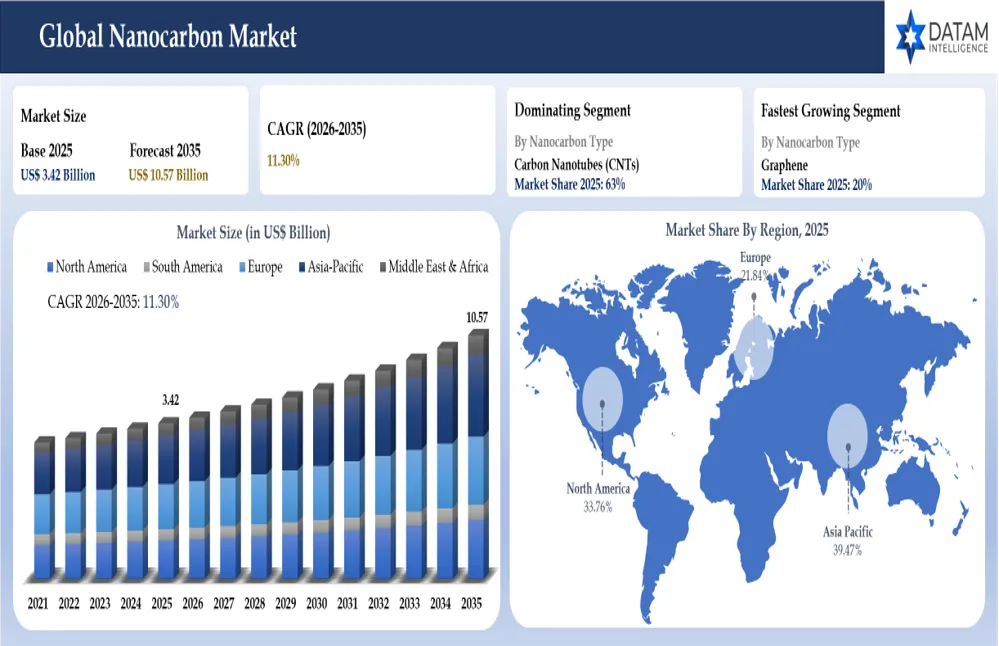
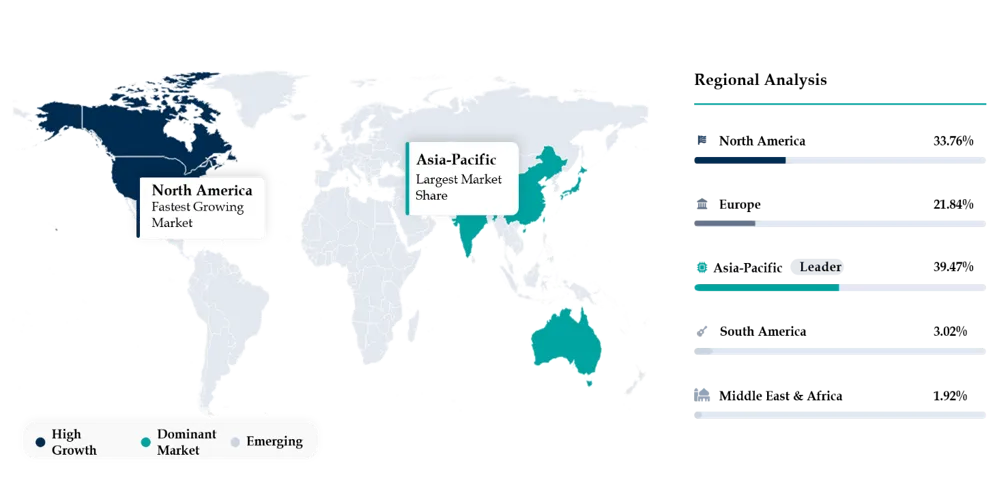
The process of energy storage is turning into a significant path of commercialization with the increasing usage of MWCNTs and graphene in EV batteries and systems of stationary energy storage. Electronics and semiconductors are also creating requirements for the materials with controlled thermal performance, conductivity and morphology on the nano scale. The Asia-Pacific region constitutes one of the main production and consumption centers enabled by battery, automotive, electronics and semiconductor manufacturing in China, Japan, South Korea and India.
Nanocarbon Market Key Takeaways
- Carbon Nanotubes (CNTs) emerged dominant in the global nanocarbon market throughout 2025, holding 63% of market share owing to the established market presence in battery conductive additives, conductive polymers, electronics, EMI shielding and advanced composites.
- Graphene type of nanocarbon is estimated to be the fastest growing segment of the industry attaining a growth rate of over 20% as a result of increases in demand from energy storage, electronics, sensors, thermal management, conductive films and advanced composites.
- Asia-Pacific is estimated to hold the largest share of the global nanocarbon market, with 39.47% market share by 2025, owing to large-scale manufacturing of EV batteries, electronics, semiconductors, automobiles and advanced materials in countries such as China, Japan and South Korea among others.
- The growing use of CNT dispersions, graphene masterbatches and functionalized nanocarbon grades is stimulating manufacturers to improve the stability of dispersions, purity, surface chemistry, conductivity and compatibility with polymers and battery electrodes.
- Increasing demand from battery and energy storage, electronics and semiconductors, automotive and EVs, aerospace and defense and advanced composites is creating possibilities for nanocarbon materials providing electrical conductivity, thermal conductivity, EMI shielding, mechanical reinforcement, electrochemical properties and barrier properties.
Nanocarbon Industry Trends and Strategic Insights
- Battery-Grade Nanocarbon Is Becoming a Core Conductive-Additive Segment: The application of conducting carbon nanotubes (CNTs) and graphene is increasing in lithium-ion batteries, silicon anodes, sodium-ion batteries and other advanced battery technologies, which results in a shift of demand from standard nano-carbon powders to high purity, low dosage and dispersible grades of carbon materials.
- Application-Specific Functionalization Is Increasing Product Differentiation: Manufacturers are evolving from generic CNT and graphene, to various functional forms that are particularly suitable for use in particular applications such as electrodes, polymers, coatings, thermal management solutions and composite materials.
- Production Scale-Up Is Shifting Competitive Advantage Toward Process Consistency: The significance of the progress in technologies such as continuous CVD, scalable graphene exfoliation, purification, automated dispersion and characterization is growing, as consumers require more and more uniform specifications in terms of physical characteristics of the substances produced.
- Nanocarbon Is Expanding Into Semiconductor and Thermal-Management Applications: The demand for nanocarbon is gradually extending its reach by moving beyond traditional composites and conductive polymers to materials such as thermal interface materials, EMI shields, advanced packaging, sensors, as well as electronic components, boosting possibilities for new-grade nanocarbon materials with certain thermal and electrical characteristics.
- Supply Localization and Downstream Integration Are Reshaping Competition: The demand from battery manufacturers and electronics producers for greater reliability of supply is pushing producers of nanocarbon to set up local manufacturing facilities, establish strategic partnerships, some formulation capabilities and direct programs for customer qualification in proximity to major manufacturing facilities.
Nanocarbon Market Scope
| Metrics | Details | |
| 2025 Market Size | US$ 3.42 Billion | |
| 2035 Projected Market Size | US$ 10.57 Billion | |
| CAGR (2026-2035) | 11.30% | |
| Largest Market | Asia-Pacific | |
| Fastest Growing Market | Asia-Pacific | |
| By Nanocarbon Type | Carbon Nanotubes, Graphene, Carbon Nanofibers, Carbon-Based Quantum Dots, Carbon Nanohorns and Other Nanocarbon Materials | |
| By Material Form | Powder, Dispersion, Masterbatch, Paste & Slurry, Film & Sheet and Others | |
| By Production Technology | Chemical Vapor Deposition (CVD), Arc Discharge, Laser Ablation, High-Pressure Carbon Monoxide (HiPco), Liquid-Phase Exfoliation, Electrochemical Exfoliation, Plasma-Based Synthesis and Other Production Technologies | |
| By Application | Energy Storage, Electronics & Semiconductors, Conductive Materials, Thermal Management, EMI Shielding, Advanced Composites, Coatings & Adhesives, Sensors, Catalyst & Catalyst Support, Biomedical Applications, Environmental Applications and Other Applications | |
| By End-Use Industry | Battery & Energy Storage, Electronics & Semiconductors, Automotive & Electric Vehicles, Aerospace & Defense, Chemicals & Polymers, Paints & Coatings, Healthcare & Pharmaceuticals, Industrial Manufacturing, Construction, Consumer Electronics, Environmental & Water Treatment and Other Industries | |
| By Functional Property | Electrical Conductivity, Thermal Conductivity, Mechanical Reinforcement, Electromagnetic Interference (EMI) Shielding, Electrochemical Performance, Barrier Properties, Lubricity & Wear Resistance, Optical Properties, Catalytic Activity and Other Functional Properties | |
| By Grade / Purity | Industrial / Technical Grade (<95%), Research Grade (95%–98%), High-Purity Grade (98%–99.5%) and Electronic Grade (>99.5%) | |
| By Region | North America | U.S., Canada, Mexico |
| Europe | Germany, UK, Russia, France, Spain, Italy, Poland | |
| Asia-Pacific | China, India, Japan, Australia, South Korea, Indonesia, Malaysia, Singapore, Vietnam, Thailand, Philippines, Taiwan | |
| South America | Brazil, Argentina | |
| Middle East and Africa | UAE, Saudi Arabia, South Africa, Israel, Turkiye, Nigeria | |
| Report Insights Covered | Competitive Landscape Analysis, Company Profile Analysis, Market Size, Share, Growth | |
Why does this report matter in 2026?
Nanocarbon market will be significant in 2026 due to the fact that nanocarbon materials will start to find usage not just for specialized applications but also for more commercial applications including high-energy storage batteries, conductive polymers, semiconductors components, thermal management materials, EMI shielding and lightweight composites. Increasingly, carbon nanotubes, graphene, carbon nanofibers and similar nanostructures are being utilized as functional fillers in order to increase the performance of the materials such as electrical conductivity, thermal properties, mechanical properties and energy storage. With adoption increasing, material purity, shape, dispersion ability, conductivity and performance will be increasingly important criteria for selecting technologies and suppliers.
The market in 2026 will be influenced by the necessity to produce nanocarbon at a larger volume and maintain consistency in the specification and cost-performance optimization. Battery producers, electronics firms, semiconductors firms and advanced composite makers need assured sources of application-specific nanocarbons which can be incorporated into large-scale manufacturing processes. The current study offers a focused analysis of the demand side by types of nanocarbons, production technologies, applications and end-use industries, thus allowing one to spot commercial opportunities, assess technology penetration and pinpoint areas of emerging demand.
Nanocarbon Market White Space & Investment Opportunities
- Battery-Grade CNT and Graphene Formulations: Investing in high-quality dispersion-ready CNTs and graphene ends for silicon containing anodes, high-nickel cathodes, sodium-ion batteries and other advanced electrodes offers vast investment potential.
- Application-Specific Nanocarbon Functionalization: Production of surface-modified and polymer-compatible nanoparticle grades for definite resin systems, coatings, adhesives and composite matrices allows creating valuable products compared to standardized powders.
- Localized Nanocarbon Production Near Battery and Semiconductor Clusters: Opening regional manufacturing and distribution facilities near battery, EV, semiconductor and electronics production centers shall help avoid logistics issues, speed up qualification timeframes and improve supply dependability.
- AI-Enabled Nanocarbon Material Development and Process Control: Investing in the use of AI in discovering and testing materials will allow the number of experiments to decrease and improve the consistency of batches and the efficiency of production.
- High-Value Thermal and EMI Management Materials: The use of nanocarbons to create thermal interface materials, EMI shielding composites, conductive films and complex electronic materials gives suppliers opportunities to go beyond traditional fillers and enter high-performance electronics markets.
Nanocarbon Future Market Transformation
Nanocarbon market will evolve from being a raw material market to that of application-oriented engineered materials as a result of incorporation of carbon nanotubes, graphene, carbon nanofibers and other nanocarbons into batteries, semiconductor packaging, conductive polymers, thermal management, sensors and composite materials. Value creation in the future will be based on functionalization, dispersibility, surface modification, material purity and formulation instead of the volume of nanocarbon. Battery applications involving CNT conductive additives, graphene-based thermal and electrical contacts and nanocarbon-enhanced light composites are expected to develop into valuable product applications, while process automation, continuous manufacturing and better materials specification will enhance scale-up and integration.
Nanocarbon Market Buyer Decision-Making Criteria
Buyers of nanocarbon materials are becoming more focused on evaluating the suitability of materials by measuring the ability of those materials to provide consistent performance in particular end-use formulations and processes rather than just looking at the price of materials. The battery makers, electronics firms, polymer blenders and advanced composite makers use criteria such as electrical and thermal performance, dispersion, purity, particle or tubular structure, compatibility with the host material, batch-to-batch consistency, scalability and cost of formulation when evaluating the nanocarbon providers. In the case of high-priority uses, the buyers also take into consideration the supplier’s technical expertise, qualification capability, production capacity, regulatory documents and reliability of supply since variations in materials have a direct impact on the electrode performance, conductivity, processing efficiency and finished-product quality.
Major Buyer Decision-Making Criteria
- Electrical Conductivity & Percolation Performance
- Thermal Conductivity Enhancement
- Purity & Material Quality
- Dispersion and Processability
- Particle Size, Morphology & Aspect Ratio
- Batch-to-Batch Consistency
- Compatibility with Polymers, Electrodes & Coatings
- Cost per Functional Performance Unit
- Production Scalability & Capacity
- Supply Reliability & Lead Time
- Technical Support & Application Development
- Qualification, Testing & Regulatory Documentation
Nanocarbon Market Economic & Investment Analysis
The nanocarbon market is seeing more investments as manufacturers are trying to find ways to scale up the production of high-performance material used in batteries, conductive polymers, semiconductors, thermal management and composites. Increasing investments in the industry will be geared towards increasing production capacity for CNTs and graphene, purification and dispersion, production of grade materials for particular applications and cost savings. Economics of investments are highly affected by the ease of scaling up production from the lab scale to full-scale high-volume production without sacrificing any characteristics like conductivity, aspect ratio, surface area, or defects.
With regards to investments, the expansion of production capacity as well as the development of battery grade conductive additives, graphene-based materials and nanocarbon formulations for electronics applications and lightweight composites have become key sectors. The possibility of vertical integration along the value chain from feedstocks to production equipment and formulation is being looked at by investors as a way to gain better cost control and supply chain security. Thus, the attractiveness of the investment will be determined by production output, cost per kilogram, training time, market concentration, efficiency of the facilities, margin per application and long-term industrial agreements.
Nanocarbon Investment Trends in the Market
- Capacity Expansion for Battery-Grade CNTs: Funding is now being focused on the establishment of the facilities for the production and spread of CNTs at a large scale for the purpose of supplying lithium-ion battery factories, silicon-anode manufacturing industries and other next-generation battery production enterprises with reliable conductive agents.
- Graphene Production Scale-Up and Quality Improvement: Money is now being directed towards scalable processes of graphene production, extraction, cleaning and functionalization on a large scale delivering consistent layer structure, defect level and chemical properties provided that there is sufficient quantity.
- Downstream Formulation and Application Development: The production firms are investing in the production of masterbatches, dispersions, different coatings and special formulations that can allow them to obtain more profit, rather than just selling nanocarbon powders-raw materials.
- Regional Manufacturing and Supply-Chain Localization: Investment is now shifting towards the production and processing facilities within proximity of clusters of batteries, EV, semiconductors and electronics, aimed at cutting logistical risks and shortening customer qualification period.
- Advanced Manufacturing and Digital Process Control: Investment in continuous synthesis, automated dispersion, in-line characterization and AI-enabled process optimization is on the rise as producers are looking for better yield, improved batch consistency and costs reduction.
Strategic Indicators for Nanocarbon Market
High Regulation Impact
The nanocarbon market is subject to substantial regulation because the industrial use of CNTs, graphene, nanodiamonds and other nanocarbons involves greater consideration of issues like worker exposure, nanoparticle handling, environmental release, waste management and other specific safety considerations. There could be regulations that may affect the manufacture of nanocarbons, packaging, labeling, worker exposure considerations and material documentation if the use of nanocarbon powder or dispersion may result in inhalation or environmental exposure. Additional product-specific tests and chemical compliance testing associated with batteries, electronics, automotive and biomedical applications may extend the qualification time cycle and add to costs, resulting in the importance of material traceability, safety data and documented handling as competitive issues for suppliers.
High Investment Activity
The nanocarbon market has witnessed high investment in CNTs, graphene, carbon nanofibers and similar application-oriented forms of nanocarbon by their manufacturers as well as technology developers in order to build capacity for use in batteries, conductive composite materials, semiconductor applications and heat management applications. Such investments have been increasingly focused on large-scale facilities of chemical vapor deposition (CVD) along with other production facilities, continuous production facilities, purification process, functionalization process, dispersing and formulation facilities to increase consistency and reduce cost per functional unit. Strategic investments have been focused on conductive battery additives as well as custom formulations of nanocarbon where long-term customer qualification can provide better opportunities.
Supply Chain Disruption
The nanocarbon market is prone to the risk of supply chain disruption because of dependence on carbon precursors that have special properties, as well as catalysts, high-temperature facilities, equipment used for purifying products and strict production parameters, while the demand for product variants with particular conductivity, surface area, morphology and dispersibility has been growing among end users. Disruption in the supply of carbon precursors, specialty catalysts, energy-consuming production, equipment maintenance and international shipping can impact the volume of production and delivery timing, especially in terms of the highest purity CNT and graphene materials. Supply risks become even greater because the customers of batteries, semiconductors and advanced composites certify only a few material suppliers, thus highlighting the importance of supplier diversification, local manufacturing, stockpiling and vertical integration in the strategy for the procurement of nanocarbons.
Pricing Volatility
The nanocarbon market is characterized by price variability due to variations in economics of manufacturing depending on type of material, manufacturing process, purity, morphology, functionalization and grade of the product. The cost of commercial CNT and graphene products may range from tens of US$/kg to hundreds of US$/kg or even more depending on the purity of the product, specialty of the material and functionalization. In addition to that, battery grade CNT dispersions will depend on concentration of CNT, medium for dispersion, electrical conductivity specifications and compatibility with electrodes; whereas prices of graphene will depend on number of layers, degree of defects, surface modifications and manufacturing method. Consequently, there is potential for energy expenses, the availability of precursors, the need for purification, yields from the production process and capacity use to generate significant variance in supplier pricing and margins.
Procurement Pressure
The nanocarbon market is experiencing increased pressures in terms of procurement as battery makers, electronics firms, polymer formulators and advanced materials manufacturers look for consistent nanocarbon grades at the lowest prices and with assured availability. The buying community is exerting pressure on suppliers to provide products that meet specific requirements in terms of conductivity, purity, morphology, surface area, dispersibility and consistency from batch to batch. In addition, there is pressure to find an appropriate balance between price per kilogram and performance per unit of output in the case of CNT conductive additives and graphene formulations, which operate on smaller loading rates. Limited qualified suppliers for unique grades, prolonged technical certification processes and application-specific customizations are additional factors that enhance the buyer's demand for multiple sources, bulk purchases, technical assistance and quality consistency.
New Technology Adoption
New manufacturing and material engineering processes are being developed within the nanocarbon market that make nanocarbons more consistent, functional and applicable for valuable uses. The improvements in continuous chemical vapor deposition, controlled plasma/catalytic synthesis, graphene production via electrochemical method, scalable exfoliation, surface functionalization and dispersion processes allow the producers to have a better control over such parameters of nanocarbons as diameter of tubes, layer structure, defect density, surface chemistry and conductivity. It is especially necessary in applications like battery conductive additives, semiconductor thermal interface materials, conductive polymers, sensors and light-weight composites where common nanocarbon products cannot provide required consistency and performance. Growing adoption of automated process monitoring and in-line analysis has also facilitated more efficient quality control and scale-up from laboratory-scale manufacturing to industrial levels.
Regional Expansion Opportunity
The nanocarbon market holds expansion possibilities in regions where there is rapid development of battery production, semiconductor production, electric vehicle value chains and advanced materials industry. There are chances for localized production of CNT and graphene in the Asia-Pacific region due to presence of battery and electronics production centers. In North America, there are prospects for production of premium nanocarbon materials for energy storage, semiconductors, aerospace and advanced composite applications. Expansion possibilities exist in Europe through battery material localization, light weighting in the automobile industry and sustainability applications, while in India and South East Asia there are emerging possibilities for downstream applications of nanocarbon compounds, conductive materials and polymer composites. Strategies for regional expansion are gradually becoming focused on producing near customers who qualify, in order to lower cost of logistics, accelerate qualification timeframes and enhance supply security.
Government Policy Support
The nanocarbon market is seeing the advantages of government backing for nanotechnology, advanced materials, semiconductor manufacturing, renewable energy and strategic materials that provide an enabling regulatory environment for the development of nanocarbons. In India, the Semicon 2.0 initiative of 2026 includes machines and materials in its semiconductor ecosystem at a total cost of ₹1,27,500 crore, creating downstream possibilities for advanced carbon materials in electronics and semiconductor sectors. The other area of government backing for nanocarbons comes from government-funded research: India’s Technology Development Board supported the 2026 Indo-Singapore initiative on the artificial intelligence-driven plasma synthesis of carbon nanostructures and graphene-diamond hybrid materials and the United States’ National Nanotechnology Initiative is continuing to fund research involving graphene, carbon nanotubes, nanomanufacturing, nanoelectronics and advanced carbon materials.
Pricing Intelligence
Pricing intelligence within the nanocarbon market ought to be centered on cost-in-use and performance-based pricing, as opposed to the price per kilogram. The reason is that high price does not necessarily translate to poor performance, but could actually mean that higher-priced nanocarbon products offer improved conductivity, thermal performance or mechanical strength in small loads. By 2026, indicative industrial prices could range between $30-80/kg for standard graphene nanoplatelets and industrial-grade MWCNTs to $100-250/kg for special-purpose and purity-grade graphene materials and up to several hundred US$ per kg of specialized SWCNTs. In the field of batteries, purchasing departments tend to measure conductivity per unit of loading, stability of dispersion, concentration of solids and cost per unit of functionality instead of choosing the cheapest nanocarbon product. In this way, they are able to compare different materials based on their role in improving the conductivity of an electrode, the performance of a polymer, heat dissipation, or reinforcement of composites.
| HS Code | Reporter | Trade Flow | 2025 Trade Value | Interpretation |
| 3801.90 | China | Exports | US$395 million | Indicates China’s significant export activity in graphite and other carbon-based preparations used as a proxy for nanocarbon-related materials |
| 3801.90 | Indonesia | Exports | US$146 million | Reflects Indonesia’s export participation in the broader graphite/carbon-material supply chain |
| 3801.90 | China | Imports | US$90 million | Indicates China’s import demand for graphite and carbon-based preparations used across advanced-material and industrial applications |
| 3801.90 | Malaysia | Imports | US$72 million | Reflects Malaysian demand for graphite/carbon preparations, including materials potentially used in advanced manufacturing |
Note: HS Code 3801.90 is used as a trade proxy for the nanocarbon market because dedicated HS codes for CNTs, graphene and other nanocarbon materials are not consistently available. The reported trade values include broader graphite and carbon-based preparations and therefore should not be interpreted as nanocarbon-specific trade values.
AI Impact Analysis of Nanocarbon Market
AI is impacting the nanocarbon market by speeding up the discovery of materials, formulation optimization and process control. ML algorithms could model the correlation between nanocarbon structure and properties like electrical conductivity, thermal conductivity, surface area, defect density, dispersion and mechanical reinforcement. This would enable the developer to determine appropriate CNTs, graphene and nanocarbon formulations for certain application areas. AI can be used to optimize the carbon nanomaterials loading and composition in batteries, while in conductive polymers and composites AI can help predict the percolation properties and performance before physical tests are conducted extensively. This will lead to reduced formulation development time and cycles.
AI is being employed in nanocarbon fabrication and quality control, especially in process monitoring, anomaly detection, yield improvement and batch-to-batch consistency. Information gathered from CVD reactors, exfoliators, purifiers and dispersion machines may be analyzed to determine process conditions that will lead to desired properties of the resulting materials. Predictive and computer vision models could further assist in analyzing particles, morphologies and dispersions. With growing adoption, the suppliers that are able to marry process optimization through AI with in-line characterization and material design will be able to enhance consistency, decrease waste and react quickly to individualized requirements of nanocarbon materials.
Disruption Analysis of Nanocarbon Market
Disruption in the nanocarbon market results from the transition away from commodity-style nanocarbon powder products to functionally engineered materials for particular applications. Manufacturers are increasingly distinguishing their CNTs, graphene, carbon nanofibers and similar materials based on specific morphology, surface functionality, dispersion, purity and customized formulations, as opposed to the quantity of material. This disruption is especially apparent in battery electrodes, conductive polymers, thermal interface materials for semiconductors and high-performance composites, where reduced nanocarbon loading at high function levels can alter the economics of formulations and eliminate the need for conductive or reinforcing fillers.
The second disruption involves scalable manufacturing and digitalized manufacturing, which include continuous synthesis, purification improvement, automation of dispersion and AI-aided process control to help provide consistent nanocarbon grades in an industrial scale. This trend could close the gap between laboratory-quality materials and industrial-grade products and enable suppliers to produce application-specific grades near the consumer end-point. Meanwhile, growing qualifications of battery, electronic and automobile industries are moving competitive advantage in favor of those businesses which are able to integrate material sciences, production scalability, validation and reliable supply chain management into their business models.
Nanocarbon Market BCG Matrix: Company Evaluation
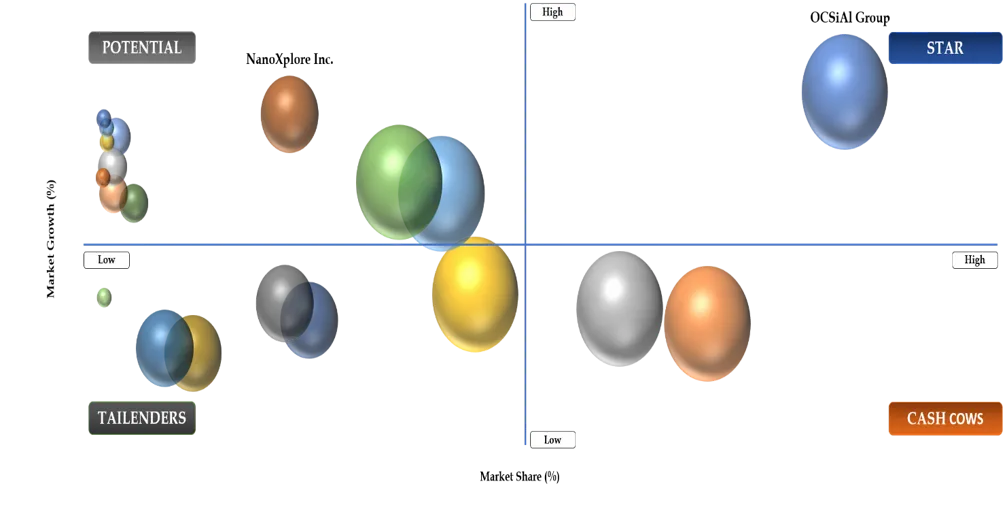
STAR
OCSiAl Group has a competitive advantage within the fast-growing nanocarbon industry due to its scalable SWCNT platform that includes the TUBALL line of products. The CNTs of OCSiAl Group are becoming increasingly attractive as conductive additives for lithium-ion batteries, silicon-based anodes, conductive polymers, coatings and composite materials where low loading levels and high conductivity play a crucial role. Battery supplier activities and involvement in development of new batteries for the future generation of electric aviation further increase the company’s presence in growing applications areas.
POTENTIAL
NanoXplore Inc. has substantial growth opportunity via its GrapheneBlack graphene nanoplatelets business, which has applications in conductive plastics, polymer masterbatches, battery materials, coatings and composite materials. NanoXplore's application-specific approach to graphene formulation and masterbatches enables it to go beyond commodity graphene powder into higher-value graphene materials where mechanical strengthening, conductivity, light weight and processability can impact the bottom line of its customers. The recent development of high-performance plastic films is indicative of NanoXplore's approach to turning graphene manufacturing expertise into usable materials.
Nanocarbon Market Dynamics
Driver Impact Analysis
| Driver | Market Growth Impact (%) | Demand Concentration | Impacted Use Case | Strategic Impact |
Rising demand for nanocarbon-enabled battery materials | 30% | Asia-Pacific, North America | Battery electrodes & conductive additives | Accelerates adoption of battery-grade CNTs and graphene |
Expansion of semiconductor and electronics manufacturing | 25% | North America, China, Japan, South Korea | Thermal management & EMI shielding | Increases demand for high-purity, application-specific nanocarbon |
Increasing adoption of lightweight conductive composites | 20% | North America, Europe, Asia-Pacific | Automotive, EV & aerospace composites | Supports substitution of conventional conductive and reinforcing fillers |
Growth of advanced coatings, sensors and functional materials | 15% | Asia-Pacific, Europe, North America | Conductive coatings, sensors & specialty materials | Expands demand for functionalized and dispersion-ready nanocarbon grades |
Driver: Rising Demand for Nanocarbon-Enabled Energy Storage and Conductive Materials
Due to the fast pace of technological innovation of high-energy batteries, conductive polymers and advanced electronic materials, there is increasing demand for CNTs, graphene and carbon nanofibers as conductive and reinforcing additives. Lithium-ion and new silicon anode batteries can benefit from the use of nanocarbon materials to enhance electron conductivity and electrode stability along with reduced additive usage, while polymers and composites benefit from their conductivity and EMI protection capabilities at low concentrations. This is driving the use of nanocarbon materials in applications other than niche markets, including batteries, EVs, semiconductors, flexible electronics and light-weight conductive composites.
Restraint Impact Analysis
| Restraint | Drag on Market Growth (%) | Primary Impact Area | Impacted Use Case | Strategic Impact |
High production and purification costs | 30% | Manufacturing economics | High-purity CNTs, graphene & specialized nanocarbon | Pressures margins and limits adoption in cost-sensitive applications |
Scale-up and batch-consistency challenges | 25% | Production scalability | Battery additives & conductive composites | Increases qualification requirements and restricts reliable high-volume supply |
Dispersion and material-integration difficulties | 20% | Processing & formulation | Polymer composites, coatings & battery electrodes | Raises formulation complexity and can reduce performance consistency |
Regulatory, safety and handling requirements | 15% | Compliance & commercialization | Nanocarbon powders, biomedical & industrial applications | Increases testing, documentation and facility-control requirements |
Restraint: High Cost and Scale-Up Complexity of Application-Grade Nanocarbon
The expensive and complex process involved in producing the required quality of nanocarbon materials is still a significant limitation, especially with regards to high purity CNTs, SWCNTs, graphene and their dispersions with very tight specifications. This is due to the fact that the production process itself involves a lot of energy when producing controlled morphology, defect levels, surface chemistry, purity and dispersion. These problems contribute to increased costs of qualification and formulation and can prevent adoption when more economical carbon additions or other conductive agents deliver adequate performance for such applications as batteries, polymers, coatings and composites.
Nanocarbon Market Segment Analysis
The global nanocarbon market is segmented based on the nanocarbon type, material type, production technology, application, end-use industry, functional property, grade / purity and region.
By Nanocarbon Type
Carbon Nanotubes dominated the Nanocarbon Market in 2025 due to their established use in battery conductive additives and conductive materials
Carbon Nanotubes (CNTs) accounted for an approximated 63% share of the market in 2025 and thus dominated the nanocarbon family. The presence of reliable commercial sources and the provision of high electrical conductivity at low loading are among the reasons that have seen CNTs gain popularity in uses such as lithium-ion batteries, conductive polymers, EMI shielding, automotive parts, electronics and composite materials. Multi-wall carbon nanotubes (MWCNTs) form significant commercial quantities due to ease of production, whereas single-wall carbon nanotubes (SWCNTs) are gaining significance in high-performance batteries and electronics.
By Nanocarbon Type
Graphene is emerging as the fastest-growing nanocarbon type, driven by expanding applications in energy storage and advanced electronics
It is projected that graphene will show a growth of 20% CAGR over the forecast period, outperforming the average growth of the entire market, due to transition of companies from production of laboratory graphene to graphene nanoplatelets, graphene oxide, reduced graphene oxide and functionalized graphene. The demand is rising for use in batteries, thermal management, coatings, sensors, flexible electronics and lightweight composites.
Nanocarbon Market Geographical Penetration
U.S. Nanocarbon Market Landscape
The growth of the U.S. nanocarbon market is propelled by significant demand for high-quality CNTs, graphene, carbon nanofibers and modified nanocarbon materials in lithium-ion battery applications, electronics and semiconductors, aerospace and military applications, conducting polymers and advanced composites. An application-specific approach is gradually replacing the general commodities-oriented approach for the market players, who now compete based on their ability to offer pure nanocarbons with high dispersion, electrical conductivity, morphological control and qualification support. Growth in domestic production of batteries and semiconductors has led to new possibilities for local supply of nanocarbons, while innovations within American research and business communities are moving forward scalable production, functionalization, artificial intelligence-enabled materials design and energy storage applications. Hence, domestic capacity, technology validation, intellectual property and reliable supply have become key competitive elements for nanocarbon providers targeting U.S. industries.
Japan Nanocarbon Market Outlook
Key characteristics of the Japan nanocarbon market include high demand for high-purity and highly engineered CNTs, graphene and other nanocarbon materials for automotive, lithium ion batteries, electronics, semiconductors, conductive polymers and advanced composite applications. In Japan, manufacturers are particularly concerned about consistency of materials, morphology control, dispersion characteristics and reliability, which is driving the market towards demand for nanocarbon materials that cater to applications as opposed to cheap commodity-type materials. The country’s existing manufacturing infrastructure for automobiles and electronics provides the chance to use nanocarbon for electrode in batteries, conductive components, thermal management systems, electromagnetic interference protection and high-quality coatings, whereas the research and development of advanced materials and the precision manufacturing process make the commercialization of functionalized nanocarbon possible.
China Nanocarbon Market Trends
The China nanocarbon market is being heavily influenced by industrial manufacturing related to batteries, electric vehicles, electronics, semiconductors and advanced materials, resulting in high internal demand for CNTs, graphene, carbon nanofibers and conductive nanocarbons. Market dynamics are moving towards large volume production of conductive additive grades for batteries and next generation batteries, graphene and CNTs in applications such as conductive plastics, coatings, thermal management materials and composite parts, while Chinese companies are also focusing on manufacturing scale, cost optimization, process automation and collaboration with downstream companies, enabling nanocarbon providers to reduce qualification time and create custom grades for growing manufacturing ecosystems in China.
Nanocarbon Market Competitive Landscape
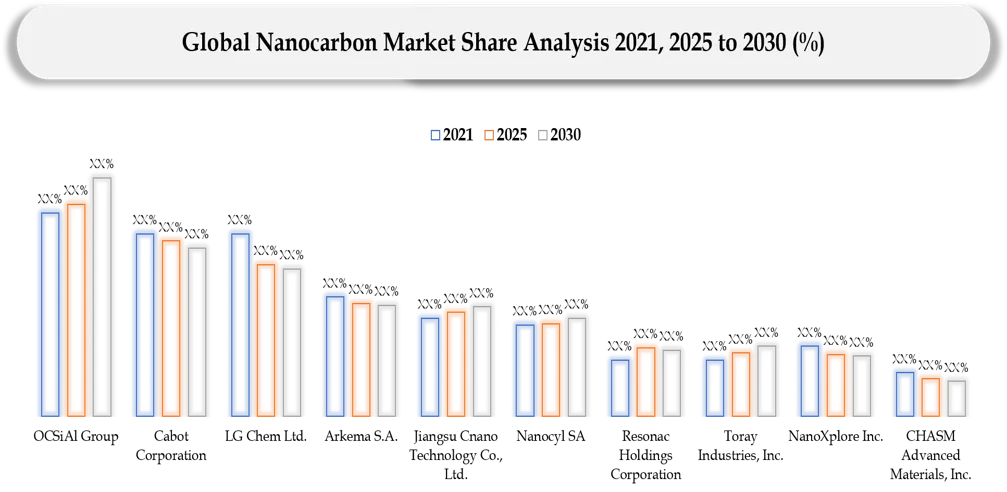
- Product and technology differentiation: The competition has moved to SWCNTs, MWCNTs, graphene, carbon nanofibers and other nanocarbon materials, while suppliers are able to separate themselves by means of purity, the aspect ratio, control of defects, surface functionalisation, conductivity and dispersion.
- Battery-grade nanocarbon capabilities: Manufacturers such as OCSiAl, LG Chem, Arkema, Jiangsu Cnano and Nanocyl are improving their capabilities of CNT conductive additives, dispersions and masterbatches used in lithium-ion batteries, silicon-containing anodes and energy storage applications for EV.
- Downstream formulation and application integration: Competitive advantage is starting to shift to dispersions that are ready for applications, conductive masterbatches, graphene-enhanced polymers and custom formulations and not just the supply of nanocarbon powders.
- Production scale and supply reliability: The emergence of CVD-based CNT production methods, as well as graphene production, purification and automated dispersion technologies, turns out to be a rather important competitive edge because battery, semiconductor and automotive industries’ clients require constant parameters of materials and continuous supply.
- Expansion into high-value applications: The major players in the industry focus on producing and selling solutions involving high-value applications, including semiconductor and electronics materials, heat management, EMI shielding, advanced materials, conductive coatings and next-generation batteries, thus decreasing the dependency on conventional applications.
Public Company Q1-Q2 2026 Performance Comparison
The table below compares five publicly listed companies with direct or strategically relevant exposure to the nanocarbon market, including carbon nanotubes (CNTs), graphene, carbon nanostructures and graphene-enabled advanced materials. Financial metrics are company-wide because nanocarbon revenue is generally not separately disclosed. Therefore, the performance drivers distinguish overall corporate performance from direct nanocarbon exposure.
| Company | Q1–Q2 2026 Performance | Nanocarbon Exposure | Key Performance Driver |
| LG Chem Ltd. | US$18.8 Billion revenue | Major MWCNT producer serving lithium-ion batteries, conductive plastics and EMI-shielding applications | Growth in Advanced Materials and demand for battery and semiconductor materials |
| Arkema S.A. | US$5.4 Billion revenue | Graphistrength multi-wall carbon nanotubes for batteries, composites, conductive materials and ESD applications | Battery, electronics and advanced-materials demand; H1 2026 sales were €4.61 billion |
| Cabot Corporation | US$1.75 Billion revenue | CNT/carbon-nanostructure conductive additives for lithium-ion batteries and advanced materials | Growing battery-energy-storage and EV demand; H1 FY2026 sales were US$1.753 billion |
| Canatu Plc | US$4.9 Million revenue | Advanced CNTs and CNT-based products for semiconductors, robotics, mobility & defense and medical diagnostics | Semiconductor and advanced CNT applications; H1 2026 revenue declined 42.7% YoY |
| Haydale plc | US$3.0 Million revenue | Graphene-enabled materials and HDPlas® functionalization technology | Expansion of graphene-enabled products; H1 FY2026 revenue increased 463% YoY |
Note: Companies use different fiscal calendars. Financial figures are company-wide, not nanocarbon market revenue.
Key Companies of Nanocarbon Market
- OCSiAl Group (Luxembourg)
- Cabot Corporation (United States)
- Arkema S.A. (France)
- LG Chem Ltd. (South Korea)
- Jiangsu Cnano Technology Co., Ltd. (China)
- Nanocyl SA (Belgium)
- Resonac Holdings Corporation (Japan)
- Toray Industries, Inc. (Japan)
- NanoXplore Inc. (Canada)
- CHASM Advanced Materials, Inc. (United States)
- Canatu Oy (Finland)
- Thomas Swan & Co. Ltd. (United Kingdom)
- Graphenea S.A. (Spain)
- Directa Plus plc (United Kingdom)
- Haydale Graphene Industries plc (United Kingdom)
- Mitsubishi Chemical Group Corporation (Japan)
- ZEON Corporation (Japan)
- Kumho Petrochemical Co., Ltd. (South Korea)
- FutureCarbon GmbH (Germany)
- Nano-C, Inc. (United States)
Company Profiles of Nanocarbon Market
OCSiAl Group
The OCSiAl Group is an established nanocarbon materials manufacturer engaged in large scale production of single wall carbon nanotubes (SWCNTs), sold under the trademark name TUBALL. The company offers SWCNT solutions in applications such as lithium ion batteries, conductive polymers, coatings, composites, elastomers and other advanced materials. OCSiAl maintains production and research facilities throughout Europe and Asia, with its Serbian site serving to enable large scale graphene-nanotube production.
Strategy elements involve expanding the use of SWCNT in batteries of electric vehicles, raising the production capacity in the region, creation of application-specific dispersions and concentrates, building strategic relationships with battery material producers and optimizing cost performance of CNTs in small loadings. On June 28, 2026 OCSiAl concluded a supply agreement with PowerCo for SWCNT solutions in Unified Cell batteries of the Volkswagen Group. OCSiAl
Cabot Corporation
Cabot Corporation is a diverse specialty chemical and performance material corporation with a considerable presence in conductive carbon material such as carbon nanotubes and carbon nanostructures. Cabot Corporation’s ENERMAX product range features CNTs and carbon nanostructures that are engineered to form an efficient conductive network within lithium-ion battery electrodes with reduced conductive additive content.
Competitive priorities of Cabot Corporation include the development of conductive carbon technologies for lithium-ion batteries, increase of electrode conductivity and energy efficiency, advanced carbon structure for future generation batteries and combination of CNTs with other conductive additives.
Arkema S.A.
Arkema is involved in the nanocarbon business through its Graphistrength® range of multi-walled carbon nanotubes. These products are engineered to enhance mechanical strength, electrical conductivity and electrostatic dissipation properties in thermoplastics, thermosets and elastomers. The Graphistrength® CNTs are manufactured using a catalytic chemical vapor deposition method and are available in powder form and as pre-dispersed masterbatches. Arkema
Strategic objectives involve enhancing CNT use in advanced composites, conductive plastics, ESD applications and battery materials as well as increasing the value of nanocarbons through specific formulation and dispersion technologies. Arkema's overall range of advanced materials can also facilitate CNT integration with polymer and composite systems.
LG Chem Ltd.
LG Chem is a significant manufacturer of MWCNTs in Asia, where the CNT business of the company is concentrated in the high-conductivity and high-dispersion types. CNT products of the company are used as additives in lithium-ion batteries and plastics and rubbers. The CNT production in LG Chem consists of three production lines located in its Yeosu plant, with a total capacity of about 2,900 tons per year.
Competitive priorities of the company include the increase in the production efficiency of CNTs, the assurance of consistency in the quality of products through mass production, better dispersion and conductivity, as well as broadening the range of CNT application in the electrodes of batteries, conductive plastics and rubber.
Jiangsu Cnano Technology Co., Ltd.
Jiangsu Cnano Technology is a Chinese firm that specializes in the manufacturing of nanocarbon materials including carbon nanotubes (CNTs) and graphene, focusing on lithium-ion battery conductive material products. In addition to development and manufacture of MWCNT products and conductive pastes, Jiangsu Cnano Technology supplies CNT powder, CNT conductive pastes, graphene composite conductive pastes and CNT conductive masterbatches. CNA Nanotechnology
Competitive advantages include increasing battery grade CNT volume, increased conductive paste volume production, improved dispersing effect and enhanced integration within the fast-growing Chinese battery manufacturing environment. CNA Nanotechnology
Nanocyl SA
Nanocyl is a Belgium company that specializes in the development of industrial carbon nanotube technology, using its NC7000 thin MWCNT system in transportation, electronic, energy storage, coatings, sensing and industrial applications. The CNTs are made by means of catalytic chemical vapor deposition process and are supplied in powder form, master batch and formulated dispersions. Birla Carbon
Competitive priorities of the company are associated with increasing CNT application in lithium-ion batteries, conductive plastics, electromagnetic interference shielding, automotive and aerospace composites, thermal management and specialty coatings. Nanocyl also develops application-specific dispersions such as ORGACYL, which allow easier introduction of CNTs in lithium-ion electrode coating and film formulations.
Nanocarbon Market Major Pain Points
- Difficulty in Achieving Consistent Material Specifications at Scale: It is difficult to ensure consistent diameters of carbon nanotubes, their lengths, aspect ratios, the number of layers of graphene, their defect density, purity and surface chemistry in industrial batches.
- Dispersion and Formulation Challenges: Nanocarbon materials demonstrate interparticle interactions of great strength capable of causing agglomeration which makes achieving uniform dispersion in battery slurries, polymers, coatings and adhesives complicated and possibly lowering the possible electrical conductivity or reinforcement properties.
- High Cost of Purification and Application-Grade Processing: Higher purity CNTs, SWCNTs, functionalized graphene and special dispersions may entail additional processing for synthesis, purification, functionalization and quality control, raising the cost of application-ready materials.
- Long Customer Qualification Cycles: Industries such as battery, automotive, semiconductors, or aerospace require great validation of the performance and reliability of such materials before they can get approval for the replacement of existing conductive materials.
- Limited Standardization Across Nanocarbon Grades: Different methods of characterization, definitions of purity, specifications of morphology, metrics of dispersion and types of performance tests create obstacles in making the selection of manufacturers and add to the complexity of qualification of materials.
Nanocarbon Market Recent Developments
- OCSiAl - September 2026: OCSiAl announced that the company’s SWCNTs have been integrated into the Horizon Europe ELEVATE project on batteries for future electric regional aircraft. The project focuses on high energy density batteries including silicon anodes and dry-coated cathodes.
- Canatu - August 2026: FST placed another order of Canatu’s reactors which is worth more than €5 million in producing carbon nanotubes for making EUV pellicles for semiconductors. This is another step towards commercializing CNTs in the field of semiconductors.
- Canatu - August 2026: Canatu launched a new strategy aimed at rapid growth in commercializing CNT technologies especially in the fields of semiconductors, automotive, medical diagnostics and other advanced sectors. It has also revised its long term financial goals with the strategy.
- OCSiAl - June 2026: OCSiAl was chosen as the supplier of SWCNTs to PowerCo, the Volkswagen battery division, in order to use the material in their Unified Cell battery design. This is because the SWCNTs are being used as conductive fillers in graphite-based anode batteries to increase conductivity and heat dissipation properties.
- Graphene - June 2026: Graphene Black xGnP Masterbatch was introduced by NanoXplore in collaboration with Techmer PM, which would be used in high-performance plastic films. Tests have shown that it offers more than 70% increase in mechanical strength and the possibility of thinning the film by up to 20%.
Analyst View / Opinion on Nanocarbon Market
- Battery applications will continue to serve as the main route of commercialization for CNTs and graphene, especially in instances where nanocarbon can enhance electrode conductivity, enable silicon-anodes, or decrease the amount of conductive additives.
- The value chain is shifting from bulk nanocarbon material to engineered materials that suit particular applications, where factors such as dispersion, functionality, purity, morphology and compatibility with particular polymers/electrodes become important.
- Market segmentation will shift from being based on material names to being based on performance grades as buyers differentiate between MWCNTs and graphene as commodities and battery-grade or semiconductor-grade materials with specific applications.
- Scale-up and consistency of quality will continue to be important competitive criteria, because those manufacturers able to maintain conductivity, surface properties, morphology and dispersion behavior throughout large-scale production runs have an advantage in completing rigorous customer qualification programs.
- The next stage in market development will see an increasing preference towards nanocarbon companies that integrate synthesis, purification, functionalization, dispersion, technical support and formulation into one offering in order to generate higher value propositions and overcome integration problems for batteries, electronics, auto and composites companies.
Target Audience of Nanocarbon Market
| INDUSTRY | WHO SHOULD BUY THIS REPORT? | REASON TO BUY THIS REPORT |
| Battery & Energy Storage | Battery manufacturers, electrode-material suppliers, energy-storage companies | Assess CNT and graphene demand for conductive additives, electrodes and next-generation batteries |
| Electronics & Semiconductors | Semiconductor manufacturers, electronic-material suppliers, component manufacturers | Evaluate nanocarbon opportunities in thermal management, conductive components, sensors and EMI shielding |
| Automotive & Electric Vehicles | Automakers, EV manufacturers, Tier-1 suppliers, battery-system companies | Identify applications in battery components, lightweight composites, conductive plastics and EMI shielding |
| Aerospace & Defense | Aerospace manufacturers, defense contractors, advanced-composite developers | Evaluate lightweight, high-strength, conductive and thermally functional nanocarbon materials |
| Chemicals & Polymers | Polymer producers, compounders, specialty-chemical manufacturers | Assess CNT and graphene integration into conductive polymers, masterbatches, coatings and composites |
| Advanced Materials & Nanotechnology | CNT, graphene, nanofiber and other nanocarbon producers | Benchmark material types, production technologies, applications, competitors and commercialization opportunities |
| Coatings & Adhesives | Coating manufacturers, adhesive producers, functional-material formulators | Identify demand for conductive, anti-corrosion, thermal and wear-resistant nanocarbon formulations |
| Healthcare & Biomedical | Biomedical-material companies, diagnostic developers, medical-device companies | Assess emerging opportunities for graphene, carbon dots, nanodiamonds, biosensors and medical applications |
| Industrial Manufacturing | Industrial-material manufacturers, equipment companies, filtration and engineering-material suppliers | Identify nanocarbon opportunities in filtration, industrial coatings, conductive materials and engineered components |
| Investors & Private Equity | Venture capital, private equity, corporate investors, strategic investment teams | Evaluate market opportunities, technology commercialization, capacity expansion, competitive positioning and investment priorities |
Why Choose DATAM?
- Data-Driven insights: Dive into detailed analyses with granular insights such as pricing, market shares and value chain evaluations, enriched by interviews with industry leaders and disruptors.
- Post-Purchase Support and Expert Analyst Consultations: As a valued client, gain direct access to our expert analysts for personalized advice and strategic guidance, tailored to your specific needs and challenges.
- White Papers and Case Studies: Benefit quarterly from our in-depth studies related to your purchased titles, tailored to refine your operational and marketing strategies for maximum impact.
- Annual Updates on Purchased Reports: As an existing customer, enjoy the privilege of annual updates to your reports, ensuring you stay abreast of the latest market insights and technological advancements. Terms and conditions apply.
- Specialized Focus on Emerging Markets: DataM differentiates itself by delivering in-depth, specialized insights specifically for emerging markets, rather than offering generalized geographic overviews. The approach equips our clients with a nuanced understanding and actionable intelligence that are essential for navigating and succeeding in high-growth regions.
- Value of DataM Reports: Our reports offer specialized insights tailored to the latest trends and specific business inquiries. The personalized approach provides a deeper, strategic perspective, ensuring you receive the precise information necessary to make informed decisions. The insights complement and go beyond what is typically available in generic databases.


























































