


Mycelium-Based Meat Alternatives Market Overview
Global Mycelium-Based Meat Alternatives Market is expected to reach approximately US$ 1,099.46 million in 2025 and US$ 3,761.01 million by 2035, growing with a CAGR of 13.20% during the forecast period 2026-2035.
The global mycelium-based meat alternatives market is evolving beyond niche applications as governments integrate it into national food innovation strategies. In 2023, the US Department of Energy’s Bioenergy Technologies Office (BETO) began funding fungal biomass R&D as part of its Alternative Protein Initiative, reflecting federal interest in integrating fungi into future food and fuel systems. Meanwhile, companies like Prime Roots have partnered with public school programs to pilot mycelium-based deli meats in institutional food services, signaling a move toward mainstream adoption beyond retail.
In Europe, support for fungi-derived proteins has been reinforced through the EU-funded Smart Protein project, which is exploring large-scale applications of mycelium as a circular economy ingredient. Trials in Denmark and the Netherlands are integrating mycelium into existing bakery and foodservice infrastructure to test feasibility at scale. These developments underscore a shift from startup-driven innovation to publicly supported integration into national supply chains and food security frameworks.
Mycelium-Based Meat Alternatives Market Scope
Metrics | Details |
By Product Type | Burger Patties, Nuggets, Sausages, Fillets, Ground Meat, Others |
By Source | Fungi, Mushrooms, Others |
By Category | Frozen, Fresh, Ready-to-eat |
By Application | Meat Substitutes, Food Additives, Pharmaceuticals, Biomaterials, Others |
By Region | North America, South America, Europe, Asia-Pacific and Middle East and Africa |
Report Insights Covered | Competitive Landscape Analysis, Company Profile Analysis, Market Size, Share, Growth |
Mycelium-Based Meat Alternatives Market Dynamics
Rising Consumer Demand for Sustainable and Clean-Label Protein Sources
Consumers are increasingly favoring sustainably produced, clean-label protein options, prompting companies and governments to respond. A USDA‑funded research initiative highlights that cultivated meat systems can reduce greenhouse gas emissions by 78–96%, use 82–96% less water, and require 99% less land than traditional meat production. Meanwhile, MyForest Foods reports that its mycelium “MyBacon” is now stocked in over 1,200 retailers across 45 US states plus Puerto Rico and the US Virgin Islands an expansion driven by consumer appetite for natural, minimally processed protein alternatives.
Limited Production Scalability and High Manufacturing Costs
Limited production scalability and high manufacturing costs are restraining the global market for mycelium-based meat alternatives. According to a USDA-supported report, current production costs for cultured proteins remain “an order of magnitude higher” than conventional proteins ranging between US$ 2 to 15 per kg requiring approximately US$ 250 billion in investments by 2050 to reach cost parity. Until economies of scale are achieved and centralized production systems mature, high capital expenditure and limited scalability will continue to restrain the market’s momentum.
Mycelium-Based Meat Alternatives Key Market Trends & Insights
Growing Demand for Sustainable Protein
Consumers are increasingly seeking alternatives that can reduce dependence on conventional animal protein while offering nutritional and environmental benefits.
Clean-Label and Natural Ingredients
Mycelium-based products are gaining attention because fungal biomass can provide a naturally derived alternative to highly processed meat substitutes.
Advancements in Fermentation Technology
Vertical fermentation and controlled cultivation technologies are improving production yields, consistency, scalability, and resource efficiency.
Expansion Beyond Retail
Mycelium products are increasingly being explored across restaurants, institutional foodservice, schools, and other large-scale food channels.
Government and Institutional Support
Public funding and research programs are helping accelerate fungal biomass research, production infrastructure, regulatory development, and commercialization.
Increasing Product Innovation
Companies are expanding from basic meat substitutes into bacon, steaks, burgers, nuggets, sausages, fillets, and other whole-cut or structured products.
Mycelium-Based Meat Alternatives Market Segment Analysis
The global mycelium-based meat alternatives market is segmented based on product type, source, category, application and region.
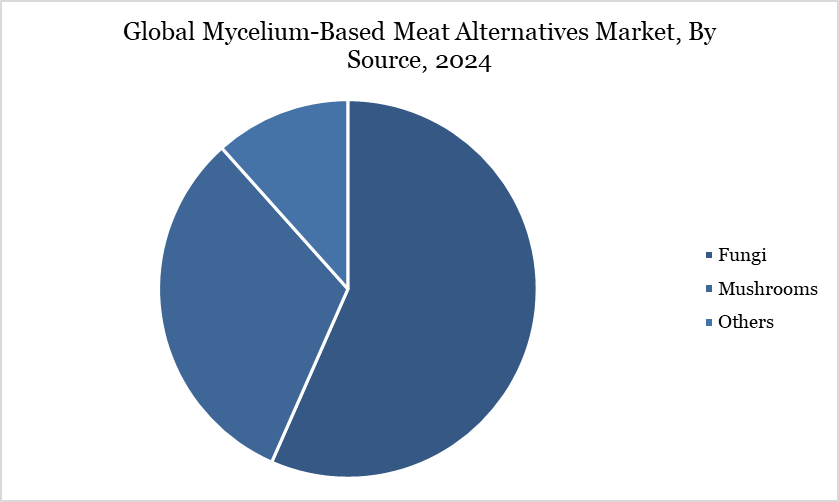
Fungi Segment Driving Mycelium-Based Meat Alternatives Market
The fungi-source segment records around 30% of the market share is rapidly advancing the development of mycelium-based meat alternatives, driven by growing institutional support and innovation in fungal fermentation. In the US, the Department of Agriculture (USDA) has played a pivotal role by awarding a US$ 681,000 Sustainable Technology and Green Energy grant and a US$ 1 million low-interest loan to MyForest Foods a company specializing in fungal bacon made from mycelium. This funding allowed the company to scale up production capacity from 35,000 to 180,000 square feet. These expansions reflect increasing confidence in fungi-derived proteins as sustainable, scalable solutions for meat replacement.
Government action is also helping standardize the production of mycelium-based foods. In January 2025, the USDA revised its National Organic Program regulations to include definitions for organic mushroom and mycelium production. This regulatory clarification, with full compliance expected by February 2027, addresses the sourcing of substrates and spawn easing certification hurdles for producers. MyForest Foods, using a vertical fermentation process, now produces around 20,000 pounds of mycelium weekly for its “MyBacon” product. Their partnership with regional development authorities is projected to create 160 new jobs, underscoring how fungi-based innovations are aligning with public goals for sustainable food systems.
Mycelium-Based Meat Alternatives Market Geographical Penetration
North America Drives the Global Mycelium-Based Meat Alternatives Market
North America’s market value holds 28% of the global value, which is US$ 271.95 million. The appetite for mycelium-based meat alternatives is growing alongside rising interest in sustainable protein sources and fungal foods. In the US, the value of mushroom production a proxy for consumer acceptance of fungal-based foods reached US$ 1.02 billion for the 2021–22 season, with 702 million pounds sold.
Additionally, USDA projections indicate stable-to-increasing interest in non-traditional protein sources through 2033, reflecting long-term demand potential. Together, these government-led indicators highlight a supportive environment for mycelium-based meat alternatives in North America, driven by both consumer acceptance and strategic investments.
Mycelium-Based Meat Alternatives Market Sustainability Analysis
Mycelium-based meat alternatives offer a highly sustainable protein source, emitting as little as 0.307 kg CO₂-eq per kg of biomass, far below traditional meat emissions (2–30 kg CO₂-eq) according to peer-reviewed life cycle data. These products can grow on agricultural by-products, minimizing land and water use. The UN recognizes mycoprotein as a key solution under SDG 2 for food security. MyForest Foods received over USD 1.6 million in public funding for scaling sustainable mycelium production. This market aligns with global efforts to reduce emissions and support eco-friendly food innovation.
Mycelium-Based Meat Alternatives Market Competitive Landscape
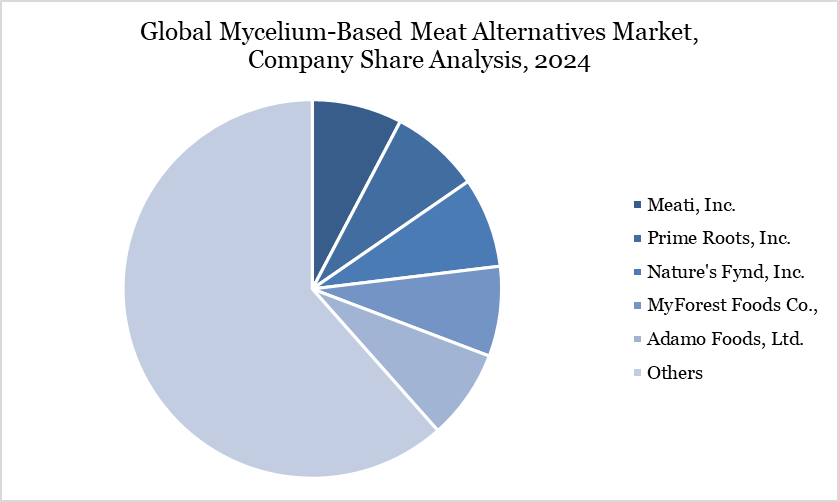
The major global players in the market include Meati, Inc., Prime Roots, Inc., Nature’s Fynd, Inc., MyForest Foods Co., Adamo Foods Ltd., ENOUGH Foods Inc., Mycorena AB, The Better Meat Co., Inc., Bosque Foods, Inc., and Quorn Foods Ltd.
Key Developments in the Mycelium-Based Meat Alternatives Market
- August 2026: Meati, Inc. continued expanding its mycelium-based meat platform, focusing on product innovation, manufacturing efficiency and broader consumer adoption of whole-food fungal protein.
- July 2026: Prime Roots, Inc. continued developing koji-based meat alternatives, focusing on high-protein products and applications designed to improve taste, texture and nutritional performance.
- July 2026: Nature’s Fynd, Inc. continued expanding its fungi-based food portfolio, focusing on protein-rich meat and dairy alternatives derived from fermentation technology.
- June 2026: MyForest Foods Co. continued scaling its mycelium-based food platform, with MyBacon and other mushroom-based products supporting expansion within the alternative-protein category.
- June 2026: ENOUGH Foods Inc. continued expanding production of its ABUNDA mycoprotein ingredient, targeting meat and dairy alternatives and emphasizing scalable fermentation-based protein production.
- May 2026: Adamo Foods Ltd. continued advancing its mycelium-based whole-cut meat technology, focusing on creating products with meat-like texture while using fermentation-derived ingredients.
- May 2026: Mycorena AB continued developing its Promyc mycoprotein platform for alternative-protein applications, with emphasis on improving functionality, taste and scalability.
- April 2026: The Better Meat Co., Inc. continued advancing fermentation-derived protein ingredients, focusing on scalable production and applications across plant-based and alternative-meat products.
- April 2026: Bosque Foods, Inc. continued developing whole-cut mycelium-based meat alternatives, emphasizing natural texture, clean-label positioning and scalable production.
- April 2026: Quorn Foods Ltd. continued expanding its mycoprotein-based food portfolio, strengthening its position in meat alternatives through new product development and wider retail availability.
Mycelium-Based Meat Alternatives Market Competitive Strategy Analysis
Production Scale-Up
Companies are investing in larger fermentation and processing facilities to improve production volumes and achieve economies of scale.
Product Portfolio Expansion
Expanding into burgers, bacon, steaks, sausages, nuggets, deli products, and other formats enables companies to address multiple consumer occasions.
Technology Investment
Investment in fermentation, strain development, texture engineering, automation, and downstream processing can improve product quality and manufacturing economics.
Strategic Partnerships
Partnerships with foodservice operators, retailers, food manufacturers, biotechnology companies, and institutional buyers can accelerate market penetration.
Retail Expansion
Increasing supermarket, specialty-food, and direct-to-consumer distribution can improve consumer accessibility.
Foodservice Partnerships
Restaurant, school, hospitality, and institutional partnerships can introduce mycelium-based products to larger consumer groups.
Sustainability Positioning
Companies can differentiate through resource efficiency, circular substrates, clean-label positioning, and environmentally responsible production.
Why Choose DataM?
Data-Driven Insights: Dive into detailed analyses with granular insights such as pricing, market shares and value chain evaluations, enriched by interviews with industry leaders and disruptors.
Post-Purchase Support and Expert Analyst Consultations: As a valued client, gain direct access to our expert analysts for personalized advice and strategic guidance, tailored to your specific needs and challenges.
White Papers and Case Studies: Benefit quarterly from our in-depth studies related to your purchased titles, tailored to refine your operational and marketing strategies for maximum impact.
Annual Updates on Purchased Reports: As an existing customer, enjoy the privilege of annual updates to your reports, ensuring you stay abreast of the latest market insights and technological advancements. Terms and conditions apply.
Specialized Focus on Emerging Markets: DataM differentiates itself by delivering in-depth, specialized insights specifically for emerging markets, rather than offering generalized geographic overviews. This approach equips our clients with a nuanced understanding and actionable intelligence that are essential for navigating and succeeding in high-growth regions.
Value of DataM Reports: Our reports offer specialized insights tailored to the latest trends and specific business inquiries. This personalized approach provides a deeper, strategic perspective, ensuring you receive the precise information necessary to make informed decisions. These insights complement and go beyond what is typically available in generic databases.
Target Audience
Manufacturers/ Buyers
Industry Investors/Investment Bankers
Research Professionals
Emerging Companies
Suggestions for Related Report


























































