


Multimodal AI Agents Market Size and Overview
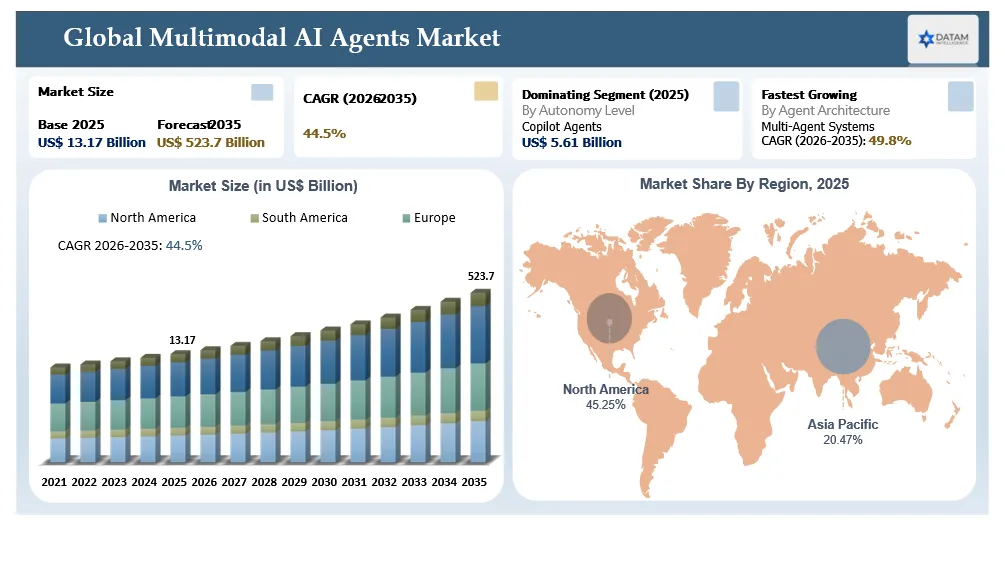
The global multimodal AI Agents market reached US$ 13.17 billion in 2025 and is expected to reach US$ 523.7 billion by 2035, growing with a CAGR of 44.5% during the forecast period 2026-2035.
The market is evolving from conventional text-based assistants toward AI agents capable of processing text, images, audio, video and enterprise data simultaneously, reasoning across multiple information sources and executing actions through applications, APIs and digital interfaces. This shift is leading to increasing adoption in customer service, software engineering, IT operations, cybersecurity, business intelligence, content creation and process automation. Based on Zapier's 2026 AI Agents Survey, 72% of businesses had already adopted or piloted AI agents and 84% of companies planned on investing more into AI agents.
Investment is increasingly shifting from experimental deployments towards agent deployment at scale, agent orchestration and enterprise system integration. As per the Zapier survey, 49% of customer support teams and 47% of operations teams had deployed AI agents, indicating a high adoption rate in workflow-focused roles. As per the KPMG 2026 AI Pulse Survey, 32% of organizations were deploying and scaling AI agents, whereas 27% were orchestrating AI agents, indicating increased adoption in multi-agent systems. Such a trend is providing vendors with chances to offer multimodal agents, who can execute tools and APIs, have memory and retrieval abilities, handle identity and access management, offer enterprise system integration, security controls and multi-agent orchestration, among others.
Multimodal AI Agents Market Key Takeaways
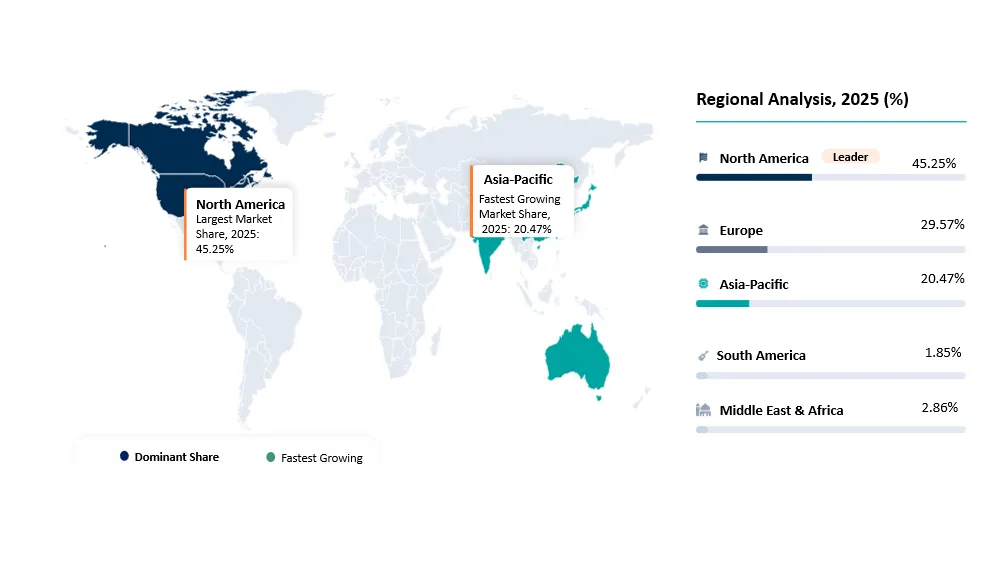
- The multimodal AI agents market was led by North America in 2025 with a market share of 45.25%, due to the presence of prominent AI model developers, hyperscalers, enterprise software vendors and AI agent firms, coupled with strong enterprise investments in agentic AI systems and applications.
- In terms of autonomy level, Copilot Agents dominated the market with a market share of 42.6% in 2025, owing to the broad implementation of AI-based assistants in productivity, CRM, software development and business applications before companies move ahead with greater autonomy.
- Multi-Agent Systems represent the fastest-growing segment, with an estimated 49.8% CAGR during 2026 to 2035, fueled by rising need for specialized agents which can coordinate, delegate tasks, share contextual knowledge and perform multi-application workflows.
- Integration of the enterprise systems has become a vital area of opportunity as agents integrate with CRM, ERP, APIs, databases and knowledge bases, thus allowing automated access to information, decision making and process execution in connected business environments.
- Security and governance have become critical areas of adoption as agents are gaining access to sensitive enterprise information and execution capabilities, thus requiring strong identity management, authorization, monitoring and auditing mechanisms.
Multimodal AI Agents Industry Trends and Strategic Insights
- Rapid evolution of multimodal foundation models enabling more capable AI agents: Increasing progress in language models, vision-language models, speech models and reasoning models is enhancing the capabilities of AI agents to process multimodal data.
- Growing enterprise adoption of agentic AI for workflow automation: Enterprises are utilizing multimodal AI agents to automate tasks ranging from knowledge work to customer interactions and software development.
- Expansion of AI agent ecosystems through enterprise software and cloud platforms: Technology vendors are adding multimodal AI agents into productivity tools, CRM, ERP, cloud services and collaboration tools to enable widespread deployment within enterprises.
- Increasing emphasis on AI governance, security and responsible deployment: Enterprises are focusing on creating agent systems that have secure architecture, governance of models, access management, compliance and human monitoring for trusted AI deployment.
- Rise of domain-specific multimodal AI agents across industries: Companies are launching domain-specific AI agents for the healthcare, BFSI, manufacturing, retail, legal, education sectors and others, to cater to their industry-specific business processes and regulations.
Multimodal AI Agents Market Scope
| Metrics | Details | |
| 2025 Market Size | US$ 13.17 Billion | |
| 2035 Projected Market Size | US$ 523.7 Billion | |
| CAGR (2026-2035) | 44.5% | |
| Largest Market | North America | |
| Fastest Growing Market | Asia-Pacific | |
| By Autonomy Level | Copilot Agents, Semi-Autonomous Agents and Fully Autonomous Agents | |
| By Agent Architecture | Single-Agent Systems and Multi-Agent Systems | |
| By Agent Purpose | General-Purpose Agents, Domain-Specific Agents and Task-Specific Agents | |
| By Multimodal Combination | Text + Image, Text + Audio, Text + Video, Image + Audio, Image + Video, Audio + Video, Text + Image + Audio, Text + Image + Video, Text + Audio + Video, Text + Image + Audio + Video and Others | |
| By Interaction Type | Conversational Agents, Computer/GUI-Using Agents, API/Tool-Using Agents, Workflow/Process Agents, Physical/Robotic Agents and Hybrid Agents | |
| By Component | Foundation Models, Agent Frameworks & Orchestration Platforms, Memory & Retrieval Systems, Integration & API Tools, Security & Governance, Identity & Access Management and Services | |
| By Model Strategy | Proprietary, Open Source and Hybrid | |
| By Deployment Mode | Cloud-Based, On-Premises and Hybrid | |
| By Enterprise Size | Small & Medium Enterprises (SMEs) and Large Enterprises | |
| By Application | Customer Service, Sales & Marketing, Content Generation, Software Development & IT Operations, Business Intelligence & Analytics, Human Resources, Research & Knowledge Management, Education & Training, Process Automation, Cybersecurity, Finance & Accounting, Legal, Supply Chain & Procurement and Others | |
| By End-Use Industry | BFSI, Healthcare & Life Sciences, IT & Telecommunications, Manufacturing, Retail & E-commerce, Government & Public Sector, Media & Entertainment, Education, Automotive & Transportation, Energy & Utilities, Travel & Hospitality and Others | |
| By Region | North America | U.S., Canada, Mexico |
| Europe | Germany, UK, Russia, France, Spain, Italy, Poland | |
| Asia-Pacific | China, India, Japan, Australia, South Korea, Indonesia, Malaysia, Singapore, Vietnam, Thailand, Philippines, Taiwan | |
| South America | Brazil, Argentina | |
| Middle East and Africa | UAE, Saudi Arabia, South Africa, Israel, Turkiye, Nigeria | |
| Report Insights Covered | Competitive Landscape Analysis, Company Profile Analysis, Market Size, Share, Growth | |
Why does this report matter in 2026?
In 2026, the Multimodal AI Agents Market shows indications of moving toward commercialization, as businesses transition from generative AI chatbots to autonomous agents with capabilities of reasoning, planning, external tool utilization and performance of different complex workflows in areas such as text, images, sounds, videos and enterprise data. The swift rates of emergence of enterprise-grade multimodal systems and platforms for agent orchestration and AI copilots has resulted in speeding up deployments in sectors like software development, customer services, medicine, finance, manufacturing and knowledge management. However, during the evaluation of supplier’s capabilities, affordability and return on investment, it is essential to worry about the understanding of the technology’s maturity and competitive landscape.
This report delivers valuable insights on the technologies, companies, applications and trends in terms of market adoption that are shaping the Multimodal AI Agents Market in 2026. This report analyzes how the evolution in multimodal reasoning, memory systems, governance of AI and enterprise integration are impacting product differentiation and competition in the market and the potential for new opportunities in different vertical industries. This report helps technology companies, investors, enterprises and government bodies make strategic decisions by evaluating the market dynamics, innovation trends, competitive trends and drivers of future market growth.
Multimodal AI Agents Market White Space & Investment Opportunities
- Vertical-specific multimodal AI agents for regulated industries: Multimodal AI agents have not yet reached their full potential in the fields of medical, banking, legal, pharmaceutical and public administration industries, which require domain knowledge to fulfill regulatory requirements.
- Enterprise AI agent orchestration, governance and security platforms: Growing enterprise adoption will fuel the demand for solutions capable of managing the collaboration, memory, monitoring, governance, identity and compliance processes of the AI agents in complex business environments.
- Edge and on-device multimodal AI agents: Investment potential is showing in slimmed-down AI agents that can operate on edge devices, industrial machines, robots, mobile devices and computers, enabling responsive, private intelligence without the constant reliance on the cloud.
- Multimodal AI agents for autonomous enterprise workflows: Companies are investing in AI agents that can independently carry out cross-departmental business processes by connecting to enterprise resource planning, customer relationship management, service desk, productivity and company knowledge systems.
- Interoperable AI agent infrastructure and ecosystem technologies: Areas of opportunity exist in agent communication protocols, memory structures, vector databases, model optimization, validation platforms and interoperability standards that support secure, extensible and multi-agent enterprise implementations.
Multimodal AI Agents Future Market Transformation
The market for Multimodal AI agents is now predicted to make an exciting transition. Rather than single-agent AI assistants, we may soon see the emergence of multimodal ecosystems that contain agents capable of seeing, thinking, scheming and performing tasks. Future business implementations will see a move away from AI cooperatives that help users and lead toward self-sufficient, multimodal agents that can plan, coordinate and execute tasks themselves. This monumental change will take place due to developments in the area of multimodal foundation models, the memory of the agent, its ability to use tools, retrieval systems and multi-agent management.
There will also be a shift toward multimodal AI agents specialized for domains and built from proprietary enterprise knowledge that will be tightly integrated into ERP, CRM, IT service management, engineering and other domain-specific systems. As the needs of enterprises grow for higher reliability, vendors will differentiate themselves not just on the scale of the model but also on multimodal reasoning, context, integration, governance and safe deployment in the enterprise environment. All of these are anticipated to form multimodal AI agents as the intelligent execution layer for enterprise data and processes.
Multimodal AI Agents Market Buyer Decision-Making Criteria
In the evolution of artificial intelligence from copilot AI to fully autonomous multimodal AI, purchasing decisions become more centered on solutions that can make sense of diverse modalities of data, reasoning across tasks, interacting with the enterprise environment and performing operations autonomously, with minimal human supervision. Procurement decisions are made based on the solutions' capability to provide enterprise-level security, governance, scalability and interoperability in addition to seamless integration with the business environment.
Major Buyer Decision-Making Criteria
- Multimodal reasoning, agent autonomy and task execution capabilities
- Integration with enterprise applications, APIs and external tools
- Security, governance, data privacy and regulatory compliance
- Scalability, deployment flexibility and orchestration of multiple AI agents
- Total cost of ownership (TCO), return on investment (ROI) and vendor ecosystem maturity
Economic & Investment Analysis
The Multimodal AI Agents Market is gaining s economic strong growth as companies boost funding related to the automation of AI technology, which facilitates increasing productivity while lowering costs and speeding up the digital transformation process. Businesses allocate growing IT budgets to multimodal AI agents intended for automation of data-driven tasks, improvement of management processes and provision of specific investment returns within various domains including customer service, programming, finance and operations. The emerging business case for autonomous multimodal AI agents serves as a foundation for the growth of companies' implementation of these technologies and the further expansion of the market.
Investment is rapidly increasing in the market with venture capital funding, mergers and acquisitions, hyperscaler investments and enterprise collaboration in areas like multimodal foundation models, agent orchestration platforms, AI infrastructure and domain-specific AI agents. The investors are concentrating on technology solutions that improve multimodal reasoning capabilities, agent independence, governance, interoperability and scalability of enterprises. Therefore, the Multimodal AI Agents Market can be considered as an important part of the enterprise AI market.
Multimodal AI Agents: Investment Trends in the Market
- Increased investments in multimodal foundation models to improve the performance of cross-modal reasoning, contextual understanding and the ability to take autonomous decisions in text, images, audio, videos and structured enterprise data.
- Growing funding for agent orchestration and memory capabilities that allow persistent memory, multi-agent cooperation, tool usage and process execution within enterprise settings.
- Capital is being invested in industry-specific multimodal AI agents for sectors such as healthcare, BFSI, manufacturing, legal, software development and scientific research, where industry knowledge gives an advantage.
- Expansion of investments in enterprise-level governance and security systems to enable secure deployment, identity management, explainability, policy enforcement and regulation of autonomous multimodal AI agents.
- Accelerating strategic partnerships and acquisitions to boost multimodal AI agent ecosystems, where technology vendors integrate foundation models, enterprise software, cloud computing and agent platforms into comprehensive enterprise AI solutions.
Strategic Indicators For Multimodal AI Agents Market
High Regulation Impact
Multimodal AI Agents Market is marked by high regulatory impact in the context of AI agents moving on from being mere conversational assistants to agents that have the capability to independently perceive, think, access the enterprise systems, use the external applications and perform critical business processes using textual data, imagery, audio, video and structured enterprise data. Increased functionality and capabilities of multimodal AI agents have resulted in more regulatory requirements in terms of AI responsibility, human intervention, auditability, cybersecurity and secure access to enterprise assets in regulated industries like healthcare, BFSI, government and legal services. With multimodal AI agents becoming more autonomous and capable of decision-making, it has become mandatory for the vendors of these solutions to provide governance capabilities, permissions management, explainability, model monitoring and compliance in their products.
High Investment Activity
Characterized by intense investments, the Multimodal AI Agents Market is seeing a move from the deployment of AI copilots to that of self-sufficient AI agents able to carry out complete business processes. The technology providers, cloud hyperscalers, enterprise software providers and venture capitalists are investing to enhance the capabilities of AI agents, to expand enterprise use cases and to create a leadership position within the fast-evolving agentic AI ecosystem. Investments are being made due to the increasing requirement of enterprise-grade AI agents with better reasoning abilities, ability to collaborate between multiple agents, secure integration and vertical capabilities. With the rising level of competition in the market, investments have become an important aspect of the Multimodal AI Agents Market.
Supply Chain Disruption
The Multimodal AI Agents Market can be subject to disruption risks due to its reliance on robust AI computing infrastructure, sophisticated semiconductor technologies, cloud services and foundation model ecosystems. The scarcity of GPUs, AI accelerators, data center space and cloud infrastructure can delay the process of model training, inference scaling and enterprise-level implementations. Moreover, the use of foundation models, APIs and enterprise-level integrations from other parties can expose market players to product availability and deployment risks. In order to manage these risks, the market players are focusing on model optimization, multi-cloud approaches, diversified infrastructure partnerships and AI inference technologies.
Pricing Volatility
There are high levels of pricing volatility observed in the Multimodal AI Agents Market as a result of changes in AI compute costs, cloud GPU prices and development of business models. Rental expenses for a powerful AI accelerator, such as NVIDIA H100, can be in the range of $1.5-$12.0 per GPU hour depending on the cloud supplier, configuration and level of support. Moreover, businesses are using different pricing strategies like token economy, subscription licensing, consumption-based billing, outcome-based pricing which leads to variation in total deployment costs. As a result, companies invest in transformation of models, hybrid deployments and inexpensive inference structure.
Procurement Pressure
Procurement for the market of multimodal AI agents has become a challenging task due to the fact that large companies need to extensively validate their decision to implement autonomous AI agents into their work process. The process of procurement includes multiple steps of evaluation, piloting, security check, compliance check and proof of value to ensure that the AI agent can perform the workflow autonomously, has access to the enterprise infrastructure and can provide some benefits. In addition, large companies have a tendency to choose those vendors that have a roadmap of the product, enterprise-level support, compatibility with existing technology stack and transparent AI governance.
New Technology Adoption
There is high new technology adoption in the Multimodal AI Agents market as enterprises shift from the use of traditional AI assistants to self-sustaining AI agents that have the capability of processing, thinking and acting upon text, visuals, audio, videos and enterprise data. There is increasing adoption of such technologies as multimodal foundation models, RAG, long-term memory, agent orchestration, tool-use systems and multi-agent collaboration for complete workflow automation. The rate of technology adoption in the market is increased by its easy integration with enterprise software and cloud platforms.
Regional Expansion Opportunity
The Multimodal AI Agents Market presents significant opportunities for geographical expansion due to increased adoption of autonomous AI agents for knowledge-intensive and business-critical processes by companies and government agencies. North America continues to be the leader in enterprise AI agent implementation and innovation, whereas Europe creates new opportunities based on trustworthy AI platforms and enterprise solutions meeting compliance requirements. Asia-Pacific becomes the region of significant growth potential, driven by investments in sovereign AI, domestic multimodal foundation models, cloud infrastructures and multilingual AI technology. On the other hand, the Middle East and Latin America expand AI adoption through digital transformation initiatives at the national and enterprise levels, thus creating opportunities for vendors to offer regionally customized multimodal AI agents.
Government Policy Support
Market for Multimodal AI Agents is witnessing a positive effect from the substantial governmental policies, including national AI strategies, sovereign AI initiatives, digital transformation in public sector and investment in AI computing infrastructure. In major economies, governments are backing AI studies, making high performance computing more accessible, fostering local foundation model development and encouraging innovations via grants, tax breaks and public-private collaborations. The use of multimodal AI agents by the public sector for citizens' services, health care, education, defense and administration automation is additionally fueling market growth and offering business prospects to technology companies.
Pricing Intelligence
Hybrid commercial pricing schemes that consist of enterprise subscriptions, API use and specialized licensing deals according to scale of deployment and capabilities are increasingly used by the Multimodal AI Agents Market. The entry-level enterprise AI agents are available starting from US$20-US$30 per month per user, while the more advanced enterprise versions cost up to US$200 per month per user depending on multimodal abilities, security, governance capabilities and integrations for enterprises. On the other hand, the multimodal AI services delivered through APIs have the price of about US$1 per million tokens. This kind of pricing is higher for multimodal models compared to the text-only models.
With increasing adoption by enterprises, it is becoming common for vendors to provide custom commercial arrangements that include AI agent software, infrastructure, orchestration, governance, support and service-level agreements (SLAs). The move to outcome-driven pricing models allows companies to match their spending with business results while deploying multimodal AI agents.
| HS Code | Reporter | Trade Flow | 2025 Trade Value | Interpretation |
| 8471.50 (Processing Units) | United States | Imports | US$ 32.8 Billion | Strong imports of AI servers and computing systems reflect expanding enterprise AI and multimodal AI agent deployments. |
| 8542.31 (Processors & Controllers) | China | Exports | US$ 41.5 Billion | High exports of processors and AI chips support the global supply chain for multimodal AI computing infrastructure. |
| 8517.62 (Communication Equipment) | Germany | Imports | US$ 18.9 Billion | Imports of networking equipment strengthen cloud connectivity and enterprise AI infrastructure supporting AI agent deployments. |
| 8473.30 (Computer Parts & Accessories) | Japan | Imports | US$ 12.4 Billion | Imports of computing components support expansion of AI servers, data centers and enterprise computing systems required for multimodal AI agents. |
AI Impact Analysis of the Multimodal AI Agents Market
The multimodal AI Agents Market is changing due to the ability of AI to move from being just conversational assistants to becoming autonomous agents that can perceive, think, reason, plan and act in different modalities such as text, image, audio, video and structured enterprise data. Current progress in multimodal foundation models, agentic reasoning, long-term memory, retrieval augmented generation (RAG) and tool usage has dramatically increased capabilities of AI agents which become capable of automating complex workflows rather than single steps. The change is driving enterprise adoption of AI agents in customer operations, software engineering, financial services, healthcare, manufacturing and other knowledge-based business functions.
AI is also changing the nature of competition in the market through transforming the differentiation of vendors from general foundation models to enterprise-ready agents that can perform multimodal reasoning, autonomously execute workflow, multi-agent coordination, safe enterprise integration and domain specific intelligence. More and more vendors are developing AI agents with specialized training using the enterprise knowledge and integrating the AI agents with ERP, CRM, IT Service Management, Engineering and Productivity platforms to drive business results. With the continued advancements of autonomous AI capability, multimodal AI agents will be seen as the intelligent layer which integrates enterprise applications, data and workflows.
Disruption Analysis of Multimodal AI Agents Market
The market for multimodal AI agents is bringing disruptive changes to the conventional enterprise software landscape by transitioning from user-based applications to independent goal-oriented systems that perform business processes automatically. Unlike traditional AI assistants, which mainly provide answers to inquiries from users, the multimodal AI agents have the ability to comprehend various modalities of data, communicate with enterprise applications, use other tools and carry out demanding processes with low human involvement.
The market environment is also influencing the competitive dynamic by altering the development and implementation process for enterprise AI solutions. Competitive advantage is now driven by autonomous task execution, multimodal reasoning capabilities, enterprise interconnectivity and vertical intelligence rather than by isolated AI models or individual software components. In the wake of adoption of multimodal AI agent platforms that can coordinate across the enterprise ecosystem, the technology vendors are transforming their strategy, partnerships and architecture to stay competitive in the emerging enterprise AI market.
Multimodal AI Agents Market BCG Matrix: Company Evaluation
STAR
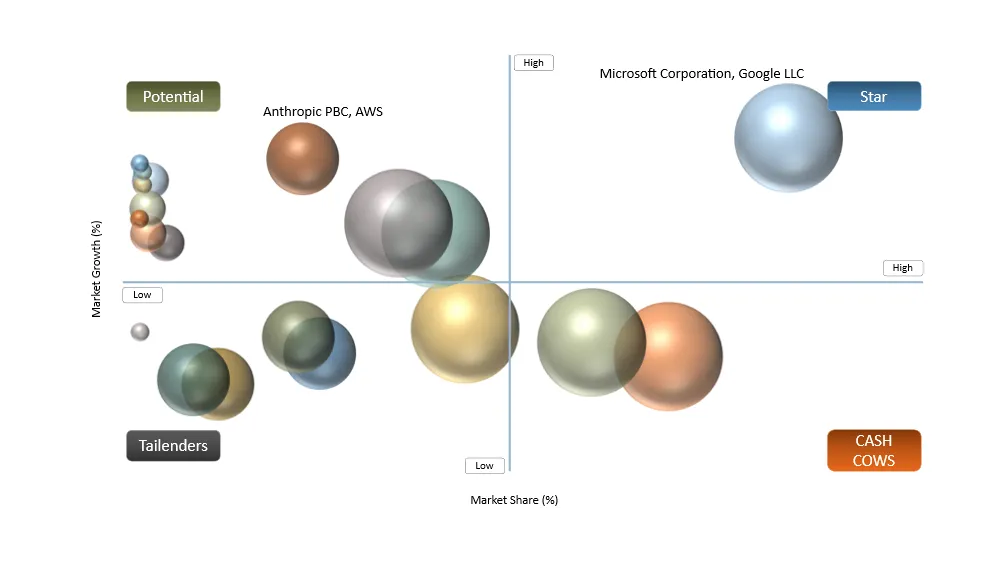
Microsoft Corporation, Google LLC, OpenAI, Salesforce, Inc. and ServiceNow are labeled as Stars due to the combination of their strong enterprise presence and the fast-growing multimodal and agentic artificial intelligence technologies. The existing cloud, productivity, CRM, enterprise software and artificial intelligence platforms of these firms give them a clear advantage in terms of distribution, while the investment in autonomous execution and enterprise agents ensures their strong positioning.
POTENTIAL
Potential Players include Anthropic PBC, AWS, IBM Corporation, Oracle Corporation, SAP SE, Palantir Technologies Inc., Cohere Inc., Glean Technologies Inc., Sierra and Cognition AI. These organizations qualify as potential players as they are developing their capacities related to enterprise AI agents, multimodal reasoning, agent orchestration, knowledge management, software development and process automation. The existing enterprise connections, unique technology capabilities and growth of agent ecosystems of these organizations offer substantial opportunities for growing their market reach amid the adoption of multimodal AI agents becoming more mainstream.
Multimodal AI Agents Market Dynamics
Driver Impact Analysis
| Driver | Market Growth Impact (%) | Demand Concentration | Impacted Use Case | Strategic Impact |
Rapid advancements in multimodal foundation models and agentic AI capabilities | 8.70% | Global | Enterprise AI agents, software development, research assistants | Accelerates development of more autonomous and capable multimodal AI agents. |
Increasing enterprise demand for autonomous workflow automation | 7.90% | North America & Europe | Customer service, IT operations, finance, HR | Drives large-scale enterprise adoption and recurring software revenue. |
Expansion of cloud AI infrastructure and enterprise AI ecosystems | 6.80% | North America & Asia-Pacific | AI agent deployment, cloud-native enterprise applications | Enables scalable deployment and integration of multimodal AI agents. |
Growing adoption of domain-specific multimodal AI agents | 6.20% | Global | Healthcare, BFSI, manufacturing, legal, retail | Expands commercialization opportunities through industry-focused AI agent solutions. |
Driver: Rapid Advancements in Multimodal Foundation Models and Agentic AI Capabilities
The development of rapid progress in the multimodal foundation models as well as the agentic AI capacities is the key factor that drives the Multimodal AI Agents Market, helping businesses leverage AI agents that can perform independently when it comes to reasoning, understanding and carrying out complex workflows involving text, images, sound, videos and structured enterprise data. Ongoing progress in multimodal reasoning, long-term memory, retrieval augmented generation (RAG), tool use and multi-agent orchestration has enabled the increase of the accuracy and the autonomy of AI agents, making them fit for the use on an enterprise level. The development of these technologies is expected to contribute to the commercialization of the Multimodal AI Agents Market in various industries, including customer operations, software engineering, healthcare, financial services, manufacturing and knowledge management, where the companies invest more in AI agents to automate their business processes.
Restraint Impact Analysis
| Restraint | Drag on Market Growth (%) | Primary Impact Area | Impacted Use Case | Strategic Impact |
Data privacy, security and regulatory compliance challenges | 4.90% | Enterprise AI Governance | Healthcare, BFSI, Government | Slows deployment of autonomous AI agents in regulated industries. |
High infrastructure and AI compute costs | 4.30% | AI Infrastructure | Large-scale multimodal model training and inference | Increases deployment costs and limits adoption among cost-sensitive organizations. |
Complexity of enterprise integration and legacy system compatibility | 3.80% | Enterprise Integration | ERP, CRM, ITSM and workflow automation | Extends implementation timelines and increases deployment complexity. |
Limited explainability and trust in autonomous AI decision-making | 3.40% | AI Reliability & Governance | Business-critical decision support and autonomous workflow execution | Restricts enterprise adoption where transparency and human oversight are mandatory. |
Restraint: Data Privacy, Security and Enterprise Trust Challenges
Privacy, security and trust issues related to the enterprise form the most important barriers for the Multimodal AI Agents Market because autonomous AI agents are becoming more capable of accessing, processing and taking action on enterprise data in various modes, including text, images, audio, video and structured data. In contrast to traditional AI assistants, multimodal AI agents work in direct interaction with enterprise software systems, proprietary knowledge bases, APIs and enterprise workflows. Thereby, the issue of security is becoming very relevant because of the risk of improper usage of the technology and exposure to cybersecurity threats and unauthorized access to confidential data of the organization. It is especially true for sectors like healthcare, BFSI, government and legal services that require a very high level of security and transparency before using AI agents.
Multimodal AI Agents Market Segmentation Analysis
The global Multimodal AI Agents market is segmented based on the Autonomy Level, Agent Architecture, Agent Purpose, Multimodal Combination, Interaction Type, Component, Model Strategy, Deployment Mode, Enterprise Size, Application, End-Use Industry and region.
By Autonomy Level
Copilot Agents Drive Widespread Enterprise Adoption
Copilot Agents held 42.6% market share in 2025 and constituted the major segment because of their extensive use in productivity applications, CRMs, software development and enterprise applications. Copilot Agents' capability of handling text, images, audio, videos and documents with humans making decisions is what makes them a feasible step from traditional AI assistants to autonomous agents. Increasing usage in customer service, sales, IT operations, knowledge management and software development, as well as comparatively low implementation complexities, will enable Copilot Agents to remain market dominant in the future.
By Agent Architecture
Multi-Agent Systems Gain Momentum in Complex Workflows
The Multi-Agent System market is expected to grow at a CAGR of 49.8% during the forecast period of 2026–2035, thus becoming the most rapidly growing segment due to the needs of enterprises to have several agents for performing specific tasks. This kind of architecture allows agents to assign tasks to other agents, exchange contexts, access enterprise data, use APIs and tools, as well as perform multi-stage tasks in collaboration. The Multi-Agent System architecture can be used in software development, cybersecurity, customer service, business intelligence, supply chain and process automation.
Multimodal AI Agents Market Geographical Penetration
U.S. Multimodal AI Agents Market Landscape
The US Multimodal AI Agents Market is among the most developed in the world because it features the concentration of the top players in terms of AI models, cloud hyperscalers, enterprise software vendors and dedicated AI-agent vendors. Currently, the market is evolving from single-use cases of conversational AI towards more complex multimodal agents that can understand texts, pictures, voice commands, videos and enterprise information while being able to use applications, APIs and other digital tools to perform multiple actions autonomously. Commercialization is boosted by the high demand for software development, customer services, IT automation, knowledge management, cybersecurity and process automation.
U.S. competitive landscape consists of OpenAI, Google, Microsoft, Anthropic, AWS, Salesforce, ServiceNow, IBM, Oracle, Palantir, UiPath and other emerging agent platform providers. It forms a very competitive landscape with the presence of foundation models, orchestrations, enterprise software and agentic workflows. One of the important characteristics of this market is the growing incorporation of multimodal agents into enterprise software, API, retrievals, memory, identity/access management and multi-agents architectures, rather than deployment of stand-alone AI tools. This makes the U.S. one of the leaders in innovation and commercialization of multimodal AI agents, with vendors focusing on execution autonomy, interoperability with enterprise software, governance and ROI measurement.
Japan Multimodal AI Agents Market Outlook
Japan is rapidly becoming a significant strategic market for multimodal AI agents, facilitated by its advanced manufacturing, robotics, industrial automation and enterprise technology infrastructure. The new strategy of the country involves development of AI technologies capable of integration of languages, speech, images, videos and sensors in order to perceive the surrounding environment, reason through complex information and perform tasks autonomously. In 2026, the Ministry of Economy, Trade and Industry of Japan (METI) initiated a project on development of Japanese multimodal foundation models for AI robots and physical AI; the program for 2026-2030 puts emphasis on the usage of Japanese industrial data.
The Japanese market is aided by a shortage of labor, requirements for efficiency gains and automation investments and therefore businesses are encouraged to use AI agents for process implementation, IT services, customer engagement, information handling and manufacturing processes. The union of multi-sensory input with autonomous decision-making will be pertinent to the Japanese robotics and manufacturing environment, in which agents can interface with machines, visual interfaces, business systems and people. Physical/robotic agents, process/workflow agents, computer/GUI agents and API/tool agents are thus significant opportunities, as well as collaborations between AI firms, robotics firms, manufacturers and technology suppliers.
China Multimodal AI Agents Market Trends
The Multimodal AI Agents Market in China is transitioning quickly from the experimental phase of generative AI to businesses using autonomous agents. Strong internal growth in multimodal foundation models, cloud platforms and AI-native enterprise solutions is filtering through to this market as major corporations such as Alibaba, Baidu and Tencent start utilizing these agents in their workflows, productivity applications, programming systems and online services. One main trend is the movement from text-based assistants to new agents whose work is centered not only on text but also involves images, audio, video and structured data, which allows them to take actions on behalf of humans without guidance. All this leads to an impressive rise in demand for workflow/process agents, API/tool-using agents and computer/GUI-using agents in China.
The emergence of ecosystems and architectures involving intelligent agent interactivity with enterprise software, cloud, knowledge stores, APIs and specialized agents is another crucial trend in China's market. AI providers are more interested in providing their products in the form of agent orchestration, autonomous action performance, enterprise integration and scalability than foundation models. The country’s huge digital platforms and vast ecosystems of data both for industry and consumers serve as good grounds for commercialization, while requirements in relation to generative AI and data security impact the development and deployment of multimodal agents. As enterprises transition from pilots to production use cases, business process automation, software development, customer operations, e-commerce and industry applications will continue to be key application domains.
Multimodal AI Agents Market Competitive Landscape
- Agent capabilities from end to end have become the key form of competition, with top vendors competing not just on foundation model performance but on multimodal reasoning, autonomous task completion, memory, tool/API usage, agent orchestration and integration with enterprise applications.
- Ownership of the enterprise ecosystem constitutes another form of competitive advantage, since firms like Microsoft, Google, Salesforce, ServiceNow, Oracle and many others already having established ecosystems can embed multimodal agents within them directly, without facing issues related to integration.
- Another competitive differentiation is multi-agent orchestration, whereby vendors are building solutions that allow specialized agents to work together, delegate tasks among each other, use enterprise tools and complete complex workflows in multiple applications.
- The foundation models are now competing through partnerships and the development of an ecosystem, bringing together multimodal models with cloud computing, enterprise applications, application programming interfaces (APIs) and system integrators.
- Specialized agents are giving rise to a competitive advantage by having emerging providers specialize in particular workflows such as software engineering, cybersecurity, customer service, knowledge management and business process automation.
Multimodal AI Agents Market Key Companies
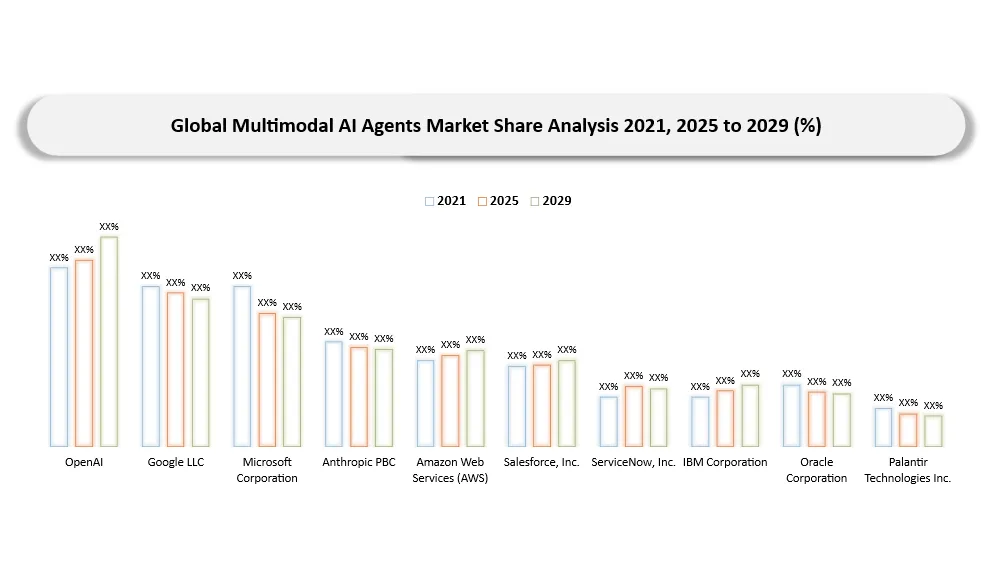
- OpenAI (United States)
- Google LLC (United States)
- Anthropic PBC (United States)
- Microsoft Corporation (United States)
- Amazon Web Services (AWS) (United States)
- IBM Corporation (United States)
- Salesforce, Inc. (United States)
- Oracle Corporation (United States)
- ServiceNow, Inc. (United States)
- Cohere Inc. (Canada)
- xAI (United States)
- Cognition AI (United States)
- Baidu, Inc. (China)
- Alibaba Cloud (China)
- Tencent Cloud (China)
- Sierra (United States)
- UiPath Inc. (United States)
- SAP SE (Germany)
- Palantir Technologies Inc. (United States)
- Adobe Inc. (United States)
- Glean Technologies, Inc. (United States)
Multimodal AI Agents Market Major Pain Points
- Ensuring reliable autonomous execution across complex enterprise workflows: Multi-modal AI agents are supposed to carry out planning and reasoning for multi-process business activities. It is difficult to provide a consistent performance with high reliability in context-sensitive decision making in various enterprise environments.
- Integrating multimodal AI agents with fragmented enterprise technology ecosystems: Enterprises may use different ERP/CRM/ITSM systems, database systems, cloud services and proprietary applications. It is rather difficult to provide integration between multi-modal AI agents and different elements of enterprise technical environment without losing workflow consistency.
- Managing secure enterprise system access for autonomous AI agents: Multimodal AI agents have limited access to enterprise applications, APIs, digital workflows and proprietary knowledge repositories in order to undertake autonomous activities. Organizational heads have to devise proper identity management, permission controls and secure system interactions without interfering with the workflow of a particular company.
- Managing the high cost of enterprise-scale multimodal AI deployments: Multimodal AI agents need heavy investment in compute infrastructure, cloud infrastructure, inference capability and optimization. These expenses may hinder the adoption process, especially for smaller companies that do not have a lot of AI budget.
- Establishing governance, explainability and operational oversight for autonomous AI agents: Organizations using autonomous AI agents should introduce sufficient and comprehensive control procedures, performance monitoring, levels of performance as well as human oversight so that the agents could work properly.
Multimodal AI Agents Market Recent Developments
- January 2026: Anthropic and ServiceNow made an announcement about their collaboration; Claude will serve as the default model for ServiceNow build agent where developers will create workflows that could act, think and perform functions automatically.
- May 2026: ServiceNow created Action Fabric for third-party AI agents to interact with enterprise-grade system of action and perform various business processes tasks. Anthropic's Claude Cowork will be the first design partner integrated in the system.
- April 2026: AWS and OpenAI deepened their collaboration by integrating OpenAI's modern solutions into Amazon Bedrock, along with Codex and Bedrock Managed Agents that utilize OpenAI technology, enhancing organizations effective use of software agents.
- March 2026: Alibaba introduced the Wukong platform, an enterprise AI agent platform that was created for managing multiple agents tasked with complex activities including document editing, spreadsheet modification, meeting transcription and research organization.
- July 2026: Palantir added features in Foundry to create, configure and deploy AI code agents that integrate large language models and Foundry data and software. Such AI agents are able to read and write Ontology data and use platform tools while working with scoped permissions.
Analyst View / Opinion on Multimodal AI Agents Market
- Commercialization will mark the next stage in the Multimodal AI Agents Market, as enterprise use moves from piloting toward production deployment geared at driving tangible business outcomes and automation.
- In the long run, market leadership will not only be driven by how well vendors execute their enterprise models but not necessarily how well their foundation models perform, with competition based on autonomous workflow execution, multimodal reasoning, interoperability, governance and enterprise integration.
- Industry-tailored multimodal AI agents will present the biggest value proposition, with enterprises demanding AI agents trained on industry insights and tailored to specific sector-based business processes.
- In the current competitive environment, companies are focusing on creating ecosystems of AI agents that require collaborative efforts from the cloud vendors, enterprise software providers, AI model creators and system integration partners.
- Firms that focus on developing multimodal AI agent platforms that are secure, governed and interoperable will gain an edge in competitiveness, as enterprises will judge any solution by its ability to provide scalable services with the right return on investment.
Multimodal AI Agents Market Target Audience
| INDUSTRY | WHO SHOULD BUY THIS REPORT? | REASON TO BUY THIS REPORT |
| Information Technology & Software | AI platform providers, enterprise software vendors, system integrators | Evaluate market trends, competitive landscape and enterprise adoption opportunities. |
| Cloud Computing | Cloud service providers, hyperscalers, managed service providers | Assess demand for AI infrastructure, multimodal agent platforms and cloud deployment strategies. |
| BFSI | Banks, insurers, financial institutions, fintech companies | Identify AI agent use cases for customer service, fraud detection, operations and decision support. |
| Healthcare & Life Sciences | Hospitals, healthcare providers, pharmaceutical companies, health-tech firms | Understand opportunities for clinical assistance, administrative automation and medical knowledge management. |
| Manufacturing | Industrial enterprises, smart factory operators, automation solution providers | Evaluate AI agent adoption for production planning, maintenance, quality control and operational efficiency. |
| Retail & E-commerce | Retailers, e-commerce platforms, consumer brands | Explore AI agent applications in customer engagement, merchandising, sales support and inventory management. |
| Telecommunications | Telecom operators, network solution providers | Assess AI agent deployment for customer support, network operations and service automation. |
| Government & Public Sector | Government agencies, public service organizations, smart city authorities | Understand AI adoption strategies for citizen services, public administration and digital government initiatives. |
| Investors & Venture Capital | Venture capital firms, private equity firms, corporate investors | Identify high-growth investment opportunities, emerging technologies and competitive positioning. |
| Consulting & Research Organizations | Management consultants, technology advisors, market research firms | Support strategic planning, market entry, technology evaluation and client advisory services. |
Why Choose DATAM?
- Data-Driven insights: Dive into detailed analyses with granular insights such as pricing, market shares and value chain evaluations, enriched by interviews with industry leaders and disruptors.
- Post-Purchase Support and Expert Analyst Consultations: As a valued client, gain direct access to our expert analysts for personalized advice and strategic guidance, tailored to your specific needs and challenges.
- White Papers and Case Studies: Benefit quarterly from our in-depth studies related to your purchased titles, tailored to refine your operational and marketing strategies for maximum impact.
- Annual Updates on Purchased Reports: As an existing customer, enjoy the privilege of annual updates to your reports, ensuring you stay abreast of the latest market insights and technological advancements. Terms and conditions apply.
- Specialized Focus on Emerging Markets: DataM differentiates itself by delivering in-depth, specialized insights specifically for emerging markets, rather than offering generalized geographic overviews. The approach equips our clients with a nuanced understanding and actionable intelligence that are essential for navigating and succeeding in high-growth regions.
- Value of DataM Reports: Our reports offer specialized insights tailored to the latest trends and specific business inquiries. The personalized approach provides a deeper, strategic perspective, ensuring you receive the precise information necessary to make informed decisions. The insights complement and go beyond what is typically available in generic databases.
What DATAM Uniquely Provides
- Granular competitive analysis of multimodal AI agent capabilities, wherein service providers are compares based on their ability to perform completely independent workflows, sinks in the advanced reasoning capability of multimodal technologies and their process integration expertise.
- Detailed illustration of the multimodal AI agent value chain including the key actors like foundation model creators, provider of platforms, companies offering orchestration frameworks and companies delivering cloud solutions.
- In-depth analysis of enterprise adoption in various industries, focusing on situational maturity, target applications, investment habits, entity requirements and monetization prospects in healthcare, finance, production, commerce, public sector and software.
- Strategic analysis of contemporary enterprise systems of artificial intelligence including multi-agent approaches, long-term memory techniques, retrieval-augmented generation (RAG), tools applications and systems of enterprise management that determine the development of future AI applications.
- Decision-making-oriented market intelligence combining the technology, competition, regulation, investment and regional intelligence, providing decision makers the ability to develop growth strategies in the Multimodal AI Agents Market.


























































