


Multicore Optical Fiber Market Size and Overview
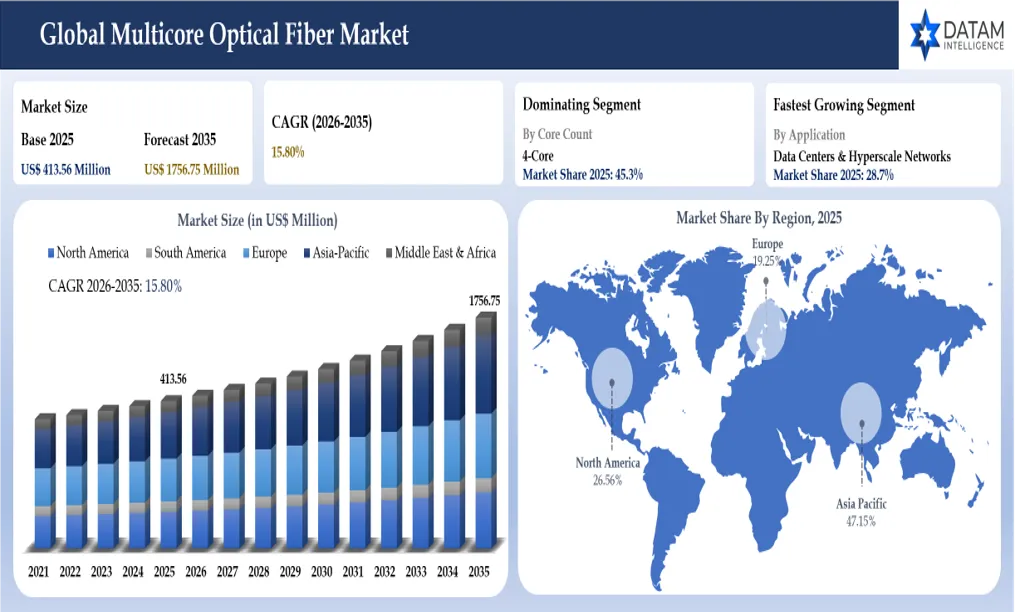
The global multicore optical fiber market reached US$ 413.56 million in 2025 and is expected to reach US$ 1756.75 million by 2035, growing with a CAGR of 15.80% during the forecast period 2026-2035.
The growth trajectory of the market is heavily influenced by the shift towards space-division multiplexing (SDM) as traditional single-core fiber technologies start to run into limitations caused by capacity and pathway-density demands. The trend is especially strong in the case of AI data centers and supercomputing systems as they benefit from the ability to house multiple spatial channels in just a single fiber. The focus in the commercial sector is shifting to 4-channel MCF solutions, with further deployment prospects opening up due to the emergence of submarine cables, advanced telecommunication systems and sophisticated optical connections.
In addition, the competitive environment is evolving from fiber generation to a bigger MCF ecosystem, involving low crosstalk fiber types, multicore connectors, fan-in/fan-out solutions, precision fiber fusion splicing, compatible transceivers and optical testing systems. Commercial implementation is advancing as manufacturers and technology firms strive for interoperable MCF standards as well as application-based development focusing on AI data centers, submarine fiber networks, dense optic infrastructure and fiber optic sensing.
Multicore Optical Fiber Market Key Takeaways
- The 4-Core multicore optical fiber was the leading product segment in the global multicore optical fiber market in 2025, holding about 45.3% of the market share, owing to the rising demand for enhanced spatial capacity, fiber density and optical infrastructure compactness.
- Data Centers & Hyperscale Networks is estimated to grow at a CAGR of 17.2%, which is the fastest growing among all segments, due to the growing AI workloads, GPU clusters, east-west traffic and requirement of enhanced optical capacity in space-limited data center infrastructure.
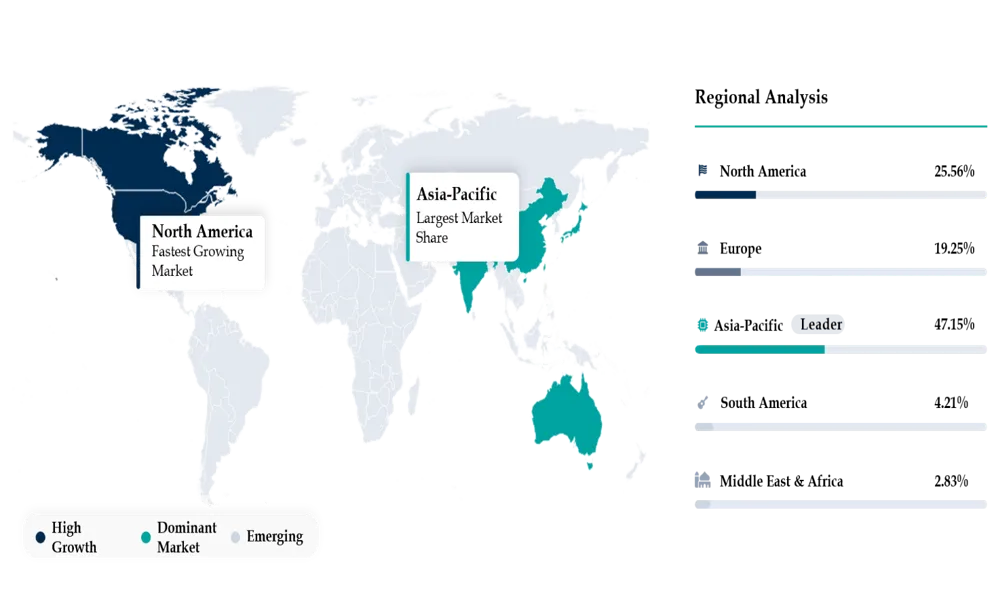
- Asia-Pacific dominated the global multicore optical fiber market with a market share of 47.15%, owing to the presence of advanced optical fiber manufacturing in China and Japan, substantial spending on high bandwidth telecommunication and submarine cable networks and increasing investment in artificial intelligence and data center infrastructures.
- The increasing use of Space Division Multiplexing (SDM) technology is motivating the manufacturing companies to come up with low cross talk MCF designs, connectors, fan-in/fan-out devices and systems that will facilitate increased optical network capacity.
- Increasing demand for MCF from sectors such as AI data centers, telecoms, submarine networks, high-performance computing, fiber optic sensing and defense and aerospace is creating more market potential for MCF solutions.
Multicore Optical Fiber Industry Trends and Strategic Insights
- AI Data Centers Are Accelerating MCF Adoption: Hyperscale and AI data centers are looking into multicore fibers in order to increase the number of transmission channels through the use of already existing cable and path infrastructure, without adding more fiber.
- 4-Core MCF Is Emerging as a Practical Deployment Architecture: The commercial development of multicore fibers is now focused on 4-core multicore fiber, which is possible due to the availability of standard connectors, splicing technologies and fan-in/fan-out.
- SDM Is Shifting MCF From Research Toward Network Deployment: Space Division Multiplexing (SDM) becomes an important architecture in utilizing the multiple cores, including weakly coupled and heterogeneous-core multicore fibers in order to reduce inter-core crosstalk.
- MCF Connectivity Is Becoming a Critical Commercial Bottleneck: Deployment of the fiber itself is not enough for MCF to succeed; connectors, fan-in/fan-out systems, splicers, transceivers and test equipment need to provide exact core alignment, leading to new possibilities for component makers and complete MCF solutions.
- Standardization and Interoperability Are Becoming Strategic Differentiators: Industry efforts by fiber makers, connectivity vendors and networking technology companies become increasingly oriented towards common MCF standards and interoperable components, decreasing risks of deployment and helping MCF adoption across AI data centers and telecommunication networks.
Multicore Optical Fiber Market Scope
| Metrics | Details | |
| 2025 Market Size | US$ 413.56 Billion | |
| 2035 Projected Market Size | US$ 1756.75 million | |
| CAGR (2026-2035) | 15.80% | |
| Largest Market | Asia-Pacific | |
| Fastest Growing Market | Asia-Pacific | |
| By Fiber Mode | Single-Mode, Few-Mode and Multimode | |
| By Fiber Architecture | Conventional Multicore Fiber, Hollow-Core Multicore Fiber, Photonic Crystal Multicore Fiber, Trench-Assisted Multicore Fiber and Other Specialty Multicore Fiber | |
| By Core Count | 2-Core, 3-Core, 4-Core, 7-Core, 8-Core, 12-Core, 19-Core and More than 19-Core | |
| By Core Coupling | Weakly Coupled and Strongly Coupled | |
| By Core Uniformity | Homogeneous Core and Heterogeneous Core | |
| By Transmission Technology | Space-Division Multiplexing (SDM), Mode-Division Multiplexing (MDM), Wavelength-Division Multiplexing (WDM), Coherent Transmission and Direct Detection / Intensity-Modulation Direct Detection (IM-DD) | |
| By Cable Construction | Loose-Tube, Ribbon, Tight-Buffered, Micro-Cable / High-Density, Armored and Specialty Cable | |
| By Wavelength Band | O-Band, E-Band, S-Band, C-Band, L-Band, U-Band and Multi-Band | |
| By Application | Telecommunications, Data Centers & High-Performance Computing, Submarine Optical Networks, Fiber-Optic Sensing, Defense & Aerospace, Medical & Healthcare, Industrial, Research & Scientific and Others | |
| By End-User | Telecom Operators, Cloud & Hyperscale Data Centers, Enterprise Data Centers, Submarine Cable Operators, Defense & Aerospace Organizations, Industrial Enterprises, Healthcare Organizations, Research Institutions, Government Organizations and Others | |
| By Region | North America | U.S., Canada, Mexico |
| Europe | Germany, UK, Russia, France, Spain, Italy, Poland | |
| Asia-Pacific | China, India, Japan, Australia, South Korea, Indonesia, Malaysia, Singapore, Vietnam, Thailand, Philippines, Taiwan | |
| South America | Brazil, Argentina | |
| Middle East and Africa | UAE, Saudi Arabia, South Africa, Israel, Turkiye, Nigeria | |
| Report Insights Covered | Competitive Landscape Analysis, Company Profile Analysis, Market Size, Share, Growth | |
Why does this report matter in 2026?
2026 is significant for multicore optical fiber market as the product moves from being research driven to targeting deployment in areas such as data-cneter use for AI technology, hyperscale computing, data center interconnects and advanced submarine networks. 4-core MCF solutions and initiatives like SDM4 specification have brought about clarity in fiber design and switching requirements for MCF configurations. Understanding MCF implementations is becoming increasingly relevant for companies involved in the field of MCF since AI workloads are driving need for optical density and network capacity.
This report also holds significance in 2026 as the competitive scenario is shifting from just fiber producers to covering the entire ecosystem of MCF, involving connectivity providers, fan-in/fan-out service providers, splicing providers, transceivers, testing equipment and SDM technology companies. Companies such as Sumitomo Electric, Corning, Fujikura, AFL and NTT are involved in various parts of the MCF ecosystem, signifying significant activity in this regard. Finding out about key parameters such as manufacturing preparedness, networking, inter-core crosstalk issues, availability of components and economics related to specific applications can facilitate commercial insights in the area of MCF technology.
Multicore Optical Fiber Market White Space & Investment Opportunities
- AI Data Center Interconnects: Investment possibilities exist in 4-core and above MCF products for AI data centers and hyperscale data centers, especially when single-core fibers become too many to fit in a limited pathway area.
- MCF Connectivity Components: There is scope in fan-in/fan-out solutions, connectors, splice machines and core alignment tools, where reliable and low loss connections are essential for deploying MCF commercially.
- High-Capacity Submarine Networks: MCF provides investment opportunities in subsea cables that require higher spatial capacity through multi-core amplification and transoceanic cable designs.
- Specialized MCF for Optical Sensing: Opportunities arise in cases of distributed acoustic sensing, structural monitoring and surveillance of pipelines and industries where more than one core allows development of parallel channels and upgrades the level of measuring abilities of the entire system.
- MCF Manufacturing & Standardization Infrastructure: Opportunities for investments appear in production of fiber with the utmost accuracy, core position control, low-crosstalk technology, automated control and MCF qualifications.
Multicore Optical Fiber Future Market Transformation
The multicore optical fiber market is set to evolve from being a high-capacity specialized fiber technology to being a more spatial capacity architecture platform for artificial intelligence, hyperscale data centers, telecom infrastructures, submarine cables and sensing applications. In the future, growth in the market will largely focus on multicore technologies with a higher number of cores, low crosstalk heterogeneous multicore fibers, SDM-based optical systems and MCF connectivity beyond just fiber. As the 4-core MCF system including interoperable connectors, fan-in/fan-out modules and MCF-compatible transceivers becomes mature, there is a possibility that the industry would move towards standardization of a higher-capacity optical system using the same physical space. Such an evolution is possible provided that the industry demonstrates its capability to scale up and create an economically convincing capacity/infrastructure ratio against conventional single-core fiber.
Multicore Optical Fiber Market Buyer Decision-Making Criteria
Multicore optical fiber buyers consider more than just transmission properties in product assessment due to the necessity of compatibility at fiber, cable, connector and optical system levels. The choice of the appropriate MCF product becomes dependent on how well such a solution performs at increasing spatial bandwidth density while managing core-to-core crosstalk and retaining stable core alignment, network equipment compatibility and reasonable economics of the deployment process. In particular, the capability of the supplier to deliver compatible fiber, connectors, fan-in/fan-out modules, splicing capabilities and supply chain becomes of crucial importance for AI data centers, telecommunications providers, submarine networks builders and sensor systems manufacturers.
Major Buyer Decision-Making Criteria
- Core Count and Spatial Capacity
- Inter-Core Crosstalk Performance
- Attenuation and Insertion Loss
- Core Geometry and Manufacturing Tolerance
- Compatibility with MCF Connectors and Fan-In/Fan-Out Devices
- Splicing and Installation Requirements
- Compatibility with SDM, WDM and Coherent Transmission Systems
- Transmission Distance and Reach
- Fiber and Cable Reliability
- MCF Testing and Qualification Capabilities
- Standards Compliance and Interoperability
- Supplier Manufacturing Scalability
- Product Availability and Delivery Lead Time
- Total Cost per Transmitted Capacity
- Supplier Technical Support and Customization Capability
Multicore Optical Fiber Market Economic & Investment Analysis
Multicore optical fiber economics are becoming increasingly associated with the cost of scaling optical capacity in networks that have physical limitations in terms of space and pathways. For AI data centers and hyperscale data centers, MCF technology may allow one to pack more spatial channels in one fiber footprint, which may result in reduced need for more fiber cables and pathways as more bandwidth needs arise. But the economic value will depend on the entire deployment stack that includes MCF-compatible connectors, fan-in/fan-out equipment, transceivers, splicing, testing and network equipment. As a result, buyers will be calculating the MCF value on the basis of total cost per capacity transmitted, not just fiber cost.
Investment has expanded beyond fiber manufacturing to include MCF connectivity and SDM components, production of optimal equipment and creation of testing infrastructure, specialty submarine network and AI-based networks. The role of capital allocation becomes important for MCF platforms without 4 cores due to the fact that standardized interfaces and compatible components have helped minimize the risk of commercialization and make manufacturing scalable. In the meantime, investors and technology partners are looking for possibilities in low crosstalk fiber production, automated system for aligning cores, MCF connectors, fan-in/fan-out technologies and high-capacity optical transceiver technologies, but the speed of investments in this endeavor relies on the standardization level, availability of components, qualification requirements and proven economy of single-mode alternatives.
Multicore Optical Fiber Investment Trends in the Market
- AI Data Center Capacity Expansion: Investments will be made in multicore fiber-based technologies, which enable high-density optics for AI clusters, GPUs and hyperscale data centers without proportional increases in fiber and cabling footprint requirements.
- Commercialization of 4-Core MCF Platforms: Fibers and connectivity suppliers will invest in production and qualifications of 4-core MCFs and associated fan-in/fan-out technologies enabling deployment within high-density optical interconnects.
- SDM Technology Development: There will be investments into development of space-division multiplexed systems based on low-crosstalk core design, MCF amplifiers, SDM transceivers and digital signal processing techniques to make use of multiple cores.
- Submarine MCF Infrastructure: The companies and network operators have invested in the multi-core fiber submarine network and equipment that works with the MCF cables to enhance the capacity carried by each cable, especially for high capacity transoceanic networks.
- MCF Manufacturing and Testing Capabilities: Funds are being spent on precise fiber drawing, positioning of the cores, minimizing crosstalk in the fiber manufacturing process and automated testing and splicing.
Strategic Indicators for Multicore Optical Fiber Market
High Regulation Impact
Regulatory impact on the multicore optical fiber market will be limited to standards of telecommunication equipment, safety and performance standards of optical fiber, approval of submarine cable, electromagnetic compatibility and requirements of network infrastructure implementation. MCF introduces new elements of qualification since all cores should be aligned in terms of geometry, attenuation, crosstalk, connector alignment and performance of transmission. With increasing introduction of 4-core and other types of MCF into commercial networks, adherence to IEC, ITU-T, Telcordia/GR, regional telecom and customer-specific qualifications become crucial for suppliers. However, regulatory and standardization requirements could lead to prolonged product qualification processes and testing expenses, whereas greater harmonization of MCF standards would minimize interoperability issues.
High Investment Activity
Investment trends in the multicore optical fiber market now tend towards the development of MCF technology for AI data center connectivity, hyperscale optical interconnects, large capacity submarine systems and next generation SDM networks. Investments are being directed not only at the traditional manufacture of fibers but also at the manufacture of 4-core MCF, low crosstalk fibers, core alignment, MCF connectors, fan-in/out units, splicing, optical transceivers and special test equipment. Strategic investments tend to focus more on the development of scalable production and interoperable components’ ecosystem because the aim is to move MCF from laboratory demonstrations to qualified network deployments. Strategic investments will be motivated even more by the fact that optical capacities need to be increased without increasing the number of cables.
Supply Chain Disruption
The multicore optical fiber market is susceptible to supply chain disruption owing to the requirement that commercial adoption of MCF necessitates an even more specialized supply chain compared to conventional single-core fibers that require precise preforms and fiber draw machines, core alignment technologies, MCF compatible connectors, fan-in/fan-out units, splicing machines, transceivers and testing tools. Supply disruptions in terms of highly precise manufacturing components and shortage of MCF component supplies may result in qualification delays. The fact that advanced MCF production and technology are concentrated amongst few vendors in Japan, China, the United States and Europe increases the risk of supply chain dependency within regions. With the rising demand for AI data centers, resiliency in the supply chain will increasingly be determined by multi-sourcing, standardization of interfaces, local production capacity and compatibility of MCF suppliers.
Pricing Volatility
Price fluctuations in the multicore optical fiber market are influenced by the difficulty of producing multiple cores, limited production output and specialized connectivity components, as well as raw material issues and changes in prices of optical fiber preforms. In 2026, the global optical fiber market was under price pressure, which resulted in CRU's global fiber price index to rise from 107.9 in January 2026 to 263.0 in March 2026 amid pressures caused by high demand for AI applications and data centers. Price changes for MCF products can also be influenced by the costs associated with the fabrication of low crosstalk fiber and precision positioning of cores, MCF connectors and special testing, which makes the cost of a low-volume order higher in comparison with full production orders. As MCF advances towards commercialization, economies of scale and standardization will play a role in reducing the price volatility per unit, whereas any sudden demand for the AI infrastructure or component scarcity might drive prices up.
Procurement Pressure
Pressure within the multicore optical fiber market procurement process continues to grow as operators of AI data centers, telecom firms and high-capacity networks require more optical bandwidth but manage the number of fibers and the use of pathways and installation costs. Potential buyers deal with a relatively specialized list of suppliers of 4 cores and above MCFs, low crosstalk designs, MCF connectors, fan-in/fan-out and associated test equipment, all of which may increase the time it takes to qualify and source the parts needed. Consequently, procurement groups are increasingly prioritizing multiyear contracts for supplies, multisourcing, compatibility, core-geometry uniformity, attenuation and crosstalk requirements, scaling and total cost of transmissible capacity. The requirement that the whole MCF eco-system be qualified, not just the fiber, is adding to switching costs, as well as giving technologically qualified vendors negotiating power during early adoption periods.
New Technology Adoption
Technology adoption in the multicore optical fiber market centered on 4-core and higher-core architectures, space-division multiplexing (SDM), low crosstalk core designs and connectivity technology for MCF that allows multiple spatial channels in the fiber. Technology adoption is growing beyond lab-scale transmission experiments into AI data center interconnection, hyperscale optical networks and high-capacity submarine optical systems through progress in multicore connectors, fan-in/fan-out modules, fusion splicing with micron-level accuracy, SDM transceivers and optical amplification. Interoperability of 4-core MCF is especially important in view of the standardized geometry and interfaces of the cores that can lower the level of complexity of integration and spur manufacturers and carriers towards qualified commercialization of the technology.
Regional Expansion Opportunity
The prospects for expansion into regional markets in the multicore optical fiber market will be most promising in those regions where there is simultaneous development of AI infrastructure, high-speed telecom networks and optical-fiber manufacturing facilities. North American region provides opportunities in the form of AI infrastructure development, hyperscale data center growth and commercialization of 4-core MCF in high density optical interconnect applications; whereas Asia Pacific provides a strong manufacturing and technological base in countries like Japan, China, South Korea and Taiwan with increasing MCF use in telecom, data centers and submarine cable systems. Europe provides opportunities in advanced optical networking and industrial sensing, along with high-capacity communications. In addition to this, emerging economies like India and South East Asia present long-term prospects as there is growth in data center capacity, cloud infrastructures and fiber networks. By creating regional capabilities in manufacturing, qualifications and technical support, suppliers will try to overcome logistical and qualification barriers and gain better access to local network operators and data centers.
Government Policy Support
Government Policy Support in favor of the multicore optical fiber market comes indirectly through national policies on infrastructure for AI, high capacity optical networks, digital infrastructure and advanced photonics. For example, in China, the 2026-2028 implementation strategy for AI + Information and Communications aims to improve the infrastructure of AI-computing networks by developing the backbone transmission networks of 400G/800G, high-speed optoelectronics chips and devices and optical interconnections for AI computing clusters, thereby providing a conducive infrastructure ecosystem for advanced fiber optics such as MCF. The 2026 NICT strategic plan of Japan focuses on similar issues of AI and communication, Beyond 5G, quantum ICT and advanced communications technologies, thereby contributing to the larger technology ecosystem in which MCF could be developed. In the United States, federal policies encouraging the rapid deployment of AI data center infrastructure could be helpful indirectly.
Pricing Intelligence
The multicore optical fiber market's pricing intelligence is effectively evolving away from simply comparing the price per fiber-kilometer to the cost of each transmission channel and the infrastructure density being delivered. According to Corning, it will be able to provide its 4-core MCF solution in 2026 with a four-fold increase in optical pathways density and 75% less use of cables and connectors, meaning that its cable mass may fall by up to 70% compared to the conventional single-core fiber solutions. This modifies the pricing benchmark for the buyers since a higher price for MCF fiber may be compensated for by cost savings in cables, pathway utilization, connectivity and installation. Consequently, pricing analysis is shifting toward calculating the actual cost per fiber core, cost per transmitted capacity, connectivity cost per channel and total installed cost, especially for AI data centers and the optical installations operating at very high density.
| HS Code | Reporter | Trade Flow | 2025 Trade Value | Interpretation |
| 9001.1 | China | Exports | US$644.57 million | Broad optical-fiber trade proxy relevant to MCF fiber |
| 9001.1 | Japan | Exports | US$166.99 million | Optical-fiber trade proxy covering Japan's broader fiber products |
| 9001.1 | United States | Exports | US$392.96 million | U.S. optical-fiber trade proxy |
| 8544.7 | China | Exports | US$3.26 billion | Optical-fiber cable trade proxy relevant to MCF cable deployment |
Note: HS 9001.10 (optical fibers, optical-fiber bundles and related products) and HS 8544.70 (optical-fiber cables) are used as broader trade proxies. The reported trade values include conventional optical-fiber products and should not be interpreted as MCF-specific trade values.
AI Impact Analysis of Multicore Optical Fiber Market
AI is boosting the need for high-density optical interconnects, as GPU clusters, AI accelerators and distributed computing technologies bring about higher east-west traffic between servers, switches, storage and accelerator nodes. The multicore optical fiber technology can satisfy this demand by allowing multiple channels to be placed in a single fiber footprint and reducing the number of fiber counts needed for high-capacity interconnects. The most significant short-term effects can be observed in AI data centers and hyperscale data centers regarding short-distance and data-center interconnect applications due to rack density, cable ways and electricity issues being constraints of the infrastructure.
AI is enhancing the development of the MCF ecosystem, instead of merely increasing the demand for fiber products. Enterprises are working on 4-core models, silent data transfer between cores, MCF-compatible connectors, equipment, transceivers and SDM technologies for AI applications. 2026 SDM4 project by Corning, AFL, Sumitomo Electric and TeraHop is an example of how the industry is shifting towards 4-core MCF solutions compatible with AI data centers. As AI consolidates, MCF is expected to become an efficient optical technology. However, the implementation of MCF primarily depends on the availability of necessary components.
Disruption Analysis of Multicore Optical Fiber Market
Multicore optical fiber is creating a disruption in traditional single-core optical fiber designs, where the number of independent transmission channels increases while maintaining the same physical fiber structure. This results in a disruption in the way in which capacity expansion occurs in such systems; that is, capacity expansion can be achieved by increasing the number of cores rather than expanding the number of parallel optical fibers and the pathway for the cables. The disruption is especially pertinent to AI data centers, hyperscale networks, large data center interconnects and space division multiplexing systems.
Disruption is taking place within the optical-fiber supply chain, as MCF demands an entirely new environment in terms of testing and connectivity. The core alignment, inter-core crosstalk management, fan-in/fan-out technology, multi-core connectors, splicing, transceivers and testing of MCF create new challenges for manufacturers and installers. The advent of the 4-core MCF standards and interoperability efforts is aiding the overcoming of these hurdles, but the speed of disruption now depends on whether the products of MCF can attain suitable levels of standardization, robustness, production scale and cost efficiency to be used outside some highly specialized cases.
Multicore Optical Fiber Market BCG Matrix: Company Evaluation
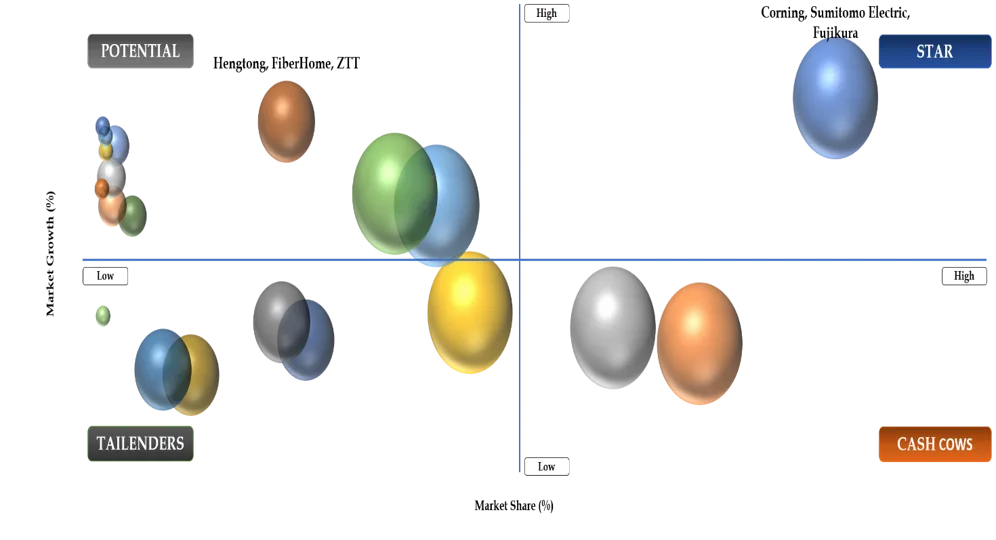
STAR
Companies that have been placed in the Star category will include the firms that possess strong technological competence and that are exposed to the most rapidly developing applications of MCF technology, especially 4-core multicore fibers, AI data center interconnects, SDM and high capacity subsea applications. The firms that are best placed in the above areas include Corning, Sumitomo Electric, Fujikura, YOFC and OFS/Lightera in the areas of commercial MCF development, interoperability efforts, specialty fiber expertise and high density optical interconnects. These growth opportunities would be enabled through the shift from the traditional single-core architecture to higher spatial bandwidth capacity, whereas further developments in low crosstalk architecture, MCF connections and production scaling could help them establish their position as MCF is poised for commercialization.
POTENTIAL
Firms in the potential group are those that have relevant fiber optic manufacturing, specialty fiber, cable and connectivity expertise that will help them develop in the context of MCF development. These companies are Hengtong, FiberHome, ZTT, STL, Taihan, Prysmian and LS Cable & System. They already have a platform for manufacturing fiber and cables that will allow them to grow in the direction of high-density MCF and SDM. Their potential is especially connected to the connectivity of AI data centers, submarine optical networks, high-capacity backbones and sensors, but their future will rely on commercial products of MCF, inter-operability, low-crosstalk characteristics, components and scalable manufacturing.
Multicore Optical Fiber Market Dynamics
Driver Impact Analysis
| Driver | Market Growth Impact (%) | Demand Concentration | Impacted Use Case | Strategic Impact |
AI Data Center and Hyperscale Bandwidth Expansion | 30% | North America, China, Japan | AI clusters, GPU interconnects, data-center interconnects | Accelerates adoption of 4-core MCF and high-density optical architectures |
Need for Higher Fiber Capacity Within Existing Pathways | 25% | North America, Europe, Asia-Pacific | High-capacity telecom networks, metro networks, enterprise data centers | Increases demand for multi-core architectures that provide additional spatial channels within existing fiber infrastructure |
Expansion of Space-Division Multiplexing (SDM) | 20% | Japan, China, Europe | Long-haul transmission, submarine networks, high-capacity backbone networks | Supports development of low-crosstalk MCF, SDM components and compatible optical systems |
Growth of High-Capacity Submarine Communication Infrastructure | 15% | Asia-Pacific, North America, Europe | Transoceanic and submarine networks | Creates opportunities for higher-capacity submarine cable architectures using multicore fibers |
Driver: AI Data Center Expansion and Fiber-Density Constraints
The fast growth of AI data center installations leads to a need to increase the optical capacity without growing the amount of fibers, cables and pathways. GPU clusters and high-performance computing systems produce very high amounts of east-west traffic, which makes the density of fibers a key infrastructure parameter. The multicore optical fiber fulfills this condition because it allows the integration of multiple spatially independent cores in a single fiber and thus increases the capacity of transmission without changing the typical size of a fiber. The advent of 4-core MCF configurations is especially crucial in the context of AI-based short-reach data-center interconnects in terms of reducing cable and connector density. This is moving the MCF technology from being mainly research-based space division multiplexing to being commercial applications-oriented towards AI and hyperscale optical networking.
Restraint Impact Analysis
| Restraint | Drag on Market Growth (%) | Primary Impact Area | Impacted Use Case | Strategic Impact |
High MCF Manufacturing and Qualification Complexity | 30% | Production cost and scalability | Commercial telecom networks, AI data centers | Encourages investment in precision manufacturing, automated testing and scalable 4-core MCF production |
Inter-Core Crosstalk and Signal Integrity Constraints | 25% | Transmission performance | Long-haul, SDM and high-capacity data links | Increases R&D requirements for core spacing, refractive-index engineering and crosstalk mitigation |
Limited MCF-Compatible Component Ecosystem | 20% | Connectivity and system integration | AI data centers, telecom, submarine systems | Creates dependence on specialized connectors, fan-in/fan-out devices, transceivers and splicing technologies |
Interoperability and Standardization Challenges | 15% | Network qualification and deployment | Multi-vendor telecom and data-center networks | Can extend qualification cycles and encourage adoption of standardized MCF interfaces |
Restraint: MCF Connectivity and Inter-Core Crosstalk Complexity
Commercialization of MCF technology is hindered by the inherent difficulty of sustaining low crosstalk between cores in the process of establishing connections between multiple cores throughout the entire optical path. In contrast to the common single-core optical fibers, MCF technology necessitates accurate core alignment in the processes of connectorization, splicing, fan-in/fan-out and coupling of transceivers, while at the same time optical systems have to maintain proper levels of attenuation and crosstalk for multiple spatial modes. The limited availability of mature multi-channel fiber (MCF)-compatible connectors, fan-in/fan-out components, splicing tools and interoperable transceivers may lead to increased qualification time and cost. Integration challenges associated with this technology impose a higher system level adoption barrier on MCF especially in multi-vendor artificial intelligence (AI) data-center and telecommunication infrastructure applications.
Multicore Optical Fiber Market Segment Analysis
The global multicore optical fiber market is segmented based on the fiber mode, fiber architecture, core count, core coupling, core uniformity, transmission technology, cable construction, wavelength band, application, end-user and region.
By Core Count
4-Core Multicore Fiber Leads Adoption Through High-Density Spatial Transmission
The 4-Core multicore optical fiber segment held 45.3% of the total market share in 2025, being the most dominant core count in the market. This is made possible due to the provision for multiple spatial channels within a particular fiber while maintaining manageable specification requirements for inter-core crosstalk, connector alignment, splicing and optical coupling. The 4-Core MCF usage is of high relevance in such fields and applications as interconnects for data center applications in AI, high-capacity telecommunications networks and new SDM deployment.
By Application
Data Centers & Hyperscale Networks Accelerate MCF Deployment for AI-Driven Traffic Growth
Data Centers & Hyperscale Networks has the highest growth rate of 17.2% CAGR during the forecast period. The driving factors of growth include AI training & inference clusters, GPU-based workloads and high east-west traffic trends. This has increased the need for dense optical connections. MCF technology allows several spatial transmission channels through one fiber optic infrastructure, thereby increasing the capacity of the infrastructure while decreasing the strain on the cables and infrastructure in hyperscale and AI-driven data centers.
Multicore Optical Fiber Market Geographical Penetration
U.S. Multicore Optical Fiber Market Landscape
The U.S. multicore optical fiber market is expected to be driven mainly by AI-powered data center growth and the requirement for denser optics within restricted rack, tray and conduit environments. Corning has announced a 4-core multicore fiber offering which aims to give four times the capacity of existing technologies in the 125-micron form factor, whereas AFL, Corning, Sumitomo Electric and TeraHop developed the SDM4 MCF specification in September 2026 for interoperability of four-core fiber in AI data centers and short-distance connections. Investment made in U.S. is also boosting the domestic supply base with Corning announcing a tenfold increase of the US optical connectivity manufacture capacity along with progress in fiber production of over fifty percent in the country to meet the needs of the AI infrastructure.
Japan Multicore Optical Fiber Market Outlook
Japan is developing as an important center for MCF technology and commercialization, thanks to robust activities from Sumitomo Electric, Fujikura, Furukawa Electric and NTT in areas such as fiber fabrication, connectivity, submarine applications and next-generation optical infrastructure. In 2026, Sumitomo Electric made submarine MCF commercially available, while NTT created a 192-core submarine cable system with 4-core MCF, which offered quadruple throughput in the same cable construction. Fujikura is also innovating 4-core MCF with a standard 125-µm cladding, as well as MCF cables, connectors and fusion splicing techniques. These efforts place Japan at the stage of MCF implementation, especially for submarine networks with high throughput, data center connectivity and next-generation optical infrastructure.
China Multicore Optical Fiber Market Trends
The multicore fiber optic market in China is becoming more aligned to AI computing architecture, dense data center interconnects and backbone transmission with high capacity, thanks to local companies such as YOFC and Hengtong. YOFC introduced integrated multicore fiber in its AI computing-center interconnects in 2026, together with 800G/1.6T optical transceivers and stressed the use of MCF for submarine and backbone applications. In the same year, Hengtong developed commercially viable 4-core MCF patch cords and completed product-level testing for roll-out in the market and developed MCF integrated solutions for AI data centers and long-haul transmission. Thus, there has been development of MCF from lab developments to product-level testing, high-density cabling, AI data center deployment and SDM-based capacity growth.
Multicore Optical Fiber Market Competitive Landscape
- Increasing competitiveness of commercial 4-core MCFs is seen, where Corning, Sumitomo Electric, Fujikura and AFL have progressed with standardizing their 4-core designs for use in AI data centers and short reach optical connections.
- Japanese companies have an excellent level of technology in MCF and SDM, especially within Sumitomo Electric, Fujikura and Furukawa Electric, where multicore fiber, low crosstalk MCFs, fusion splicing, connectors and high density optical interconnections are available.
- The Chinese firms have developed from simple fiber producers to advanced MCF providers, including YOFC, Hengtong, FiberHome and ZTT for multicore fibers, high density optical cables and AI data center connections.
- Competitive differentiation is shifting from the performance of the fibers themselves to the entire MCF system, which involves components such as the multicore connector, fan-in/fan-out device, precise fusion splicing, transceiver, testing equipment and appropriate cables design. The capability of companies to deliver an integrated solution for MCF will lower the deployment difficulties for network operators.
- Specialization based on applications is resulting in unique competitive advantage, where companies are focusing on different applications, such as AI data centers, submarine optical communication networks, SDM backbone systems and fiber optic sensing rather than just focusing on the traditional fiber specifications.
Public Company Q1-Q2 2026 Performance Comparison
The table below provides comparisons of five publicly held firms with direct or strategic relevance to the multicore optical fiber market. The financials shown are company-wide or specific business segment metrics since it is rare for a firm to report MCF revenues alone. As a result, the performance drivers differentiate firm/segment performance from MCF performance.
| Company | Q1–Q2 2026 Performance | Multicore Optical Fiber Exposure | Key Performance Driver |
| Corning Incorporated | US$8.65 billion core sales in Q1–Q2 2026; Optical Communications sales reached US$2.07 billion in Q2 2026, up 32% YoY | Direct 4-core MCF technology for AI data centers and high-density optical networks | Gen-AI optical connectivity demand, hyperscale deployments and higher optical pathway density |
| Sumitomo Electric Industries, Ltd. | US$8.40 billion revenue in Q1 FY2026, based on ¥1,330.6 billion reported net sales | Direct MCF and SDM technology, including 2-core submarine MCF and 4-core MCF standardization | Submarine capacity expansion, SDM commercialization and next-generation optical communications |
| Fujikura Ltd. | US$2.54 billion revenue in Q1 FY2026, based on ¥402.01 billion sales; revenue increased 50.1% YoY | Direct MCF development, including 4-core fiber, MCF cables, connectors and fusion-splicing technologies | AI data-center connectivity and strong information & telecommunications demand |
| Yangtze Optical Fibre and Cable Co., Ltd. (YOFC) | US$1.46 billion H1 2026 revenue, based on RMB9.809 billion; revenue increased 53.6% YoY | Direct customizable MCF portfolio for SDM, sensing, data centers and high-capacity networks | AI data-center construction, optical interconnection demand and improving optical-fiber market conditions |
| Hengtong Optic-Electric Co., Ltd. | US$5.98 billion H1 2026 revenue, based on RMB42.03 billion; revenue increased approximately 31.1% YoY | MCF and 4-core MCF-related products, including high-density optical connectivity solutions | AI data-center connectivity, high-capacity transmission, submarine communications and optical-network expansion |
Note: Company-level revenue should not be interpreted as MCF revenue unless separately disclosed. Fiscal calendars also differ across companies.
Key Companies of Multicore Optical Fiber Market
- Corning Incorporated (United States)
- Sumitomo Electric Industries, Ltd. (Japan)
- Fujikura Ltd. (Japan)
- Furukawa Electric Co., Ltd. (Japan)
- OFS Fitel, LLC / Lightera (United States)
- Prysmian S.p.A. (Italy)
- Yangtze Optical Fibre and Cable Co., Ltd. (YOFC) (China)
- Hengtong Optic-Electric Co., Ltd. (China)
- Sterlite Technologies Limited (STL) (India)
- AFL (America Fujikura Ltd.) (United States)
- FiberHome Technologies Group (China)
- ZTT Group (China)
- LS Cable & System Ltd. (South Korea)
- Taihan Fiberoptics Co., Ltd. (South Korea)
- Exail (France)
Company Profiles of Multicore Optical Fiber Market
Corning Incorporated
Corning is one of the world's leading optical fiber and connectivity companies and is an important player in the commercialization of multicore optical fiber. The product line consists of multicore fiber solutions that feature four cores which serve to enhance the density of the optical pathway for AI data centers and ultra-high bandwidth connections.
Competition will be focused on ramping up the production of four-core MCFs, enhancing core-to-core performance and interoperability, broadening MCF connectivity capabilities and establishing multicore fiber as a practical architectural solution for AI data centers and hyperscale networks.
Sumitomo Electric Industries, Ltd.
Sumitomo Electric is one of Japan's largest manufacturers of optical fibers and has vast experience in MCFs and SDM technology. Sumitomo Electric has innovated MCFs for submarine communications, where two-core MCF technology has been developed with an aim of enhancing transmission capacity in submarine cables.
Priorities of the competition will be commercialization of MCFs in submarine and terrestrial environments, development of low crosstalk core structures, development of optical components and expansion of SDM technology to increase capacity without increasing cable diameter.
Fujikura Ltd.
Fujikura is one of the top Japanese manufacturers of optical fibers and connectivity and is currently developing MCFs, MCF cables, connectors and fusion splicing technology. The MCF development by Fujikura centers around sustaining the standard fiber cladding size while incorporating multiple cores to provide enhanced spatial capacity and density of optical connectivity. The company is also engaged in developing standards for four-core MCFs.
The competitive priorities for MCFs include enhancing core positioning and crosstalk in MCFs, MCF connectivity and splicing techniques, deployment of MCFs in high density data centers and application of MCFs in SDM and future optical networks.
Furukawa Electric Co., Ltd.
Furukawa Electric is a large Japanese firm involved in manufacturing optical fiber, cable and connectivity products and having MCF capabilities through its Optical Communications division and Lightera/OFS operations. Furukawa Electric possesses technology that covers specialty fibers, high density optical connectivity, fiber optic cables and components for optical networking systems. Furukawa Electric's MCF work is carried out amidst other efforts aimed at enhancing optical density for AI and high-performance networking applications.
Key competition areas encompass enhanced high density optical connectivity, MCF component and installation technology development, increasing advanced optical product production capacity and AI data center/next generation networks deployment.
Yangtze Optical Fibre and Cable Co., Ltd. (YOFC)
YOFC is one of the major players in China's optical-fiber and optical-cable markets and it has diversified into multicore fiber and other cutting-edge fiber designs. YOFC provides customized multicore fiber designs in different core counts and coupling options to be used in space-division multiplexing, sensing, data centers and high-throughput communications. The company's 2026 AI vision also includes cutting-edge optical technologies like multicore and hollow-core fibers to be a part of AI connectivity infrastructure.
Some of the competitive priorities of the firm include scaling multicore fiber, developing AI data center optical solutions, developing high-throughput SDM solutions, increasing specialty fiber expertise and applying multicore fiber to submarine and backbone, sensing and high-performance computing networks.
Hengtong Optic-Electric Co., Ltd.
Hengtong Optic-Electric is one of China’s leading optical fiber and cable companies whose capabilities include optical fibers, high-density cables, connections and submarine communications. It has developed advanced multicore fiber technology as well as MCF-based products, such as patch-cord assemblies based on MCF and solutions for high density AI data centers and long distance optical transmission.
The areas of competitive advantage are the commercialization of four-core MCF products, improvements in MCF connectivity and assembly technologies, application in AI data centers and undersea networks, mass production and integration of multicore fiber into optical transmission systems.
Multicore Optical Fiber Market Major Pain Points
- Inter-Core Crosstalk Management: When the cores are densely spaced, there may be unintended optical interaction between them, necessitating low crosstalk fiber design, manufacture and signal equalization.
- Complex MCF Connectivity: Aligning cores among themselves at connectors, splices and fan-in/fan-out elements complicates connectivity and increases loss chances compared to single-core fibers.
- Limited Component Ecosystem: Commercially scalable components for MCF-based links—transceivers, amplifiers, connectors, switches and measurement equipment—are fewer compared to those available for traditional optical connectivity solutions.
- High Manufacturing Precision Requirements: High precision is needed to keep core dimensions and distances, core attenuation and uniformity over extended fiber lengths, making the manufacturing process more complicated.
- Interoperability and Standardization Gaps: Variations in the number of cores, their positioning, interconnection properties, connectors used and networking principles can make the interworking of multi-core fibers manufactured by various vendors difficult.
Multicore Optical Fiber Market Recent Developments
- September 2026 - Corning Incorporated: At ECOC 2026, Corning introduced the company’s four-core Multicore Fiber Solution, featuring four cores integrated into one fiber to build more dense optical infrastructure for AI data centers.
- September 2026 - Sumitomo Electric Industries, Ltd.: In collaboration with Corning, AFL and TeraHop, Sumitomo Electric completed version 1.0 of the SDM4 Multicore Fiber MSA, which established the set of common requirements for four-core MCF intended for AI data centers, campus networks and short reach optical links.
- September 2026 - OFS Fitel / Lightera: Lightera’s 4-core, 125-µm MCF solution was tested at ECOC 2026 through an OIF multi-vendor interoperability test in order to further develop SDM applications.
- September 2026 - Furukawa Electric : The Snap-Beam optical connector from Furukawa Electric won the ECOC Fibre Infrastructure Innovation Award 2026, facilitating high density optical connectivity solutions for AI and CPO applications in data centers with up to 320 optical channels in its current form factor design.
- June 2026 - YOFC: The YOFC AI-2030 Strategy was initiated by YOFC, where multicore and hollow-core fibers were identified as among the key optical fibers of YOFC and included in the strategy.
Analyst View / Opinion on Multicore Optical Fiber Market
- MCF Is Moving From Research Toward Targeted Commercial Deployment: Multicore optical fibers are advancing past laboratory proofs of concept into real-world implementations where bandwidth density and physical routing considerations provide sufficient reason to tolerate the greater installation complexity.
- AI Networking Is Creating a Strong Near-Term Use Case: As the rapid growth in GPU clustering and AI workloads stresses optical interconnect bandwidth capabilities, multicore optical fibers become even more important as a solution for dense data centers.
- 4-Core Designs Are Emerging as an Important Commercial Architecture: The four-core formations provide multiple space channels, which lead to a relatively simple balance of fiber production and connectivity, testing and integration of systems.
- Competitive Value Is Shifting Toward the MCF Ecosystem: Future market differentiation will certainly include not only the process of manufacturing fibers, but also of connecting them, the fan-in/fan-out components, splicing, transceivers, amplifiers and testing techniques that would work for multicore systems.
- Standardization Will Be Critical to Wider Adoption: Standardized approaches to the geometry of cores, to the level of crosstalk, to connectors' interfaces, to testing and to interoperation are crucial for the wider acceptance of MCF in different networks.
Target Audience of Multicore Optical Fiber Market
| INDUSTRY | WHO SHOULD BUY THIS REPORT? | REASON TO BUY THIS REPORT |
| Optical Fiber & Cable Manufacturing | MCF manufacturers, optical-fiber producers, specialty-fiber companies | Assess MCF demand, core-count preferences, competing architectures, manufacturing opportunities and regional expansion potential |
| Telecommunications | Telecom operators, network infrastructure providers, backbone network developers | Evaluate MCF adoption for high-capacity networks, SDM, metro networks and next-generation network upgrades |
| AI & Data Centers | Hyperscale data-center operators, cloud providers, AI infrastructure companies | Assess MCF opportunities for high-density optical interconnects supporting GPU clusters, AI workloads and data-center connectivity |
| Optical Components & Connectivity | MCF connector, fan-in/fan-out, transceiver, splicing and optical-module manufacturers | Identify demand for MCF-compatible components, connectivity technologies and interoperability solutions |
| Submarine Communications | Submarine cable manufacturers, marine network operators and system integrators | Evaluate MCF opportunities for increasing transmission capacity within submarine cable architectures |
| Fiber-Optic Sensing | Sensing-system manufacturers, infrastructure-monitoring companies, industrial sensing providers | Identify opportunities for MCF in distributed sensing, structural monitoring, pipeline monitoring and advanced optical sensing |
| Defense & Aerospace | Defense contractors, aerospace companies and secure-network developers | Assess opportunities for high-capacity, lightweight optical communication and specialized sensing applications |
| Network Equipment & System Integration | Optical-network equipment manufacturers, data-center connectivity providers and system integrators | Evaluate MCF ecosystem requirements, interoperability, supplier capabilities and integrated optical-network opportunities |
| Government & Research Organizations | Telecommunications agencies, research institutes, universities and photonics laboratories | Track MCF technology development, SDM research, standardization and next-generation optical infrastructure |
| Investors & Private Equity Firms | Venture capital firms, private equity investors, corporate investors and infrastructure investors | Evaluate market growth drivers, commercialization readiness, competitive positioning, emerging suppliers and investment opportunities |
Why Choose DATAM?
- Data-Driven insights: Dive into detailed analyses with granular insights such as pricing, market shares and value chain evaluations, enriched by interviews with industry leaders and disruptors.
- Post-Purchase Support and Expert Analyst Consultations: As a valued client, gain direct access to our expert analysts for personalized advice and strategic guidance, tailored to your specific needs and challenges.
- White Papers and Case Studies: Benefit quarterly from our in-depth studies related to your purchased titles, tailored to refine your operational and marketing strategies for maximum impact.
- Annual Updates on Purchased Reports: As an existing customer, enjoy the privilege of annual updates to your reports, ensuring you stay abreast of the latest market insights and technological advancements. Terms and conditions apply.
- Specialized Focus on Emerging Markets: DataM differentiates itself by delivering in-depth, specialized insights specifically for emerging markets, rather than offering generalized geographic overviews. The approach equips our clients with a nuanced understanding and actionable intelligence that are essential for navigating and succeeding in high-growth regions.
- Value of DataM Reports: Our reports offer specialized insights tailored to the latest trends and specific business inquiries. The personalized approach provides a deeper, strategic perspective, ensuring you receive the precise information necessary to make informed decisions. The insights complement and go beyond what is typically available in generic databases.
What DATAM Uniquely Provides
- MCF Architecture-Level Market Mapping: DATAM analyzes the market according to fiber type, core count, core configuration, transmission, application, cable construction, wavelength range and end user, facilitating the ability to analyze MCF architecture innovations instead of viewing multicore fiber as a single product type.
- AI Data Center-Focused Demand Analysis: The analysis focuses on how GPU clusters, hyperscale facilities, high density optical interconnects and artificial intelligence bandwidth demands are driving the commercial viability of multicore fibers.
- Technology-to-Deployment Assessment: DATAM links SDM, low-crosstalk core design, fan-in/fan-out technology, MCF connectors, splicing and optical testing to their deployment requirements, thereby distinguishing between technology development and deployment ready solutions.
- MCF Competitive & Ecosystem Intelligence: This analysis includes fiber makers among those who are involved in connectivity, cables, components and system technologies, thus giving an insight into competitive positioning and MCF supply ecosystem creation.
- Emerging Opportunity & Investment Tracking: DATAM focuses on particular opportunities in AI data centers, large capacity telecoms, undersea cabling systems, optical sensing and MCF production facilities, while evaluating standardization and interoperability developments that might affect commercialization.


























































