


Motorsports Market Size and Overview
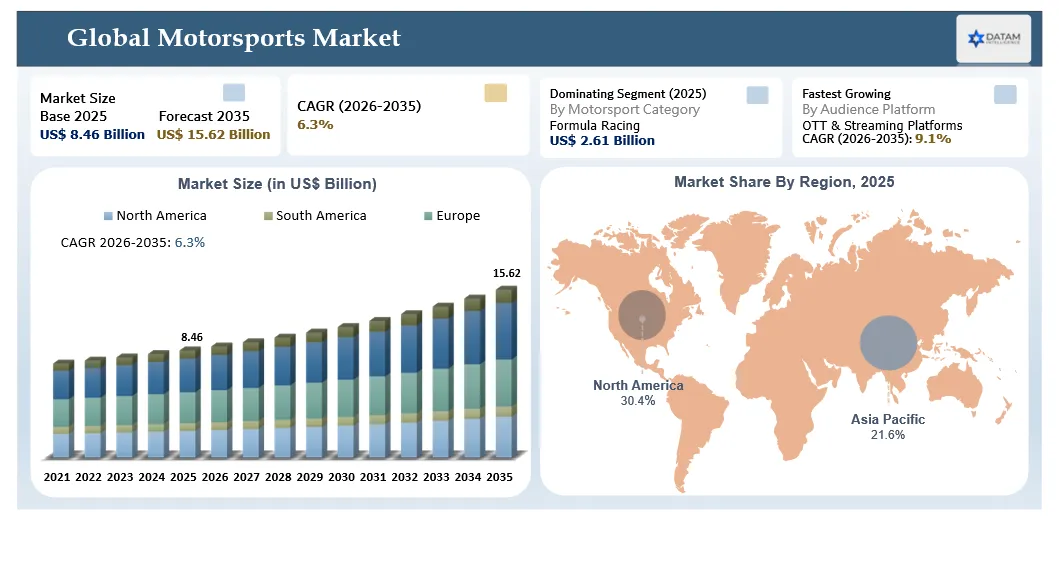
The global Motorsports market reached an estimated US$ 8.46 billion in 2025 and is expected to reach US$ 15.62 billion by 2035, growing at a CAGR of 6.3% during 2026-2035. The market includes championship and team sponsorship, media rights, race-hosting fees, ticketing, premium hospitality, merchandising, licensing, participation and technical partnerships across four-wheel, two-wheel, karting and specialized off-road competition. Formula racing remains the largest race-series family because Formula 1 combines worldwide media distribution, premium sponsor inventory, destination hosting, hospitality and a highly valuable team franchise structure. Sports car endurance, NASCAR, IndyCar, MotoGP, rally, touring cars and grassroots categories provide additional revenue pools with different audience, cost and geographic profiles.
The market is moving from a calendar-led sports property into a continuous content and technology ecosystem. Rights holders now monetize race weekends, documentaries, social video, data products, gaming, fantasy, hospitality and year-round sponsor activation. Automakers use competition to demonstrate electrification, hybrid systems, sustainable fuels, aerodynamics, materials and software. Host cities use major races to support tourism, infrastructure and global branding. These overlapping objectives make motorsport resilient, but they also increase pressure for measurable audience returns, cost control, safety and environmental credibility.
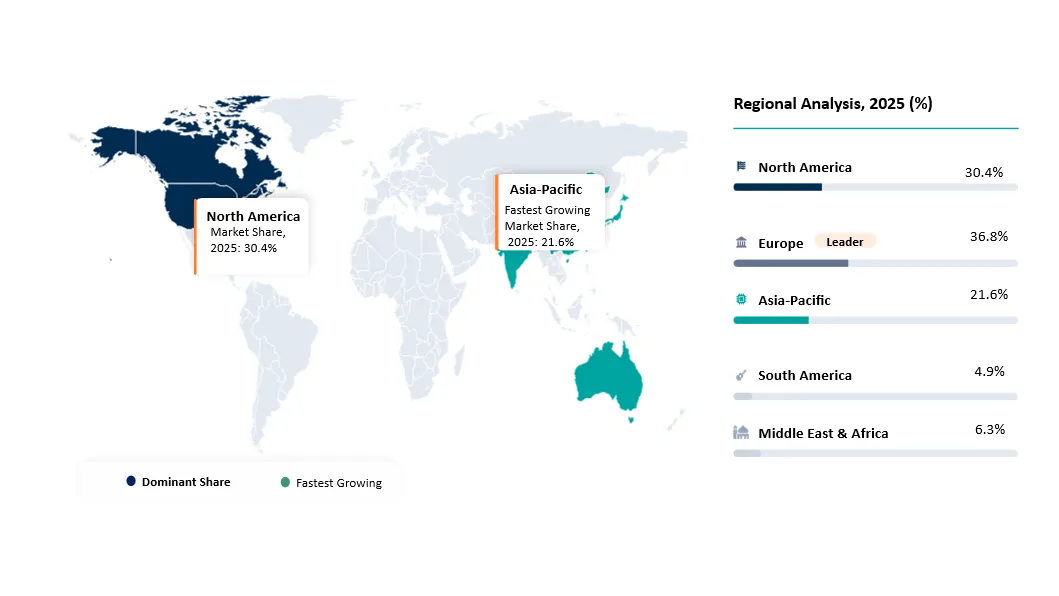
Europe remains the largest regional market through its concentration of major series, teams, constructors, circuits and engineering clusters. North America has a broad commercial base across NASCAR, IndyCar, IMSA, drag racing and Formula 1 events. Asia-Pacific is expected to grow fastest as Japan, Australia, China, Singapore, India, Thailand and other markets expand event hosting, sponsorship and fan engagement. The Middle East is becoming a strategic hosting and investment center, while South America retains strong audiences and driver-development pathways despite uneven event economics.
Market Snapshot
| Metric | Details |
| 2025 Market Size | US$ 8.46 Billion |
| 2035 Projected Market Size | US$ 15.62 Billion |
| CAGR (2026-2035) | 6.3% |
| Largest Motorsport Category | Formula Racing |
| Largest Revenue Channel | Sponsorship and Advertising |
| Largest Region | Europe |
| Fastest-Growing Region | Asia-Pacific |
| Forecast Period | 2026-2035 |
Motorsports Market Key Takeaways
- Formula racing remains the largest race-series family, led by Formula 1, Formula E, IndyCar, Super Formula and structured feeder categories.
- Sponsorship is the largest revenue channel because teams, championships, circuits and events sell global visibility, hospitality, content and business-to-business access.
- Media rights are gaining strategic value as championships combine traditional broadcasters with direct-to-consumer streaming, regional digital packages and social distribution.
- Premium hospitality is one of the fastest-growing monetization areas because corporate buyers seek trackside access, paddock experiences and high-value client engagement.
- Endurance racing is strengthening through manufacturer participation, prototype convergence and renewed interest in Le Mans, WEC and IMSA.
- Women’s racing and grassroots driver pathways are attracting new sponsors, audiences and talent-development investment.
- Electric, hybrid, sustainable-fuel and hydrogen categories are becoming technology platforms that connect motorsport with automotive transition strategies.
- Future leadership will depend on fan data ownership, calendar quality, sponsor return measurement, competitive balance, cost control and the ability to convert casual digital audiences into paying customers.
Motorsports Industry Trends and Strategic Insights
- Championships are building year-round content operations around race highlights, behind-the-scenes access, documentaries, podcasts and short-form video.
- Calendar expansion is increasingly selective because rights holders must balance host fees and new markets against logistics, team workload and audience dilution.
- Automakers are concentrating spending on series that provide clear technology transfer, strong global reach or direct relevance to electric and hybrid product strategies.
- Sports car racing is benefiting from common prototype rules, manufacturer competition and the ability to participate across WEC, IMSA and major endurance events.
- Direct-to-consumer platforms are giving rights holders more control over customer data, subscription packaging and international audience development.
- Sponsors are demanding measurable engagement, lead generation, content rights, hospitality utilization and sustainability alignment rather than relying only on logo exposure.
- Circuit promoters are adding concerts, fan zones, food, gaming, support races and experiential activities to increase attendance duration and per-capita spending.
- Grassroots karting, esports and junior formulas are being integrated into talent pipelines, brand academies and fan-acquisition programs.
Motorsports Market Scope
| Metrics | Details |
| By Vehicle Platform | Four-Wheel Motorsport, Two-Wheel Motorsport, Karting and Specialized Off-Road Vehicles |
| By Revenue Channel | Sponsorship, Media Rights, Host Fees, Ticketing, Hospitality, Merchandising, Licensing, Participation, Technical Supply and Digital Content |
| By Race Series | Formula, Sports Car and Endurance, Touring Car, Stock Car, Rally, Rallycross, Off-Road, Motorcycle, Drag, Karting, Drifting, Hill Climb, Speedway and Historic Racing |
| By Competition Level | Global, Continental, National, Feeder, Club and Amateur |
| By Event Format | Circuit, Street, Oval, Stage Rally, Endurance, Off-Road, Drag, Hill Climb and Time-Attack |
| By Audience Platform | Free-to-Air TV, Pay TV, OTT, Social Media, In-Person Attendance and Gaming |
| Regions | North America, Europe, Asia-Pacific, South America, Middle East and Africa |
Why does this report matter in 2026?
The year 2026 is a major reset point for motorsport. Formula 1 enters a new technical and commercial cycle with revised power-unit and chassis rules, while Cadillac joins as an additional team and broadens U.S. manufacturer participation. Formula E continues to develop high-performance electric competition, endurance racing benefits from a deep manufacturer field, and the wider market is testing sustainable fuels, battery systems, data-led race strategy and new fan formats. These changes influence team valuations, sponsor demand, supplier opportunities and the geographic balance of the sport.
The report matters because the motorsports market cannot be understood through one headline series. Formula 1, NASCAR, MotoGP, WEC, IndyCar, rally, touring cars, karting and off-road racing have different commercial structures, audiences and technology needs. A sponsor seeking global luxury visibility will evaluate a different property from an automotive supplier seeking technical credibility or a regional brand seeking local event activation. The detailed race-series segmentation allows buyers to compare these opportunities at parent and subseries level.
Decisions made in 2026 on rights packaging, calendar expansion, team investment, circuit upgrades, digital platforms and technology partnerships will influence competitive position through 2035. The market remains attractive, but growth is uneven. Premium global properties are becoming more valuable, while smaller series must prove audience reach and sponsor return. This report supports portfolio planning across rights ownership, sponsorship, event hosting, media distribution, engineering supply and market entry.
Motorsports Market White Space & Investment Opportunities
- Women’s motorsport offers white space across junior formulas, touring cars, endurance racing, academies and sponsor-led talent development.
- Asia-Pacific provides event-hosting and audience-growth opportunities, particularly where major automotive markets lack consistent global championship exposure.
- Direct-to-consumer streaming can monetize underserved territories and niche series without requiring full linear broadcast coverage.
- Premium hospitality, paddock clubs and destination packages can raise revenue per attendee and attract non-endemic corporate buyers.
- Grassroots karting, club racing and simulator-to-track pathways can create scalable participant funnels and sponsor communities.
- Electric, hybrid, sustainable-fuel and hydrogen series can attract technology partners that are less active in traditional combustion-focused competition.
- Fan-data platforms can integrate ticketing, content, merchandise, loyalty and sponsor activation across multiple events.
- Sports car and endurance racing offers cross-series manufacturer efficiency through shared platforms and major-event visibility.
Motorsports Future Market Transformation
The market will evolve toward fewer disconnected race weekends and more integrated fan ecosystems. Rights holders will use unified identities across ticketing, streaming, merchandise, fantasy, gaming and social media. Data will allow properties to identify high-value fans, personalize offers and demonstrate sponsor outcomes. This will support dynamic pricing, targeted hospitality packages and region-specific content. Teams will also become media businesses, producing direct content and monetizing communities beyond race results.
Technology competition will become more diversified. Formula 1 will remain an important hybrid and aerodynamics platform, Formula E will advance electric powertrain and energy-management visibility, endurance racing will test efficiency and durability, while rally and off-road competition will support alternative fuels and harsh-environment validation. Simulation, digital twins and AI-assisted strategy will reduce development time and improve race execution. Suppliers that can serve several series will gain leverage through reusable electronics, software, materials and safety systems.
By 2035, leading motorsport organizations are likely to operate portfolios across physical events, digital content, gaming and hospitality. Calendar expansion will be constrained by logistics and audience capacity, increasing the value of event quality and destination integration. The strongest properties will combine compelling competition, recognizable teams and drivers, stable regulation, global distribution and measurable commercial returns. Smaller series will need sharper positioning around regional identity, technology or participation.
Motorsports Market Buyer Decision-Making Criteria
Sponsors evaluate audience scale, geographic fit, brand safety, content rights, hospitality, activation flexibility and measurable return. Broadcasters evaluate exclusivity, schedule consistency, production quality, local audience potential and digital rights. Host cities assess tourism impact, infrastructure requirements, global visibility, public funding exposure and contract duration. Teams and automakers assess regulation, competitive balance, technology relevance, cost, supplier availability and the probability of sustained promoter support.
Circuit operators prioritize sanctioning fees, attendance potential, support-race packages, food and beverage sales, hospitality, transport access and year-round venue utilization. Technology suppliers evaluate homologation requirements, sales volumes, engineering visibility and cross-series scalability. Investors consider rights ownership, recurring revenue, team scarcity value, calendar control and the ability to grow media or hospitality income. Across all buyer groups, governance stability and transparent economics are becoming more important.
Motorsports Market Economic & Investment Analysis
Motorsport economics differ by series. Global championships can support high media-rights values, large sponsor portfolios and premium hosting contracts. National series rely more heavily on domestic broadcasting, event attendance and local sponsorship. Grassroots categories depend on participant spending, entry fees, equipment, coaching and circuit access. A realistic market model therefore separates rights-holder revenue, team revenue, event revenue and participant expenditure before reconciling overlap.
Investment is increasingly directed toward scarce assets. Team franchises, circuit contracts, championship rights and premium event dates have strategic value because supply is limited. Investors also favor properties with multi-year media agreements, international calendars and strong sponsor retention. However, high fixed costs and competitive uncertainty create risk. Team performance can affect commercial value, while poor event execution can weaken renewal prospects. Debt capacity is therefore stronger for stable rights businesses than for performance-dependent teams.
Host-city economics require careful evaluation. Major races can generate tourism, hospitality and global exposure, but public costs may include circuit construction, road closures, security and annual hosting fees. The most sustainable models connect the race with wider destination marketing, conferences, concerts and year-round venue use. Promoters must also manage ticket affordability and local access to preserve community support.
Technology investment is moving toward simulation, data analytics, energy management, advanced materials, sustainable fuels and fan platforms. Suppliers can generate returns outside motorsport when racing validates products for automotive, aerospace, defense or industrial use. This spillover increases the strategic value of technical partnerships. Investors should distinguish between visibility-led sponsorship and IP-led collaboration because the latter can create longer-duration commercial value.
Motorsports Investment Trends in the Market
- Capital is moving toward premium team and championship assets with scarce entry rights, recurring media income and global sponsor demand.
- Automakers are investing in endurance, Formula 1, Formula E, rally and off-road programs that align with hybrid, electric and sustainable-fuel strategies.
- Promoters are upgrading hospitality, fan zones, paddock experiences and destination packages to increase revenue per visitor.
- Media investment is shifting toward direct-to-consumer streaming, multilingual content, data products and short-form social distribution.
- Private capital is targeting circuits, event promoters, production companies and sports-technology providers that can serve multiple championships.
- Sponsors are allocating more budget to women’s racing, youth pathways and purpose-led programs that can reach new audiences.
- Engineering investment is increasing in simulation, AI race strategy, battery thermal management, lightweight materials and sustainable fuels.
- Emerging-market governments are using major races as destination-marketing and infrastructure catalysts, creating new hosting opportunities.
Strategic Indicators for the Motorsports Market
High Regulation Impact
Technical, sporting and safety regulations shape costs, competitive balance and technology direction. Rule changes can create supplier opportunities but also require major capital. Stable governance is therefore central to team and sponsor confidence.
High Investment Activity
Team valuations, new entries, circuit upgrades, media platforms and hospitality assets are attracting capital. Investment remains concentrated in properties with global reach, strong rights control or strategic automotive relevance.
Supply Chain Disruption
Teams depend on specialized composites, electronics, tires, powertrain components and global freight. Calendar density and customs complexity increase exposure to disruption, making supplier redundancy and logistics planning essential.
Pricing Volatility
Sponsorship, hospitality and hosting fees vary widely by series, geography and inventory scarcity. Premium events can raise prices rapidly, while smaller properties face discount pressure when audience measurement is weak.
Procurement Pressure
Teams and promoters seek reliable suppliers that can meet homologation, lead-time, safety and trackside-support requirements. Buyers increasingly evaluate lifecycle support and cross-series scalability alongside unit cost.
New Technology Adoption
Simulation, AI, digital twins, advanced telemetry, sustainable fuels, batteries and fan-data platforms are changing sporting and commercial operations. Adoption is fastest where technology improves performance or creates measurable revenue.
Regional Expansion Opportunity
Asia-Pacific and the Middle East provide growth through hosting, sponsorship and audiences. Expansion requires local promoter capability, government support, broadcast distribution and culturally relevant activation.
Government Policy Support
Public authorities support selected races through tourism budgets, infrastructure and national branding. Policy support can accelerate market entry but creates political and renewal risk if economic benefits are not demonstrated.
Pricing Intelligence
Commercial buyers need benchmarks across title sponsorship, team partnerships, trackside inventory, hospitality, media rights and host fees. Comparable pricing is difficult because packages include different rights and activation obligations.
AI Impact Analysis of the Motorsports Market
AI is changing technical competition through simulation, setup optimization, tire and energy prediction, anomaly detection and race strategy. Teams can process telemetry, weather, competitor behavior and historical data more rapidly. AI also supports driver coaching and reliability forecasting. Competitive advantage depends on data quality, model validation and the ability to integrate recommendations into fast operational decisions.
Commercially, AI can personalize content, identify fan segments, optimize ticket and hospitality pricing, measure sponsor exposure and automate multilingual media. Rights holders can use recommendation engines to convert casual viewers into subscribers or attendees. Governance will be important because fan data, automated decisions and synthetic content raise privacy and authenticity concerns.
Disruption Analysis of Motorsports Market
Streaming and social media are disrupting the traditional broadcast model by giving championships and teams direct audience relationships. This improves data ownership but also increases production and customer-acquisition responsibility. Documentary content and creator-led coverage can attract audiences who do not initially follow race results, broadening the commercial funnel.
Electrification and sustainable fuels are disrupting technical positioning. Series must decide whether to specialize in one technology or allow multiple pathways. Esports is also changing talent discovery and participation by lowering the cost of entry. It does not replace physical racing, but it expands reach and creates sponsor inventory between events.
Motorsports Market BCG Matrix: Company Evaluation
| Category | Organizations | Strategic Rationale |
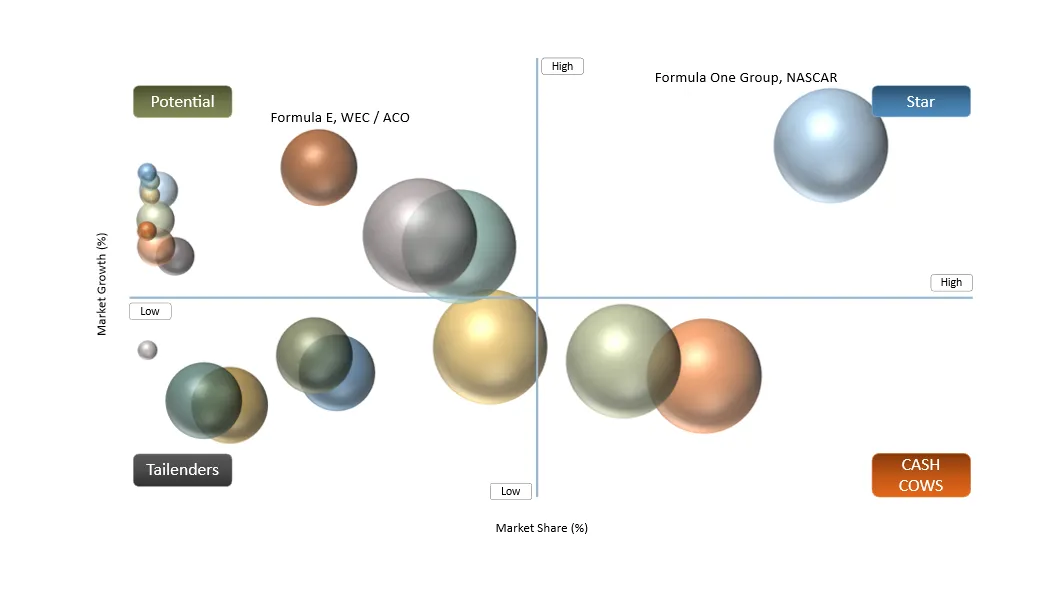
| Stars | Formula One Group, NASCAR, MotoGP / Dorna Sports | Large audiences, strong rights control, premium sponsors and scalable global or national franchises. |
| Potential | Formula E, WEC / ACO, IMSA, SRO Motorsports Group | High growth linked to electrification, endurance resurgence, manufacturer participation and multi-series portfolios. |
| Cash Cows | Established circuit groups, mature national series, tire and technical suppliers | Stable recurring events, long-term relationships and established commercial inventory. |
| Tailenders | Fragmented regional series with weak media reach | Limited sponsor measurement, small audiences and high event costs restrict growth unless the property has a clear niche. |
Formula One Group is positioned as a Star because Formula 1 combines global media rights, premium host fees, sponsorship, hospitality and scarce team participation. NASCAR and MotoGP also occupy strong positions through established audiences, recognizable event formats and deep commercial ecosystems. Formula E, WEC, IMSA and SRO properties are positioned as Potential because they can grow through electrification, manufacturer competition and international expansion.
Motorsports Market Dynamics
Driver Impact Analysis
| Driver | Growth Impact | Demand Concentration | Impacted Use Case | Strategic Impact |
| Global calendar and event expansion | High | Formula, motorcycle and endurance series | Host fees, ticketing and hospitality | Adds new markets and sponsor inventory. |
| Streaming and social engagement | High | Global and niche championships | Media rights and fan monetization | Expands reach and creates direct fan data. |
| Automaker technology investment | Medium-High | Formula, endurance, rally and electric series | Technical supply and manufacturer programs | Supports R&D spending and premium partnerships. |
| Premium hospitality demand | Medium-High | Major international events | Corporate experiences and destination packages | Raises revenue per attendee and sponsor value. |
Driver: Global Content Expansion and Premium Event Economics
Motorsport properties are increasing revenue by expanding distribution and improving the value of each race weekend. Streaming opens markets without strong linear coverage, while social content keeps fans engaged between events. Premium hospitality and destination packages add high-margin revenue. These channels reinforce each other because broader awareness increases ticket demand and stronger events improve media content.
Restraint Impact Analysis
| Restraint | Drag on Growth | Primary Impact Area | Impacted Use Case | Strategic Impact |
| High participation and event costs | High | Teams, circuits and promoters | Series entry and calendar expansion | Limits grids and increases dependence on sponsors. |
| Logistics and sustainability pressure | Medium-High | International championships | Global calendar operations | Raises costs and scrutiny of event footprints. |
| Uneven competitive balance | Medium-High | Team-based championships | Audience retention and sponsor value | Predictable outcomes can reduce engagement. |
| Fragmented audience measurement | Medium | Smaller series | Sponsorship sales | Makes cross-property comparison difficult. |
Restraint: High Cost and Competitive-Balance Pressure
Motorsport requires specialized vehicles, personnel, travel, facilities and safety systems. High costs can reduce entries and make teams dependent on a small sponsor base. If competition becomes predictable, audience growth and sponsor value may weaken. Cost caps, technical convergence and revenue sharing can improve stability, but they may also reduce technical freedom or create governance disputes.
Motorsports Market Segmentation Analysis
The global Motorsports market is segmented by vehicle platform, revenue channel, race series, competition level, event format, audience platform, and region. Race Series is the most detailed dimension because commercial economics differ materially across formula, endurance, touring, stock car, rally, motorcycle, drag, karting and other categories.
By Vehicle Platform
Four-Wheel Motorsport Will Retain the Largest Commercial Share
Four-wheel competition leads because Formula 1, NASCAR, IndyCar, WEC, IMSA, rally and touring cars combine major media rights, host fees, sponsorship and hospitality. Two-wheel racing remains strategically important through MotoGP, WorldSBK, motocross and speedway. Karting is smaller in revenue but essential to participation and talent development. Specialized off-road vehicles provide strong regional communities and manufacturer relevance.
By Revenue Channel
Sponsorship and Advertising Will Remain the Largest Revenue Pool
Sponsorship leads because it monetizes teams, drivers, cars, circuits, broadcasts, digital content and hospitality. Media rights are gaining share as global properties renew premium agreements and develop streaming. Host fees are concentrated in major international series. Ticketing and hospitality depend on event quality, while merchandising and licensing benefit from strong team and driver identities.
By Motorsport Category
Formula Racing Will Continue to Lead, While Endurance and Electric Categories Accelerate
Formula Racing is the largest parent segment because Formula 1 provides a global commercial anchor and is supported by Formula 2, Formula 3, Formula 4, Formula Regional, Formula E, IndyCar, Super Formula and women’s single-seater programs. The feeder structure creates recurring participation, driver development and sponsor activation. Formula E adds electric technology relevance, while IndyCar and Super Formula provide strong regional platforms.
Sports Car and Endurance Racing is expected to record strong growth through WEC, the 24 Hours of Le Mans, IMSA, ELMS, Asian Le Mans and GT World Challenge. Prototype convergence and manufacturer participation improve scale. Touring cars, stock cars and rally remain important in national and regional markets, while MotoGP and WorldSBK anchor motorcycle road racing. Karting, drifting, drag racing, hill climb and club racing provide participation-led demand and sponsor communities.
Motorsport Category Segmentation Framework
| Parent Race-Series Segment | Detailed Subsegments |
| Formula Racing | Formula 1; FIA Formula 2; FIA Formula 3; Formula 4; Formula Regional; Formula E; IndyCar; Super Formula; F1 Academy; other feeder formulas |
| Sports Car & Endurance | FIA WEC; 24 Hours of Le Mans; IMSA; ELMS; Asian Le Mans; GT World Challenge; Intercontinental GT Challenge; one-make GT cups |
| Touring Car | TCR World Tour; regional TCR; BTCC; DTM; Supercars; Super GT; national touring car series |
| Stock Car | NASCAR Cup; Xfinity; Craftsman Truck; ARCA; NASCAR Euro; Stock Car Pro; regional stock car |
| Rally | WRC; ERC; national rally; historic rally; W2RC; Dakar Rally; cross-country rally |
| Rallycross | World RX; European Rallycross; RallyX; national rallycross |
| Off-Road | Baja and desert racing; short-course; trophy truck; Ultra4; UTV; alternative-energy off-road |
| Motorcycle Road Racing | MotoGP; Moto2; Moto3; MotoE; WorldSBK; WorldSSP; EWC; national superbike; road racing |
| Motorcycle Off-Road | MXGP; MX2; Supercross; EnduroGP; Hard Enduro; TrialGP; Speedway GP; Flat Track |
| Drag Racing | NHRA; FIA European Drag; motorcycle drag; regional and street-legal drag |
| Kart Racing | FIA Karting; Rotax MAX; IAME; national and club karting; electric karting |
| Drifting & Time-Attack | Formula Drift; Drift Masters; D1GP; national drifting; time-attack championships |
| Hill Climb & Speedway | FIA European Hill Climb; Pikes Peak; sprint car; oval speedway; motorcycle speedway |
| Historic, Club & Esports | Historic racing; club racing; one-make amateur cups; sim-racing extensions |
By Competition Level
Global Championships Will Lead Value, While Grassroots Racing Supports Participation Volume
Global championships command the largest media and sponsor values because they provide international reach and premium events. Continental and national series are important for local audiences and manufacturer relevance. Feeder categories support talent development, while club and amateur racing create the broad participation base that sustains circuits, equipment suppliers and driver pipelines.
By Event Format
Circuit Racing Will Remain Dominant
Circuit racing leads because most formula, sports car, touring car and motorcycle championships use permanent or temporary circuits. Street races provide destination visibility and urban access but require complex logistics. Oval racing is central to NASCAR and IndyCar. Stage rally, desert racing, drag events and hill climbs have distinct operational and safety requirements and attract specialized audiences.
By Audience Platform
OTT and Direct-to-Consumer Streaming Will Record the Fastest Growth
Traditional television remains important for mass reach, but streaming is growing fastest because it can serve global and niche audiences, provide on-demand content and capture fan data. Social media supports discovery and highlights. In-person attendance drives ticketing and hospitality, while gaming and simulation create year-round engagement and lower-cost participation.
Motorsports Market Geographical Penetration
U.S. Motorsports Market Landscape
The U.S. is the largest national market by breadth. NASCAR, IndyCar, IMSA, NHRA, Formula 1 events, Supercross, motocross, off-road racing and extensive grassroots competition create multiple revenue pools. The addition of Cadillac to Formula 1 strengthens manufacturer and sponsor interest. Growth is being supported by streaming, sports betting partnerships, premium hospitality and new urban audiences. The market also benefits from large circuit groups, corporate sponsorship budgets and a deep sports-media ecosystem.
UK Motorsports Market Outlook
The UK is a global engineering and team hub, particularly for Formula 1 and high-performance suppliers. Silverstone anchors major events, while BTCC, club racing, historic racing and motorcycle competition provide domestic depth. The country’s motorsport valley supports composites, simulation, electronics and specialist manufacturing. Growth opportunities include sustainable fuels, digital engineering, women’s racing and cross-sector technology transfer.
Germany Motorsports Market Trends
Germany combines major automotive manufacturers, engineering suppliers, DTM, endurance racing and a strong enthusiast market. Manufacturer strategy has shifted toward series with clearer technology and global marketing value. Nürburgring endurance events remain commercially significant. Electric and sustainable-fuel programs, premium brand activation and automotive engineering partnerships are key growth areas.
Italy Motorsports Market Outlook
Italy benefits from Ferrari, Ducati, Lamborghini, major circuits and a strong culture around Formula 1, MotoGP, GT and karting. The market connects premium automotive brands with tourism, merchandising and fan communities. Growth is supported by manufacturer racing programs, hospitality and historic events.
France Motorsports Market Outlook
France has a central role through the FIA, ACO, Le Mans, Alpine, major circuits and strong rally and karting traditions. Endurance racing is a major strategic asset. The market also benefits from motorsport governance, event production and technology suppliers.
Japan Motorsports Market Trends
Japan has deep manufacturer participation across Formula 1 supply, WEC, Super GT, Super Formula, MotoGP and national series. Toyota, Honda, Nissan, Yamaha and other brands use racing for technology and brand development. Growth opportunities include international streaming, inbound tourism and stronger global packaging of domestic series.
China Motorsports Market Outlook
China provides long-term audience and sponsor potential through its automotive scale, electric-vehicle leadership and major-city event capacity. Growth depends on consistent calendars, local promoter capability, accessible content and integration with domestic brands. Electric racing, gaming and simulator communities are especially relevant.
India Motorsports Market Outlook
India is an emerging market with a large digital audience, growing automotive investment and increasing interest in MotoGP, Formula E, rally and karting. Event continuity, circuit infrastructure and sponsor economics remain constraints. Opportunities exist in grassroots academies, esports, two-wheel competition and supplier development.
Australia Motorsports Market Trends
Australia combines Formula 1, Supercars, MotoGP, WorldSBK, motocross and strong club participation. Major events are important tourism assets. State competition for event rights is increasing, which supports venue investment but can raise hosting costs. Supercars remains a strong domestic commercial platform.
Middle East Motorsports Market Outlook
Bahrain, Saudi Arabia, UAE and Qatar have become major hosts across Formula 1, Formula E, endurance, rally raid and motorcycle racing. Investment is linked to tourism, national branding and sports diversification. The region offers premium hospitality and infrastructure, while long-term success depends on local participation and fan development.
Brazil and South America Market Outlook
Brazil has a strong Formula 1 audience, Stock Car Pro, karting and driver heritage. Argentina and other markets add rally, touring and motorcycle activity. Currency volatility and promoter funding can limit major events. Digital distribution, regional sponsors and talent development provide growth opportunities.
Regional Strategic Trends Summary
- Europe is consolidating engineering, rights ownership and premium event tourism around established motorsport clusters.
- North America is benefiting from Formula 1 growth while retaining strong domestic properties in NASCAR, IndyCar, IMSA and drag racing.
- Asia-Pacific is expanding through manufacturer participation, digital audiences, urban events and government-backed hosting.
- The Middle East is building a multi-series event portfolio supported by tourism, infrastructure and sports investment.
- South America offers strong fan intensity and driver development, but requires more stable event financing and broadcast monetization.
Motorsports Market Competitive Landscape
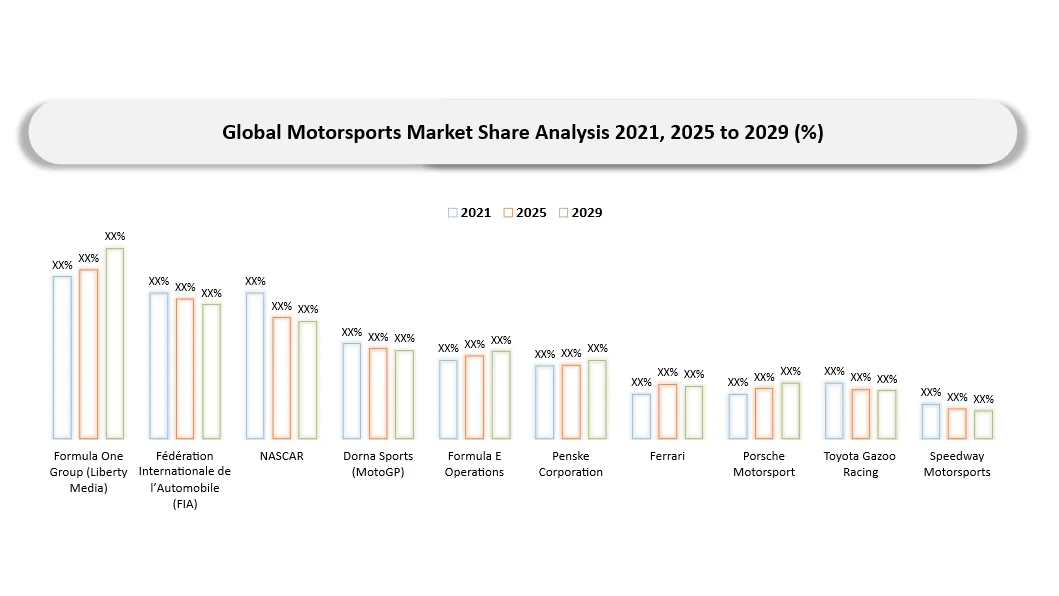
- Formula One Group holds the strongest global commercial position through premium media rights, hosting, sponsorship and hospitality.
- NASCAR controls a broad North American ecosystem spanning national series, teams, tracks, media and licensing.
- Dorna Sports has built MotoGP and WorldSBK into global motorcycle properties with integrated media and event operations.
- ACO, WEC, IMSA and SRO are benefiting from manufacturer interest and the growth of endurance and GT racing.
- Teams increasingly compete for sponsors, engineering talent, content audiences and hospitality buyers in addition to on-track performance.
- Circuit groups and destination promoters compete for scarce calendar dates and must demonstrate event quality, logistics and economic impact.
- Technical suppliers differentiate through homologation, reliability, trackside support, data integration and the ability to serve several series.
Competitive intensity is highest around premium global properties because media reach, sponsor inventory and calendar slots are scarce. Formula 1 teams have strong scarcity value, while major NASCAR, MotoGP and endurance teams benefit from established fan bases and manufacturer relationships. Smaller series compete by offering lower activation cost, regional relevance, closer fan access or technology specialization. Rights holders that own customer data and can package multiple channels will have stronger pricing power.
Key Companies of the Motorsports Market
- Formula One Group / Liberty Media
- Fédération Internationale de l’Automobile
- Formula E Operations
- NASCAR
- INDYCAR
- Dorna Sports / MotoGP
- Automobile Club de l’Ouest
- International Motor Sports Association
- SRO Motorsports Group
- Red Bull Racing
- Ferrari
- Mercedes-AMG Motorsport
- McLaren Racing
- Porsche Motorsport
- Toyota Gazoo Racing
- Hyundai Motorsport
- Penske Corporation
- Speedway Motorsports
- Motorsport Network
- Pirelli
Motorsports Market Major Pain Points
- High team, vehicle, logistics and venue costs.
- Dependence on sponsorship and economic cycles.
- Uneven competitive balance within some championships.
- Fragmented audience measurement across television, streaming and social media.
- Complex international freight, customs and calendar logistics.
- Environmental scrutiny of travel, events and powertrain technologies.
- Limited affordability and access at grassroots level.
- Governance disputes between rights holders, teams, promoters and regulators.
- Scarcity of premium calendar dates and circuit capacity.
- Difficulty converting digital audiences into paid subscriptions or attendance.
Motorsports Market Recent Developments
- 2026: Formula 1 began a new technical cycle centered on revised power units, vehicle rules and a broader manufacturer field.
- 2026: Cadillac entered Formula 1 as an additional team, increasing U.S. manufacturer participation and commercial inventory.
- 2026: Endurance racing continued to benefit from deep Hypercar and GTP manufacturer participation across WEC and IMSA.
- 2026: Rights holders expanded direct digital content, multilingual social distribution and fan-data capabilities.
- 2026: Promoters increased premium hospitality, fan festivals and destination programming around major race weekends.
- 2025-2026: Women’s racing programs and driver academies attracted additional sponsor and media attention.
- 2025-2026: Electric, sustainable-fuel, and alternative-energy competition remained central to manufacturer and supplier strategy.
Analyst View / Opinion on Motorsports Market
The motorsports market is entering a period of disciplined growth rather than unlimited calendar expansion. Premium properties can continue to raise value through media, hospitality, sponsorship and data, but they must protect competition quality and manage logistical pressure. Formula 1 will remain the largest commercial engine, while endurance racing, Formula E, MotoGP and major national series provide differentiated growth.
- The most attractive investments combine scarce rights, recurring revenue and direct fan relationships.
- Formula racing will retain leadership, but endurance and electric categories offer faster incremental growth from smaller bases.
- Sponsors will shift spending toward properties that prove digital engagement, hospitality utilization and business outcomes.
- Asia-Pacific and the Middle East will account for a rising share of hosting and fan growth.
- Grassroots affordability is strategically important because long-term participation and talent pipelines depend on accessible entry points.
- Rights holders that integrate streaming, ticketing, merchandise and fan data will outperform properties that rely only on broadcast exposure.
Motorsports Market Target Audience
| Industry | Who Should Buy This Report? | Reason to Buy This Report |
| Rights Holders and Promoters | Championship executives, event owners and commercial teams | Assess series growth, channel economics and expansion priorities. |
| Teams and Automakers | Team principals, OEM motorsport leaders and business development teams | Evaluate series attractiveness, sponsorship and technology relevance. |
| Circuits and Host Cities | Circuit operators, tourism boards and government agencies | Benchmark hosting opportunity, infrastructure and event economics. |
| Broadcasters and Media | Sports networks, OTT platforms and production companies | Assess rights demand, audience platforms and content strategy. |
| Sponsors and Agencies | Brand leaders, sponsorship agencies and hospitality buyers | Compare properties, audiences and activation models. |
| Technology Suppliers | Engineering, data, tire, fuel and safety suppliers | Identify series-level demand and partner opportunities. |
| Investors and Consulting | Private equity, venture capital, banks and advisors | Evaluate rights, teams, circuits and sports-technology assets. |
Why Choose DATAM?
- Data-driven market sizing across race series, channels, regions and commercial models.
- Post-purchase analyst support for sponsorship, market entry, partner identification and hosting strategy.
- Annual updates covering calendars, rights agreements, team entries, sponsor activity and technology changes.
- Country-level analysis linking events, audiences, engineering clusters and investment.
- Actionable segmentation that separates parent race categories from specific championships and feeder series.
What DATAM Uniquely Provides
- Ten-year forecasts across vehicle platform, channel, race series, competition level, event format, audience platform and region.
- Detailed Formula Racing segmentation from Formula 1 through feeder and regional series.
- Comparable analysis across four-wheel, two-wheel, karting and off-road properties.
- Buyer-focused assessment of sponsorship, media rights, host fees, hospitality and fan data.
- Country-level views linking circuits, promoters, manufacturers, audiences and tourism strategy.
- Strategic recommendations for rights packaging, partnerships, technology supply and market entry.



























































