

Global Modular Substation Market Overview
The global market for modular substation is growing owing to an increasing demand for reliable, flexible and fast-deployable electrical installations for utilities, renewable energy applications, data centers, industrial applications and transportation systems. Rising electricity consumption, transmission and distribution network upgrading, development of renewable energy and aging substation infrastructures are some factors that drive the market for compact substations, E-Houses, skid-mounted substations and mobile substations.
In addition to this, an increasing trend towards reduction in project execution time, site construction and integration of equipment is also promoting the use of modular substation assemblies. More and more manufacturers are offering power transformers, switchgears, protection and control systems, monitoring devices and auxiliary devices in customized modular packages. Also, rising investment in solar and wind power, battery energy storage systems, data center infrastructure and electrification of industries is opening up new avenues. These advancements are contributing to the increased significance of modular substations in contemporary electrical systems through enhanced installation speed, decreased onsite assembling and testing, efficient use of space, flexibility of operations and effective power distribution.
Global Modular Substation Market Strategic Insights
- Renewable Energy Integration and Grid Expansion: The growth of renewable energy across the globe is driving the need for modular substations for connecting solar and wind power plants to the grid. According to IRENA, there was an unprecedented installation of 692 GW of renewable energy power capacity in 2025, with solar power accounting for 510 GW and wind 159 GW. This growth creates an opportunity for prefabricated substations, compact switchgear and modular grid connection system applications.
- Data Center Electrification and High-Capacity Power Infrastructure: AI development and hyperscale data centers have led to an increased demand for reliable and fast-deployed electrical infrastructure. As per the International Energy Agency, the global electricity consumption by data centers has risen by 17% in 2025 to reach 485 TWh. Energy consumption will increase almost two-fold to 950 TWh in 2030, thus providing avenues for the use of modular E-Houses, skid-mounted substations and medium-voltage power distribution systems.
- Grid Modernization and Transmission Infrastructure Investment: Increased investments in power transmission and distribution networks are presenting opportunities for the producers of modular substations serving utilities and grid operators. According to the International Energy Agency (IEA), there needs to be a 50% rise in annual investments in the power grid globally from USD 400 billion to meet the rising power demands up to 2030. Besides, more than 2,500 GW of renewable power generation plants, storage and large load connections are still waiting in the grid connection queue.
- Factory-Integrated Designs and Digital Substation Technologies: Manufacturing companies are turning to factory-made, tested and digitalized modular substations to facilitate installation and commissioning. For example, ABB produces modular E-Houses and skid modules that include both medium and low voltage solutions, whereas Hitachi Energy manufactures mobile and containerized substations that use IEC 61850 technology in protection and control systems. These developments illustrate the trend towards standardization in engineering, automation, remote surveillance and rapid deployment.
Why Choose Datam?
- Accelerated Customer Identification – Target 2.0× Qualified Sales Leads: Help modular substation manufacturers double their qualified customer pipeline through utility identification, EPC contractor mapping and end-user profiling. DataM enables businesses to identify high-value prospects across renewable energy, data centers, industrial facilities and infrastructure projects, improving customer targeting and accelerating sales opportunities.
- Faster Market Entry & Business Expansion – Target 25% Reduction in Market Entry Time: Help manufacturers of modular substations cut down the time taken for entering the market through regional opportunity assessments, regulatory intelligence, project pipeline analysis and identifying distributors. DataM helps in geographical expansion, strategic partnership and market entry of companies in utility, renewable energy and industrial infrastructure markets.
- Stronger Competitive Positioning – Target 25% Improvement in Sales Win Rate: Allow modular substation manufacturers to boost their sales performance by benchmarking against competitors, analyzing product portfolio, pricing intelligence and technology comparison. DataM can help understand the competitive gaps between various categories of compact substations, E-Houses, skid mounted substations and mobile substations in terms of voltage level, insulation and equipment integration, strengthening product differentiation and customer acquisition.
- Higher Customer Revenue & Account Expansion – Target 1.25× Revenue per Key Account: Support revenue growth from strategic utility, EPC, renewable energy and industrial accounts through customer requirement analysis, cross-selling opportunities and project-based demand assessments. DataM helps manufacturers identify additional equipment requirements, expand existing customer relationships and increase long-term account value.
- Improved Pricing & Profitability – Target 2 Percentage-Point Gross Margin Improvement: Assist in improving profitability of modular substation producers by providing information on competitor pricing, benchmarking of cost components, costs appraisal at the project level, procurement analysis and positioning of products. DataM helps in making decisions related to pricing, negotiation with suppliers and competitive bidding at various voltage levels and substation configuration types.
- Strategic Partnerships & Channel Expansion – Target 1.5× Customer Acquisition: Assist in increasing the number of customers through EPC contractor mapping, electrical equipment distributor identification and partner analysis. DataM helps establish better relationships with transformers and switchgear suppliers, project developers, engineering companies and regional distributors to expand commercial reach.
- Improved Demand Forecasting & Revenue Protection – Target 25% Reduction in Forecast Errors: Assist in improving demand forecasting by means of analyzing investments by utilities, renewables projects, data center expansions and infrastructure procurements. DataM helps in optimizing production plans, inventory, procurement of components and delivering projects while minimizing demand variability and disruptions in the supply chain.
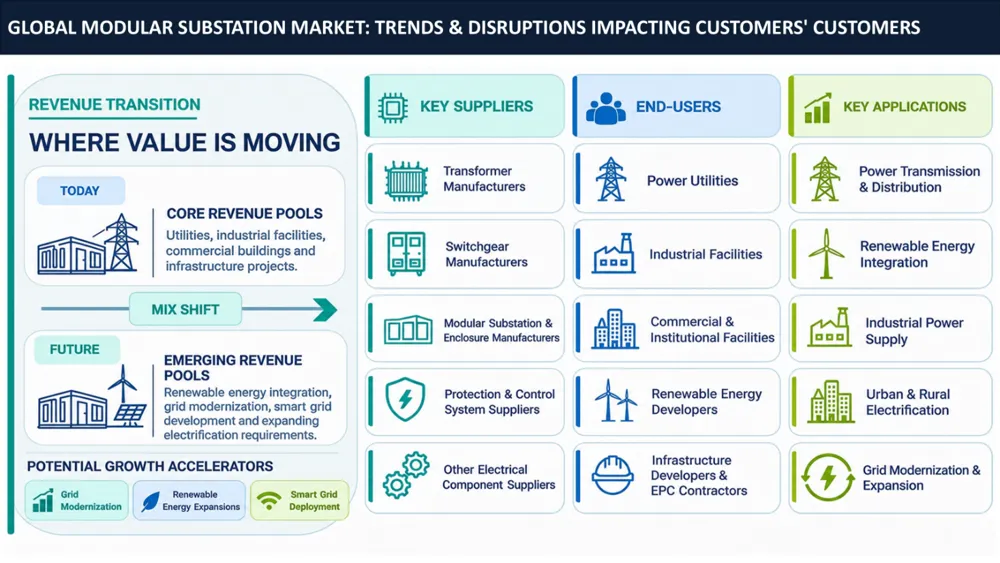
Global Modular Substation Market: Trends & Disruption Impacting Client Customers
Global Modular Substation Market: Commercial Use Cases Across Industries
| COMPANY | USE CASE DESCRIPTION | BENEFITS |
 | Prefabricated substations for utility distribution networks, renewable energy connections and industrial power infrastructure. | Faster installation, reduced on-site construction, optimized space utilization and reliable power distribution. |
 | Mobile and prefabricated substations for grid expansion, utility upgrades, temporary power supply and emergency grid restoration. | Rapid deployment, improved grid flexibility, shorter installation timelines and enhanced power supply continuity. |
 | Compact substations integrating transformers and switchgear for commercial facilities, industrial plants and distribution networks. | Space-efficient installations, simplified equipment integration, improved safety and reliable power management. |
 | Containerized and skid-mounted substations for renewable energy projects, utility networks and industrial applications. | Faster project execution, flexible deployment, reliable grid integration and reduced on-site assembly. |
 | Prefabricated substations and E-Houses for renewable energy, urban distribution networks, data centers and industrial facilities. | Factory-integrated systems, shorter construction schedules, reduced site work and scalable power infrastructure. |
Global Modular Substation Market Ecosystem
The global modular substation market ecosystem comprises modular substation manufacturers, electrical equipment suppliers, power transformer and switchgear manufacturers, engineering, procurement and construction (EPC) contractors, substation automation providers and electric utilities. Together, these stakeholders support substation design, equipment manufacturing, system integration, prefabrication, installation, commissioning and maintenance across power transmission, distribution, renewable energy, industrial, commercial and infrastructure applications.
MODULAR SUBSTATION MANUFACTURERS AND SYSTEM INTEGRATORS | ELECTRICAL EQUIPMENT AND COMPONENT SUPPLIERS | EPC CONTRACTORS AND INFRASTRUCTURE DEVELOPERS |
| ABB Ltd. | Eaton Corporation plc | Larsen & Toubro Limited |
| Siemens Energy AG | WEG S.A. | Wasco Berhad |
| Schneider Electric SE | CG Power and Industrial Solutions Limited | Ingeteam S.A. |
| Hitachi Energy Ltd. | Hyosung Heavy Industries Corporation | Ampcontrol Limited |
| TGOOD Global Limited | LS ELECTRIC Co., Ltd. | Matelec Group |
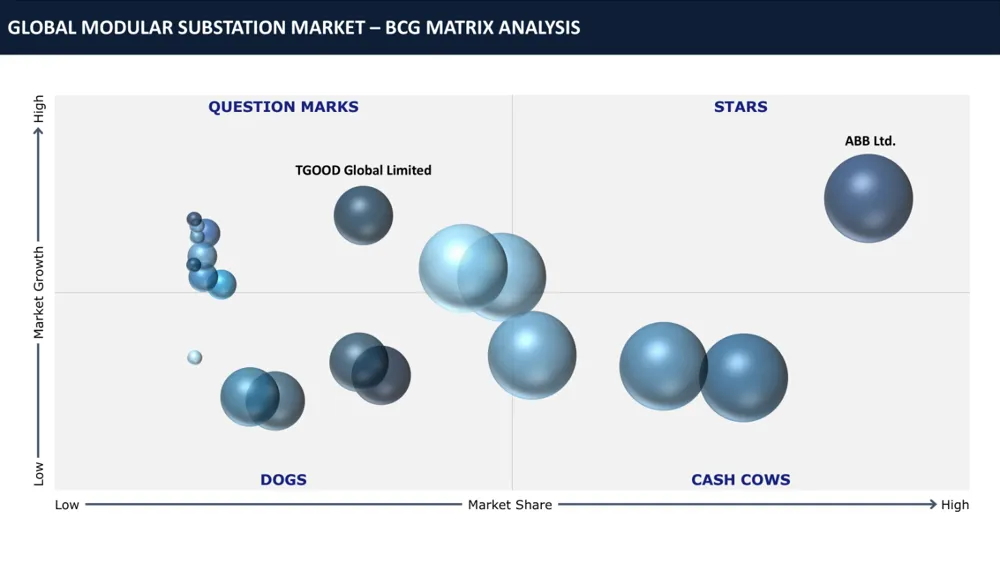
Modular Substation Market: BCG Matrix Analysis
- Stars: E-House substations, skid-mounted substations and modular solutions for data centers and renewable energy projects exhibit strong growth potential.
- Cash Cows: Established compact substations and standardized prefabricated distribution systems generate relatively stable demand across utility and industrial applications.
- Question Marks: High-voltage modular substations, digitally integrated systems and specialized mobile substations represent emerging opportunities with evolving adoption.
- Dogs: Outdated modular configurations with limited integration capabilities, poor space optimization and inadequate automation face declining competitiveness.
GLOBAL MODULAR SUBSTATION MARKET KEY MARKET PLAYERS
- ABB Ltd. (Switzerland)
- Siemens Energy AG (Germany)
- Schneider Electric SE (France)
- Hitachi Energy Ltd. (Switzerland)
- Eaton Corporation plc (Ireland)
- GE Vernova Inc. (United States)
- TGOOD Global Limited (China)
- Powell Industries, Inc. (United States)
- Aktif Elektroteknik (Türkiye)
- Ampcontrol Limited (Australia)
- Hyosung Heavy Industries Corporation (South Korea)
- LS ELECTRIC Co., Ltd. (South Korea)
- WEG S.A. (Brazil)
- CG Power and Industrial Solutions Limited (India)
- Larsen & Toubro Limited (India)
- Matelec Group (Lebanon)
- VEO Oy (Finland)
- Ingeteam S.A. (Spain)
- Meidensha Corporation (Japan)
- Wasco Berhad (Malaysia)
Modular Substation Market Recent Developments
- Siemens Energy AG (November 2026): Siemens unveiled information about its E-House substation technologies, which combine medium and low voltage switchgears, protection and automation systems and other auxiliary equipment in factory-built modular units. It is pointed out that the E-House system of Siemens can help decrease the amount of on-site construction work up to 80% and the commissioning time up to 50%. In addition, Siemens has supplied more than 1,000 E-House solutions globally for data centers, utilities, mining, chemical and oil and gas industries.
- ABB Ltd. (November 2026): ABB India witnessed orders of compact secondary substations and E-Houses by an IT services and software client in the July-September 2026 quarter. Its third quarter orders stood at INR 4,733 crore, showing a year-over-year growth of 56%. The case emphasizes growing demand for integrated substation systems in the data center, utility and infrastructure segments.
- TGOOD Global Limited (September 2026): TGOOD was recognized as the first company in the world to obtain the prequalification from Saudi Electricity Company, qualifying it as a producer of prefabricated substations at the voltage level of 380 kV. This qualification helps to enhance TGOOD's competitiveness in the field of prefabricated substation solutions for high voltage and aids in developing business in the electricity infrastructure industry in the Middle East.
- Hitachi Energy Ltd. and GE Vernova Inc. (August 2026): SSEN Transmission has made its initial orders under framework agreements with Hitachi Energy and GE Vernova for the standardized modular substations to be deployed in northern Scotland. The program includes the procurement of 15 modular substations which will have the capacity to deliver more than 1 GW of renewable generation, with the 132 kV and 33 kV voltage types. Assembly, wiring and testing within the factory will lessen the need for construction at the site of renewable energy integration into the grid.
Modular Substation Market Delivered Customization
| CLIENT REQUEST | CUSTOMIZATION DELIVERED | VALUE ADDS |
| Electric Utilities and Grid Operators |
|
|
| Modular Substation Manufacturers |
|
|
| Transformer and Switchgear Manufacturers |
|
|
| Renewable Energy Developers |
|
|
| Data Center and Industrial Infrastructure Developers |
|
|
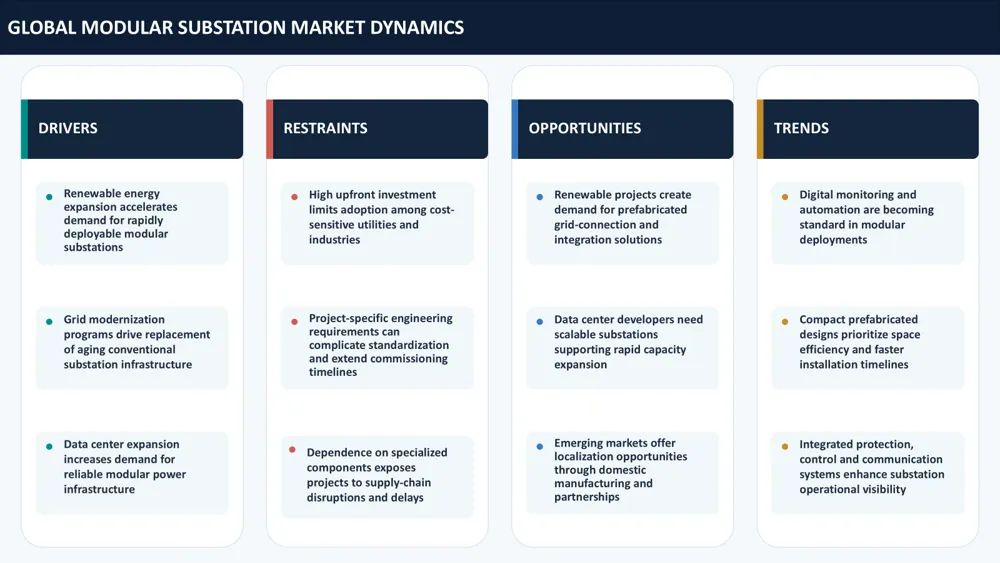
Global Modular Substation Market: Market Dynamics
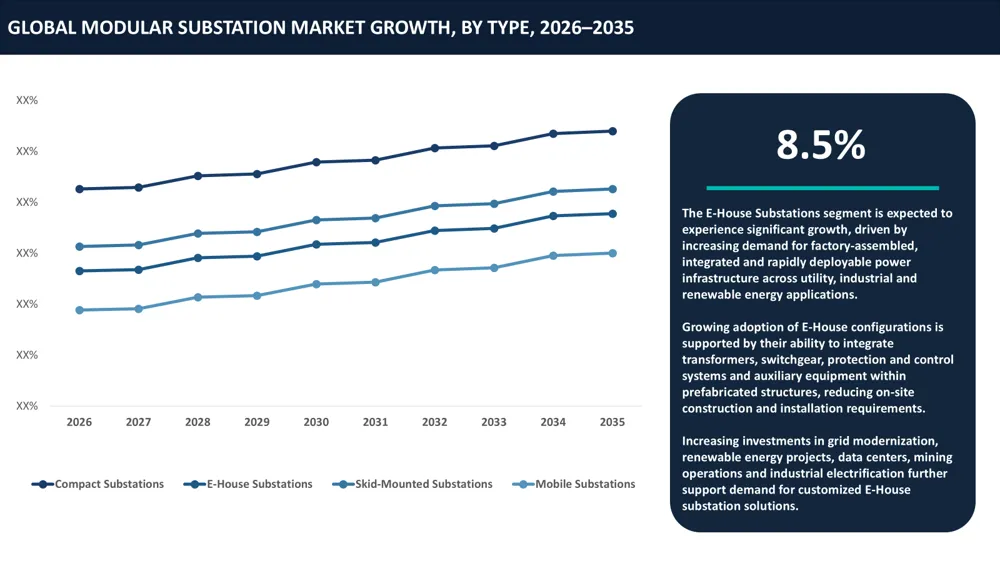
Global Modular Substation Market: Market Segment Analysis
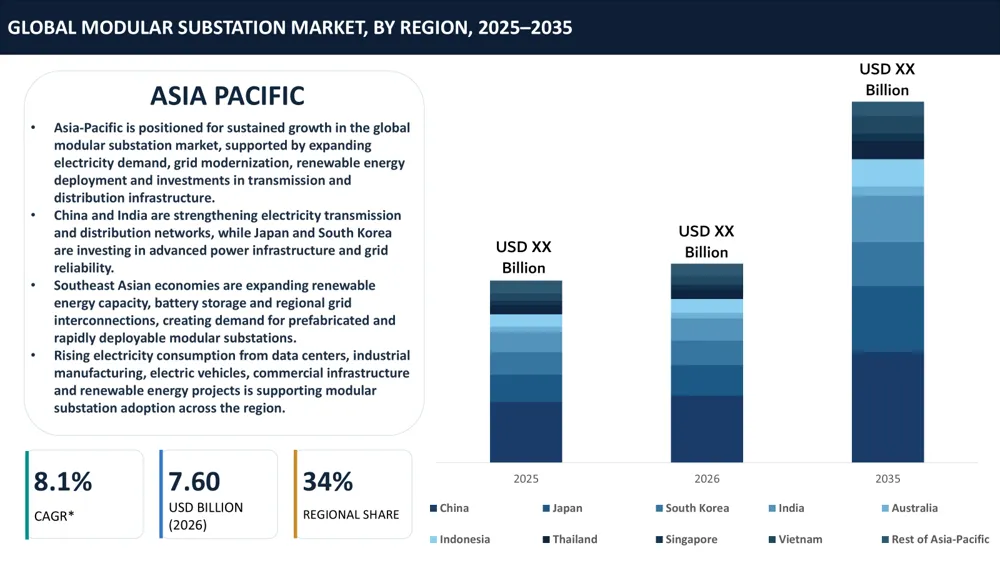
Global Modular Substation Market: Region Wise Analysis
Global Modular Substation Market: Market Scope
| Metrics | Details | |
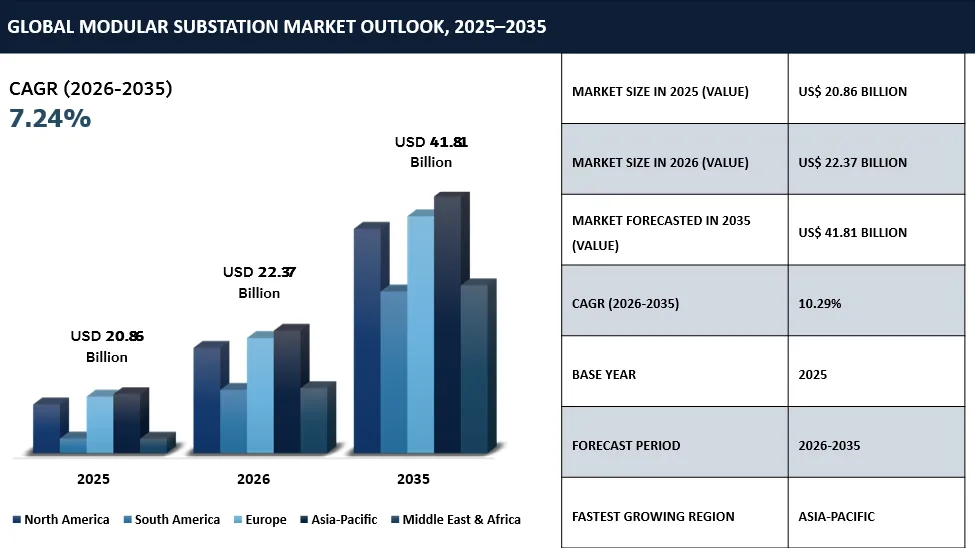
| Market Size in 2025 (Value) | USD 20.86 Billion | |
| Market Size in 2026 (Value) | USD 22.37 Billion | |
| Market Forecasted in 2035 (Value) | USD 41.81 Billion | |
| CAGR (2026-2035) | 7.24% | |
| Years Considered | 2024-2035 | |
| Base Year | 2025 | |
| Forecast Period | 2026-2035 | |
| By Type | Compact Substations E-House Substations Skid-Mounted Substations Mobile Substations | |
| By Voltage Level | Low Voltage (Up to 1 kV) Medium Voltage (1 kV to 36 kV) High Voltage (6 kV to 145 kV) Extra High Voltage (145 kV to 400 kV) Ultra-High Voltage (Above 400 kV) | |
| By Component | Power Transformers Switchgear Protection and Control Systems Monitoring and Communication Systems Auxiliary Systems | |
| By Insulation Type | Air-Insulated Substations (AIS) Gas-Insulated Substations (GIS) Hybrid-Insulated Substations | |
| By Installation Type | Indoor Substations Outdoor Substations | |
| By Application | Power Distribution Power Transmission Renewable Energy Integration Industrial Power Supply Commercial and Infrastructure Power Supply Emergency and Temporary Power Supply | |
| By End-User | Electric Utilities Manufacturing and Processing Industries Commercial Facilities Renewable Energy Developers Transportation and Infrastructure Operators Mining, Oil & Gas Companies | |
| By Region | North America | U.S., Canada, Mexico |
| Europe | Germany, UK, France, Spain, Italy, Poland | |
| Asia-Pacific | China, India, Japan, Australia, South Korea, Indonesia, Malaysia, Singapore, Vietnam, Thailand, Philippines, Taiwan | |
| South America | Brazil, Argentina | |
| Middle East and Africa | UAE, Saudi Arabia, South Africa, Israel, Turkiye | |
| Report Insights Covered | Competitive Landscape Analysis, Company Profile Analysis, Market Size, Market Share, Market Growth | |
Global Modular Substation Market: Target Audience
| INDUSTRY | WHO SHOULD BUY THIS REPORT? | REASON TO BUY THIS REPORT |
| ELECTRIC UTILITIES AND GRID OPERATORS | Transmission and distribution utilities, grid operators and electricity distribution companies | Evaluate grid modernization investments, substation deployment requirements, voltage-level demand and infrastructure expansion opportunities. |
| MODULAR SUBSTATION MANUFACTURERS | Compact substation, E-House, skid-mounted and mobile substation manufacturers | Benchmark product portfolios, competitive positioning, regional demand, project opportunities and manufacturing expansion strategies. |
| TRANSFORMER AND SWITCHGEAR MANUFACTURERS | Power transformer, medium-voltage switchgear and high-voltage equipment manufacturers | Identify equipment demand, technology requirements, supplier opportunities and integration partnerships across modular substation projects. |
| EPC AND ENGINEERING COMPANIES | Engineering, procurement and construction contractors, substation integrators and infrastructure developers | Assess project pipelines, procurement opportunities, installation requirements and regional infrastructure investment trends. |
| RENEWABLE ENERGY DEVELOPERS | Solar, wind, hybrid power and battery energy storage project developers | Evaluate grid-connection requirements, renewable integration demand and opportunities for prefabricated substation deployment. |
| DATA CENTER AND HYPERSCALE OPERATORS | Hyperscalers, colocation providers and data center infrastructure developers | Assess scalable power infrastructure requirements, deployment timelines, substation configurations and capacity expansion opportunities. |
| INDUSTRIAL AND MANUFACTURING COMPANIES | Manufacturing facilities, process industries, mining companies and oil and gas operators | Identify reliable industrial power supply solutions, evaluate modular deployment benefits and plan electrical infrastructure investments. |
| TRANSPORTATION AND INFRASTRUCTURE OPERATORS | Railway operators, metro networks, airports, ports and infrastructure developers | Evaluate substation requirements for electrification projects, transportation networks and large-scale infrastructure developments. |
| COMMERCIAL AND INSTITUTIONAL FACILITY OPERATORS | Commercial complexes, hospitals, educational campuses and large public infrastructure operators | Evaluate reliable power distribution requirements, space-efficient substation configurations and electrical infrastructure modernization opportunities. |
| SUBSTATION AUTOMATION AND CONTROL PROVIDERS | Protection and control system manufacturers, automation companies and monitoring technology providers | Identify opportunities in digital monitoring, integrated protection, communication systems and substation automation technologies. |
WHY DOES THIS REPORT MATTER IN 2026?
In 2026, there will be considerable strategic growth and evolution for the global modular substation market as a result of the increasing investments made by governments, electric companies, renewable energy producers, data centers and industries in the infrastructure that will provide reliable electricity infrastructure solutions. Growing demand for electricity, development of grid infrastructure, the use of renewable energy and the replacement of old transmission and distribution infrastructure have led to the increased installation of prefabricated and rapidly deployed substations. Investments made in North America, Europe, Asia-Pacific and other emerging markets have increased the demand for substation solutions like modular substations, E-Houses, skid-mounted substations and mobile substations. Modular substations are now playing an important role in meeting the demands of power transmission network improvements, distributed generation, renewable energy projects and other electricity demand from industries and data centers.
On the other hand, utility and infrastructure developers are also under increasing pressure to reduce time to completion, optimize capital expenditure, increase reliability and meet the needs of complicated grid systems. Advances in monitoring technology, substation automation, protection and control, gas insulated and hybrid insulator technologies, as well as factory prefabrication techniques are influencing the product development and competitive strategies in the industry. In order to assess long-term market opportunities, eliminate procurement and execution risks and find commercially viable modular substation technologies and markets, the buyers, investors and technology players are requesting more details on voltage-level requirements, substation configurations, equipment integration, manufacturing processes, project plans, regional investments, supplier competitiveness and grid modernization efforts.
Global Modular Substation Market: Analyst View / Opinion
The global modular substation market is characterized by two significant driving forces; utility-based grid enhancement projects and power solutions for particular applications such as renewable energy, data centers and heavy industries. Demand segments should not be viewed under one umbrella of a procurement or implementation perspective. Utility demands necessitate a focus on compatibility with the grid and the required voltages, reliability of equipment and standardization of installation. As opposed to utilities, renewable and industrial operations lay more stress on the specifics of the projects and their configurations, speed of installation, gallery optimization, scalability and compatibility with existing electrical systems.
There are three areas that are competitive in nature. First, modular substations have complex integration of components including transformers, switchgear, protection system, control and auxiliary devices. Component compatibility and system engineering become extremely important to ensure successful execution of such projects. Manufacturers should develop component partnerships, standardization where necessary and ensure adherence to relevant electrical standards. Second, high upfront cost, engineering specific to each project and component specificity may be limiting factors for many projects and customers. Competitive pricing, localized manufacturing and product configuration flexibility may help to facilitate this process. Third, modular substation projects have interrelated components of equipment purchasing, site preparation, connection permission and commissioning procedures. Delays related to equipment manufacturers, contractors and other stakeholders of the project may negatively affect schedule and project costs. Manufacturers and systems integrators with a combination of equipment integration, digital expertise, robust supply chain and specialized engineering services will be well-placed to capitalize on the opportunities available in the changing modular substation industry.