


Modern Fabric Market Overview
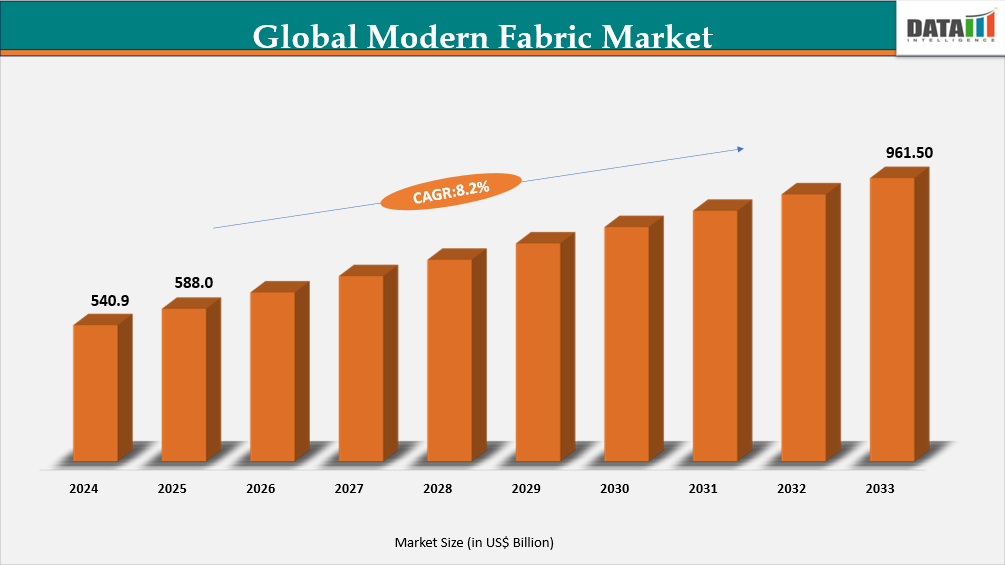
The global modern fabric market reached US$16.6 billion in 2024, rising to US$588.0 billion in 2025 and is expected to reach US$1,104.5 billion by 2033, growing at a CAGR of 8.2% from 2026 to 2033.
The global modern fabrics market is expanding steadily as major manufacturers accelerate innovation in high-performance textiles, sustainable fibers and technical coatings. Companies such as Toray Industries, Mitsubishi Chemical, Lenzing, Hyosung, and DuPont have all announced significant expansions in engineered fibers, ranging from carbon-fiber-reinforced fabrics to next-generation cellulosic materials.
For example, in 2025, Toray Industries, Inc. revealed that it had developed a recycling process that can degrade various carbon fiber reinforced polymers (CFRP) created from thermosetting resins while keeping the fibers' strength and surface quality. The business used this method to manufacture a nonwoven fabric with recycled carbon fibers. This fabric combines the benefits of carbon fiber, such as radio frequency shielding and thermal conductivity, with the appealing look of washi.
The market’s long-term trajectory is supported by the rise of electric vehicles, infrastructure upgrades, geotextile use in construction and high-performance interior fabrics in transportation. EV platform designs from Toyota, Hyundai and European OEMs increasingly incorporate lightweight composite fabrics and flame-resistant materials to improve safety and energy efficiency. Combined with rising consumer demand for functional apparel, moisture-management textiles and antimicrobial fabrics, the outlook for modern fabrics remains robust through 2032.
Modern Fabric Market Industry Trends and Strategic Insights
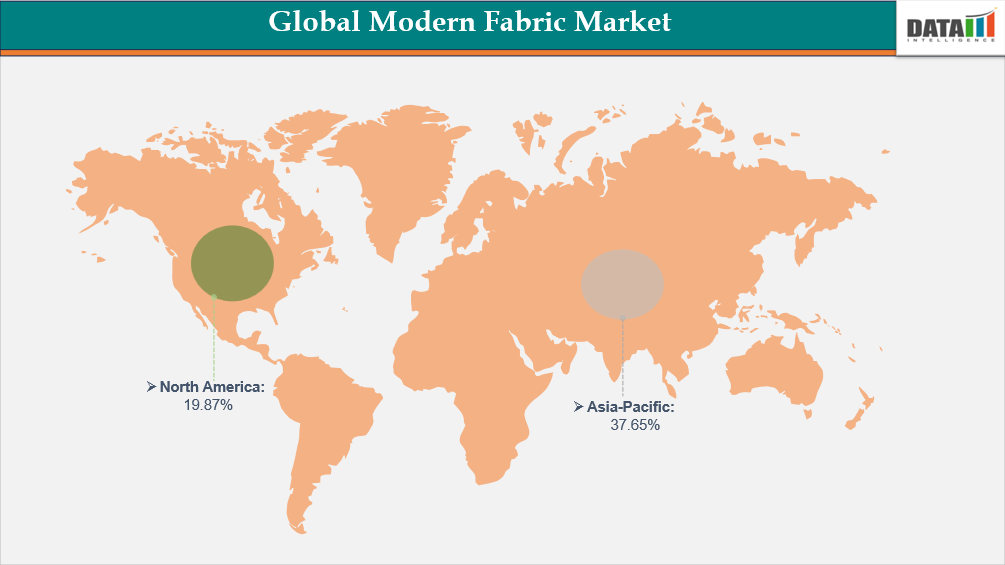
- Asia-Pacific leads the global modern fabric market, capturing the largest revenue share of 37.67% in 2024.
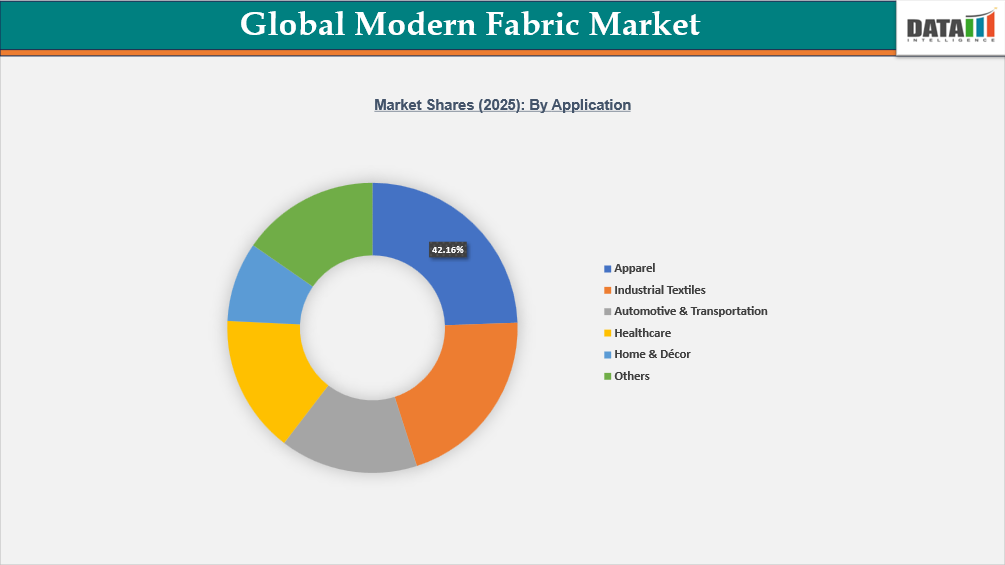
- By Application segment, Apparel led the global modern fabric market, capturing the largest revenue share of 42.16% in 2024.
Global Modern Fabric Market Size and Future Outlook
- 2025 Market Size: US$588.0 Billion
- 2033 Projected Market Size: US$1,104.5 Billion
- CAGR (2026–2033): 8.2%
- Dominating Market: Asia-Pacific
- Fastest Growing Market: North America
Market Scope
| Metrics | Details |
| By Material | Synthetic Fibers, Natural Fibers, Recycled Fibers, Others |
| By Production Process | Woven, Non-Woven, Coated, Others |
| By Function | Water- Resistant, UV-Protection, Antimicrobial, Flame Retardant, Others |
| By Application | Apparel, Industrial Textiles, Automotive & Transportation, Healthcare, Home & Décor, Others |
| By Region | North America, South America, Europe, Asia-Pacific, Middle East and Africa |
| Report Insights Covered | Competitive Landscape Analysis, Company Profile Analysis, Market Size, Share, Growth |
Market Dynamics
Growing Industrial & Consumer Demand for High-Performance Technical Fabrics
Demand for high-performance and technical fabrics is rising sharply as industries pivot toward lightweight, durable and safety-enhancing materials. In 2023, DuPont launched Kevlar EXO, its most advanced aramid fabric in a decade, offering a 50% improvement in comfort without compromising ballistic or cut resistance, targeting defense, emergency response and industrial protection markets.
Meanwhile, Toray’s expansion in carbon-fiber based prepreg fabrics, used in aerospace and high-performance automotive components, reflects the broader global shift toward stronger yet lighter materials.
Industrial sectors are also driving uptake of advanced fabrics. In 2024, Freudenberg has introduced a new 100% synthetic wetlaid nonwoven product line made in Germany. The new materials can be made from a variety of polymer-based fibers, including ultra-fine microfibers that are intended for use in filtration and other industrial applications. The innovation emphasizes the trend toward engineered, application-specific textiles.
In transportation, the rise of electric vehicles is increasing demand for flame-resistant and lightweight interior fabrics. OEMs are adopting advanced nonwoven insulation layers, high-strength seat fabrics and flame-barrier materials that meet stringent EV battery safety norms.
Companies such as Milliken launched new Westex FR fabrics targeting electric-utility workers and high-heat industrial environments, showing the growing overlap between technical textiles and industrial safety requirements. The innovations highlight how EV platforms and electrical infrastructure upgrades are becoming major downstream demand centers.
Segmentation Analysis
The global modern fabric market is segmented based on material, production process, function, application and region.
Apparel and Sustainability Drive Innovation and Demand for Modern Performance Fabrics
The apparel industry is one of the strongest drivers of modern fabrics, supported by a global shift toward performance wear, athleisure, moisture-management fabrics and technical apparel. Real-world developments highlight this trend; Hyosung expanded the regen BIO Elastane portfolio to include new regen BIO Plus and regen BIO Max yarns with enhanced renewable resource content. It was the first company to commercially produce USDA and SGS-certified regen Bio-Based Elastane manufactured with 30% renewable resources at scale in 2022 and it was successfully accepted by top global brands like Pangaia, Icebreaker, Silver Sea Apparel, Van Harvey, etc. The developments reflect a sustained move toward breathable, stretchable, quick-dry and antimicrobial fabrics across premium and mass-market segments.
Sustainability is another major factor in apparel demand. Brands have committed to increasing recycled polyester, bio-based fibers and Bluesign-approved dyes in their collections. For example, H&M and Inditex pledged 100% recycled or sustainable materials by 2030, driving demand for recycled polyester and PET fabrics. The commitments directly drive demand of modern fabrics with traceable, low-impact credentials.
The rise of outdoor and performance apparel has accelerated the integration of advanced coatings and laminates. Gore-Tex, Toray Dermizax and Polartec NeoShell represent a growing class of water-resistant, breathable and lightweight membrane fabrics widely adopted in mountaineering, activewear and tactical clothing. The technologies depend heavily on modern microfilament structures, functional PU membranes and PFAS-free water repellency systems, driving investment into engineering-grade fabrics.
Industrial Textiles: Powering Growth Beyond Apparel in the Modern Fabrics Market
The industrial textiles segment, also known as Indutech within the technical textiles classification, is gaining prominence as a key growth driver in the modern fabrics market due to its wide range of engineered, performance‑oriented applications. Technical textiles, which include industrial textiles used primarily for functional and performance purposes rather than aesthetic ones, are increasingly integrated into sectors such as construction, automotive, filtration, and protective industrial uses. These textiles offer specialized qualities like strength, durability, and resistance to environmental stresses, making them essential in applications from conveyor belts and filters to geotextiles for infrastructure reinforcement and maintenance.
Government and industry push toward infrastructure upgrades and safety compliance has further elevated industrial textile demand. For example, geotextiles are widely used in civil engineering projects, road construction and soil stabilization due to their capacity to separate, filter, and reinforce soils, reflecting policy support for resilient infrastructure. Technical textiles are also expanding in automotive and aerospace applications, where lightweight, durable fabrics are required for belts, composite reinforcements, and filtration systems. In India, the National Technical Textiles Mission has been actively promoting domestic production and global competitiveness of technical textiles such as industrial fabrics, with targets including US$ 10 billion in exports by 2025‑26, stimulating growth across industrial segments.
Geographical Penetration
FASTEST GROWING MARKET:
Demand for the Modern Fabric Market in North America
North America’s modern fabric market is witnessing accelerated demand, particularly in technical and performance textiles used in healthcare, automotive, aerospace, and protective applications. The US textile and fabric industry had employment of over 500,000 people across textile and related sectors, underscoring the economic scale of the market. The region accounted for roughly 14% of the global textile market revenue in 2024, reflecting a strong footprint in both apparel and advanced fabric segments. Innovative use of advanced fibres and fabrics for industrial applications, and increased consumer demand for smart and sustainable textiles, are key drivers of growth. Technical textile segments are among the fastest-expanding sub‑markets, driven by demand for high‑performance materials.
Within this growth backdrop, near‑shoring and advanced manufacturing investments are contributing to the North American modern fabrics surge, especially in niche and high‑value products. Demand for modern fabrics is bolstered by rising adoption in non‑woven medical textiles, engineered composites for automotive interiors, and smart textiles for wearables. These trends, along with supportive industry restructuring that emphasizes resilience and regional supply security, are positioning North America as the fastest‑growing modern fabric market globally.
US Modern Fabric Market Outlook
The US textile and fabric industry generated approximately US$ 64.8 billion in shipments in 2023, with strong employment fundamentals. Technical textiles and advanced performance fabrics are expanding rapidly due to healthcare and industrial demand. The US is also a significant exporter of textile products, with billions in annual overseas shipments. Domestic innovation and advanced manufacturing investments are expected to further fuel growth in modern fabric segments.
Canada Modern Fabric Market Trends
Canada’s modern fabric market is expanding through increased demand for sustainable and high‑performance textiles in both consumer and industrial segments. While smaller in scale than the US, Canada benefits from innovation adoption and regional integration with US value chains. Consumer preferences toward eco‑friendly fabrics and investment in technical textile applications are key growth factors. Policy support for sustainable manufacturing practices is enhancing Canada’s competitiveness in modern fabric markets.
LARGEST MARKET:
Asia-Pacific Records the Largest Growth in the Modern Fabric Market
Asia-Pacific is the global powerhouse for modern fabrics, driven by massive production ecosystems in China, India, Japan, South Korea, Taiwan, Vietnam and Indonesia. China alone accounts for the majority of global polyester fiber output, while Japan and South Korea lead in specialty fibers, composites and engineered performance fabrics. Companies such as Toray, Toyobo, Hyosung and Mitsubishi Chemical operate large-scale spinning, weaving and finishing facilities that supply apparel, automotive and industrial OEMs worldwide.
Technological investments across the Asia-Pacific also play a key role. Toray’s expansion of Ultrasuede in Japan in 2023 and India’s increasing adoption of digital dyeing and water-efficient finishing lines demonstrate the region’s leadership in high-performance fiber technology.
The proliferation of modern equipment, nonwoven melt-blown lines, composite lamination units, PFAS-free finishing plants has transformed Asia-Pacific into the most advanced textile manufacturing hub globally.
Regulatory pressure is rising across the region. China’s GB 18401 safety standard, India’s BIS textile norms and Japan’s strict JIS testing requirements are pushing manufacturers toward safer, compliant and more functional fabrics. Environmental mandates in China and Japan have accelerated the shift from solvent-based finishing to water-based and low-VOC coatings, influencing the global adoption of modern fabric technologies.
The region’s dominance is reinforced by strong demand from growing domestic markets. Rising disposable income in China, India and Southeast Asia is boosting sales of athleisure, outdoor wear, home textiles and automotive fabrics.
India Modern Fabric Market Insights
India’s modern fabric market is rapidly expanding as the country strengthens its textile industry through strategic initiatives like Production Linked Incentive (PLI) schemes and the establishment of textile parks that elevate manufacturing capabilities. The textile sector contributed about 2.3% to India’s GDP and 13% to industrial production in 2024, employing over 45 million people. India is the second‑largest textile producer in the region and its domestic consumption plus export potential are driving increased demand for both traditional and advanced fabric categories.
China Modern Fabric Market Industry Growth
China is the dominant force in Asia‑Pacific fabric demand and supply, accounting for around 35% of global textile production and serving as the largest exporter of textiles worldwide. The country’s modern fabric demand is supported by its massive integrated textile ecosystem encompassing raw fibre processing to finished technical textiles and advanced performance materials. China’s production scale and export orientation make it a central hub for both traditional and modern fabrics, with substantial output geared toward global apparel and industrial applications.
Sustainability Analysis
The modern fabric market is increasingly shaped by sustainability considerations, driven by consumer demand, regulatory pressures, and environmental impact concerns. The global textile industry is responsible for approximately 10% of global carbon emissions and 20% of industrial water pollution, according to the United Nations Environment Programme. This has led to a significant shift toward sustainable fabrics, such as organic cotton, recycled polyester, and bio-based fibers, which reduce environmental footprint by lowering water consumption, chemical use, and greenhouse gas emissions. For instance, organic cotton requires 91% less water than conventional cotton.
Modern fabric manufacturers are also adopting circular economy principles, including fiber recycling, upcycling, and take-back programs, which enhance resource efficiency and minimize waste. Globally, recycled textiles accounted for approximately 15% of total fabric production in 2024, projected to reach 25% by 2030. Sustainability certifications such as GOTS, OEKO-TEX, and Bluesign are becoming standard benchmarks, providing transparency and traceability across supply chains.
Additionally, energy-efficient production technologies, low-impact dyeing processes, and renewable energy integration in textile mills are gaining traction. For example, European fabric producers now source 30–40% of energy from renewable sources on average, reducing CO₂ emissions and operational costs. These sustainable practices not only mitigate environmental risks but also enhance brand value, consumer trust, and compliance with evolving global regulations, making sustainability a critical factor in the modern fabric market.
Competitive Landscape
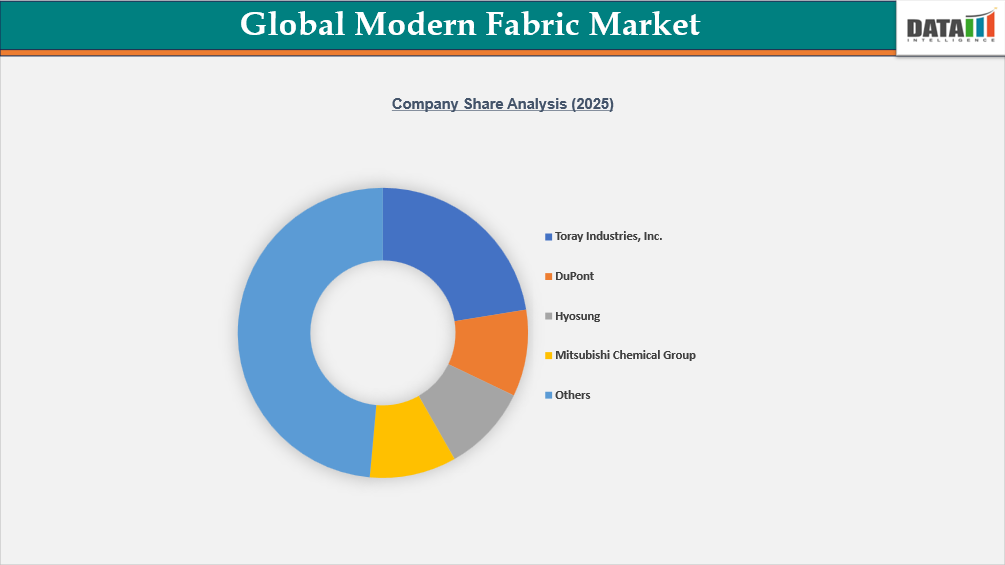
- The top tier competes on scale, upstream integration and technology depth.
- Toray and Mitsubishi leverage strong R&D, composite and high-performance fiber portfolios and extensive OEM relationships in aerospace, automotive and industrial applications.
- Hengli’s massive polyester and integrated petrochemical-to-textile footprint gives it cost and volume leadership in commodity and engineered synthetics, while DuPont’s specialty fibers (aramids, high-performance polymers) command premium margins in protective, filtration and specialist industrial markets.
- The firms win large institutional and OEM contracts because they can guarantee volume, certification and long-term supply continuity.
Key Developments
- In January 2025, Danish fashion brand Ganni entered a multi-year offtake agreement with Los Angeles-based Ambercycle to secure access to cycora, a regenerated polyester made from end-of-life textiles. Under this agreement, Ganni plans to replace over 20 % of its annual virgin and recycled polyester usage with cycora, a textile-to-textile circular material that diverts waste from landfills while matching the performance and durability of conventional polyester. This strategic partnership exemplifies modern fabric innovation by embedding truly circular materials into commercial collections and strengthening supply-chain integration for next-gen fabrics.
- In October 2024, Sympatex Technologies showcased new sustainable fabric developments at Performance Days Munich, including fabrics produced in cooperation with e.dye, a solution-dyed polyester color system that significantly reduces environmental impact. These innovations reflect industry momentum toward Fiber2Fiber and circular textiles, with Sympatex’s projects demonstrating how chemically recycled textile waste and advanced dyeing can reduce resource use while supporting high-performance applications for functional and outdoor garments.
What Sets This Global Modern Fabric Market Intelligence Report Apart
- Latest Data & Forecasts – Comprehensive, up-to-date insights and projections through 2032. Coverage includes global value by material, production process, function, application. Scenario forecasts with region-level splits (North America, Europe, Asia-Pacific, South America, Middle East and Africa) and sensitivity to factors such as regulatory reclassification and raw-material costs.
- Regulatory Intelligence – Actionable analysis of textile and materials regulations that directly affect modern fabric production and commercialization, including chemical usage restrictions, sustainability and recyclability standards, labeling and traceability requirements, labor compliance, and import/export controls across major manufacturing and consumption markets.
- Competitive Benchmarking – Standardized profiling and benchmarking of leading global fabric producers, specialty fiber manufacturers, technical textile innovators, and integrated supply-chain players, with assessment of product portfolios, manufacturing footprints, sustainability initiatives, and innovation pipelines.
- Geographic & Emerging Market Coverage – Region-by-region market analysis highlighting growth drivers, industrial demand, consumer preferences, policy support, and market-entry considerations, with special focus on high-growth and transitioning markets in Asia-Pacific, the Middle East, Africa, and Latin America.
- Actionable Strategies – Identification of opportunities for advanced, sustainable, and high-performance fabric development, alongside guidance on strategic partnerships, vertical integration, and localized manufacturing to enhance margins and market reach.
- Pricing & Cost Analysis – Detailed evaluation of fabric pricing trends, raw-material and energy costs, and the impact of circularity, recycling, and bio-based inputs on cost structures across regions.
- Expert Analysis – Insights drawn from textile engineers, sustainability experts, supply-chain specialists, and senior executives from leading fabric and materials companies, offering practical perspectives on market evolution and innovation pathways.


























































