


Model Context Protocol Market Size
The global model context protocol market reached US$ 1.28 billion in 2025 and is expected to reach US$ 28.46 billion by 2035, growing with a CAGR of 37.22% during the forecast period 2026-2035.
The rapid development in the developer ecosystem and movement from experimental integrations to production-ready agent architecture creates enormous opportunities for the global model context protocol market. As per the model context protocol project, the Tier 1 MCP SDKs had reached a mark of around 500 million downloads per month by July 2026 and both TypeScript and Python SDKs had crossed the 1 billion downloads mark cumulatively, thus showing high adoption among developers. The stateless nature of the MCP core protocol introduced by the 2026-07-28 specification enables MCP servers to run remotely behind standard HTTP load balancers without the need for session information at the protocol level, improving scalability for enterprise deployments.
Adoption of enterprise is gradually moving towards security, governance and interoperability of agent-based processes. As per the ecosystem update of the MCP project in December 2025, MCP had surpassed 10,000 active public servers count, with best client support seen among all AI platforms such as ChatGPT, Claude, Gemini, Microsoft Copilot and Visual Studio Code. By July 2026, the MCP protocol’s capabilities had grown through Tools, Resources, Prompts, Elicitation, Apps and Tasks. The latest specification also improved its authorization and enterprise deployment methods. All these changes result in opening new opportunities in the fields of management of MCP gateways, server administration, security and authorization, enterprise integration, observability and agent-development infrastructure.
Model Context Protocol Market Key Takeaways
- Integration Platforms and MCP Gateway platforms led in the model context protocol market in 2025 with around 32.47% market share, aided by their capability to link MCP server and client applications through enterprise APIs, database applications, SaaS solutions and business processes while providing central routing and access control.
- Cybersecurity is expected to emerge as the fastest-growing application segment with a CAGR of 44.56% from 2026 to 2035, mainly attributed to rising adoption of MCP technology for securing AI agents in accessing cybersecurity tools and threat intelligence, among others.
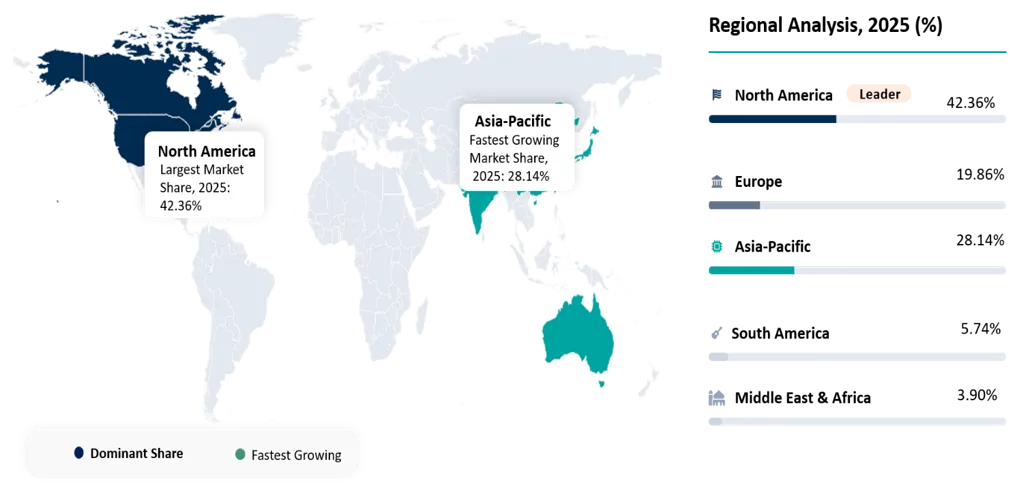
- North America held a leading position in the global model context protocol market with 42.36% market share in 2025, driven by high acceptance of AI Agents, software development, and Enterprise Automation, along with the availability of key AI, cloud, developer platforms and enterprise software firms.
- MCP ecosystem has been growing at an unprecedented rate beyond basic tool connectivity, as evident by the official MCP Registry with 18,843 unique servers recorded in a July 2026 snapshot, while remote only servers constituted 54.3% of new servers in July, indicating a trend towards hosted and accessible MCP architecture.
- The increasing adoption of MCP within enterprises has opened up new avenues within MCP gateways, server management, security & authorization, enterprise integration, monitoring, server discovery and hosted infrastructure as organizations move from a one-off to multiple server agent architecture.
Model Context Protocol Industry Trends and Strategic Insights
- Integration Platforms and MCP Gateway platforms led in the model context protocol market in 2025 with around 32.47% market share, aided by their capability to link MCP server and client applications through enterprise APIs, database applications, SaaS solutions and business processes while providing central routing and access control.
- Cybersecurity is expected to emerge as the fastest-growing application segment with a CAGR of 44.56% from 2026 to 2035, mainly attributed to rising adoption of MCP technology for securing AI agents in accessing cybersecurity tools and threat intelligence, among others.
- North America held a leading position in theglobal model context protocol market with 42.36% market share in 2025, driven by high acceptance of AI Agents, Software Development and Enterprise Automation, along with the availability of key AI, cloud, developer platforms and enterprise software firms.
- MCP ecosystem has been growing at an unprecedented rate beyond basic tool connectivity, as evident by the official MCP Registry with 18,843 unique servers recorded in a July 2026 snapshot, while remote only servers constituted 54.3% of new servers in July, indicating a trend towards hosted and accessible MCP architecture.
- The increasing adoption of MCP within enterprises has opened up new avenues within MCP gateways, server management, security & authorization, enterprise integration, monitoring, server discovery and hosted infrastructure as organizations move from a one-off to multiple server agent architecture.
Model Context Protocol Market Scope
| Metrics | Details | |
| 2025 Market Size | US$ 1.28 Billion | |
| 2035 Projected Market Size | US$ 28.46 Billion | |
| CAGR (2026-2035) | 37.22% | |
| Largest Market | North America | |
| Fastest Growing Market | Asia-Pacific | |
| By Component | MCP Servers, MCP Clients, MCP Host Platforms, MCP Gateway & Integration Platforms and Others | |
| By Capability | Tools, Resources, Prompts, Elicitation, Tasks and MCP Apps | |
| By Deployment Mode | Cloud and On-Premises | |
| By Application | AI Agents, AI Assistants, Software Development, Data & Analytics, Enterprise Automation, Customer Service, Cybersecurity, Knowledge Management and Others | |
| By Organization Size | Large Enterprises and Small & Medium Enterprises (SMEs) | |
| By End-User | IT & Telecom, Banking, Financial Services & Insurance (BFSI), Healthcare & Life Sciences, Retail & E-commerce, Manufacturing, Automotive, Government, Media & Entertainment, Energy & Utilities, Education, Professional Services and Others | |
| By Region | North America | U.S., Canada, Mexico |
| Europe | Germany, UK, Russia, France, Spain, Italy, Poland | |
| Asia-Pacific | China, India, Japan, Australia, South Korea, Indonesia, Malaysia, Singapore, Vietnam, Thailand, Philippines, Taiwan | |
| South America | Brazil, Argentina | |
| Middle East and Africa | UAE, Saudi Arabia, South Africa, Israel, Turkiye, Nigeria | |
| Report Insights Covered | Competitive Landscape Analysis, Company Profile Analysis, Market Size, Share, Growth | |
Why does this report matter in 2026?
Market for the model context protocol has evolved from experimentation by developers in its early days into a production-level protocol for agentic AI. The MCP protocol defined in July 2026 includes a stateless core of the protocol, thus making the MCP servers horizontally scalable through standard HTTP infrastructure without any sessions or session storage at the protocol level. Also, MCP is becoming more and more relevant in the field of AI because of the increased adoption of MCP by AI platforms, cloud providers, developers and enterprises.
The report takes on significance in 2026 as the MCP ecosystem approaches the stage of commercialization and enterprise readiness. This is evidenced by the way MCP Apps and Tasks have expanded the scope of the protocol from mere tool invocation to interactive interfaces and agent workflow. Also, there is security through hardening and authorization of enterprise-managed identities, which is being done to cater to production needs. The Tier 1 MCP SDKs are now reaching 500 million downloads per month, indicating increasing developer uptake. As such, the report will assist in evaluating market potential within the MCP ecosystem prior to maturity and competition.
Model Context Protocol Market White Space & Investment Opportunities
- MCP Server Management Platforms: There are possibilities for platforms that make it easier to deploy, version, monitor and manage a set of MCP servers, especially with stateless MCP making servers scalable within standard HTTP networks.
- MCP Security & Access-Control Solutions: There are possibilities for solutions tailored specifically towards authentication, authorization, token management, tool-based permission controls and access monitoring at runtime. Enterprise-Managed Authorization opens up possibilities for access controls for MCP managed through corporate identity services.
- MCP Server Discovery & Marketplace Platforms: Trusted MCP marketplaces will be developed that assist companies with discovering, authenticating, organizing and managing MCP servers, making it easier to identify suitable servers for their business needs. Standardization of server metadata is being worked on as part of the MCP roadmap for more effective discovery.
- MCP Enterprise Integration Solutions: Service providers can create MCP connectors for databases, SaaS applications, APIs, CRM, ERP and enterprise systems, making it less technically challenging to enable their business applications and data for AI agents.
- MCP Observability & Performance Tools: Possible investments include custom observability around MCP tool requests, latency, error handling, server health, routing, caching and agent-server interaction. Header-based routing and list response caching enabled by the 2026 specification header opens up new possibilities for MCP-aware gateway and observability tools.
Model Context Protocol Future Market Transformation
The MCP Market is expected to evolve from being a connectivity technology of AI tools to becoming an interoperability layer technology for agentic systems on a large scale. With regard to the 2026 version specification, which has become stateless at the level of the core protocol, the MCP servers can work behind standard load balancers without protocol-level session management, which improves the scalability of the solution for corporate environments. Meanwhile, the MCP Apps and Tasks extension broaden the applicability of MCP from mere tool and data access to interactive interfaces and agent work processes.
Market development in the future will be more focused around control, identification, discovery and governance of enterprises than just protocol connectivity. The Enterprise Managed Authorization is already giving out centralized MCP server access from the corporate identity providers, whereas the roadmap shows that there will be a continued focus on agent identity, enterprise security, native HTTP transport, server discovery and improved SDK experience. This may lead to emergence of commercial opportunities for MCP gateways, security platforms, server marketplaces, observability services and managed MCP infrastructure, with open governance being promoted through Agentic AI Foundation.
Model Context Protocol Market Buyer Decision-Making Criteria
Buyers of MCP are more interested in solutions that can offer secure, scalable and interoperable links between AI systems and enterprise systems. The 2026 version of MCP has a stateless protocol core, routing through headers, caching list responses and enhanced authorization procedures. This is why scalability, compatibility with gateways and security are now important aspects when purchasing solutions. Enterprise Managed Authorization also tackles the issue of access to the MCP servers centrally, thereby emphasizing the significance of enterprise identity and policy control.
Major Decision-Making Criteria
- MCP Specification & Version Compatibility
- Security & Authorization
- Scalability & Performance
- Enterprise Integration Capability
- MCP Server & Client Compatibility
- Governance & Policy Management
- Observability & Monitoring
- Developer Experience
- MCP Apps & Tasks Support
- Total Cost of Ownership
Model Context Protocol Market Economic & Investment Analysis
The market for MCP is now beginning a phase of enterprise-grade investment due to the fast-growing agentic AI industry, the rapid adoption of MCP server/client architecture and increased coupling of AI systems with enterprise applications/data. The introduction of stateless protocol core, designed to horizontally scale over traditional HTTP infrastructure, is part of the July 2026 specification release and helps make the economics of running MCP remote servers easier. Meanwhile, MCP’s Tier 1 SDK platform is now close to achieving 500 million monthly downloads, pointing to significant developer interest and making the business case for MCP infrastructure, gateways, integration platforms, security solutions and managed services even stronger.
Opportunities for investment are gradually transitioning from protocol-level connectivity to MCP infrastructure and governance in enterprises. It is expected that money would be spent on MCP server management, secure gateways, enterprise integration, identity and authorization, observability, server discovery and capabilities for long-lived agent workflows. The transfer of protocol to the Agentic AI Foundation under the Linux Foundation ensures neutrality from vendors. The Enterprise-Managed Authorization and the roadmap till 2026 point at enterprise security, identity, scalability and interoperability. It strengthens the investment thesis by establishing MCP as an infrastructure layer of the future of multi-vendor agentic AI ecosystems.
Model Context Protocol Investment Trends in the Market
- Rising Investment in MCP Infrastructure: There is an increase in the funding towards the hosting, implementation, scaling and management of the lifecycle of MCP servers as companies move from experimenting to deploying MCP infrastructure.
- Growing Focus on MCP Security: More investors are interested in solutions that will help protect the AI agents that have access to enterprise applications using the MCP.
- Expansion of MCP Gateway Platforms: There is an increased interest in investing in MCP gateways, which serve to route traffic and manage multiple MCP servers in enterprise environments.
- Increasing Enterprise Integration Investment: There are increased investment opportunities in integration platforms that link the MCP to databases, SaaS apps, APIs, CRM and ERP systems, as well as enterprise workflows to deploy more AI agents.
- Growing Investment in Developer & Ecosystem Tools: Investments are being made in tools such as MCP SDKs, server discovery, testing, observability, registries and developer tools that make MCP server development and maintenance easier.
Strategic Indicators For Model Context Protocol Market
High Regulation Impact
The MCP market is highly affected by regulations due to the fact that MCP makes it possible for AI systems to have access to enterprise data, APIs, tools and business systems, which means that there is higher risk associated with data privacy, AI governance, cybersecurity, access control and auditing. The regulatory obligations, including the European AI Act, the GDPR and other regulations in the finance and healthcare sectors, are creating additional demand for MCP solutions with robust authentication, authorization, data protection, activity tracking, consent management and policy enforcement. As organizations implement agentic workflows that leverage the use of MCP in regulated environments, compliance becomes an important consideration for MCP server, gateway and enterprise integration adoption.
High Investment Activity
There is heavy investment in the MCP market due to the transition from MCP experimentation to production-grade infrastructure of agentic AI by enterprises and technology vendors. There is heavy concentration of investment in the areas of server management, secure gateways, enterprise integration, authorization, observability and tools for developers as the ecosystem of MCP-capable servers and SDKs is growing. The increasing involvement of big players of the AI and cloud and enterprise technology industries contributes significantly to the commercialization process.
Supply Chain Disruption
The MCP market features low exposure to disruption from the physical supply chain, since MCP is mainly a software protocol; nevertheless, disruption may arise from the cloud computing platform, AI computation power, API services, data platforms and dependency on third-party MCP servers. The dependency on third-party SaaS systems, model providers, cloud providers and infrastructure may lead to service disruption for the MCP-powered agent workflow, hence the need for multi-cloud architecture, backup MCP servers, failover gateway and integration infrastructure.
Pricing Volatility
The market for MCP is characterized by significant price volatility because the deployment costs depend on the type of cloud infrastructure used, API use, AI inference, number of MCP servers, security needs and complexities of integration within enterprises. The prices of managed MCP infrastructure could range between hundreds of dollars per month for simple deployments to several thousand dollars per month for enterprise-level deployments, whereas the prices for custom MCP integrations could cost tens of thousands of dollars per deployment. The cost fluctuations have encouraged providers to implement usage-based pricing, subscription models, enterprise licensing and managed services.
Procurement Pressure
The MCP market is characterized by medium to high procurement pressure, due to the fact that enterprises increasingly need MCP vendors to prove security, interoperability, scalability, governance and ability to integrate with other APIs, SaaS applications, databases and AI before procurement. The buyers are also benchmarking managed MCP gateways, servers, security products and integrators based on flexibility of deployment, protocol version compatibility, enterprise authorization, observability and total cost of ownership. This is causing stiff competition among vendors and prompting them to provide pre-built connectors, flexible licensing, managed deployment and enterprise support to reduce implementation risk and procurement barriers.
New Technology Adoption
The MCP market has high degree of new technology adoption due to fast innovation in agentic AI, MCP Apps, Long-lived Tasks, stateless MCP design and authorization management at the enterprise level. The July 2026 specification of the model context protocol provided enhanced support for stateless operations and horizontal scaling via Streamable HTTP, while MCP Apps allow interactive user interfaces in AI conversations. These innovations are increasing adoption of MCP technology in AI agents, developer environments, enterprise automation, data integration and AI-powered business software, resulting in a need for new MCP gateways, security, observability and server management solutions.
Regional Expansion Opportunity
There are good opportunities for regional growth in the MCP market in view of the rapid acceptance of agentic AI, cloud platforms and enterprise applications of AI in North America, Europe and Asia Pacific regions along with the emergence of new prospects in the South American and Middle East and Africa regions. North America is expected to have early enterprise-level acceptance in light of the presence of AI platform and cloud service providers in this region, Europe will see prospects based on the demand for secure and governed AI integration and Asia Pacific will offer huge possibilities in terms of AI infrastructure and software development for enterprises.
Government Policy Support
The market for MCP is seeing advantages because of the rising backing by governments for AI interoperability, digital infrastructure, cybersecurity and ethical deployment of AI. The government efforts in terms of adoption of AI, cloud modernization, open standards, secure data exchange and AI governance are paving way for a good environment that will enable AI and enterprise application connectivity via MCPs. More specifically, the focus of regulators and the public sector on interoperable AI, security of AI tools, data protection and transparency of AI has promoted the adoption of standard integration approaches like MCP, providing prospects for MCP gateways, security, enterprise integrations and AI use in governments.
Pricing Intelligence
In the MCP market, pricing is becoming highly structured around usage, deployment scale and enterprise functionality, rather than licensing costs. The indicative market pricing for the less-complex managed MCP service can range between US$20 and US$200 per month, while it can rise to between US$1,000-P10,000+ for complex implementations involving centralized gateways, permissioning, tracking and multiple instances if the model context protocol in enterprise systems. Pricing for custom MCP server development and complex enterprise integrations can range between US$10,000-US$100,000+ per project. It facilitates differentiated monetization using server-specific, user-specific, API call-specific, usage-based and enterprise subscription models.
| HS Code | Reporter | Trade Flow | 2025 Trade Value | Interpretation |
| 8523 | United States | Export | US$ 14.8 Billion | Major Technology Exporter: Strong digital-technology supply chains provide a favorable ecosystem for AI and MCP deployment. |
| 8523 | Germany | Export | US$ 8.9 Billion | Strong European Technology Hub: Advanced enterprise technology infrastructure supports AI integration and interoperability adoption. |
| 8523 | China | Import | US$ 28.5 Billion | Major Technology Demand Center: High technology demand reflects substantial digital infrastructure and enterprise technology deployment. |
| 8523 | Japan | Import | US$ 6.2 Billion | Mature Technology Market: Established enterprise IT and digital infrastructure create favorable conditions for AI and MCP adoption. |
Note: HS Code 8523 is used solely as a broad trade proxy for the digital technology and data-storage ecosystem. MCP does not have a dedicated HS code and the reported trade values do not represent direct MCP software, services, API transactions, or protocol activity.
AI Impact Analysis of Model Context Protocol Market
Demand for the MCP market is primarily driven by AI, as there is an accelerating trend of moving from conversational AI to agentic AI and autonomous work process automation requires standardized access to external software and hardware solutions, enterprise data, APIs and applications. The model context protocol makes it possible for AI agents to work with external systems using a single protocol, without developing dedicated integration between AI and applications.The growth of the MCP Servers, Clients, Tools, Resources, Prompts and MCP Apps will thus lead to an increase in the addressable market of MCP infrastructures in software development, data analytics, automation, customer support and knowledge management.
The development of AI is also redefining the business and technical needs associated with MCP implementations. Better agents need secure, scalable and monitorable tool connectivity, thus creating more demand for MCP gateways, authorization, enterprise identity, server management, monitoring and governance products.The 2026 transition to a stateless MCP core and HTTP-native implementations provides yet more support for large-scale agent infrastructures, while MCP Apps and Tasks broaden MCP from just calling tools to more involved interactive agent processes. As AI agents become increasingly autonomous, MCP emerges as an increasingly important interoperability layer bridging AI reasoning with enterprise execution systems.
Disruption Analysis of Model Context Protocol Market
The market for model context protocol disrupts the architecture of traditional AI integration through the transition from a piecemeal approach to connecting AI applications to each tool, database, API and enterprise system into a standardized interoperability layer that avoids unnecessary repetition in integration and allows AI agents to use MCP-compliant tools regardless of the AI platform they work on. The specification for 2026 July provides even more disruption through its stateless core that allows MCP servers to be used behind load balancers and over HTTP infrastructure without session management.
Disruption is also influencing the competitive dynamics towards MCP Infrastructure, Security, Governance and Control Platforms. The adoption of MCP from big AI and tech platforms, along with the shift towards the Agentic AI Foundation, which takes a neutral approach to the development and governance of MCP, is decreasing dependency on proprietary solutions and promoting interoperability. As MCP is extending its reach from simple apps and tasks into enterprise authorization and agent workflows, vendors offering secure gateways, server management, observability, discovery and enterprise integration are gaining significant importance.
Model Context Protocol Market BCG Matrix: Company Evaluation
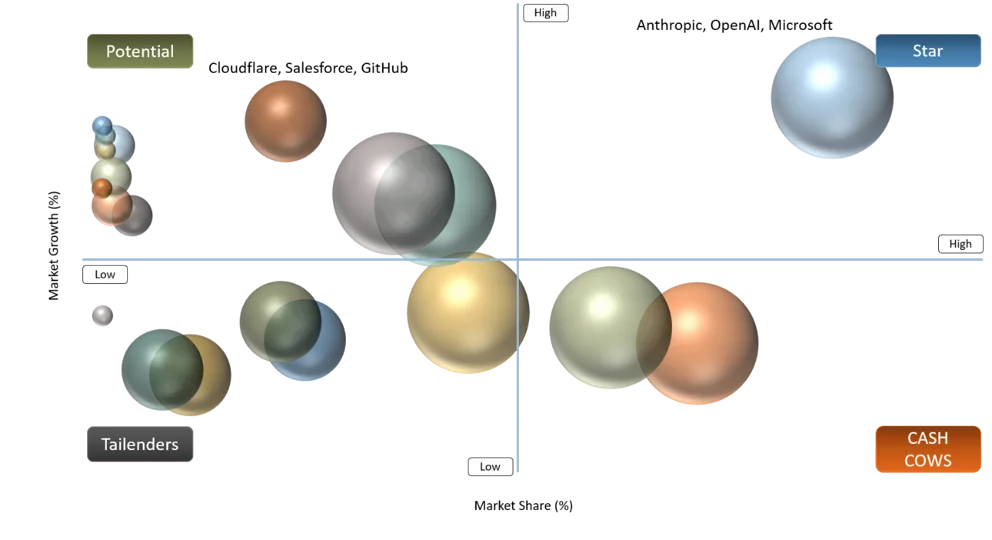
STAR
Anthropic, OpenAI, Microsoft, Google and AWS qualify as Stars in the model context protocol market owing to their robust AI and cloud platforms, wide developer footprint and growing support for integration of the model context protocol in agentic AI and enterprise use cases. Anthropic’s involvement in the development of MCP, along with its adoption by big names in the space of AI and cloud computing, has hastened MCP’s adoption as a standard for interoperability layer in connecting AI agents with external resources and tools. The MCP specification introduced in July 2026, with stateless protocol architecture and enhanced Streamable HTTP functionalities, continues to encourage production-ready usage and bolster the development opportunities for key AI and cloud players.
POTENTIAL
Potential companies operating within the model context protocol market include Cloudflare, Salesforce, GitHub, Figma, Vercel, Supabase and LangChain. These companies have substantial potential to grow their MCP-based business operations since enterprise-level adoption of MCP is moving towards production agentic workflow adoption. Cloudflare has the potential to benefit from MCP-based server hosting, authentication, traffic management and edge computing services; on the other hand, Salesforce and GitHub will have potential to benefit from adoption of MCP into enterprise-level workflows and software development practices. Figma, Vercel, Supabase and LangChain will benefit from the rising demand for MCP-based design workflows, infrastructure for applications, data connectivity solutions and agent development. Transition to stateless MCP environments and adoption of MCP Apps and Tasks increases possibilities for these vendors to become more involved in the developing MCP infrastructure space.
Model Context Protocol Market Dynamics
Driver Impact Analysis
| Driver | Market Growth Impact (%) | Demand Concentration | Impacted Use Case | Strategic Impact |
Rapid Adoption of Agentic AI & Autonomous AI Systems | 32% | Enterprise AI and agent-intensive organizations | AI Agents & Enterprise Automation | Prioritize MCP-enabled platforms that allow AI agents to securely access tools, data and business workflows |
Growing Enterprise Integration of AI with APIs, Data & Applications | 28% | Large enterprises and data-intensive industries | Data & Analytics, Knowledge Management & Business Application Integration | Develop scalable MCP connectivity across databases, APIs, SaaS applications and enterprise systems |
Expansion of MCP Servers, SDKs & Developer Ecosystem | 22% | AI developers, software companies and developer-platform users | Software Development & AI Assistants | Expand MCP server availability, SDK support, registries and developer tooling to accelerate ecosystem adoption |
Increasing Demand for Secure AI Tool Access & Governance | 18% | Regulated industries and large enterprises | Cybersecurity, Customer Service & Enterprise Automation | Strengthen authentication, authorization, access controls, monitoring and governance for enterprise MCP deployments |
Driver: Rapid Expansion of Agentic AI and Autonomous Workflows
The fast adoption of agentic AI and autonomous workflows is one of the leading factors that drive the growth of the MCP market because of the growing need of AI agents for access to external resources and software. This helps to simplify integration with each new AI app without the need for creation of different connections, as it can be done using the reusable connection to all systems compatible with MCP. The stateless protocol architecture that is scheduled for 2026-07-28 will facilitate horizontal scaling of the MCP servers through existing HTTP infrastructure, thus bolstering the need for MCP servers, gateways, security systems and enterprise integration platforms.
Restraint Impact Analysis
| Restraint | Drag on Market Growth (%) | Primary Impact Area | Impacted Use Case | Strategic Impact |
| Security & Data Privacy Concerns | 30% | Sensitive enterprise data and tool access | Enterprise Automation, Data & Analytics, Customer Service | Strengthen authentication, authorization, access controls, encryption, monitoring and governance |
Lack of Standardization Across MCP Implementations | 25% | Interoperability and cross-platform compatibility | AI Agents, Software Development & AI Assistants | Improve specification compliance, SDK interoperability, testing frameworks and compatibility standards |
Complexity of Enterprise MCP Integration | 24% | Legacy systems, APIs, databases and enterprise workflows | Enterprise Automation, Knowledge Management & Data Integration | Provide pre-built connectors, managed MCP gateways, integration tools and professional services |
Limited Enterprise Readiness & Governance Maturity | 21% | Compliance, monitoring, lifecycle management and operational control | Regulated Enterprise AI & Agentic Workflows | Develop enterprise-grade governance, auditing, policy management, observability and lifecycle controls Bottom of Form |
Restraint: Security & Authorization Complexity
Authorization and security challenges represent one of the key constraints on the development of the model context protocol market since this protocol allows AI agents to connect to enterprise applications, APIs, databases and access sensitive data. Enterprises will have to deal with such authorization issues as OAuth-based authorization, security of tokens, access scopes, authentication, confused deputy problem and secure server-to-server communication, adding more complications to deployment and governance. While the 2026 MCP specification added further enhancements to authorization hardening, the NSA has stressed the importance of securing the process of MCP-based AI automation carefully. This can increase both the time taken and the cost involved in adopting the MCP in an enterprise environment.
Model Context Protocol Market Segment Analysis
The global model context protocol market is segmented based on the component, capability, deployment mode, application, organization size, end-user and region.
By Component
MCP Gateway & Integration Platforms lead the market by centralizing agent-to-enterprise connectivity
MCP Gateway & Integration Platforms are the predominant component type with a market share of 32.47%. This is because there is a need to handle connections for various artificial intelligence agents, MCP Servers, APIs, databases, SaaS applications and even enterprise processes through a centralized integration platform. These platforms also include routing, authentication, policy enforcement and multi-server management functionality, which makes them highly useful in deploying MCP within an enterprise setting.
By Application
Cybersecurity emerges as the fastest-growing application as agent tool access expands
The cybersecurity application segment is expected to become the fastest-growing one, exhibiting a CAGR of 44.56% between 2026 and 2035. This can be attributed to growing adoption of MCP technology to interface AI agents with security operations, threat intelligence platforms, monitoring solutions, vulnerability management software and security APIs. With the growing capacity of agents to access and perform security operations on sensitive data, there is a need for authentication, authorization, identification and policies using the MCP approach.
Model Context Protocol Market Geographical Penetration
U.S. Model Context Protocol Market Landscape
The U.S. market for model context protocol is rapidly developing into an advanced ecosystem for AI agent interoperability at enterprise scale with good engagement of Anthropic, Microsoft, GitHub, OpenAI, cloud service providers and enterprise software firms. Increasing use of MCP by U.S. firms to integrate AI agents with APIs, databases, developer tools, SaaS apps and business systems along with development of enterprise-level MCP solutions on the part of Microsoft and AWS provides impetus to the growth of the U.S. MCP market. Availability of a vibrant developer community, in excess of 10,000 active public MCP servers and about 500 million Tier 1 SDK downloads a month is bolstering the U.S. MCP market.
China Model Context Protocol Market Trends
The market for China model context protocol is advancing swiftly towards interoperable agent usage in enterprises, driven by increased acceptance on popular cloud and artificial intelligence platforms. Alibaba Cloud, Tencent Cloud and Baidu are enhancing their MCP offerings for cloud APIs, enterprise applications and AI-agents creation and Alibaba Cloud has launched its managed MCP solutions and MCP-enabled access to its cloud services. China is working on an extensive interoperability framework for AI agents which includes issues such as digital identity, agent discovery, interaction protocol, invocation of tools and task execution, thus forming a unique market setting where MCP acceptance is emerging along with interoperability standards in the country.
Japan Model Context Protocol Market Outlook
The Japan Market Context Protocol (MCP) will be set on a growth path as organizations speed up their adoption of generative AI, AI agents, cloud services and automation solutions in order to fulfill the needs for productivity and labor efficiency. Japanese technology suppliers and system integrators are starting to look into connecting their AI agents to enterprise systems, databases, APIs and business processes using MCP technology solutions, with the demand for secure and governed AI integration being a source of MCP gateways, enterprise connectors and managed services offerings. Japan's robust robot industry, manufacturing, automotive and enterprise information technology sectors also offer a significant application environment for agentic workflow enabled by MCP, especially in industrial automation, software development, customer services and knowledge management.
India Model Context Protocol Market Analysis
India Market Protocol (MCP) for Generative & Agentic AI Market is making progress with more organizations, technology firms and developers implementing deployments of generative AI and agentic AI in their IT services, software development, BFSI, health care and digital commerce applications. With India having a huge developer and system integrator community, the need for MCP for connection between AI agent and enterprise API, database and other SaaS and internal systems is being generated and at the same time, leading IT Services and technology companies are also looking into MCP-based solutions.The focus of the country on AI infrastructure, digital public platforms, data management and cost-effective automation of enterprises is providing openings for the MCP server design, integration services, gateway solutions and MCP infrastructure.
Model Context Protocol Market Competitive Landscape
- Protocol Standardization & Ecosystem Expansion: The competition lies in promoting the developing MCP protocol, SDK and extensions such as MCP Apps and Tasks, with the requirement that all these be interoperable between the AI client, servers and enterprises.
- Enterprise MCP Infrastructure Differentiation: Competitors are using MCP gateways, server management, routing, scalability and deployment through managed services as the 2026 stateless architecture allows MCP servers to scale through standard HTTP infrastructure.
- Security & Governance as Competitive Factors: Authentication, authorization, enterprise identity, access policy, observability and audit functions are gaining importance because of MCP’s integration of AI agents with sensitive enterprise systems.
- Expansion of First-Party MCP Integrations: The biggest players in the field of AI, cloud computing, development software and enterprise software are now offering first party MCP integration to enable communication between the agents and code repositories, databases, SaaS applications, cloud and business process flows, leading to an increased competitive pressure among ecosystems.
- Developer Ecosystem & Server Availability: Competitive advantage now relies on the extent of SDK usage, availability of MCP servers and developer tooling. Tier 1 MCP SDK downloads reached 500 million per month by July 2026.
Public Company Q1-Q2 2026 Performance Comparison
The following table compares five publicly listed companies with material participation in the model context protocol (MCP) ecosystem. Financial metrics are reported at the company level, while MCP exposure reflects each company's relevant AI, cloud, gateway, enterprise-software and agentic-AI activities.
| Company | Q1–Q2 2026 Performance | Model context protocol Exposure | Key Performance Driver |
| Microsoft Corporation | Calendar Q1 revenue US$82.9B, +18% YoY; calendar Q2 revenue US$90.0B, +18% YoY | Very High – MCP support across Microsoft Foundry, Azure, GitHub/Copilot ecosystem and enterprise agent infrastructure | Strong Azure and AI demand; Microsoft AI business exceeded a US$37B annual revenue run rate in calendar Q1 2026 |
| Salesforce, Inc. | FY27 Q1 revenue US$11.1B, +13% YoY; FY27 Q2 revenue US$11.3B, +11% YoY | High – MCP connectivity across Salesforce/Agentforce and Slack; Slack MCP surpassed 1M active users within six weeks of launch | Agentforce, Data 360 and agentic workflows; Agentforce ARR exceeded US$1.5B in Q2 FY27 |
| ServiceNow, Inc. | Q2 revenue US$3.99B, +24% YoY; subscription revenue US$3.88B, +24.5% YoY | High – MCP-related enterprise agent interoperability within ServiceNow's AI and workflow ecosystem | Rapid enterprise AI adoption; ServiceNow AI crossed US$1B in annual contract value in Q2 2026 |
| IBM | Q2 software revenue US$7.8B, +5% YoY; Data revenue +19% YoY | High – Enterprise MCP gateway, governance and integration exposure through IBM's AI and hybrid-cloud stack | Growth in Data, Red Hat and enterprise AI infrastructure; focus on governed AI deployment across hybrid environments |
| Cloudflare, Inc. | Q2 revenue US$696.1M, +36% YoY; current RPO growth 35% YoY | Very High – MCP server hosting, remote MCP infrastructure, authorization, Workers and AI-agent connectivity at the network edge | Rapid developer adoption and growth in machine-to-machine/agent traffic across Cloudflare's connectivity platform |
Note: The financial period varies since businesses have different fiscal years. Company-wide revenue does not represent MCP revenue since the companies do not report revenue from MCP. MCP exposure is a qualitative evaluation of each business based on protocol integration, infrastructure, gateways, agent platform and enterprise artificial intelligence of the company. In the case of Microsoft, the financial period represents the quarters ended March 31 and June 30, 2026 for Q1-Q2 2026, while Salesforce corresponds to FY27 Q1 & Q2.
Key Companies of Model Context Protocol Market
- Anthropic PBC
- OpenAI, LLC
- Microsoft Corporation
- Google LLC
- Amazon Web Services, Inc. (AWS)
- GitHub, Inc.
- Cloudflare, Inc.
- Salesforce, Inc.
- Atlassian Corporation
- Figma, Inc.
- Vercel Inc.
- Supabase, Inc.
- Databricks, Inc.
- Notion Labs, Inc.
- Slack Technologies, LLC
- Zapier Inc.
- LangChain, Inc.
- LlamaIndex, Inc.
- International Business Machines Corporation (IBM)
- ServiceNow, Inc.
Company Profiles
Anthropic PBC
Anthropic is the inventor of the model context protocol, along with being one of the key contributors to its ecosystem and development of specifications. Anthropic has embedded MCP into Claude and its developer toolkit, making it possible for AI applications to interface with external tools and data using a standard interface. Anthropic's priorities revolve around development of MCP interoperability, development of SDKs, authorization and development of agentic workflows with MCP.
The competitive priorities involve the use of MCP in enterprise AI implementations, development of security and interoperability of MCP, specification development for the whole ecosystem and creation of MCP-based agentic architecture.
OpenAI, LLC
MCP has been included in OpenAI's App SDK and ChatGPT developer ecosystem, where developers can develop MCP-driven apps that integrate ChatGPT with other applications and external services. The focus of MCP at OpenAI is gradually moving away from basic connectivity towards interactive apps and agents.
The priorities in the competitive landscape for OpenAI include expanding MCP-driven apps, developing enterprise connectors and agents, enhancing developer tools and interoperability between ChatGPT, Codex and external MCP services.
Microsoft Corporation
Microsoft has been promoting MCP within its Azure AI and development environment through the Microsoft Foundry that creates the infrastructure required to create and govern AI agents. MCP is applicable to Azure, GitHub, Visual Studio and enterprise agent operations where the standardized access to the tools and business processes will minimize integration difficulties.
The competitive advantages consist of improved governance of MCP, increased security in enterprises, enhanced interoperability of agents, deployment on Azure and integration with developer and enterprise software.
Google LLC
Google has been using MCP to integrate it into its Gemini and Google Cloud AI ecosystem, where connections between AI agents and outside tools, data and enterprise services can be facilitated. Its wider cloud and AI ecosystem offers an extensive deployment platform for MCP-based agent workflows in areas such as data analytics, application development and enterprise automation.
Competitor priorities involve further integration of MCP into its ecosystem, agent connections with enterprise data and services, security and governance enhancements and developer adoption of agentic-AI.
Amazon Web Services (AWS)
Expanding MCP is the focus of AWS through the AWS MCP Server and Agent Toolkit, offering AI coding agents secured access to various AWS services via MCP. The infrastructure offered by MCP offers access control to AWS APIs, along with identity, monitoring and governance capabilities.
Competitive priorities are the expansion of MCP access to other AWS services, enhancing identity and governance controls, agent operations and developer adoption of AI agents on AWS.
GitHub, Inc.
GitHub is one of the most important providers of the MCP ecosystem for developers; in its MCP system, AI agents are allowed to communicate with repositories, issues, pull requests and workflows associated with software development. The development of AI coding agents requires direct and controlled access to development environments; this is the area where the capabilities of GitHub's MCP system fit well.
The competitive priorities in the area are related to further development of agent-based software development, improvements of repositories and workflows automation, MCP security and permissions.
Cloudflare, Inc.
A significant infrastructure layer for MCP has been created by Cloudflare, where its MCP server can connect with the application-development services, security and performance services of Cloudflare. The capability of Cloudflare to support stateless MCP makes the company ready for the increasing demand for scalable HTTP-based MCP infrastructure.
The competitive priorities of the company are MCP server hosting, edge infrastructure, authorization, traffic management, security and scalable deployment for enterprise AI workloads.
Salesforce, Inc.
MCP is being expanded at Salesforce across enterprise applications, Data 360, Agentforce and Slack, where MCP servers will facilitate the availability of enterprise functionalities to authorized AI agents. The approach is increasingly making use of interoperability standards to connect CRM data and business processes to agentic AI.
Priorities of the competition are connecting CRM data and business processes to AI agents, improving authorization and governance, MCP servers expansion to Salesforce clouds and Agentforce adoption.
Atlassian Corporation
The inclusion of MCP within the Jira, Confluence and enterprise collaboration platform allows AI agents to interact with information related to project management and knowledge management. MCP enables a consistent method for interfacing agentic tools within Atlassian processes.
Some of the competitive priorities include the expansion of MCP functionality within Jira and Confluence, ensuring security for agent activity, enterprise-level permissions and reusability of Atlassian workflows within multi-agent settings.
Figma, Inc.
The company has secured an effective MCP strategy with the use of its remote and desktop Figma MCP Servers, which enable integration of design data into AI toolkits for development purposes. With the help of such MCP capabilities, agents can get information on the design context and perform AI-driven design-to-code and code-to-design workflows.
Areas of competition include agent-to-design workflows, design-to-code automation, code-to-design interactions and MCP connectivity across the Figma product suite.
Model Context Protocol Market Major Pain Points
- MCP Security & Permission Management: The task of handling authentication and authorization scopes, permissions of tools and security for agents becomes complicated in MCP once AI agents are plugged into sensitive enterprise systems.
- Fragmented MCP Server Quality: Differing implementations of the server itself, tools, error handling and specification support may lead to inconsistent operation of MCP client and server.
- Enterprise Integration Complexity: Integrating MCP with legacy databases, proprietary APIs, SaaS applications and internal applications may involve significant effort.
- MCP Server Discovery & Trust: Enterprises struggle to find reliable MCP servers, authenticate their capabilities, identify security vulnerabilities and handle version control as the market grows.
- Operational Monitoring & Governance: Enterprises require better visibility into MCP tool calls, agent-server communications, latency, errors, access control and auditing especially for production environments and those that are highly regulated.
Model Context Protocol Market Recent Developments
- August 2026 - LangChain, LlamaIndex & Enterprise AI Platforms: Enhanced support for MCP throughout various agent systems, data integration and enterprise AI operations, leading to greater uptake of MCP in tool and data connectivity.
- July 2026 - Anthropic / MCP Community: Launched the MCP 2026-07-28 specification featuring a stateless protocol core, enhancements to the Streamable HTTP scalability, header-based routing, improved authorization and extension capabilities including Tasks and MCP Apps.
- July 2026 - Microsoft & GitHub: Advanced MCP functionalities within enterprise AI and developer ecosystem that enables greater connectivity of AI agents and development environment and enterprise services.
- July-August 2026 - Cloudflare & Vercel: Scalable deployment methods for MCP on remote servers through clouds and serverless computing infrastructure that enables advanced connectivity of MCP based agents.
- June-July 2026 - OpenAI: Extended support of MCP within its agent and developer community environment ensuring better interoperability between various AI applications, third-party tools and other sources of information.
Analyst View / Opinion on Model Context Protocol Market
- MCP is transitioning from an integration standard into foundational agent infrastructure: The stateless core, native HTTP routing and scalable architecture of the 2026-07-28 specification contribute significantly to making MCP suitable for large-scale AI agents.
- Enterprise security will determine the pace of MCP commercialization: Authorization has become one of the primary challenges to be addressed, which highlights the importance of identity, access management and Enterprise-Managed Authorization.
- MCP is expanding beyond basic tool connectivity: MCP Apps and Tasks take the protocol forward to an interactive interface and agent workflow scenarios, thus broadening its uses.
- The ecosystem is creating a new infrastructure opportunity: Growth in MCP servers, SDKs, gateways, observability, security and discovery technologies presents an opportunity beyond the protocol itself, especially around MCP Infrastructure.
- Open governance strengthens MCP’s long-term competitive position: The ongoing evolution of MCP by a wider community of maintainers and ecosystem members limits reliance on a single AI provider and enables the realization of MCP as a common interoperability layer among rival AI ecosystems.
Model Context Protocol Market Target Audience
| INDUSTRY | WHO SHOULD BUY THIS REPORT? | REASON TO BUY THIS REPORT |
| AI & Agentic AI Platforms | AI Platform Providers, Agent Developers & Product Strategy Teams | Assess MCP adoption, agent-tool connectivity, ecosystem growth and competitive positioning |
| MCP Infrastructure & Gateway Providers | MCP Server, Gateway, Proxy & Infrastructure Companies | Evaluate demand for MCP infrastructure, server management, routing, scalability and enterprise deployment |
| Cloud Computing & AI Infrastructure | Cloud Providers, AI Infrastructure & Platform Teams | Identify opportunities to provide hosted MCP servers, gateways, security and agentic-AI infrastructure |
| Enterprise Software & SaaS | SaaS Product Leaders, CTOs & Enterprise Integration Teams | Assess opportunities to enable MCP connectivity across enterprise applications and workflows |
| Developer Tools & IDE Platforms | DevTool Providers, IDE Vendors & Developer Experience Teams | Analyze demand for MCP clients, SDKs, developer tools, coding agents and AI-assisted development |
| Data & Database Platforms | Database Vendors, Data Platform Providers & Data Engineering Teams | Evaluate opportunities to expose enterprise data, databases and knowledge resources through MCP |
| Cybersecurity & AI Security | Security Vendors, CISOs & AI Security Teams | Assess demand for MCP authentication, authorization, tool-access controls, monitoring and governance |
| Enterprise AI & Digital Transformation | CIOs, CTOs, AI Transformation & Enterprise Architecture Teams | Develop MCP adoption strategies and evaluate integration opportunities across enterprise systems |
| IT Services & System Integrators | MCP Consultants, System Integrators & Managed Service Providers | Identify opportunities in MCP implementation, custom server development, integration and managed services |
| Investors & Technology Companies | Venture Capital, Private Equity & Corporate Strategy Teams | Evaluate MCP market growth, emerging business models, competitive landscape and investment opportunities |
Why Choose DATAM?
- Data-Driven insights: Dive into detailed analyses with granular insights such as pricing, market shares and value chain evaluations, enriched by interviews with industry leaders and disruptors.
- Post-Purchase Support and Expert Analyst Consultations: As a valued client, gain direct access to our expert analysts for personalized advice and strategic guidance, tailored to your specific needs and challenges.
- White Papers and Case Studies: Benefit quarterly from our in-depth studies related to your purchased titles, tailored to refine your operational and marketing strategies for maximum impact.
- Annual Updates on Purchased Reports: As an existing customer, enjoy the privilege of annual updates to your reports, ensuring you stay abreast of the latest market insights and technological advancements. Terms and conditions apply.
- Specialized Focus on Emerging Markets: DataM differentiates itself by delivering in-depth, specialized insights specifically for emerging markets, rather than offering generalized geographic overviews. The approach equips our clients with a nuanced understanding and actionable intelligence that are essential for navigating and succeeding in high-growth regions.
- Value of DataM Reports: Our reports offer specialized insights tailored to the latest trends and specific business inquiries. The personalized approach provides a deeper, strategic perspective, ensuring you receive the precise information necessary to make informed decisions. The insights complement and go beyond what is typically available in generic databases.
What DATAM Uniquely Provides
- MCP Ecosystem Mapping: Analysis of MCP protocol users spanning AI platforms, cloud providers, enterprise software, developer tools, data platforms, gateways and integration providers.
- MCP-Specific Market Segmentation: Thorough market segmentation by components, capabilities, deployment models, transports, applications, organization size, industries and regions to uncover high growth pockets in the market.
- Enterprise Adoption & Security Assessment: Analysis of obstacles and prospects for MCP adoption in terms of authorization, identity, governance, access, observability and enterprise integration needs.
- Technology & Ecosystem Evolution Tracking: Examination of emerging MCP innovations such as stateless architectures, Streamable HTTP, MCP Apps, Tasks, SDKs, server discovery and enterprise-level authorization.
- Investment & Competitive Opportunity Analysis: Identification of appealing investment opportunities in areas of MCP servers management, gateways, security solutions, enterprise connectors, observability, discovery solutions and managed MCP ecosystems, along with assessment of ecosystem stakeholders.


























































