


Military Drone Market Size and Overview
The global Military Drone market is estimated at approximately US$ 18.3 billion in 2025 and is projected to reach about US$ 66.5 billion by 2035, representing an estimated CAGR of around 13.8% during 2026-2035. Demand is being supported by defense modernization, persistent ISR requirements, tactical unmanned-system adoption and growing investment in autonomy, resilient communications and scalable production.
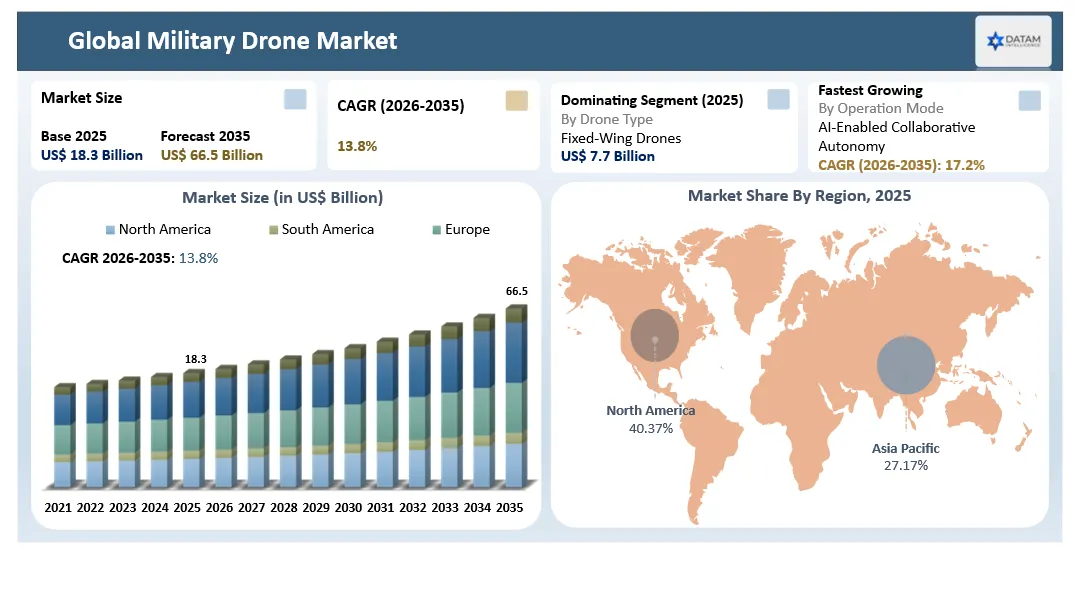
The market spans portable tactical UAVs, MALE and HALE aircraft, combat-capable systems and emerging attritable or collaborative platforms. Competitive advantage is shifting toward modular architectures, trusted electronics, mission software, production capacity and the ability to integrate new payloads quickly.
| Metrics | Details |
| 2025 Market Size | US$ 18.3 Billion |
| 2035 Projected Market Size | US$ 66.5 Billion |
| CAGR (2026-2035) | ~13.8% |
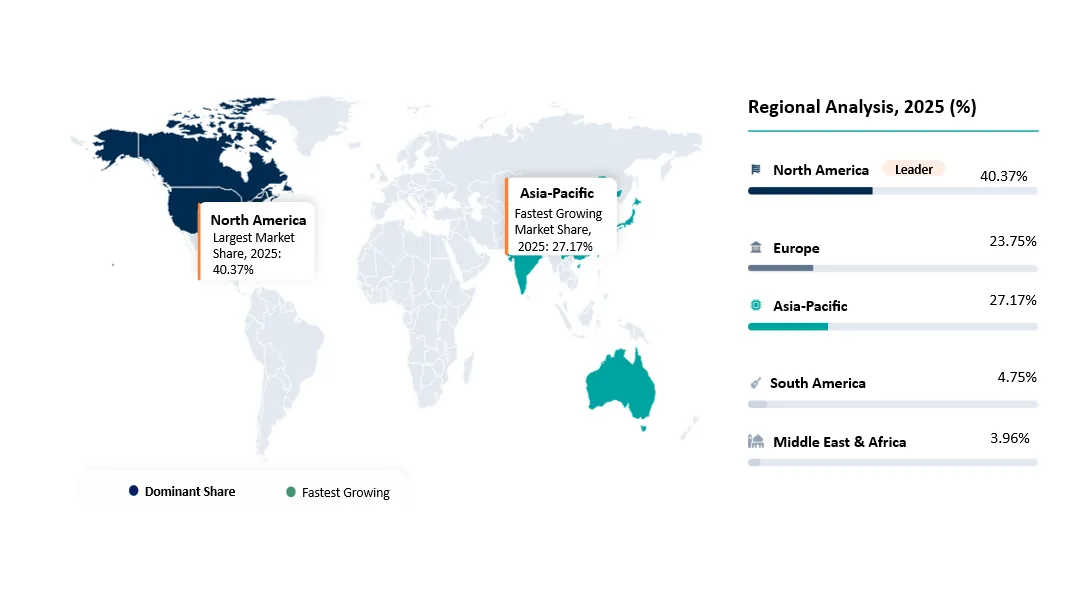
| Largest Market | North America |
| Fastest Growing Market | Europe / Asia-Pacific |
| Largest Drone Type | Fixed-Wing Drones |
| Fastest Growing Technology | AI-Enabled Autonomous / Collaborative UAVs |
| Key Demand Theme | Mass, autonomy and resilient ISR |
| Key Growth Theme | Tactical mass, collaborative autonomy, resilient ISR and scalable production |
Military Drone Market Key Takeaways
- Fixed-wing systems account for a significant share of market value through long-endurance tactical, MALE and HALE programs, while rotary-wing and hybrid / VTOL platforms are gaining importance in short-range and expeditionary missions.
- Tactical and attritable systems are expected to drive the strongest unit growth as armed forces seek affordable mass, rapid replenishment and faster hardware-software refresh cycles.
Military Drone Industry Trends and Strategic Insights
- Demand is increasingly split between high-end persistent ISR platforms and lower-cost tactical or attritable systems that can be procured in greater quantities.
- AI-enabled autonomy, sensor fusion and resilient navigation are becoming procurement differentiators as operators seek systems that can function in contested environments.
- Modular open architectures are gaining importance because defense customers want to integrate new sensors, radios and mission software faster than traditional platform refresh cycles.
- Production scalability and supply-chain resilience are becoming as important as peak platform performance, particularly for expendable and high-attrition mission classes.
- North America remains the largest market, while Europe and Asia-Pacific are accelerating procurement through rearmament, sovereign capability programs and domestic industrial policy.
- Government-to-government channels, direct prime contracts and local industrial partnerships remain central to market access due to export controls and national-security procurement rules.
Why Does This Report Matter in 2026?
This report is relevant since military drone acquisition is moving away from a few valuable aircraft towards reusable, attritable, and expendable unmanned aircraft systems. Large long endurance MALE and HALE UAVs are capital intensive projects, whereas small tactical UAVs and loitering systems are now being acquired in higher numbers.
Military Drone Market White Space & Investment Opportunities
- Low-cost attritable UAVs designed for scalable production and rapid replenishment.
- Collaborative autonomy and human-machine teaming software that can coordinate multiple unmanned platforms.
- Modular payload and open-mission-system architectures that shorten sensor and communications upgrade cycles.
- Resilient navigation, anti-jam communications and onboard perception for operations in communications-degraded environments.
- Tactical logistics drones and autonomous resupply platforms for distributed forces.
- Localized manufacturing and component ecosystems in Europe, India, Japan, South Korea and the Middle East.
Military Drone Future Market Transformation
By 2035, military aviation is expected to operate as a mixed ecosystem of crewed aircraft, large unmanned aircraft, tactical drones and collaborative autonomous systems. Procurement will increasingly emphasize software-defined capability, rapid upgrades and fleet-level effects rather than treating every UAV as a standalone aircraft.
The market is also likely to become more production-sensitive. Recent conflicts have demonstrated that drones can experience high attrition and rapid countermeasure cycles, rewarding architectures that are affordable, modular and fast to manufacture while preserving secure mission capability.
Military Drone Market Buyer Decision-Making Criteria
Defense buyers prioritize mission effectiveness, survivability, payload flexibility, communications resilience, autonomy maturity, operating range, endurance, lifecycle cost, production capacity, exportability and compatibility with existing command-and-control architectures.
Large strategic programs emphasize reliability, payload performance and certification. Tactical programs place greater weight on unit cost, ease of training, portability, replacement speed and the ability to iterate software and hardware quickly.
Military Drone Market Economic & Investment Analysis
The investment case is being strengthened by recurring defense budgets, expanding mission sets and the transition from limited UAV fleets to larger distributed inventories. Growth is increasingly captured not only by airframe primes but also by autonomy software, sensors, secure communications, propulsion, mission computing and sustainment providers.
Capital is concentrating in production automation, autonomy stacks, low-cost propulsion, advanced sensors and vertically integrated manufacturing. Suppliers that can prove both operational relevance and manufacturing scale are better positioned to win multi-year procurement programs.
Military Drone Investment Trends in the Market
- Expansion of production capacity for tactical, attritable and loitering unmanned systems.
- Investment in autonomy, computer vision, collaborative behaviors and mission software.
- Development of resilient communications, alternative navigation and electronic-warfare hardened architectures.
- Acquisition and consolidation of drone, autonomy, counter-UAS and advanced-sensor companies by larger defense groups.
- Localization programs that build sovereign airframe, propulsion, sensor and electronics supply chains.
- Increased funding for test infrastructure, digital engineering and rapid qualification.
Strategic Indicators For the Military Drone Market
High Regulation Impact
Military drones are strongly affected by export controls, airworthiness requirements, spectrum rules, weapons-release authorities, cybersecurity standards and sovereign procurement requirements.
High Investment Activity
Defense ministries are increasing unmanned-system spending, while private capital continues to fund autonomy, robotics and low-cost defense technology companies.
Supply Chain Disruption
Supply chains depend on secure semiconductors, electro-optics, propulsion, communications, navigation components and specialty materials. Export restrictions and single-source components can constrain production.
Pricing Volatility
Pricing spans low-cost portable UAVs to strategic long-endurance systems. Unit economics are increasingly influenced by expected attrition, software content, payload value and production scale.
Procurement Pressure
Buyers demand faster delivery, modular upgrades, open architectures, domestic content, cybersecurity assurance and evidence that suppliers can scale production during surges.
New Technology Adoption
AI-enabled autonomy, onboard perception, collaborative behaviors, alternative navigation and modular mission systems are moving from demonstrations into operational procurement.
Regional Expansion Opportunity
Europe, India, Japan, South Korea and the Middle East are expanding local unmanned-system programs and industrial partnerships alongside continued North American leadership.
Government Policy Support
National defense strategies increasingly identify unmanned systems, autonomy and resilient manufacturing as priority capability areas, supporting procurement and domestic industrial investment.
Pricing Intelligence
Pricing intelligence must distinguish small tactical systems from MALE / HALE aircraft and separate air vehicle, payload, ground-control, software and support value.
Disruption Analysis of Military Drone Market
The largest disruption is the shift from platform-centric procurement toward mass, autonomy and rapid iteration. Smaller systems can be upgraded through software and modular payload changes far faster than traditional aircraft, compressing technology cycles and challenging legacy acquisition models.
Military Drone Market BCG Matrix: Company Evaluation
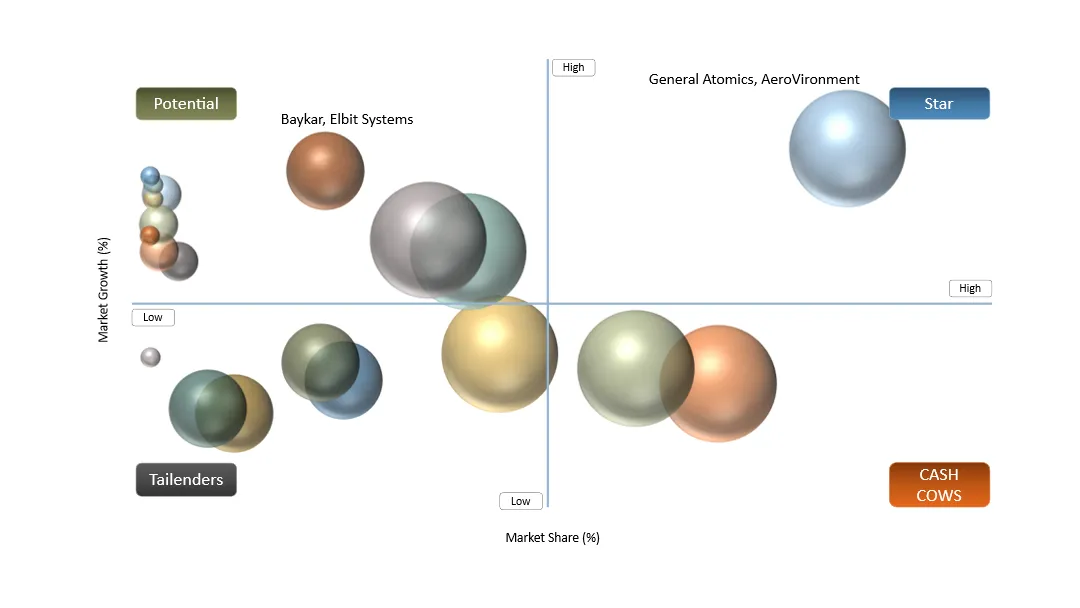
STAR: General Atomics, AeroVironment, Northrop Grumman, Lockheed Martin and Kratos combine strong defense relationships with established or rapidly expanding unmanned portfolios.
POTENTIAL: Baykar, Elbit Systems, IAI, Textron Systems, Anduril and other specialists can capture share through low-cost platforms, autonomy, export success and rapid-production models.
Military Drone Market Dynamics
Driver Impact Analysis
| Driver | Market Growth Impact | Demand Concentration | Impacted Use Case | Strategic Impact |
| Defense modernization and unmanned-system adoption | High | Global defense markets | ISR, tactical operations | Expands UAV inventories across force levels. |
| AI-enabled autonomy and collaborative systems | High | U.S., Europe, Asia-Pacific | Collaborative / attritable platforms | Increases software and mission-computing content. |
| Rising ISR and border/maritime surveillance demand | High | Global | Persistent surveillance | Supports recurring procurement of tactical and MALE platforms. |
| Need for affordable mass and rapid replenishment | Medium-High | NATO, Asia, Middle East | Attritable / tactical systems | Rewards scalable manufacturing and modular designs. |
Driver: Rapid Expansion of Unmanned Systems in Modern Defense Operations
Persistent ISR demand, force-protection requirements and the operational value of distributed unmanned systems are driving procurement across air, land and maritime forces. Drones extend sensing and communications reach while reducing personnel exposure and can be deployed across a wide range of force structures.
Restraint Impact Analysis
| Restraint | Drag on Market Growth | Primary Impact Area | Impacted Use Case | Strategic Impact |
| Electronic-warfare and communications vulnerability | High | Contested operations | All networked UAVs | Raises demand for resilient navigation and communications. |
| Export controls and airworthiness requirements | Medium-High | International procurement | MALE / HALE and armed systems | Lengthens sales cycles and favors established suppliers. |
| Trusted-component and sensor supply constraints | High | Production scale-up | Tactical and advanced platforms | Requires localization and second-source strategies. |
| Rapid technology obsolescence | Medium-High | Lifecycle economics | Small and attritable drones | Accelerates refresh cycles and software-defined architectures. |
Restraint: Electronic-Warfare Vulnerability, Regulation and Procurement Complexity
Military drones operate in contested electromagnetic environments and may depend on communications, navigation and specialized electronic components. Export rules, airworthiness requirements and slow acquisition processes can delay deployment even when operational demand is strong.
Military Drone Market Segmentation Analysis
The global Military Drone market is segmented based on Drone Type, class/size, Range, Operation Mode, Payload Type, Application, End User, procurement model, and region.
By Drone Type
Fixed-Wing Drones Will Retain the Largest Value Share
Fixed-wing systems lead value contribution because long-endurance tactical, MALE and HALE platforms carry larger sensor suites and command-and-control packages. Rotary and hybrid systems are gaining share in short-range missions where vertical takeoff, portability and confined-area operations are important.
By Class/Size
Small / Tactical UAVs Will Drive Unit Volumes
Small and tactical UAVs are expected to account for the largest shipment volumes as forces distribute ISR and targeting capability to lower echelons. MALE and HALE systems remain important for persistent theater-level surveillance and communications missions.
By Range
Short and Medium-Range Systems Will See Broadest Deployment
Short- and medium-range UAVs benefit from tactical ISR, border surveillance, artillery support, convoy protection and local communications relay. Long-range systems remain higher-value but are procured in smaller numbers.
By Operation Mode
Autonomy Will Become a Core Differentiator
Remotely piloted systems remain the installed base, but semi-autonomous and AI-enabled functions are expanding in route planning, sensing, object recognition, navigation and multi-vehicle coordination. Human oversight will remain central for many mission and engagement decisions.
By Payload Type
ISR and Multi-Mission Payloads Will Dominate
EO/IR, radar, SIGINT and communications payloads represent a large share of system value. Modular payload bays and open interfaces are increasingly important because they let operators adapt a common air vehicle to multiple mission sets.
By Application
ISR Will Remain the Largest Application
ISR remains the foundational military-drone mission, while logistics, electronic warfare, communications relay and combat-support roles are expanding. Procurement increasingly favors platforms that can switch among several mission profiles.
By End User
Air Forces and Armies Will Remain the Largest End Users
Air forces dominate large long-endurance programs, while armies are driving tactical and portable UAV demand. Naval forces increasingly deploy unmanned aircraft for maritime surveillance and ship-launched operations.
By Procurement Model
Direct Program Contracts Will Dominate Procurement
Defense procurement is concentrated in direct prime contracts, government frameworks and government-to-government channels. Local industrial partnerships are important where sovereign-content and technology-transfer requirements influence awards.
Military Drone Market Geographical Penetration
U.S. Military Drone Market Landscape
The United States is the biggest national market for unmanned aerial vehicle (UAV) military systems, given the significant spending on its defense budget, procurement programs and investments in autonomous systems, ISR, loitering weapons, and collaborating combat aircraft. Its demand includes small tactical UAVs, MALE, HALE, UCAV, attritable systems, as well as dedicated electronic warfare and ISR UAVs. In addition, the country boasts of a developed defense ecosystem involving primes, technology companies, test centers, and component suppliers for UAV development and implementation.
Japan Military Drone Market Trends
The use of military drones by Japan will continue to grow with the purpose of improving the surveillance of waters and islands as well as border and ISR activities. As more drones are evaluated by the Japan Self-Defense Forces in regard to their performance in geographically spread locations, technology developments and interoperability will increase their demand.
China Military Drone Market Trends
China has built up a substantial domestic ecosystem for military drones that is backed by state-sponsored military programs, extensive production capacity and robust investments in autonomous, ISR and combat drone systems. The country's well-established aerospace and electronics industries form a wide domestic base for the provision of airframes, propulsion, sensors and communications systems.
Middle East and Africa Military Drone Market Outlook
The countries of the Middle East region are making considerable investments in ISR, surveillance and combat drones along with efforts at setting up facilities for building and maintaining the drones domestically. As far as Africa is concerned, their needs in this regard are mainly for border surveillance, anti-terrorism, intelligence gathering, and reconnaissance.
Military Drone Market Competitive Landscape
- Competition is concentrated among suppliers with operational heritage, qualified air vehicle components, dedicated aerospace engineering and long-term program relationships.
- Military Drone Competitive Landscape
- Competition is becoming more fragmented as established aerospace primes face fast-growing defense-technology specialists. Winning strategies combine mission credibility, modular open systems, autonomy, production scale, secure supply chains and the ability to support rapid field-driven upgrades.
- Regional localization is becoming a competitive factor as governments seek sovereign unmanned-system production and reduced dependence on foreign electronics, propulsion and payload supply.
Public Company Q1-Q2 2026 Performance Comparison
| Public Company | Q1-Q2 2026 Performance Snapshot | Military Drone Exposure | Factors Driving Growth |
| Lockheed Martin (NYSE: LMT) | Q2 2026 sales were US$20.1B, up about 11% YoY; backlog reached a record US$230B. | Strategic exposure through advanced air systems, autonomy, sensors and collaborative combat-aircraft development. | Higher defense demand, production expansion, digital engineering and autonomous / collaborative air-system investment. |
| Northrop Grumman (NYSE: NOC) | Q2 2026 sales were about US$10.9B, up 5% YoY. | Direct exposure through high-altitude unmanned aircraft, autonomous systems and integrated mission systems. | Persistent ISR demand, classified air programs, mission systems and higher defense modernization budgets. |
| AeroVironment (NASDAQ: AVAV) | Fiscal Q4 2026 revenue was US$641.6M; FY2026 revenue reached US$1.98B, up 141% YoY, with funded backlog of US$1.2B. | Highly direct exposure through small UAS, autonomous systems, loitering systems and related defense technologies. | Tactical UAS demand, BlueHalo integration, autonomy, international orders and U.S. Army production programs. |
| Kratos Defense (NASDAQ: KTOS) | Q2 2026 revenue was US$458.8M, up 30.5% YoY; the company raised full-year guidance. | Direct exposure through Valkyrie and other high-performance unmanned aircraft and target-drone programs. | Attritable UAV demand, tactical-drone production, defense budget growth and expanding government programs. |
| Textron (NYSE: TXT) | Q2 2026 revenue was US$3.8B, up 3% YoY, with growth across manufacturing segments. | Direct exposure through Textron Systems tactical UAS and adjacent defense platforms. | Tactical ISR demand, installed-base sustainment, modernization and broader defense procurement. |
Market Ecosystem Table
| Value-Chain Sector | Representative Companies / Organizations | Role in Military Drone Ecosystem |
| Airframes & Prime UAV OEMs | General Atomics, Northrop Grumman, AeroVironment, Kratos, Textron Systems, Boeing / Insitu, Elbit Systems, IAI, Baykar | Design and manufacture military UAV platforms, ground-control systems and integrated mission solutions. |
| Propulsion & Power Systems | Honeywell, Rolls-Royce, GE Aeromilitary, Pratt & Whitney, UAV Turbines, specialty electric-propulsion suppliers | Provide engines, turbines, propulsion subsystems, generators and power-management hardware. |
| Sensors & Mission Payloads | L3Harris, RTX, Teledyne FLIR, Leonardo, Thales, Hensoldt, Elbit Systems | Provide EO/IR, radar, SIGINT, EW, targeting and communications payloads. |
| Autonomy, Mission Computing & AI | Anduril, Shield AI, AeroVironment / BlueHalo, Lockheed Martin, Northrop Grumman, Kratos | Provide autonomy stacks, onboard perception, mission software, collaborative behaviors and edge computing. |
| Secure Communications & Navigation | L3Harris, Collins Aeromilitary, Viasat, Thales, Honeywell, specialized PNT vendors | Provide datalinks, SATCOM, anti-jam communications, navigation and resilient PNT. |
| Defense Primes / System Integrators | Lockheed Martin, Northrop Grumman, Boeing, RTX, Leonardo, Saab, Rheinmetall | Integrate UAVs into broader air-defense, ISR, command-and-control and joint-force architectures. |
| Government & Defense Buyers | U.S. DoD, NATO members, European defense ministries, India MoD, Japan MOD, Australia DoD, Middle Eastern defense ministries | Set requirements, fund programs, manage procurement and define interoperability and sovereign-content rules. |
| Testing, Certification & Training | Defense test ranges, military airworthiness authorities, simulation and training providers | Support qualification, flight testing, operator training and mission validation. |
| MRO, Logistics & Sustainment | OEM support organizations, defense logistics agencies, specialized MRO providers | Provide spares, depot support, software updates, field service and fleet sustainment. |
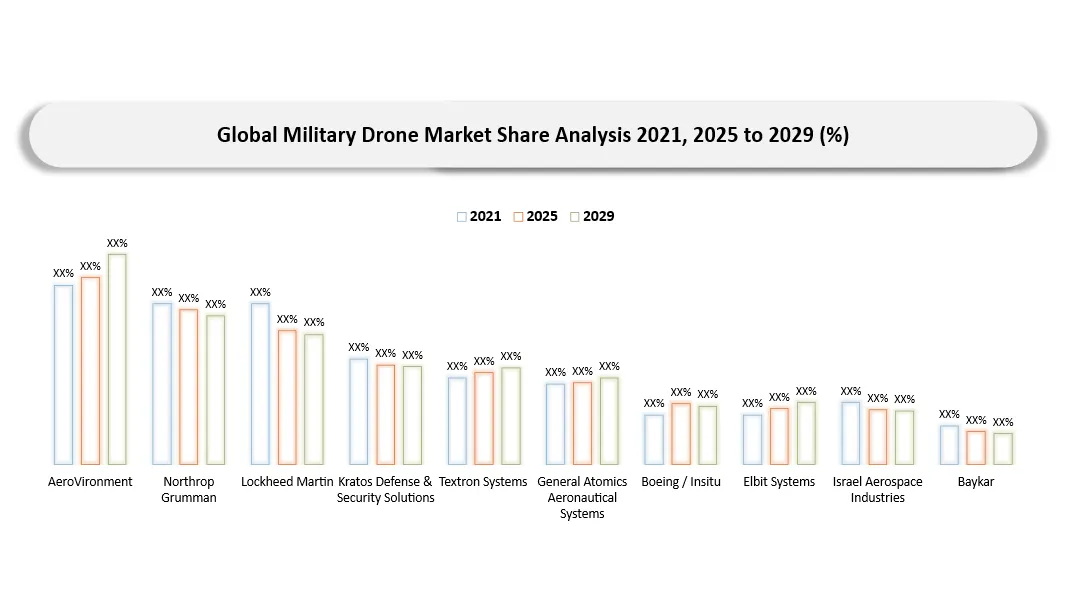
Key Companies
- AeroVironment
- Northrop Grumman
- Lockheed Martin
- Kratos Defense & Security Solutions
- Textron Systems
- General Atomics Aeronautical Systems
- Boeing / Insitu
- Elbit Systems
- Israel Aerospace Industries
- Baykar
- Leonardo
- Thales
- Saab
- Rheinmetall
- Anduril Industries
Company Profiles
AeroVironment
AeroVironment is a major U.S. defense technology supplier with broad exposure to small unmanned aircraft, autonomous systems and loitering systems. Its portfolio and recent acquisitions position it across tactical UAS, autonomy and adjacent counter-UAS markets.
Competitive priorities include production scaling, autonomy, modular payloads, software integration, tactical portability and rapid delivery against expanding U.S. and allied demand.
Northrop Grumman
Northrop Grumman has long-standing experience in high-altitude and strategic unmanned aircraft, mission systems, autonomy and advanced defense aerospace. Its competitive position is strongest in complex, high-value systems integrated with broader sensing and command networks.
Competitive priorities include advanced mission systems, secure networking, autonomy, persistent ISR and integration with broader joint-force architectures.
Lockheed Martin
Lockheed Martin participates in unmanned aviation through advanced air systems, autonomy, collaborative platforms, sensors and mission integration. Its scale allows it to connect unmanned systems with broader air, missile-defense and command-and-control ecosystems.
Competitive priorities include collaborative combat aircraft, open mission systems, autonomy, secure communications and integration with crewed platforms.
Kratos Defense & Security Solutions
Kratos is a prominent supplier of high-performance, lower-cost unmanned jet aircraft and target systems, with a strategy centered on attritable and affordable mass. The XQ-58A Valkyrie has made the company particularly visible in collaborative and tactical unmanned-aircraft programs.
Competitive priorities include affordability, rapid production, jet-powered unmanned systems, collaborative autonomy and scaling production capacity.
Textron Systems
Textron Systems supplies tactical unmanned aircraft and associated command-and-control solutions, including the Shadow and Aerosonde families. Its installed base and defense relationships support opportunities in upgrades, services and next-generation tactical systems.
Competitive priorities include tactical ISR, modular payloads, expeditionary operations, sustainment and integration with multi-domain force structures.
General Atomics Aeronautical Systems
General Atomics Aeronautical Systems is one of the most established military-UAS manufacturers globally, with the Predator, Reaper and Gray Eagle families and a large international installed base. The company remains a benchmark supplier for MALE and persistent ISR systems.
Competitive priorities include long endurance, multi-mission payloads, autonomy, export programs, maritime ISR and next-generation collaborative capabilities.
Military Drone Market Major Pain Points
- Exposure to electronic warfare, GPS denial and communications disruption in contested environments.
- Long procurement and certification cycles for complex military air systems.
- Dependence on specialized sensors, propulsion, secure semiconductors and communications components.
- Rapid obsolescence as countermeasures and autonomy technologies evolve.
- Balancing affordability and attritability with survivability, range and payload performance.
- Export-control and sovereign-content restrictions that fragment global supply chains.
- Difficulty scaling production quickly enough to support surge demand and replenishment.
- Cybersecurity and trusted-software requirements across increasingly autonomous platforms.
Military Drone Market Recent Developments
- August 2026: Kratos reported strong Q2 growth and continued investment in tactical drone production, including the Valkyrie family and other unmanned systems.
- July 2026: AeroVironment announced a US$117.3 million U.S. Army production contract for its P550 unmanned aircraft, reinforcing demand for next-generation tactical UAS.
- July 2026: AeroVironment also announced a US$500 million IDIQ award supporting the Domestic Shield counter-UAS program, illustrating the broader convergence of unmanned and counter-unmanned portfolios.
- March 2026: U.S. and allied defense programs continued to accelerate collaborative combat aircraft, attritable autonomy and tactical UAS procurement, supporting a broader shift toward mixed crewed-uncrewed force structures.
- January 2026: European and Asia-Pacific defense ministries expanded domestic drone industrial strategies and procurement pathways in response to operational lessons and supply-chain security priorities.
Analyst View / Opinion on Military Drone Market
- Military drones are moving from specialized assets to a core layer of modern force structure, increasing both unit demand and the strategic importance of production capacity.
- The fastest growth is likely to occur in tactical, attritable and collaborative systems rather than only in high-end strategic UAVs.
- Autonomy and mission software will capture a rising share of value as platforms become more modular and field upgrades become more frequent.
- Traditional aerospace primes retain advantages in complex integration, while smaller defense-technology firms can gain share through speed, affordability and software-centric development.
- The strongest competitive moat will combine operational credibility, scalable manufacturing, trusted electronics and the ability to update mission software rapidly.
- Regional defense-industrial policy will increasingly determine where production, final assembly and sensitive electronics are sourced.
Military Drone Market Target Audience
| INDUSTRY | WHO SHOULD BUY THIS REPORT? | REASON TO BUY THIS REPORT |
| Defense UAV OEMs | Strategy, business development, product and program teams | Benchmark market growth, mission segments, competitors and procurement opportunities. |
| Sensors, Communications & Autonomy Suppliers | Business development, R&D and product teams | Identify payload, autonomy, networking and mission-computing white militarys. |
| Defense Ministries & Agencies | Program offices, procurement and capability planners | Assess technology shifts, supplier landscape, sourcing risk and regional capability trends. |
| Defense Primes & Integrators | Corporate strategy, capture and partnership teams | Evaluate make-buy-partner decisions and integration opportunities. |
| Investors & Consulting | PE, VC, public-market investors and strategy teams | Evaluate growth themes, supplier positioning, consolidation and technology risk. |
| MRO / Training / Test Providers | Service-development and commercial teams | Identify recurring lifecycle-support and qualification demand. |
Why Choose DATAM?
- Data-driven insights combining defense procurement, drone class, autonomy, payload architecture and supplier benchmarking.
- Post-purchase analyst consultations for market entry, partnership screening, program prioritization and custom forecasting.
- Annual updates covering procurement awards, defense budgets, major exercises, production investments and autonomy milestones.
- Specialized focus on rapidly evolving tactical and attritable unmanned systems as well as established long-endurance programs.
- Actionable analysis linking mission requirements with platform economics, payload mix, autonomy and procurement channels.
What DATAM Uniquely Provides
- Ten-year forecasts across eight segmentation categories and five regions.
- Mission-specific analysis separating tactical, MALE, HALE, combat and collaborative unmanned-aircraft requirements.
- Competitive benchmarking of established aerospace primes and fast-growing defense-technology specialists.
- Market ecosystem mapping from propulsion, sensors and mission computing through primes, integrators and defense customers.
- Public-company performance comparison linked to specific military-drone growth drivers.


























































