


Microfluidic Coolants Market Size and Overview
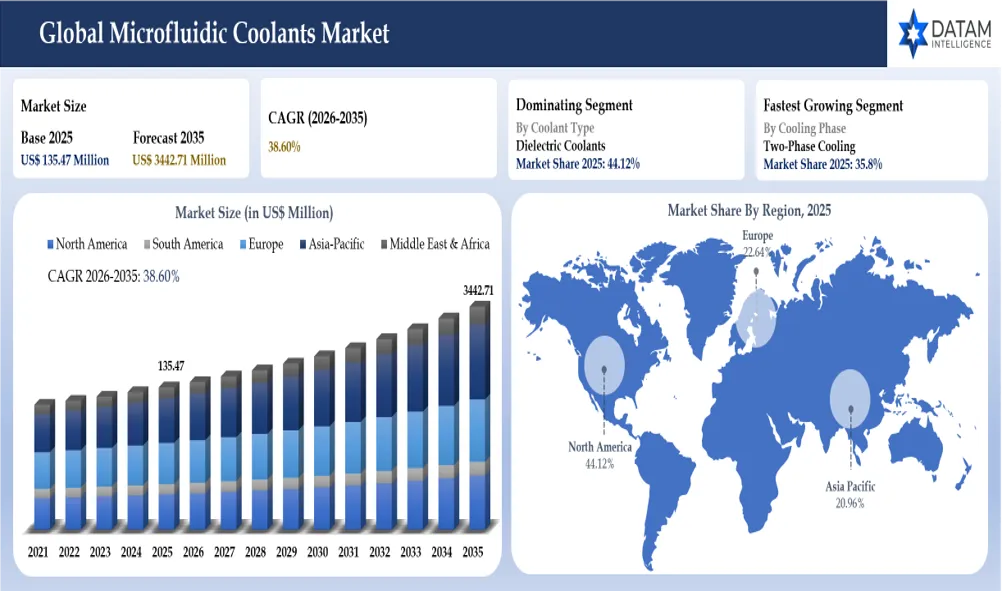
The global microfluidic coolants market reached US$ 135.47 million in 2025 and is expected to reach US$ 3442.71 million by 2035, growing with a CAGR of 38.60% during the forecast period 2026-2035.
Factors influencing the growth of the global microfluidic coolants market include rising heat loads of AI accelerators, GPUs, HPC chips, 2.5D/3D ICs, chiplets and powerful semiconductors. The demonstrated microchannels’ thermal performance capacity is beyond 1,000 W/cm², stressing the need for the development of coolants with low viscosity, excellent heat transfer performance, well-controlled dielectric characteristics and good material compatibility. This is resulting in growing demand for dielectric, fluorinated, water, nanofluids and phase change coolants tailored to microscale flow applications rather than traditional bulk cooling applications.
The market is also evolving in the direction of coolant design for specific applications because of the need for better control of contamination, pressure drop, corrosion, thermal stability and phase change in embedded, backside, direct-to-chip and packaging-level microfluidics. The results from microfluidics studies have shown thermal resistance of the order of 0.02°C/W in the most advanced 2.5D integrated circuit chips, while the next generation of AI infrastructure is expected to generate extremely high heat loads at the rack level. Such advancements are motivating coolant manufacturers to collaborate in developing fluids with semiconductor and thermal management firms, thereby making coolant chemistry an indispensable aspect of the future chip-cooling technology designs.
Microfluidic Coolants Market Key Takeaways
- Dielectric Coolants were the most popular product type in the global microfluidic coolants market in 2025 and held around 44.12% market share on account of their electrical insulation properties, low viscosity, thermal stability and use in direct chip, embedded microchannel and high heat flux semiconductor cooling applications.
- Two-Phase Cooling is estimated to be the fastest growing cooling phase segment and would witness 42% CAGR in the period 2026–2035 owing to the capability of this technology to dissipate concentrated heat via phase change in microchannels.
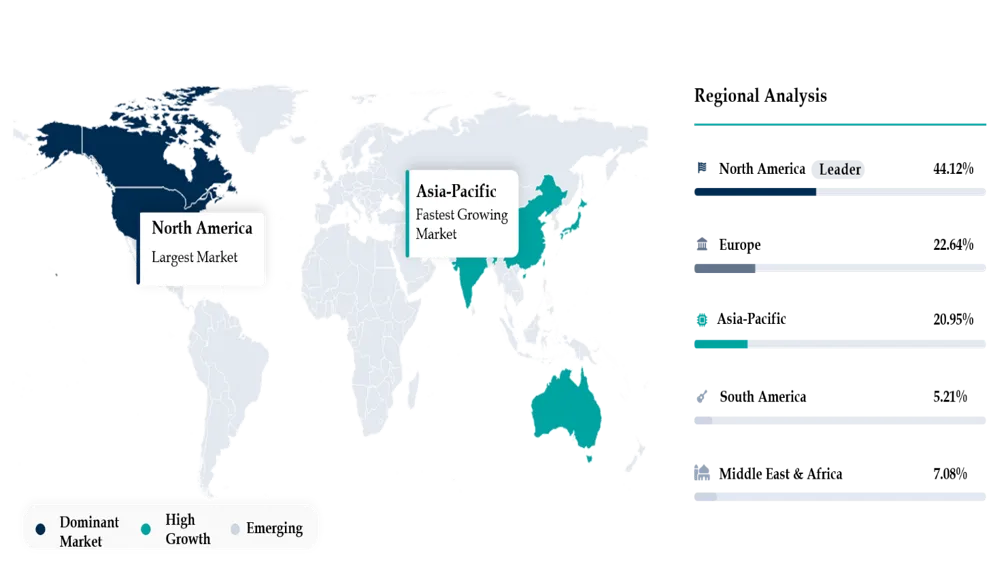
- North America had an overwhelming share of 44.12% of the microfluidic coolants market in 2025 owing to investments in AI data centers, hyperscale computing, semiconductor fabrication processes and high-performance computing infrastructure.
- Rising use of AI accelerators, GPUs, HBM, chiplets and 2.5D/3D ICs is pushing the demand for special coolants that have low viscosity, high purity, low pressure drop and dielectric properties and that are compatible with copper, silicon, polymers, GaN and SiC.
- Rising adoption of microfluidic cooling from the backside, embedded microfluidic cooling and direct-to-chip configurations is offering opportunities for the development of coolants tailored to specific applications along with microchannels, flow conditions and semiconductor materials.
Microfluidic Coolants Industry Trends and Strategic Insights
- Shift toward ultra-low-viscosity coolants for microscale channels: The coolants being developed are those having low viscosity and constant thermophysical characteristics so that maximum flow rate is maintained, but there is minimum pressure loss and pumping power in the microchannel.
- Growing adoption of electrically insulating coolants: Electrically dielectric and fluorinated coolants have assumed significance for cooling mechanisms near the processors and power modules and semiconductors wherein electrical insulation becomes very important.
- Development of coolants for two-phase microchannel cooling: Increasing attention is being paid to design coolants that can achieve controlled boiling and condensation of vapor in microchannels and have heat extraction capacity much greater than that of normal single-phase cooling.
- Greater emphasis on coolant-substrate compatibility: The formulation development process is now taking into account the aspects of corrosion, deposition, particle generation, chemical degradation and compatibility of coolant with silicon, copper, aluminum, plastics, seals and next-generation semiconductor packaging materials.
- Integration of coolant development with advanced chip architectures: Specifications for coolants are increasingly being developed to cater to 3D ICs, chiplets, high bandwidth memory, AI accelerators, gallium nitride and silicon carbide devices and direct-to-package cooling applications where localized heat flux and non-uniform thermal profile necessitates more than data-center cooling fluids.
Microfluidic Coolants Market Scope
| Metrics | Details | |
| 2025 Market Size | US$ 135.47 million | |
| 2035 Projected Market Size | US$ 3442.71 million | |
| CAGR (2026-2035) | 38.60% | |
| Largest Market | North America | |
| Fastest Growing Market | Asia-Pacific | |
| By Coolant Type | Water-Based Coolants, Water-Glycol Coolants, Dielectric Coolants, Fluorinated Coolants, Engineered Nanofluids, Phase-Change Coolants and Other Coolant Types | |
| By Cooling Phase | Single-Phase Cooling and Two-Phase Cooling | |
| By Cooling Architecture | Microchannel Cooling, Embedded Microfluidic Cooling, Direct-to-Chip Cooling, Direct-to-Package Cooling, Interposer-Level Cooling, Intra-Chip Cooling, Backside Microfluidic Cooling and Other Microfluidic Cooling Architectures | |
| By Cooling Loop | Open-Loop Cooling and Closed-Loop Cooling | |
| By Application | CPUs, GPUs, AI Accelerators, High-Bandwidth Memory, Chiplets, 2.5D/3D ICs, Power Semiconductors, RF Devices, Photonic Devices, High-Power LEDs and Other Electronic Components | |
| By End Use | Data Centers, High-Performance Computing, AI Infrastructure, Telecommunications, Automotive Electronics, Consumer Electronics, Industrial Electronics, Aerospace & Defense, Research & Laboratory Systems and Other End Uses | |
| By Region | North America | U.S., Canada, Mexico |
| Europe | Germany, UK, Russia, France, Spain, Italy, Poland | |
| Asia-Pacific | China, India, Japan, Australia, South Korea, Indonesia, Malaysia, Singapore, Vietnam, Thailand, Philippines, Taiwan | |
| South America | Brazil, Argentina | |
| Middle East and Africa | UAE, Saudi Arabia, South Africa, Israel, Turkiye, Nigeria | |
| Report Insights Covered | Competitive Landscape Analysis, Company Profile Analysis, Market Size, Share, Growth | |
Why does this report matter in 2026?
The microfluidic coolants market in 2026 is increasingly significant since the usage of AI accelerators, advanced processors, 3D IC chips, chiplets and GaN/SiC devices leads to localized heat generation. Traditional cooling methods have encountered limitations related to localized heat flux, heat distribution uniformity and heat dissipation at the package level, which has led to the importance of coolants tailored for microchannel applications. This has made it necessary for companies to understand the viscosity, thermal characteristics, dielectric properties, purity, materials compatibility and two-phase aspects of coolants.
The significance of the report in 2026 arises due to the transition from a cooling fluid selection process to an application-oriented engineering process. Companies such as semiconductor companies, advanced packaging developers, artificial intelligence infrastructure companies and companies dealing in thermal management increasingly require an analysis of the fluid along with the microchannel design, flow conditions, materials used and reliability aspects. The report provides insight into new cooling fluid chemistry, white spaces in technology, investment areas, material compatibility issues and applications where microfluidic coolants can create differentiation.
Microfluidic Coolants Market White Space & Investment Opportunities
- High-heat-flux coolant formulations for AI and advanced semiconductor cooling: There are investment opportunities in the development of low-viscosity, high-heat transfer coolants that are specially designed to cool micro-channel cooling of AI accelerators, GPUs, chiplets and advanced packages running at higher concentrated heat fluxes.
- Two-phase coolant platforms for ultra-high heat removal: There is white space in the area of designing engineering fluids that will support stable nucleate boiling and efficient vapor and condensation within micro-channels for cases where the limits of single-phase cooling are exceeded.
- Low-GWP dielectric coolant development: Investments can be made on electrically insulating liquids with reduced environmental footprint, high material compatibility and thermal stability for direct-to-chip and direct-to-package microcooling.
- Coolants optimized for advanced semiconductor materials: There is scope for coolants which have been developed keeping in mind the requirement for advanced semiconductors made up of copper, silicon, silicon carbide, gallium nitride, polymers and advanced semiconductor packaging materials to avoid corrosion and deposition.
- Application-specific coolant formulations and fluid-management systems: A growing white space can be seen in the development of custom-tailored coolant systems based on specific microchannel geometry, flow rate, heat flux and operating temperature ranges.
Microfluidic Coolant's Future Market Transformation
The microfluidic coolants market is projected to move towards supplying very sophisticated design coolants rather than just heat transfer fluids. In the future, all-important aspects like low viscosity of these fluids, formulation of highly pure dielectric fluids, use of low GWP chemicals and formulation of two-phase coolants that can manage high heat loads occurring in AI processors, advanced ICs, chiplets, packages using HBM, GaN or SiC power chips would be important. Differentiation for coolant manufacturers will come from their compatibility with various materials, contamination resistance, durability and optimal digital thermal performance and cooperation with developers of semiconductors, packages and cooling systems is expected to turn coolant design into an integral element of future thermal architecture instead of an independent consumable component.
Microfluidic Coolants Market Buyer Decision-Making Criteria
Microfluidic coolants market buyers are assessing coolants not only for their capacity to provide stable heat transport in microchannels without causing any pressure drop, contamination, corrosion, or degradation of the material but also considering more complex issues such as fluid properties, electrical characteristics, compatibility with semiconductor packages, reliability under high heat flux conditions and the impact on the system as a whole. For AI processors, advanced packaging and GaN/SiC technologies, there is also a need to provide proof that the coolant is capable of working continuously in the channel dimensions and temperature range of the particular cooling system.
Major Buyer Criteria
- Thermal conductivity and specific heat capacity
- Viscosity and pressure-drop characteristics
- Dielectric strength/electrical conductivity
- Boiling and critical heat-flux performance
- Microchannel and package-material compatibility
- Purity, contamination and corrosion control
- Long-term chemical and thermal stability
- Environmental profile/GWP
- Qualification and reliability data
- Total cost of ownership
Microfluidic Coolants Market Economic & Investment Analysis
The economic future of the microfluidic coolants market is growing to be more dependent on capital investments in AI data centers, advanced semiconductor manufacturing facilities, HPC systems and packaging. With the increasing power density of processors, the need for cooling technology shifts from facility-level fluids to chip-level thermal management, driving demand for custom-designed coolants instead of standard coolant technologies. Therefore, investments are being made into high-purity dielectric liquids, lower viscosity liquids, two-phase coolants and liquids suitable for copper, silicon, gallium nitride, silicon carbide and advanced package materials, where value creation will be driven by thermal performance, reliability and qualification rather than coolant volume alone.
There are also opportunities for investment in the coolant development and microfluidic thermal management field, encompassing everything from formulation R&D, highly purified coolant manufacture, coolant purification, testing and qualification for use in applications. The investors and technology providers will be looking at options that can provide stable operation under conditions of high heat flux, while controlling pressure drop, corrosion, contamination and instability of two-phase flow. Opportunities at a strategic level are especially important when coolant providers partner with companies in the semiconductor industry, advanced packaging design firms, AI accelerator businesses and microchannel coolers system companies, which allows for the development of tailor-made coolants and partnerships, rather than selling commodity coolants.
Microfluidic Coolants Investment Trends in the Market
- Investment in next-generation dielectric coolant formulations: Funding is being allocated for fluids which provide electrical insulation properties together with superior thermal, chemical and viscosity characteristics for cooling using direct to chip and micro-channel architectures.
- Funding for two-phase microfluidic cooling technologies: Funding is going towards coolant systems which can utilize controlled boiling and condensation for handling extremely high heat fluxes from AI accelerators, supercomputers and semiconductor packages.
- Expansion of specialty coolant production capabilities: Coolant manufacturers are making investments in the ability to formulate, purify, blend and quality control specialty high purity coolants used in semiconductor and electronics cooling applications.
- Investment in environmentally improved coolant chemistries: Research & development funds are now being invested in environmentally friendly dielectric and phase change fluids that have low GWP without compromising on the thermodynamic and reliability attributes necessary for micro-cooling.
- Strategic investment around advanced semiconductor packaging: Companies providing fluid solutions and those involved in thermal management are now investing in fluids for 3D IC, chiplet technology, high bandwidth memory, GaN/SiC devices and direct-to-package microfluidics cooling.
Strategic Indicators for Microfluidic Coolants Market
High Regulation Impact
Regulatory considerations have an important influence on the microfluidic coolants market in terms of the use of fluorinated, dielectric and phase change coolants formulations in the proximity of semiconductors. PFAS and other fluorinated chemicals regulation, chemical registration, occupational safety, disposal and the ever-growing environmental considerations may influence formulation of a coolant, its qualification, manufacturing and commercialization. These requirements are particularly significant for companies developing the next generation of coolants for use in microchannel and direct chip cooling as well as cooling of advanced semiconductor packages because changing a regulated coolant entails validating its performance and compatibility properties.
High Investment Activity
Microfluidic coolants market investment trends are becoming more pronounced among coolant chemistries which can sustain AI accelerators, high-performance CPUs, semiconductor packaging technologies and power devices that generate high heat fluxes. Investments are being made in dielectric fluids with extremely high purity, fluids with very low viscosity, two-phase coolants and low GWP alternatives, along with the expertise to purify, test and qualify these fluids. Strategic investments have also become evident at the interface of coolant vendors, semiconductor manufacturers, microchannel experts and advanced packaging firms, where co-development could ensure that the coolant composition would be optimized for certain channel characteristics and operating conditions.
Supply Chain Disruption
The microfluidic coolants market may experience disruptions in supply chain owing to the dependence of the special coolant formulation on few qualified suppliers of high purity fluorinated chemicals, dielectric fluid raw materials, specialty additives, corrosion inhibitors and materials for purification. Any disruptions in the production and transportation of the chemicals, any environmental regulations, or semiconductor grade purification capacity will extend the process of qualification because some alternative fluids will not necessarily be able to be used right away without repeating the process of validating their thermal characteristics, viscosity, material compatibility, contamination level and reliability. This poses specific supply risk for emerging two-phase and dielectric coolants employed in semiconductor and microchannel cooling systems, where constant chemical composition is essential in maintaining system efficiency.
Pricing Volatility
In the microfluidic coolants market, pricing variability regarding high-purity dielectric and fluorinated fluids is significant due to reliance on specialized chemical feedstocks, the scarcity of qualified supplier companies, high purity standards and expensive reformulation and validation. The significance of the advent of alternative coolant chemistries and replacement fluid qualification has grown very much following completion of the PFAS exit by 3M at the end of 2025, leading to a much higher price difference for established oils and new high-purity alternatives. For example, prices provided by suppliers for special fluorinated cooling fluids may range from tens of dollars per kilogram up to several hundred dollars, depending on the chemistry, purity, packaging volume and grade of application. Thus, the existence of 2× price ratio between traditional and special grades of coolants may cause significantly higher operational expenses of microfluidic cooling systems especially when semiconductor purity and validated compatibility are needed.
Procurement Pressure
Pressure is mounting in the procurement environment for the microfluidic coolants market, as semiconductor manufacturers, AI infrastructure providers and advanced packaging companies need highly pure coolants with precise control over their viscosity, electrical characteristics, level of contamination and compatibility with materials. Pressure is growing due to the fact that coolant replacement may be a costly process in terms of the need to validate the coolant’s thermal, chemical and reliability performance, which makes supplier qualification and continuity just as relevant as cost. As such, there is growing emphasis on dual sourcing, long-term supply contracts, lot-to-lot consistency, purity verification, regulatory compliance and validated substitutes in procurement circles, especially for dielectric and two-phase fluids where the number of suppliers with technical know-how is limited.
New Technology Adoption
Technology adoption in the microfluidic coolants market is focusing on the use of two-phase microchannel cooling systems, advanced dielectric fluids, low-viscosity coolants and special fluids suited to specific applications based on the growing heat density of semiconductors. Technology adoption is especially applicable to AI accelerators, 3D ICs, chiplets, HBM-capable packaging and GaN/SiC power devices, where coolant performance has to match that of microchannel geometry, properties and conditions. Future systems will integrate microchannels with thermal sensing and flow control systems in real-time, thus creating an increase in need for fluids that remain consistent with respect to viscosity, phase transition, purity and materials compatibility under varying heat loads.
Regional Expansion Opportunity
There are significant chances for growth in the microfluidic coolants market in regions known for their semiconductor and AI-computing industries due to the need for package thermal management caused by rising chip power density. The United States, via its artificial intelligence data centers, advanced semiconductor production facilities and high-end computing resources, is expected to present growth opportunities for the microfluidic coolants market. China offers similar prospects in domestic semiconductor production, packaging processes and power electronics, whereas Japan provides possible openings in manufacturing semiconductor materials, advanced packaging processes and high-reliability electronics. South Korea and Taiwan offer further growth potential for the microfluidic coolants market by virtue of their state-of-the-art memory, logic, chiplet and packaging activities that require technologically advanced low-viscosity coolants efficient for microscale thermal management processes.
Government Policy Support
Government policy is indirectly facilitating growth in the microfluidic coolants market by supporting initiatives that favor semiconductor fabrication, advanced packaging, AI infrastructure, high-performance computing and domestic electronics production. The government initiatives will ensure that higher density chipsets and advanced packaging structures are used which means increased usage of micro-channel and package-level cooling solutions. Meanwhile, environmental policies related to the use of PFAS, fluorinated chemicals, refrigerants, chemical handling and emissions from industry have driven the manufacturers towards developing coolants that are environmentally friendly with lower GWP. The confluence of growth in the capacity of semiconductors and increased demand for chemicals is leading to investments in high-purity dielectric coolants, low viscosity and two-phase coolants that are next generation.
Pricing Intelligence
In the microfluidic coolants market, pricing intelligence is no longer about basing prices according to one common standard price for the whole market but about differentiating the prices of various fluids by chemical nature, purity level and specific cooling needs. Commodity water-based and glycol-based solutions have a single digit price of US$/kg, whereas advanced dielectric and fluorinated fluids are priced from tens to hundreds of US$/kg based on purity, composition, packaging capacity and qualification. In terms of microfluidics applications that require high purity, buyers must take into account the costs associated with the heat extracted per unit, the frequency of coolant replacement, energy consumption, life of the fluid and qualification costs along with the price of the product itself. This gives suppliers a huge price intelligence advantage if they can prove that their product is less expensive to cool down.
| HS Code | Reporter | Trade Flow | 2025 Trade Value | Interpretation |
| 3820 | Belgium | Export | US$339 million | Indicates Belgium’s significant export base of prepared anti-freezing and cooling-fluid formulations, serving as a broad proxy for its specialty coolant supply ecosystem. |
| 3820 | Germany | Export | US$317 million | Reflects Germany’s substantial export activity in prepared cooling-fluid formulations, relevant to its industrial, automotive and advanced electronics sectors. |
| 3820 | Germany | Import | US$116 million | Indicates Germany’s import demand for prepared cooling-fluid formulations, reflecting domestic industrial and thermal-management requirements. |
| 3820 | France | Import | US$115 million | Represents France’s import activity for prepared cooling-fluid formulations and provides an indicative measure of its coolant-related supply demand. |
Note: HS Code 3820.00 is used as an indicative trade proxy because there is no dedicated HS code specifically identifying microfluidic coolants. The reported trade values represent the broader category of anti-freezing preparations and prepared de-icing fluids and therefore should not be interpreted as direct microfluidic coolants market trade values.
AI Impact Analysis of Microfluidic Coolants Market
The quick use of AI accelerators, GPU systems and powerful AI machines is bringing about local heating exceeding standard air-cooling systems, hence making the microfluidic cooling more important. This raises the need for fluids that have low viscosity, high heat transfer ability, controlled electric features and first-class chemical purity that can move in tiny pipes located near AI processors. Besides, the AI-based thermal modeling gives coolant manufacturers the ability to increase the fluid characteristics considering the pipe shape, flow rate, pressure drop and heat maps, therefore, developing different types of coolants for various applications instead of a universal solution.
The development of coolants is also being altered by AI through data-driven composition and thermal performance improvement. The application of machine learning methods would allow assessing the blends of thermal conductivity, specific heat, viscosity, dielectric strength, boiling behavior and compatibility to find the best formulations and operation conditions. AI control is also helpful in the two-phase microfluidic systems to react timely to temperature spikes, flow instability, vapor generation, etc. So it opens the door to the suppliers to stand out with the solutions which are based on fluid chemistry, efficiency enhancements, ongoing modeling and AI integration into the thermal management process.
Disruption Analysis of Microfluidic Coolants Market
Disruption within the microfluidic coolants market has been caused by the transition from bulk liquid cooling to chip-level and package-level cooling technologies. With AI accelerators, 3D ICs, chiplets and power GaN/SiC devices creating concentrated heat within smaller spaces, traditional water-cooling methods may be hampered by considerations including heat flux capacity, channel size, pressure drop and temperature homogeneity. It is driving the innovation of low viscosity dielectric fluids, engineered coolants and two-phase fluids that have been optimized for use in microchannels, which could transform coolant choices from an industry standard to an engineering variable.
A second disruption is occurring through the integration of the chemical makeup of the coolant, microchannel design and smart thermal management systems. In contrast to testing the individual performance of coolants, it is now more common to consider fluid properties along with channel design, flow patterns, surface characteristics and operating conditions. This creates a competitive disadvantage to those who can supply application-specific fluids that have material compatibility, contamination control, boiling characteristics and extended reliability, while putting pressure on the traditional coolant suppliers who provide formulations that are more suitable for large-scale cold plates or even building cooling than microscale environments.
Microfluidic Coolants Market BCG Matrix: Company Evaluation
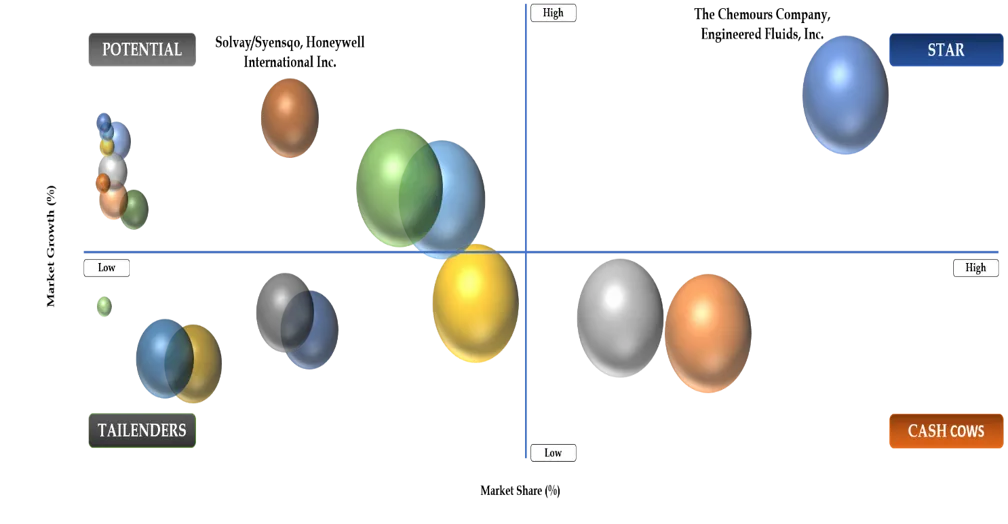
STAR
Star companies like The Chemours Company, Engineered Fluids, Inc., Dow Inc. and Daikin Industries, Ltd. have been identified due to their strong capability in developing specialty electronic cooling fluids and their high exposure to high-density thermal management applications. They have portfolios covering dielectric cooling, direct to chip cooling, fluorinated heat transfer fluids and high-heat flux electronic applications that match the increasing requirements of AI accelerators, GPUs, HPC systems and semiconductor packaging. Their capability in developing specific formulations, providing qualification for coolants and collaborating with data center and semiconductor customers helps them position themselves well.
POTENTIAL
Solvay/Syensqo, Honeywell International Inc., AGC Inc., M&I Materials Ltd., Dynalene, Inc. and Lubrizol Corporation, are considered Potential firms due to their ability to use their fluorochemicals, dielectric fluids, heat transfer fluids, or specialty chemicals, which can be improved for microfluidic cooling purposes. The prospects for these firms are primarily connected with the development of low viscosity fluids, two phase cooling, backside microfluidic cooling, advanced semiconductor packaging and environmentally friendly formulations. Expanding in the industry will require qualifications in line with application, material compatibility, adherence to environmental regulations and cooperation with technology suppliers.
Microfluidic Coolants Market Dynamics
Driver Impact Analysis
| Driver | Market Growth Impact (%) | Demand Concentration | Impacted Use Case | Strategic Impact |
Rising heat flux in AI accelerators and high-performance processors | 29% | AI data centers, HPC clusters, GPU systems | Direct-to-chip and microchannel cooling | Accelerates adoption of high-performance, low-viscosity coolants capable of removing concentrated chip-level heat |
Increasing adoption of 3D ICs, chiplets and advanced semiconductor packaging | 25% | Advanced semiconductor manufacturing and packaging hubs | Embedded and package-level microfluidic cooling | Creates demand for application-specific coolants compatible with semiconductor and packaging materials |
Growth of GaN and SiC power electronics | 23% | Automotive, power electronics, RF and industrial electronics | Microchannel cooling of high-power devices | Expands demand for thermally stable coolants with strong material compatibility and controlled electrical properties |
Shift toward dielectric and two-phase microfluidic cooling | 23% | AI/HPC, advanced electronics and high-heat-flux systems | Two-phase and electrically insulated microchannel cooling | Encourages development of premium dielectric and phase-change coolant formulations for ultra-high heat-flux applications |
Driver: Rising Heat Flux in AI Accelerators and Advanced Semiconductor Packages
The rapid increase in localized heat flux due to AI processors, GPUs, 3D ICs, chiplets and HBM-based packaging is directly driving the demand for microfluidic coolants that can efficiently manage heat transfers in very small cooling systems. Unlike traditional liquid cooling systems that work at the level of the package or the board, microfluidic cooling techniques deploy the cooling liquid closer to the hot silicon to ensure that low viscosity, good thermal conductivity, excellent electrical insulation and highly controlled flow of cooling liquid are achieved. As the power density of processors increases, the formulations of coolant that can provide stable thermal performance with minimum pressure drop and no contamination or degradation of materials become more significant in cooling methods like embedded microchannel cooling and direct-to-package approaches.
Restraint Impact Analysis
| Restraint | Drag on Market Growth (%) | Primary Impact Area | Impacted Use Case | Strategic Impact |
High coolant qualification and validation requirements | 27% | Product qualification and deployment timelines | Semiconductor microchannel and direct-to-package cooling | Favors suppliers with extensive reliability, compatibility and thermal-performance data |
Microchannel fouling, contamination and corrosion risks | 25% | Cooling reliability and maintenance | High-purity semiconductor and embedded microchannel systems | Increases demand for filtration, coolant purification, corrosion control and contamination monitoring |
High pressure drop and pumping-power requirements | 24% | System energy efficiency | High-flow microchannel cooling for AI/HPC processors | Drives development of lower-viscosity fluids and optimized coolant/channel combinations |
Regulatory restrictions on fluorinated and high-GWP coolant chemistries | 24% | Product availability and formulation development | Dielectric and two-phase microfluidic cooling | Encourages investment in lower-GWP alternatives and increases reformulation and qualification costs |
Restraint: Coolant Compatibility and Reliability in Microscale Channels
Microfluidic coolants are limited by the precise compatibility and reliability specifications of finely-engineered cooling channels and advanced semiconductor packages. In channels of very small dimensions, even minimal amounts of particles, ionic impurities and corrosion products can seriously affect flow and thus, heat transfer efficiency. Furthermore, coolants have to be kept compatible with such materials as copper, silicon, dielectrics, plastics, solder, glue and other packing materials for long periods of time. Such specifications obviously lead to longer qualification periods and testing expenses and also make issues harder to deploy than regular bulk liquid cooling mediums.
Microfluidic Coolants Market Segment Analysis
The global microfluidic coolants market is segmented based on the coolant type, cooling phase, cooling architecture, cooling loop, application, end use and region.
By Coolant Type: Dielectric Coolants Dominated the Market Due to Their Electrical Insulation and High-Heat-Flux Performance
The market for microfluidic coolants was led by dielectric coolants in 2025, with a segment share of 44.12%. The reason behind their demand is their effective heat dissipation capability in electrical appliances. Since they can provide electrical insulation and eliminate heat from tightly packed electronic components, they are ideal for direct-to-chip, embedded microchannel, backside microfluidic and advanced-package cooling in AI Accelerator chips, GPUs, high-bandwidth memory and supercomputers.
By Cooling Phase: Two-Phase Cooling Is Emerging as the Fastest-Growing Segment as Heat Flux Rises in AI and Advanced Semiconductor Devices
It is anticipated that the two-phase cooling segment will have the highest rate of growth, with a projected CAGR of 42% during the period from 2026 to 2035, due to the use of phase-change heat transfer techniques in the effective management of heat loads generated in microscale channels. The growing use of these techniques in AI accelerators, GPUs, HPC processors, 3D ICs and chiplet-integrated packages is leading to an increasing demand for coolants with precise boiling characteristics, effective latent heat, chemical stability and operation reliability during a phase cycle.
Microfluidic Coolants Market Geographical Penetration
U.S. Microfluidic Coolants Market Landscape
The U.S. microfluidic coolant market is witnessing rapid developments due to AI accelerator, HPC and advanced semiconductor package technologies, which need cooling solutions at high heat flux levels. The growing need is towards the development of coolant materials with high purity, low viscosity and electrical insulation characteristics for microchannel coolants and direct-to-package cooling technologies, where pressure drop, materials compatibility, dielectric properties and contaminant control play an important role. The U.S. is one of the leading regions having a rich ecosystem comprising semiconductor manufacturers, hyperscale data centers, thermal management technology companies and university programs, which would present new opportunities to fluid suppliers in the development of coolants for 3D ICs, chiplets, GaN/SiC devices and advanced microchannel geometries rather than supplying generic liquid-cooling fluids.
Japan Microfluidic Coolants Market Outlook
The microfluidic coolants market in Japan is strongly associated with the county's sophisticated semiconductor, precision electronics, power devices and high-density computing industries, with their compact thermal-management techniques requiring precise properties of the coolants. Therefore, there is a call for high-purity, low-viscosity coolants that are compatible with the materials and can work well in short microchannels without causing corrosion, deposition and instability of the flow. Japan, meanwhile, is successful in manufacturing semiconductors, advanced packaging, precision manufacturing and thermal engineering allowing for the development of coolants specifically designed for 3D ICs, chiplets, GaN/SiC power devices and microchannel cooling, the emphasis being on the long-lasting quality of the products and strict requirements in the manufacturing process.
China Microfluidic Coolants Market Trends
The China microfluidic coolants market is experiencing positive growth due to the rising demand for semiconductor production in China, AI computing infrastructure, power electronics and advanced packaging that require compact systems for cooling highly concentrated heat load. The important trend within this market is the creation of locally made coolant fluids characterized by purity, thermal stability, low viscosity, corrosion resistance and compatibility with copper, silicon, SiC, GaN and polymers used in advanced designs. The rising investments into equipment and advanced packaging provide opportunities for the creation of application-specific fluids for 3D integration, chiplets, power semiconductors and high-performance computing instead of regular bulk liquid coolants.
Microfluidic Coolants Market Competitive Landscape
- Custom portfolios of coolants are being recognized as an effective way for manufacturers to gain a market edge in the form of low viscosity dielectric fluids or fluorinated, water-based, or phase-change coolants for high-heat-transfer microchannel and direct-to-chip cooling.
- The race to develop new coolants targeting different applications is intensifying, with manufacturers concentrating on producing the best-performing coolants for specific applications like AI acceleration, GPU, HBM, chiplets and 2.5D/3D ICs.
- The enhanced ability to deal with problems connected with fluid materials compatibility is enabling coolants to gain a more competitive edge, especially those operating in environments made of copper, silicon, polymer, GaN and SiC and advanced semiconductor packaging, where contamination or the possibility of chemical degradation can jeopardize reliability of operations.
- Environmental aspects are becoming more prominent as manufacturers are investing into new formulations of cooler with reduced global warming potential and reduced concentration of PFAs while at the same time ensuring the expected thermal and dielectric characteristics for the processing of highly concentrated electronics.
- The emergence of strategic partnerships and co-development is on the rise throughout the value chain connecting coolant manufacturers with semiconductor companies, data center operators, advanced packaging developers and providers of microchannel cooling technologies to qualify necessary liquids for next generations of thermal systems.
Public Company Q1-Q2 2026 Performance Comparison
The table below compares five publicly listed companies with direct or strategically relevant exposure to the microfluidic coolants market. Financial metrics are company-wide or relevant business-segment figures because standalone microfluidic-coolant revenue is generally not separately disclosed.
| Company | Q1–Q2 2026 Performance | Microfluidic Coolants Exposure | Key Performance Driver |
| The Chemours Company | US$2.97 billion revenue | Fluorinated specialty chemicals and thermal-management fluid technologies relevant to advanced electronic cooling | Growth in high-value specialty products serving data-center and semiconductor applications, including liquid-cooling solutions. |
| Solvay S.A. | US$2.37 billion revenue | Specialty fluorinated and high-performance chemical materials applicable to dielectric and advanced cooling-fluid formulations | Specialty-chemicals demand and fluorinated-material applications; H1 2026 net sales were €2.028 billion, converted to approximately US$2.37 billion. |
| Dow Inc. | US$21.89 billion revenue | Specialty fluids, engineered chemical formulations and materials relevant to electronic thermal management | Higher pricing and increased demand for Industrial Solutions, including data-center applications. |
| Daikin Industries, Ltd. | US$9.0 billion revenue | Fluorochemical products and advanced cooling technologies relevant to semiconductor and data-center applications | Semiconductor recovery and data-center demand; Q1 FY2026 net sales increased 17.5% year over year to ¥1.427 trillion, approximately US$9.0 billion. |
| Honeywell International Inc. | US$18.86 billion revenue | Specialty fluorinated materials and thermal-management technologies relevant to advanced cooling applications | Higher pricing, new product introductions and growth across automation and technology businesses; Q1 and Q2 2026 sales were US$9.14 billion and US$9.72 billion, respectively. |
Note: Company-level revenue should not be interpreted as microfluidic coolants market revenue unless the company separately discloses coolant-specific sales. Financial reporting periods also differ.
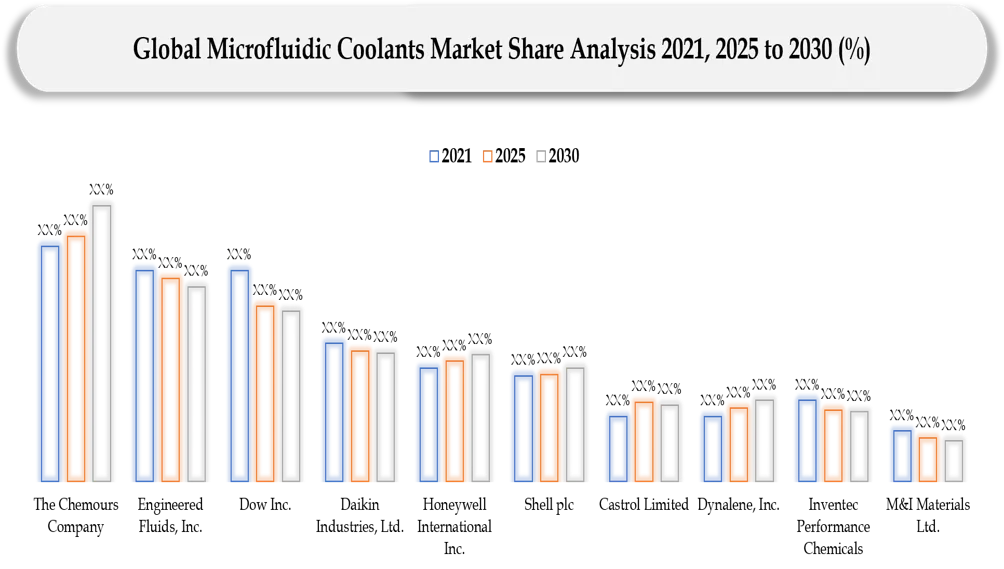
Key Companies of Microfluidic Coolants Market
- The Chemours Company (U.S.)
- Engineered Fluids, Inc. (U.S.)
- Solvay S.A. (Belgium)
- Dow Inc. (U.S.)
- Daikin Industries, Ltd. (Japan)
- Honeywell International Inc. (U.S.)
- AGC Inc. (Japan)
- Exxon Mobil Corporation (U.S.)
- Shell plc (U.K.)
- FUCHS SE (Germany)
- Castrol Limited (U.K.)
- TotalEnergies SE (France)
- M&I Materials Ltd. (U.K.)
- Lubrizol Corporation (U.S.)
- Dynalene, Inc. (U.S.)
- 3M Company (U.S.)
- Boyd Corporation (U.S.)
- ENEOS Corporation (Japan)
- Inventec Performance Chemicals (Taiwan)
- Zhejiang Noah Fluorochemical Co., Ltd. (China)
Company Profiles of Microfluidic Coolants Market
The Chemours Company
Chemours Company specializes in producing specialty chemicals and has direct exposure to advanced electronics cooling technology, owing to its Opteon™ dielectric and heat transfer fluid product line. The company’s cooling fluid technologies cater to high-density computer systems where heat flux from artificial intelligence (AI), graphics processing unit (GPU) and other high-performance electronic components is prompting the need for electrical insulation and thermally-stable fluids.
Competitive priorities involve the expansion of low-GWP dielectric fluid applications, qualification with data center and semiconductor customers, development of fluids for high heat flux cooling systems, improved environmental performance and building relationships within the advanced electronic cooling industry.
Engineered Fluids, Inc.
Engineered Fluids is a coolant company that specializes in developing dielectric and engineered coolants for use with electronics, data centers, GPUs, FPGAs, ASICs and other high-power semiconductor devices. The ElectroCool and SafetyCool product lines of Engineered Fluids consist of low viscosity dielectric fluids used in electronic cooling applications, thus making this company very relevant to microfluidics and direct to chip cooling methods, where low viscosity and electrical insulation are crucial.
The main competitive priorities of this company are the development of ultra-low viscosity fluids for direct to chip cooling; adoption of dielectric coolants in AI and HPC infrastructure; minimum pumping; material compatibility; and environmental improvements for next-generation electronic cooling.
Solvay S.A. / Syensqo
Following the Solvay Specialty spinout, Syensqo is related to advanced electronic cooling because of its Galden PFPE heat transfer fluids, which offer high thermal stability, chemical inertness, low viscosity and material compatibility for challenging electronics and semiconductors applications. This product range can be considered important for high-density cooling system designs where existing cooling solutions suffer from heat-flux limitations, as well as in advanced computing and semiconductors applications.
Competitor priorities will be increasing the use of Galden in high density computing, development of new fluids for thermal management architectures, customer qualification, scaling up, preservation of dielectric and thermal properties, as well as addressing environmental challenges for fluorinated cooling fluids chemistry.
Dow Inc.
Dow offers direct access to leading liquid cooling through their DOWFROST LC direct-to-chip cooling fluids and DOWSIL liquid cooling immersion products. Their product line caters to the needs of direct-to-chip and other liquid-cooling products for data centers and high-performance computing. The focus is on heat transfer, anti-corrosion, material compatibility, viscosity and long-term fluid performance.
The competitive priorities include growing the market for direct-to-chip coolant solutions, formulation of coolants for AI data center applications, coolant monitoring and management services, high density cooling fluid development and integration of coolant technology with new semiconductor and thermal management architectures.
Daikin Industries, Ltd.
Daikin is now offering their range of fluorochemicals in the development of advanced liquid-cooling systems for semiconductor and data center cooling, which includes fluorinated heat-transfer and immersion cooling fluids. Fluoropolymers are also developed by the company in the development of components related to liquid-cooling systems. The fluorochemical chemistry experience of Daikin offers a base for the development of fluids with required thermal and dielectric properties along with environmental safety.
The competitive priorities of Daikin include the development of more applications of fluorinated cooling fluids in high-density computing, development of materials for semiconductor cooling architecture, support to advanced liquid-cooling systems, such as direct-to-chip, thermal management performance improvement and environmentally safe cooling solutions.
Honeywell International Inc.
Honeywell is active in advanced electronics cooling due to its Solstice E-Cooling technology that utilizes dielectric heat transfer fluids for two-phase cooling of high-performance electronics. This technology is pertinent to high heat flux application since the coolant not only removes significant amounts of heat but maintains the electrical insulation at the same time. Honeywell’s additional offerings include technologies for direct-on-chip and immersion cooling.
Priorities among competitors consist of the development of applications for the two-phase coolant, low GWP and environmentally friendly formulations, direct to chip cooling and other high density cooling designs, improving thermal and materials compatibility, as well as cooperation with cooling system and electronics manufacturers.
Microfluidic Coolants Market Major Pain Points
- Microchannel fouling and particle accumulation: Even the presence of trace amounts of contaminants, precipitates or corroded materials can block the flow of fluids in microchannels, causing increased pressure drop and poor heat transfer.
- Coolant compatibility with advanced packaging materials: In practice, formulations should have chemical stability with copper, silicon, aluminum as well as with plastics and adhesives to meet the long-term performance and compatibility requirements.
- Thermal performance versus pumping-power trade-off: By enhancing the coolant flow may lead to better heat dissipation and better uniformity of temperature while at the same time increasing pumping work and hydraulic resistance resulting in decreased system performance.
- Two-phase flow instability: Microfluidic cooling with the use of boiling heat transfer may have flow instabilities, including vapor lock, flowing oscillations, dry heat transfer and uneven cooling, thus making it difficult to work reliably under high heat flux.
- Limited standardized qualification for specialized coolants: Variations in microchannel design, temperature, heat flux, purity of the coolant and material affect the ability to create performance and reliability standards.
Microfluidic Coolants Market Recent Developments
- September 2026 - Dow Inc.: At Data Center World Asia 2026, Dow presented its portfolio for integrated thermal management in the context of increasing AI and HPC thermal challenges, involving electronic materials, direct liquid cooling, immersion cooling and facility cooling solutions.
- August 2026 - Dynalene, Inc. : Dynalene’s PG-D25 direct-to-chip coolant gained Open Compute Project (OCP) Accepted designation. This propylene glycol coolant is formulated for direct to chip cooling and corrosion protection for copper cold plates and heat exchangers.
- August 2026 - Castrol Limited: Castrol confirmed that its Castrol ON PG25 and PG25T direct-to-chip cooling fluids have been qualified against the requirements of NVIDIA with regard to corrosion protection, thermal stability, coolant purity, dilution water quality and compatibility with wetted materials.
- July 2026 - Daikin Industries, Ltd. : Daikin and NTT DATA announced the start of PoC project to optimize AI data center cooling using a combination of AI server thermal prediction along with HVAC, chiller and liquid cooling system control for high power AI servers.
- June 2026 - Dow Inc. : Dow extended its Direct to Chip (DTC) cooling offerings and capabilities with respect to AI and HPC data centers with the development of DOWFROST™ LC fluids that can help with heat removal, anti-corrosion protection, high purity and materials compatibility in liquid cooled systems.
Analyst View / Opinion on Microfluidic Coolants Market
- Coolant performance is becoming a system-level design parameter: In microfluidic thermal management, properties like viscosity, thermal conductivity, specific heat, dielectric characteristics and boiling characteristics have a direct impact on the dimensions of channels, flowing speeds, pressure drops and attainable heat flow.
- Application-specific formulations will gain importance: Coolants designed for specific applications regarding AI accelerators, 3D integrated circuits, GaN/SiC electronics and direct-to-package designs will cater to other thermal loads and materials used as compared to conventional fluids that are used for cooling in data centers.
- Two-phase cooling represents a technically demanding growth avenue: Boiling and condensation could ensure high heat extraction capability in a small microchannel, but stability of flow, dry out and fluid handling need to be considered.
- Coolant purity will become increasingly important as channels shrink: Microfluidics for semiconductors do not have much tolerance for particulates, ions, films and corrosion products, making purification and coolant quality control essential.
- The market will evolve into a niche market based on thermal management ecosystems: Coolant vendors, semiconductor producers, packaging firms and thermal solutions providers will have to design fluids together with microchannels, packaging materials, operational regimes and required heat loads instead of treating coolant choice independently.
Target Audience of Microfluidic Coolants Market
| INDUSTRY | WHO SHOULD BUY THIS REPORT? | REASON TO BUY THIS REPORT |
| Semiconductor Manufacturers | Thermal Engineering & Process Engineering Teams | Evaluate coolant requirements for microchannel, direct-to-chip, 3D IC and advanced-package cooling architectures. |
| AI & High-Performance Computing | Data Center Infrastructure & Thermal Management Teams | Assess coolant technologies for AI accelerators, GPUs and high-heat-flux computing systems. |
| Advanced Semiconductor Packaging | Packaging Engineering & Technology Development Teams | Identify coolant formulations compatible with chiplets, 2.5D/3D ICs, HBM and embedded cooling structures. |
| Coolant & Specialty Chemical Manufacturers | Product Development & R&D Teams | Identify opportunities for high-purity dielectric, low-viscosity, two-phase and lower-GWP coolant formulations. |
| Thermal Management Technology Providers | Cooling System Design & Engineering Teams | Evaluate coolant requirements alongside microchannel geometry, pressure drop and heat-flux targets. |
| Power Electronics Manufacturers | Thermal Design & Reliability Teams | Assess cooling fluids for high-power GaN and SiC devices operating under concentrated thermal loads. |
| Data Center Operators & Hyperscalers | Infrastructure Procurement & Sustainability Teams | Compare coolant options based on thermal performance, reliability, energy requirements, environmental profile and total cost of ownership. |
| Chemical & Fluid Technology Companies | Strategic Planning & Commercial Teams | Identify specialty-fluid white spaces, regional expansion opportunities and emerging application requirements. |
| Investors & Private Equity Firms | Investment & Due Diligence Teams | Evaluate technology differentiation, investment opportunities, regulatory exposure and growth areas within advanced cooling fluids. |
| Research Institutions & Technology Developers | R&D and Advanced Technology Teams | Benchmark emerging coolant chemistries, two-phase cooling approaches, material compatibility and microfluidic thermal-management technologies. |
Why Choose DATAM?
- Data-Driven insights: Dive into detailed analyses with granular insights such as pricing, market shares and value chain evaluations, enriched by interviews with industry leaders and disruptors.
- Post-Purchase Support and Expert Analyst Consultations: As a valued client, gain direct access to our expert analysts for personalized advice and strategic guidance, tailored to your specific needs and challenges.
- White Papers and Case Studies: Benefit quarterly from our in-depth studies related to your purchased titles, tailored to refine your operational and marketing strategies for maximum impact.
- Annual Updates on Purchased Reports: As an existing customer, enjoy the privilege of annual updates to your reports, ensuring you stay abreast of the latest market insights and technological advancements. Terms and conditions apply.
- Specialized Focus on Emerging Markets: DataM differentiates itself by delivering in-depth, specialized insights specifically for emerging markets, rather than offering generalized geographic overviews. The approach equips our clients with a nuanced understanding and actionable intelligence that are essential for navigating and succeeding in high-growth regions.
- Value of DataM Reports: Our reports offer specialized insights tailored to the latest trends and specific business inquiries. The personalized approach provides a deeper, strategic perspective, ensuring you receive the precise information necessary to make informed decisions. The insights complement and go beyond what is typically available in generic databases.


























































