


Mexico Cables & Wires Market Size and Overview
The Mexico cables and wires market was valued at US$ 5.30 billion in 2025 and is projected to reach US$ 6.22 billion by 2031, expanding at a 2.69% CAGR during 2026-2031. The market includes low-voltage building wires, medium- and high-voltage power cables, datacom and fiber-optic cables plus specialty products used in manufacturing, energy, transportation, telecommunications and construction. Low-voltage cables represent 49.43% of the 2025 market, followed by medium- and high-voltage cables at 30.65%.
Demand is supported by industrial parks and manufacturing clusters, automotive and electronics investment, utility distribution upgrades and commercial construction. Nearshoring-related facility expansions raise requirements for dependable power-distribution and control wiring. Cable purchases remain sensitive to industrial project execution, copper and aluminum price movements, utility procurement cycles and construction activity across Mexico.
| 2025 MARKET SIZE | 2031 FORECAST | CAGR (2026–2031) |
|---|---|---|
| US$ 5.30 Billion | US$ 6.22 Billion | 2.69% |
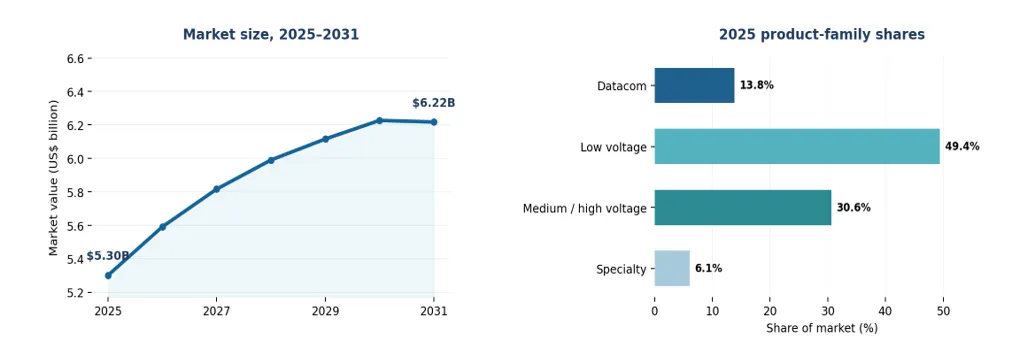
Mexico’s cable and wire market expands from US$ 5.30 billion in 2025 to US$ 6.22 billion in 2031, an increase of US$ 0.92 billion.
A 2.69% forecast CAGR reflects demand from electrical infrastructure upgrades, industrial facilities, residential and commercial wiring plus digital connectivity.
Low-voltage cables account for 49.43% of the market in 2025, reflecting their importance in buildings, factories and electrical distribution.
Medium- and high-voltage cables hold 30.65% of the 2025 market, with demand tied to grid reinforcement, renewable interconnection and industrial power systems.
Datacom cables account for 13.82% in 2025, supported by fiber deployment, telecom modernization and network requirements in industrial and data-center sites.
Supply competitiveness depends on product certification, qualified distributor networks, metal-price risk management and delivery reliability across industrial corridors.
Mexico Cables & Wires Industry Trends and Strategic Insights
Nearshoring and export-oriented manufacturing investment drives wiring in new plants, process lines, distribution centers and adjacent industrial infrastructure, especially in northern and central Mexico.
Electricity reliability and industrial electrification generate opportunities in medium-voltage feeders, low-voltage power distribution, armored cables and technically qualified interconnection systems.
Fiber and structured cabling demand is supported by telecom backbone upgrades, enterprise networking, cloud infrastructure and growing automation requirements in manufacturing.
Manufacturers compete on cost stability, regulatory and product compliance, inventory availability and the ability to support project developers through engineering and electrical contractors.
Mexico Cables & Wires Market Scope
| METRICS | DETAILS |
| 2025 Market Size | US$ 5.30 Billion |
| 2031 Projected Market Size | US$ 6.22 Billion |
| CAGR (2026–2031) | 2.69% |
| Geographic Coverage | Mexico (national market; industrial corridor and state demand context) |
| By Cable Type | Datacom Cables (Communication & Data Cables, Fiber Optic Cables); Low-Voltage Cables (Fire Resistant Cables, Low Smoke & Halogen Free Cables, Low Voltage Cables & Wires); Medium- and High-Voltage Cables (Medium Voltage Cables, High Voltage Cables); Special Cables (Mining Oil & Gas Cables, Photovoltaic Cables, Ship & Harbour Cables, Windmill Cables) |
| By Industry | Industrial — Discrete (Aerospace & Defense, Automotive, Batteries, Electrical & Electronics, Machine Building, Semiconductor); Process (Chemicals, Energy/Oil & Gas, Metal Processing); Hybrid (Food & Beverage, Lifesciences, Mining & Quarrying, Other Manufacturing). Non Industrial — Transportation (Air, Land, Rail, Marine Services); Infrastructure & Services (Commercial Real Estate, Data Centers, Healthcare, Hospitality & Entertainment, Public Sector/Research/Education, Residentials, Water & Waste, Others). Power Utilities — Power Generation (Coal, Conventional Excl. Coal, Renewables); Power Distribution & Transmission. |
| By Conductor / Transmission Medium | Copper; Aluminum; Optical Fiber; Composite / Hybrid Construction |
| By Voltage Rating (Power Cables) | Low Voltage (up to 1 kV); Medium Voltage (above 1 to 35 kV); High Voltage (above 35 to 230 kV); Extra-High Voltage (above 230 kV) |
| By Insulation and Sheathing Material | Cross-Linked Polyethylene (XLPE); Polyvinyl Chloride (PVC); Ethylene Propylene Rubber (EPR/EPDM); Polyethylene (PE); Low Smoke Zero Halogen (LSZH); Other Materials |
| By Installation Method | Overhead; Underground / Buried; Submarine / Underwater; Indoor / Building; Outdoor / Industrial |
| Competitive Landscape | Competitive positioning, 10 company profiles, recent developments and partnerships |
| Market Data Coverage | Cable-type and cable-subtype market values, 2025–2031 (US$ million); industry, material, voltage and installation breakdowns within the defined report scope |
The report evaluates Mexico cable-market value by product family and uses the industry end-market hierarchy to organize demand. Conductor, voltage, insulation and installation categories provide additional product and application perspectives.
Mexico Cables & Wires Market White Space & Investment Opportunities
Manufacturing clusters: Wiring and specialty cable opportunities arise from automotive, electronics, appliance and machinery production facilities, along with adjacent utility and logistics infrastructure.
Grid reinforcement: Medium-voltage distribution, reliability programs and new customer connections support demand for qualified power cables and installation-ready products.
Connectivity and renewable energy: Fiber networks, industrial ethernet, photovoltaic interconnects and energy infrastructure create openings for application-specific cables and distribution partnerships.
Mexico offers differentiated opportunities across Nuevo León, Coahuila, Chihuahua, Baja California, Guanajuato, Querétaro and the Mexico City metropolitan area. Northern and Bajío industrial corridors concentrate manufacturing growth and electrical installations, while renewable energy and power-network requirements vary by location. Project timing depends on electrical capacity, construction readiness, procurement arrangements and financing.
Driver Impact Analysis
Mexico’s cables and wires market is supported by the construction and modernization of factories, industrial parks, commercial buildings and power distribution networks. Export-oriented automotive and electronics plants require reliable low-voltage feeders, automation wiring, fire-resistant products and communication cabling. New customer connections and upgrades to transmission and distribution infrastructure also increase demand for medium- and high-voltage cable products.
| DRIVER | AFFECTED PRODUCT / SIGNAL | 2026–2031 CAGR | STRATEGIC IMPACT |
| Industrial electrification and power-network upgrades | Distribution and transmission power cables | High | Support long-term utility qualifications and supplier agreements. |
| Broadband and industrial connectivity | Fiber-optic and communication cables | High | Expand network-cable portfolio and qualified installation partnerships. |
| Renewable interconnection and energy investment | Medium-voltage and PV / wind cable products | Moderate–High | Align inventory and certification with renewable construction cycles. |
| Manufacturing relocation and factory construction | Armored and specialty power cables | Moderate–High | Target remote-site durability, technical support and regional logistics. |
Growth conversion is uneven across end markets. Industrial projects typically move through permitting, grid-connection reviews, equipment selection and phased commissioning before large cable orders materialize. Manufacturers with engineering-approved specifications, contractor relationships, copper hedging arrangements and local inventories can better respond to changing project schedules. Fiber deployments and renewable interconnections add opportunities for specialized cable providers.
Restraint Impact Analysis
Copper and aluminum input-cost volatility remains a key margin and pricing challenge for Mexican cable makers. Exchange-rate movements affect imported compounds, specialized conductors and machinery. Competition from lower-cost product lines and price-sensitive construction channels can compress margins, particularly for standard low-voltage wiring. Utility projects also face permitting, approval and contractor scheduling dependencies.
| RESTRAINT | PRIMARY EXPOSURE | RISK LEVEL | STRATEGIC IMPACT |
| Copper and aluminum price volatility | Low- and medium-voltage product pricing and contractor budgets | High | Index-based quotations, hedging and pass-through clauses protect project margins. |
| Permitting and infrastructure delays | Utility transmission and specialized power-cable orders | High | Diversify project backlog and stage production around realistic commissioning dates. |
| Manufacturing and skilled-labor constraints | Mexican extrusion capacity, testing and specialized cable production | Moderate–High | Invest in process capability, workforce development and delivery reliability. |
| Competitive price pressure and imports | Standardized low-voltage and commodity datacom cables | Moderate | Compete through product certification, channel service and customer-specific designs. |
Industrial power availability and regional infrastructure gaps can delay plant openings or reduce initial cable procurement. High-voltage and specialty cable orders require technical qualification, while differences in installation environment create complex stocking needs. Cross-border logistics, customs administration and local transport costs can extend lead times. Suppliers can protect commercial performance through metal-price adjustment clauses, technical service, application-based stocking and diversified distribution routes.
Mexico Cables & Wires Market Competitive Landscape
Competition in Mexico includes international cable manufacturers, locally active groups, electrical distributors and fiber-cable specialists. Commercial differentiation depends on low-voltage scale, utility-grade product qualification, cross-border manufacturing and warehousing, network-cabling portfolios plus reliable delivery to industrial customers. Procurement decisions increasingly weigh lifecycle reliability alongside quoted price.
| COMPANY | CANADIAN CABLES & WIRES POSITIONING |
| Nexans | Building wire, power cables and utility-linked electrical infrastructure. |
| Prysmian | Power, industrial, construction and optical-cable systems. |
| Southwire | Electrification and low-voltage wire, including expanded Mexican manufacturing presence. |
| Corning | Optical fiber, cable and advanced connectivity for data centers and broadband. |
| Belden | Industrial communication, specialty cables and network connectivity. |
| Amphenol | Fiber and copper connectivity systems across datacom and infrastructure. |
| AFL | Optical fiber cable systems, accessories and network services. |
| Marmon Electrical | Diversified electrical wire and cable solutions for industrial and utility uses. |
| General Cable | Power and submarine cable systems with Mexican investment activity. |
| Sumitomo Electric Industries | Optical fiber, energy cable and industrial wiring systems. |
Leading suppliers can compete through localized cable assembly and distribution, production flexibility, long-term relationships with contractors, specification support and product families covering both conventional wiring and industrial-grade applications. Partnerships with EPCs, system integrators and electrical wholesalers are important routes to plant expansions and infrastructure projects.
Mexico Cables & Wires Market Recent Developments
2026: Nearshoring-oriented manufacturing expansion and industrial park development sustain demand for facility wiring, power-distribution cables and network connectivity.
2026: Power reliability and grid-connection requirements remain important purchasing considerations for industrial operators and electrical infrastructure contractors.
2026: Data-center and telecommunications network upgrades increase specification requirements for fiber optic, copper communication and structured cabling.
2026: Automotive, appliance and electronics manufacturing programs require low-voltage, control and specialty cables for automation-intensive production.
2026: Cable suppliers continue to emphasize local distribution, product certifications and copper-price management in project bids.
2026: Renewable and utility-interconnection projects create additional opportunities in medium-voltage and weather-resistant cable systems.


























































