


Metamaterials Market Size
The global Metamaterials market reached an estimated US$ 1.45 billion in 2025 and is expected to reach US$ 10.78 billion by 2035, growing with a CAGR of 22.2% during the forecast period 2026-2035. Growth is being driven by the movement of metamaterial concepts from laboratory demonstrations into system-level products such as flat-panel satellite terminals, compact electronically scanned radar, metalens-enabled optical modules, security screening platforms and programmable radio environments.
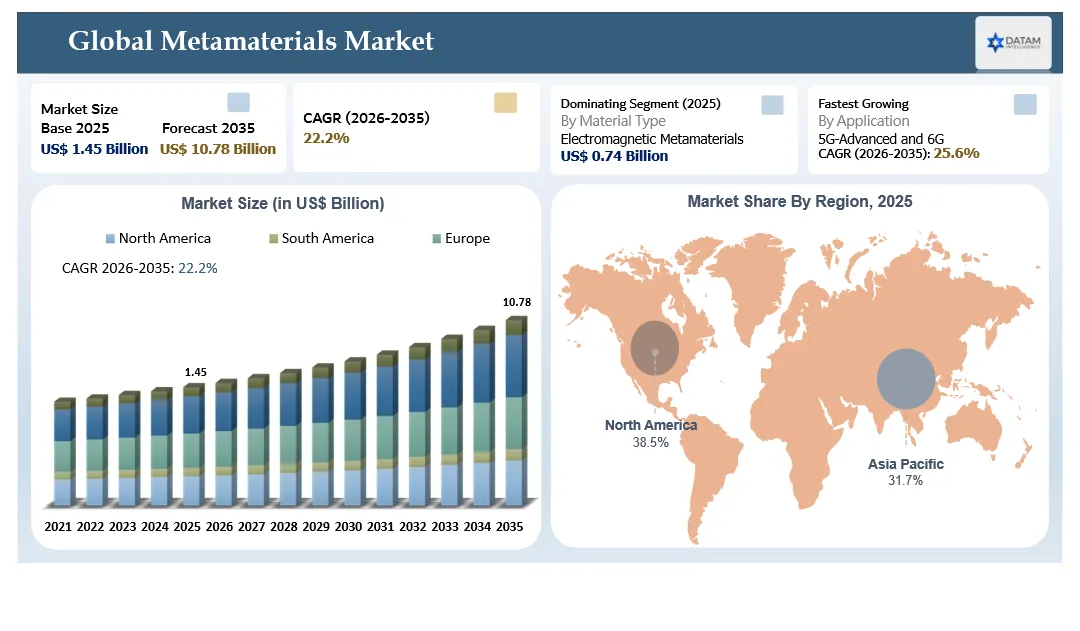
Electromagnetic metamaterials account for the largest commercial revenue base because RF and microwave architectures have progressed furthest toward scalable deployment. They are already used in metasurface antennas, radar arrays, filters, absorbers and signal-control systems. Optical metamaterials and metalenses are expected to grow fastest as semiconductor-compatible fabrication enables compact imaging, depth sensing, polarization analysis and biometric authentication in high-volume electronics.
North America leads the market through defense procurement, private investment, satellite communications, advanced radar and a strong startup ecosystem. Asia-Pacific is expected to record the fastest growth through semiconductor manufacturing, telecom infrastructure, consumer electronics, automotive sensing and government-backed advanced materials research. Europe remains important in reconfigurable intelligent surfaces, terahertz systems, optical technologies, acoustic metamaterials and collaborative research commercialization.
Commercial Metamaterial Platform Landscape
| Platform / Product | Company | Primary Technology | Core Market | Commercial Relevance |
| u8 / Goshawk terminals | Kymeta | Metasurface electronically steered antenna | Satellite communications | Flat-panel multi-orbit mobility and defense connectivity |
| EchoShield / EchoGuard radar | Echodyne | Metamaterials electronically scanned array | Defense and counter-UAS | Compact high-performance radar with lower size, weight, power and cost |
| Holographic beamforming systems | Pivotal Commware | Metasurface antennas and repeaters | 5G and fixed wireless | Improves coverage and capacity using lower-complexity beamforming |
| Light Control Metasurface | Lumotive | Semiconductor optical beam steering | LiDAR and sensing | Solid-state steering for mobility, robotics and industrial sensing |
| Polar ID / meta-optics | Metalenz | Semiconductor metasurface optics | Consumer electronics | Compact polarization sensing and biometric authentication |
| Evolv Express | Evolv Technologies | Advanced electromagnetic sensing | Security screening | High-throughput weapons detection and venue security |
| RIS panels | Greenerwave | Reconfigurable intelligent surfaces | Telecom and satellite | Software-controlled radio propagation and antenna efficiency |
Metamaterials Market Key Takeaways
- Electromagnetic metamaterials held the largest share in 2025 because RF, microwave and millimeter-wave products have the strongest commercial maturity.
- North America held an estimated 38.5% share in 2025, supported by defense, satellite communications, advanced sensing and venture-backed commercialization.
- Photonics and optical metamaterials are expected to record the fastest growth as metalenses move toward high-volume semiconductor manufacturing.
- Aerospace and defense remains the largest end-use industry, while consumer electronics and telecom represent the most important scale opportunities.
- Direct OEM and government contracts dominate revenue because products require integration, qualification, customization and long support cycles.
Metamaterials Industry Trends and Strategic Insight
- The industry is shifting from passive, fixed-response structures toward tunable, programmable and software-defined metasurfaces.
- Commercial differentiation increasingly depends on system integration, calibration algorithms, semiconductor packaging and manufacturing yield rather than unit-cell design alone.
- Multi-band and multi-orbit satellite terminals are creating a new product cycle for electronically steered metasurface antennas.
- Counter-UAS demand is accelerating deployment of compact metamaterial radar across military bases, borders, airports and critical infrastructure.
- Metalens manufacturing partnerships are linking optical startups with semiconductor foundries, creating a route from specialty modules to mass-market sensing.
Metamaterials Market Scope
| Metrics | Details |
| 2025 Market Size | US$ 1.45 Billion |
| 2035 Projected Market Size | US$ 10.78 Billion |
| CAGR (2026-2035) | 22.2% |
| Largest Market | North America |
| Fastest Growing Market | Asia-Pacific |
| By Material Type | Electromagnetic, Photonic and Optical, Acoustic, Mechanical and Elastic, Thermal |
| By Product Type | Antennas and RF Components, Radar and Sensing Modules, Metalenses and Optical Modules, Absorbers and Shields, Reconfigurable Intelligent Surfaces, Acoustic Products |
| By Function | Beam Steering, Absorption and Shielding, Imaging, Sensing, Signature Management, Noise and Vibration Control |
| By Frequency Spectrum | RF and Microwave, Millimeter Wave, Terahertz, Infrared, Visible and Ultraviolet |
| By Fabrication Technology | Printed Circuit and Additive, Photolithography, Nanoimprint, Thin-Film Deposition, 3D Printing and Microfabrication |
| By Application | Satellite Communications, Radar and Counter-UAS, 5G-Advanced and 6G, LiDAR, Security Screening, Thermal Management, Medical Imaging |
| By End Use Industry | Aerospace and Defense, Telecommunications, Consumer Electronics, Automotive, Industrial, Healthcare, Energy, Construction |
| By Distribution Channel | Direct OEM and Government Contracts, System Integrators, Licensing, Foundry and Design Services, Distributors |
| Report Insights Covered | Market Size, Share, Growth, Technology Readiness, Competitive Landscape, Company Profiles and Country-Level Opportunity |
Why does this Metamaterials Market report matter in 2026?
The year 2026 is a transition point because several metamaterial technologies are moving from first-generation products to scaled manufacturing and broader system integration. Multi-band metasurface satellite terminals are entering development through partnerships between antenna specialists and display or semiconductor manufacturers. Compact metamaterial radar is being deployed in counter-UAS and infrastructure security, while optical metasurfaces are progressing toward foundry-scale production for consumer and industrial sensing.
The report matters because metamaterials are not a single homogeneous materials market. Commercial value is created through different combinations of design IP, fabrication process, active control electronics, algorithms, packaging and system certification. A company leading in microwave antennas may have little overlap with a metalens supplier or an acoustic metamaterial developer. The study separates these value chains and identifies where scale, margin and defensibility are highest.
Decisions made in 2026 on foundry partnerships, defense qualification, telecom trials, multi-orbit antenna roadmaps and optical module integration will influence leadership through the rest of the decade. The market is early enough for focused entrants to establish category leadership, but mature enough that customers increasingly require field performance, production consistency and support rather than laboratory claims.
Metamaterials Market White Space & Investment Opportunities
- Semiconductor-compatible metalenses for mobile devices, wearables, robotics and automotive sensing represent a major scale opportunity.
- Reconfigurable intelligent surfaces can address indoor coverage, private networks, industrial campuses and 6G radio-environment control.
- Multi-band metasurface antennas provide white space in defense, emergency response, maritime mobility, aviation and connected vehicles.
- Acoustic metamaterials offer underdeveloped opportunities in HVAC noise, electric-vehicle cabins, industrial machinery and lightweight building materials.
- Terahertz metamaterials can improve spectroscopy, non-destructive testing, pharmaceutical inspection and security imaging.
- Foundry services, design automation, measurement tools and packaging create enabling-market opportunities beyond finished metamaterial products.
Metamaterials Future Market Transformation
The market will transform from a collection of specialized hardware products into software-defined wave-control platforms. Fixed antennas and absorbers will increasingly be complemented by tunable materials, digital coding, active elements and machine-learning control. This will make performance upgradeable after deployment and create recurring software, calibration and lifecycle revenue.
Manufacturing will move toward established electronics and photonics infrastructure. Printed RF structures will continue to support large-area and lower-frequency products, while photolithography, nanoimprint and wafer-level packaging will enable high-volume optical and millimeter-wave technology components. Companies that design for foundry compatibility and yield from the beginning will scale faster than those dependent on bespoke laboratory processes.
By 2035, successful vendors are likely to own a combination of unit-cell IP, simulation tools, active control, packaging and application-specific data. Strategic partnerships with satellite operators, defense primes, semiconductor foundries, telecom equipment vendors and automotive Tier-1 suppliers will determine access to volume. The market will reward products that reduce system size, weight, power, cost or component count while maintaining reliability in real operating environments.
Metamaterials Market Buyer Decision-Making Criteria
Buyers evaluate metamaterial products on measurable system benefit. Antenna customers prioritize gain, scan range, bandwidth, efficiency, thermal performance and mobility. Radar buyers emphasize detection range, angular accuracy, classification, integration and false-alarm performance. Optical customers focus on efficiency, image quality, field of view, polarization response, wafer yield and packaging compatibility. Acoustic buyers assess insertion loss, weight, thickness, durability and manufacturability.
Qualification and supply confidence are equally important. Defense and aerospace buyers require environmental testing, cyber and export compliance, long-term support and secure production. Consumer electronics companies require very high yield, stable optical performance and a credible foundry ramp. Telecom operators evaluate total network economics, power consumption, installation complexity and interoperability. Vendors that provide design tools, reference architectures and integration support reduce customer risk and accelerate adoption.
Metamaterials Market Economic & Investment Analysis
The economic profile of the market varies by application. Defense radar and satellite terminals generate high unit values and long contracts but require extended qualification and support. Consumer optical modules provide lower unit value but much larger volume, making yield and foundry economics decisive. Telecom intelligent surfaces may combine hardware revenue with network software and managed services, while licensing models can generate high-margin income when the supplier owns foundational IP but does not operate manufacturing assets.
Investment is moving toward platforms that can reuse design architecture across several customers. A radar array that scales across perimeter, airborne and counter-UAS missions offers better capital efficiency than a single-purpose product. Metalens developers create more value when one wafer process can support face authentication, depth sensing, spectroscopy and imaging. Investors should distinguish broad platform claims from evidence of repeatable production, customer qualification and product revenue.
The strongest acquisition targets are likely to be companies that combine protected IP with manufacturing readiness and system-level design wins. Strategic buyers may include defense primes, satellite terminal suppliers, semiconductor companies, optical module manufacturers, telecom equipment vendors and industrial sensing groups. Valuation will depend on contracted backlog, production yield, field data, patent freedom to operate and the cost required to scale.
Metamaterials Investment Trends in the Market
- Capital is concentrating in defense sensing, counter-UAS radar, multi-orbit satellite terminals and semiconductor meta-optics.
- Foundry and manufacturing partnerships are becoming more important than standalone research funding.
- Government procurement is supporting commercialization where national security, resilient communications and spectrum efficiency are priorities.
- Investors favor tunable and software-defined platforms that can serve several applications rather than fixed passive structures.
- Strategic funding increasingly includes joint development, supply agreements and customer-backed qualification instead of equity investment alone.
Strategic Indicators for Metamaterials Market
High Regulation Impact
Defense export controls, spectrum rules, radio certification, optical safety, cybersecurity and critical-infrastructure requirements shape product development. Products used in military radar, satellite communications or surveillance may require export licensing and secure supply chains. Consumer optical and medical applications add safety, privacy and device-specific regulatory obligations.
High Investment Activity
Investment is high in radar, satellite communications, advanced optics and 6G research. Capital is directed toward production facilities, semiconductor process development, qualification and integration. The market remains selective because laboratory performance does not guarantee manufacturability or field reliability.
Supply Chain Disruption
Metamaterial products depend on specialized substrates, semiconductors, RF components, thin films, lithography, packaging and calibration equipment. Disruption can delay qualification because material or process changes may require redesign and recertification. Geographic concentration of advanced fabrication increases exposure to trade controls and capacity constraints.
Pricing Volatility
Pricing varies from low-cost printed structures to high-value radar and satellite systems. Semiconductor wafers, specialty substrates, RF chips and packaging influence cost. Early-stage products carry engineering and low-volume premiums, while price declines after foundry scaling can be rapid.
Procurement Pressure
Customers demand evidence of system savings and predictable supply. Defense buyers seek lifecycle support and secure sourcing, while electronics buyers demand aggressive cost-down roadmaps. Procurement pressure pushes suppliers to standardize modules and qualify second sources.
New Technology Adoption
Programmable metasurfaces, active tuning, AI control, wafer-level meta-optics and large-area printing are changing product architecture. Adoption is fastest where metamaterials remove bulky mechanical components or enable functions that conventional materials cannot deliver economically.
Regional Expansion Opportunity
North America leads commercialization, Europe offers strong research and telecom activity and Asia-Pacific provides the largest manufacturing and consumer-electronics scale opportunity. Regional expansion often requires local manufacturing, government partnerships and integration with established OEM supply chains.
Government Policy Support
Defense modernization, sovereign satellite communications, 6G programs, semiconductor incentives and advanced-materials funding support the market. Policy can accelerate demand but also create export restrictions and domestic-content requirements.
Pricing Intelligence
Premiums are justified when products reduce system weight, power, installation time or component count. Pricing models include product sales, non-recurring engineering, licensing, subscription software, maintenance and volume-based wafer supply agreements.
Disruption Analysis of Metamaterials Market
Metamaterials disrupt incumbent architectures by replacing mechanical steering, stacked optical components, bulky absorbers or complex acoustic assemblies with engineered surfaces. In satellite communications, flat panels can replace parabolic dishes in mobile use. In radar, compact electronically scanned arrays reduce the size and cost of high-performance sensing. In optics, metalenses can collapse several lens functions into a patterned surface.
The disruption is gradual because system-level qualification remains difficult. Conventional solutions benefit from mature supply chains, standards and known failure modes. Metamaterial suppliers must show that integration, calibration, environmental stability and manufacturing yield remain acceptable at scale. The strongest disruption therefore occurs where performance advantages are large enough to justify redesign, such as mobility antennas, counter-UAS radar, polarization sensing and compact depth modules.
Metamaterials Market BCG Matrix: Company Evaluation
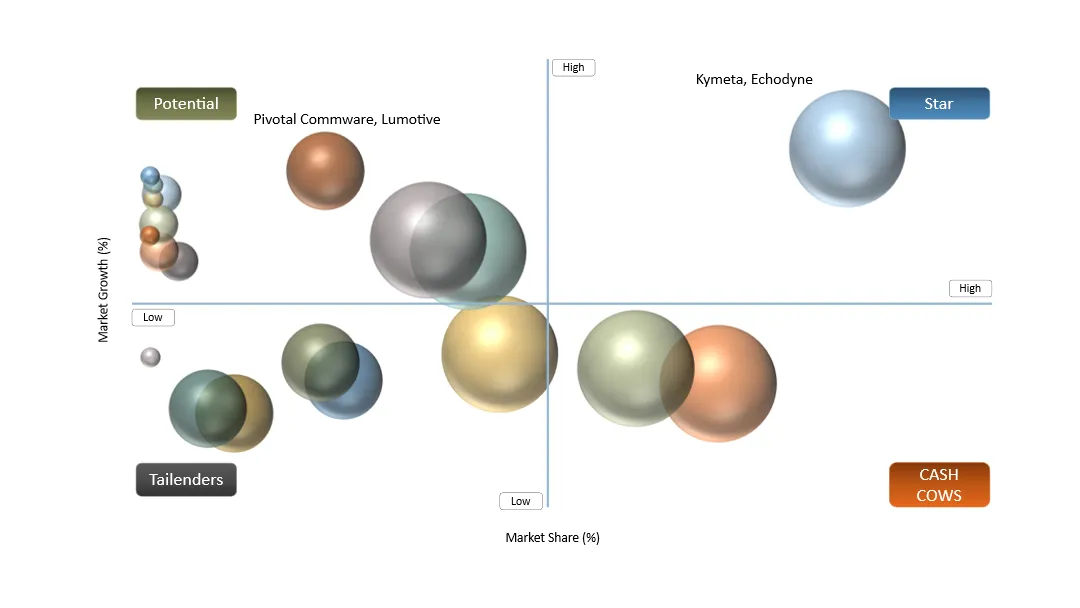
| Category | Representative Companies | Rationale |
| STAR | Kymeta, Echodyne, Metalenz | Commercial products, differentiated IP, strong strategic partnerships and expanding addressable markets. |
| POTENTIAL | Pivotal Commware, Lumotive, Greenerwave | High-growth technologies with meaningful deployment potential but scaling and market timing remain important. |
| CASH COWS | Evolv Technologies, established defense integrators | Installed systems and procurement relationships generate recurring revenue in defined applications. |
| TAILENDERS | Small research-led specialists without scalable manufacturing | Valuable IP but limited commercialization, customer concentration or dependence on project funding. |
Metamaterials Market Dynamics
Driver Impact Analysis
| Driver | Market Growth Impact (%) | Demand Concentration | Impacted Use Case | Strategic Impact |
| Flat-panel antennas and resilient satellite connectivity | 31% | Defense, mobility and remote communications | Multi-orbit SATCOM terminals | Supports production scaling and partnerships with satellite operators. |
| Compact radar and counter-UAS demand | 27% | Defense and critical infrastructure | Airspace surveillance and drone detection | Accelerates government procurement and system integration. |
| Metalens and optical miniaturization | 24% | Consumer electronics and sensing | Biometrics, depth sensing and imaging | Drives semiconductor foundry partnerships and wafer-level production. |
| 5G-Advanced and 6G wave control | 18% | Telecom and private networks | RIS, repeaters and beamforming | Creates software-defined infrastructure and licensing opportunities. |
Driver: Rising Adoption of Flat-Panel Antennas and Compact Radar
Demand for high-capacity satellite connectivity and persistent airspace awareness is accelerating use of electronically steered metasurface systems. Flat-panel antennas support mobility, low-profile installation and rapid switching between beams or satellite networks. Compact metamaterial radar offers performance associated with larger phased arrays at lower size, weight, power and cost. These advantages are important for counter-UAS, border protection, autonomous platforms and critical infrastructure.
Restraint Impact Analysis
| Restraint | Drag on Market Growth (%) | Primary Impact Area | Impacted Use Case | Strategic Impact |
| High fabrication cost and yield complexity | 32% | Manufacturing economics | Metalenses, millimeter-wave and terahertz products | Requires design-for-manufacturing and foundry partnerships. |
| Lengthy qualification and integration cycles | 28% | Commercial adoption | Defense, aerospace, automotive and medical systems | Slows revenue conversion despite technical validation. |
| Limited standardization and measurement consistency | 22% | Buyer confidence | Cross-vendor comparison and procurement | Increases need for reference methods and third-party validation. |
| Bandwidth, loss and environmental stability constraints | 18% | Product performance | Broadband antennas, optical and active materials | Drives materials innovation, packaging and active tuning. |
Restraint: High Fabrication Cost and Qualification Complexity
Subwavelength structures require tight control of geometry, materials and process variation. Yield losses can rise quickly when products move from small prototypes to large-area panels or high-volume wafers. The product must then be integrated with electronics, software, packaging and thermal management before it can be qualified. Defense, automotive and medical applications may require years of validation, creating a gap between technical success and commercial revenue.
Metamaterials Market Segment Analysis
The global Metamaterials market is segmented based on material type, product type, function, frequency spectrum, fabrication technology, application, end-use industry, distribution channel, and region.
By Material Type
Electromagnetic Metamaterials Will Retain the Largest Commercial Share
Electromagnetic metamaterials lead because RF and microwave products have the strongest field deployment. They support electronically steered antennas, radar, filters, absorbers, shielding and signal-control systems. Photonic and optical metamaterials are expected to grow fastest as metalenses and metasurface optics move into semiconductor-compatible manufacturing. Acoustic and mechanical metamaterials remain smaller but offer attractive applications where low weight, thin form factor and targeted frequency control create clear value.
By Product Type
Antennas and RF Components Will Remain the Largest Product Category
Metasurface antennas are a major revenue pool because they address satellite communications, defense mobility, connected vehicles and high-capacity wireless links. Radar and sensing modules are expanding rapidly through counter-UAS and infrastructure security. Metalenses and optical modules are the fastest-growing product class as foundry partnerships reduce cost and improve volume. Reconfigurable intelligent surfaces represent an emerging category with significant long-term telecom potential.
By Function
Beam Steering and Wavefront Control Will Lead Revenue
Beam steering creates direct system-level value in antennas, radar, LiDAR and optical sensing. It can remove motors, reduce profile and enable software control. Absorption and shielding remain important in defense, electronics and industrial environments. Imaging and sensing will gain share through metalens optics, terahertz systems and polarization-aware modules. Noise and vibration control offers a less mature but commercially diverse opportunity.
By Frequency Spectrum
RF and Microwave Will Remain the Largest Spectrum Segment
RF and microwave products dominate because fabrication tolerances are less demanding and large-area printed structures are commercially practical. Millimeter-wave demand is increasing with 5G, automotive radar and satellite links. Infrared and visible metasurfaces will grow fastest through compact optics. Terahertz remains a specialized market for imaging, spectroscopy and industrial inspection.
By Fabrication Technology
Photolithography and Semiconductor Processing Will Record the Fastest Growth
Printed circuit and additive approaches remain important for antennas, absorbers and large-area RF structures. Photolithography and semiconductor processing are gaining value because they enable precise, repeatable optical and millimeter-wave structures. Nanoimprint can lower cost for large-volume meta-optics once master designs and replication yields are established. Thin-film deposition and advanced etching remain critical for high-performance optical devices.
By Application
Satellite Communications and Radar Will Anchor Near-Term Demand
Satellite communications is the largest application because mobility and multi-orbit connectivity require electronically steered low-profile terminals. Radar and counter-UAS is expanding quickly through defense and infrastructure spending. Optical sensing may become the largest volume opportunity over the long term. 5G-Advanced and 6G intelligent surfaces are strategically important but depend on operator economics, standardization and deployment models.
By End Use Industry
Aerospace and Defense Will Remain the Largest End User
Defense procurement supports radar, communications, signature management and sensing applications with high willingness to pay for performance. Telecommunications is the next major opportunity through satellite, fixed wireless, repeaters and reconfigurable surfaces. Consumer electronics can create the highest volume if metalenses enter phones, wearables and authentication modules. Automotive adoption will grow through radar, LiDAR and connected mobility.
By Distribution Channel
Direct OEM and Government Contracts Will Continue to Dominate
Most metamaterial products are sold through direct development and integration relationships because performance is application-specific. System integrators and Tier suppliers are important for defense, automotive and telecom scale. Licensing and technology partnerships allow IP-focused firms to reach semiconductor and optical manufacturing. Foundry and design services will gain importance as customers seek manufacturable reference designs.
Fossil-Style Comparison Adapted for Metamaterials: Passive vs Tunable Platforms
| Parameter | Passive Metamaterials | Tunable / Programmable Metamaterials |
| Control mechanism | Fixed geometry and material response | Electrical, thermal, optical or software-controlled response |
| Bandwidth flexibility | Limited after fabrication | Can switch or adapt operating state |
| Power consumption | Very low | Higher due to active elements and control |
| System complexity | Lower | Higher integration and calibration requirements |
| Unit cost | Lower at scale | Higher but falling |
| Commercial maturity | High in absorbers, filters and fixed optics | Growing in antennas, RIS, LiDAR and adaptive sensing |
| Strategic value | Cost, size and passive performance | Software-defined functionality and upgradeability |
Metamaterials Market Geographical Penetration
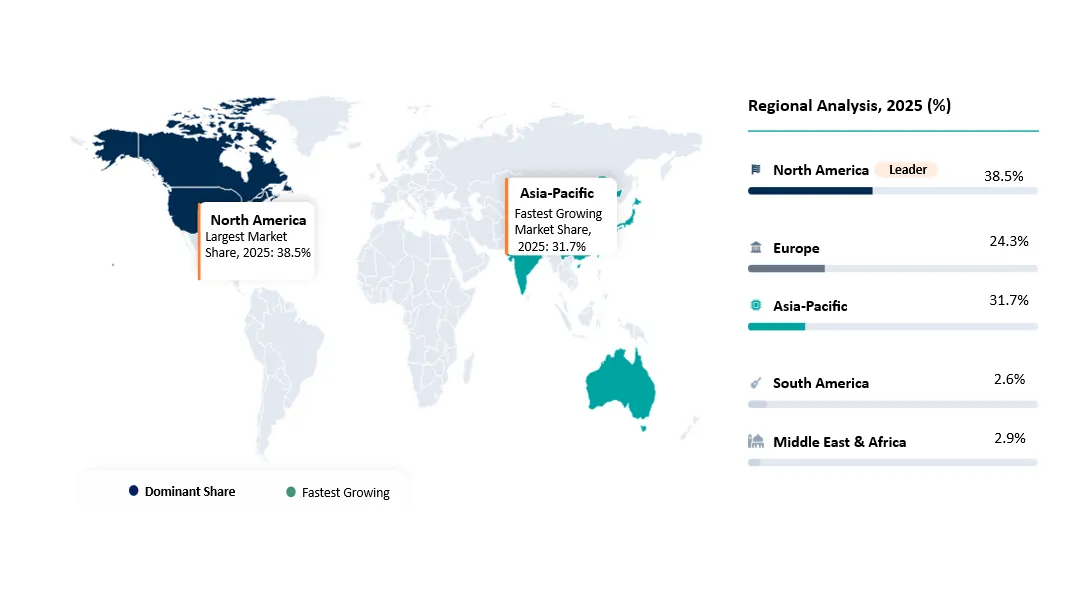
| Region | 2025 Share | Market Position | Primary Growth Drivers |
| North America | 38.5% | Largest market | Defense radar, satellite communications, startups, semiconductor and optical innovation |
| Europe | 24.3% | Research and telecom strength | RIS, terahertz, photonics, acoustic metamaterials and collaborative programs |
| Asia-Pacific | 31.7% | Fastest-growing market | Semiconductor manufacturing, electronics, telecom, automotive and government investment |
| South America | 2.6% | Emerging demand | Defense modernization, telecom coverage and industrial inspection |
| Middle East and Africa | 2.9% | Selective high-value adoption | Defense, satellite communications, smart infrastructure and energy facilities |
U.S. Metamaterials Market Landscape
The U.S. is the largest national market through defense procurement, counter-UAS demand, satellite communications, security screening, optical startups and advanced research. Commercial leaders in metasurface antennas, metamaterial radar, holographic beamforming and metalenses are concentrated in the country. Growth will depend on government contracts, foundry scaling, export compliance and integration with major defense, telecom and electronics platforms.
Japan Metamaterials Market Outlook
Japan combines display, optical, semiconductor and precision manufacturing capabilities with strong research in metasurfaces. Development of wavelength-selective metalenses and partnerships in multi-band metasurface antennas show the country’s importance as both a technology and manufacturing partner. Opportunities are strongest in compact optics, automotive sensing, display systems, communications and industrial inspection.
China Metamaterials Market Trends
China has a large research base and significant activity in electromagnetic materials, defense, telecom and advanced manufacturing. Government support for 6G, aerospace, photonics and domestic semiconductor capability can accelerate commercialization. The market is also influenced by export controls, intellectual property concerns and limited transparency around defense-related applications.
Germany Metamaterials Market Outlook
Germany is important in automotive sensing, industrial engineering, RF electronics, optics and acoustic control. Universities and applied research institutes support technology transfer, while telecom and automotive supply chains provide routes to commercialization. Adoption will favor solutions with validated reliability and integration into existing manufacturing standards.
France Metamaterials Market Outlook
France has strong activity in reconfigurable intelligent surfaces, satellite communications, defense electronics and photonics. Telecom trials and European research funding support programmable radio environments. Partnerships between startups, operators, research institutes and aerospace groups are central to commercialization.
India Metamaterials Market Outlook
India is an emerging market through defense modernization, satellite communications, 5G infrastructure, space programs and advanced-materials research. Commercial scale remains limited, but local manufacturing incentives and demand for resilient communications can support partnerships, licensing and application engineering.
Middle East and Africa Metamaterials Market Outlook
Demand is concentrated in Gulf defense, satellite communications, smart infrastructure and energy facilities. The region can become an early adopter of high-value systems even without a large local manufacturing base. Partnerships with sovereign technology programs, telecom operators and security integrators will be important.
Metamaterials Market Competitive Landscape
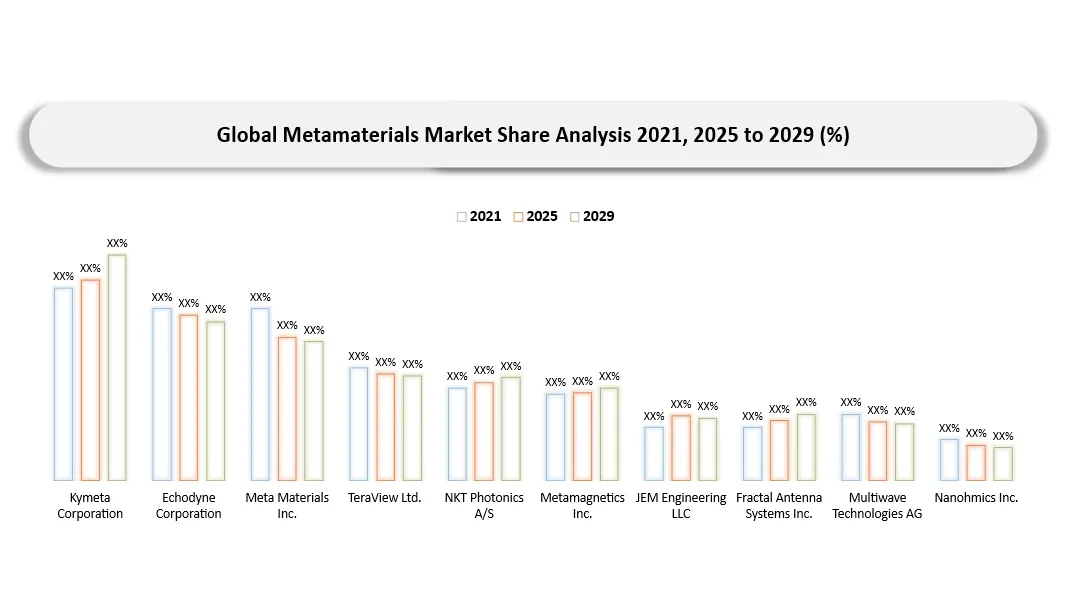
- Kymeta, Echodyne, Pivotal Commware, Lumotive and Metalenz are among the most commercially visible specialists across antennas, radar, wireless infrastructure, LiDAR and optical sensing.
- Competition is segmented by wavelength and application, with limited direct overlap between RF antenna suppliers, optical metasurface companies and acoustic metamaterial developers.
- Manufacturing partnerships are becoming a decisive competitive advantage because scalable yield and packaging determine whether a technology can enter volume markets.
- Defense and satellite companies compete on deployed performance, reliability and contract execution, while consumer optics companies compete on wafer economics, module integration and design wins.
- Patent portfolios remain important, but customer access, system integration and production readiness increasingly determine market position.
Metamaterials Market Key Companies
- Kymeta Corporation (U.S.)
- Echodyne Corp. (U.S.)
- Pivotal Commware (U.S.)
- Lumotive (U.S.)
- Metalenz, Inc. (U.S.)
- Evolv Technologies (U.S.)
- Greenerwave (France)
- Fractal Antenna Systems, Inc. (U.S.)
- TeraView Limited (UK)
- Meta Materials Inc. (Canada)
- Metamagnetics Inc. (U.S.)
- Multiwave Technologies AG (Switzerland)
- JEM Engineering, LLC (U.S.)
- Kuang-Chi Technologies (China)
Metamaterials Market Company Profiles
Kymeta Corporation
Kymeta develops metasurface electronically steered antennas and intelligent communications platforms for mobile satellite connectivity. Its competitive position is built on low-profile antenna architecture, software control, mobility use cases and relationships with satellite operators and defense customers. The company is developing multi-band capability and has partnered with Japan Display to use advanced TFT manufacturing for a next-generation Ku and Ka-band metasurface aperture. Success depends on terminal performance, production cost, multi-orbit interoperability and the ability to secure government and commercial design wins.
Echodyne Corp.
Echodyne commercializes metamaterials electronically scanned array radar for defense, critical infrastructure, aviation and autonomous systems. Its portfolio includes EchoShield, EchoGuard and related platforms that aim to deliver phased-array performance at lower size, weight, power and cost. The company has expanded rapidly through counter-UAS demand and introduced rapid deployment and software integration products. Competitive strength comes from field-proven tracking accuracy, compact architecture, software-defined operation and customer integration.
Pivotal Commware
Pivotal Commware develops holographic beamforming antennas, repeaters and reconfigurable wireless infrastructure. The technology uses metamaterial concepts to direct RF energy with fewer active components than conventional phased arrays. The company targets fixed wireless access, network densification, coverage improvement and future intelligent surfaces. Commercial outcomes depend on operator economics, interoperability, installation simplicity and scaling through telecom partners.
Lumotive
Lumotive develops semiconductor-based optical beam steering using Light Control Metasurface technology. The platform targets LiDAR, robotics, industrial automation and mobility by enabling solid-state beam control without mechanical scanning. Its competitive position depends on optical efficiency, field of view, range, integration with laser and sensor modules and the ability to scale through semiconductor manufacturing partnerships.
Metalenz, Inc.
Metalenz develops meta-optics produced with semiconductor manufacturing methods. Its products include polarization-sensing and authentication technologies intended to reduce optical stack complexity. The company’s manufacturing partnership with UMC for Polar ID demonstrates a route toward high-volume production. Differentiation rests on design IP, foundry compatibility, module integration and the ability to win consumer-electronics platforms.
Evolv Technologies
Evolv Technologies supplies high-throughput security screening systems using advanced electromagnetic sensing and software analytics. The company has built an installed base across venues and public spaces. Its relevance to the metamaterials market is tied to engineered sensing architectures that improve detection while supporting continuous visitor flow. Commercial priorities include recurring service revenue, performance validation, customer retention and regulatory scrutiny of automated detection claims.
Greenerwave
Greenerwave develops reconfigurable intelligent surfaces and electronically controlled wave-shaping technologies for telecom, satellite and sensing. The company is positioned in the emerging software-defined radio environment where passive or low-power surfaces improve propagation and antenna performance. Partnerships with operators, aerospace groups and equipment suppliers are important for deployment scale.
Fractal Antenna Systems, Inc.
Fractal Antenna Systems develops compact antennas, absorbers, cloaking-related structures and electromagnetic products based on fractal and metamaterial principles. The company serves defense, communications and specialty engineering markets. Competitive value comes from intellectual property, compact form factor and application-specific design, while scale depends on integration into larger systems and recurring contract programs.
TeraView Limited
TeraView develops terahertz imaging and spectroscopy systems used in industrial inspection, semiconductor analysis and pharmaceutical applications. Metamaterial and structured optical components can enhance terahertz generation, control and sensing. The company competes on application expertise, instrumentation, data analysis and customer validation in specialized industrial markets.
Meta Materials Inc.
Meta Materials has developed engineered films, optical and electromagnetic products across several application areas. Its history includes thin-film metamaterials, laser protection, transparent conductive structures and specialty optical solutions. Competitive relevance depends on commercialization discipline, customer-backed programs, manufacturing efficiency and focus on products with repeatable demand.
Metamagnetics Inc.
Metamagnetics develops advanced ferrite, magnetic and RF materials for defense and communications. Its products address non-reciprocal components, interference control and high-frequency applications. The company benefits from specialized materials expertise and defense relationships, with growth linked to radar, electronic warfare and compact RF systems.
Multiwave Technologies AG
Multiwave Technologies develops RF and microwave metamaterial solutions, imaging and antenna technologies. The company operates in specialized healthcare, sensing and communications applications. Its position depends on technical differentiation, partnerships and conversion of research-grade systems into repeatable commercial platforms.
JEM Engineering, LLC
JEM Engineering designs antennas and RF systems for defense, aerospace and communications. Metamaterial and engineered-surface methods support low-profile, conformal and performance-optimized antennas. The company’s value lies in application engineering, rapid development and customer-specific qualification rather than mass-market volume.
Kuang-Chi Technologies
Kuang-Chi Technologies is associated with advanced electromagnetic materials, aerospace and defense applications in China. The company has pursued engineered materials for signature control, communications and sensing. Its market relevance is significant in the domestic ecosystem, although public visibility into program scale and product economics is limited.
Metamaterials Market Major Pain Points
- Difficulty translating narrowband laboratory performance into broadband, temperature-stable and manufacturable products.
- High non-recurring engineering cost and long customer qualification cycles.
- Yield and process-control challenges for nanoscale optical structures and large-area RF panels.
- Limited interoperability and standard measurement methods across emerging product categories.
- Dependence on specialized substrates, RF semiconductors, lithography and packaging.
- Customer concern around durability, calibration drift, repairability and lifecycle support.
- Export controls and security restrictions for defense, radar and advanced communications technology.
- Uncertain deployment economics for reconfigurable intelligent surfaces and some 6G concepts.
Metamaterials Market Recent Developments
July 2026: Kymeta continued advancing metamaterial-enabled satellite communications, while NASA selected a concept for robotically assembled electromagnetic metamaterials aimed at enabling large apertures for space situational awareness and advanced radar applications.
- June 2026: The metamaterials ecosystem strengthened commercialization efforts through industry-focused research and development programs, with the Henry Royce Institute supporting collaborative projects designed to accelerate the scale-up and industrial application of metamaterial technologies.
- May 2026: Metamagnetics expanded its advanced materials capabilities by integrating Lanthanide Solutions, supporting the development of vertically integrated magnetic and RF technologies for mission-critical applications.
- April 2026: Kymeta highlighted continued advances in metamaterial-based flat-panel electronically steered antennas, supporting the evolution of compact satellite communication systems and multi-band connectivity.March 2026: Researchers at North Carolina State University demonstrated magnetically controlled metamaterials capable of regulating deformation sequences, opening opportunities for programmable structures and kinetic-energy absorption applications.
- February 2026: Kymeta and Japan Display Inc. announced a collaboration to develop a multi-band metasurface aperture capable of concurrent Ku- and Ka-band satellite operation, targeting defense and future commercial communications applications.
- January 2026: Kyocera developed a metasurface-based metalens capable of wavelength-controlled focusing and incorporated the technology into a compact wearable aerial display prototype, demonstrating opportunities for miniaturized optical systems.
- February 2026: Kymeta and Japan Display announced a master supply agreement to develop a next-generation multi-band metasurface aperture supporting concurrent Ku and Ka-band satellite operation, with defense deployment planned before broader commercial applications.
- December 2025: Kyocera announced a metasurface-based metalens capable of controlling focal position by wavelength and planned to demonstrate a wearable aerial-display prototype at CES 2026.
- November 2025: Metalenz and UMC entered a manufacturing partnership to move Polar ID metasurface-based face authentication toward mass production using semiconductor foundry capabilities.
- October 2025: Echodyne introduced EchoWare, a software platform intended to simplify integration, command, configuration and lifecycle management of networks using its metamaterials radar products.
- September 2025: Echodyne launched the EchoShield Rapid Deployment Kit, combining four radar units and supporting hardware for rapid hemispherical counter-UAS and airspace-surveillance deployment.
- May 2025: Eutelsat OneWeb and Kymeta launched the Goshawk u8 flat-panel terminal for government and military users, supporting resilient multi-orbit satellite connectivity.
Analyst View / Opinion on Metamaterials Market
- The market is entering a durable commercialization phase, led by antennas, radar and optical modules rather than broad sales of standalone engineered materials.
- North America will remain the largest revenue market through defense and satellite demand, while Asia-Pacific will determine the pace of manufacturing scale and consumer adoption.
- Metalenses have the strongest potential to create very high shipment volume, but success depends on foundry yield, packaging and design wins with large electronics customers.
- Reconfigurable intelligent surfaces can become a major category if operators can prove lower network cost or new performance that cannot be achieved through conventional densification.
- Companies with system-level software, calibration and integration capability will outperform firms that rely only on material IP.
- Partnerships with foundries, defense primes, satellite operators, telecom vendors and Tier-1 suppliers are the most important route to commercial scale.
Metamaterials Market Target Audience
| INDUSTRY | WHO SHOULD BUY THIS REPORT? | REASON TO BUY THIS REPORT |
| Aerospace & Defense | Defense primes, radar suppliers, program offices and integrators | Assess compact radar, SATCOM, signature management and sensing opportunities. |
| Telecommunications | Operators, equipment vendors, tower companies and private-network providers | Evaluate beamforming, RIS, repeaters and future 6G deployment models. |
| Semiconductors & Optics | Foundries, optical module makers, sensor companies and packaging providers | Identify metalens, millimeter-wave and wafer-level manufacturing opportunities. |
| Consumer Electronics | Device OEMs, biometric suppliers and camera module companies | Assess compact optics, polarization sensing and component integration. |
| Automotive & Mobility | OEMs, Tier-1 suppliers, radar and LiDAR developers | Evaluate solid-state sensing, connectivity and lightweight wave-control systems. |
| Industrial & Security | Automation suppliers, inspection companies, venue operators and security integrators | Track terahertz imaging, screening, acoustic control and infrastructure protection. |
| Investors & Consulting | Venture capital, private equity, corporate strategy and advisory teams | Support investment, partnership, market entry and technology diligence. |
Why Choose DATAM?
- Data-driven insights combining market sizing, application shipments, technology readiness, manufacturing economics and company-level analysis.
- Post-purchase analyst consultations for market entry, partnership identification, technology benchmarking and custom modeling.
- Quarterly white papers and case studies linked to purchased titles and strategic priorities.
- Annual report updates covering new contracts, product launches, manufacturing partnerships and regulatory changes.
- Specialized focus on emerging markets and commercialization pathways rather than broad academic technology summaries.
- Actionable analysis that connects material performance with system economics, manufacturing and buyer qualification.
What DATAM Uniquely Provides
- Detailed separation of electromagnetic, photonic, acoustic, mechanical and thermal metamaterial value chains.
- Forecasts across product, function, spectrum, fabrication, application, end use and region.
- Competitive benchmarking based on deployed products, foundry readiness, partnerships, IP and system integration.
- Buyer-focused analysis of qualification, reliability, yield, pricing and lifecycle support.
- Country-level opportunity analysis linking defense, telecom, semiconductor and research ecosystems.




























































