


MCT Oil Market Size
The global MCT oil market reached an estimated US$ 2.31 billion in 2025 and is expected to reach US$ 4.82 billion by 2035, growing at a CAGR of 7.7% during 2026-2035. Growth is supported by broadening use in ketogenic nutrition, sports and active-lifestyle products, clinical nutrition, infant formula, functional beverages, dietary supplements and personal care. Liquid C8/C10 blends remain the commercial core, while high-purity C8 oil and powdered MCT systems are gaining share because they support differentiated positioning, easier formulation and premium pricing.
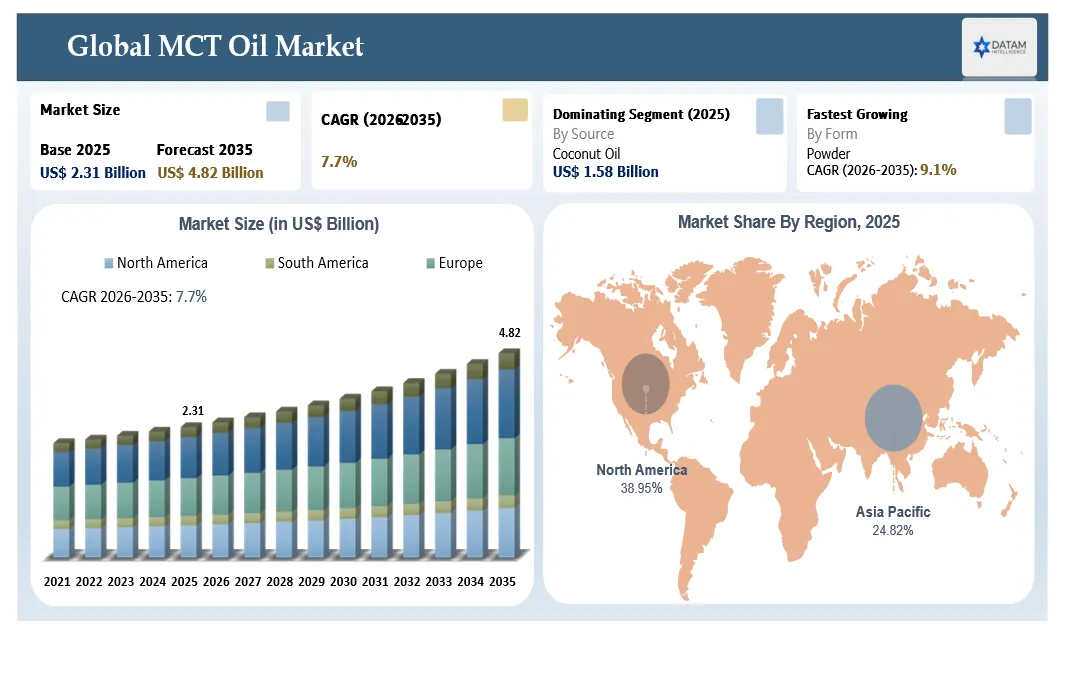
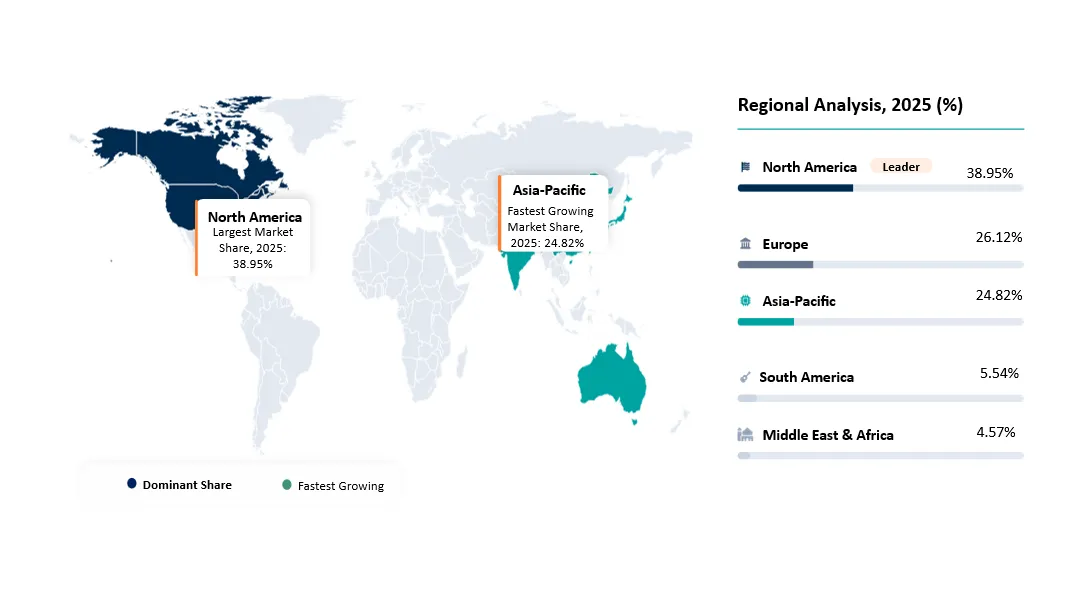
North America represents the largest demand market due to strong supplement penetration, a mature sports-nutrition channel and widespread consumer awareness of ketogenic products. Asia-Pacific is the central production and feedstock region because Indonesia, Malaysia and the Philippines are major suppliers of coconut and palm-kernel oils and host integrated oleochemical capacity. Europe is characterized by demanding quality, traceability and sustainability requirements, while Japan and South Korea support premium clinical, beauty and functional-food applications.
The market is moving from commodity-like C8/C10 oils toward value-added systems defined by purity, sensory performance, dispersibility, certification and application support. Buyers increasingly compare suppliers on verified fatty-acid composition, peroxide and moisture controls, source traceability, allergen management, packaging stability and continuity of supply. Products supported by clinical evidence, branded ingredient programs or customized delivery systems can command a premium above bulk MCT oil.
MCT Oil Market Scope
| Metrics | Details |
| 2025 Market Size | US$ 2.31 Billion |
| 2035 Projected Market Size | US$ 4.82 Billion |
| CAGR (2026-2035) | 7.7% |
| Largest Market | North America |
| Fastest Growing Market | Asia-Pacific |
| By Fatty Acid Composition | C8, C10, C8/C10 Blends, Specialty Blends |
| By Source | Coconut Oil, Palm Kernel Oil, Other and Blended Sources |
| By Form | Liquid Oil, Powder, Emulsions and Premixes, Capsules and Delivery Systems |
| By Grade | Food and Nutraceutical, Pharmaceutical, Cosmetic and Personal Care, Feed and Industrial |
| By Application | Supplements, Sports and Ketogenic Nutrition, Clinical Nutrition, Infant Nutrition, Functional Food and Beverages, Pharmaceuticals, Personal Care, Animal Nutrition |
| By Distribution Channel | Direct Sales, Ingredient Distributors, Online B2B, Retail and E-commerce |
| Report Insights Covered | Market Size, Share, Growth, Pricing, Ecosystem, Competitive Landscape and Country-Level Opportunity |
Why does this report matter in 2026?
The year 2026 is a decision point for the MCT oil industry because feedstock inflation, supply-chain concentration and changing consumer demand are reshaping margins. Producers are raising prices for medium-chain triglycerides, rationalizing assets and reviewing global operations, while food, supplement and personal-care customers continue to seek high-purity and traceable products. The market is therefore expanding in value even when volume growth varies by region and application.
The report matters because the MCT category is not homogeneous. Commodity C8/C10 blends compete mainly on delivered cost and reliability, while pure C8, powder, emulsified and branded systems compete on performance, sensory quality, claims support and formulation convenience. The study separates these opportunities and shows where investment in purification, powder conversion, customer application support and sustainable sourcing can create higher returns.
MCT Oil Market Key Takeaways
- Liquid C8/C10 blends remain the largest product pool because they combine broad functionality, established manufacturing and competitive pricing.
- High-purity C8 oil is the fastest-growing premium segment, driven by ketogenic positioning, rapid energy claims and use in sports and cognitive-wellness products.
- Coconut-derived MCT oil benefits from a strong natural-source perception, while palm-kernel-derived supply remains important for scale, cost and continuity.
- Powdered MCT is gaining adoption in drink mixes, protein powders, meal replacements, bakery premixes and clinical nutrition because it improves handling and dispersibility.
- North America leads demand, while Asia-Pacific combines the fastest growth with the strongest feedstock and manufacturing base.
- Feedstock costs, freight, energy, glycerol and purification yields are the primary variables shaping producer margins and contract pricing.
- Quality differentiation depends on fatty-acid profile, oxidation stability, sensory neutrality, traceability, certification and documentation.
- Market leadership will increasingly depend on application-specific systems, multi-region supply, sustainability evidence and co-development with downstream brands.
MCT Oil Market White Space & Investment Opportunities
- Investment in high-purity C8 capacity and advanced fractionation can capture premium demand from ketogenic, sports and cognitive-nutrition brands.
- Powder conversion and microencapsulation create opportunities in sachets, beverages, clinical powders and convenience formats where liquid oil is difficult to use.
- Regionally diversified feedstock sourcing can reduce exposure to weather events, crop cycles, trade restrictions and concentration in Southeast Asia.
- Certified sustainable palm-kernel and fully traceable coconut supply can improve access to multinational customers with supplier due-diligence requirements.
- Application laboratories and turnkey formulation support can move suppliers closer to customers and increase retention in food, beverage and personal-care accounts.
MCT Oil Future Market Transformation
The MCT oil market will gradually shift from bulk triglyceride supply toward an application-platform model. Ingredient suppliers will offer targeted fatty-acid profiles, powders with different carrier systems, water-dispersible emulsions, flavored blends and branded concepts supported by technical or clinical evidence. Customers will increasingly purchase a complete formulation solution rather than a generic oil, particularly in beverages, clinical nutrition, gummies, stick packs and beauty-from-within products.
Digital procurement and quality documentation will also become more important. Buyers will expect real-time certificates of analysis, origin documentation, sustainability records and predictable lead times. Producers with multi-site manufacturing, qualified alternative feedstocks and strong distributor networks will be better positioned to serve global brands. By 2035, differentiation will be based as much on service, traceability and delivery performance as on chemistry.
MCT Oil Market Buyer Decision-Making Criteria
Buyers prioritize verified C8 and C10 composition, neutral odor and taste, low peroxide value, low moisture, color consistency and stability during storage. Food and nutraceutical companies also assess allergen statements, GMO status, halal, kosher, organic or sustainability certifications, solvent and contaminant controls, packaging options and the supplier’s ability to provide regulatory documentation across markets.
Commercial decisions combine quality with delivered cost, minimum order quantities, lead time, inventory programs and technical support. High-volume buyers may use formula-based contracts linked to coconut or palm-kernel oil, fatty-acid and freight indices. Smaller brands value flexible packaging, distributor inventory and rapid product development. Powder and emulsion customers place additional emphasis on carrier composition, dispersibility, bulk density, flavor masking and shelf-life data.
MCT Oil Market Economic & Investment Analysis
The economics of MCT production depend on access to lauric oils, fractionation yield, esterification efficiency, purification losses, energy consumption and co-product values. Feedstock represents the largest variable cost. Integrated producers with access to coconut or palm-kernel processing and captive fatty-acid streams can manage volatility more effectively than stand-alone refiners. Capacity utilization is critical because the process requires specialized equipment, quality controls and working capital.
Investment returns are strongest in high-purity fractions, pharmaceutical-grade products, powders and customer-specific systems. These categories require additional purification, analytical capability and application development but support higher margins and longer customer qualification cycles. Investors should model demand by application and grade rather than applying a single market-average price. They should also separate consumer brand growth from ingredient volume because retail pricing contains formulation, packaging and marketing value not captured by the MCT supplier.
MCT Oil Investment Trends in the Market
- Capital is moving toward purification, deodorization, automation and quality systems that improve sensory performance and batch consistency.
- Producers are investing in powdering, microencapsulation and emulsion technologies to participate in higher-value downstream formats.
- Supply-chain investment focuses on origin diversification, long-term farmer relationships and certified sustainable palm-kernel or coconut sourcing.
- Public and private companies are optimizing underperforming assets while protecting specialty-lipid capabilities and customer-facing application support.
- Distributors and contract manufacturers are expanding private-label and small-batch services for fast-growing supplement and functional-food brands.
Strategic Indicators for MCT Oil Market
High Regulation Impact
Food, supplement, infant-nutrition, pharmaceutical and cosmetic uses are governed by different standards. Suppliers must maintain compositional specifications, contaminant controls, good manufacturing practices and market-specific documentation. Claims around energy, weight management, cognition and ketosis require particular caution because permitted language and evidence standards differ by country.
High Investment Activity
Investment is concentrated in high-purity C8, powder conversion, application laboratories, sustainable sourcing and integrated oleochemical capacity. Large producers are also pursuing cost reduction and network optimization, making 2026 a period of both expansion and rationalization.
Supply Chain Disruption
The market relies heavily on coconut and palm-kernel feedstocks from Southeast Asia. Weather, crop disease, plantation labor, port congestion, energy costs and policy changes can affect availability and price. Qualified dual sourcing and inventory buffers are becoming standard procurement requirements.
Pricing Volatility
MCT pricing follows lauric oil, fatty-acid, glycerol, energy and freight movements. Premiums vary by C8 concentration, grade, certification, packaging and order size. Producers use quarterly adjustments, indexed contracts and minimum-margin mechanisms to manage volatility.
Procurement Pressure
Large customers demand competitive pricing, audit readiness, traceability and uninterrupted supply. Smaller customers require flexible quantities and distributor inventory. Procurement teams increasingly score suppliers on sustainability, quality-event response and geographic resilience.
New Technology Adoption
Improved fractionation, molecular distillation, deodorization, microencapsulation and emulsion systems are broadening the range of applications. Digital process control can improve yield and reduce off-spec production, while analytical tools support tighter fatty-acid and contaminant specifications.
Regional Expansion Opportunity
Asia-Pacific offers the strongest combination of feedstock, processing and downstream growth. North America remains attractive for premium brands and clinical nutrition, while the Middle East and Latin America offer whitespace in sports nutrition, functional beverages and local distribution.
Government Policy Support
Policies affecting coconut farming, palm sustainability, food fortification, clinical nutrition and domestic oleochemical processing influence market development. Export duties and sustainability regulations can shift trade flows and sourcing decisions.
Pricing Intelligence
Bulk C8/C10 blends form the reference price. Pure C8 generally commands a substantial premium, while powders include conversion, carrier and packaging costs. Pharmaceutical and validated clinical grades are priced on documentation, purity and qualification burden rather than commodity feedstock alone.
Disruption Analysis of MCT Oil Market
The market is being disrupted by the combination of premium consumer demand and raw-material pressure. Pure C8 products, powders and water-dispersible systems are expanding the addressable market, while input volatility is forcing suppliers to revise prices and operating footprints. The result is a bifurcated market in which integrated producers compete on scale and cost, while specialty suppliers compete on purity, application support and branded evidence.
Consumer scrutiny of palm sourcing and scientific claims is another disruptive force. Coconut-derived products may benefit from perception, but coconut supply is also geographically concentrated and exposed to aging trees and climate risk. Customers are therefore seeking evidence-based sourcing narratives rather than simple source claims. Companies that can document origin, labor practices, land-use controls and product carbon footprint will gain access to demanding multinational accounts.
MCT Oil Market BCG Matrix: Company Evaluation
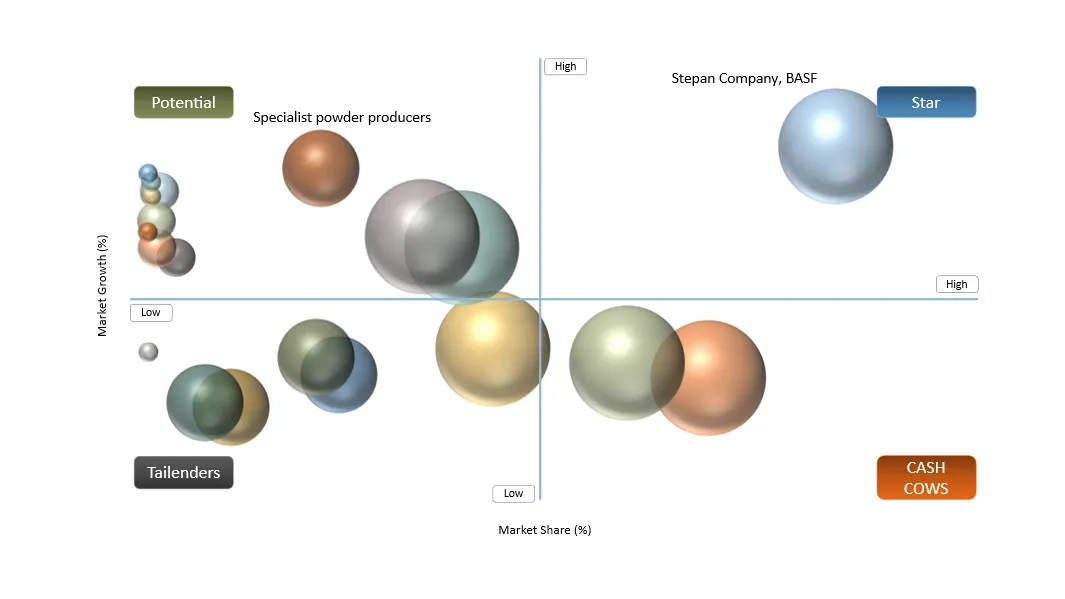
STAR
Stepan Company, BASF, Croda and integrated Asian oleochemical groups occupy the Star category because they combine broad customer reach, technical capability and exposure to growing specialty-lipid applications. Stepan has direct visibility through its NEOBEE medium-chain triglyceride line, while BASF and Croda participate through nutrition, pharmaceutical and personal-care ingredient platforms. Integrated Asian producers benefit from feedstock access and export scale.
POTENTIAL
Specialist powder producers, branded ingredient developers and regional coconut processors represent Potential players. Their growth depends on customer qualification, sensory performance, certification and the ability to move beyond commodity liquid oil. Companies that build strong application science or secure differentiated sustainable feedstock can progress rapidly despite smaller scale.
MCT Oil Market Dynamics
Driver Impact Analysis
| Driver | Market Growth Impact | Demand Concentration | Impacted Use Case | Strategic Impact |
| Ketogenic and sports nutrition adoption | High | North America, Europe, urban Asia | C8 oil, shots, powders, capsules | Supports premium formats and branded claims platforms. |
| Clinical and medical nutrition growth | High | Hospitals, elderly care, specialty nutrition | Enteral formulas and energy-dense nutrition | Rewards pharmaceutical-grade quality and long-term supply. |
| Functional food and beverage innovation | Medium-High | Beverages, coffee, snacks and meal replacements | Powders and emulsions | Expands demand for dispersible and neutral-taste systems. |
| Personal care and beauty applications | Medium | Premium skin care and hair care | Emollients and carrier oils | Broadens demand beyond nutrition and supports stable margins. |
Driver: Expansion of Ketogenic, Sports and Clinical Nutrition
MCT oil provides rapidly metabolized fatty acids that are widely used in ketogenic diets, sports products and clinical nutrition. The category benefits from consumer interest in convenient energy, low-carbohydrate formulations and healthy aging. Clinical applications create a stable base because MCTs are used where digestion or fat absorption is impaired and in energy-dense formulas. Product innovation is extending demand into powders, gummies, ready-to-drink beverages and meal-replacement systems.
Restraint Impact Analysis
| Restraint | Drag on Market Growth | Primary Impact Area | Impacted Use Case | Strategic Impact |
| Coconut and palm-kernel price volatility | High | Manufacturing cost and contract pricing | All grades | Encourages indexed contracts, dual sourcing and inventory buffers. |
| Gastrointestinal tolerance limits | Medium-High | Consumer acceptance | High-dose supplements and beverages | Requires dosage guidance, gradual-use recommendations and formulation work. |
| Claims and evidence limitations | Medium | Marketing and regulation | Weight, cognition and metabolic claims | Favors conservative positioning and stronger clinical substantiation. |
| Commodity competition and private label | Medium | Margins | Standard C8/C10 oil | Pushes suppliers toward purity, certification and technical service. |
Restraint: Feedstock Volatility and Consumer Tolerance
MCT producers are exposed to crop-driven lauric oil markets and competition from food, soap, personal-care and industrial users. Sudden increases in coconut or palm-kernel oil can compress margins when customer contracts reset slowly. At the consumer level, large doses may cause gastrointestinal discomfort, which can limit repeat purchase or constrain formulation. Suppliers and brands respond through gradual-use guidance, smaller serving sizes, powder systems and blends designed for tolerance.
MCT Oil Market Segment Analysis
The global MCT oil market is segmented by fatty acid composition, source, form, grade, application, end use industry, distribution channel and region.
By Fatty Acid Composition
C8/C10 Blends Remain Largest, While Pure C8 Grows Fastest
C8/C10 blends lead because they deliver balanced performance and broad suitability at a lower cost than isolated C8. Pure C8 is growing faster in ketogenic, sports and cognitive-wellness products where brands seek premium positioning and rapid-energy narratives. C10-focused and specialty blends serve formulation, clinical and cost-optimization needs.
By Source
Coconut Oil Leads Consumer Preference
Coconut-derived MCT oil benefits from strong label recognition and is widely preferred by supplement and food brands. Palm-kernel oil remains strategically important because it supports large-scale, integrated oleochemical production. Buyers increasingly evaluate traceability and sustainability rather than assuming one source is inherently superior.
By Form
Liquid Oil Leads, Powder Records Faster Growth
Liquid oil remains the largest form due to simple production, broad use and strong retail recognition. Powder is growing faster because it supports drink mixes, bars, bakery applications, clinical powders and convenient single-serve formats. Emulsions and premixes are gaining attention for ready-to-drink products.
By Grade
Food and Nutraceutical Grade Dominates
Food and nutraceutical grade accounts for the largest share, supported by dietary supplements and functional foods. Pharmaceutical grade commands higher pricing due to tighter specifications, validation and documentation. Cosmetic grade provides stable demand as a lightweight emollient and carrier.
By Application
Dietary Supplements Remain Largest
Supplements lead through bottled oils, softgels and powder blends. Sports and ketogenic nutrition grows rapidly, while clinical and infant nutrition provide technically demanding, defensible demand. Functional beverages are an important emerging application because of the need for stable emulsions and neutral sensory performance.
By Distribution Channel
Direct Sales Control Large Accounts
Large food, clinical and personal-care customers purchase directly under qualification and supply agreements. Distributors serve fragmented regional customers and provide inventory, repacking and regulatory support. E-commerce is important for retail MCT brands but represents a smaller share of bulk ingredient transactions.
MCT Oil Market Geographical Penetration
U.S. MCT Oil Market Landscape
The United States is the largest national demand market due to high supplement consumption, established sports-nutrition channels, widespread e-commerce and strong adoption of ketogenic products. Growth is moving toward pure C8, powder and flavored formats. Clinical nutrition and specialty food applications provide a stable institutional base. Competition is intense, making brand trust, quality documentation and fulfillment important.
Germany MCT Oil Market Outlook
Germany combines a mature supplement market with strong pharmaceutical, clinical-nutrition and personal-care industries. Buyers emphasize EU compliance, traceability and sustainability. Demand is strongest for documented food-grade, pharmaceutical-grade and cosmetic products supplied through established distributors and direct contracts.
Japan MCT Oil Market Trends
Japan has a sophisticated functional-food and clinical-nutrition market. MCT oil is used in health foods, sports products, elderly nutrition and beauty applications. Consumers favor convenient formats and credible scientific communication. Domestic ingredient companies and food manufacturers have strong formulation capability, creating demand for consistent high-purity oils and powders.
China MCT Oil Market Outlook
China is a fast-growing consumption and processing market supported by sports nutrition, meal replacements, infant nutrition, personal care and e-commerce. Domestic manufacturers are expanding, but premium imported ingredients retain value in high-end formulations. Regulatory compliance and local distribution are critical.
Indonesia, Malaysia and the Philippines
These countries are central to the supply base because of coconut and palm-kernel production and integrated oleochemical capacity. Opportunity lies in moving downstream from crude oils and fatty acids into purified MCT, powders and branded ingredients. Export competitiveness depends on energy, logistics, certification and customer qualification.
Brazil MCT Oil Market Outlook
Brazil is an emerging demand market for sports nutrition, supplements and functional beverages. Growth is supported by gyms, digital retail and local contract manufacturing. Import costs and currency volatility encourage distributor inventory and potential local formulation partnerships.
Middle East and Africa MCT Oil Market Outlook
The region offers whitespace in sports nutrition, weight-management products, clinical nutrition and premium wellness. Gulf markets provide the strongest near-term demand, supported by high disposable income and modern retail. Halal documentation, distributor capability and temperature-stable packaging are important.
MCT Oil Market Ecosystem
| Value Chain Sector | Representative Companies / Organizations | Role in the Ecosystem | Key Growth Factors |
| Lauric feedstock producers | Wilmar, KLK, IOI, Musim Mas, coconut cooperatives in the Philippines and Indonesia | Supply coconut oil, palm kernel oil and fatty-acid streams | Crop yields, plantation practices, traceability and export policy |
| Fractionation and oleochemicals | BASF, KLK OLEO, IOI Oleo, Wilmar, Musim Mas, Oleon, Kao | Produce medium-chain fatty acids and specialty oleochemical intermediates | Integrated feedstock, scale, energy efficiency and purification |
| MCT oil manufacturers | Stepan, BASF, Croda, IOI Oleo, KLK OLEO, ABITEC, Oleon | Esterify, purify, deodorize and standardize MCT oils | C8/C10 profile, quality consistency, capacity and customer qualification |
| Powder and delivery-system specialists | Sternchemie, Bioriginal, contract spray dryers, encapsulation companies | Convert liquid MCT into powders, emulsions and premixes | Dispersibility, carrier selection, sensory quality and shelf life |
| Ingredient distributors | Acme-Hardesty, Brenntag, Azelis, IMCD, Barentz, regional distributors | Provide inventory, repacking, technical support and local compliance | Coverage, lead time, application support and customer reach |
| Contract manufacturers | Softgel producers, powder blenders, beverage co-packers, clinical-nutrition manufacturers | Convert ingredients into finished dosage and food formats | Flexible capacity, GMP, formulation expertise and speed to market |
| Consumer and clinical brands | Sports-nutrition brands, ketogenic brands, medical-nutrition companies, personal-care brands | Create finished products and consumer demand | Claims, brand trust, format innovation and channel access |
| Retail and e-commerce | Amazon, pharmacies, specialty nutrition retailers, supermarkets, direct-to-consumer stores | Distribute finished MCT products | Search visibility, education, pricing and repeat purchase |
| Testing and certification | SGS, Intertek, Eurofins, NSF, USP, halal and kosher bodies, RSPO | Validate composition, contaminants, GMP and sustainability | Audit readiness, market access and retailer requirements |
| Regulators and trade bodies | FDA, EFSA, national food authorities, Codex, customs agencies | Set food, supplement, infant-nutrition, claims and trade requirements | Safety standards, labeling, tariffs and enforcement |
MCT Oil Market Competitive Landscape
- The market includes integrated oleochemical producers, specialty ingredient companies, powder-system specialists and retail brands. Integrated producers compete through feedstock access and scale, while specialty suppliers compete through purity, technical support and application-specific solutions.
- Stepan is a visible direct participant through the NEOBEE range and has highlighted medium-chain triglycerides in 2026 pricing and earnings commentary. BASF, Croda and Asian oleochemical groups participate through broader nutrition, pharmaceutical and personal-care portfolios.
- Competition is strongest in standard C8/C10 oil, where customers can qualify multiple suppliers. Pure C8, pharmaceutical grade, powder and branded systems have higher barriers because qualification, sensory performance and documentation matter more.
- Multi-region supply, sustainable sourcing and rapid response to quality events are becoming competitive differentiators. Customers increasingly seek suppliers capable of serving several markets with consistent specifications.
- Partnerships among feedstock processors, ingredient suppliers, distributors, contract manufacturers and consumer brands are central to product launches and geographic expansion.
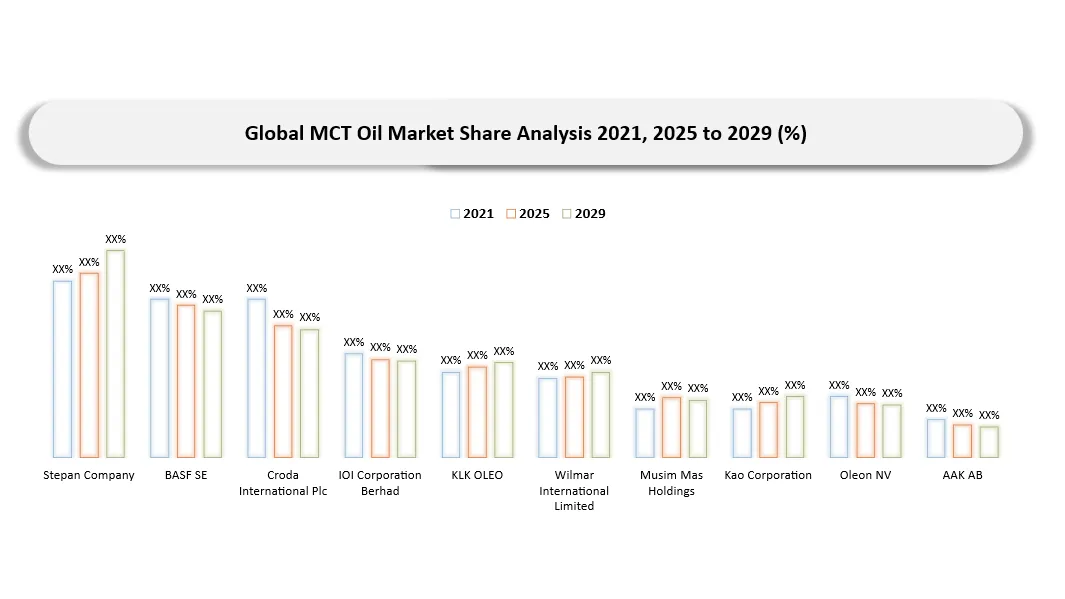
Key Companies
- Stepan Company
- BASF SE
- Croda International Plc
- IOI Oleo GmbH / IOI Corporation Berhad
- KLK OLEO / Kuala Lumpur Kepong Berhad
- Wilmar International Limited
- Musim Mas Holdings
- Kao Corporation
- Oleon NV
- Acme-Hardesty Co.
- Lonza Group
- AAK AB
- Sternchemie GmbH & Co. KG
- ABITEC Corporation
- Bioriginal Food & Science Corp.
Public Company Q1-Q2 2026 Performance Comparison
| Public Company | Q1-Q2 2026 Performance | MCT Oil Exposure | Growth Drivers and Constraints |
| Stepan Company (NYSE: SCL) | Q2 net sales were approximately US$684.1 million, up about 15% year over year. Management reported that medium-chain triglyceride mix was less favorable, partly offset by stronger food and flavor earnings. | Direct through NEOBEE medium-chain triglycerides and related specialty lipid products. | Growth is driven by food, nutrition and personal-care demand. Margin pressure reflects product mix, feedstock costs and restructuring. A July 2026 MCT price increase supports recovery. |
| BASF SE (Frankfurt: BAS) | Q2 sales rose 16% to €17.2 billion and EBITDA before special items reached €2.4 billion. Nutrition & Care recorded a slight earnings increase. | Exposure through Nutrition & Care, pharmaceutical excipients and specialty lipid systems. | Volume recovery, higher group pricing and operational improvement support growth. Nutrition pricing remained competitive and raw-material working capital increased. |
| Croda International Plc (LSE: CRDA) | Q1 group sales were £431 million, up 1% at constant currency. H1 reporting highlighted continued progress in Consumer Care and health-related ingredients, with transformation actions continuing. | Exposure through health care, nutraceutical, pharma and personal-care lipid ingredients. | Beauty actives, specialty health ingredients and innovation support growth. Crop weakness, currency and portfolio optimization constrain group performance. |
| Kuala Lumpur Kepong Berhad (Bursa: KLK) | For the quarter ended March 2026, revenue was about RM6.55 billion and profit for the period about RM316.6 million; quarterly net profit improved strongly year over year. Oleochemical contribution was softer. | Direct through KLK OLEO and integrated palm-kernel oleochemical operations. | Integrated feedstock and global oleochemical reach support scale. Downstream margin compression and fatty-alcohol/oleochemical cycles can offset plantation strength. |
| Wilmar International Limited (SGX: F34) | Q1 2026 core net profit declined to about US$264.2 million from US$343.0 million a year earlier. | Indirect and direct exposure through lauric oils, specialty fats, oleochemicals and downstream ingredients. | Integrated origination and processing support supply security. Earnings are sensitive to edible-oil margins, commodity volatility, financing costs and regional demand. |
Company Profiles
Stepan Company
Stepan is one of the most visible public companies in the MCT oil market through its NEOBEE range. Its competitive strengths include established food, nutrition and personal-care relationships, application expertise and manufacturing scale. In 2026, the company announced a cost and efficiency program and raised MCT prices, indicating active margin management amid feedstock and mix pressure.
BASF SE
BASF participates through Nutrition & Care and pharmaceutical ingredient capabilities. Its broad portfolio, global manufacturing network and regulatory expertise support supply to food, healthcare and personal-care customers. MCT is not reported separately, but the company benefits from cross-selling and large-account relationships.
Croda International Plc
Croda supplies high-performance ingredients to consumer care and life sciences. Its strengths include formulation science, premium customer relationships and innovation. MCT-related opportunities are linked to nutraceutical, pharmaceutical and personal-care systems rather than commodity volume.
IOI Oleo GmbH / IOI Corporation Berhad
IOI combines upstream palm-oil resources with downstream oleochemical operations. The company is positioned to supply medium-chain intermediates and specialty esters through an integrated value chain. Growth depends on oleochemical spreads, sustainable sourcing and customer qualification.
KLK OLEO / Kuala Lumpur Kepong Berhad
KLK OLEO is a major global oleochemical supplier backed by integrated feedstock. Its scale, geographic reach and broad fatty-acid and ester portfolio support participation in MCT and related specialty lipids. Downstream profitability remains sensitive to global oleochemical cycles.
Wilmar International Limited
Wilmar is a large integrated agribusiness and oleochemical company with access to palm-kernel and coconut-related supply chains. Its scale and logistics support reliable feedstock and export capability. MCT is part of a much broader portfolio and is not disclosed separately.
Musim Mas Holdings
Musim Mas is a major integrated palm-oil and oleochemical group. It provides fatty acids, glycerin and specialty ingredients relevant to MCT production. Competitive advantages include feedstock integration, global distribution and sustainability programs.
Kao Corporation
Kao has extensive oleochemical, surfactant and consumer-product expertise. Its technical capabilities support specialty esters and high-quality ingredients for food, pharmaceutical and personal-care applications.
Oleon NV
Oleon produces specialty oleochemicals and esters for food, pharmaceutical, personal-care and industrial markets. Its European manufacturing base and sustainability positioning support premium customer segments.
Acme-Hardesty Co.
Acme-Hardesty is an important distributor and supplier of specialty oils and oleochemicals in North America. It connects global producers with regional formulators and provides inventory, documentation and technical support.
Lonza Group
Lonza is relevant through pharmaceutical and nutrition manufacturing capabilities, dosage-form technologies and quality systems. Its role is stronger in downstream formulation and contract manufacturing than in bulk MCT production.
AAK AB
AAK specializes in plant-based oils and specialty fats. Its application expertise and customer co-development model are relevant to clinical nutrition, food and functional-lipid systems.
Sternchemie GmbH & Co. KG
Sternchemie supplies functional lipids and powdered systems for food and nutrition. Its strengths include powder technology, customized blends and application support.
ABITEC Corporation
ABITEC is known for specialty lipids and excipients used in pharmaceutical, nutrition and personal-care applications. Its portfolio includes high-value lipid systems where documentation and performance create barriers to entry.
Bioriginal Food & Science Corp.
Bioriginal develops and distributes nutritional oils and specialty ingredients. Its capabilities in formulation, branded ingredients and global sourcing support participation in MCT-based consumer products.
MCT Oil Market Major Pain Points
- Volatile coconut, palm-kernel, glycerol, energy and freight costs.
- Concentration of lauric feedstock and processing in Southeast Asia.
- Gastrointestinal tolerance concerns at high serving levels.
- Inconsistent scientific claims and varying regulatory treatment across markets.
- Commodity competition in standard C8/C10 oil and private-label retail.
- Need for strict sensory, oxidation and contaminant control.
- Difficulty maintaining powder dispersibility and shelf life in complex formulations.
- Sustainability scrutiny around palm-kernel sourcing and limited traceability among smallholder coconut supply.
MCT Oil Market Recent Developments
- July 2026: Stepan Company announced price increases for NEOBEE medium-chain triglycerides ranging from US$0.04 to US$0.20 per pound, with related increases for triglyceride specialties.
- July 2026: Stepan reported that Q2 net sales increased 15% year over year, while a less favorable mix in medium-chain triglycerides was largely offset by higher earnings in food and flavor products.
- July 2026: BASF reported Q2 sales of €17.2 billion and EBITDA before special items of €2.4 billion, with Nutrition & Care delivering a slight earnings improvement.
- July 2026: Croda released first-half 2026 results following Q1 group sales of £431 million and continued transformation of its manufacturing and distribution footprint.
- May 2026: Kuala Lumpur Kepong reported stronger quarterly earnings, while noting weaker profit contribution from oleochemicals, highlighting the divergence between plantation economics and downstream specialty-chemical margins.
- April 2026: Wilmar reported lower Q1 core net profit, reflecting softer performance across parts of its integrated agribusiness and processing portfolio.
Analyst View / Opinion on MCT Oil Market
- The market is positioned for durable growth because MCT oil serves several independent demand pools, including supplements, sports nutrition, clinical nutrition, infant products, food and personal care.
- Value growth will outpace volume growth as suppliers pass through feedstock inflation and customers adopt pure C8, powder and application-specific systems.
- Asia-Pacific will remain the strategic supply center, but customers will demand more traceability, sustainability evidence and contingency planning.
- North America will continue to lead premium consumer demand, while Japan, China and selected Southeast Asian markets offer strong growth in functional food and clinical nutrition.
- Suppliers that rely only on commodity C8/C10 oil will face margin pressure. Stronger positions will come from purification, powder conversion, branded evidence, formulation support and multi-region distribution.
- Public-company results in 2026 show that MCT demand can remain attractive even when group earnings are influenced by restructuring, crop cycles or broader oleochemical margins. Market analysis must therefore separate category demand from company-wide performance.
MCT Oil Market Target Audience
| Industry | Who Should Buy This Report? | Reason to Buy This Report |
| Oleochemicals | Fatty-acid producers, ester manufacturers and integrated processors | Assess feedstock economics, capacity, pricing and downstream opportunities. |
| Nutraceuticals | Ingredient suppliers, supplement brands and contract manufacturers | Identify growth formats, source preferences and channel opportunities. |
| Food and Beverage | Formulators, beverage companies, bakery and meal-replacement producers | Evaluate powder, emulsion and sensory requirements. |
| Clinical Nutrition | Medical-nutrition companies, hospitals and specialized formulators | Understand grade, documentation and long-term supply needs. |
| Personal Care | Cosmetic ingredient companies and brand formulators | Assess demand for lightweight emollients and carrier oils. |
| Distribution | Specialty distributors, traders and B2B platforms | Evaluate regional gaps, inventory needs and customer segmentation. |
| Investment and Consulting | Investors, private equity, banks and strategy teams | Support capacity, M&A, market entry and competitive benchmarking. |
Why Choose DATAM?
- Data-driven insights combining market sizing, price analysis, value-chain mapping, public-company performance and country-level demand.
- Post-purchase analyst consultations for sourcing strategy, market entry, partnership identification and custom modeling.
- Annual report updates covering feedstock prices, capacity, regulation, product launches and competitive developments.
- Specialized focus on emerging markets and Southeast Asian supply rather than generalized regional summaries.
- Actionable analysis connecting ingredient chemistry, consumer demand, formulation requirements and procurement risk.
What DATAM Uniquely Provides
- Ten-year forecasts across composition, source, form, grade, application, end use, distribution channel and region.
- Market ecosystem mapping from coconut and palm-kernel feedstocks through consumer channels and certification.
- Public-company Q1-Q2 2026 comparison with clear distinction between group performance and direct MCT exposure.
- Buyer-focused analysis of purity, sensory quality, sustainability, packaging and technical support.
- Strategic recommendations for high-purity C8, powder, clinical nutrition and regional expansion.




























































