


Masterbatch Market Size and Overview
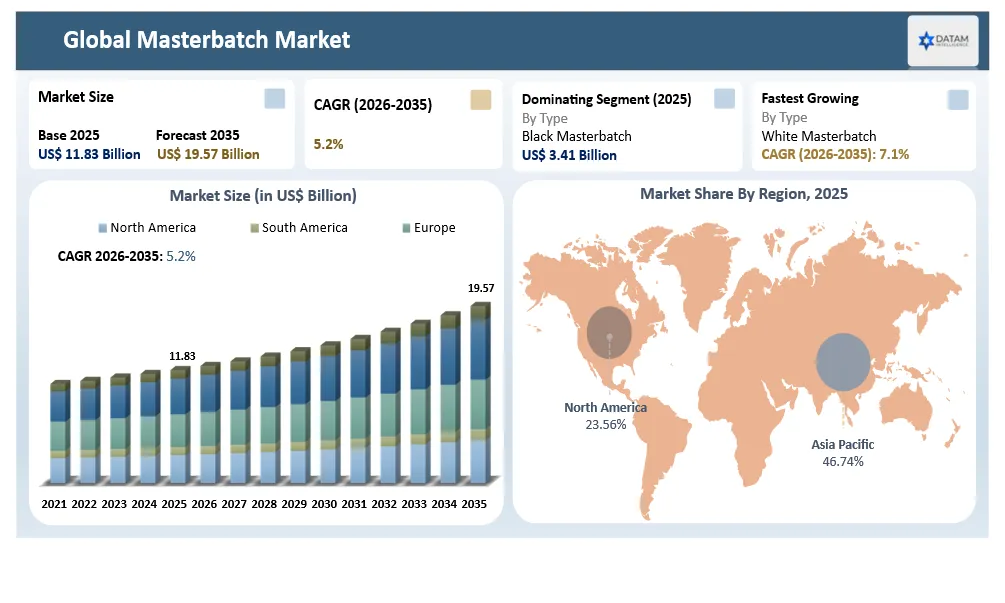
The global masterbatch market reached US$ 11.83 billion in 2025 and is expected to reach US$ 19.57 billion by 2035, growing with a CAGR of 5.2% during the forecast period 2026-2035.
The market is increasingly shifting toward specialty and application-specific masterbatch formulations. The need for additives that will give UV stability, flame retardant qualities, antimicrobial action, antistatic qualities, nucleation and clarification, anti-fog properties and conductivity/ ESD qualities is on the increase. High concentrate formulations are becoming more important because less let-down rates can lead to reduction in the amount of materials used, at the same time offering consistent color or additive efficiency. There are some key applications of masterbatch, which include packaging, agricultural films, automotive parts, electrical & electronics and medical plastics. PE and PP will continue to form high volume systems in masterbatch applications.
Sustainability is yet another growth opportunity, especially with PCR/PIR compatible masterbatch and recycling packaging solutions. Formulations using recycled polymers have to handle fluctuations in terms of color, haze, melt flow, contamination and thermal history, thereby driving the need for technical formulations. On the other hand, engineering polymers like PA, PBT, PC and ABS are becoming more and more significant in applications like automobiles, EVs, electricals and electronics, where temperatures could be in excess of 250°C depending on the polymer and end use. Such applications demand high precision in terms of thermal stability, flame retardancy, conductivity/ESD, dispersion and color.
Masterbatch Market Key Takeaways
- In 2025, the global masterbatch market was controlled by black masterbatch which made a contribution of 28.8% market share owing to the high demand from packaging, pipes, agricultural films, automotive parts and cables.
- White masterbatch is predicted to be fastest-growing segment which is expected to have a growth rate of 7.1% CAGR, due to greater demand for high opacity, brightness, UV protection and economical pigmenting in packaging, consumer products and agriculture film
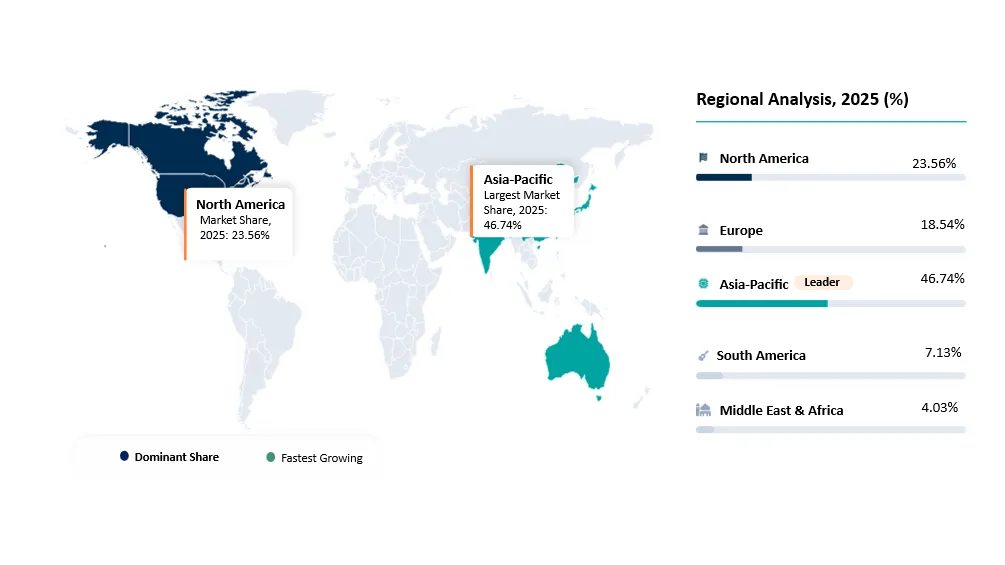
- The Asia-Pacific region was the leader in the masterbatch market with a market share of 46.74% in 2025, supported by huge capacity for plastics processing, packaging, auto manufacturing and electronics manufacturing.
- The growing use of PCR/PIR compatible and concentrated masterbatch is pushing the producers of masterbatch to come up with formulations that preserve color consistency and dispersibility as well as performance during the processing of recycled plastics.
- Growing demand from packaging, automobiles, electric vehicles, electrical & electronics and agriculture segments will drive the opportunity for functional masterbatch providing protection from UV, flame resistance, conductivity/ESD properties and thermal stability.
Masterbatch Industry Trends and Strategic Insights
- In 2025, the global masterbatch market was controlled by black masterbatch which made a contribution of 28.8% market share owing to the high demand from packaging, pipes, agricultural films, automotive parts and cables.
- White masterbatch is predicted to be fastest-growing segment which is expected to have a growth rate of 7.1% CAGR, due to greater demand for high opacity, brightness, UV protection and economical pigmenting in packaging, consumer products and agriculture film
- The Asia-Pacific region was the leader in the masterbatch market with a market share of 46.74% in 2025, supported by huge capacity for plastics processing, packaging, auto manufacturing and electronics manufacturing.
- The growing use of PCR/PIR compatible and concentrated masterbatch is pushing the producers of masterbatch to come up with formulations that preserve color consistency and dispersibility as well as performance during the processing of recycled plastics.
- Growing demand from packaging, automobiles, electric vehicles, electrical & electronics and agriculture segments will drive the opportunity for functional masterbatch providing protection from UV, flame resistance, conductivity/ESD properties and thermal stability.
Masterbatch Market Scope
| Metrics | Details | |
| 2025 Market Size | US$ 11.83 Billion | |
| 2035 Projected Market Size | US$ 19.57 Billion | |
| CAGR (2026-2035) | 5.2% | |
| Largest Market | Asia-Pacific | |
| Fastest Growing Market | Asia-Pacific | |
| By Type | Black Masterbatch, White Masterbatch, Color Masterbatch, Additive Masterbatch and Filler Masterbatch | |
| By Carrier Polymer | Polyethylene (PE), Polypropylene (PP), Polyethylene Terephthalate (PET), Polyvinyl Chloride (PVC), Polystyrene (PS), Acrylonitrile Butadiene Styrene (ABS), Polyamide (PA), Polycarbonate (PC), Polyurethane (PU), Ethylene Vinyl Acetate (EVA), Polybutylene, Terephthalate (PBT) and Others | |
| By Application Process | Compounding, Film Extrusion, Sheet Extrusion, Injection Molding, Blow Molding, Pipe & Profile Extrusion, Fiber Spinning, Rotational Molding, Thermoforming and Others | |
| By End Use Industry | Packaging, Building & Construction, Automotive & Transportation, Consumer Goods, Agriculture, Electrical & Electronics, Textiles, Healthcare & Medical, Industrial and Others | |
| By Functional Property | UV Protection, Antioxidant & Thermal Stabilization, Antistatic, Conductive / ESD, Flame Retardant, Antimicrobial, Slip & Antiblock, Optical Brightening, Nucleating & Clarifying, Foaming / Blowing, Anti-Fog, Desiccant / Moisture Absorption, Odor Scavenging, Processing Aid, Laser Marking and Others | |
| By Form | Pellet / Granule, Powder, Liquid and Others | |
| By Polymer Feedstock | Virgin Polymer and Recycled Polymer | |
| By Bio-based Content | Fossil-Based, Partially Bio-Based and Bio-Based | |
| By End-of-Life Compatibility | Conventional, Biodegradable-Compatible and Compostable-Compatible | |
| By Region | North America | U.S., Canada, Mexico |
| Europe | Germany, UK, Russia, France, Spain, Italy, Poland | |
| Asia-Pacific | China, India, Japan, Australia, South Korea, Indonesia, Malaysia, Singapore, Vietnam, Thailand, Philippines, Taiwan | |
| South America | Brazil, Argentina | |
| Middle East and Africa | UAE, Saudi Arabia, South Africa, Israel, Turkiye, Nigeria | |
| Report Insights Covered | Competitive Landscape Analysis, Company Profile Analysis, Market Size, Share, Growth | |
Why does this report matter in 2026?
The masterbatch market is experiencing a transition from traditional coloring to performance-driven and polymer-based masterbatch. In 2026, rising usage of PCR/PIR resin is posing technical problems regarding color changes, contamination, inconsistent melt flow and dispersion, making a greater need for the development of masterbatches that are designed for recycled polymers. Moreover, converters in packaging, automotive, agriculture, electrical and electronics and construction are looking for additional functionalities such as UV stabilization, anti-static, antimicrobial, flame retardants, slip, antiblock and others along with coloring.
This report is important for 2026 since recycling content incorporation, lightweighting and use of sustainable polymers is changing the product portfolio and strategies among masterbatch manufacturers. Masterbatch manufacturers are competing based on increased pigment/additive loadings, low let-down ratios, formulations, polymer compatibility and sustainable masterbatches. This knowledge allows companies to find out which masterbatches will have a high growth potential, carrier polymers, applications, market demand trends and technologies till 2035.
Masterbatch Market White Space & Investment Opportunities
- PCR-Compatible High-Opacity Masterbatch: Create masterbatches in various colors that retain their opacity, whiteness and hue integrity in PCR-based packaging resins regardless of differences in quality among the feedstocks used.
- Low-Let-Down High-Performance Masterbatch: Utilize very concentrated pigments and additives formulations that offer desired performance in low let-down rates to reduce masterbatch usage and resin dilution for large converters.
- Multifunctional Masterbatch for Flexible Packaging: Aim at multifunctional formulations which provide UV stability, slip, antiblock, antistatic and optical functionality in one single concentrate, thus simplifying the formulation process.
- Engineering-Polymer Masterbatch for Electrification: Formulate specialized masterbatches for various engineering polymers with specifications for components such as PA, PC, ABS, PBT, etc. which are employed in components of EVs, battery systems, connectors, charging equipment and electronic enclosures where thermal stability and color matching are very important.
- Masterbatch for Biodegradable and Compostable Polymers: Focus on special formulations that are suitable for compatible with biodegradable polymers such as PLA, PBAT, PBS and PHA to make color and functional products that maintain processing and characteristics of biodegradable polymers at the end of their life.
Masterbatch Future Market Transformation
The masterbatch market is set to change from a typical color concentrate market into an advanced formulation and materials engineering market. By 2035, growing adoption of PCR/PIR plastics will drive development towards formulations that can compensate for variability in color, opacity, dispersion and processability of the recycled resin. The use of masterbatch suppliers for high concentration, low let down and multifunctional formulations will enable converters to realize multiple property performance while reducing the amount of material required. Growth in EVs, batteries, electronics, medical devices and lightweight automotive applications will increase demand for specialist masterbatches which are compatible with engineering polymers like PA, PC, ABS and PBT.
The competitive environment would also favor those firms with formulation R&D capabilities, polymer compatibility skills, digital color-matching abilities and sustainability in their product portfolio. Bio-based, compostable and recycled-polymer compatible masterbatches are projected to take precedence as converters use more sustainable polymers. This revolution would favor those suppliers that can offer a combination of color accuracy, functional excellence, recycled resin compatibility, reduction in let-down ratio and application-specificity rather than competing solely on color masterbatch cost.
Masterbatch Market Buyer Decision-Making Criteria
The purchase decision for masterbatch market participants is becoming increasingly driven by the ability of suppliers to ensure consistency in terms of color, performance, polymer compatibility and processing. Packaging, automotive, construction, agriculture and electronics companies are interested in suppliers that will be able to maintain consistency in shade, pigment dispersibility, thermal stability and performance at optimal let-down rates. Compatibility with PCR/PIR recycled polymers becomes especially important as converters seek to increase recycled materials usage without compromising the appearance and processing qualities of the end-product. Buyer considerations include not only customization and technical support but also regulation and sustainability performance, as well as cost of masterbatch use in plastics.
Major Buyer Decision-Making Criteria
- Color Strength, Shade Consistency and Pigment Dispersion
- Polymer Compatibility and Processing Performance
- Let-Down Ratio and Cost per Finished Product
- Recycled-Polymer Compatibility and Sustainability Profile
- Functional Performance and Product Consistency
- Supply Reliability and Manufacturing Capacity
- Customization and Technical Support
- Regulatory Compliance and Quality Certifications
- Price Competitiveness and Price Stability
- Application-Specific Performance and Innovation Capability
Masterbatch Market Economic & Investment Analysis
The masterbatch market provides investment options in terms of both volume-based commodity usage as well as high margin specialty grades. The economy is directly related to plastic processing in packaging, automobile, construction, agriculture, electrical & electronics and consumer goods industries. The investments are progressively becoming more and more inclined towards additive, functional, high concentration, recyclable polymer and engineering polymer masterbatches, wherein technical advantage is an option that can give higher margins than color concentrates. The profitability will be influenced by the variations in polymer resins, pigments, additives, energy and logistics costs.
The attractiveness of investment in Asia Pacific is mainly due to the region’s huge base of plastics conversion and growing packaging and manufacturing capacity. Investment in North America and Europe may be made in the specialty, recycled content and sustainable formulations. Main areas of investment in masterbatches are PCR-compatible coloring system, multifunctional additive masterbatch, high concentration formulations, sustainable masterbatch and materials for EV & electronics components. When making investments, investors need to consider manufacturer capabilities regarding production capacity, formulation research and development, customer diversification, raw material sourcing, geographical closeness to converters, profitability and capacity utilization.
Masterbatch Investment Trends in the Market
- Expansion of PCR/PIR-Compatible Production Capacity: Masterbatch producers have been making investments in formulations and manufacturing lines that can cater to recycled-polymer applications, specifically for packaging materials in which recycled resin variability poses issues of color and dispersion.
- Investment in High-Concentration Dispersion Technology: Companies are making investments in pigment and additive loading technologies to create high concentration masterbatches that perform well at reduced let-down ratios.
- Capacity Development for Engineering-Polymer Applications: Capacity Building for Masterbatch Production: Growing investment is being made towards R&D and production capacity for PA, PC, ABS and PBT masterbatches to cater to the applications in EVs, batteries, electrical connections and housing for electronics.
- Scaling Sustainable Masterbatch Portfolios: Manufacturers are making investment towards formulating masterbatches suitable for bio-based, biodegradable and recycled polymers especially those used in packaging and agriculture.
- Regional Manufacturing and Technical-Service Expansion: Businesses have started building manufacturing plants, color labs and development application centers closer to large processing and packaging plants for plastics to minimize logistics costs and save on time.
Strategic Indicators For the Masterbatch Market
High Regulation Impact
There are many influences of regulation on the masterbatch market as formulations have to adhere to chemical safety, food contact, packaging, environmental and product-specific regulations in key markets. There are regulations about restricted pigments, heavy metals, hazardous substances, flame retardants and recycled plastics that may oblige companies to change their formulations and sourcing of raw materials. Food contact and medical products have stricter regulations, while rising regulations about recycled content lead to growing demands for formulations meeting PCR/PIR masterbatch requirements. Therefore, suppliers having good testing, tracing, documentation and formulation capabilities benefit from the market dynamics.
High Investment Activity
There has been an increased level of investments in masterbatch production, specialized formulation research and application-oriented manufacturing processes in the Masterbatch Market. There has been an increasing trend of investments in premium masterbatches used in plastics (PCR/PIR), engineering polymers, EV parts, electrical & electronics and sustainable packaging where the technicalities involved are more complex than those in ordinary colored masterbatches. Investments have also been made in pigments dispersion technology, dosing, digital color matching and quality control measures. The expansion of regional capacity in the vicinity of major plastic conversion locations has resulted in increased investments due to lower logistics costs and faster customer qualification.
Supply Chain Disruption
Disruption risks exist for the masterbatch market due to the need for stable supply of the necessary raw material, including polymers carriers, titanium dioxide, carbon black, organic and inorganic pigments and other additives. Disruption risk associated with pigments and additives is especially high, since the replacement of such raw materials will likely require additional steps, such as formulation, color matching, performance testing and re-approval by customers. The cost fluctuations related to polymers, energy and logistics can also create additional pressure on the profitability of masterbatch production. To increase the supply chain resilience, masterbatch producers have been developing alternative sourcing strategies.
Pricing Volatility
The masterbatch market remains exposed to pricing volatility because carrier resins, pigments, additives, energy and freight directly influence production costs. Global masterbatch prices moved from US$2.185/kg in Q1 2025 to US$2.142/kg in Q3 2025 before recovering to US$2.293/kg in Q1 2026, representing a 4.9% increase from Q1 2025 to Q1 2026. Regional pricing also varies significantly: Q1 2026 prices were approximately US$1.65/kg in China, US$2.18/kg in India, US$2.40/kg in the U.S. and US$2.94/kg in Germany.
The volatility of raw materials is key for black and white masterbatch, as carbon black and titanium dioxide influence formulation economics. The price of carbon black has also increased in the first quarter of 2026, as it reached US$1.16 per kg in Northeast Asia and US$1.92 per kg in North America, while the difference in regional costs of resin and energy keeps generating a huge variation in pricing of masterbatch. Thus, producers rely more on long-term contracts on raw materials, multi-sourcing, inventory management, formulation optimization and price adjustment techniques in order to safeguard their profit.
Procurement Pressure
The challenges faced in the masterbatch market procurement include balancing the price of raw material, the performance of the formulation, supply stability and regulatory compliance requirements. Procurement professionals have to ensure availability of carrier polymers, pigments, titanium dioxide, carbon black and other additives meeting specific quality standards with regards to the strength of color, dispersion, heat resistance and let-down ratio. Changing the raw materials used requires extensive reformulation process involving lab testing, color matching, process evaluation and qualification by the customers for packaging, automotive, medical and electronic products among others. Consequently, big buyers are increasingly focusing on technical and commercial aspects in supplier selection such as qualified multi-sourcing, contractual agreements, documentation and supply capability among others.
New Technology Adoption
In the masterbatch market, there has been an increased focus on adoption of advanced technologies to ensure better pigment dispersibility, accurate color formulation, efficient distribution of additives and improved manufacturing efficiencies. The increasing need for strict specifications in terms of color and greater adoption of recycled polymers by converters is a major driver behind the adoption of advanced technology for masterbatch manufacturing. Twin screw compounding, high shear dispersion, automated gravimetric dosing and digital spectrophotometric color matching are some of the advanced technologies used to ensure consistent quality masterbatch at optimum let down ratio. Greater use of PCR/PIR resins is leading to increased adoption of advanced formulation and dispersion technologies to account for variability in the feedstock. Advanced color formulation through AI, laboratory testing and in-line quality checking have been gaining traction in decreasing formulation development times.
Regional Expansion Opportunity
Expansion in the masterbatch market is seen as highly viable in the region of Asia Pacific through India, China and Southeast Asia where increased production of plastics coupled with packaging materials, agricultural films, auto parts and consumer products has created an avenue for further masterbatch production capacity within the regions. India and Southeast Asia are especially attractive for such investments due to their proximity to converters which reduces lead times and creates avenues for formulation of masterbatches in tune with local requirements. On the other hand, expansion in the markets of North America and Europe is primarily focused in PCR/PIR compatible, sustainable, functional and engineering-polymer masterbatches due to regulatory constraints and specialized applications in these markets.
Government Policy Support
Policies that support recycling of plastic waste, adoption of recycled content and development of a circular economy create immediate opportunities for the masterbatch market. Policies and procurement practices that mandate increased use of PCR/PIR plastics will lead to higher need for masterbatches that can ensure color uniformity, opacity, dispersion and good processing properties of recycled resin. On the other hand, policies that restrict usage of heavy metal pigments, specific flame retardants, hazardous substances and additives will encourage reformulation of traditional masterbatches and development of safer alternative products. Investments in collection, sorting, recycling and advanced recycling of plastic waste could provide additional market opportunities for recycled polymer compatible masterbatches.
Pricing Intelligence
There are high price differentiations for masterbatch based on its type, concentration, base polymer, complexity of formulation and economics of production in different regions. Prices for Q1 2026 were estimated at US$1.65/kg in China, US$2.18/kg in India, US$2.40/kg in the U.S. and US$2.94/kg in Germany, which shows that there is 78.2% price differential between the lowest and highest prices in different regions. Special formulations usually carry high prices due to the use of special pigments, high concentration, additional additives, color control requirements and special formulation requirements. Therefore, the important price parameter to be considered by purchasers is the cost-in-use price per formula, determined from the masterbatch price and the required ratio of dilution, not the price per kilogram of masterbatch itself.
| HS Code | Reporter | Trade Flow | 2025 Trade Value | Interpretation |
3206.49 (Other coloring matter and preparations) | China | Export | US$286.48 Million | Major Colorant Supply Base: Captures inorganic coloring preparations relevant to plastic coloration and certain masterbatch formulations. China is an important manufacturing and export base for these products. |
3204.17 (Pigments and preparations based on synthetic organic pigments) | Germany | Export | US$533.48 Million | Specialty Colorant Supply: Reflects Germany's established position in synthetic organic pigments and preparations used in high-performance plastic coloration. |
3206.19 (Other coloring matter and preparations based on titanium compounds) | U.S. | Import | US$210.65 Million | Titanium-Based Colorant Demand: Relevant to white-color formulations and titanium-based coloring systems used in plastics and masterbatch. |
3206.49 (Other coloring matter and preparations) | India | Import | US$118.42 Million | Growing Colorant Demand: Relevant to India's expanding plastics-processing and masterbatch ecosystem. |
AI Impact Analysis of the Masterbatch Market
AI is gaining popularity as an optimization technology in the masterbatch market in terms of formulation, color matching and quality control. Using AI and machine learning algorithms, manufacturers can evaluate the interaction between pigments, properties of carrier polymers, levels of additives and other parameters of a formula to predict the desired colors and optimize the formulation. The use of AI in color matching will save manufacturers from experiments and the use of AI for process monitoring will enable them to detect any discrepancies in dispersion, temperatures, dosing, melt flow and consistency in the compound and extrusion process.
The implementation of AI would likely be most beneficial in the creation of customized colors, recycling polymers masterbatches, high concentration formulas and engineering polymer uses. The use of recycling polymers results in higher levels of variability regarding color and processes involved; thus, data-driven formulation would prove valuable. AI could also provide assistance in predicting quality control, improved production yield, optimization of raw materials used and reduced number of rejected batches. However, AI should be viewed as an enabler but not as a substitute for the skills of formulators.
Disruption Analysis of Masterbatch Market
Disruption in the masterbatch market is resulting from the shift from traditional uses of virgin resin to the recycling and usage of lightweight and specialty polymers. Usage of PCR/PIR as feedstock results in formulation problems such as differences in coloration, contamination, variations in flow and thermal history. This is leading to an increase in the need for recycled polymer-friendly and high dispersion masterbatches. On the other hand, high concentration low let down masterbatches are affecting the economics of converters due to reduced usage of concentrates.
The second disruption involves the development of masterbatch into engineering plastics. Masterbatch that is required by EV components, battery plastics, connectors, housing of electronics, medical items and lightweight automobile components needs more stringent standards regarding thermal stability, electrical properties, flame retardancy, UV resistance and accurate coloring. This is causing the need for special-purpose PA, PBT, PC, ABS, conductive, flame-retardant and laser marking masterbatches. Simultaneously, digital color matching, formulation automation, advanced dispersion techniques and AI-based formulation technologies have minimized the development cycle and increased consistency. In consequence, competitiveness is changing from production to formulation.
Masterbatch Market BCG Matrix: Company Evaluation
STAR
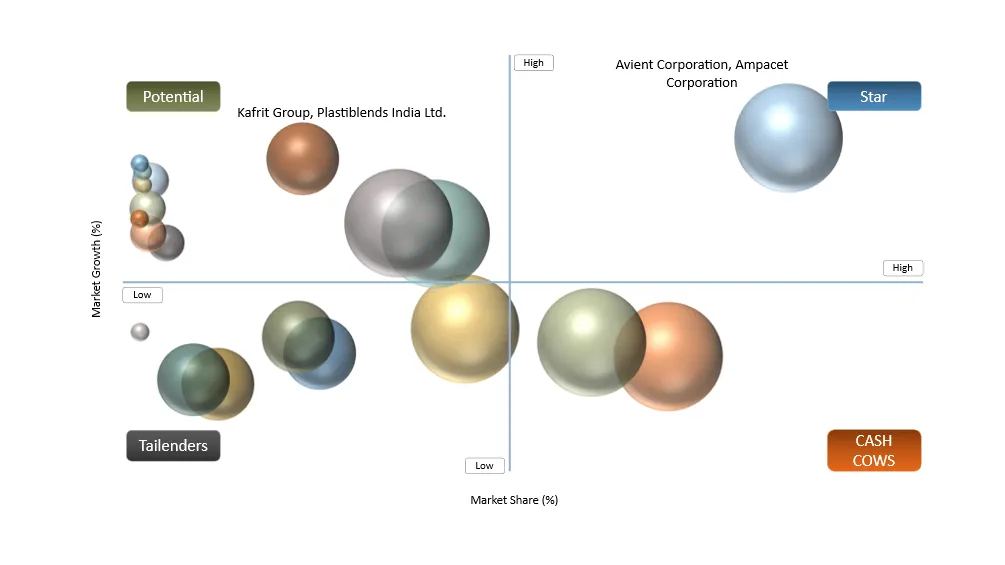
Avient Corporation, Ampacet Corporation, Cabot Corporation and LyondellBasell Industries. They possess substantial market share, diversified masterbatch range, well-established international client base, as well as competence in formulating specialty, additive and sustainable products. Their involvement in such sectors as packaging, automotive, electronics and recycled polymers gives them a great deal in terms of growth opportunities.
POTENTIAL
Kafrit Group, Plastiblends India Ltd., Tosaf Group, Gabriel-Chemie Group and Astra Polymers. These are the firms that offer growth prospects in the specialty masterbatch and recycled polymer compatible formulation business, as well as additives. They have growth opportunities in the Asia Pacific, sustainable packaging, agriculture, automotive and engineering polymers applications sectors despite having smaller global market presence compared to leading multinational firms.
Masterbatch Market Dynamics
Driver Impact Analysis
| Driver | Market Growth Impact (%) | Demand Concentration | Impacted Use Case | Strategic Impact |
Rising Demand for Sustainable and Recycled Polymer-Compatible Masterbatch | 28% | Packaging, Agriculture, Consumer Goods | PCR/PIR packaging films, containers, agricultural films | Accelerates development of masterbatches that maintain color, dispersion and processing performance in recycled polymers |
Growing Demand for Functional Masterbatch Beyond Coloration | 24% | Packaging, Agriculture, Automotive, Electronics | UV protection, antistatic, flame retardant, antimicrobial, slip & antiblock applications | Shifts supplier competition toward multifunctional formulations and higher-value additive systems |
Expansion of Plastic Packaging and Flexible Film Applications | 26% | Food & Beverage, Consumer Goods, Pharmaceutical Packaging | Flexible films, rigid packaging, caps & closures | Increases demand for high-dispersion color, opacity, slip, antiblock, anti-fog and processing-aid masterbatch |
Increasing Use of Masterbatch in Automotive, Electrical & Electronics Applications | 22% | Automotive, EVs, Electrical & Electronics | Interior/exterior components, connectors, housings, battery-related components | Creates opportunities for specialty masterbatches compatible with PA, PBT, PC, ABS and other engineering polymers |
Driver: Rising Demand for Sustainable and Recycled-Polymer-Compatible Masterbatch
The growing use of PCR/PIR recycled polymers and high-end engineering polymers in packaging, automotive, electrical & electronics, agriculture and consumer goods applications is creating demand for unique masterbatch solutions. The recycled polymers usually have more variability in terms of base color, melt flow, contamination levels and heat history than virgin materials, which is generating a need for masterbatches capable of providing consistency in terms of look and processing behavior. In addition, there is growing demand for engineering polymers in electric vehicles, electronic enclosures, connectors and automotive applications where specific color requirements and special performance characteristics are becoming more important.
Restraint Impact Analysis
| Restraint | Drag on Market Growth (%) | Primary Impact Area | Impacted Use Case | Strategic Impact |
Volatility in Polymer, Pigment and Additive Costs | 30% | Production Costs & Margins | Black, White, Color and Additive Masterbatch | Encourages long-term raw-material contracts, multi-sourcing, formulation optimization and cost pass-through mechanisms |
Stringent Chemical and Plastic Regulations | 24% | Product Development & Compliance | Food-contact packaging, healthcare, electrical & electronics | Increases testing and reformulation requirements while favoring suppliers with compliant pigment and additive systems |
Technical Challenges with Recycled Polymer Feedstocks | 27% | Formulation Performance | PCR/PIR packaging, recycled films, containers and consumer products | Requires specialized formulations to manage color variation, contamination, dispersion and processing instability |
High Qualification Costs and Customer Switching Barriers | 19% | Supplier Adoption & Customer Conversion | Automotive, healthcare, food packaging and high-specification plastics | Extends customer approval cycles and increases the importance of technical support, color matching, testing and application-development capabilities |
Restraint: Volatility in Polymer, Pigment and Additive Costs
The masterbatch market is limited by the volatility of carrier polymers, pigments and specialty additives that have the potential of raising costs and pricing issues especially with regard to pigment-heavy white, black and specialty masterbatches. The problem is intensified by the nature of production of masterbatches as changes in pigments, polymers and other additives could change the color intensity, dispersion, thermal resistance and processing capabilities. Producers will not be able to use cheaper input materials straight away since the change may entail testing of the new formulae, color matching, processing experiments and requalification of customers.
Masterbatch Market Segmentation Analysis
The global masterbatch market is segmented based on the Type, Carrier Polymer, Application Process, end-use industry, Functional Property, Form, Polymer Feedstock, Bio-based Content, End-of-life compatibility, and region.
By Type
Black Masterbatch Leads on Broad Industrial and UV-Protection Demand
In 2025, black masterbatch became the leading power in the global masterbatch market with a market share of 28.8%. This can be attributed to the high amount of carbon-black-based formulations being used in packaging films, pipes, agricultural films, automotive parts, construction plastic, wire & cables and molded products. Apart from its coloring properties, black masterbatch provides UV resistance, opacity, electrical conductivity, thermal stability and increased durability making it a great option for products exposed to sunlight, outdoor surroundings and rigorous processing conditions. There is also a demand for black masterbatch because it helps mask inconsistencies in recycled polymer feedstocks that allow converters to provide consistently looking products from PCR or PIR material.
By Type
White Masterbatch Gains Momentum from High-Opacity and Premium Packaging Requirements
The white masterbatch will grow at the highest rate with a CAGR of 7.1%, faster than the CAGR of 5.2% for the entire masterbatch market. This growth will be supported by the rising need for increased opacity, brightness, whiteness, UV resistance and even coloring in applications such as flexible and rigid packaging, agriculture film, consumer goods, containers and household plastics. The titanium dioxide masterbatch is highly valued due to its high level of opacity and optical properties. Improvements in dispersion technology and the use of concentrate formulations will help processors achieve consistency in whiteness in an efficient let-down ratio.
Masterbatch Market Geographical Penetration
U.S. Masterbatch Market Landscape
The U.S. masterbatch market is driven by demand for high-performance color and functional formulations across packaging, automotive, electrical & electronics, healthcare, construction and consumer products. The U.S. converters have a significant focus on color matching, pigment dispersion, let-down ratio, processability, regulations and performance of masterbatches. This results in increased demand for specialty masterbatch. The growing use of PCR material is another factor that is generating demand for masterbatches to compensate for the variability of recycled resin in terms of color, opacity, dispersion and processability. The demand for masterbatch formulations with flame retardancy, conductivity, ESD, UV stabilization and engineering plastic compatibility is also increasing due to the growing usage of masterbatches in automotive, EV, electronics and industrial applications.
Japan Masterbatch Market Outlook
Characteristics of the Japan masterbatch market are the demand for premium grade, specialized and engineering polymer masterbatch due to its automotive, electronics, electrical, medical and precision manufacturing industries. Japan's converters usually demand precise control over color stability, pigment dispersion, thermal stability, surface properties and processing properties, hence the opportunity to develop technically differentiated grades beyond the commodity grades alone. The growth in EVs, battery materials, electronics, connectors and lightweight automotive components has created a demand for masterbatch that is suitable for engineering polymers like PA, PBT, PC, ABS and others, such as flame retardants, conductive, laser marking and UV resistant grades. On the other hand, Japan's emphasis on resource conservation and plastic recycling is driving demand for recyclable polymer masterbatch with high performance capability despite the use of recycled feedstock.
China Masterbatch Market Trends
China's masterbatch market is developing in line with its well-established infrastructure in plastics processing, packaging production, car manufacturing, electronics supply chain and recycling of plastics. There is an emerging trend away from standard color concentrates towards high-concentrated color, additives, fillers and functional masterbatch such as for film extrusion, rigid packaging, agri films, automotive parts and consumer goods. As the usage of recycled polymers grows, there is also a need for PCR/PIR formulas that can control variability in color, dispersion and processing of recycled resin. At the same time, China's growing EV and electronics industry opens up possibilities for engineering polymer, conductive/ESD, flame-retardant, UV-resistant and laser marking masterbatches. The market is highly competitive on the pricing front in commodity applications.
Masterbatch Market Competitive Landscape
- Shift from Commodity Color to Specialty Formulations: Competitors are now looking beyond the typical range of commodity blacks, whites and colors into specialized, concentrated, ESD/conductive, flame-retarded, UV-resistant and engineering polymer masterbatches, where performance and applications knowledge make for more meaningful differentiation.
- Recycled-Polymer Compatibility as a Competitive Differentiator: The most prominent producers are offering increased ranges of PCR/PIR compatible masterbatches to overcome the issues arising out of the use of recycled polymers.
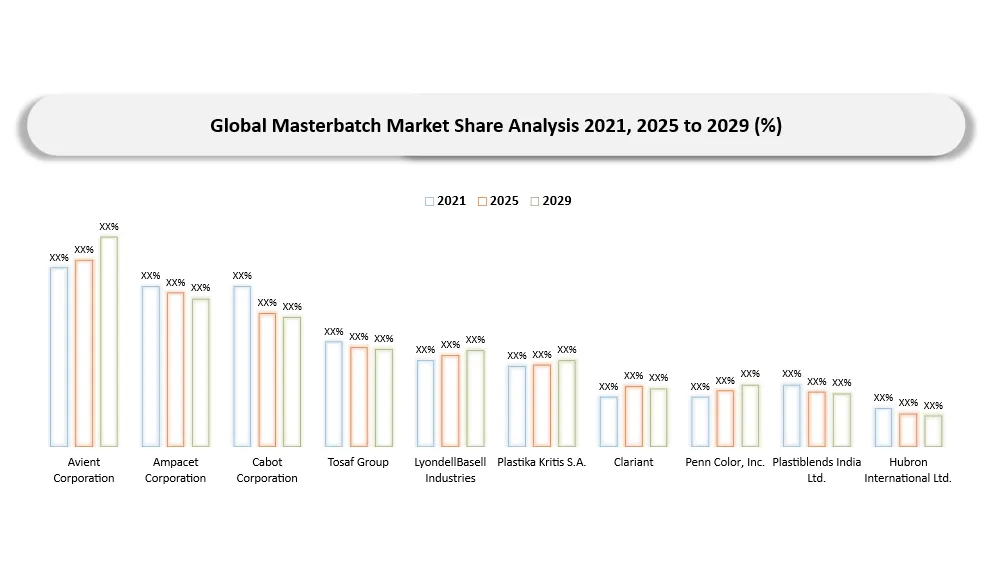
- Global Scale Versus Regional Customization: Large players like Avient, Ampacet, Cabot and LyondellBasell compete via comprehensive product range, global manufacturing and international customer base, while regional companies compete via customized color matching, local production, reduced lead time and application-specific technical expertise.
- Competition for Engineering-Polymer and Electrification Applications: Suppliers are focusing on value-added applications with respect to PA, PBT, PC, ABS, electrification parts, battery-associated plastics, connectors and electronic enclosures, where thermal stability, electrical properties, flame retardancy and color matching demand more technical considerations.
- Formulation Capability and Technical Service as Competitive Moats: Formulation competency and technical services have now become key competitive moats since these technologies allow for better specifications, quick qualification of customers, low rejection rate and consistency in masterbatch performance.
Public Company Q1-Q2 2026 Performance Comparison
This table shows five publicly traded firms with either direct or strategic interest in the masterbatch market. The financial data is provided at the firm level or at the level of the business unit, as it is uncommon for diversified material firms to report revenue figures for their masterbatch business units. This comparison is done to assess the financial performance of these firms in relation to their masterbatch exposure.
| Company | Q1–Q2 2026 Performance | Masterbatch-Relevant Exposure | Key Performance Driver |
| Avient Corporation | Q1 2026 sales reached US$847 million, up 3% YoY; adjusted EPS increased 9% to US$0.83. | Color and additive masterbatch, specialty engineered materials, and recycled-polymer solutions | Demand for specialty materials, sustainable formulations, and application-specific masterbatch |
| Cabot Corporation | Q2 FY2026 net income reached US$68 million, with adjusted EPS of US$1.61. | Carbon black and specialty compounds used in black masterbatch and polymer applications | Carbon-black demand, specialty compounds, pricing, and operational efficiency |
| LyondellBasell Industries | Q2 2026 EBITDA reached US$1.3 billion, reflecting improved polymer margins and favorable co-product pricing. | Polyolefins and polymer materials used as carrier systems and feedstocks for masterbatch | Improved polymer margins, stronger asset utilization, and supply-constrained market conditions |
| Plastiblends India Ltd. | Q1 FY2027 revenue reached US$23.2 million, up 11.0% YoY; PAT increased 67.5% YoY to US$1.56 million. | Direct exposure to color, additive, filler, and biodegradable masterbatch | Indian plastics-processing demand, packaging growth, exports, and sustainable formulations |
Dainichiseika Color & Chemicals Mfg. Co., Ltd. | Q1 FY2027 revenue reached US$219.6 million, up 9.1% YoY; net income increased 16.2% YoY to US$18.4 million. | Direct exposure to colorants, pigments, masterbatch, and functional materials | Demand for specialty coloration, pigments, functional materials, and higher-performance polymer applications |
Note: Financial periods differ slightly because the companies use different fiscal calendars. The comparison uses the latest Q1–Q2 2026 reported results available and should not be interpreted as standalone masterbatch revenue, since diversified companies generally do not separately disclose masterbatch sales.
Key Companies of the Masterbatch
- Avient Corporation (U.S.)
- Ampacet Corporation (U.S.)
- Cabot Corporation (U.S.)
- LyondellBasell Industries (U.S./Netherlands)
- Clariant (Switzerland)
- Plastika Kritis S.A. (Greece)
- Plastiblends India Ltd. (India)
- Tosaf Group (Israel)
- Penn Color, Inc. (U.S.)
- Americhem, Inc. (U.S.)
- Hubron International (U.K.)
- Kafrit Group (Israel)
- Colloids Ltd. (U.K.)
- Sukano AG (Switzerland)
- Astra Polymers (Saudi Arabia)
- Alok Masterbatches Pvt. Ltd. (India)
- Gabriel-Chemie Group (Austria)
- Polyplast Müller GmbH (Germany)
- Dainichiseika Color & Chemicals Mfg. Co., Ltd. (Japan)
- Prayag Polytech Pvt. Ltd. (India)
Company Profiles
Avient Corporation
Avient is one of the largest manufacturers of color and additives masterbatch for packaging, automotive, healthcare, consumer goods, agricultural and electrical/electronics end uses around the world. The company’s product offering is progressively focusing on recycled polymer compatibilities and specialty additives.
Priorities for competition include growing PCR/PIR compatible masterbatch business, creating application-focused solutions, optimizing formulations, and raising market penetration for sustainable and high-performance plastics.
Ampacet Corporation
Ampacet is one of the most renowned producers of masterbatches that provide color, black, white, additive, and functional masterbatches in packaging, agricultural, healthcare, automotive, and consumer plastics. The company provides specialized products for processing, deodorizing, slip, antiblock, and recycled resin applications.
Priority areas include growth of functional masterbatches, development of PFAS-free and recycled polymer solutions, optimization of processability, and customization of formulations for converters.
Cabot Corporation
Cabot is engaged in the masterbatches market in the form of carbon black and specialty compounds for purposes of providing black coloring, UV stabilization, conductivity, and performance modification in plastic materials. Cabot products are especially applicable in pipes, auto parts, packaging, wire and cables, and polymer industries.
Competitive priorities involve advanced carbon black grades, conductive products, UV resistant products, enhanced dispersion, and advanced polymer systems.
LyondellBasell Industries
LyondellBasell has a strategic position with respect to masterbatch because of its broad range of polyethylene and polypropylene products, which serve as carrier materials for color, additive, and filler masterbatch products.
Key competitive factors for LyondellBasell will be circular polymers, recycled-content materials, lightweighting, and carrier systems that can work with masterbatch.
Plastika Kritis S.A.
Plastika Kritis is one of the major European masterbatch providers providing black masterbatch, white masterbatch, color masterbatch, additive masterbatch, and filler masterbatch for packaging, agriculture, construction, and industrial applications.
The competitive priorities of Plastika Kritis include expansion of specialty formulations, development of solutions based on recycled polymers, enhancement of applications for agricultural films, and market penetration into other countries.
Tosaf Group
Tosaf is an international company which produces color and functional additives masterbatch for various applications including UV stabilization, flame retardation, antiblock, slip, antistatic and processing aid. The applications include packaging, agricultural, automotive, construction, electrical/electronic and industrial plastics.
Competitive priorities involve growth in high-performance functional masterbatch, formulation of regulatory-compliant products, capacity enhancement in regional plants, and focusing on specialized applications which offer higher value through functional performance.
Masterbatch Market Major Pain Points
- Inconsistent Color Performance with Recycled Resins: Color variations, pollution, melt flow and thermal history of recycled materials can create problems in obtaining uniform shades and opacity, or dispersion across production runs.
- High Raw Material Cost Exposure: High costs of raw materials such as titanium oxide, carbon black, organic pigments, carrier polymers and specialty additives can lead to pressure on producer profit margins and more complicated pricing for converters.
- Complex Formulation and Customer Qualification: Formulation issues with changes in pigments, carriers and additives could involve color formulation and qualification process.
- Maintaining Performance at Low Let-Down Ratios: Customers demand highly concentrated masterbatches that can provide the desired function or color at a low let-down ratio without affecting performance in terms of dispersion, melt flow and processing.
- Polymer-Specific Formulation Complexity: A masterbatch formulated for a particular polymer or process cannot give satisfactory results in another situation, making the number of formulations and stock keeping units (SKUs) essential.
Masterbatch Market Recent Developments
- July 2026 - Avient Corporation: Launched Cesa Solvent Barrier Technology masterbatch range that can deliver outstanding barrier properties without using PFAS and requiring no production line changes for HDPE bottles.
- April 2026 - Tosaf Group: Built a new plant in Olkusz, Poland with the goal of expanding the production of masterbatch in Central and Eastern Europe region.
- March 2026 - Ampacet Corporation: Introduced innovative circular economy masterbatches such as SLIP Scavenger 1540 and OdorClear odor neutralizers which cater to packaging based on recycled polymers.
- October 2025 - Sukano AG: Introduced an all-purpose masterbatch system for 100% monomaterial and fully recyclable PET bottle closures which can be recycled using existing clear-PET recycling systems.
- September 2025 - Kafrit Group: Acquired Karl Finke GmbH, broadening its capabilities in producing colors masterbatch and liquid colorants in Europe.
Analyst View/Opinion on Masterbatch Market
- Value creation is shifting toward specialty formulations: Standard black, white and colored masterbatch will continue to be the key volumes, but new value trends can be seen in high concentration, functional, polymer-specific and application specific masterbatch formulations.
- Recycled-polymer expertise will increasingly determine supplier competitiveness: With PCR/PIR usage growing, the capability to address color variance issues, contamination, melt flow and dispersion control will become a key value differentiator in qualifying customers.
- Packaging will remain the volume base, while advanced applications improve value potential: Packaging will continue to be a large consumption market, but EV, electronics, auto parts and engineering plastics will present good opportunities in masterbatch formulations which require thermal, electric and flame resistant characteristics and precise color performance.
- Technical customization will become more important than broad product availability: Customers demand customized masterbatch tailored specifically to polymer grades, processing parameters, let-down ratios and end-product requirements, preferring suppliers who have good formulation labs and application-development expertise.
- Supplier economics will increasingly depend on formulation efficiency: The ability to incorporate high levels of pigments/additives, reduce let-down ratios, optimize raw material use and achieve proper dispersion will enable suppliers to compete in terms of performance and not just price-per-kilogram of masterbatch.
Masterbatch Market Target Audience
| INDUSTRY | WHO SHOULD BUY THIS REPORT? | REASON TO BUY THIS REPORT |
| Masterbatch Manufacturers | Business Strategy Heads, Product Managers, R&D Leaders | Identify high-growth masterbatch types, functional formulations, carrier polymers and application opportunities for portfolio expansion. |
| Plastic Compounders & Converters | Procurement Managers, Operations Heads, Technical Managers | Evaluate masterbatch suppliers, pricing, polymer compatibility, formulation performance and recycled-resin requirements. |
| Packaging Industry | Packaging R&D Heads, Procurement Directors, Product Development Managers | Assess demand for color, UV, slip, antiblock, anti-fog and recycled-polymer-compatible masterbatch across flexible and rigid packaging. |
| Polymer & Resin Producers | Commercial Directors, Product Managers, Business Development Teams | Identify opportunities to develop compatible masterbatch solutions for PE, PP, PET, engineering polymers and recycled resin grades. |
| Chemical & Additive Manufacturers | Business Development Managers, Product Strategy Teams | Assess downstream demand for pigments, additives, carrier resins and functional materials used in masterbatch formulations. |
| Automotive & EV Components | Materials Managers, Engineering Teams, Procurement Heads | Evaluate opportunities for specialty masterbatch compatible with PA, PBT, PC, ABS and other engineering polymers used in vehicle and EV components. |
| Electrical & Electronics Manufacturers | Materials Engineers, Procurement Managers, Product Development Teams | Assess demand for conductive/ESD, flame-retardant, UV-stable and other functional masterbatch for electronic and electrical components. |
| Recycling & Circular Plastics Companies | Sustainability Heads, Recycling Managers, Commercial Strategy Teams | Identify opportunities for PCR/PIR-compatible masterbatch that improves color, opacity, dispersion and processing performance of recycled polymers. |
| Investors & Private Equity Firms | Investment Managers, Portfolio Strategy Teams, M&A Professionals | Evaluate market growth areas, competitive positioning, capacity expansion opportunities and attractive specialty-masterbatch segments. |
| Distributors & Specialty Chemical Suppliers | Category Managers, Sales Directors, Distribution Strategy Teams | Identify high-demand product categories, regional opportunities, customer industries and potential supplier partnerships. |
Why Choose DATAM?
- Data-Driven insights: Dive into detailed analyses with granular insights such as pricing, market shares and value chain evaluations, enriched by interviews with industry leaders and disruptors.
- Post-Purchase Support and Expert Analyst Consultations: As a valued client, gain direct access to our expert analysts for personalized advice and strategic guidance, tailored to your specific needs and challenges.
- White Papers and Case Studies: Benefit quarterly from our in-depth studies related to your purchased titles, tailored to refine your operational and marketing strategies for maximum impact.
- Annual Updates on Purchased Reports: As an existing customer, enjoy the privilege of annual updates to your reports, ensuring you stay abreast of the latest market insights and technological advancements. Terms and conditions apply.
- Specialized Focus on Emerging Markets: DataM differentiates itself by delivering in-depth, specialized insights specifically for emerging markets, rather than offering generalized geographic overviews. The approach equips our clients with a nuanced understanding and actionable intelligence that are essential for navigating and succeeding in high-growth regions.
- Value of DataM Reports: Our reports offer specialized insights tailored to the latest trends and specific business inquiries. The personalized approach provides a deeper, strategic perspective, ensuring you receive the precise information necessary to make informed decisions. The insights complement and go beyond what is typically available in generic databases.
What DATAM Uniquely Provides
- Granular masterbatch market Mapping: Links market demand along the lines of type, carrier polymer, process for application, end-use industry, functional property, form and region, thus allowing for pinpointing of growth pockets through a detailed understanding beyond general market classifications.
- Formulation-Level Opportunity Intelligence: Analyzes high-value functionalities, such as conductive/ESD, nucleation and clarification, anti-fog, desiccants, odor scavengers, laser marking, flame retardants and UV resistance, to determine the opportunities for specialized formulations.
- Recycled-Polymer Opportunity Analysis: Differentiates between virgin and recycled polymer usage and how the usage of PCR/PIR impacts the needs in terms of masterbatch formulation, color uniformity, processability and opportunity for suppliers.
- Country-Level Competitive and Trade Intelligence: Connects country demand, trade factors, manufacturing capabilities, competitive strength and regional expansion potential in order to determine suitable countries for masterbatch companies to serve.
- Decision-Oriented Strategic Intelligence: Combines price information, buying pressure, supply chain challenges, regulation effects, investment activity, competitive position, pain points and technology adoption in order to turn market information into decisions.


























































