


Malonic Acid Market Size and Overview
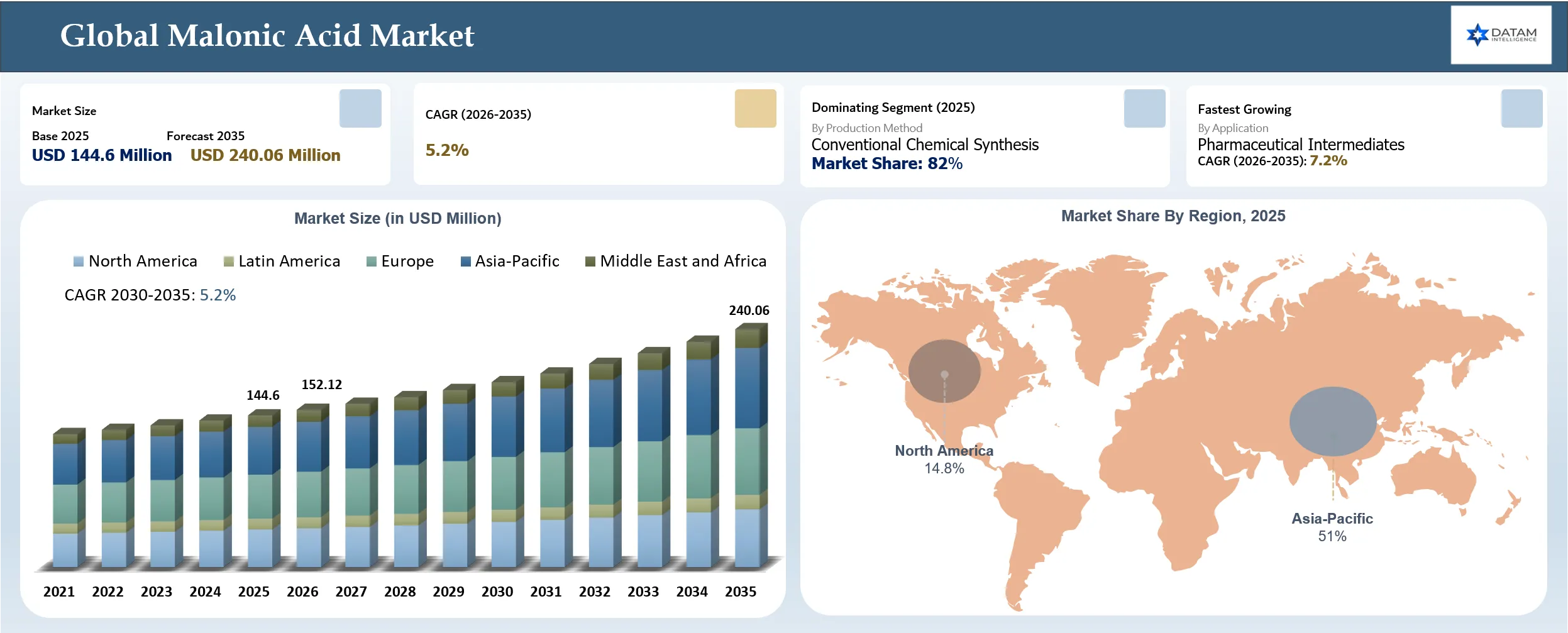
The global malonic acid market stood at USD 144.6 million in 2025 and is anticipated to reach USD 240.06 million by 2035, growing at a CAGR of 5.2% during the forecast period 2026-2035. Demand for malonic acid is driven by its use as a chemical intermediate in various drugs, agrochemicals, flavours, fragrances, and speciality chemicals. In April 2025, according to ACS Synthetic Biology and indexed in PubMed, Malonic acid was produced in metabolically engineered E. coli at 17.8 g/L via fed-batch fermentation, while in shake-flask fermentation, the yield was 1.4 g/L.
In another development in April 2025, as highlighted in CIOReview on Lygos, malonic acid was successfully manufactured at pilot scale from biomass-based sugar feedstock and fermentation technology, replacing the traditional method that used petroleum feedstock and utilised chloroacetic acid and sodium cyanide.
White-Space Opportunities for the Malonic Acid Market Through Alternative-Feedstock Chemical Manufacturing and Bio-Based Process Scale-Up
In September 2026, the U.S. Department of Energy (DOE), Alternative Fuels and Feedstocks Office (AFFO), announced up to USD 58 million available in funding for projects that will develop chemical manufacturing technologies that use alternative and waste feedstocks made in the United States. The maximum individual award amount is offered in the category of Pre-pilot ASPECT, where USD 10 million–20 million per award is available to support pre-pilot plant design, construction, and operations and to develop integrated chemical manufacturing processes.
The amount of funding available in the category of Bench ASPECT is USD 2 million–10 million per award, which can be used for technology validation, process optimisation, bench development, and unit operations pre-piloting. The other areas of interest are waste-to-chemical conversion, biomass usage, alternative feedstock processing, chemical process scale-up, and production of strategically important chemicals in the U.S.
The funding will likely open up opportunities for firms developing technologies for alternative-feedstock conversion, biomass valorisation, fermentation-based chemicals, waste-to-chemicals processes, and chemical process scale-up. Among the companies in the bio-based chemicals and fermentation space developing biological and alternative-feedstock chemical production technologies, there are Lygos, Genomatica, and Solugen.
Firms that have been identified in the space of biomass conversion and renewable feedstock processing for alternative carbon feedstocks and sustainable chemical production are LanzaTech, Virent, and Gevo. In terms of process engineering, pilot plant development, and technology scale-up, Worley, KBR, and Technip Energies are firms operating in the space that relates to chemical process design and engineering. The above list includes some of the potential industry participants by technology area.
Malonic Acid Market Key Takeaways
- The Asia-Pacific region commands a 51% share of the global malonic acid market in 2025. The region acts as both the largest and fastest-growing market due to expansive fine chemical manufacturing.
- Conventional chemical synthesis currently holds an 82% market share in 2025. It remains the primary route due to established manufacturing infrastructure, despite emerging bio-based alternatives.
- In May 2025, BioMADE and Lygos partnered to convert a Hayward, California facility using over USD 80 million from the U.S. Department of Defence. The 25,000-square-foot facility accommodates biological fermenters holding up to 4,000 liters.
- In September 2026, the U.S. DOE announced up to USD 58 million in funding for alternative feedstock manufacturing. Pre-pilot plant grants offer USD 10 million to 20 million per award, while bench-scale grants provide USD 2 million to 10 million.
Malonic Acid Market Industry Trends and Strategic Insight
- Transition Toward Bio-Based Malonic Acid Manufacturing. Manufacturers and technology developers are exploring fermentation-based production to reduce dependence on conventional petroleum-derived chemical routes and hazardous cyanide intermediates.
- Development of Alternative Catalytic Production Routes. Alongside fermentation, researchers are investigating catalytic pathways that convert alternative chemical intermediates into malonic acid. Selective oxidation of 3-hydroxypropionic acid is one such approach, offering a potential route that differs from conventional cyanide-based synthesis.
- Integration of Techno-Economic and Environmental Assessment. Process selection is increasingly being evaluated through combined economic and environmental modelling rather than reaction performance alone. Producers can use these assessments to compare fermentation and catalytic routes, identify energy-intensive operations, evaluate waste-treatment requirements, and determine whether lower-emission production can remain commercially competitive.
- Commercialisation Through Scale-Up and Customer Qualification. A laboratory result or pilot demonstration does not automatically establish industrial readiness. Commercial progress depends on reproducible product quality, dependable plant operation, acceptable production costs, reliable logistics, and successful qualification by downstream users.
Malonic Acid Market Scope
| Metrics | Details | |
| 2025 Market Size | USD 144.6 Million | |
| 2035 Projected Market Size | USD 240.06 Million | |
| CAGR (2026-2035) | 5.2% | |
| Largest Market | Asia-Pacific | |
| Fastest Growing Market | Asia-Pacific | |
| By Grade | Food Grade, Pharmaceutical Grade, Electronic Grade | |
| By Production Method | Conventional Chemical Synthesis, Bio-Based Production Through Microbial Fermentation, Other Synthetic Production Routes | |
| By Application | Pharmaceutical Intermediates, Agrochemical Intermediates, Flavors and Fragrances, Specialty Chemical Synthesis, Polymer and Resin Intermediates, Food Additives and Acidity Regulation, Others | |
| By Region | North America | U.S., Canada, Mexico |
| Europe | Germany, UK, France, Spain, Italy, Poland, Netherlands, Switzerland | |
| Asia-Pacific | China, India, Japan, Australia, South Korea, Indonesia, Malaysia | |
| Latin America | Brazil, Argentina | |
| Middle East and Africa | UAE, Saudi Arabia, South Africa, Israel, Türkiye | |
| Report Insights Covered | Competitive Landscape Analysis, Company Profile Analysis, Market Size, Share, Growth | |
Malonic Acid Market Disruption Analysis
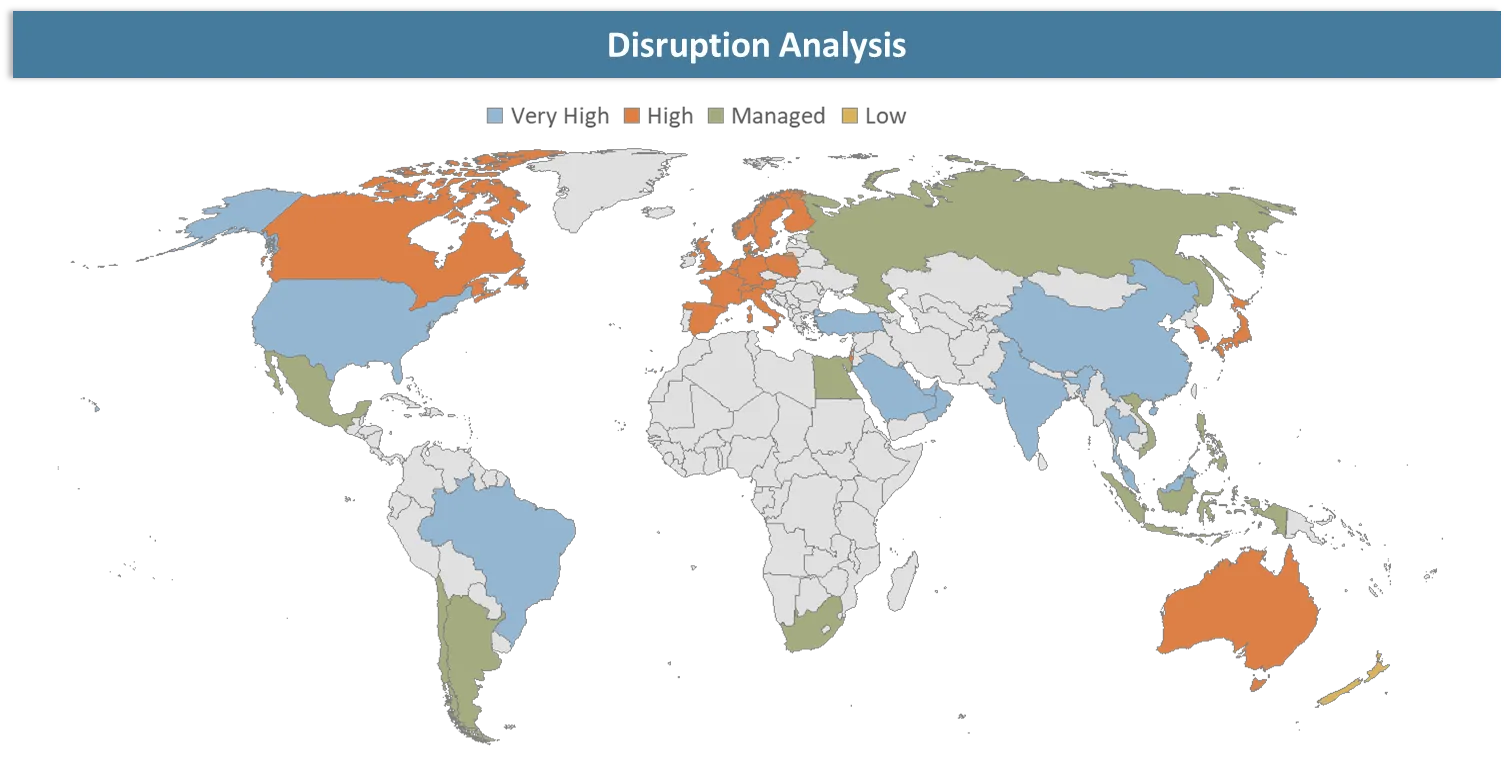
Emergence of Bio-Based Manufacturing Reshaping the Malonic Acid Production Landscape
The disruption in the malonic acid market is increasingly associated with the transition from the conventional chemical production process to the biological one using renewable sugars and microbial engineering. Processes that traditionally use intermediate chemicals obtained from petroleum and dangerous reagents are under pressure to become safer and more environmentally friendly. The change will be able to affect competition patterns, since biotechnology providers will have an opportunity to introduce new ways of production, whereas traditional chemical producers may want to optimise their processes or switch to fermentation techniques.
In July 2026, according to India’s Ministry of Science and Technology, through the Press Information Bureau (PIB), more than 2,000 proposals have been submitted under the BioE3 biomanufacturing program, out of which more than 270 proposals have been shortlisted and will receive funding support, covering product and technology development activities such as scale-up. The program also had more than 450 proposals submitted in terms of shared biomanufacturing infrastructure, and 17 facilities have been selected under the first BioEnablers call for support.
Malonic Acid Market BCG Matrix: Company Evaluation
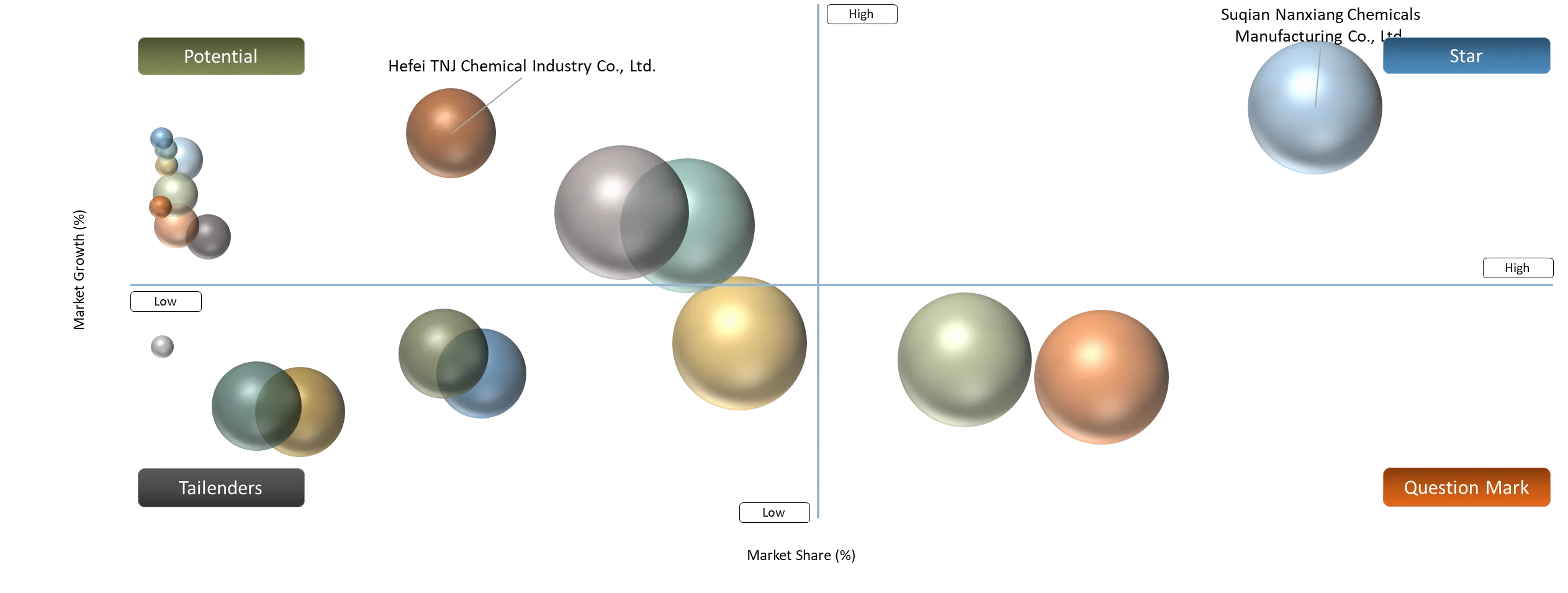
Stars group contains Suqian Nanxiang Chemicals Manufacturing Co., Ltd. and Tateyama Kasei Co., Ltd., pending validation of their existing capacity and positioning in malonic acid manufacturing. Question Marks include Trace Zero LLC, Merck KGaA, and FUJIFIforLM Wako Pure Chemical Corporation.
The Potential group contains Hefei TNJ Chemical Industry Co., Ltd., Columbus Chemical Industries, Inc., Tokyo Chemical Industry Co., Ltd. (TCI), and Spectrum Chemical Manufacturing Corp. The Tailenders group includes Thermo Fisher Scientific Inc., Central Drug House (P) Ltd., and SimSon Pharma Limited.
Malonic Acid Market Dynamics
Driver Impact Analysis
| Driver | Market Growth Impact (%) | Demand Concentration | Impacted Use Case | Strategic Impact |
Expanding Pharmaceutical Manufacturing and Demand for Advanced Drug Intermediates | 1.8% | Pharmaceutical and fine-chemical manufacturing hubs across Asia-Pacific, North America, and Europe | API synthesis, pharmaceutical intermediates, and complex organic compound synthesis | Strengthens demand for high-purity malonic acid, encouraging suppliers to improve product consistency, quality assurance, and long-term supply agreements with pharmaceutical manufacturers. |
Advancements in Bio-Based Malonic Acid Production Through Microbial Fermentation | 1.5% | Biotechnology research centres and chemical manufacturing clusters in North America, Europe, and Asia-Pacific | Fermentation-based malonic acid production and renewable-feedstock chemical synthesis | Creates opportunities to diversify production routes, reduce reliance on conventional chemical feedstocks, and develop differentiated low-impact products, subject to scale-up economics and purification efficiency. |
Growing Demand for Sustainable Chemicals and Low-Carbon Manufacturing Processes | 1.0% | Specialty chemical manufacturers and sustainability-focused industrial supply chains in Europe, North America, and Asia-Pacific | Renewable chemical intermediates, greener synthesis pathways, and specialty chemical manufacturing | Encourages manufacturers to assess life-cycle emissions, improve process efficiency, and invest in lower-waste production technologies to meet customer sustainability requirements. |
Growing Use of Malonic Acid in Battery-Related Chemical Applications | 0.6% | Battery-material research centres and advanced-materials development clusters, particularly in Asia-Pacific, North America, and Europe | Experimental electrolyte chemistry, functional materials research, and synthesis of battery-related chemical compounds | Offers a potential diversification opportunity for malonic acid suppliers, but commercial expansion depends on application validation, performance testing, and evidence of sustained industrial-scale demand. |
Expanding Pharmaceutical Manufacturing and Demand for Advanced Drug Intermediates
The growth of pharmaceutical manufacturing and the demand for chemical intermediates required for the manufacture of APIs and complex drugs are expected to grow. Malonic acid helps in the manufacturing process of pharmaceuticals because of the contribution that it makes in the process of forming carbon–carbon bonds and substituting organic chemicals. With the increase in manufacturing capacity among pharmaceutical manufacturers, the need for reliable sources of synthesis intermediates is likely to grow.
Increased pharmaceutical manufacturing is increasing the demand for the efficient production of highly pure chemical intermediates in the development of complex drugs. In February 2025, according to the journal Advanced Science, which is published by Wiley, scientists genetically modified Yarrowia lipolytica to enhance the biosynthesis of malonic acid via the malonyl-CoA pathway. The genetically modified yeast produced a malonic acid titer of 13.8 g/L in shake-flask fermentation and a maximum malonic acid titer of 63.6 g/L in 156 h of fed-batch fermentation at a rate of 0.41 g/L/h.
Restraint Impact Analysis
| Restraint | Drag on Market Growth (%) | Primary Impact Area | Impacted Use Case | Strategic Impact |
Low Product Yield and Thermal Decomposition Limiting Conventional Production Efficiency | 1.4% | Reaction efficiency and product recovery | Pharmaceutical intermediates and specialty chemical synthesis | Optimize reaction conditions and thermal control to improve yield, reduce by-product formation, and lower purification costs. |
Insufficient Microbial Production Titers Restricting Commercial-Scale Bio-Based Manufacturing | 1.3% | Fermentation productivity and scale-up economics | Bio-based malonic acid for pharmaceuticals and sustainable chemical production | Improve microbial strains, fermentation productivity, and process scalability to make bio-based production more commercially competitive. |
Complex Downstream Separation and Purification Increasing Processing Requirements | 1.1% | Separation, purification, and product quality | High-purity pharmaceutical, laboratory, and specialty chemical applications | Develop selective recovery methods and integrated purification processes to reduce processing costs and improve product consistency. |
Volatility in Petroleum-Based Feedstock Prices Increasing Malonic Acid Manufacturing Costs | 1.0% | Raw-material procurement and manufacturing cost stability | Conventional chemical synthesis for pharmaceutical and industrial intermediates | Diversify feedstock sourcing, strengthen supplier contracts, and evaluate alternative feedstocks to limit cost fluctuations. |
Low Product Yield and Thermal Decomposition Limiting Conventional Production Efficiency
One of the key restrictions in the malonic acid market is the complexity of recovering the maximum amount of pure product from chemical synthesis. The well-known methods based on the reaction of chloroacetic acid and the hydrolysis of malonate ester include several reaction, separation, and purification steps. The result is losses in terms of recovered product due to reversibility of reactions, appearance of impurities, and thermal decomposition.
However, there are still technological issues, such as the low yield of malonic acid and competing oxidation processes, that need to be addressed. In May 2026, according to Dryad, there was 56.9% selectivity and 50.5% yield for malonic acid formation under experimental conditions such as an oxygen pressure of 3 bar, a sodium hydroxide/3-hydroxypropionic acid mole ratio of 1:1, and a temperature of 50 degrees. In addition, acetic acid and oxalic acid were also found to be byproducts as a result of further oxidation, indicating the competitive reaction effects on malonic acid isolation and a reduction in process efficiency.
Malonic Acid Market Segmentation Analysis
The global malonic acid market is segmented based on grade, production method, application, and region.
Conventional Chemical Synthesis Dominates Malonic Acid Production Through Established Manufacturing Infrastructure
Conventional chemical synthesis remains the dominant segment in the malonic acid market, with a market share of 82% in 2025, due to the possibility of employing existing technologies for chemical synthesis, known reaction paths, and purification procedures to provide malonic acid for use as a pharmaceutical intermediate, agrochemicals, and speciality chemical synthesis. Unlike bio-manufacturing, traditional manufacturing methods possess advantages associated with the presence of well-developed operating procedures and experience in manufacturing, whereas bio-manufacturing still faces certain limitations associated with the efficiency of the fermentation process, process scale-up, and product separation.
In June 2026, Oxford University reported a solvent-free and catalyst-free transformation of malonic esters. An 85% yield was obtained at 400 °C in 2 minutes, while a larger-scale reaction with 1 mmol yielded 83% after purification. The method does not require solvent, catalysts, hydrolysis, or extraction; therefore, it shows prospects for simplifying the work with ester transformations in the synthesis of chemicals. The publication is aimed at the conversion of malonic esters to other carboxylic acids and not at the production of malonic acid; hence, it does not provide information about the commercial production of the latter.
Malonic Acid Market Geographical Penetration
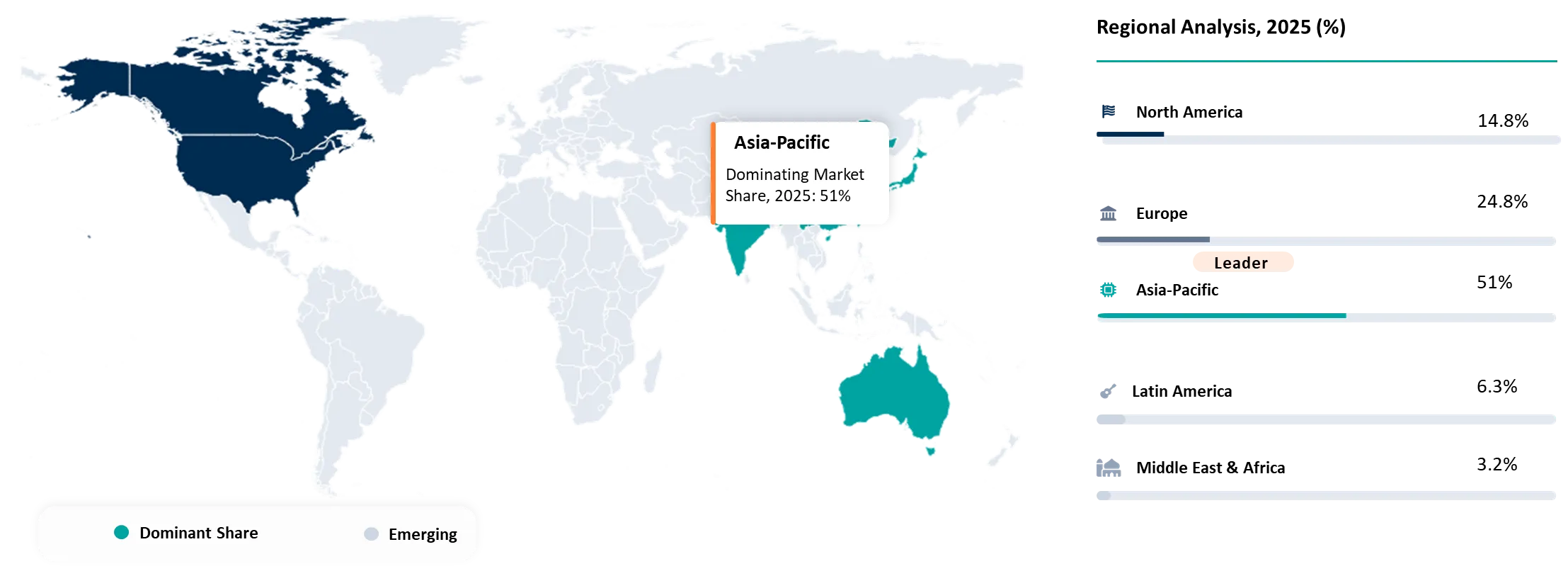
Asia-Pacific Dominance Through Chemical Manufacturing Expansion and Bio-Based Production Innovation
Asia-Pacific dominates the malonic acid market, with a market share of 51% in 2025, owing to the presence of well-established chemical manufacturing, pharmaceutical intermediate manufacturing of the pharmaceuticals, and specialised chemical production chains in China, Japan, South Korea, and others. The manufacturing ecosystem of the region helps drive the consumption of malonic acid in pharmaceuticals, agrochemical intermediates, and specialised chemical applications.
In February 2026, a team of researchers from Shanghai Jiao Tong University and Tongji University of China published their results in the Chinese Journal of Chemistry on enantioselective nickel-catalysed reductive decarboxylative cross-coupling reactions via the use of malonic acid derivatives for the synthesis of chiral α-aryl and α-alkenyl esters. The findings were published in Vol. 44(10), pp. 1591-1598, demonstrating its potential usefulness in the field of medicinal chemistry and in synthesising complex molecules. Key research institutions include Shanghai Jiao Tong University (China; public research university) and Tongji University (China; public research university).
China Malonic Acid Market Trends
China holds a dominant position in the Asia-Pacific malonic acid market, due to its developed fine-chemistry manufacturing capabilities, chemical intermediaries, and access to pharmaceutical and speciality chemical customers. The domestic manufacturers and suppliers benefit from the integrated chemical production and export channels available. Reinforces the capability of the country to supply the malonic acid required for pharmaceutical production, agrochemical intermediaries, and research purposes.
Malonic acid (CAS No. 141-82-2) with 99% purity, by Hebei Chuanghai Biotechnology Co., Ltd., a chemical manufacturing and trading company in Shijiazhuang, Hebei, China. Malonic acid is available for use in industrial or chemical purposes such as pharmaceutical intermediates and speciality chemicals. It is an instance where a company operates in the Chinese malonic acid market as a supplier. However, the above-mentioned capability of supply does not in itself prove production or production expansion.
Japan Malonic Acid Market Outlook
Japan is one of the major countries in the Asia Pacific malonic acid market due to its strengths in the field of fine chemical manufacturing and pharmaceutical intermediate production, along with demand for pure chemicals that have applications in advanced industries. Manufacturers in Japan place a high emphasis on product uniformity, metal trace content, and supply reliability for the synthesis of pharmaceuticals and electronic products, thus providing opportunities for value-added segments of malonic acid.
Juzen Chemical Corporation is a Japan-based chemical manufacturer and CDMO providing malonic acid through their unique manufacturing process. Based on the product information provided by the company, the company provides malonic acid with exceptionally high purity and very low metal impurities, suitable for pharmaceutical raw material and electronic material applications. The company’s published analysis reports indicate that the products have 23 different elemental impurities including lithium, sodium, iron, nickel, and lead among others, with an upper limit of 1 ppb for most listed elements.
U.S. Malonic Acid Market Trends
The U.S. dominates the North American malonic acid market owing to its robust infrastructure of pharmaceutical research centres, speciality chemical distributors, and the demand for highly pure intermediates required for synthesising drugs and manufacturing chemicals. The availability of laboratory chemical vendors and biotech research centres drives the demand for reagent-grade malonic acid, and biological production of malonic acid provides scope for decreasing dependency on chemical production processes.
In May 2025, the partnership between BioMADE and Lygos, Inc., includes the conversion of the current pilot-scale biomanufacturing capabilities of Lygos, Inc. in Hayward, California, to a multi-user facility through investments worth at least USD 80 million from the United States Department of Defense. With a footprint of around 25,000 square feet, the new biomanufacturing facility will be able to accommodate fermentation, chemical processing, analytical testing, and downstream processing of biological products with fermenters capable of holding up to 4,000 liters.
Malonic Acid Market Competitive Landscape
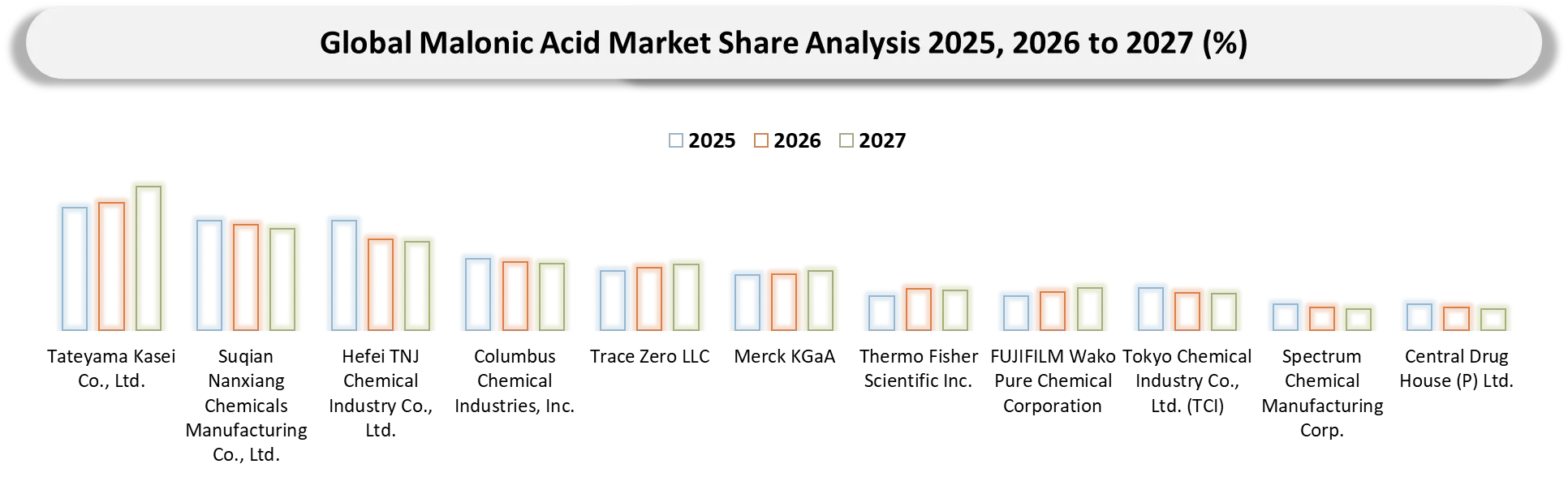
- The malonic acid market is characterized by three types of participants; these include speciality chemical producers, pharmaceutical and fine chemical suppliers, and laboratory reagent suppliers. Examples of companies involved in chemical production and supply in this case include Tateyama Kasei Co., Ltd., Suqian Nanxiang Chemicals Manufacturing Co., Ltd., and Hefei TNJ Chemical Industry Co., Ltd. Specialty chemical producers are represented in this market by Columbus Chemical Industries, Inc., and Trace Zero LLC. Suppliers of laboratory reagents and ultra-pure chemicals are represented in the market by Merck KGaA, Thermo Fisher Scientific Inc., FUJIFILM Wako Pure Chemical Corporation, and Tokyo Chemical Industry Co., Ltd. (TCI). Pharmaceutical, research, and specialty chemical suppliers in this market include Spectrum Chemical Manufacturing Corp., Central Drug House (P) Ltd., and SimSon Pharma Limited.
- Key players in the malonic acid market include Tateyama Kasei Co., Ltd. (Japan), Suqian Nanxiang Chemicals Manufacturing Co., Ltd. (China), Hefei TNJ Chemical Industry Co., Ltd. (China), Columbus Chemical Industries, Inc. (United States), Trace Zero LLC (United States), Merck KGaA (Germany), Thermo Fisher Scientific Inc. (United States), FUJIFILM Wako Pure Chemical Corporation (Japan), Tokyo Chemical Industry Co., Ltd. (TCI) (Japan), Spectrum Chemical Manufacturing Corp. (United States), Central Drug House (P) Ltd. (India), and SimSon Pharma Limited (India).
Key Developments
- January 2025: BioMADE’s “Greener Chemistry via Process Integration and Intensification at Pilot Scale” project involved Lygos, a developer of bio-based chemicals, to improve the production process for its Ecoteria bio-based malonate platform.
Key Procurement Priorities and Buyer Evaluation Criteria
- Buyers in organizations looking for suppliers of malonic acid are increasingly taking into account the supplier’s capability to ensure steady supplies of consistent product purity, quality, volume, and grades that can be used as intermediates in the pharmaceutical industry, in the formulation of agrochemicals, for specialty chemicals, and for other applications.
- The purchasing decision is affected by the need for intermediates for pharmaceutical and fine chemicals, the need for a reliable supply of raw materials, biobased manufacturing processes, and the chemical properties expected of the products in various downstream processes.
- Procurement considerations include the assay and purity levels, impurities, moisture level, consistency in batches, technical specifications, certificates of analysis, quality control documents, packaging considerations, and conformance to application-specific standards.
Why Choose DataM?
- Technological Innovations: Explores advancements in conventional chemical synthesis, microbial fermentation, and bio-based malonic acid production, highlighting process optimization, improved production efficiency, and emerging opportunities for more sustainable manufacturing routes.
- Product Performance & Market Positioning: Evaluates malonic acid suppliers based on product purity, grade specifications, impurity control, consistency, production capabilities, and suitability for pharmaceutical intermediates, agrochemicals, flavors and fragrances, and specialty chemical synthesis.
- Real-World Evidence: Examines the use of malonic acid as a chemical building block in pharmaceutical synthesis, agrochemical production, and specialty chemical manufacturing, identifying application-specific requirements and factors influencing industrial adoption.
- Market Updates & Industry Changes: Tracks relevant developments in production technologies, bio-based manufacturing research, product offerings, and regional chemical supply chains across Asia-Pacific, North America, and Europe to assess changes in the malonic acid industry.
- Competitive Strategies: Analyzes how key companies strengthen their market positions through product portfolio development, manufacturing capabilities, quality assurance, distribution networks, and partnerships supporting pharmaceutical and specialty chemical customers.
- Pricing & Market Access: Assesses factors influencing malonic acid procurement costs, including feedstock prices, production methods, purity requirements, order volumes, packaging, transportation, and supplier availability, helping buyers understand sourcing options and cost considerations.
- Market Entry & Expansion: Identifies growth opportunities arising from demand for pharmaceutical and agrochemical intermediates, specialty chemical applications, and emerging bio-based production routes, while examining strategies such as regional distribution expansion, product-grade diversification, and manufacturing process improvements.
Target Audience 2026
- Malonic Acid Manufacturers and Producers
- Pharmaceutical Companies
- Agrochemical Manufacturers
- Specialty Chemical Manufacturers
- Research and Development Organizations
- Raw Material Suppliers and Distributors
- Procurement and Supply Chain Professionals


























































