

Global Magnet-Free Motor Market Overview
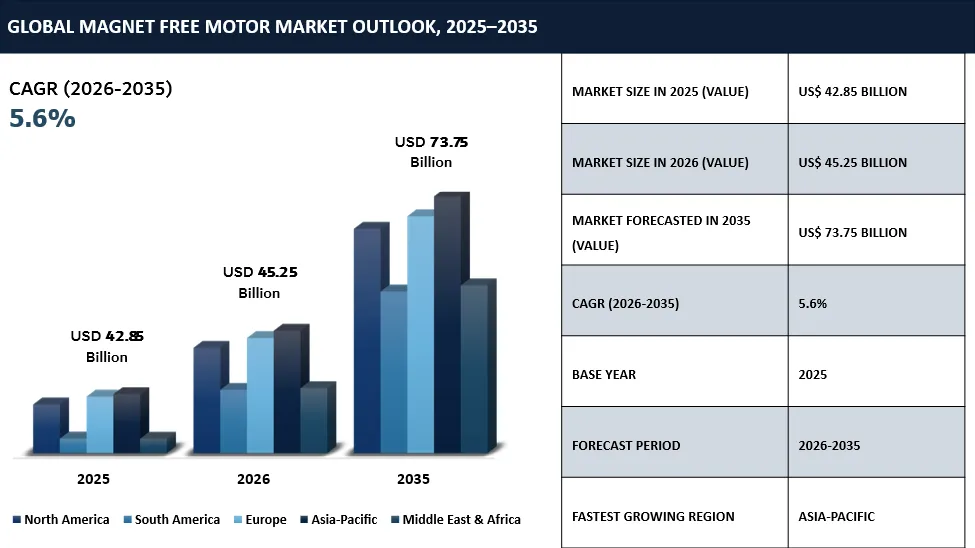
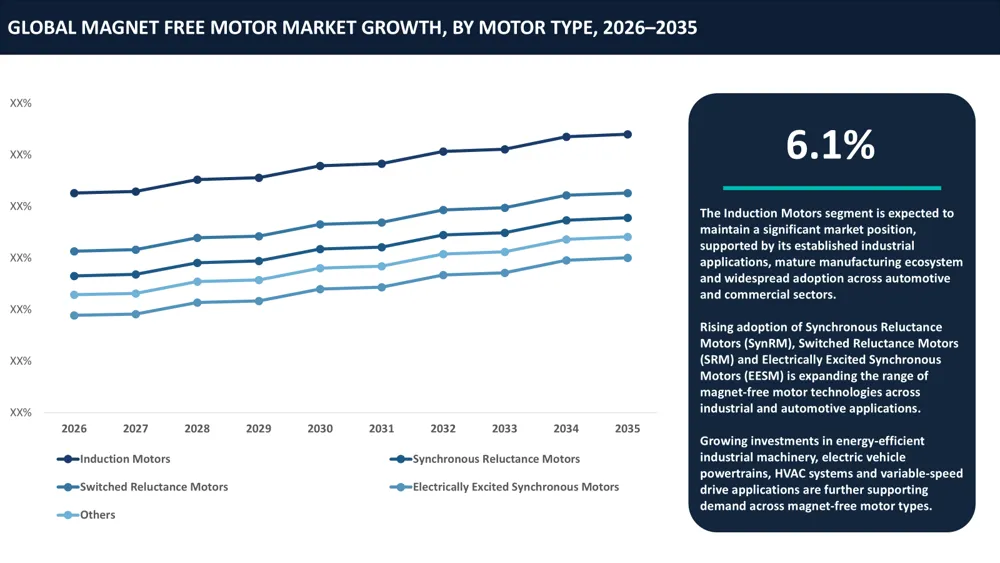
The demand for magnet free motors is becoming more prominent because industries now focus on energy efficiency, industrial electrification, use of electric vehicles and reduced dependency on permanent magnet materials. Magnet free motors include technologies such as induction motors, synchronous reluctance motors (SynRM), switched reluctance motors (SRM) and electrically excited synchronous motors (EESM). The International Energy Agency (IEA) reported that electric motor systems consumed around 53% of the global electricity consumption in 2023. Industrial motor systems alone consumed around 60% of global industrial electricity demand and 25% of global electricity consumption. In addition, global electricity consumption from industrial motor systems grew by around 60% from 2005 to 2023; most of this growth came from China, which had an increase of 190% and India, with an increase of 180%. Increased investments in industrial automation, electric vehicle manufacturing, energy-efficient machinery and motor designs are presenting opportunities to magnet-free motor manufacturers and technology developers worldwide.
Global Magnet-Free Motor Market: Strategic Insights
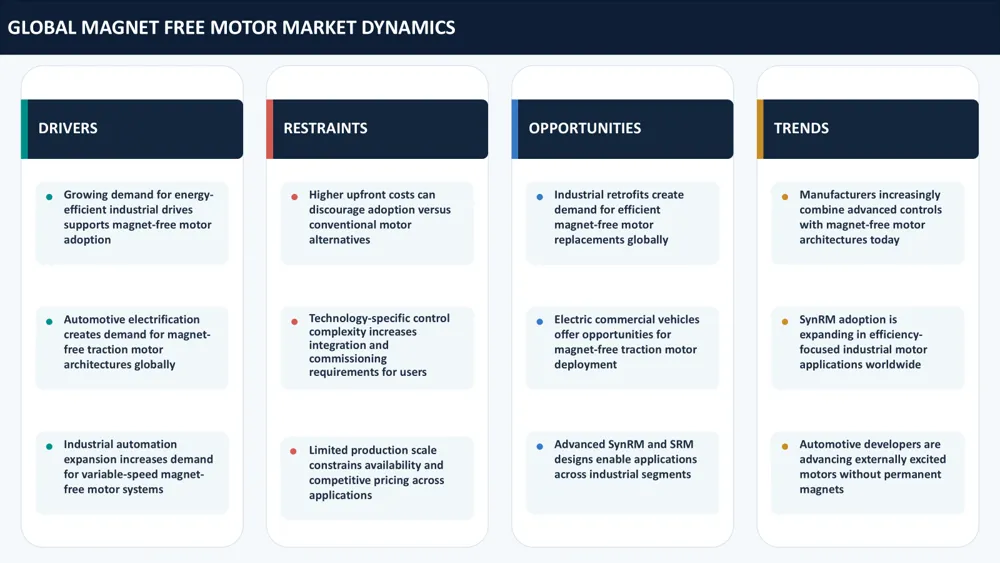
- Acceleration of Global Electric Vehicle Adoption: As per IEA,in 2025, global sales of electric vehicles reached 20 million units, growing by around 20% from 2024 and representing about a quarter of all new cars purchased worldwide. The rise is contributing to an increase in demand for electric traction drives and motivating automotive manufacturers to consider different motor configurations. Electrically excited synchronous motors and switched reluctance motors offer potential pathways to reduce permanent-magnet dependence in electric vehicle powertrains.
- Strengthening Global Energy-Efficiency Policies: Global energy-efficiency progress improved to an estimated 1.8% in 2025, compared with approximately 1% in 2024, according to the IEA. Governments also implemented more than 250 new or updated energy-efficiency policies across countries representing 85% of global energy demand. These developments reinforce the importance of improving industrial motor performance, creating opportunities for efficient magnet-free technologies in pumps, compressors, fans, HVAC systems and manufacturing equipment.
- Expansion of High-Efficiency Magnet-Free Motor Portfolios:ABB extended its range of IE5 synchronous reluctance motors from power rating 0.75 kW up to 450 kW, offering new frame sizes for industrial purposes. These motors demonstrate energy losses of about 40% less than IE3 motors, making them even more appropriate for such devices as pumps, fans, compressors, etc. This demonstrates an increasing commercial interest in high-efficiency magnet free technologies to optimize energy usage in industry.
- Development of High-Performance Magnet-Free EV Motors:Valeo and MAHLE revealed a newly designed iBEE system based on the use of electrically excited synchronous motor for high-performance electric vehicles with 800V architecture. The design is aimed at generating power over 350 kW with torque of up to 600 Nm, showing the prospects of such motor designs in traction application. This demonstrates an increasing interest in optimizing power supply while minimizing the use of permanent magnets in next-generation electric vehicles.
Why Choose Datam?
- Accelerated Customer Identification – Target 2.0× Qualified Sales Leads: Support magnet-free motor manufacturers to double their qualified customer pipeline through OEM identification, industrial buyer profiling and customer segmentation based on applications. DataM will assist companies to find valuable prospects in the automotive industry, industrial machinery, HVAC, commercial and energy sectors, to enhance lead qualification and customer acquisition.
- Faster Market Entry & Business Expansion – Target 25% Reduction in Market Entry Time: Assist magnet-free motor companies to shorten their market entry process using geographical opportunity assessment, industrial demand analysis, regulation intelligence and distributor identification. DataM will support businesses to penetrate into the market quicker by conducting geographical adoption assessment of induction, synchronous reluctance, switched reluctance and electrically excited synchronous motors, identifying business partnership and new application opportunities.
- Stronger Competitive Positioning – Target 25% Improvement in Sales Win Rate: Help magnet-free motor manufacturers to increase their sales win rates by assessing competitor benchmarks, product portfolio, pricing and technologies. DataM will assist businesses to assess competing motor architectures, such as induction, SynRM, SRM and EESM, to discover gaps and build product differentiation and positioning across industrial and automotive customer segments.
- Higher Customer Revenue & Account Expansion – Target 1.25× Revenue per Key Account: Drive higher revenue from strategic clients through customer wallet-share analysis, cross-selling potential and application gap analysis. DataM enables magnet-free motor manufacturers to know other requirements from their end customers such as automotive OEMs, industrial equipment manufacturers, pump & compressors makers and HVAC manufacturers and use them for increasing product penetration and relationship building with the customers.
- Improved Pricing & Profitability – Target 2 Percentage-Point Gross Margin Improvement: Drive higher gross margins for magnet-free motor manufacturers by analyzing competitive pricing, willingness-to-pay, manufacturing costs and positioning of products. DataM analyzes differences in prices among various motor technologies, motor power ratings and applications in order to help businesses know about their customer buying preferences, product portfolio optimization and commercial negotiations.
- Strategic Partnerships & Channel Expansion – Target 1.5× Customer Acquisition: Assist manufacturers of magnet free motors to boost customer acquisition through channel generated opportunities by performing distributor mapping, system integrator identification and ecosystem analysis. The DataM helps in building stronger business networks for its customers by identifying partners for industrial automation, drive systems, automotive powertrain integration and regional distribution channels.
- Improved Demand Forecasting & Revenue Protection – Target 25% Reduction in Forecast Errors: Help magnet free motor manufacturers improve their demand forecasting process through application level demand analysis, regional market intelligence, production capacity analysis and scenario planning. The DataM assesses investments in industrial automation, electric vehicles, motor replacements and efficiency requirements.
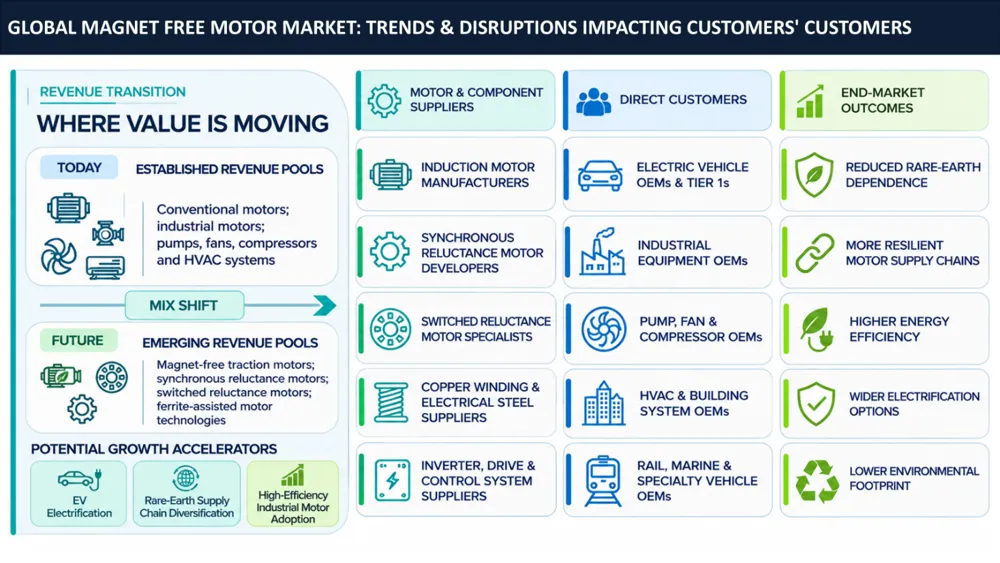
Global Magnet-Free Motor Market: Trends & Disruption Impacting Client
Global Magnet-Free Motor Market: Commercial Use Cases Across Industries
| COMPANY | USE CASE DESCRIPTION | BENEFITS |
 | Deployment of magnet-free synchronous reluctance motors (SynRM) in industrial pumps, compressors, fans, conveyors, extruders and HVAC systems. | Higher energy efficiency, reduced operating costs, lower rotor losses, improved reliability and reduced maintenance requirements. |
 | Application of switched reluctance motors (SRM) in industrial cooling fans, high-speed centrifugal pumps, screw compressors and conveyor systems. | Robust motor construction, high-speed operating capability, high overload torque and reduced dependence on permanent magnets. |
 | Development of electrically excited synchronous motors (EESM) for electric passenger cars, buses, trucks and other electric mobility applications. | Eliminates permanent magnets, reduces rare-earth dependence, improves power density and supports efficient electric vehicle traction systems. |
 | Development of its In-Rotor Inductive-Excited Synchronous Motor (I²SM) for electric vehicle traction and integrated electric drive systems. | Compact motor architecture, high torque and power density and elimination of permanent magnets and rare-earth materials. |
 | Development of magnet-free contactlessly excited synchronous motors for electric passenger vehicles and commercial vehicle powertrains. | Reduced dependence on rare-earth materials, contactless rotor excitation, high efficiency and suitability for different vehicle applications. |
Magnet-Free Motor Market Ecosystem
The magnet-free motor market ecosystem includes manufacturers of industrial motors, developers of automotive electric powertrains, motor drive and controls systems manufacturers, motor components and materials manufacturers, manufacturers of industrial machinery, system integrators and distributors. The above actors play a key role in the design, production, integration, distribution and application of magnet-free motors in industrial machinery, automotive, HVAC, commercial machines, power generation, railway and marine sectors. The market ecosystem includes induction motors, synchronous reluctance motors (SynRM), switched reluctance motors (SRM) and electrically excited synchronous motors (EESM), which produce torque without permanent magnets.
INDUSTRIAL MAGNET-FREE MOTOR MANUFACTURERS | AUTOMOTIVE MAGNET-FREE MOTOR DEVELOPERS | MOTOR DRIVES AND CONTROL SYSTEM PROVIDERS |
| ABB Ltd. (Switzerland) | Valeo SE (France) | ABB Ltd. (Switzerland) |
| Innomotics GmbH (Germany) | ZF Friedrichshafen AG (Germany) | Danfoss A/S (Denmark) |
| Nidec Corporation (Japan) | MAHLE GmbH (Germany) | Siemens AG (Germany) |
| WEG S.A. (Brazil) | BorgWarner Inc. (United States) | Schneider Electric SE (France) |
| Mitsubishi Electric Corporation (Japan) | DENSO Corporation (Japan) | Yaskawa Electric Corporation (Japan) |
Global Magnet-Free Motor Market: BCG Matrix Analysis
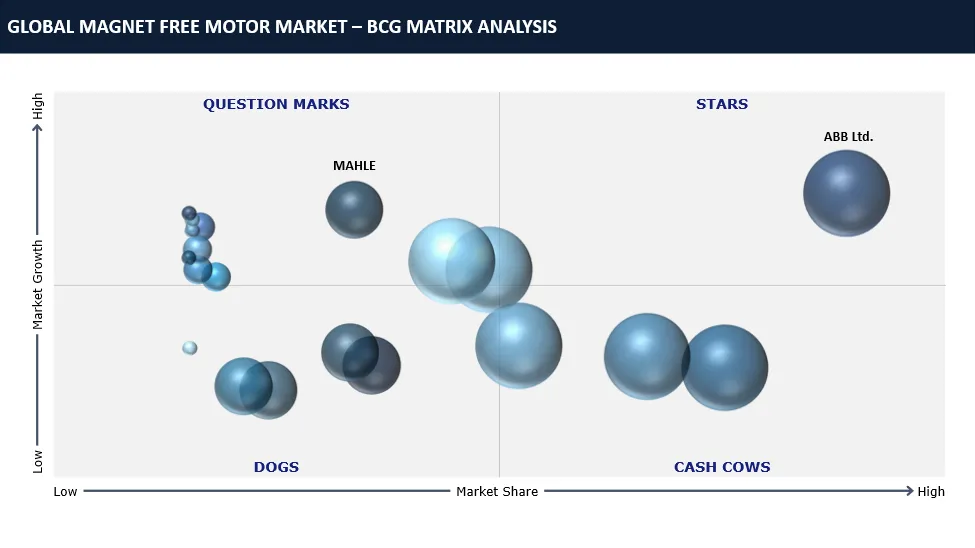
- Stars: Synchronous reluctance motors (SynRM) and electrically excited synchronous motors (EESM) provide good opportunities for growth, due to growing industrial demands for energy-efficiency, increased electrification in the automotive sector and the need for non-permanent-magnet motor architectures.
- Cash Cows: Conventional induction motors generate stable revenue streams due to extensive use in industrial equipment, pumps, compressors, fans, HVAC and commercial devices, owing to their existing production processes and effective distribution channels.
- Question Marks: Switched reluctance motors (SRM) represent an emerging opportunity, supported by technological improvements in motor controls, power electronics and non-permanent-magnet traction motors. Commercial viability of SRM technology will depend upon improvements in torque ripple, noise and complex controls.
- Dogs: Mature magnet-free motor offerings with limited differentiation, low adoption rate and poor competitiveness in certain applications may face declining growth due to the growing importance of energy efficiency and motor technology.
Magnet-Free Motor Market: Key Market Players
- ABB Ltd. (Switzerland)
- Innomotics GmbH (Germany)
- Nidec Corporation (Japan)
- WEG S.A. (Brazil)
- Toshiba Corporation (Japan)
- Mitsubishi Electric Corporation (Japan)
- Wolong Electric Group Co., Ltd. (China)
- Regal Rexnord Corporation (United States)
- TMEIC Corporation (Japan)
- TECO Electric & Machinery Co., Ltd. (Taiwan)
- Danfoss A/S (Denmark)
- KSB SE & Co. KGaA (Germany)
- Robert Bosch GmbH (Germany)
- BorgWarner Inc. (United States)
- Valeo SE (France)
- MAHLE GmbH (Germany)
- ZF Friedrichshafen AG (Germany)
- Schaeffler AG (Germany)
- DENSO Corporation (Japan)
- Hyundai Mobis Co., Ltd. (South Korea)
Magnet-Free Motor Market: Recent Developments
- November 2026: ABB showcased its IE6 Hyper-Efficiency Synchronous Reluctance Motor (SynRM) technology at ADIPEC 2026. Designed for industrial applications, including hazardous environments, the motor range features ATEX and IECEx certifications. ABB reports up to 60% lower energy losses compared with IE3 induction motors.
- September 2026: MAHLE introduced its Magnet-Free Contactless Transmitter (MCT) electric motor for heavy-duty commercial vehicle applications at IAA TRANSPORTATION 2026. The motor delivers a peak output of 370 kW and torque exceeding 900 Nm, with approximately 95% efficiency under the VECTO driving cycle. Its permanent-magnet-free design eliminates the need for rare-earth magnets, saving up to 3 kg of rare-earth magnets per vehicle and reducing the motor's weight by approximately 10% compared with comparable permanent-magnet motors.
- September 2026: Schaeffler highlighted its electrically excited synchronous motor (EESM) technology within its integrated electric powertrain portfolio. The motor generates its rotor magnetic field through electrical excitation rather than permanent magnets, eliminating the need for rare-earth materials. The technology supports high-speed electric drive applications and is incorporated into Schaeffler's production-ready powertrain solutions.
Magnet Free Motor Market: Delivered Customization
| CLIENT REQUEST | CUSTOMIZATION DELIVERED | VALUE ADDS |
| Industrial Motor Manufacturer |
|
|
Automotive OEM / Electric Powertrain Developer |
|
|
Industrial Equipment and Machinery Manufacturer |
|
|
Motor Drives and Power Electronics Supplier |
|
|
Motor Component and Material Supplier |
|
|
Magnet-Free Motor Market: Market Dynamics
Magnet-Free Motor Market: Market Segment Analysis
Global Magnet-Free Motor Market: Region Wise Analysis
Global Magnet-Free Motor Market: Market Scope
| Metrics | Details | |
| Market Size in 2025 (Value) | USD 42.85 Billion | |
| Market Size in 2026 (Value) | USD 45.25 Billion | |
| Market Forecasted in 2035 (Value) | USD 73.75 Billion | |
| CAGR (2026-2035) | 5.6% | |
| Years Considered | 2024-2035 | |
| Base Year | 2025 | |
| Forecast Period | 2026-2035 | |
| By Motor Type | Induction Motors Synchronous Reluctance Motors Switched Reluctance Motors Electrically Excited Synchronous Motors Others | |
| By Power Rating | Low-Power Motors (Below 10 kW) Medium-Power Motors (10–100 kW) High-Power Motors (Above 100 kW) | |
| By Voltage | Low Voltage (Up to 1 kV) Medium Voltage (Above 1–6.6 kV) High Voltage (Above 6.6 kV) | |
| By Phase | Single-Phase Three-Phase | |
| By Speed | Low-Speed (Below 1,000 RPM) Medium-Speed (1,000–3,000 RPM) High-Speed (Above 3,000–10,000 RPM) Ultra-High-Speed (Above 10,000 RPM) | |
| By Operating Configuration | Fixed-Speed Motors Variable-Speed Motors | |
| By Cooling Type | Air-Cooled Motors Liquid-Cooled Motors | |
| By Application | Automotive Industrial Machinery HVAC Systems Commercial Equipment Household Appliances Power Generation and Energy Rail and Marine Transportation Aerospace and Defense Agricultural, Mining and Construction Equipment Others | |
| By Distribution Channel | Direct Sales Indirect Sales Online Sales | |
| By Region | North America | U.S., Canada, Mexico |
| Europe | Germany, UK, France, Spain, Italy, Poland | |
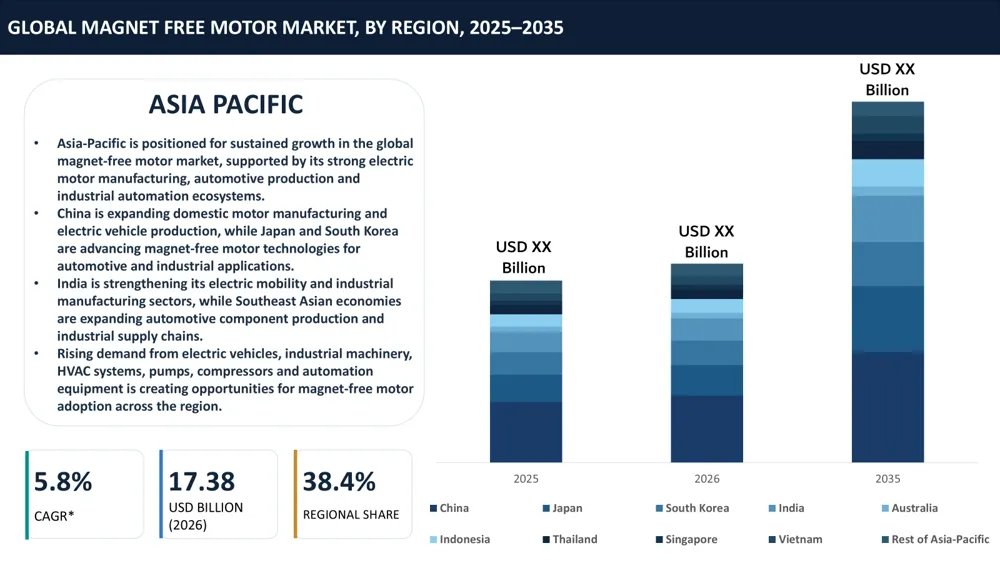
| Asia-Pacific | China, India, Japan, Australia, South Korea, Indonesia, Malaysia, Singapore, Vietnam, Thailand, Philippines, Taiwan | |
| South America | Brazil, Argentina | |
| Middle East and Africa | UAE, Saudi Arabia, South Africa, Israel, Turkiye | |
| Report Insights Covered | Competitive Landscape Analysis, Company Profile Analysis, Market Size, Market Share, Market Growth | |
Global Magnet Free Motor Market: Target Audience
| INDUSTRY | WHO SHOULD BUY THIS REPORT? | REASON TO BUY THIS REPORT |
| INDUSTRIAL MOTOR MANUFACTURERS | Industrial electric motor manufacturers and magnet-free motor technology developers | Evaluate motor technology demand, product positioning, manufacturing opportunities and competitive developments across induction, SynRM, SRM and EESM technologies. |
| AUTOMOTIVE AND POWERTRAIN | Automotive OEMs, electric vehicle manufacturers and Tier-1 powertrain suppliers | Assess magnet-free traction motor opportunities, technology developments, vehicle electrification trends and permanent-magnet supply-chain alternatives. |
| INDUSTRIAL MACHINERY | Manufacturers of pumps, compressors, fans, blowers, conveyors and machine tools | Identify energy-efficient motor applications, industrial replacement demand and opportunities for magnet-free motor integration. |
| POWER ELECTRONICS AND DRIVE SYSTEMS | Variable-frequency drive manufacturers, inverter developers, motor-control suppliers and electric drive system integrators | Evaluate control-system requirements, motor-drive compatibility, integration opportunities and demand for advanced magnet-free motor systems. |
| HVAC AND BUILDING SYSTEMS | HVAC equipment manufacturers, ventilation system suppliers, chiller manufacturers and building automation companies | Assess demand for energy-efficient motors across air handling units, cooling systems, ventilation equipment and commercial building applications. |
| MOTOR COMPONENT SUPPLIERS | Manufacturers of electrical steel, copper windings, bearings, shafts, insulation, stators and rotor components | Understand component demand, motor design developments, material requirements and emerging supply-chain opportunities. |
| COMMERCIAL AND HOUSEHOLD EQUIPMENT | Manufacturers of elevators, escalators, refrigeration systems, washing machines and household appliances | Identify potential applications for magnet-free motors and evaluate opportunities arising from energy-efficiency improvements. |
| ENERGY AND TRANSPORTATION | Power generation companies, utilities, railway operators, marine equipment manufacturers and electric mobility suppliers | Assess magnet-free motor applications across auxiliary drives, rail traction, marine propulsion and renewable energy systems. |
| DISTRIBUTORS AND SYSTEM INTEGRATORS | Electric motor distributors, industrial automation providers, equipment suppliers and engineering system integrators | Evaluate regional demand, emerging customer requirements, product availability and commercial opportunities across end-use industries. |
| INVESTORS AND POLICYMAKERS | Strategic investors, private equity firms, government agencies, industrial development institutions and industry advisors | Assess market growth potential, competitive positioning, manufacturing investments, technology commercialization and permanent-magnet supply-chain diversification. |
WHY DOES THIS REPORT MATTER IN 2026?
The global magnet free motors industry will witness an important stage of development in 2026, with industrial machinery manufacturers, automotive OEMs, electric drive train manufacturers and motor technology firms paying increasing attention to energy efficiency, electrification and motor technologies that do not rely on the use of permanent magnets. The growing demand for electricity in industries, the increasing number of electric vehicles, industrial automation and diversifying supply chains of rare earth elements are boosting the attractiveness of the induction motors, synchronous reluctance motors (SynRM), switched reluctance motors (SRM) and electrically excited synchronous motors (EESM). This shift is positioning magnet-free motors as important technologies supporting industrial machinery, electric mobility, HVAC systems, commercial equipment and energy infrastructure.
On the other hand, there is increased pressure on motor manufacturers to enhance efficiency, power density, torque performance, thermal management and manufacturing economics, along with application-related control considerations. Progress in the areas of rotor design, power electronics, variable frequency drives, digital motor control and rotor excitation without physical contact is increasing the business prospects for magnet-free motors. There is an increased need for insight into the performance of motor technology, manufacturing capabilities, application demand, supply chain by region, commercialization of products, competitive position and regulatory issues from the buyers, investors, automotive OEMs and industrial players to assess investment prospects, minimize risks associated with the supply chain for permanent magnets and determine commercially viable segments within the global magnet free motors industry.
GLOBAL MAGNET FREE MOTOR MARKET: ANALYST VIEW / OPINION
The global magnet free market is identified with two main demand segments: established motor applications focusing on energy efficiency in addition to automotive electrification applications searching for alternatives for the architecture of motors with permanent magnets. The analysis cannot be based on one pricing and/or technology adoption assumption. The competition in industrial sector is between induction motors and synchronous reluctance motors (SynRM) based on efficiency, dependability, costs and the compatibility of motors with variable frequency drives. In automotive applications, development and commercialization of electrically excited synchronous motors (EESM) and switched reluctance motors (SRM) is initiated to ensure traction performances as well as parameters such as power density, heat management and issues related to the supply of permanent magnets.
There are three competition issues that should be taken into consideration. Firstly, magnet free motors have performance issues depending on their application, such as torque ripple, sound, power density and complexity of the control system. It is necessary to make rotor design upgrades, utilize advanced power electronics and improve motor control in order to increase the commercial value of these devices. Secondly, there are already available permanent-magnet motor technologies with their manufacturing, supply chains and customer acceptance being developed. The magnet-less motors manufacturers have to prove their competitive lifecycle cost, efficiency, reliability and suitability in specific applications to ensure their adoption by customers. Thirdly, there are difficulties in scaling up the production process at a competitive cost level for some motor architectures and applications. Manufacturing investment, sourcing of components, customer qualification and manufacturing capacity should be made according to practical forecasting of the demand. In such an atmosphere, firms that have experience in industrial motors with differentiating magnet free technology will benefit from the market opportunities.