


Low Voltage Switchgear Market Size and overview
The global Low Voltage Switchgear market reached an estimated US$ 45.6 billion in 2025 and is projected to reach approximately US$ 84.0 billion by 2035, expanding at a CAGR of about 6.3% during 2026-2035. Demand is supported by electrification across data centers, commercial buildings, factories, transportation, renewable-energy projects and utility distribution networks. Replacement of aging panels and breakers adds a large recurring revenue pool, while digital power architectures are raising the average value per installation.
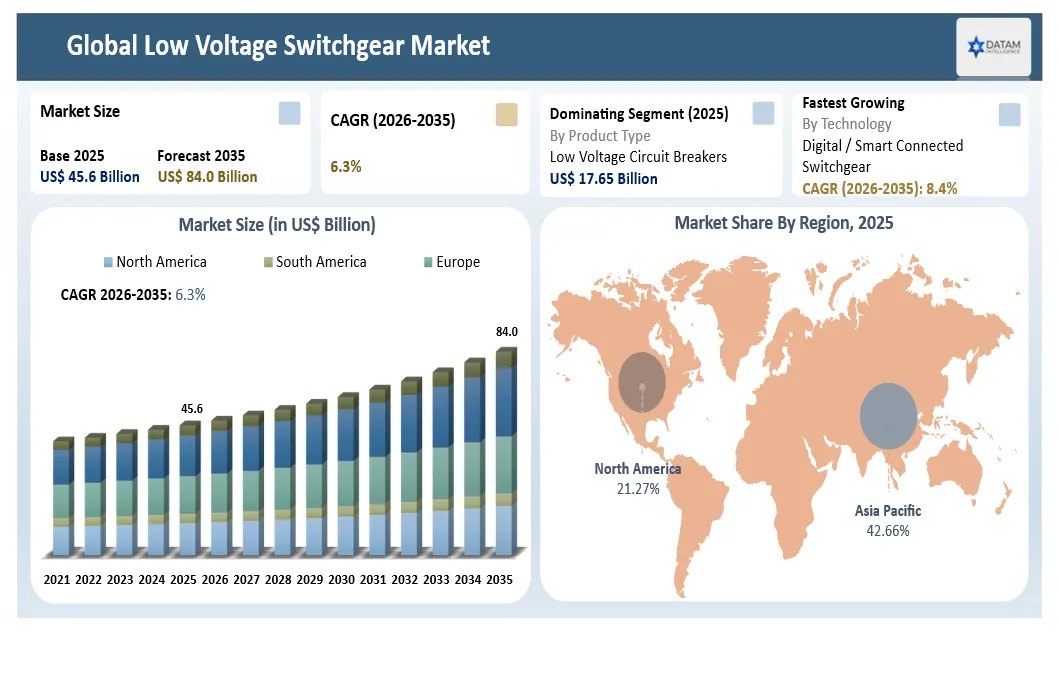
Low voltage switchgear is becoming a software-enabled electrical platform rather than a collection of protective devices. Embedded sensing, metering, communication and analytics allow operators to monitor loading, identify abnormal heat or trip behavior, coordinate protection and integrate equipment with building or industrial energy-management systems. Data centers are particularly influential because high power density, redundancy and uptime requirements favor premium switchboards, intelligent breakers and selective coordination.
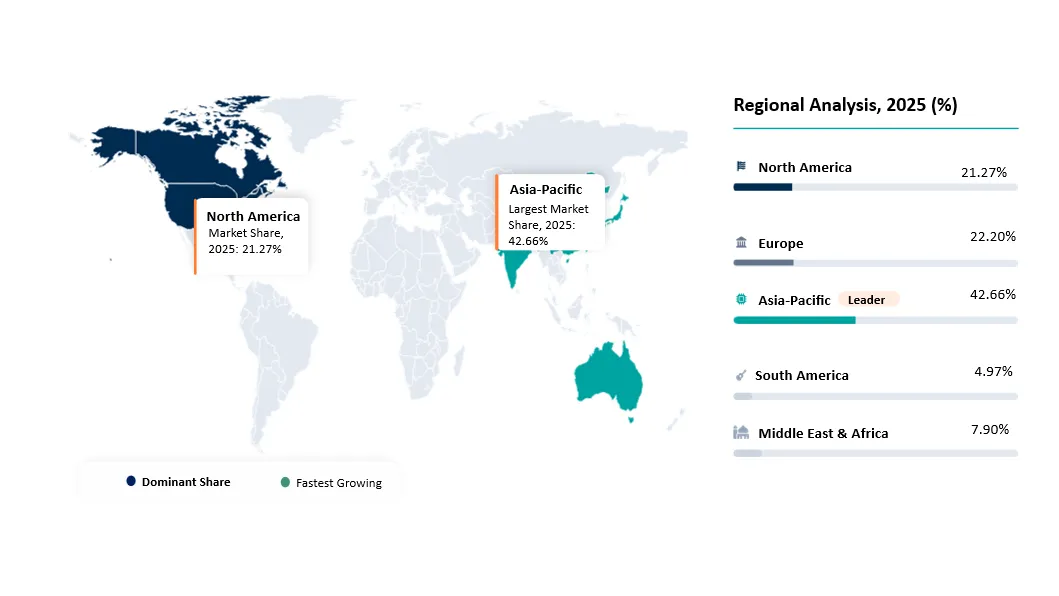
Asia-Pacific is the largest regional market because of its manufacturing base, construction pipeline and electrical infrastructure expansion. North America is benefiting from unprecedented data-center development, reshoring and electrification investment, while Europe is emphasizing energy efficiency, smart buildings and modernization of aging distribution assets. Competition remains intense across commodity devices, but suppliers with broad portfolios, digital ecosystems, panel-builder networks and service capabilities are gaining strategic advantage.
| Metric | Details |
| 2025 Market Size | US$ 45.6 Billion |
| 2035 Projected Market Size | US$ 84.0 Billion |
| CAGR (2026-2035) | ~6.3% |
| Largest Market | Asia-Pacific |
| Fastest-Growing Demand Cluster | Data Centers & Digital Infrastructure |
| Dominating Product | Low Voltage Circuit Breakers |
| Technology Shift | Connected / digital switchgear with embedded metering and condition monitoring |
Low Voltage Switchgear Market Key Takeaways
- Circuit breakers remain the largest product category because every low voltage distribution architecture requires overcurrent and short-circuit protection across incoming, feeder and final distribution circuits.
- Data centers are one of the strongest growth engines, increasing demand for high-current switchboards, transfer systems, intelligent breakers, arc-flash mitigation and power-quality monitoring.
- Digital switchgear is gaining share as facilities seek real-time energy data, predictive maintenance, remote alarms and integration with building-management and industrial automation platforms.
- Asia-Pacific leads volume demand, while North America is experiencing especially strong growth in mission-critical power distribution driven by AI infrastructure and advanced manufacturing.
- Copper and electronic component costs remain important pricing variables, while qualification, certification and panel-builder availability can constrain execution on complex projects.
- Suppliers increasingly compete through complete architectures combining protection, control, metering, software, cybersecurity and lifecycle services rather than through standalone devices.
Low Voltage Switchgear Industry Trends and Strategic Insights
- Power distribution is converging with digital energy management as breakers and switchboards become connected nodes in facility-management platforms.
- Arc-flash reduction, selective coordination and remote operation are gaining priority in data centers, hospitals, semiconductor fabs and continuous-process facilities.
- Modular switchboard designs and standardized digital interfaces are shortening engineering cycles for hyperscale and repeat-build projects.
- Energy-efficiency regulations and corporate carbon targets are increasing demand for submetering, branch-circuit monitoring and load-level visibility.
- Panel builders and distributors remain critical route-to-market partners because much of the market is configured locally around national codes and customer specifications.
- AI-assisted diagnostics, digital twins and predictive maintenance are emerging differentiators for premium installed bases.
Low Voltage Switchgear Market Scope
| Metrics | Details |
| 2025 Market Size | US$ 45.6 Billion |
| 2035 Projected Market Size | US$ 84.0 Billion |
| CAGR (2026-2035) | ~6.3% |
| Largest Market | Asia-Pacific |
| By Product Type | Low Voltage Circuit Breakers, Switches & Disconnectors, Fuses, Contactors & Relays, Switchboards & Distribution Boards, Motor Control Centers, Automatic Transfer Switches, Others |
| By Voltage Rating | Up to 250 V, 251-690 V, 691-1,000 V |
| By Current Rating | Up to 100 A, 101-630 A, 631-1,600 A, Above 1,600 A |
| By Installation | Indoor, Outdoor |
| By Technology | Conventional / Electromechanical, Digital / Smart Connected Switchgear, Arc-Fault & Advanced Protection |
| By Application | Power Distribution, Motor Control, Building Automation, Data Centers, Renewable Energy & Storage, EV Charging Infrastructure, Industrial Process Power, Others |
| By End Use Industry | Commercial Buildings, Industrial Manufacturing, Data Centers & Telecom, Utilities & Renewables, Oil & Gas, Mining & Metals, Transportation Infrastructure, Residential & Mixed-Use, Others |
| By Distribution Channel | Direct OEM Sales, Electrical Distributors, Panel Builders & System Integrators, EPCs & Contractors, Online / Digital Channels, Others |
| Report Insights Covered | Market Size, Share, Growth, Pricing, Ecosystem, Competitive Landscape, Company Profiles and Country-Level Opportunity |
Why does this report matter in 2026?
The year 2026 is a strategically important point for low voltage switchgear because the electrical infrastructure cycle is being pulled forward by AI data centers, grid-edge electrification, factory investment and building modernization. Demand is no longer driven only by square meters of new construction. Power density, resilience, monitoring and cybersecurity are increasing equipment value per project, while lead-time sensitivity is changing sourcing behavior.
At the same time, manufacturers are facing a more complex operating environment. Copper, steel and electronic components remain exposed to price and trade volatility, and customers are increasingly specifying digital communication, energy metering and arc-safety functionality as part of the base architecture. The resulting market favors suppliers that can offer product breadth, local manufacturing, strong channel partners and software integration.
Low Voltage Switchgear Market White Space & Investment Opportunities
- Data-center-specific switchboards, bus interfaces, intelligent breakers and transfer systems designed for high-density AI clusters.
- Retrofit kits that add metering, communication, thermal monitoring and remote diagnostics to installed switchgear without complete replacement.
- Localized manufacturing and panel-builder capacity in fast-growing markets where project lead times are constrained.
- Arc-flash mitigation, active energy management and safety analytics for hospitals, factories and mission-critical infrastructure.
- Integrated electrical architectures for solar, battery storage, EV charging and behind-the-meter microgrids.
- Digital lifecycle services combining installed-base visibility, spare-parts forecasting and predictive maintenance.
Low Voltage Switchgear Future Market Transformation
The market is expected to transform from product-centric electrical protection toward connected power-distribution ecosystems. Circuit breakers, metering, contactors and transfer systems will increasingly share data through standardized protocols and feed facility-level energy-management software. This transition creates recurring value through monitoring, analytics, cybersecurity updates and lifecycle service while making software compatibility a more important purchasing criterion.
High-volume commodity products will remain price competitive, but premium growth will come from switchgear that improves uptime, safety and energy productivity. Data centers, advanced manufacturing, healthcare and transportation will lead adoption because electrical interruptions carry high economic cost. Over the forecast period, suppliers that combine global scale with local panel engineering and digital platforms are likely to consolidate share.
Low Voltage Switchgear Market Buyer Decision-Making Criteria
Buyers prioritize compliance with national electrical codes and IEC/UL standards, interrupting capacity, selectivity, thermal performance, arc-flash safety, reliability and spare-parts availability. For large projects, panel footprint, modularity, installation time, short-circuit rating, communication protocols and service response become decisive. Data-center and industrial users also evaluate remote operation, cybersecurity, power-quality visibility and compatibility with existing energy-management systems.
Commercial decisions increasingly use total lifecycle cost rather than purchase price alone. A higher-priced breaker or switchboard can be justified if it reduces downtime, simplifies maintenance, provides early warning of abnormal conditions or lowers engineering effort across repeated sites. Supplier bankability, channel inventory and delivery certainty are especially important in fast-track construction programs.
Low Voltage Switchgear Market Economic & Investment Analysis
The market benefits from a diversified demand base, with recurring replacement spending reducing dependence on any single construction cycle. Investment is concentrating in factory expansion, automation, digital protection, data-center architectures and regional assembly. Economically, suppliers with strong scale in copper procurement, standardized platforms and local configuration capability can protect margins better than fragmented manufacturers competing only on price.
Capital allocation is also shifting toward software-enabled offerings and service. Installed switchgear creates a large aftermarket for maintenance, retrofit, spare parts and digital upgrades. Acquisitions of monitoring, software and specialty power-distribution capabilities can therefore create higher recurring revenue than simple capacity expansion. The strongest strategic positions combine installed base, channel access and proprietary digital platforms.
Low Voltage Switchgear Investment Trends in the Market
- Capacity expansion for switchboards, breakers and electrical distribution equipment in North America, India and the Middle East.
- Automation of assembly and testing to reduce labor content and improve consistency.
- R&D for digital breakers, edge analytics, thermal monitoring and cybersecurity.
- Acquisitions that extend data-center, busway, power-quality and energy-management portfolios.
- Channel investment in panel builders, distributors and certified system integrators.
- Localization of components and dual sourcing for copper-intensive and electronic subassemblies.
Strategic Indicators For Low Voltage Switchgear Market
High Regulation Impact
Electrical equipment must comply with national wiring rules, IEC or UL standards, short-circuit and arc-safety requirements, building codes and product certification. Regulation shapes product design, panel testing and market access, making certification breadth a competitive asset.
High Investment Activity
Data centers, industrial reshoring, smart buildings and electrification are stimulating investment in manufacturing capacity, digital platforms and channel expansion. Suppliers are prioritizing high-current switchboards and intelligent protection where demand is strongest.
Supply Chain Disruption
Copper, silver contacts, steel, molded plastics, semiconductors and electronic components can create bottlenecks. Product families with electronics or specialized trip units are more exposed than conventional electromechanical devices.
Pricing Volatility
Commodity input costs and strong project demand can move prices quickly. Premium digital and high-current equipment is less commoditized, while miniature breakers and basic switches face stronger price competition.
Procurement Pressure
Large customers increasingly demand framework pricing, documented lead times, product environmental data, digital compatibility and regional redundancy. Contractors and panel builders also seek simplified configuration and broad stock availability.
New Technology Adoption
Connected breakers, embedded metering, Ethernet-based communication, arc-flash reduction, digital twins and condition monitoring are moving from premium options toward mainstream specification in critical facilities.
Regional Expansion Opportunity
India, Southeast Asia, the Gulf and North America offer strong opportunities through data centers, industrial investment and electrification. Local standards and panel-builder ecosystems make regional execution essential.
Government Policy Support
Energy efficiency, electrification, semiconductor manufacturing, EV infrastructure and industrial localization programs indirectly support demand for low voltage distribution equipment.
Pricing Intelligence
Prices vary substantially by interrupting rating, current class, enclosure, busbar content, metering, communication and certification. Smart breakers and critical-power switchboards command substantial premiums over basic products.
Disruption Analysis of Low Voltage Switchgear Market
Low voltage switchgear is being disrupted by the convergence of power protection, sensing and software. The same equipment that interrupts a fault is increasingly expected to report energy use, temperature, breaker health and event data. This changes the competitive field because value migrates toward integrated platforms and recurring service while software interoperability becomes part of electrical specification.
The second major disruption is demand concentration in high-growth power-intensive applications. AI data centers and advanced manufacturing require faster project delivery and higher current density, creating bottlenecks in switchboard engineering, testing and installation. Suppliers are responding with standardized modular designs, expanded factories and closer relationships with repeat-build customers.
Low Voltage Switchgear Market BCG Matrix: Company Evaluation
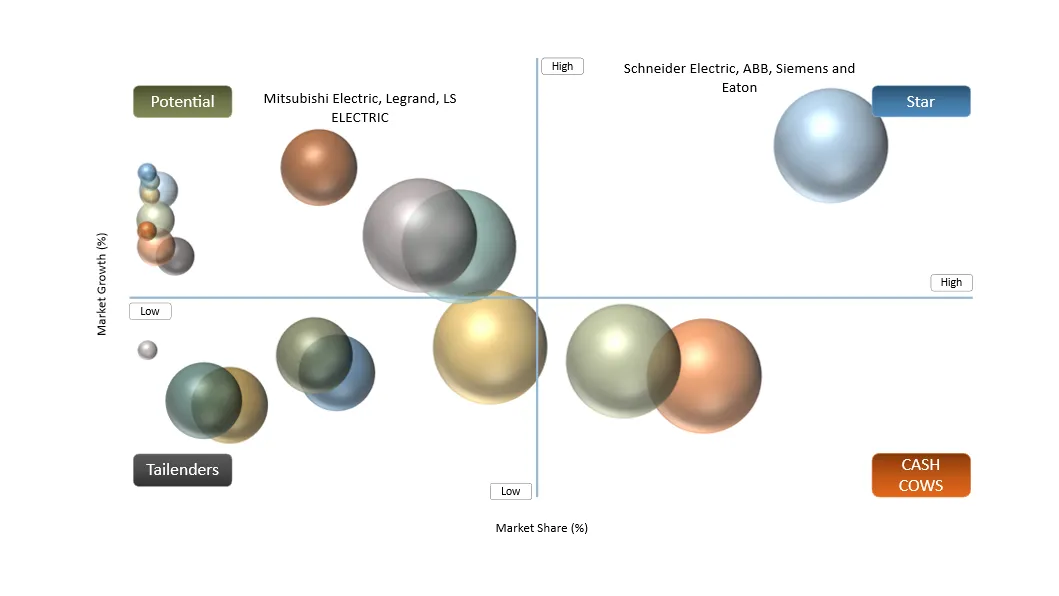
STAR
Schneider Electric, ABB, Siemens and Eaton are positioned as Stars because they combine broad protection portfolios, global channels, digital power platforms and strong exposure to data centers, infrastructure and industrial electrification. Their scale supports R&D, certification, regional manufacturing and lifecycle services.
POTENTIAL
Mitsubishi Electric, Legrand, LS ELECTRIC, Fuji Electric, CHINT and selected regional manufacturers represent high-potential players where geographic expansion, digital product development and stronger panel-builder networks can translate into share gains. Their trajectory depends on premiumization beyond commodity protection devices.
Low-Voltage Switchgear Market Dynamics
Driver Impact Analysis
| Driver | Market Growth Impact | Demand Concentration | Impacted Use Case | Strategic Impact |
| AI data centers and mission-critical infrastructure | High | North America, Asia-Pacific | High-current switchboards, ATS, digital breakers | Supports capacity expansion and premium architectures |
| Industrial electrification and reshoring | High | U.S., China, India, Europe | MCCs, breakers, distribution boards | Expands project pipeline and replacement demand |
| Smart buildings and energy management | Medium-High | Global urban markets | Connected breakers, metering, panels | Raises digital content per installation |
| Renewables, storage and EV charging | Medium-High | Global | Protection, isolation and distribution | Creates new grid-edge applications |
Driver: Electrification and Digital Power Distribution
The strongest structural driver is the rise in electrical load across data centers, factories, transport and buildings. Each new or expanded facility requires protection, switching and distribution, while power density increases the value and complexity of equipment. Digital energy management amplifies this effect by adding metering, communication and analytics to the same installed base.
Restraint Impact Analysis
| Restraint | Drag on Market Growth | Primary Impact Area | Impacted Use Case | Strategic Impact |
| Commodity and component volatility | High | Manufacturing cost | Copper-intensive switchboards and breakers | Encourages pricing discipline and dual sourcing |
| Price competition | Medium-High | Margins | Standard breakers and switches | Pushes differentiation toward digital and service |
| Certification and engineering complexity | Medium | Project execution | Critical and customized switchgear | Favors scaled suppliers and experienced panel builders |
| Skilled labor and panel capacity | Medium | Delivery lead time | Large data-center and industrial projects | Drives modularization and factory automation |
Restraint: Price Competition and Supply-Side Constraints
The market remains highly competitive in standard devices, especially where local manufacturers can meet baseline certification at lower cost. At the same time, copper, silver contacts and electronic trip-unit components can be volatile. Suppliers therefore need disciplined portfolio segmentation, regional sourcing and product architectures that reduce engineering and assembly time.
Low Voltage Switchgear Market Segment Analysis
The global Low Voltage Switchgear market is segmented based on Product Type, Voltage Rating, Current Rating, Installation, Technology, Application, End Use Industry, Distribution Channel and region.
By Product Type
Circuit Breakers Will Continue to Lead Market Value
Circuit breakers remain the largest product category because they form the core protection layer in low voltage distribution. Growth is strongest in molded-case and air circuit breakers used in commercial buildings, industrial facilities and data centers, where higher interrupting ratings, digital trip units and communication options increase average selling prices.
By Technology
Digital / Smart Connected Switchgear Will Grow Fastest
Connected switchgear is expected to outpace conventional equipment as owners seek energy visibility, predictive maintenance and remote diagnostics. Adoption is strongest in data centers, hospitals, smart buildings and advanced factories where downtime is costly and branch-level data has operational value.
By Application
Power Distribution Remains the Largest Application
Power distribution accounts for the broadest demand across buildings and industrial facilities. Data-center power distribution is a particularly high-value subsegment because of redundancy, selectivity, current density and monitoring requirements.
By End Use Industry
Data Centers & Telecom Are Among the Fastest-Growing End Uses
AI infrastructure is increasing demand for switchboards, breakers, transfer systems and monitoring. Growth is also supported by colocation capacity, edge infrastructure and telecom modernization, while manufacturing remains a large recurring base for MCCs and distribution equipment.
By Distribution Channel
Electrical Distributors and Panel Builders Remain Critical
Distribution channels are essential because low voltage products are stocked, configured and integrated locally. Large OEM-direct relationships are most important for hyperscale, industrial and repeat-build programs, while smaller projects depend heavily on distributors, contractors and panel builders.
Low Voltage Switchgear Market Geographical Penetration
U.S. Low Voltage Switchgear Market Landscape
The U.S. market is being accelerated by AI data centers, semiconductor fabs, battery manufacturing, warehouses, healthcare and grid-edge electrification. Strong project pipelines favor premium switchboards, intelligent breakers and transfer systems, while local assembly and panel capacity are strategic bottlenecks. Replacement of aging commercial and industrial electrical equipment adds recurring demand.
Germany Low Voltage Switchgear Market Outlook
Germany combines a mature industrial installed base with automation, building-efficiency and electrification investment. Demand centers on high-quality protection, motor control and digitally connected distribution equipment. Engineering standards, energy efficiency and industrial modernization support premium products despite slower construction growth.
China Low Voltage Switchgear Market Trends
China is one of the world’s largest production and consumption centers, supported by manufacturing, data centers, infrastructure and commercial construction. Domestic manufacturers exert intense price pressure in standard products, while multinational suppliers retain stronger positions in premium industrial, mission-critical and export-oriented applications.
India Low Voltage Switchgear Market Outlook
India offers high growth through industrial corridors, data centers, commercial construction, renewable projects and rising electricity consumption. Formalization of electrical safety and quality standards supports branded equipment, while local production, distributor reach and price-performance positioning remain essential.
Middle East and Africa Low Voltage Switchgear Market Outlook
Gulf markets are expanding through data centers, airports, industrial projects, utilities and large commercial developments. Africa remains more fragmented, with demand concentrated in mining, utilities, commercial buildings and industrial facilities. Distributor capability and local project support are central to market access.
Low Voltage Switchgear Market Competitive Landscape
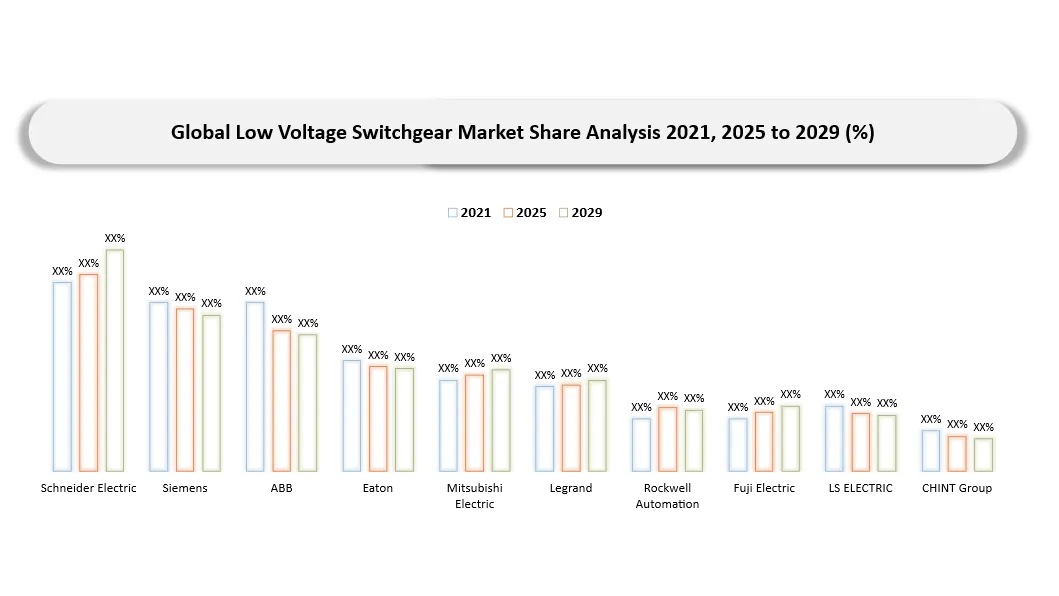
- Schneider Electric, ABB, Siemens and Eaton lead the premium global market through broad portfolios, installed bases, software platforms and extensive distribution channels.
- Mitsubishi Electric, Legrand, Fuji Electric, LS ELECTRIC, CHINT and regional specialists compete strongly by geography, product family and price-performance position.
- Competition is shifting from standalone breakers and panels toward complete electrical architectures integrating protection, metering, power quality, automation, connectivity and lifecycle service.
- Data centers have become a strategic battleground because high growth and repeat-build designs reward suppliers with high-current capacity, global manufacturing and standardized digital platforms.
- Panel builders, distributors and EPCs remain important competitive multipliers because local engineering, stock availability and code compliance strongly influence supplier selection.
Public Company Q1-Q2 2026 Performance Comparison
The comparison below uses publicly disclosed company or segment performance as a proxy for competitive momentum. Low voltage switchgear revenue is generally not reported as a standalone line item, so the table distinguishes broader electrical or smart-infrastructure performance from direct product exposure.
| Public Company | Q1-Q2 2026 Performance Signal | Relevant Growth Drivers | Implication for Low Voltage Switchgear |
| Schneider Electric | Q1 2026 revenue reached €9.8 billion, up 11.2% organically; Energy Management grew 12.8% organically. | Data centers, Power & Grid, Systems growth, pricing and volume. | Strong exposure to breakers, switchboards and digital energy platforms positions the company to capture mission-critical and building demand. |
| Siemens | Q2 FY2026 comparable revenue grew 6%; Smart Infrastructure raised FY2026 comparable growth outlook to 8-10%. | Smart Infrastructure orders, electrification, data centers and digital building systems. | Supports strong demand for low voltage distribution, protection and smart infrastructure architectures. |
| ABB | Q2 2026 reported record-high orders and strong operational execution at group level; Electrification remains a core growth engine. | Electrification, data centers, industrial automation, M&A and digital power. | Broad breaker and switchgear portfolio benefits from power-density and energy-management demand. |
| Eaton | Q1 2026 sales rose 17%; Electrical Americas sales reached $3.6 billion, up 20%, with organic sales up 14%. | Data centers, backlog expansion, capacity investment and electrification. | High-current distribution and mission-critical power demand is driving strong electrical momentum. |
| Mitsubishi Electric | FY2027 Q1 results were scheduled for July 31, 2026; company remains a major listed supplier in factory automation and power distribution. | Industrial automation, factory investment, infrastructure and Asian electrical demand. | Competitive position is strongest where industrial controls and power-distribution products are specified together. |
Source note: Company performance metrics are based on 2026 investor-relations releases from Schneider Electric, Siemens, ABB, Eaton and Mitsubishi Electric. Figures refer to company or reporting-segment performance and should not be interpreted as standalone low voltage switchgear revenue.
Low Voltage Switchgear Market Ecosystem
| Value Chain Sector | Role in the Ecosystem | Representative Companies / Organizations |
| Raw Materials | Copper, steel, engineered plastics, silver contacts and insulation materials | Aurubis, Wieland, Prysmian material suppliers, regional metal processors |
| Electronic & Sensing Components | Trip-unit electronics, sensors, communication modules, power supplies | Infineon, STMicroelectronics, NXP, Texas Instruments, Analog Devices |
| Core Switchgear OEMs | Circuit breakers, switches, panels, MCCs, transfer systems | Schneider Electric, ABB, Siemens, Eaton, Mitsubishi Electric, Legrand, LS ELECTRIC, CHINT |
| Panel Builders & Assemblers | Configure switchboards and distribution panels to project specifications | Local authorized panel builders, system houses, UL/IEC-certified assemblers |
| Digital Energy Platforms | Metering, power monitoring, analytics and energy management | Schneider EcoStruxure, ABB Ability, Siemens Electrification X / Building X, Eaton Brightlayer |
| Electrical Distribution | Stock, specification support and contractor fulfillment | Rexel, Sonepar, Wesco, Graybar and regional electrical distributors |
| EPCs & Contractors | Design, procurement, installation and commissioning | Quanta Services, EMCOR, Comfort Systems USA, regional electrical contractors |
| End Users | Commercial, industrial, data center, utility and infrastructure buyers | Hyperscalers, colocation operators, manufacturers, hospitals, transport authorities, utilities |
| Testing & Standards | Product certification, safety and interoperability | IEC, UL Solutions, CSA Group, TÜV, national electrical code bodies |
Key Companies of Low Voltage Switchgear Market
- Schneider Electric
- Siemens
- ABB
- Eaton
- Mitsubishi Electric
- Legrand
- Rockwell Automation
- Fuji Electric
- LS ELECTRIC
- Larsen & Toubro
- Hager Group
- CHINT Group
- Havells India
- Hyundai Electric
- Lucy Electric
Company Profiles
Schneider Electric
Schneider Electric is one of the strongest global competitors in low voltage distribution through circuit breakers, switchboards, panel systems, transfer solutions and the EcoStruxure digital architecture. Its competitive advantage comes from product breadth, strong electrical distribution channels, data-center exposure and integration of protection with energy management. Growth priorities include high-current systems, modular architectures, software-defined energy management and regional capacity expansion.
Siemens
Siemens participates through Smart Infrastructure, combining low voltage protection, control, distribution and building technologies. The company benefits from strong industrial and commercial engineering relationships and can connect electrical distribution with automation and digital building platforms. Data centers, industrial electrification and smart infrastructure are major growth vectors.
ABB
ABB is a global leader in electrification with broad low voltage breaker, switch, distribution and digital-energy portfolios. The company competes through installed base, technology, channel partnerships and advanced protection. Its SACE platform and connected energy-management capabilities support strong positions in data centers and industrial systems.
Eaton
Eaton has a large North American and global electrical business spanning breakers, switchgear, panelboards, switchboards, transfer equipment, busway and digital power management. Rapid data-center demand and capacity expansion are strengthening its position in mission-critical distribution. Its broad installed base supports aftermarket and service opportunities.
Mitsubishi Electric
Mitsubishi Electric combines low voltage power distribution with factory automation and industrial control. This provides cross-selling potential in manufacturing and infrastructure projects, particularly in Asia. Competitive priorities include smart factories, energy efficiency and integrated control architectures.
Legrand
Legrand is an important participant in the low voltage electrical equipment ecosystem through protection devices, distribution equipment, industrial controls, panel systems or regional channel strength. Its competitive position depends on product certification, price-performance, distributor reach, local manufacturing, engineering support and the ability to add digital functionality to established electrical platforms.
Rockwell Automation
Rockwell Automation is an important participant in the low voltage electrical equipment ecosystem through protection devices, distribution equipment, industrial controls, panel systems or regional channel strength. Its competitive position depends on product certification, price-performance, distributor reach, local manufacturing, engineering support and the ability to add digital functionality to established electrical platforms.
Fuji Electric
Fuji Electric is an important participant in the low voltage electrical equipment ecosystem through protection devices, distribution equipment, industrial controls, panel systems or regional channel strength. Its competitive position depends on product certification, price-performance, distributor reach, local manufacturing, engineering support and the ability to add digital functionality to established electrical platforms.
LS ELECTRIC
LS ELECTRIC is an important participant in the low voltage electrical equipment ecosystem through protection devices, distribution equipment, industrial controls, panel systems or regional channel strength. Its competitive position depends on product certification, price-performance, distributor reach, local manufacturing, engineering support and the ability to add digital functionality to established electrical platforms.
Larsen & Toubro
Larsen & Toubro is an important participant in the low voltage electrical equipment ecosystem through protection devices, distribution equipment, industrial controls, panel systems or regional channel strength. Its competitive position depends on product certification, price-performance, distributor reach, local manufacturing, engineering support and the ability to add digital functionality to established electrical platforms.
Hager Group
Hager Group is an important participant in the low voltage electrical equipment ecosystem through protection devices, distribution equipment, industrial controls, panel systems or regional channel strength. Its competitive position depends on product certification, price-performance, distributor reach, local manufacturing, engineering support and the ability to add digital functionality to established electrical platforms.
CHINT Group
CHINT Group is an important participant in the low voltage electrical equipment ecosystem through protection devices, distribution equipment, industrial controls, panel systems or regional channel strength. Its competitive position depends on product certification, price-performance, distributor reach, local manufacturing, engineering support and the ability to add digital functionality to established electrical platforms.
Havells India
Havells India is an important participant in the low voltage electrical equipment ecosystem through protection devices, distribution equipment, industrial controls, panel systems or regional channel strength. Its competitive position depends on product certification, price-performance, distributor reach, local manufacturing, engineering support and the ability to add digital functionality to established electrical platforms.
Hyundai Electric
Hyundai Electric is an important participant in the low voltage electrical equipment ecosystem through protection devices, distribution equipment, industrial controls, panel systems or regional channel strength. Its competitive position depends on product certification, price-performance, distributor reach, local manufacturing, engineering support and the ability to add digital functionality to established electrical platforms.
Lucy Electric
Lucy Electric is an important participant in the low voltage electrical equipment ecosystem through protection devices, distribution equipment, industrial controls, panel systems or regional channel strength. Its competitive position depends on product certification, price-performance, distributor reach, local manufacturing, engineering support and the ability to add digital functionality to established electrical platforms.
Low Voltage Switchgear Market Major Pain Points
- Volatility in copper, silver-contact and electronic component costs.
- Long engineering and assembly lead times for customized switchboards and large project packages.
- Intense price competition in standard breakers and switches.
- Fragmented standards, codes and certification requirements across countries.
- Shortage of skilled panel builders and electrical installation labor in fast-growing markets.
- Cybersecurity and interoperability concerns for connected protection devices.
- Need to retrofit aging installed bases without prolonged facility shutdowns.
- Balancing premium digital features with customer willingness to pay.
Low Voltage Switchgear Market Recent Developments
- July 2026: ABB reported record-high orders and strong operational execution in Q2 2026, reinforcing the strength of electrification demand across data centers and industrial markets.
- July 2026: Schneider Electric scheduled its 2026 half-year results following a Q1 in which Energy Management grew 12.8% organically, led by data centers and Power & Grid demand.
- May 2026: Siemens reported Q2 FY2026 comparable revenue growth of 6% and raised the Smart Infrastructure full-year comparable revenue growth outlook to 8-10%.
- May 2026: Eaton reported Q1 2026 sales of $7.5 billion, up 17%, with Electrical Americas sales up 20% and strong backlog growth driven by data-center momentum.
- 2026: Major switchgear vendors continued expanding connected protection, digital energy management and modular data-center power-distribution portfolios as project lead-time and power-density requirements increased.
Analyst View / Opinion on Low Voltage Switchgear Market
- The market is entering a durable growth phase because electrification is increasing both the number of low voltage distribution points and the value of equipment installed at each point.
- Data centers will remain the most strategically important premium demand pool through the late 2020s because they combine high current, redundancy, monitoring and repeat-build requirements.
- Digital functionality will become increasingly standard in commercial and industrial switchgear, although basic residential and commodity products will remain price driven.
- Asia-Pacific will retain the largest volume position, while North America is likely to lead premium growth in mission-critical electrical infrastructure.
- Competitive advantage will depend on manufacturing capacity, local panel ecosystems, software compatibility, lifecycle service and the ability to deliver standardized architectures at speed.
- Suppliers that connect protection hardware with power analytics and retrofit services can create recurring revenue and defend margins more effectively than component-only competitors.
Low Voltage Switchgear Market Target Audience
| INDUSTRY | WHO SHOULD BUY THIS REPORT? | REASON TO BUY THIS REPORT |
| Electrical Equipment | Switchgear OEMs, breaker manufacturers, panel builders | Benchmark product demand, technology shifts, regional growth and competitive positioning. |
| Data Centers | Hyperscalers, colocation operators, electrical designers | Assess high-current distribution, redundancy, digital monitoring and supplier capacity. |
| Industrial Manufacturing | Plant owners, automation companies, engineering teams | Plan MCC, distribution and retrofit investment across factories. |
| Buildings & Construction | Developers, MEP consultants, contractors | Evaluate code requirements, smart-building demand and channel dynamics. |
| Utilities & Renewables | Utilities, solar/storage developers, microgrid integrators | Assess protection and distribution demand at the grid edge. |
| Distribution | Electrical distributors, wholesalers and channel partners | Understand product mix, inventory priorities and regional opportunities. |
| Investment & Consulting | Investors, PE firms, consultants, strategy teams | Support market entry, M&A, competitive benchmarking and portfolio decisions. |
Why Choose DATAM?
- Data-driven insights combining market sizing, pricing, value-chain analysis and primary interviews.
- Post-purchase analyst support for market entry, supplier strategy, segmentation and custom modeling.
- Annual report updates covering capacity, product launches, regulation and competitive change.
- Specialized focus on emerging markets and local channel structures.
- Actionable analysis connecting technology shifts with procurement, distribution and investment priorities.
What DATAM Uniquely Provides
- Ten-year forecasts across eight low voltage switchgear segmentation categories and major regions.
- Detailed analysis of digital switchgear, connected breakers, arc-flash safety and data-center power distribution.
- Market ecosystem mapping from materials and semiconductors through OEMs, panel builders, distributors and end users.
- Public-company performance benchmarking to connect financial momentum with market growth drivers.
- Country-level analysis linking construction, industrial investment, data centers and electrical standards.



























































