


Low Carbon Aluminium Market Size and Overview
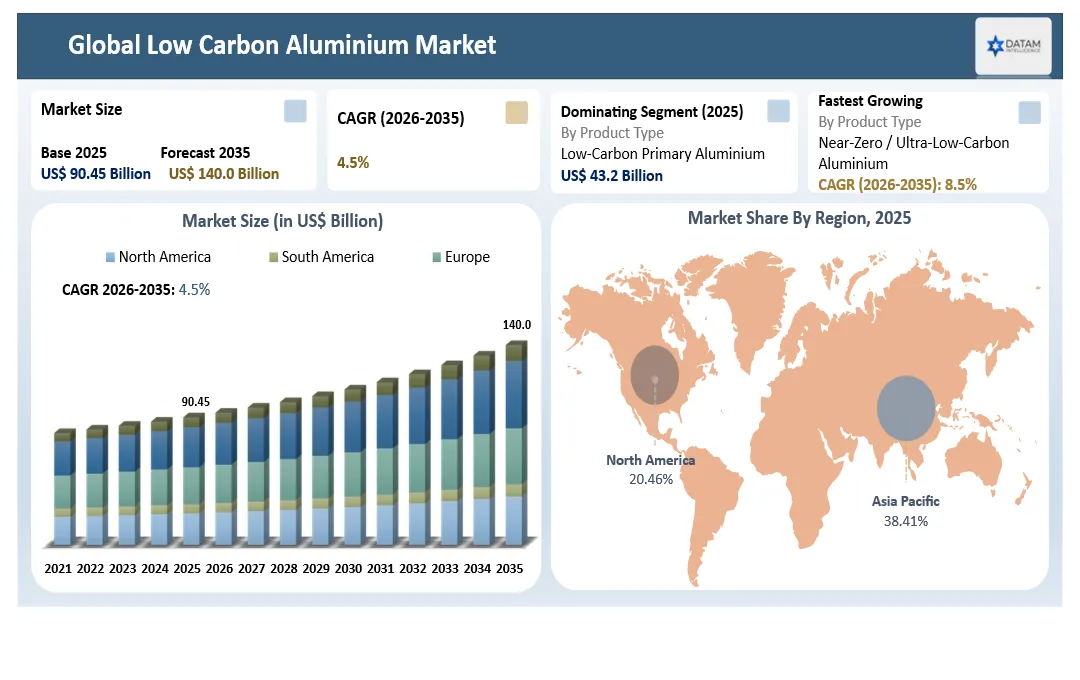
The global low carbon aluminium market Size is estimated at US$ 90.45 billion in 2025 and is projected to reach approximately US$ 140.0 billion by 2035, expanding at a CAGR of about 4.5% during 2026-2035. The market covers primary and recycled aluminium supplied with demonstrably lower cradle-to-gate greenhouse gas emissions than conventional production. Commercial value is increasingly linked to verified product carbon footprints, renewable-power intensity, recycled content, low-carbon alumina, responsible sourcing and traceable chain of custody. Demand is being driven by automotive and EV platforms, packaging, construction, electrical infrastructure, renewable energy, aerospace and consumer-electronics companies seeking measurable Scope 3 reductions.
Primary aluminium has a structurally high electricity and process-emissions burden, making power source and smelter technology central to low-carbon differentiation. Hydro-powered and renewable-powered smelters, efficient alumina refining and emerging inert-anode routes can materially reduce emissions intensity. Recycled aluminium provides a second pathway because remelting requires far less energy than primary smelting, although alloy chemistry, scrap availability and contamination control determine how much secondary material can be used in demanding applications.
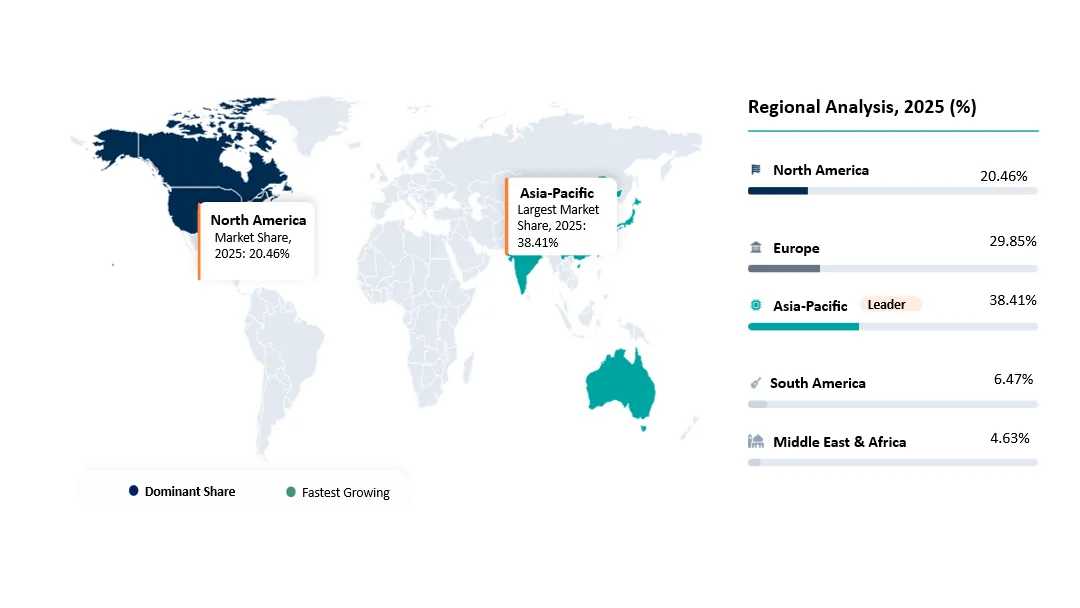
Europe is the largest value market for verified low-carbon aluminium because automotive, packaging, construction and industrial buyers face stringent climate targets, carbon-price exposure and the definitive phase of the EU Carbon Border Adjustment Mechanism. Asia-Pacific remains the largest production base and is expected to expand rapidly as China, India, Australia and Southeast Asia add recycling, renewable power and lower-emission smelting capacity. North America is gaining momentum through automotive closed loops, can-sheet recycling, renewable-powered primary production and infrastructure investment.
| Metric | Details |
| 2025 Market Size | US$ 90.45 Billion (DataM estimate) |
| 2035 Projected Market Size | US$ 140.0 Billion (DataM estimate) |
| CAGR (2026-2035) | 4.5% |
| Largest Market | Asia-Pacific |
| Fastest Growing Market | Asia-Pacific |
| Leading Product Type | Low-Carbon Primary Aluminium |
| Fastest-Growing Product Type | Near-Zero / Ultra-Low-Carbon Aluminium |
| Key Demand Engines | Automotive, Packaging, Construction, Renewable Energy and Electrical |
| Critical Supply Factors | Renewable electricity, scrap quality, low-carbon alumina, smelter technology and traceability |
Low Carbon Aluminium Market Key Takeaways
- Low-carbon primary aluminium remains the largest revenue pool because premium automotive, construction and electrical applications still require primary-grade chemistry and performance.
- Recycled aluminium is gaining share rapidly as beverage can, automotive and building-product companies expand closed-loop scrap systems and minimum recycled-content targets.
- Near-zero / ultra-low-carbon aluminium is the fastest-growing strategic segment, but commercialization depends on scaling inert-anode electrolysis, renewable power and low-carbon alumina at competitive cost.
- Europe leads demand through stringent embodied-carbon policy, automotive decarbonization and carbon-border mechanisms, while Asia-Pacific leads global production and capacity additions.
- Low-carbon premiums are most durable where suppliers provide verified product carbon footprints, guaranteed recycled content, traceability and long-term supply rather than generic environmental claims.
- Scrap availability is becoming a strategic bottleneck as multiple industries compete for high-quality post-consumer aluminium with low contamination and suitable alloy chemistry.
- Automotive body sheet, EV battery enclosures, beverage can sheet, solar structures and grid conductors are among the most commercially attractive applications for premium low-carbon aluminium.
- Long-term leadership will depend on access to renewable power, recycling scale, low-carbon alumina, process innovation, customer co-development and defensible carbon accounting.
Low Carbon Aluminium Industry Trends and Strategic Insights
- Procurement is shifting from broad ESG screening toward product-level carbon intensity, recycled content and chain-of-custody evidence.
- Automotive OEMs are signing multi-year low-carbon aluminium agreements and investing in closed-loop scrap systems to reduce vehicle embodied emissions.
- Beverage and packaging companies are increasing demand for can-to-can recycling because aluminium maintains high material value and can circulate repeatedly when collection systems perform well.
- Hydropower-based primary aluminium maintains a structural carbon advantage, but new renewable PPAs and captive solar/wind projects are widening the low-carbon supply base.
- Inert-anode technologies such as ELYSIS and Hydro HalZero represent potentially disruptive pathways because they target direct process emissions rather than only electricity emissions.
- Digital traceability, product carbon footprints and certified chain-of-custody are becoming commercial differentiators as customers prepare for carbon reporting and border-adjustment requirements.
- Recycling economics are moving upstream: producers are acquiring scrap-processing capacity and designing alloys that tolerate higher recycled content without sacrificing performance.
- The market is evolving from commodity aluminium with a sustainability premium toward differentiated material platforms with verified carbon, circularity and performance attributes.
Low Carbon Aluminium Market Scope
| Metrics | Details |
| 2025 Market Size | US$ 90.45 Billion |
| 2035 Projected Market Size | US$ 140.0 Billion |
| CAGR (2026-2035) | 4.5% |
| Largest Market | Europe |
| Fastest Growing Market | Asia-Pacific |
| By Product Type | Low-Carbon Primary Aluminium, Recycled / Secondary Aluminium, Near-Zero / Ultra-Low-Carbon Aluminium |
| By Carbon Intensity | Below 1 tCO2e/t Al, 1-4 tCO2e/t Al, 4-8 tCO2e/t Al |
| By Production Route | Renewable-Power Primary Smelting, Post-Consumer & Closed-Loop Recycling, Pre-Consumer Scrap Recycling, Inert-Anode / Novel Electrolysis, Low-Carbon Alumina & Refining, Hybrid / Other Decarbonized Routes |
| By Product Form | Ingots & Foundry Alloy, Billets, Slabs, Flat-Rolled Products, Extrusions & Profiles, Foil & Other Semi-Fabricated Products |
| By Application | Automotive & EV Lightweighting, Building & Construction, Packaging, Electrical & Power, Renewable Energy, Aerospace & Defense, Consumer & Electronics, Industrial Machinery, Others |
| By End Use Industry | Automotive & Transportation, Construction & Infrastructure, Packaging & Beverage, Energy & Utilities, Electrical & Electronics, Aerospace, Consumer Goods, Industrial Manufacturing, Others |
| By Certification & Traceability | ASI-Certified / Chain of Custody, Product Carbon Footprint / EPD Verified, Mass-Balance / Book-and-Claim Models, Digital Product Passport / Traceability Platforms, Other Verified Low-Carbon Claims |
| By Distribution Channel | Direct Long-Term Contracts, OEM / Strategic Offtake, Metal Traders & Distributors, Service Centers & Fabricators, Spot / Exchange-Linked Sales |
| By Region | North America, Europe, Asia-Pacific, South America, Middle East & Africa |
| Report Insights Covered | Market Size, Share, Growth, Carbon Intensity, Recycling, Technology, Pricing, Trade, Ecosystem, Competition and Country-Level Opportunity |
Why does this report matter in 2026?
The year 2026 is a transition point for low-carbon aluminium because product-level carbon accounting is moving from voluntary sustainability procurement into trade, compliance and customer-contract economics. The EU Carbon Border Adjustment Mechanism entered its definitive phase in 2026, increasing the commercial importance of auditable embedded emissions for aluminium entering Europe. At the same time, automotive, packaging, cable, construction and renewable-energy companies are tightening supplier decarbonization requirements and increasingly specifying maximum carbon-intensity thresholds in purchasing decisions.
Producer investment is moving from pilots toward scale. Hydro continues to expand REDUXA and recycling capacity while advancing HalZero, Alcoa is investing in low-carbon casthouse and smelter capability, Rio Tinto is progressing ELYSIS and traceability, and downstream producers are increasing recycled-content capacity. Buyers need to distinguish commercially available low-carbon metal from future near-zero technologies, while investors need to assess where customer premiums, carbon costs and long-term offtake are sufficient to support capital-intensive decarbonization.
This report connects market size with carbon intensity, power sourcing, alumina emissions, scrap economics, certification, trade policy and customer offtake. It identifies which low-carbon aluminium routes are commercially scalable in 2026-2030 and which depend on longer-cycle technology, infrastructure or regulatory change.
Low Carbon Aluminium Market White Space & Investment Opportunities
- Closed-loop automotive scrap offers strong value because it lowers carbon intensity while preserving alloy chemistry and reducing exposure to primary-metal prices.
- Low-carbon billet and extrusion products are attractive for solar structures, EV platforms, rail, data centers and building envelopes where customers want both structural performance and lower embodied carbon.
- High-recycled-content can sheet and packaging alloys can capture recurring demand from beverage brands pursuing circularity and recycled-content targets.
- Near-zero-carbon primary aluminium creates a premium opportunity for aerospace, EV, electronics and branded consumer applications that cannot meet material specifications using high recycled content alone.
- Scrap sorting, alloy separation and digital material passports are investable enabling layers because recycled aluminium growth depends on cleaner feedstock and verified chain of custody.
- Low-carbon alumina and renewable-powered refining represent an underdeveloped upstream opportunity because smelter decarbonization alone does not eliminate emissions embedded in alumina.
Low Carbon Aluminium Future Market Transformation
The market will shift from a simple split between primary and secondary aluminium toward a carbon-intensity continuum. Buyers will increasingly specify maximum product carbon footprints, recycled-content thresholds, responsible-sourcing standards and regional content. Suppliers will respond with differentiated grades that combine low-carbon primary metal with recycled feedstock, allowing alloy performance and emissions targets to be optimized together.
By 2035, successful producers are likely to operate integrated carbon-management systems spanning mine, refinery, smelter, scrap collection, remelting, casting and downstream fabrication. Digital product passports will connect production data with customer Scope 3 reporting, while long-term renewable-power contracts and circular scrap agreements will become strategic assets. Near-zero-carbon technologies will begin to influence benchmark pricing where industrial-scale capacity is proven.
Competition will also move closer to end users. Rather than selling only billet, slab or ingot, aluminium companies will offer alloy design, closed-loop scrap collection, remelting, traceability and carbon data as a bundled service. This favors producers with downstream conversion capability, recycling networks and deep customer relationships.
Low Carbon Aluminium Market Buyer Decision-Making Criteria
Industrial buyers evaluate low-carbon aluminium on carbon intensity, alloy performance, recycled content, certification, traceability, supply reliability and delivered cost. A low product carbon footprint is valuable only if it is calculated with a transparent methodology and can be audited. Automotive and aerospace buyers also require long qualification cycles, consistent mechanical properties and control of residual elements, while packaging buyers prioritize can-to-can recyclability and food-contact requirements.
Commercial decisions increasingly compare total value rather than metal price alone. Buyers consider low-carbon premiums against avoided carbon cost, customer-brand commitments, regulatory exposure and future carbon-border obligations. Long-term contracts are more likely where suppliers can guarantee renewable power, stable recycled-content levels, production capacity and auditable emissions data across several years.
Low Carbon Aluminium Market Economic & Investment Analysis
Low-carbon aluminium economics are shaped by electricity cost, carbon intensity, alumina cost, scrap spreads, collection rates, alloy yield and carbon pricing. Hydropower-based smelters often hold a structural advantage because electricity can account for a large share of primary aluminium cost and emissions. Recyclers benefit from much lower energy intensity, but margins depend on scrap quality, sorting efficiency and the spread between scrap and primary metal.
Investment is moving into renewable power contracts, scrap-processing assets, remelt furnaces, low-carbon casthouses, digital traceability and novel smelting technologies. The highest-return projects are typically those that improve both cost and carbon position, such as energy-efficiency upgrades, high-yield scrap sorting, closed-loop customer contracts and renewable electricity at competitive long-term prices. Deep-decarbonization projects such as inert anodes require larger capital commitments and longer qualification periods but can create durable strategic differentiation.
Valuation should therefore separate mature low-carbon capacity from technology-option value. Existing hydro-powered smelters and efficient recycling assets can monetize low-carbon premiums today, while near-zero-carbon technologies should be assessed using milestone-adjusted scenarios based on pilot performance, scale-up cost, power availability and customer willingness to sign premium offtake agreements.
Low Carbon Aluminium Investment Trends in the Market
- Capital is moving toward recycling and remelt capacity because circular aluminium can lower emissions quickly while serving established downstream customers.
- Producers are signing longer renewable-power contracts to protect cost competitiveness and lock in low-carbon credentials for primary metal.
- Investment in low-carbon casthouses, billet and slab capability is increasing as customers request product-specific carbon and recycled-content guarantees.
- Automotive and packaging closed-loop systems are attracting investment in scrap segregation, digital tracking and alloy-specific recycling.
- Novel smelting technologies are progressing from research toward larger pilots as producers seek to eliminate direct carbon-anode emissions.
- M&A and strategic partnerships increasingly target scrap collection, recycling technology, downstream fabrication and customer access rather than only primary production capacity.
Strategic Indicators For Low Carbon Aluminium Market
High Regulation Impact
Carbon-border measures, emissions reporting, product environmental declarations, recycled-content rules and responsible-mining requirements increasingly affect market access. Compliance is moving closer to product-level data, raising the value of traceability and independently verified carbon footprints.
High Investment Activity
Producers are investing in renewable power, recycling, energy efficiency, low-carbon casthouses, scrap sorting and breakthrough electrolysis. Capital intensity is high, but long-lived smelter assets make early decarbonization strategically important.
Supply Chain Disruption
Low-carbon aluminium supply is exposed to power-market volatility, bauxite and alumina disruptions, trade restrictions and scrap shortages. High-quality scrap is increasingly strategic because buyers compete for the same low-contamination feedstock.
Pricing Volatility
Low-carbon premiums sit on top of volatile LME prices, regional premiums, energy costs and scrap spreads. Premiums are more stable when tied to verified carbon thresholds and long-term offtake rather than spot claims.
Procurement Pressure
OEMs are demanding auditable Scope 3 reductions, tighter recycled-content levels and reliable multi-year supply. Suppliers unable to provide product-level carbon data face growing risk of exclusion from premium procurement programs.
New Technology Adoption
Inert anodes, improved electrolysis, electrified calcination, hydrogen, advanced scrap sorting and digital product passports are changing the production and verification stack.
Regional Expansion Opportunity
Europe has the strongest premium demand, while Asia-Pacific offers the largest scale opportunity. North America is attractive for can-sheet and automotive circularity, and the Middle East can leverage solar power and efficient modern smelters.
Government Policy Support
Industrial decarbonization grants, renewable-power policy, recycling mandates and carbon-border mechanisms support low-carbon aluminium investment, although policy design varies significantly by region.
Pricing Intelligence
Low-carbon metal pricing depends on standard aluminium benchmarks plus regional premiums, conversion charges and a low-carbon premium reflecting carbon intensity, certification, scarcity and customer willingness to pay.
Disruption Analysis of Low Carbon Aluminium Market
The market is being disrupted by carbon-accounted procurement, recycling technology and new smelting routes. Carbon intensity is becoming an explicit commercial attribute, which changes how aluminium from different power systems competes even when chemical specifications are identical. Products from hydro-powered or renewable-powered smelters can command preferential demand, while high-emission supply faces rising carbon and compliance exposure.
Circularity is the second major disruption. Closed-loop systems allow automotive, packaging and construction scrap to return directly into similar products, improving material yield and making scrap access a competitive moat. Advanced sorting, laser-induced breakdown spectroscopy, sensor-based separation and digital tagging can increase the usable recycled-content ceiling in demanding alloys.
Near-zero-carbon electrolysis could become the third disruption. If inert-anode and alternative cell technologies scale reliably, direct process emissions from carbon anodes can fall sharply. The timing remains uncertain because industrial-scale economics, cell life, retrofitability and power requirements must be proven.
Low Carbon Aluminium Market BCG Matrix: Company Evaluation
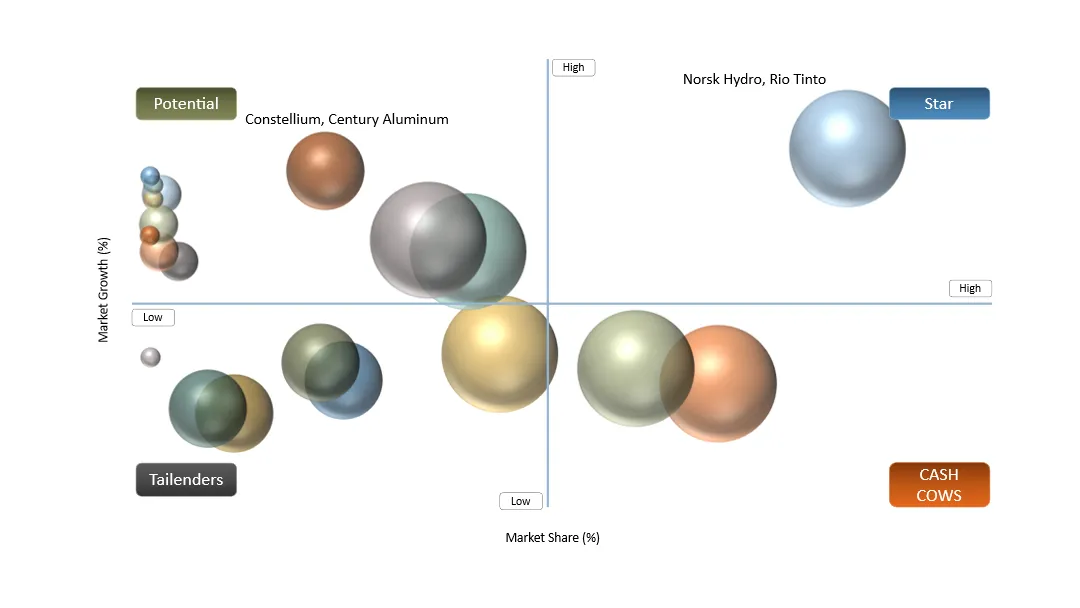
STAR
Norsk Hydro, Rio Tinto, Alcoa and Novelis/Hindalco are positioned as Stars because they combine scale, established low-carbon or recycled aluminium portfolios, access to renewable power or large recycling networks and strong customer relationships. Their competitive advantage is reinforced by branded low-carbon products, integrated supply chains and investment in next-generation decarbonization technologies.
POTENTIAL
Constellium, Century Aluminum, Press Metal, Alba, China Hongqiao, Chalco, Gränges and other regional leaders are Potential players. Their ability to move toward the Star quadrant depends on expanding low-carbon power sourcing, recycling intensity, certified product portfolios and downstream customer integration while maintaining cost competitiveness.
Low Carbon Aluminium Market Dynamics
Driver Impact Analysis
| Driver | Market Growth Impact | Demand Concentration | Impacted Use Case | Strategic Impact |
| Scope 3 and embodied-carbon targets | High | Europe, North America, global OEMs | Automotive, building, consumer products | Accelerates long-term procurement of verified low-carbon metal. |
| Expansion of closed-loop recycling | High | Automotive and packaging | Can sheet, auto sheet, extrusions | Raises recycled content and reduces primary-metal dependence. |
| Carbon-border and climate policy | Medium-High | Europe and export markets | Imported primary and semi-finished aluminium | Improves relative economics of low-carbon production. |
| Renewable-energy expansion | Medium-High | Hydro, solar and wind-rich regions | Primary smelting | Improves access to lower-carbon electricity for new capacity. |
Driver: Scope 3 Decarbonization and Circularity Become Procurement Requirements
Automotive, packaging, construction and technology companies increasingly include material emissions in supplier selection. Aluminium is highly visible because its embodied carbon varies significantly with electricity source and recycled content. As a result, demand is moving toward quantified carbon thresholds, long-term low-carbon supply and closed-loop scrap arrangements that can generate measurable Scope 3 reductions.
Restraint Impact Analysis
| Restraint | Drag on Market Growth | Primary Impact Area | Impacted Use Case | Strategic Impact |
| Renewable-power scarcity and cost | High | Primary smelting | Low-carbon primary metal | Limits competitive expansion outside favorable power regions. |
| High capex for deep decarbonization | High | Smelters and refineries | Near-zero-carbon metal | Slows industrial scale-up of new electrolysis routes. |
| Scrap quality and availability | Medium-High | Recycling | Automotive and packaging loops | Constrains high recycled content in demanding alloys. |
| Fragmented green definitions | Medium | Commercial claims | Cross-border procurement | Creates comparison and greenwashing risk. |
Restraint: Renewable Power, Scrap Quality and Verification Limit Scale
Low-carbon aluminium supply cannot expand simply by relabeling existing metal. Primary producers need low-carbon electricity and lower process emissions, while recyclers need clean scrap and effective alloy management. At the same time, inconsistent carbon-accounting boundaries can make products difficult to compare. These constraints increase the value of renewable-power contracts, scrap-processing infrastructure and standardized product carbon footprints.
Low Carbon Aluminium Market Segment Analysis
The global Low Carbon Aluminium market is segmented based on Product Type, Carbon Intensity, Production Route, Product Form, Application, End Use Industry, Certification & Traceability, Distribution Channel and region.
By Product Type
Low-Carbon Primary Aluminium Will Remain the Largest Revenue Pool
Low-carbon primary aluminium leads because premium automotive, aerospace, electrical and structural applications still require primary-grade chemistry and large reliable volumes. Recycled aluminium grows faster in packaging and automotive closed loops, while near-zero-carbon metal has the highest long-term strategic potential.
By Carbon Intensity
Below 4 tCO2e/t Aluminium Will Gain Share Rapidly
Products below approximately 4 tCO2e per tonne provide a clear emissions advantage versus coal-intensive primary aluminium. The below-1 tCO2e segment remains smaller but is strategically important for customers with aggressive Scope 3 targets.
By Production Route
Post-Consumer and Closed-Loop Recycling Will Record Strong Growth
Closed-loop recycling combines low energy use with secure scrap quality and customer visibility. Renewable-powered primary smelting remains the largest route by value, while inert-anode and novel electrolysis are expected to grow from a small base.
By Product Form
Billet, Slab and Flat-Rolled Products Will Dominate Commercial Demand
Billet and slab are the main interfaces between low-carbon metal production and downstream extrusion or rolling. Flat-rolled products are especially important in auto body sheet and packaging, where carbon and recycled-content requirements are increasingly embedded in contracts.
By Application
Automotive & EV Lightweighting Will Be a Leading Premium Application
EV battery packs, body structures, crash components and closures require lightweight, corrosion-resistant aluminium. OEMs can combine low-carbon primary metal with closed-loop scrap to reduce embodied emissions without compromising performance.
By End Use Industry
Automotive & Transportation Will Lead Premium Adoption
Automotive customers have strong purchasing power, clear Scope 3 targets and the ability to sign multi-year supply agreements. Packaging is the other major circularity engine due to established collection and can-to-can recycling.
By Certification & Traceability
Verified Product Carbon Footprints Will Become the Core Commercial Standard
Buyers increasingly require product-specific data that can flow into Scope 3 reporting. ASI certification, EPDs and digital product passports support credibility but need consistent boundaries and chain-of-custody controls.
By Distribution Channel
Direct Long-Term Contracts Will Capture the Highest-Value Business
Low-carbon aluminium requires coordination on alloy, carbon intensity, recycled content and traceability. Direct contracts and strategic offtake therefore dominate premium applications, while distributors remain important for smaller customers.
Low Carbon Aluminium Market Geographical Penetration
U.S. Low Carbon Aluminium Market Landscape
The U.S. combines large automotive, packaging and aerospace demand with expanding recycling infrastructure. Can-sheet recycling, automotive closed loops and domestic smelter competitiveness are central themes. Trade policy and regional aluminium premiums influence economics, while customers increasingly request low-carbon metal for EV, data-center electrical and clean-energy projects.
Canada Low Carbon Aluminium Market Outlook
Canada is one of the world’s most important low-carbon primary aluminium production bases because Quebec and British Columbia smelters have access to hydropower. Rio Tinto and Alcoa operate major assets, giving the country a structural advantage in supplying lower-carbon primary metal to North American and European customers.
Germany Low Carbon Aluminium Market Outlook
Germany is a major demand center through automotive, machinery, building systems and packaging. EU carbon policy and OEM decarbonization targets support premium procurement, while domestic recyclers and extruders are increasing recycled-content and product-carbon-footprint offerings.
Norway Low Carbon Aluminium Market Trends
Norway is strategically important because hydropower supports some of the lowest-carbon primary aluminium in Europe. Norsk Hydro and Alcoa operate major smelting assets, and investment is expanding into recycled-content casthouse capability and next-generation process technology.
China Low Carbon Aluminium Market Trends
China is the world’s largest aluminium producer and therefore the largest long-term decarbonization opportunity. Growth depends on shifting smelting capacity toward lower-carbon power regions, increasing renewable electricity, expanding scrap recycling and improving product-level emissions transparency for export customers.
India Low Carbon Aluminium Market Outlook
India is a fast-growing market because aluminium demand is expanding across transport, construction, electrical and renewable energy. Hindalco is scaling renewable energy and low-carbon product brands, while broader industry decarbonization depends on renewable power, grid emissions and recycling infrastructure.
Middle East Low Carbon Aluminium Market Outlook
The Gulf combines modern efficient smelters with abundant solar resources, but much existing aluminium still depends on natural gas. The region can improve its green position through renewable electricity, carbon capture, efficiency and premium low-carbon products, supported by export-oriented logistics and large-scale industrial policy.
Low Carbon Aluminium Market Competitive Landscape
- Norsk Hydro differentiates through hydro-powered primary aluminium, REDUXA low-carbon products, CIRCAL recycled-content products, recycling assets and the HalZero technology pathway.
- Rio Tinto combines low-carbon Canadian smelting, RenewAl-branded aluminium, ELYSIS technology exposure and strong mining-to-metal integration.
- Alcoa competes through its Sustana portfolio, EcoLum low-carbon aluminium, renewable-powered assets and growing recycled-content capability at casthouses.
- Hindalco and Novelis combine upstream aluminium with the world’s largest aluminium recycling footprint, creating a differentiated closed-loop position in automotive and packaging.
- Constellium, Gränges, Kaiser Aluminum and other downstream specialists compete on high-value rolled and extruded products, recycled content, scrap optimization and customer co-development.
- Competitive advantage is shifting toward verified carbon intensity, secure renewable power, scrap access, traceability and the ability to offer low-carbon metal in qualified customer-specific alloys.
Public Company Q1-Q2 2026 Performance Comparison
| Public Company | Q1-Q2 2026 Performance | Low-Carbon Aluminium Exposure | Growth Drivers |
| Alcoa Corporation | Q2 2026 revenue US$3.966 billion, up 24% sequentially; adjusted EBITDA excluding special items US$901 million, up 51% sequentially; aluminum production rose 5% sequentially to 636 kt. | Sustana/EcoLum low-carbon aluminium, renewable-powered smelting, low-carbon alumina and recycled-content casthouse capability. | Higher aluminium prices, smelter restarts, strong operating performance, value-added product demand and investment in lower-carbon capacity. |
| Norsk Hydro ASA | Q2 2026 adjusted EBITDA NOK 8.923 billion versus NOK 7.790 billion a year earlier. Aluminium Metal adjusted EBITDA reached NOK 6.421 billion and recycling adjusted EBITDA exceeded NOK 0.9 billion. | REDUXA low-carbon primary aluminium, CIRCAL recycled aluminium, hydropower-backed smelting, recycling and HalZero technology. | Higher all-in metal prices, improved recycling margins, smelter ramp-up, renewable-power sourcing and a five-year low-carbon wire-rod agreement with Nexans. |
| Rio Tinto plc | H1 2026 underlying EBITDA increased 28% and free cash flow rose 75%; Copper, Aluminium and Lithium contributed more than 50% of underlying EBITDA, while the integrated aluminium business sustained strong operating performance. | Low-carbon aluminium from Canadian hydropower assets, ELYSIS inert-anode technology, START traceability and lower-carbon alumina initiatives. | Operational productivity, favourable commodity pricing, hydropower-backed aluminium, technology investment and demand for traceable lower-emission materials. |
| Constellium SE | Q2 2026 delivered strong results with record segment adjusted EBITDA and management raised full-year 2026 guidance. | High-recycled-content rolled and extruded aluminium, closed-loop recycling and lightweight products for automotive, packaging and aerospace. | Improved aerospace and transportation demand, stronger product mix, recycling economics, cost control and customer demand for lower-carbon material solutions. |
| Kaiser Aluminum Corp. | Q2 2026 net sales were approximately US$1.257 billion; conversion revenue was about US$437 million and adjusted EBITDA reached about US$166 million with shipments up year over year. | Specialty rolled aluminium with scrap optimization, recycled-content exposure and high-value packaging, automotive and aerospace applications. | Higher-value product mix, improved aerospace demand, packaging resilience, favourable scrap spreads and operating leverage. |
Low Carbon Aluminium Market Ecosystem
| Value Chain Sector | Role in Low-Carbon Aluminium | Representative Companies / Organizations |
| Bauxite & Alumina | Responsible mining, low-carbon alumina and refinery decarbonization | Rio Tinto, Alcoa, Hydro, Chalco, Hindalco, South32 assets |
| Renewable Power & Energy | Hydro, solar, wind, PPAs and grid decarbonization for smelters | Statkraft, Hydro Energy, renewable utilities, regional grid operators |
| Primary Smelters | Low-carbon primary metal and near-zero technology scale-up | Hydro, Rio Tinto, Alcoa, EGA, RUSAL, Alba, Press Metal, Century Aluminum |
| Recyclers & Remelters | Post-consumer and pre-consumer scrap conversion | Novelis, Constellium, Hydro Recycling, Gränges, Kaiser Aluminum, regional recyclers |
| Sorting & Scrap Technology | Sensor sorting, shredding, alloy separation and quality control | TOMRA, Steinert, Spectro/AMETEK, scrap processors and metals service firms |
| Rolling & Extrusion | Convert low-carbon billet/slab into qualified customer products | Novelis, Constellium, Hydro Extrusions, Gränges, Kaiser, Hindalco |
| Certification & Traceability | Carbon footprint verification, chain of custody and responsible sourcing | Aluminium Stewardship Initiative, ISO frameworks, EPD program operators, third-party auditors |
| Automotive & Transport Buyers | Closed-loop scrap, lightweighting and Scope 3 procurement | BMW, Mercedes-Benz, Volvo Cars, Ford, GM, Tesla, Stellantis, rail and aerospace OEMs |
| Packaging Buyers | Can-to-can recycling and recycled-content procurement | Ball, Crown, beverage brands and packaging converters |
| Construction & Energy Buyers | Low-carbon building systems, solar frames and grid equipment | Building-product groups, solar manufacturers, utilities, cable and electrical OEMs |
| Trading & Service Centers | Inventory, regional distribution and risk management | Metal traders, service centers, distributors and LME-linked merchants |
| Policy & Standards | Carbon-border rules, recycling policy, reporting and standards | European Commission, national regulators, IAI, ASI, ISO and industry associations |
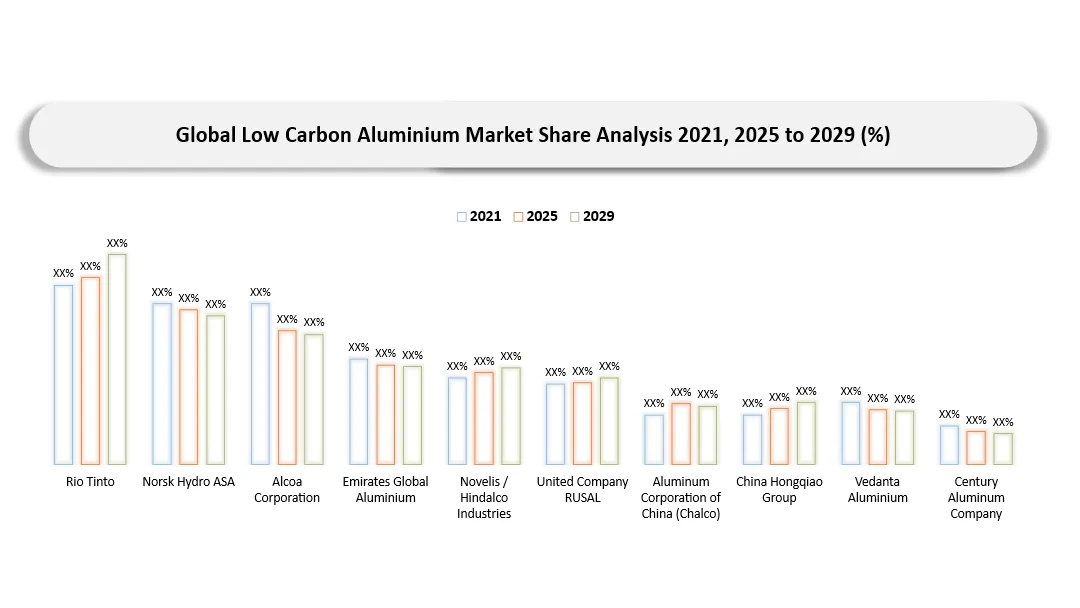
Key Companies
- Norsk Hydro ASA (Norway)
- Rio Tinto (UK/Australia)
- Alcoa Corporation (U.S.)
- Hindalco Industries Limited / Novelis (India/U.S.)
- Constellium SE (France)
- Emirates Global Aluminium (UAE)
- United Company RUSAL (Russia)
- China Hongqiao Group (China)
- Aluminum Corporation of China / Chalco (China)
- Century Aluminum Company (U.S.)
- Press Metal Aluminium Holdings (Malaysia)
- Aluminium Bahrain B.S.C. / Alba (Bahrain)
- Gränges AB (Sweden)
- Kaiser Aluminum Corporation (U.S.)
- Vedanta Aluminium (India)
Company Profiles
Norsk Hydro ASA
Hydro is one of the most vertically integrated low-carbon aluminium companies, with bauxite and alumina, hydro-powered smelting, recycling and extrusion. Its REDUXA product family emphasizes low-carbon primary aluminium, while CIRCAL uses high recycled post-consumer scrap. Hydro also operates extensive European and North American recycling assets.
Strategically, Hydro is investing in renewable power security, scrap access and technology that can reduce direct smelter emissions. The HalZero test facility commissioned in 2026 is an important technology milestone. Hydro’s combination of low-carbon primary metal and recycled products gives it flexibility across automotive, construction, electrical and industrial demand.
Rio Tinto
Rio Tinto is a major integrated aluminium producer with bauxite, alumina and smelting assets, including low-carbon hydro-powered production in Canada. The company markets lower-carbon aluminium and participates in ELYSIS, the inert-anode technology venture.
Its low-carbon aluminium advantage is tied to renewable electricity, scale and upstream integration. Canadian smelters provide a strong carbon position for North American and European customers, while ELYSIS offers longer-term optionality to reduce direct electrolysis emissions.
Alcoa Corporation
Alcoa is a global producer of bauxite, alumina and aluminium with a portfolio that includes lower-carbon products under the Sustana platform. EcoLum is positioned around lower-carbon primary aluminium, supported by renewable-powered smelters and customer-specific product solutions.
In 2026, Alcoa reported strong financial performance and invested US$65 million to expand the Mosjøen casthouse in Norway so recycled content can be introduced into casting. This supports a strategy that combines low-carbon primary metal with growing circularity and higher-value products.
Hindalco Industries Limited / Novelis
Hindalco combines Indian upstream aluminium and downstream products with Novelis, the world’s largest aluminium recycler and a leading flat-rolled producer. Hindalco’s EcoEdge products target lower-carbon aluminium, while Novelis operates extensive closed-loop recycling with automotive and beverage-can customers.
The group’s strategic advantage is the ability to link primary production, renewable-power investments and downstream recycling. In Q1 FY27, Hindalco reported record aluminium upstream EBITDA and operationalized a 65 MW round-the-clock renewable energy project at Aditya Aluminium.
Constellium SE
Constellium is a major producer of advanced rolled and extruded aluminium products serving aerospace, automotive, packaging and industry. Its sustainability strategy emphasizes recycling, scrap utilization and lower-carbon product solutions.
The company benefits from deep customer integration and strong recycling performance in North America and Europe. Automotive closed loops and packaging circularity allow Constellium to increase recycled content while maintaining demanding alloy performance.
Emirates Global Aluminium
EGA is one of the world’s largest premium aluminium producers and an important Middle Eastern participant in low-carbon aluminium. Its competitive pathway includes efficiency, renewable power sourcing, solar-linked metal and development of lower-carbon production routes.
The company can leverage modern smelting assets, export logistics and regional renewable-energy growth. The key strategic challenge is reducing the carbon intensity of power and process emissions enough to compete with hydro-powered producers in premium low-carbon markets.
United Company RUSAL
RUSAL has historically benefited from a high share of hydropower-based smelting, providing relatively low carbon intensity across large parts of its primary aluminium portfolio. It also has significant upstream bauxite and alumina integration.
Its market position is constrained by geopolitical and trade risks, but low-carbon power remains a structural strength. Customer access, sanctions compliance, logistics and certification are critical variables for future growth.
China Hongqiao Group
China Hongqiao is one of the world’s largest aluminium producers. Its low-carbon aluminium strategy is linked to relocation toward lower-carbon power regions, renewable electricity, recycling and improved energy efficiency.
Because China accounts for a very large share of world aluminium output, decarbonization at scale can materially change global low-carbon aluminium supply. Hongqiao’s competitiveness will depend on verified power mix, product carbon data and access to export customers with strict carbon requirements.
Aluminum Corporation of China (Chalco)
Chalco is a major Chinese integrated aluminium company with bauxite, alumina and primary aluminium assets. It is positioned to participate in low-carbon aluminium growth through renewable power, improved smelter efficiency and recycling.
Scale is a major advantage, but product-level carbon transparency and the pace of power decarbonization are important for premium export markets. Domestic demand from EVs, renewable energy and grid infrastructure can support investment.
Century Aluminum Company
Century Aluminum operates primary aluminium smelters in the U.S. and Iceland. Its Icelandic exposure provides access to low-carbon renewable electricity, while U.S. operations benefit from policy interest in domestic strategic aluminium supply.
The company can participate in low-carbon aluminium through renewable-power optimization, domestic supply security and customer demand for lower-carbon metal. Cost competitiveness and power agreements remain decisive.
Press Metal Aluminium Holdings
Press Metal is a leading Southeast Asian aluminium producer with major smelting capacity in Malaysia. Hydropower availability in Sarawak provides a lower-carbon electricity base than coal-intensive production.
The company is well positioned to serve Asian automotive, solar, construction and industrial demand. Expansion of verified carbon accounting, recycling and downstream value-added products can strengthen premium positioning.
Aluminium Bahrain B.S.C. (Alba)
Alba is one of the world’s largest single-site aluminium smelters and a major Middle Eastern exporter. Its green transition depends on efficiency, renewable power integration, process upgrades and potential carbon-capture or low-carbon fuel pathways.
The company benefits from scale and modern operations but competes with hydro-powered smelters on carbon intensity. Access to regional solar and evolving carbon management can improve future positioning.
Gränges AB
Gränges is a Swedish aluminium technology company focused on rolled products for heat exchangers, automotive and other specialized applications. Its sustainability strategy emphasizes recycled aluminium, efficient production and circular customer solutions.
Gränges can capture low-carbon aluminium demand through high recycled content and engineering expertise, particularly where customers require tightly controlled thermal and mechanical properties.
Kaiser Aluminum Corporation
Kaiser Aluminum is a U.S. producer of specialty semi-fabricated aluminium serving aerospace, packaging, automotive and general engineering. Its green exposure comes through scrap optimization, packaging circularity and high-value products that can incorporate recycled metal.
Record Q2 2026 performance reflected higher-value packaging mix, improving aerospace demand and favorable scrap spreads. The company is well positioned to benefit from North American recycling economics and customer demand for domestic low-carbon materials.
Vedanta Aluminium
Vedanta Aluminium is a major Indian producer with large-scale upstream capacity and expanding value-added products. Its low-carbon aluminium strategy includes renewable power procurement, energy efficiency, lower-carbon product development and increasing circularity.
India’s fast-growing domestic aluminium demand creates a large opportunity, but decarbonizing grid and captive power remains central. Progress on renewable energy, carbon intensity and recycled-content capability will determine premium-market access.
Low Carbon Aluminium Market Major Pain Points
- Insufficient renewable electricity near existing smelters and high cost of long-term low-carbon power in some regions.
- Large capital requirements and technology risk for inert-anode, refinery and deep-decarbonization projects.
- Competition for high-quality post-consumer scrap, particularly can sheet and automotive alloys.
- Contamination and alloy-mixing constraints that limit recycled content in demanding applications.
- Fragmented definitions of low-carbon, green, recycled and near-zero aluminium across markets.
- Difficulty comparing product carbon footprints when system boundaries, electricity assumptions and allocation methods differ.
- Volatile LME prices, regional premiums, scrap spreads and energy costs that can overwhelm the low-carbon premium.
- Lengthy OEM qualification cycles for new recycled alloys, suppliers and low-carbon production routes.
Low Carbon Aluminium Market Recent Developments
- August 2026: Hindalco reported record Q1 FY27 performance and said a 65 MW round-the-clock renewable energy project at Aditya Aluminium had become operational, strengthening renewable-power integration in its aluminium portfolio.
- July 2026: Constellium reported strong Q2 and H1 2026 results, highlighting strong recycling performance in North America and Europe as part of its margin improvement and customer-value strategy.
- June 2026: Alcoa entered a definitive agreement to acquire South32 interests in bauxite, alumina and aluminium assets for approximately US$4.1 billion upfront plus contingent value, potentially expanding its integrated aluminium platform.
- May 2026: Alcoa announced a US$65 million investment at its Mosjøen smelter in Norway to expand foundry capability and enable recycled content in the casting process, with phased commissioning planned through 2028.
- April 2026: Norsk Hydro reported strong Q1 aluminium and recycling results and confirmed successful commissioning of its HalZero test facility, advancing a proprietary pathway for lower-emission aluminium production.
Analyst View/Opinion on Low Carbon Aluminium Market
- The Low Carbon Aluminium market is moving from a niche premium category into a structurally differentiated part of the global aluminium industry as carbon intensity becomes visible in procurement and trade.
- Recycled aluminium will provide the fastest near-term emissions reduction, but low-carbon primary metal remains essential because scrap supply cannot satisfy all demand growth and some applications require tighter chemistry.
- Europe will continue to set many of the commercial rules through embodied-carbon policy and buyer requirements, while Asia-Pacific will determine the scale and speed of global supply transformation.
- Producers with renewable power, low-carbon alumina, large recycling networks and direct customer relationships will have the strongest ability to capture low-carbon premiums.
- Inert-anode and near-zero technologies are strategically important, but investors should separate pilot milestones from bankable industrial capacity and apply conservative scale-up assumptions.
- Long-term winners will combine primary and recycled metal, verified carbon data, closed-loop logistics and customer-specific alloy engineering rather than competing only on headline carbon intensity.
Low Carbon Aluminium Market Target Audience
| INDUSTRY | WHO SHOULD BUY THIS REPORT? | REASON TO BUY THIS REPORT |
| Aluminium Producers | Smelters, refiners, recyclers, rolling mills and extruders | Benchmark low-carbon routes, pricing, capacity, technology and regional opportunity. |
| Automotive & Mobility | OEMs, Tier 1s, EV and battery-enclosure suppliers | Assess low-carbon aluminium sourcing, recycled content and closed-loop scrap strategies. |
| Packaging | Can-sheet producers, beverage companies and converters | Evaluate can-to-can recycling, recycled-content economics and premium supply. |
| Construction | Building-product manufacturers, architects and developers | Understand embodied-carbon requirements and low-carbon extrusion/rolled-product availability. |
| Energy & Electrical | Solar, wind, cable, grid and electrical-equipment companies | Plan procurement of lower-carbon structural and conductive aluminium. |
| Investors & Consulting | Private equity, institutional investors, lenders and strategy teams | Evaluate decarbonization capex, low-carbon premiums, competitive positioning and M&A. |
| Government & Standards | Policy makers, trade bodies, certification and standards organizations | Assess carbon-border, recycling, traceability and industrial-policy implications. |
Why Choose DATAM?
- Data-driven analysis connecting market size with carbon intensity, power mix, scrap economics, low-carbon premiums, trade and customer procurement.
- Post-purchase analyst consultations supporting capacity strategy, supplier benchmarking, regional entry and low-carbon portfolio planning.
- Annual updates covering producer investments, technology milestones, carbon policy, recycling expansions and competitive developments.
- Specialized emerging-market coverage across China, India, Southeast Asia and the Middle East in addition to mature European and North American markets.
- Actionable insights that connect aluminium production technology with buyer requirements, certification and investment economics.
What DATAM Uniquely Provides
- A value-chain view from bauxite and alumina through renewable power, smelting, recycling, semi-fabrication and end-user procurement.
- Market segmentation by carbon intensity, production route, product form, application, end use and verification method rather than only by geography.
- Competitive benchmarking of low-carbon product brands, renewable-power positions, recycling scale, process technology and customer partnerships.
- Country-level analysis connecting energy mix, industrial policy, scrap availability, trade exposure and downstream demand.
- Strategic analysis of low-carbon premiums, long-term offtake, product carbon footprints, closed-loop models and near-zero-carbon technology.


























































