


Long-Duration Energy Storage Market Size and Overview
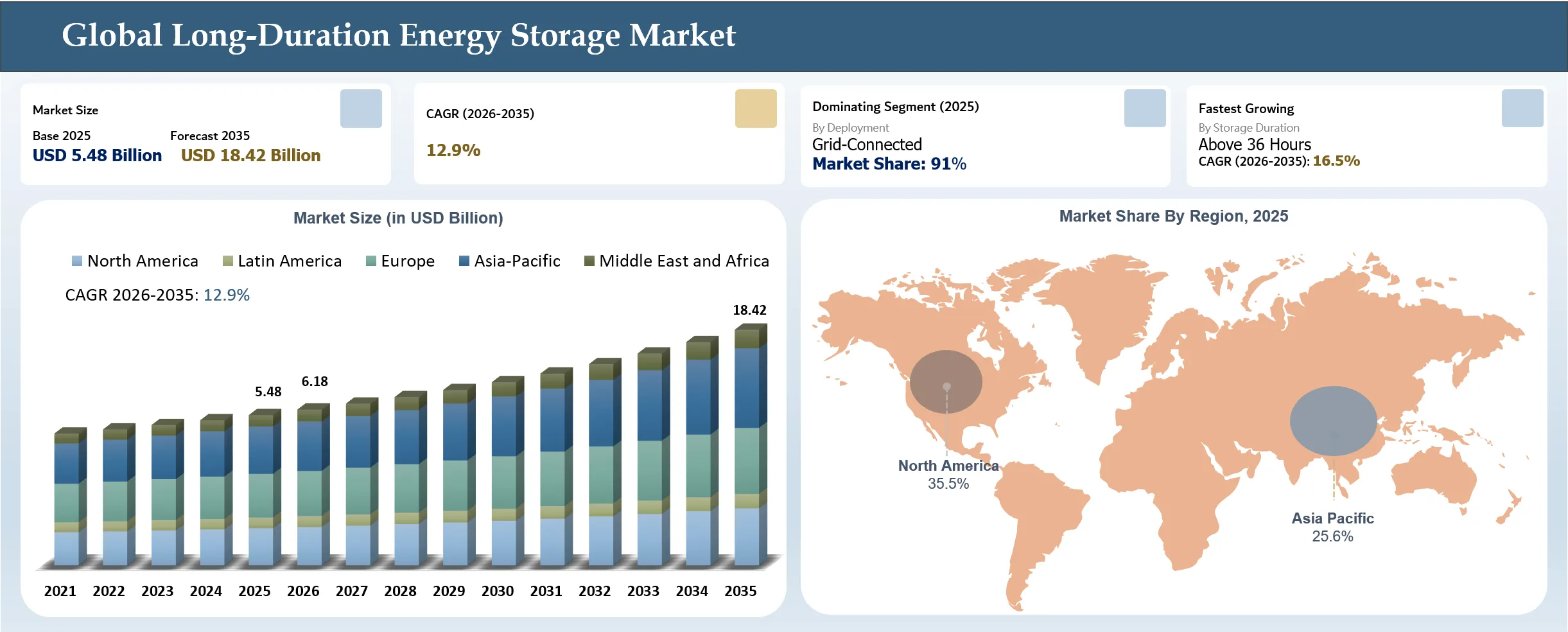
The global long-duration energy storage market reached USD 5.48 billion in 2025 and is expected to reach USD 18.42 billion by 2035, growing with a CAGR of 12.9% during the forecast period 2026-2035. The market expansion is being reinforced by growing LDES deployments globally, where LDES installations across the world surpassed 15 GWh in 2025, posting an annual increase of 49%, as per Wood Mackenzie. The share of LDES in total energy storage deployments was 6% in 2025, whereas CAES, thermal storage, and VRFB constituted 45%, 33%, and 21% of global LDES installations in the same year, respectively. China retained its supremacy in terms of the deployment market, accounting for 93% of global LDES installations due to supportive storage policies at national and provincial levels. Furthermore, the global average storage duration requirement needed to be increased from 2.5 hours to around 20 hours under net-zero scenarios, emphasizing the need for more extended duration of storage as the penetration level of renewables increases. However, declining investments in LDES constitute a hindrance, as global LDES investments witnessed a drop of 30% in 2025, while venture capital investments declined by 72%, along with competitive costs compared to lithium-ion systems.
Strategic funding is fueling innovation of high-capacity A-CAES systems for grid stability and renewable energy deployment. In September 2025, according to Hydrostor, the company secured USD 55 million in funding from Export Development Canada (EDC) under a credit facility for development expenditures secured against development-related obligations. This money would be used for development activities and letter of credit obligations for its 200 MW Silver City Energy Storage Centre located in Broken Hill, New South Wales, Australia. It utilizes Advanced Compressed Air Energy Storage (A-CAES) technology as a long-duration storage technology. Additionally, Hydrostor disclosed its development pipeline of more than 7 GW in Australia, Canada, Europe, and the United States.
White-Space Opportunities for Long-Duration Energy Storage (LDES) Investment and Grid-Scale Deployment
In April 2025, according to Ofgem, the UK regulator launched a cap-and-floor investment support scheme specifically to unlock billions of pounds of investment in Long Duration Electricity Storage (LDES) projects, with the first application window targeting 2.7–7.7 GW of capacity for delivery by 2030 or 2033. The scheme is creating opportunities across pumped-storage hydropower (PSH), compressed-air energy storage (CAES), lithium-ion battery systems, and vanadium redox flow batteries (VRFB), with the strongest investment opportunity concentrated in large-scale utility storage projects and grid-connected LDES infrastructure. By June 2026, Ofgem had provisionally selected 16 projects across England, Scotland, and Wales, covering these four technology areas, demonstrating that investment is spreading across both established and emerging storage technologies.
The investment support is expected to benefit companies across the LDES value chain, with opportunities varying by technology area. SSE, Drax, ScottishPower, and Statkraft can benefit from opportunities in pumped-storage hydropower, while Highview Power and Hydrostor are positioned in long-duration air-based and liquid-air storage technologies. In the flow-battery segment, Invinity Energy Systems, CellCube, and VRB Energy can benefit from growing demand for vanadium flow battery systems, while Form Energy and ESS Inc. are positioned to benefit from emerging long-duration battery technologies. Opportunities also extend to grid-integration, engineering, construction, and project-development companies such as Siemens Energy, GE Vernova, Hitachi Energy, Schneider Electric, Jacobs, AECOM, and Mott MacDonald, which can support grid connection, system integration, engineering, and infrastructure development. Meanwhile, Fluence, Wärtsilä, and Wärtsilä Energy Storage & Optimisation can benefit from opportunities in large-scale energy-storage system integration and optimization. Ofgem’s cap-and-floor framework is particularly significant because the floor provides minimum revenue protection, while the cap limits excess project revenues, reducing revenue uncertainty and improving the bankability of capital-intensive LDES projects.
Long-Duration Energy Storage Market Key Takeaways
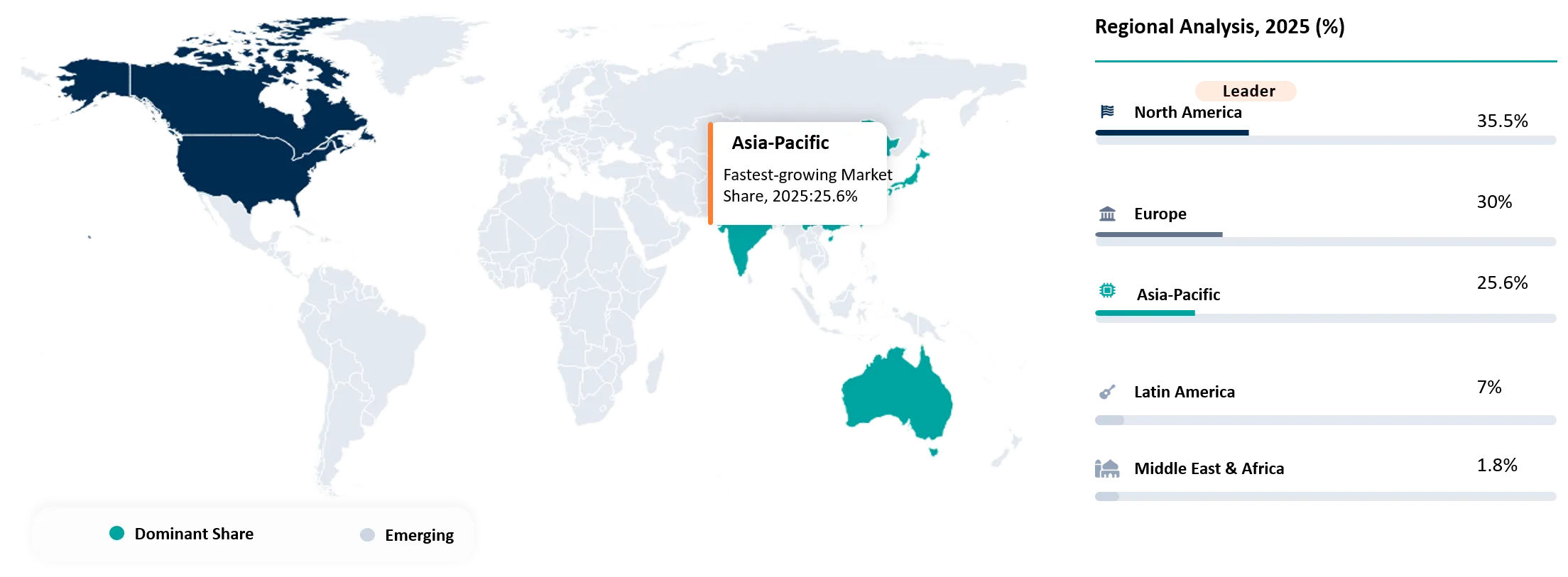
- North America dominated the global LDES footprint with a 35.5% market share in 2025. Asia-Pacific secured a 25.6% market share and stands as the fastest-growing regional market.
- Grid-connected deployments held a commanding 91.0% market share in 2025. United States battery storage installations hit a record 57.6 GWh in the same year.
- The U.S. Department of Energy launched the USD 500,000 STEP Prize Competition in July 2026. The initiative provides awards up to USD 100,000 to streamline supply chains and lower manufacturing risks.
- Ofgem’s UK investment framework targets 2.7–7.7 GW of LDES capacity for delivery by 2030 or 2033. By June 2026, Ofgem provisionally selected 16 projects across England, Scotland, and Wales.
Long-Duration Energy Storage Market Industry Trends and Strategic Insight
- Renewable energy integration is becoming the primary deployment driver, with LDES increasingly positioned to absorb excess solar and wind generation and discharge electricity during prolonged periods of low renewable output.
- Diversification beyond lithium-ion technology is gaining momentum, with iron-air, flow batteries, thermal storage, compressed-air, liquid-air, and other technologies progressing toward commercial-scale deployment.
- Data centers and AI infrastructure are emerging as new LDES demand centers, because continuous power requirements and constrained grid connections are increasing the value of extended-duration, firm electricity supply.
- Technology developers should prioritize duration-specific economics rather than competing directly with lithium-ion on short-duration applications, focusing on use cases where extended discharge provides measurable capacity and reliability value.
- Project developers should target markets with explicit compensation for capacity, reliability, and flexibility services, because energy-arbitrage revenues alone may not adequately support capital-intensive LDES projects.
Long-Duration Energy Storage Market Scope
| Metrics | Details | |
| 2025 Market Size | USD 5.48 Billion | |
| 2035 Projected Market Size | USD 18.42 Billion | |
| CAGR (2026-2035) | 12.9% | |
| Largest Market | North America | |
| Fastest Growing Market | Asia-Pacific | |
| By Technology | Mechanical Storage, Electrochemical Storage, Thermal Energy Storage | |
| By Storage Duration | 4–8 Hours, 8–24 Hours, 24–36 Hours, above 36 Hours | |
| By Power Capacity | Up to 50 MW, 50–100 MW, above 100 MW | |
| By Deployment | Grid-Connected, Off-Grid | |
| By Application | Grid Balancing, Renewable Energy Integration, Peak Shifting, Load Shifting, Backup Power, Off-Grid and Microgrid Systems, Others | |
| By End User | Utilities, Industrial, Residential & Commercial, Transportation & Mobility, Others | |
| By Region | North America | U.S., Canada, Mexico |
| Europe | Germany, UK, France, Spain, Italy, Poland | |
| Asia-Pacific | China, India, Japan, Australia, South Korea, Indonesia, Malaysia | |
| Latin America | Brazil, Argentina | |
| Middle East and Africa | UAE, Saudi Arabia, South Africa, Israel, Türkiye | |
| Report Insights Covered | Competitive Landscape Analysis, Company Profile Analysis, Market Size, Share, Growth | |
Long-Duration Energy Storage Market Disruption Analysis
Lithium-Ion Battery Expansion into Longer-Duration Applications Reshaping the Long-Duration Energy Storage Landscape
The disruption in the long-duration energy storage (LDES) market is being driven by the increasing importance of manufacturing and supply chain readiness for future storage solutions. In July 2026, the U.S. Department of Energy Office of Electricity started the STEP Prize Competition worth USD 500,000 specifically to solve the problems related to the manufacturing and supply chain of next-generation storage technology designs. This new direction in the development of storage solutions is aimed at solving issues with scalable manufacturing and material procurement and represents a change from the focus on performance of storage technologies to scalable manufacturing.
The DOE initiative further highlights how manufacturability, materials sourcing, and supply chain resilience are elements of competitiveness for LDES technologies in the making. In the framework of this two-part initiative, up to three Phase 1 Champions will be awarded USD 20,000 each, and up to nine Finalists USD 10,000 each, while up to two Phase 2 Champions and three Finalists will each get up to USD 100,000 and USD 50,000, respectively. The U.S. Department of Energy claims that this program is designed to minimize risks of manufacturing, prevent redesigns, and speed up commercialization of stationery and grid-scale energy storage technologies. This makes LDES developers think about manufacturing and supply chain implications at the early stages of technology development.
Long-Duration Energy Storage Market BCG Matrix: Company Evaluation
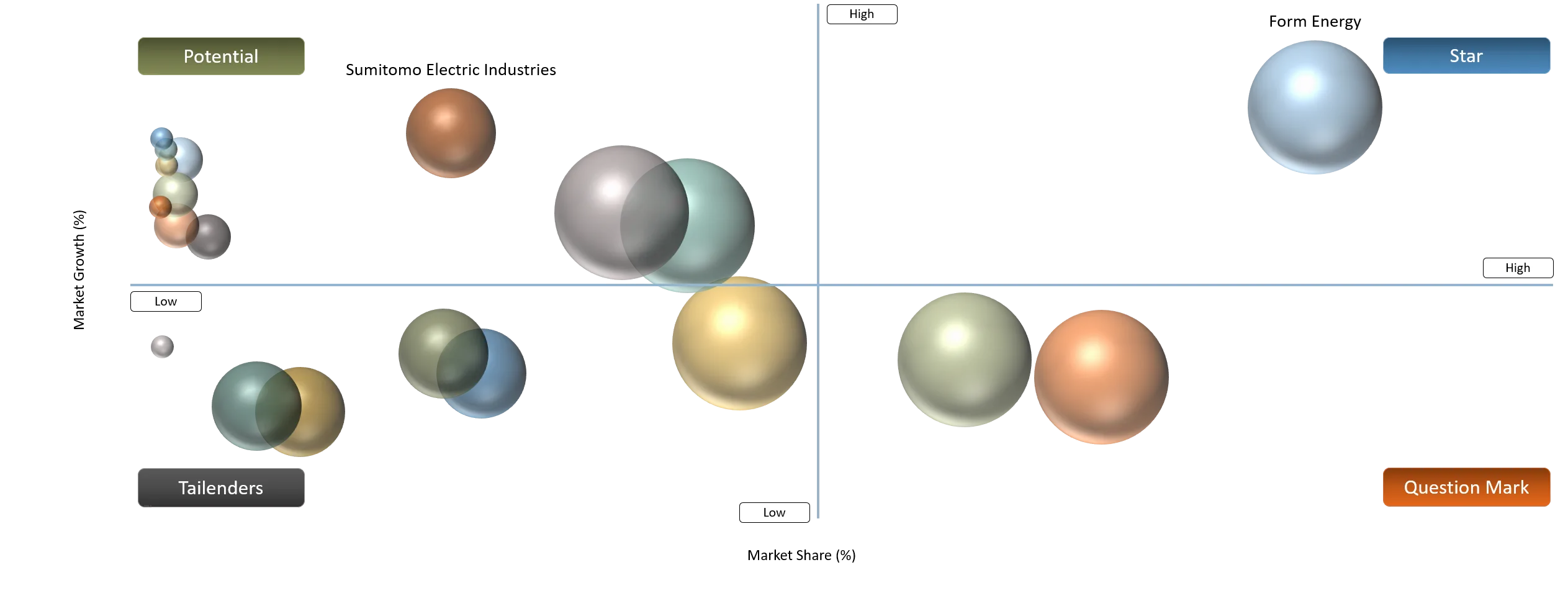
Stars include Form Energy, ESS Inc., and Energy Vault because they have established strong positions in emerging LDES technologies and are expanding commercial-scale deployments across utility and grid applications. These companies are benefiting from increasing utility demand for longer-duration storage and are moving from technology demonstration toward broader commercial deployment. Question Marks include Invinity Energy Systems, Eos Energy Enterprises, and Hydrostor, which possess differentiated technologies but are operating in a highly competitive and still-developing LDES market.
Potential includes Sumitomo Electric Industries, Rongke Power, and Energy Dome, which have established technology platforms and commercial experience but have comparatively narrower geographic or technology-specific market penetration. Their established technology capabilities provide a foundation for expansion as utilities increasingly seek alternatives to lithium-ion storage for longer-duration applications. Tailenders include Malta Inc., Antora Energy, and Rondo Energy, as their technologies are highly differentiated but remain concentrated in specific applications or earlier commercialization stages compared with more established LDES deployment platforms.
Long-Duration Energy Storage Market Dynamics
Driver Impact Analysis
| Driver | Market Growth Impact (%) | Demand Concentration | Impacted Use Case | Strategic Impact |
Rapid integration of renewable energy is increasing the need for long-duration storage to balance intermittent solar and wind power. | 28% | High – Utility-scale renewable markets | Renewable Energy Integration; Grid Balancing; Peak Shifting; Renewable Curtailment Reduction | Drives demand for 8+ hour storage capable of shifting surplus renewable electricity into evening, overnight, and low-generation periods. |
Growing electricity demand from data centers and electrification is driving demand for reliable energy storage. | 22% | High – North America, Europe, and Asia-Pacific | Backup Power; Load Shifting; Behind-the-Meter Storage; Grid Support | Creates a premium market for firm, extended-duration power, particularly around AI data centers and electricity-intensive industrial loads. |
Grid modernization and increasing grid instability are accelerating the deployment of long-duration storage. | 20% | High – Congested and renewable-intensive grids | Grid Balancing; Capacity Support; Transmission Deferral; Grid Resilience | Positions LDES as a grid infrastructure asset, enabling utilities to manage congestion, renewable variability, capacity shortages, and prolonged supply disruptions. |
Government incentives and supportive energy-storage policies are encouraging investments in large-scale long-duration energy storage projects. | 17% | High – Policy-supported storage markets | Grid-scale Storage; Renewable Integration; Capacity Procurement; Energy Resilience | Improves project bankability through procurement mandates, capacity mechanisms, incentives, and long-duration storage-specific market frameworks. |
Retirement of conventional power plants is increasing the need for long-duration storage to provide replacement capacity and grid flexibility. | 13% | Medium–High – Markets with accelerated coal/gas retirements | Capacity Replacement; Peak Shifting; Grid Reliability; Backup Power | Creates an opportunity for LDES to replace part of the dispatchable capacity and flexibility lost through conventional-generation retirements. |
Rapid integration of renewable energy is increasing the need for long-duration storage to balance intermittent solar and wind power
The rapid expansion of renewable energy generation is strengthening demand for LDES as electricity systems face increasing variability between renewable generation and electricity demand. In April 2026, according to the International Renewable Energy Agency (IRENA), global renewable power capacity grew to 5,149 GW in 2025 by adding 692 GW, which represents 15.5% annual growth. The amount of solar power was 511 GW, and wind energy grew up by 159 GW; however, both of them accounted for 96.8% of all capacity additions during the year. Such fast development of variable power generation raises the necessity of using storage facilities for storing extra energy produced by renewable sources and using it when there is not enough solar and wind energy.
In parallel, the California Public Utilities Commission (CPUC) illustrated the growing adoption of LDES in renewable-based grid planning via the Tumbleweed Energy Storage system, completed in June 2026 as the state's first battery storage project of eight hours, developed within the framework of its Integrated Resource Planning. The Tumbleweed Energy Storage project represents one of 1,000 MW of long-duration energy storage capacity procurement targets, set by the CPUC in 2023, whereas California has previously installed more than 16,000 MW of energy-storage capacity since 2020. In addition, the CPUC emphasized that the eight-hour energy storage projects could be used to charge batteries on the excess solar power generated during the day and use the stored energy during evening peak consumption hours and at night, avoiding the use of natural gas power plants and ensuring grid reliability.
Restraint Impact Analysis
| Restraint | Drag on Market Growth (%) | Primary Impact Area | Impacted Use Case | Strategic Impact |
Long project development and permitting timelines can delay the deployment of large-scale long-duration energy storage facilities. | 10% | Project Development & Permitting | Utility-scale grid storage; renewable energy integration; transmission support | Delays project commissioning, increases development and financing costs, and can defer revenue generation. |
Limited revenue certainty and evolving market structures can make it difficult to achieve attractive returns on long-duration storage projects. | 12% | Project Economics & Investment | Merchant storage; renewable firming; capacity adequacy; energy arbitrage | Revenue uncertainty increases financing risk and can raise the required return on investment, slowing investment decisions. |
Lower energy density of some LDES technologies can increase land requirements and balance-of-system costs for large-scale installations. | 8% | Land, Infrastructure & Balance-of-System Costs | Multi-hour/multi-day storage; renewable energy shifting; grid-scale capacity | Larger physical footprints can increase land acquisition, civil works, site preparation and supporting infrastructure costs, particularly for pumped-hydro, compressed-air and other lower-energy-density technologies. |
Lack of standardized valuation and compensation mechanisms for the multiple grid services provided by LDES can constrain invest | 10% | Market Design & Revenue Monetization | Frequency regulation; capacity adequacy; renewable integration; congestion management; black start | Difficulty assigning monetary value to multiple services can leave LDES undercompensated and weaken project economics. |
Lower energy density of some LDES technologies can increase land requirements and balance-of-system costs for large-scale installations
One of the major challenges hindering the widespread deployment of long-duration energy storage technologies is the lower energy density of some LDES systems, which can require substantially larger physical infrastructure to provide long-duration storage capacity. Thus, according to Sustainability Directory, pumped-hydro technology, which has an average round-trip efficiency rate of approximately 75%-85%, needs large amounts of space for the construction of upper and lower reservoirs, as well as millions of tons of earth and concrete for the creation of reservoirs providing long-duration backups. Compressed air energy storage, having an average round-trip efficiency rate of about 50%-70%, requires huge underground caves or large pressure vessels. These requirements result in an increase in the land requirement for LDES plants, thus becoming one of the critical constraints for such projects in areas where land availability is limited.
In addition, the large footprint of the storage facility can contribute to the higher balance-of-system cost due to the additional cost of preparing the site, civil engineering, electricity supply, safety system, and other supporting equipment. In May 2025, according to Mercom, a proposal from the Central Transmission Utility of India (CTUIL) noted that 3 acres per 100 MWh was the proposed benchmark land area needed for a standalone BESS project, and 1.5 acres/MWh of land documents were needed for ISTS connectivity proposals. The CTUIL clarified that the requirement would vary depending on the design of the battery container, power conversion system, transformers, technology, safety regulations, infrastructure, and scalability. In the case of LDES projects which require long-term storage capability, these additional spatial and infrastructure requirements will add costs to project development and make scaling difficult.
Long-Duration Energy Storage Market Segment Analysis
The global long-duration energy storage market is segmented based on technology, storage duration, power capacity, deployment, application, end user, and region.
Grid-Connected Deployment Dominating the Long-Duration Energy Storage Market
The grid-connected segment dominates the deployment of long-duration energy storage (LDES), with a market share of 91.0% in 2025. The rise in demand for flexible and reliable electricity sources has become a major factor in the growing share of this type of long-duration energy storage. Such devices can store and distribute electricity for more than eight hours or even days to serve as additional capacity to intermittent solar and wind power generation and minimize the use of fuel-based plants for back-up capacity. Grid energy storage is becoming more popular, with the United States achieving an all-time high level of installations of battery storage in 2025 (57.6 GWh), according to Reuters, citing the Solar Energy Industries Association (SEIA) and Benchmark Mineral Intelligence.
Major utility and technology companies are starting to utilize LDES in their grid-tied power infrastructure systems as sources of firm capacity and to increase the reliability of the grid. In March 2026, as per Reuters, Xcel Energy and Google have unveiled a project in Minnesota that will contribute 1.6 GW of clean energy into the grid, and that includes a 300 MW/30 GWh, 100-hour iron-air battery system from Form Energy. Furthermore, the upcoming Google data center in Michigan is set to get support from 2.7 GW of new grid assets, out of which 480 MW will be energy storage, with 55 MW being LDES. These installations indicate the increasing role of multi-day storage solutions in the power system capacity stack and highlight the dominance of grid-connected installations in the LDES market deployment segments.
Long-Duration Energy Storage Market Geographical Penetration
Large-Scale Grid Deployment and Investment Supporting North America's Dominance
The North America region dominates the long-duration energy storage (LDES) market, accounting for 35.5% of the global market in 2025, supported by the region's established renewable-energy infrastructure, increasing electricity demand, strong utility participation, and growing focus on grid modernization and energy resilience. The United States represents the major contributor to regional demand, as utilities and technology companies increasingly deploy advanced storage solutions to integrate renewable power, manage peak loads, and provide firm capacity. The rapid expansion of data centers and AI-related electricity demand is also encouraging the development of longer-duration storage systems capable of delivering reliable power when renewable generation is unavailable, strengthening North America's leading position in the LDES market.
The acquisition strengthens Zeo Energy’s position in thermal energy storage and long-duration clean-energy solutions for growing commercial, industrial, and data-center power demand. In May 2025, Zeo Energy Corp., a U.S.-based residential solar, distributed-energy, and energy-efficiency company, announced an agreement to acquire Heliogen, Inc., a U.S.-based clean-energy technology company specializing in concentrated solar power and thermal energy storage. The transaction was structured as an all-stock acquisition, with Heliogen securityholders expected to receive approximately USD 10 million in aggregate Zeo Class A shares. Following the transaction, Zeo planned to establish a division focused on long-duration energy generation and storage for commercial and industrial facilities, including AI and cloud data centers.
U.S. Long-Duration Energy Storage Market Trends
The U.S. holds a dominant position in the North America long-duration energy storage (LDES) market owing to its established utility-scale energy storage industry, expanding renewable-energy generation, supportive federal and state-level policies, and growing demand for flexible grid resources. The country's extensive deployment of battery storage and increasing commercialization of multi-hour and multi-day storage technologies are enabling utilities to integrate intermittent renewable power, manage peak electricity demand, and strengthen grid reliability.
Growing collaboration between LDES technology providers and project developers is accelerating the development of utility-scale storage projects across major U.S. electricity markets. In November 2025, Bimergen Energy Corporation, a U.S.-based independent power provider and utility-scale battery energy storage project developer, entered into a Joint Development Agreement (JDA) with Eos Energy Enterprises, Inc., a U.S.-based energy-storage technology and battery manufacturer. The partnership combines Bimergen’s project-development capabilities with Eos’s Z3 zinc-based battery technology, which is designed for long-duration energy storage applications. The companies initially targeted 1.0 GWh of late-stage ERCOT projects, while Bimergen’s broader U.S. project pipeline totaled nearly 8 GWh across ERCOT, MISO, WECC, and PJM.
Canada Long-Duration Energy Storage Market Outlook
Canada is one of the major countries in the North America long-duration energy storage (LDES) market owing to its expanding clean-electricity infrastructure, increasing renewable-energy integration, large hydroelectric base, and growing requirement for grid flexibility and reliability. The country is developing an increasingly diversified energy-storage ecosystem spanning battery energy storage systems, pumped-storage hydropower, and compressed-air energy storage. In July 2025, Canada Energy Regulator (CER) reported that grid-connected energy-storage capacity above 1 MW could increase from 552 MW at the end of 2024 to 1,149 MW by 2030 based only on projects already under construction, while an additional 27 approved projects could raise capacity to 2,768 MW if all are completed. CER also identified battery energy storage systems (BESS) as Canada's fastest-growing and dominant storage technology by capacity and number of sites.
Large-scale CAES projects are creating opportunities for extended-duration storage while strengthening grid reliability and renewable-energy integration. In December 2025, EllisDon Corporation, a Canada-based construction and infrastructure services company, partnered with Cache Power Corp., a Canada-based compressed-air energy storage project developer, to deliver Canada’s first commercial-scale Compressed Air Energy Storage (CAES) facility in Northeast Alberta. The project will be developed in two phases near the Marguerite Lake substation and is designed to provide up to 48 hours of energy storage, making it an ultra-long-duration energy storage project. The facility will use Siemens Energy technology and underground solution-mined salt caverns, while the system can blend up to 75% hydrogen with natural gas, with a pathway toward full hydrogen use.
Rapid Grid-Scale Deployment and Energy Storage Investment in Asia-Pacific
The Asia-Pacific is a major region in the long-duration energy storage (LDES) market, accounting for 25.6% of the global market in 2025, driven by rapid renewable-energy deployment, rising electricity demand, grid modernization, and increasing investment in utility-scale energy storage across China, India, Japan, and Australia. The region's large and rapidly expanding power systems require flexible storage solutions to manage intermittent solar and wind generation, reduce peak-demand pressure, and improve grid stability. Strong government support, renewable-energy targets, and the development of large-scale battery and pumped-storage projects are further encouraging the commercialization of LDES technologies and strengthening Asia-Pacific's position in the global market.
Partnerships focused on zinc-air flow batteries are expanding technology development for longer-duration, lower-cost storage and renewable-energy integration across the Asia-Pacific region. In October 2025, Sharp Corporation, a Japan-based electronics and technology company, entered into a strategic Memorandum of Understanding (MoU) with Energy Storage Industries–Asia Pacific (ESI Asia Pacific), an Australia-based energy-storage technology and project-development company, to co-develop zinc-air flow battery technology in Queensland. The collaboration will begin with a technical proof-of-concept with The University of Queensland, supported by targeted research funding and a dedicated research position. The technology is being developed as a long-duration energy storage solution offering longer storage durations, lower costs, and improved compatibility with renewable energy sources, with the companies planning to pursue additional research grants and commercialization following the initial proof-of-concept.
Japan Long-Duration Energy Storage Market Trends
Japan is a leading country in the Asia-Pacific long-duration energy storage (LDES) market owing to its advanced electricity infrastructure, high renewable-energy integration requirements, established battery manufacturing ecosystem, and increasing focus on grid flexibility and energy resilience. The country's geographically constrained power system and growing renewable generation are creating demand for storage systems capable of shifting electricity over extended periods and supporting grid stability. Japan is also strengthening its domestic storage ecosystem through coordinated government and industry initiatives, while the increasing electricity requirements of AI data centers are creating additional demand for comprehensive storage and power-management solutions.
Large-scale storage collaborations are expanding Japan’s grid flexibility and creating opportunities for battery deployment alongside renewable-energy generation. In November 2025, Marubeni Power Retail Corporation (MPR), a Japan-based electricity retail and power-management company, entered into a Memorandum of Understanding with Contemporary Amperex Technology Co., Limited (CATL), a China-based lithium-ion battery and battery energy-storage manufacturer, and SunVillage Co., Ltd., a Japan-based renewable-energy power-plant developer headquartered in Tochigi. The companies agreed to jointly develop 2.4 GWh of grid-scale battery storage projects in Japan.
Long-Duration Energy Storage Market Competitive Landscape
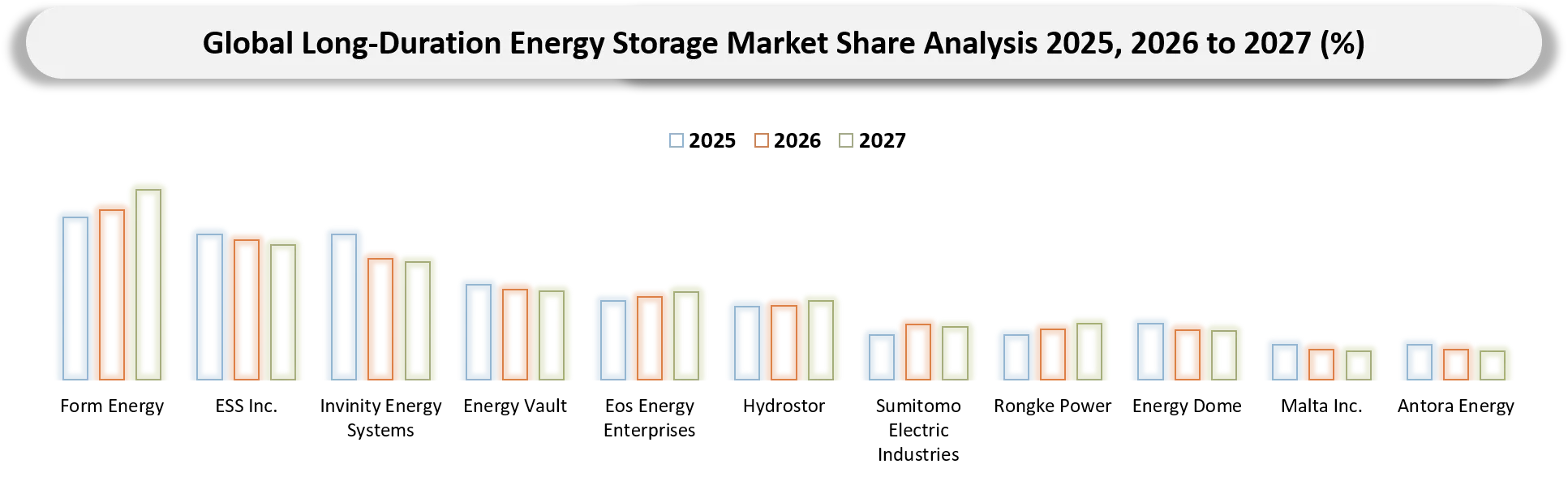
- The market is characterized by three key participant groups: advanced battery technology providers, alternative long-duration storage specialists, and diversified energy-storage companies. Form Energy, ESS Inc., Invinity Energy Systems, Eos Energy Enterprises, and Sumitomo Electric Industries focus on iron-air, iron-flow, zinc-based, vanadium redox-flow, and other electrochemical storage technologies; Hydrostor, Energy Vault, Energy Dome, and Malta Inc. specialize in compressed-air, gravity, CO₂-based, and thermal/mechanical storage solutions; while Rongke Power, Antora Energy, and Rondo Energy focus on large-scale flow-battery and thermal energy storage technologies for grid and industrial applications. This creates a highly technology-diverse competitive landscape where storage duration, technology maturity, project scalability, system efficiency, manufacturing capabilities, and customer alignment define competitiveness.
- Key players include Form Energy (U.S.), ESS Inc. (U.S.), Invinity Energy Systems (UK), Energy Vault (U.S.), Eos Energy Enterprises (U.S.), Hydrostor (Canada), Sumitomo Electric Industries (Japan), Rongke Power (China), Energy Dome (Italy), Malta Inc. (U.S.), Antora Energy (U.S.), and Rondo Energy (U.S.).
Key Developments
- May 2026: Frontier Power USA, a U.S.-based long-duration energy storage development and investment platform, signed an agreement to acquire a 480-MWh battery-storage portfolio from Bimergen Energy Corporation, a U.S.-based utility-scale battery energy storage project developer.
- October 2025: MN8 Energy, a U.S.-based independent renewable-energy and energy-storage power producer, signed a supply agreement with Eos Energy Enterprises, Inc., a U.S.-based energy-storage technology and zinc-based battery manufacturer, for up to 750 MWh of Eos Z3™ energy-storage systems across MN8’s renewable-energy portfolio.
- December 2025: Atlantica Sustainable Infrastructure, a U.K.-based sustainable infrastructure company focused on renewable energy, storage, transmission, and other infrastructure assets, completed its acquisition of Statkraft’s Canadian renewable-energy platform, with Statkraft, a Norway-based state-owned renewable-energy and power company, transferring the platform to Atlantica.
- September 2025: La Caisse, a Canada-based global institutional investment group, agreed to acquire Edify Energy, an Australia-based renewable-energy and battery-storage company.
- August 2025: Energy Vault Holdings, Inc., a U.S.-based energy-storage technology and infrastructure company, completed the acquisition of the Stoney Creek BESS from Enervest, an Australia-based renewable-energy and battery-storage developer, following final Australian Foreign Investment Review Board (FIRB) approval.
- April 2026: HiTHIUM, a China-based energy-storage battery and system manufacturer, entered into a strategic cooperation agreement with Brawn Capital, an Asia-Pacific renewable-energy infrastructure investment and asset-management company, with offices in Hong Kong and Singapore.
Key Procurement Priorities and Buyer Evaluation Criteria
- Organizations investing in the Long-Duration Energy Storage Market are increasingly selecting suppliers based on their ability to provide reliable, scalable, and cost-effective storage systems capable of delivering electricity for extended durations and supporting grid-scale applications such as renewable-energy integration, peak-load management, and grid resilience.
- The procurement decision-making process is increasingly influenced by the growing deployment of solar and wind power, rising electricity demand, grid congestion, and the need for flexible capacity. Buyers are therefore prioritizing LDES technologies that can provide multi-hour to multi-day discharge capabilities while maintaining operational reliability and compatibility with existing power-grid infrastructure.
- Buyers consider factors such as storage duration, round-trip efficiency, system degradation, cycle life, response time, safety, availability, operating costs, and total cost of ownership when selecting an LDES technology provider. Project developers and utilities also evaluate the technology's ability to operate reliably under different environmental and grid conditions throughout its expected service life.
Why Choose DataM?
- Technological Innovations: Explores advancements across iron-air batteries, vanadium flow batteries, compressed-air energy storage, gravity storage, thermal energy storage, and CO₂-based storage technologies, highlighting improvements in storage duration, efficiency, safety, scalability, and system performance for grid-scale and industrial applications.
- Product Performance & Market Positioning: Evaluates how different LDES providers compete based on discharge duration, round-trip efficiency, degradation, cycle life, response time, system scalability, safety, and total cost of ownership, highlighting how leading companies differentiate their technologies across utility, renewable-energy, and industrial applications.
- Real-World Evidence: Highlights commercial and demonstration deployments of LDES technologies for renewable-energy integration, grid balancing, peak-load management, capacity provision, data-center power requirements, and industrial heat applications, demonstrating how long-duration systems support reliability and reduce dependence on conventional power-generation assets.
- Market Updates & Industry Changes: Tracks key developments such as large-scale project deployments, technology commercialization, manufacturing capacity expansions, utility agreements, government funding, and renewable-energy integration initiatives across North America, Europe, and Asia-Pacific, supporting analysis of the evolving LDES ecosystem.
- Competitive Strategies: Analyzes how leading companies expand through technology commercialization, project development, strategic partnerships, manufacturing scale-up, utility contracts, and diversification across battery and non-battery storage technologies to address increasing demand for flexible and reliable energy storage.
- Pricing & Market Access: Evaluates cost differences across LDES technologies based on storage duration, system capacity, technology type, project configuration, operating requirements, and lifecycle performance, while assessing market access through utilities, independent power producers, renewable-energy developers, grid operators, and industrial customers.
- Market Entry & Expansion: Identifies growth opportunities driven by renewable-energy expansion, grid modernization, increasing electricity demand, data-center growth, and the need for multi-hour and multi-day energy storage, while outlining strategies such as regional project development, technology differentiation, local manufacturing, utility partnerships, and integration with renewable-energy assets.
Target Audience 2026
- Energy Storage System Manufacturers
- Utilities and Grid Operators
- Renewable Energy Developers and IPPs
- Project Developers and EPC Companies
- Technology Providers and Component Suppliers
- Data Center and Hyperscale Technology Companies
- Government Bodies and Regulators


























































