


Liquid hydrogen Market Growth
Hydrogen is moving from pilot-stage deployment to large-scale energy infrastructure, and liquid hydrogen is emerging as a critical enabler for long-distance transport, aerospace propulsion, and heavy-duty mobility. With governments backing hydrogen as a core decarbonization pathway, the Liquid Hydrogen market size 2026 reflects early but accelerating capital deployment.
What matters for decision makers is not just growth, but timing. The current phase is defined by heavy upfront investment, policy-backed demand, and a rapidly expanding Liquid Hydrogen project pipeline. However, commercialization at scale still depends on cost reduction, infrastructure readiness, and regulatory alignment.
Market Scope
| Metric | Details |
| Market Size (2025) | US$ 44.71 Billion |
| Market Size (2035) | US$ 78.04 Billion |
| CAGR | 5.70% |
| Historic Years | 2023-2024 |
| Base Year | 2025 |
| Forecast Period | 2026-2035 |
| Segments Covered | Product Type, Grade, Application, End-User, Region |
| Leading Region | North America |
| Fastest Growing Region | Asia-Pacific |
Key Takeaways
- The market expands from US$ 44.71 billion in 2025 to US$ 78.04 billion by 2035, signaling steady but policy-dependent growth rather than hyper-scaling.
- Automotive and mobility accounted for 28.87% of demand in 2024, confirming transport as the primary commercialization pathway.
- North America holds 38% market share, driven by federal funding and infrastructure deployment.
- Over US$ 110 billion committed to 500+ hydrogen projects globally highlights a strong Liquid Hydrogen project pipeline, but execution risk remains.
- Liquid Hydrogen pricing and adoption trends are heavily influenced by liquefaction energy costs and storage complexity.
- Asia-Pacific is the fastest-growing region due to coordinated national hydrogen strategies and industrial demand.
- ROI is strongest in sectors where hydrogen replaces diesel or enables long-duration energy storage.
Investment Landscape and Cost Structure
Capex and Opex Drivers
Liquid hydrogen economics are shaped by a combination of high capital intensity and energy-heavy operations:
- Capex drivers include liquefaction plants, cryogenic storage systems, transport infrastructure, and refueling stations
- Opex drivers are dominated by electricity costs for liquefaction, maintenance of cryogenic systems, and logistics
Liquefaction alone consumes significant energy, directly impacting the Liquid Hydrogen levelized cost outlook. As renewable electricity prices decline, green hydrogen is expected to become more competitive.
Technology Comparison and Production Pathways
The market includes three primary production pathways:
- Green hydrogen: Produced via electrolysis using renewable energy, offering the lowest carbon footprint but currently higher cost
- Blue hydrogen: Derived from natural gas with carbon capture, balancing cost and emissions
- Grey hydrogen: Conventional production with higher emissions but lower cost
Electrolyzer technology is central to green hydrogen scalability, while carbon capture systems determine the viability of blue hydrogen. Investment decisions increasingly depend on regional policy incentives and energy pricing.
Market Dynamics
Policy Incentives and Decarbonization Mandates
Government-backed Liquid Hydrogen policy incentives are the backbone of market expansion. Programs such as the US Hydrogen Shot and European hydrogen strategies are accelerating infrastructure deployment and reducing financial risk for early adopters.
Subsidies, tax credits, and emission regulations are directly influencing demand in transportation and industrial sectors.
End-Use Demand Expansion
The strongest Liquid Hydrogen growth drivers are concentrated in:
- Fuel cell vehicles and heavy-duty transport
- Aerospace propulsion and space exploration
- Renewable energy storage and grid balancing
- Industrial decarbonization in chemicals and metals
Hydrogen’s high energy density and zero-emission profile make it particularly attractive for applications where battery alternatives are less viable.
Infrastructure and Adoption Barriers
Despite strong demand signals, adoption remains constrained by:
- Limited refueling and distribution infrastructure
- High storage and transport complexity
- Safety and regulatory compliance requirements
These barriers slow down deployment timelines and increase total cost of ownership, especially in emerging markets.
Market Opportunities and Investable Use Cases
For investors and industry participants, the opportunity lies in targeted, high-impact applications rather than broad deployment.
- Mobility: Long-haul trucking, buses, and hydrogen-powered fleets offer clear ROI due to fuel efficiency and emission compliance
- Aerospace: Liquid hydrogen remains essential for rocket propulsion and future aviation fuel innovation
- Energy storage: Seasonal storage and grid balancing represent long-term demand drivers
- Industrial applications: Steel, chemicals, and semiconductors present stable, high-volume consumption
The most attractive opportunities align with strong policy backing and existing infrastructure.
Project Pipeline Snapshot
| Region | Project Focus | Investment Trend |
| North America | Liquefaction plants, mobility infrastructure | High federal funding support |
| Europe | Green hydrogen production, electrolyzers | Policy-driven expansion |
| Asia-Pacific | Mobility, export-oriented hydrogen production | Rapid scaling investments |
Segmentation Analysis
Segmented by product type (green, blue, grey hydrogen), by grade (industrial, aerospace, fuel cell), by application (fuel cells, aerospace propulsion, energy storage), by end-user (automotive, aerospace, power and utilities), and by region - share, trends, and forecast to 2035.
End-User Insights
The automotive and mobility segment leads demand, supported by fuel cell vehicle adoption and government-backed decarbonization targets. Hydrogen enables longer range and faster refueling compared to battery-electric alternatives, making it suitable for heavy-duty transport.
Application Insights
Fuel cells and aerospace propulsion remain core applications. Meanwhile, energy storage is emerging as a strategic segment as renewable penetration increases globally.
Regional Analysis
North America
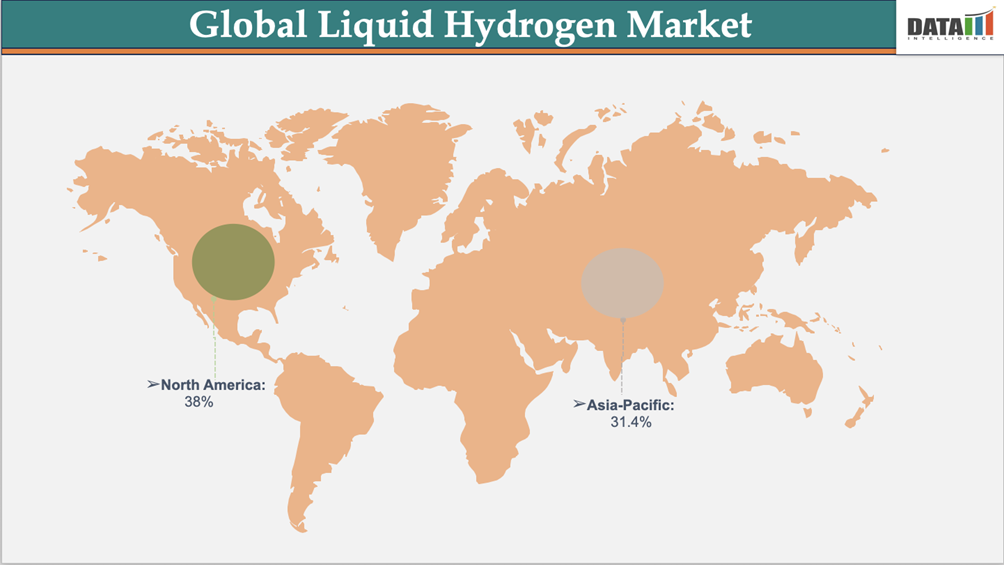
North America leads the Liquid Hydrogen regional analysis with a 38% market share, driven by strong federal initiatives and large-scale infrastructure investments. The US dominates with projects focused on liquefaction capacity, mobility deployment, and industrial decarbonization.
Asia-Pacific
Asia-Pacific is the fastest-growing region, supported by aggressive hydrogen strategies in Japan, China, South Korea, and Australia. The region benefits from manufacturing scale, export potential, and strong integration of hydrogen in mobility and industry.
Europe
Europe is advancing through regulatory frameworks and sustainability mandates. Investments in green hydrogen and electrolyzer capacity are positioning the region as a leader in low-carbon hydrogen production.
Competitive Landscape
The Liquid Hydrogen vendor landscape includes a mix of industrial gas leaders, energy companies, and fuel cell technology providers.
Key Liquid Hydrogen top companies include:
- Air Liquide
- Air Products Inc
- Linde plc
- Plug Power Inc
- Cummins Inc
- Ballard Power Systems
- FuelCell Energy Inc
- PowerCell Sweden AB
Strategy and Positioning
- Industrial gas companies focus on scaling production and infrastructure
- Technology firms are advancing fuel cell efficiency and electrolyzer systems
- Energy companies are integrating hydrogen into broader decarbonization strategies
Competitive advantage is increasingly linked to supply chain integration and cost optimization.
Recent Developments
In May 2026, Air Liquide expanded its liquid hydrogen production and distribution infrastructure to support mobility and industrial applications. The initiative focuses on scaling hydrogen supply chains. This supports clean energy transition.
In April 2026, Linde plc introduced advanced liquid hydrogen storage and transportation solutions with improved efficiency and safety. The development enhances handling and logistics. This benefits hydrogen ecosystems.
In March 2026, Shell plc strengthened its hydrogen strategy with investments in liquid hydrogen production and fueling infrastructure. The innovation focuses on decarbonization and mobility solutions. This supports energy transition goals.
Sustainability and Policy Impact
Liquid hydrogen plays a central role in reducing emissions across transportation, energy, and industrial sectors. The shift toward green hydrogen production is lowering lifecycle emissions, aligning with global net-zero targets.
Policy frameworks are critical in bridging the cost gap and enabling large-scale adoption.
Report Benefits
- Identify high-impact investment areas across hydrogen value chains
- Understand Liquid Hydrogen pricing and adoption trends and cost drivers
- Evaluate project pipeline and infrastructure readiness
- Benchmark competitors and technology strategies
- Support procurement, expansion, and partnership decisions
Why Choose DataM?
- Data-Driven Insights: Dive into detailed analyses with granular insights such as pricing, market shares and value chain evaluations, enriched by interviews with industry leaders and disruptors.
- Post-Purchase Support and Expert Analyst Consultations: As a valued client, gain direct access to our expert analysts for personalized advice and strategic guidance, tailored to your specific needs and challenges.
- White Papers and Case Studies: Benefit quarterly from our in-depth studies related to your purchased titles, tailored to refine your operational and marketing strategies for maximum impact.
- Annual Updates on Purchased Reports: As an existing customer, enjoy the privilege of annual updates to your reports, ensuring you stay abreast of the latest market insights and technological advancements. Terms and conditions apply.
- Specialized Focus on Emerging Markets: DataM differentiates itself by delivering in-depth, specialized insights specifically for emerging markets, rather than offering generalized geographic overviews. This approach equips our clients with a nuanced understanding and actionable intelligence that are essential for navigating and succeeding in high-growth regions.
- Value of DataM Reports: Our reports offer specialized insights tailored to the latest trends and specific business inquiries. This personalized approach provides a deeper, strategic perspective, ensuring you receive the precise information necessary to make informed decisions. These insights complement and go beyond what is typically available in generic databases.
Target Audience
- Energy companies and utilities
- Hydrogen infrastructure developers
- Automotive and aerospace OEMs
- Industrial manufacturers
- Investors and private equity firms
- Policy and regulatory bodies


























































