


Light Fidelity Li-Fi Market Size
Light Fidelity, or Li-Fi, is becoming an important connectivity option for smart buildings, hospitals, defense facilities, factories, transportation hubs and urban infrastructure where secure, high-speed and low-interference communication is required. Unlike radio-based wireless networks, Li-Fi uses LED light to transmit data, making it attractive in RF-sensitive environments and dense indoor networks.
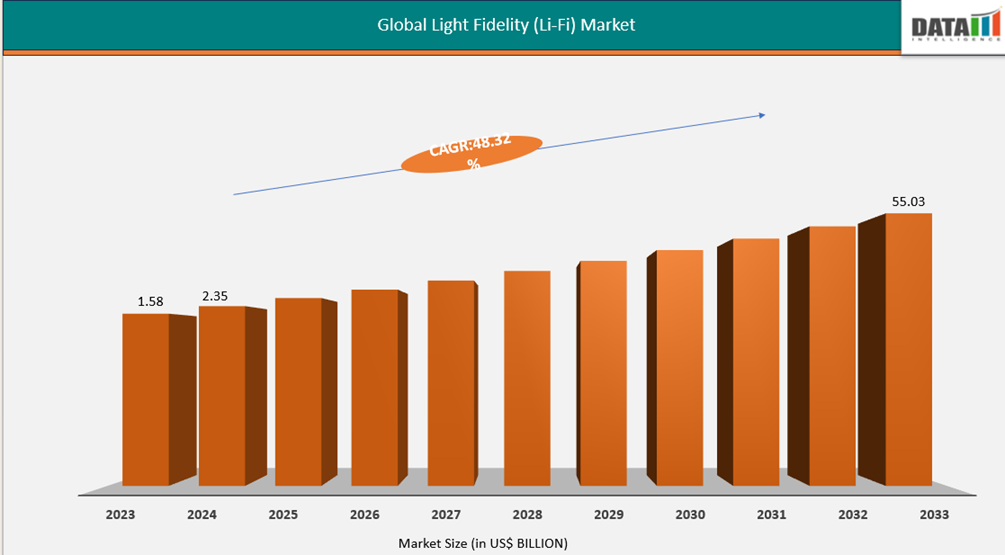
Light Fidelity (Li-Fi) Market is valued at US$ 3.49 billion in 2025 and is projected to reach US$ 179.81 billion by 2035, growing at a CAGR of 48.32% during 2026–2035.
The market is gaining investment attention because Li-Fi sits at the intersection of smart infrastructure, mobility, secure enterprise networking and 5G edge integration. Its strongest near-term value is in indoor environments where Wi-Fi faces congestion, security or interference limitations.
Key Takeaways
- The Light Fidelity Li-Fi market size 2026 is recalculated at US$ 5.18 billion, supported by secure indoor connectivity and smart infrastructure deployment.
- The Light Fidelity Li-Fi market forecast 2035 is recalculated at US$ 179.81 billion, reflecting long-term growth in light-based wireless communication.
- Asia-Pacific is the largest market, driven by smart city investments, LED infrastructure and deployments across China, India and South Korea.
- North America is the fastest-growing market, supported by enterprise, healthcare, defense and aviation use cases.
- In 2025, Signify introduced upgraded Trulifi retrofit kits offering speeds up to 250 Mbps, targeting commercial and defense use.
- Light Fidelity Li-Fi top companies include pureLiFi, Oledcomm, Velmenni, Signify, Lucibel, Fraunhofer HHI, Firefly LiFi, VLNComm, Kyocera SLD Laser and Panasonic.
Light Fidelity Li-Fi Market Scope
| Metric | Details |
| Market Size in 2025 | US$ 3.49 billion |
| Market Size by 2035 | US$ 179.81 billion |
| CAGR | 48.32% |
| Historic Years | 2023 to 2024 |
| Base Year | 2025 |
| Forecast Period | 2026 to 2035 |
| Segments Covered | By Component, Application and Region |
| Leading Region | Asia-Pacific |
| Fastest Growing Region | North America |
Light Fidelity Li-Fi Growth Drivers
Secure Indoor Connectivity Is Creating Early Demand
Light Fidelity Li-Fi growth drivers are strongest in environments where data security, low interference and high bandwidth matter. Hospitals, defense facilities, manufacturing sites and financial institutions can use Li-Fi to reduce RF interference and limit signal leakage beyond controlled spaces.
In 2025, Intelligent Waves partnered with Signify to deliver Li-Fi kits to the U.S. Department of Defense, validating the technology for secure, radio-free environments. This defense use case is strengthening confidence among healthcare, commercial real estate and industrial buyers.
Smart Cities and LED Infrastructure Support Scale
Li-Fi fits naturally into smart-city procurement because it can use LED lighting infrastructure for both illumination and communication. Cities investing in smart poles, connected transport hubs, smart campuses and digital public infrastructure can evaluate Li-Fi as a complementary network layer.
Asia-Pacific is leading this adoption path. China is integrating Li-Fi into public infrastructure, transport hubs and industrial zones, while India is using smart campuses, railway stations and rural connectivity programs to accelerate deployment.
5G Edge and IoT Integration Strengthen the Use Case
Li-Fi is not positioned as a full replacement for Wi-Fi or cellular networks. Its strongest role is as a complementary indoor and edge connectivity layer. Integrated with 5G, edge computing and IoT ecosystems, Li-Fi can support secure high-bandwidth connectivity in buildings, factories, hospitals and mobility hubs.
Recent market trends also show rising adoption in smart cities, industrial automation and defense applications, where low-latency and interference-free communication can improve operational reliability.
Smart-City Procurement Drivers
| Procurement Driver | Why Li-Fi Matters |
| Secure public infrastructure | Light-based transmission can reduce wireless signal spillover |
| Smart lighting upgrades | LED infrastructure can support illumination and data transfer |
| Transport hubs | Supports secure indoor connectivity in railway stations and airports |
| Smart campuses | Enables controlled high-speed connectivity in education and research settings |
| Healthcare networks | Reduces RF interference risk in sensitive medical environments |
| Industrial zones | Supports real-time data exchange where RF signals are restricted or unreliable |
Interoperability Standards and Adoption Readiness
The introduction of IEEE 802.11bb in July 2023 is an important commercialization milestone. Interoperability standards reduce buyer risk by enabling compatibility across devices and vendors. This is critical for enterprise and public-sector procurement because buyers need confidence that Li-Fi devices, receivers, transmitters and lighting systems can scale across facilities.
Standardization also supports vendor competition, lowers integration friction and improves long-term procurement confidence.
Pricing and Adoption Trends
Light Fidelity Li-Fi pricing and adoption trends are shaped by LED transmitter cost, photodetector cost, retrofit requirements, installation complexity, device compatibility and integration with building networks. Li-Fi can be more expensive than Wi-Fi in early deployments because it requires specialized transmitters, receivers and precise lighting infrastructure integration.
Adoption is strongest where the performance value is clear: defense, healthcare, industrial automation, aviation, research labs, smart buildings and secure enterprise networks. Cost remains a barrier in large retrofits and price-sensitive markets, but retrofit kits and standards-based equipment can reduce deployment friction over time.
Light Fidelity Li-Fi Market Segmentation Analysis
Segmented by Component (transmitter, receiver, microcontroller, LED drivers and others), by Application (residential, commercial and industrial), and by Region - Share, Trends, and Forecast to 2035.
By Component
Transmitters and LED drivers are critical because Li-Fi depends on light modulation for data transfer. Receivers and photodetectors convert light signals into data, while microcontrollers support system control, communication processing and device interaction.
Component demand will rise as Li-Fi moves from pilot deployments to integrated lighting and communication systems.
By Application
Commercial adoption is accelerating in offices, hospitals, retail spaces and financial institutions. These buyers value secure, high-speed and interference-free connectivity.
Industrial adoption is growing in factories, transportation hubs and mining operations where RF communication can be unreliable or restricted. Residential adoption is likely to develop through smart home and connected lighting ecosystems, although enterprise and public-sector use cases are expected to lead earlier investment.
Urban Deployment Case Studies
| Market | Deployment Signal | Strategic Relevance |
| China | CETC advanced secure optical systems for defense and industrial use in 2024 | Supports Li-Fi deployment in RF-sensitive critical environments |
| India | Jabil announced a silicon-photonics plant in Gujarat in 2025 | Strengthens Li-Fi component supply-chain resilience |
| United States | Getac integrated Li-Fi into rugged devices through Signify’s Trulifi platform in 2023 | Supports defense, manufacturing and healthcare field communication |
| United States | Intelligent Waves and Signify delivered Li-Fi kits to the Department of Defense in 2025 | Validates secure non-RF communication use cases |
| Global | Signify upgraded Trulifi retrofit kits with speeds up to 250 Mbps in 2025 | Improves commercial and defense deployment readiness |
Regional Analysis
Asia-Pacific
Asia-Pacific is the largest Light Fidelity Li-Fi market, supported by smart cities, LED infrastructure and industrial modernization. China, India and South Korea are key markets due to public infrastructure projects, manufacturing capacity and demand for secure connectivity.
China is advancing Li-Fi through smart city rollouts, public infrastructure and defense-oriented optical systems. India is the fastest-growing country-level opportunity in the source content, supported by Digital India, smart campuses, railway stations and component manufacturing expansion.
North America
North America is the fastest-growing region. The U.S. leads adoption across enterprise, defense, healthcare and aviation applications. Strong R&D capability, venture funding and secure communication demand are supporting commercialization.
The Getac and Signify collaboration supports rugged Li-Fi devices for RF-restricted environments, while defense-grade deployments are improving buyer confidence.
Europe
Europe is an important market for Li-Fi due to smart building adoption, industrial automation, sustainability policies and strong research activity. European buyers are likely to prioritize interoperability, energy efficiency, data security and integration with building automation systems.
Public-Private Investment Models
Li-Fi adoption will depend on collaboration between lighting companies, telecom operators, smart city authorities, defense agencies, device manufacturers and infrastructure developers. Public-private investment can reduce early deployment risk and support pilot-to-scale commercialization.
Relevant models include smart city pilots, defense procurement programs, hospital connectivity upgrades, smart campus deployments, transport hub modernization and industrial automation partnerships.
Safety and Sustainability Benefits
Li-Fi supports safer connectivity in RF-sensitive environments such as hospitals, aircraft, defense facilities and industrial sites. Because it uses visible light, it can reduce electromagnetic interference and improve network containment in controlled spaces.
Sustainability benefits come from dual-use LED systems that combine lighting and data transmission. AI-optimized and LED-based networks can support energy-efficient smart buildings and lower dependence on radio spectrum congestion.
Competitive Landscape and Company Strategy
The Light Fidelity Li-Fi vendor landscape includes specialist Li-Fi companies, lighting firms, photonics players and electronics manufacturers. Key companies include pureLiFi, Oledcomm, Velmenni, Signify, Lucibel, Fraunhofer HHI, Firefly LiFi, VLNComm, Kyocera SLD Laser and Panasonic.
Signify is strongly positioned through Trulifi and defense collaborations. pureLiFi and Oledcomm are important specialist players focused on Li-Fi technology commercialization. Panasonic, Kyocera SLD Laser and Fraunhofer HHI add electronics, laser, photonics and research depth.
Vendor differentiation depends on data speed, retrofit ease, device compatibility, security performance, lighting integration, standards compliance and ability to support enterprise-scale deployment.
Recent Developments
- May 2026 – pureLiFi expands next-generation Li-Fi connectivity solutions
pureLiFi enhanced its wireless communication portfolio by introducing advanced Li-Fi modules with higher data throughput, lower latency, and improved interoperability for enterprise, industrial, defense, and smart building applications. - May 2026 – Signify strengthens connected lighting and Li-Fi integration
Signify continued integrating Li-Fi technology into its intelligent lighting ecosystem, enabling secure, high-speed wireless communication through LED lighting infrastructure for offices, healthcare facilities, and industrial environments. - April 2026 – Oledcomm advances commercial Li-Fi networking solutions
Oledcomm expanded its Li-Fi offerings with upgraded access points and mobile connectivity solutions designed to provide secure, interference-free wireless communication in education, healthcare, transportation, and enterprise environments. - April 2026 – Panasonic enhances optical wireless communication research
Panasonic continued developing optical wireless communication technologies by integrating Li-Fi with smart infrastructure, IoT devices, and next-generation industrial automation systems to improve connectivity and operational efficiency. - March 2026 – Fraunhofer HHI advances high-speed optical wireless communication technologies
Fraunhofer HHI strengthened research into Li-Fi systems by improving optical transmission performance, network reliability, and multi-user communication capabilities for future wireless networking applications. - March 2026 – Kyocera SLD Laser develops advanced laser-based Li-Fi components
Kyocera SLD Laser expanded development of laser-based optical communication technologies that enable faster and more reliable Li-Fi connectivity for industrial, aerospace, and high-performance networking applications. - February 2026 – Lucibel strengthens enterprise Li-Fi deployments
Lucibel continued expanding commercial deployments of Li-Fi-enabled lighting systems in offices, hospitals, and secure facilities, focusing on enhanced cybersecurity and energy-efficient wireless communication.
Report Benefits
- This report helps Li-Fi vendors evaluate demand across smart buildings, defense, healthcare, industrial automation and transport infrastructure.
- It supports investors by quantifying the Light Fidelity Li-Fi market forecast 2035 and identifying growth signals in smart infrastructure and mobility.
- It helps smart-city teams assess procurement drivers, interoperability needs, public-private deployment models and urban use cases.
- It supports technology companies in evaluating opportunities across LED drivers, receivers, microcontrollers, photonics, 5G edge and IoT integration.
- It helps strategy teams compare vendor positioning, adoption barriers, pricing trends and regional growth opportunities.
Why Choose DataM?
- Data-Driven Insights: Dive into detailed analyses with granular insights such as pricing, market shares and value chain evaluations, enriched by interviews with industry leaders and disruptors.
- Post-Purchase Support and Expert Analyst Consultations: As a valued client, you gain direct access to our expert analysts for personalized advice and strategic guidance, tailored to your specific needs and challenges.
- White Papers and Case Studies: Benefit quarterly from our in-depth studies related to your purchased titles, tailored to refine your operational and marketing strategies for maximum impact.
- Annual Updates on Purchased Reports: As an existing customer, enjoy the privilege of annual updates to your reports, ensuring you stay abreast of the latest market insights and technological advancements. Terms and conditions apply.
- Specialized Focus on Emerging Markets: DataM differentiates itself by delivering in-depth, specialized insights specifically for emerging markets, rather than offering generalized geographic overviews. This approach equips our clients with a nuanced understanding and actionable intelligence that are essential for navigating and succeeding in high-growth regions.
- Value of DataM Reports: Our reports offer specialized insights tailored to the latest trends and specific business inquiries. This personalized approach provides a deeper, strategic perspective, ensuring you receive the precise information necessary to make informed decisions. These insights complement and go beyond what is typically available in generic databases.
Target Audience
- Li-Fi technology providers
- Lighting companies
- Telecom operators
- Smart city authorities
- Defense agencies
- Hospitals and healthcare facilities
- Industrial automation companies
- Transport infrastructure operators
- Electronics manufacturers
- Investors in wireless communication and smart infrastructure sector
- Procurement teams
- Strategy and planning leaders


























































