


Japan Rare Disease Patient Identification Services Market Overview
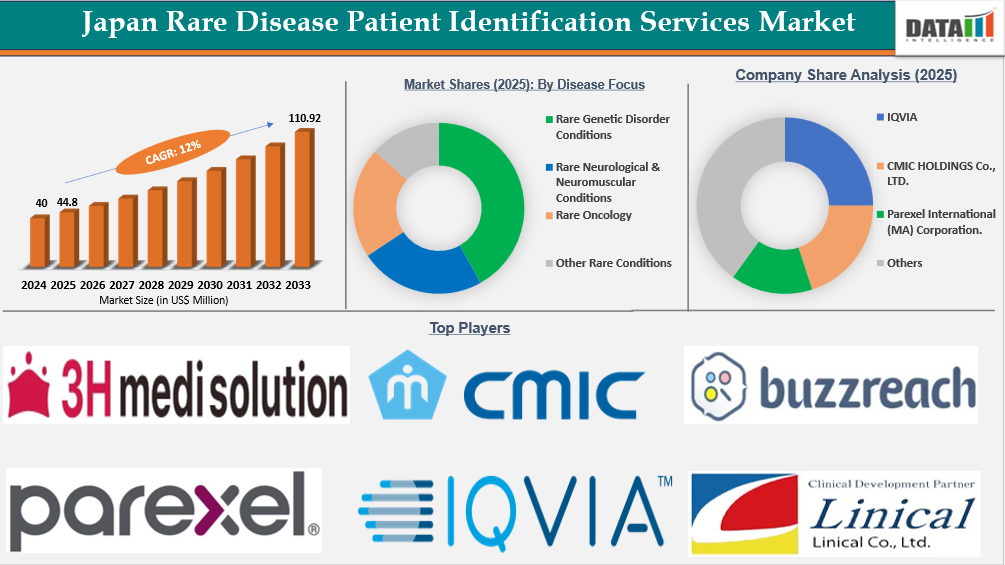
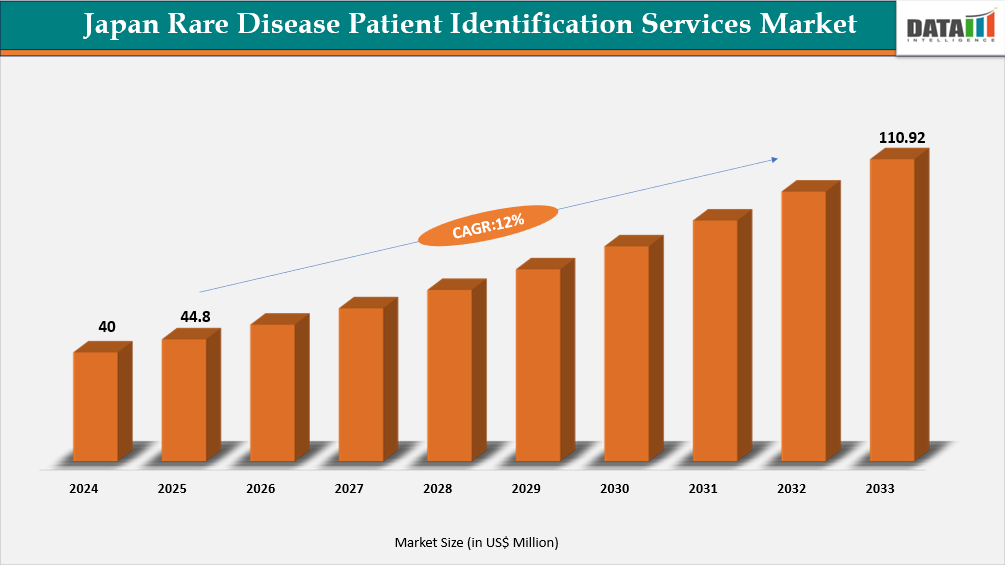
The Japan Rare Disease Patient Identification Services Market reached US$40 Million in 2024, rising to US$44.8 Million in 2025, and is expected to reach US$110.92 Million by 2033, growing at a CAGR of 12% from 2026 to 2033.
The Japan Rare Disease Patient Identification Services Market is significantly influenced by national policy frameworks and registry-based management systems for rare diseases, established by the Ministry of Health, Labour and Welfare (MHLW). Under the Intractable Diseases Act of Japan, a rare disease is defined as a disease that has fewer than 50,000 people affected in Japan. According to the latest government statistics, over 330 diseases currently exist that receive official approval for the provision of medical expense subsidies and the establishment of systems for the collection and storage of structured data. Government reports show that there are more than 1,000,000 patients in Japan with rare and intractable diseases that have met these imposed designations; therefore, creating a significant need for developing systematic identification methodologies, as well as procedures for tracking diagnoses and long-term monitoring.
In response to these unique circumstances, the government formed The Initiative on Rare and Undiagnosed Diseases (IRUD) through the Japan Agency for Medical Research and Development (AMED) in order to create an initiative that will help reduce the number of patients that experience delays to their diagnosis and the number of patients who are undiagnosed. IRUD operates a national network of over 400 hospitals with different types of clinicians and resources where patients can receive specialized consultations and genomic sequencing services, as well as have their information collected in a centralized database, which will aid in the improvement of patient-identification accuracy. In conjunction with the IRUD, the Pharmaceuticals and Medical Devices Agency (PMDA) provide support for orphan drug designation, post-marketing surveillance and registry-based data use and linkage; thus, helping to provide a structured way to track patients with rare and intractable diseases and provide effective regulatory oversight.
The Ministry of Health, Labour and Welfare also supports the collection of epidemiological, clinical and treatment data for designated conditions by maintaining national rare disease registries. They use these data to establish eligibility for subsidies, long-term monitoring of patients, and collaboration among researchers. Together, the disease designation system established by the Japanese Government, national diagnostic networks, genomic initiatives and a mandatory registry reporting framework are the institutional basis for rare disease patient identification services in hospitals, research institutions, and specialized medical care.
Rare Disease Patient Identification Services Market Industry Trends and Strategic Insights
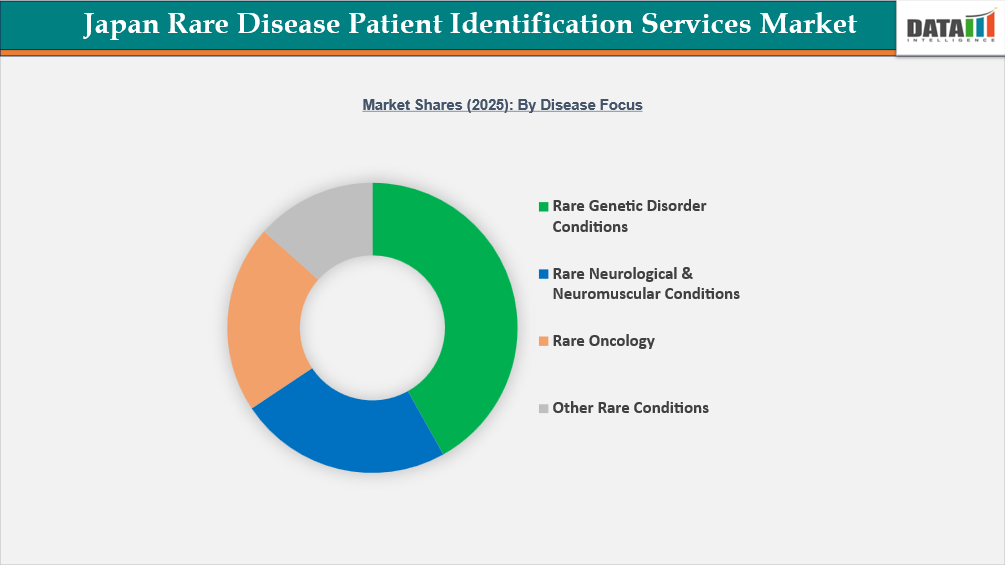
- By Disease Focus segment, Rare Genetic Disorder Conditions led the Japan Rare Disease Patient Identification Services Market, capturing the largest revenue share of 41.88% in 2025.
Japan Rare Disease Patient Identification Services Market Size and Future Outlook
- 2025 Market Size: US$44.8 Million
- 2033 Projected Market Size: US$110.92 Million
- CAGR (2026–2033): 12%
Market Dynamics
Advances in Genomic and Diagnostic Technologies Drive Growth of Rare Disease Patient Identification Services in Japan
Japan's capability of identifying patients with rare diseases has dramatically increased due to advances in genomic and diagnostic technology, and is one of the major drivers for the growth of the rare disease patient identification services market. The Government of Japan has set up the IRUD (Initiative on Rare and Undiagnosed Diseases), which is a national program that the Japan Agency for Medical Research and Development (AMED), in collaboration with the Ministry of Health, Labour, and Welfare have implemented, where many individuals from numerous families will have undergone whole genome sequencing. Of the patients who had their whole genomes sequenced from the IRUD program, a significant number now have a confirmed diagnosis due to their genomic testing results. In addition to providing patients with a diagnosis, the IRUD program has found hundreds of causative genes and thousands of pathogenic variants that were previously unknown, highlighting the capabilities of advanced genomic testing to discover new genetic causes of rare diseases. The results demonstrate how modern genetic analytic and diagnostic systems, when properly coordinated, help identify patients with rare diseases and add to the current national databases to enable earlier diagnosis and treatment of rare diseases across Japan.
Segmentation Analysis
The Japan Rare Disease Patient Identification Services Market is segmented based on Service Type, Disease Focus, Method, End User, and Mode of Delivery.
Patient Identification & Registry Services Drive Growing Demand for Rare Genetic Disease Conditions
Rare genetic disorders are caused by unusual alterations to an individual's DNA that impact only a very small segment of the global population. The majority of these rare genetic disorders do not have effective treatment and are difficult to properly diagnose and therefore manage in the long term. To date, more than 7,000 rare diseases have been reported around the world. Almost all of these have been identified due to a genetic mutation. In Japan’s nationally administered Nanbyo system, only about 1,800 of these rare diseases have been recognized, and therefore, the majority of rare genetic diseases remain largely unnoticed and undiagnosed in Japan. A review of the National Health Insurance database has shown approximately 4,500 patients in Japan diagnosed with a rare disease, and roughly 3,000 of these cases are also documented in international databases. Several of the rare genetic diseases diagnosed in Japan are diagnosed later in the diagnostic process than they would be with the same patient in another country; by extension, many individuals with rare genetic diseases in Japan do not have adequate access to leading-edge genetic tests. Strengthening the ability to identify patients, increasing access to genetic testing, and enhancing registry systems to facilitate timely diagnosis and appropriate care for patients diagnosed with rare genetic diseases are essential.
Competitive Landscape
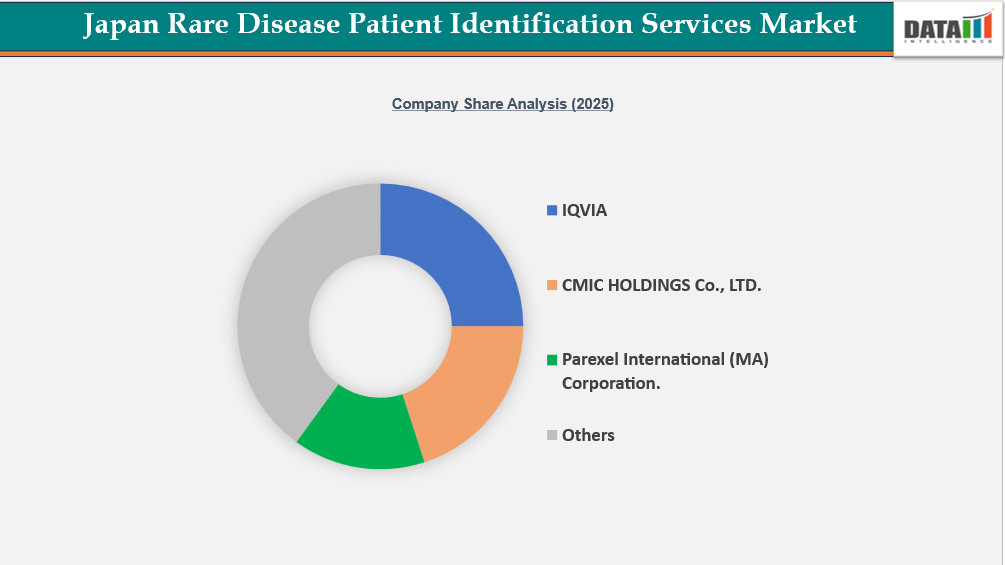
Japan's competitive market for rare disease patient identification services has a moderate level of consolidation. There is a good mix of both local and global players in this space. The five largest domestic providers are: CMIC Holdings Co., Ltd., 3H Medi Solution, Buzzreach, Inc., Linical Co., Ltd., and DCT Japan. Each of these companies provides robust patient recruitment, clinical registry management, decentralized trial infrastructure, and digital matching service solutions that are tailored to meet the unique needs of rare disease and genetic disorder trial participants.
Major global CROs also operate in this space, which include companies like Parexel International (MA) Corporation and IQVIA. These companies use advanced analytic methodologies, real-world data, and genomic information to help improve the process of identifying patients for clinical trials and determining if a clinical trial is feasible based on this information, particularly in relation to complex or ultra-rare patient populations.
Competition methods continue to evolve through the collaboration of both international and domestic firms, establishing joint ventures or other types of strategic alliances that leverage the strengths and capabilities of all parties involved. Company strategies are also involved in the recent trend of utilizing technology-based recruitment solutions along with synergies created from integrating existing registries. As result companies are focusing on rare neurological, genetic, and oncology diseases while utilizing their existing patient databases, existing hospital networks and implemented decentralized strategies to reach more patients, enroll them faster and foster greater participation and enthusiasm for research in a market that remains very fragmented due to the makeup of patient populations and the continued growth in the demand for precision medicine initiatives.
Key Developments
- In March 2024, IQVIA used real-world data from Japanese electronic medical records and claims databases to enhance patient cohort analysis and rare disease research in Japan. IQVIA used advanced analytics and machine learning to expand patient identification beyond typical hospital referrals, resulting in more data-driven discovery of complicated and rare illnesses in the Japanese population.
What Sets This Japan Rare Disease Patient Identification Services Market Intelligence Report Apart
- Latest Data & Forecasts – Comprehensive and up-to-date market intelligence with forecasts through 2033, covering Japan demand by key segmentation, with detailed analysis.
- Regulatory Intelligence – Provides an in-depth assessment of Japan's regulatory frameworks governing rare illness patient identification activities, such as PMDA guidelines, clinical trial paths, patient registry requirements, data privacy legislation, and post-marketing surveillance implications. Comparing findings with the FDA, EMA, NMPA, and CDSCO frameworks helps understand cross-market compliance implications.
- Competitive Benchmarking – Structured evaluation of leading service providers and solution vendors, with emphasis on service portfolio depth, technological capabilities, collaborations with hospitals and specialty clinics, and strategic initiatives in rare disease patient engagement.
- Actionable Strategies & Cost Dynamics – Strategic insights into patient identification program design, pricing structures, technology uptake, and cost-effective service delivery. Includes professional viewpoints on patient recruiting problems, market access methods, and lifecycle management for rare illness initiatives, assisting stakeholders in minimizing risk and increasing operational efficiency.


























































