Japan Lighting Market Size and Overview
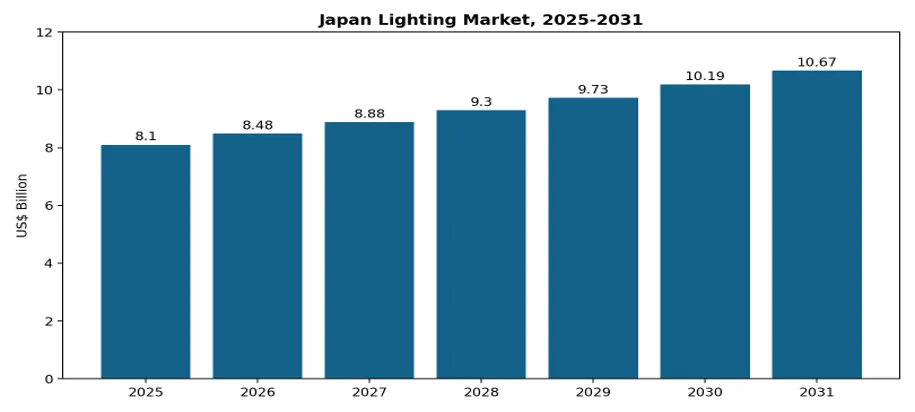
The Japan Lighting Market is estimated at US$ 8.10 billion in 2025 and is projected to reach US$ 10.67 billion in 2031, representing an estimated 4.7% annual growth rate. LED replacement across commercial buildings, homes and public infrastructure is supporting demand, while connected controls and premium architectural products raise the value of new installations.
Japan has an extensive installed base of fluorescent lighting in offices, schools, factories and residential properties. The gradual restrictions on general-purpose fluorescent lamp production and imports from 2026 are encouraging owners to plan LED upgrades. Suppliers are focusing on installation compatibility, lower electricity use and lighting quality for existing buildings.
| 2025 MARKET SIZE | 2031 FORECAST | CAGR (2026–2031) |
| US$ 8.10 Billion | US$ 10.67 Billion | 4.7% |
Japan Lighting Key Takeaways
Japan lighting revenue is estimated at US$ 8.10 billion in 2025 and US$ 10.67 billion by 2031.
The phase-out of general-purpose fluorescent lamps supports replacement demand in commercial and residential buildings.
LED fixtures remain the largest technology opportunity, with higher-value controls gaining acceptance in large facilities.
Municipal upgrades create demand for streetlights, tunnel fixtures and maintenance-efficient outdoor systems.
Aging properties and rising labor costs favor easy-to-install retrofit solutions and long-life fixtures.
Lighting quality, glare control and connected functionality are increasingly important in offices and hospitality sites.
Japan Lighting Industry Trends and Strategic Insights
Retrofit activity is becoming more important than new construction in several mature building segments.
Wireless controls and occupancy sensing help owners cut operating expenses without full electrical rewiring.
Commercial buyers are comparing lifetime operating cost, glare, color rendering and maintenance access.
Local brands retain strong specification channels while imported premium products compete in architectural projects.
Japan Lighting Market Scope
| METRICS | DETAILS |
| 2025 Market Size | US$ 8.10 Billion |
| 2031 Projected Market Size | US$ 10.67 Billion |
| CAGR (2026–2031) | 4.7% |
| By Transformer Type | LED fixtures, lamps, architectural, commercial, industrial and outdoor lighting |
| By Data Center Type | Residential, offices, hospitality, factories, healthcare, education, public areas |
| By Voltage Rating | LED, fluorescent, specialty lamps and high-intensity discharge |
| By Insulation and Cooling | Standalone, dimming, occupancy sensing and networked controls |
| By Power Architecture | New installations, replacements, connected retrofits and servicing |
| By Phase and Installation | Indoor, outdoor, new-build, retrofit and replacement |
| By Installation Stage | Top 10 lighting suppliers and brands with Japan market presence |
| Competitive Landscape | 2025-2031 Japan lighting market and applications |
Japan Lighting Market White Space & Investment Opportunities
Fluorescent replacement: target offices, educational facilities and industrial buildings needing planned multi-site upgrades.
Connected commercial lighting: combine LED fixtures with sensors, wireless controls and commissioning support.
Outdoor infrastructure: offer weather-resistant, high-efficacy luminaires and maintenance services for municipal networks.
Suppliers can improve project conversion through compatibility assessments, lighting design support, clear payback calculations and access to installers. Retrofit programs are particularly attractive when product delivery, site surveys and disposal of old fixtures are handled as one package.
Driver Impact Analysis
The planned end of manufacturing and importation of general-purpose fluorescent lamps is accelerating decisions to replace legacy lighting in offices, schools, shops and homes. Rising expectations for energy savings are also shifting purchases toward high-efficacy luminaires and intelligent control systems. Japan’s aging building stock creates broad demand for reliable replacements with minimal installation disruption.
| DRIVER | AFFECTED PRODUCT / SIGNAL | 2026–2031 CAGR | STRATEGIC IMPACT |
| Fluorescent-to-LED transition | High | Commercial, residential and institutional replacements | Offer retrofit-compatible products and bundled replacement services |
| Electricity and operating cost | High | High-efficacy LED fixtures and smart controls | Quantify energy savings for facilities and portfolio owners |
| Building renovation activity | Medium-High | Office, retail and hospitality lighting upgrades | Work with designers and fit-out contractors early |
| Municipal and industrial upgrades | Medium-High | Roadway, high-bay and outdoor fixtures | Expand specification and long-term servicing support |
Commercial renovation, warehouse modernization and municipal LED programs generate additional orders for task lighting, high-bay fixtures and outdoor luminaires. Building operators increasingly value low-glare optics, sensor-based dimming and centralized maintenance monitoring. Suppliers that offer compatible retrofit designs and local installer support can capture repeat project demand.
Restraint Impact Analysis
Japan’s lighting industry faces intense price competition in standard LED products, while the cost of installation can delay replacements in occupied buildings. Buyers may continue using existing lamps while stocks remain available, spreading retrofit demand over several years. Some older fixtures cannot safely accept simple LED tube substitutions, requiring rewiring or complete fixture replacement.
| RESTRAINT | PRIMARY EXPOSURE | RISK LEVEL | STRATEGIC IMPACT |
| Installation and labor expense | Occupied commercial and industrial properties | High | Provide quick-fit designs and installer training |
| Price competition | Commodity LED lamps and basic luminaires | High | Differentiate through warranties, controls and optics |
| Compatibility and safety | Legacy wiring, ballasts and fixture fittings | Medium-High | Validate electrical compatibility before replacement |
| Capital spending delays | Office renovation and public procurement budgets | Medium | Offer phased conversion and whole-life cost cases |
New-build demand is constrained by mature building activity and cautious capital spending in some customer segments. Electronics supply costs, project labor shortages and complex site-level approvals can also affect rollout schedules. Vendors can reduce purchasing risk by simplifying product families, documenting electrical compatibility and using phased retrofit packages.
Japan Lighting Market Competitive Landscape
Japan’s lighting industry includes established domestic fixture suppliers, consumer electrical brands and international lighting companies. Competition centers on product reliability, installer availability, efficiency, design quality, connected controls and access to retail and construction specification channels.
| COMPANY | LIGHTING POSITIONING |
| Panasonic | Residential, commercial and outdoor LED fixtures with Japan-wide installation channels |
| Toshiba Lighting & Technology | Commercial luminaires, office retrofits and lighting controls |
| Mitsubishi Electric Lighting | Building and industrial LED lighting with domestic specification support |
| Iris Ohyama | Residential and commercial LED products with broad retail reach |
| Endo Lighting | Architectural, commercial and retail lighting products |
| Koizumi Lighting | Office, residential and hospitality illumination systems |
| Odelic | Residential and commercial decorative and architectural fixtures |
| Yamagiwa | High-end architectural and designer lighting |
| Signify Japan | Professional LED luminaires and connected lighting solutions |
| Stanley Electric | Automotive and specialty LED lighting technology |
Domestic producers are well positioned for retrofit projects requiring Japan-specific fittings and contractor relationships. Global suppliers have opportunities in professional LED systems, control software and specialty architectural installations.
Japan Lighting Market Recent Developments
January 1, 2026: Japan began restrictions on manufacturing and importing certain compact fluorescent lamp categories, supporting longer-term LED replacement programs.
January 5, 2026: Japan’s government publicized the scheduled phase-out of general lighting fluorescent lamps and encouraged planned conversion to LEDs.
May 21, 2026: Panasonic introduced its Palook LED ceiling light Color Frame series, with ten design variants planned for release from late June.
June 9, 2026: Signify Japan announced its first Japan-market professional LED fixtures sold under the Signify brand, transitioning its professional fixture branding from Philips.
July 2026: Panasonic introduced recessed models in its slim integrated LED base-light sB series for commercial spaces.
October 2026: Panasonic added LED retrofit-oriented facility lighting, including kitchen, multipurpose and exterior bracket fixtures designed for easier installation and lamp replacement.