Japan Industrial Motors Market Overview
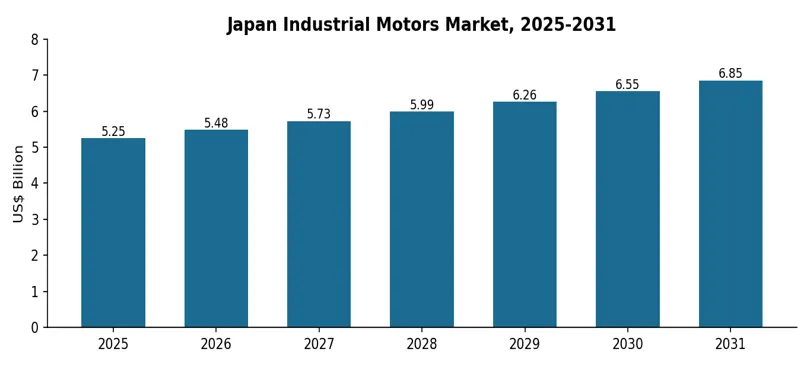
The Japan Industrial Motors Market is estimated at US$ 5.25 billion in 2025 and is forecast to reach US$ 6.85 billion by 2031, representing an estimated 4.5% CAGR. The market covers industrial electric motors installed in manufacturing plants, process facilities, industrial utilities and machinery. Replacement of aging equipment, investment in factory automation and purchases of energy-efficient motors support demand across Japan’s established industrial base.
Industrial motors convert electrical energy into mechanical power for pumps, fans, compressors, conveyors, machinery and production equipment. Japanese buyers place strong emphasis on reliability, operating efficiency and compatibility with existing plant systems. The market includes industrial induction, synchronous, permanent-magnet, servo and specialty motors, but excludes the revenue of standalone variable-frequency drives and drive electronics. Motor-and-drive packages are counted only for their motor component.
| 2025 MARKET SIZE | 2031 FORECAST | CAGR (2026-2031) |
| US$ 5.25 Billion | US$ 6.85 Billion | 4.5% |
Japan Industrial Motors Key Takeaways
Industrial motor revenue is estimated to grow from US$ 5.25 billion in 2025 to US$ 6.85 billion by 2031.
Aging motors in pumps, fans, compressors and production machinery create a steady replacement market across Japan.
Factory automation supports purchases of servo and precision motors for machine tools, robotics and packaging equipment.
Three-phase induction motors remain widely used, while permanent-magnet and synchronous motors gain attention for efficiency.
Motor efficiency, operating life and service availability often matter more to buyers than initial purchase price alone.
Retrofit demand is strongest where higher-efficiency motors can be installed without lengthy production shutdowns.
Japan Industrial Motors Industry Trends and Strategic Insights
High-efficiency IE3 motors remain central to replacement activity, while Japan is reviewing the potential adoption of stronger IE4 requirements.
Permanent-magnet and compact precision motors support high-performance machinery and automated production lines.
Plants favor motors with familiar mounting dimensions, proven insulation systems and manageable maintenance requirements.
Local repair networks, replacement parts and documented energy savings help suppliers secure repeat industrial customers.
Japan Industrial Motors Market Scope
| METRICS | DETAILS |
| 2025 Market Size | US$ 5.25 Billion |
| 2031 Projected Market Size | US$ 6.85 Billion |
| CAGR (2026-2031) | 4.5% |
| By Motor Type | Induction, permanent-magnet, synchronous, servo, geared and specialty industrial motors |
| By End-Use Industry | Manufacturing, chemical plants, metals, utilities, machinery and process industries |
| By Power Rating | Fractional to high-power motors, low- and medium-voltage industrial designs |
| By Efficiency Class | IE2, IE3, IE4 and higher-efficiency motor technologies |
| By Application | Pumps, fans, compressors, conveyors, machine tools and precision equipment |
| By Installation Setting | Plant-mounted, OEM-installed, indoor, outdoor and hazardous environments |
| By Installation Stage | New-build machinery, motor replacement, testing, repair and lifecycle service |
| Competitive Landscape | Top 10 motor manufacturers and industrial equipment suppliers active in Japan |
| Market Data Coverage | Japan industrial motors, equipment revenue and applications, 2025-2031 |
Japan Industrial Motors Market White Space & Investment Opportunities
Energy-efficiency replacement: target continuously operated pump, fan and compressor motors where reduced losses lower lifetime costs.
Precision machinery: supply compact high-torque and servo motors to robotics, machine tool and packaging equipment manufacturers.
Installed-base service: offer drop-in replacement designs, testing, condition monitoring, bearing repair and planned maintenance.
The strongest opportunities depend on actual motor operating hours, load factors and replacement constraints. Suppliers can win projects by checking existing mounting and electrical specifications, demonstrating achievable energy savings and providing reliable onsite support. Customers value equipment that can be installed during normal maintenance periods and supported for many years.
Driver Impact Analysis
Japan’s large installed base of industrial equipment creates regular demand for motor replacement even where construction of new factories is limited. Operators of pumps, compressors, blowers, conveyors and industrial HVAC equipment are assessing higher-efficiency motors to reduce power consumption and operating costs. Japan’s review of industrial motor efficiency requirements could also increase interest in products above the existing IE3 level. Manufacturers of precision machinery and automation equipment continue to need compact servo and permanent-magnet motors with stable torque and repeatable performance.
| DRIVER | AFFECTED PRODUCT / SIGNAL | 2026–2031 IMPACT | STRATEGIC IMPACT |
| Energy-saving motor replacement | High | IE3/IE4 induction and PM motors | Quantify lifetime operating savings and offer compatible replacements |
| Factory automation and precision equipment | High | Servo, brushless and precision motors | Work with machinery OEMs on torque and motion requirements |
| Replacement of aging plant equipment | Medium-High | Industrial AC motors and geared motors | Offer tested drop-in designs and maintenance support |
| Industrial reliability and uptime | Medium-High | Continuous-duty motors and condition monitoring | Build service plans around critical equipment |
Motor replacement opportunities differ by duty cycle and site conditions. A motor running many hours each year can justify a more efficient model through lower electricity costs, while machinery applications may require a better torque-to-size ratio or tighter speed control. Buyers also expect compatible mounting, thermal performance and dependable spare parts. Suppliers that provide site surveys, motor sizing checks, efficiency comparisons, testing and commissioning can convert aging installed equipment into long-term supply and service contracts.
Restraint Impact Analysis
Japan’s industrial motor market is mature and equipment is often maintained for long periods, which limits replacement demand when existing motors continue to perform reliably. Higher-efficiency, permanent-magnet and specialty motors can have a higher purchase price than standard induction models. Payback can be less attractive for equipment with short operating hours or infrequent use. Copper, electrical steel, bearings and magnet material costs can also affect supplier margins. Competition from domestic and imported products places pressure on pricing.
| RESTRAINT | PRIMARY EXPOSURE | RISK LEVEL | STRATEGIC IMPACT |
| Long motor replacement cycles | Installed motors in mature factories | High | Demonstrate efficiency and reliability improvements |
| Limited maintenance shutdowns | Process plants and production lines | High | Prepare replacement specifications before outages |
| Mechanical and electrical fit | Motor frames, couplings and inverter-fed motors | Medium-High | Check dimensions, insulation and thermal duty |
| Premium motor cost and materials | High-efficiency and magnet-based motors | Medium-High | Provide lifecycle payback and phased retrofit options |
Motor replacement can be delayed by practical site requirements. Existing couplings, foundations and mounting dimensions may prevent a direct changeover. A replacement motor must match starting torque, duty cycle, enclosure protection and cooling conditions. Where a motor is operated through an existing inverter, insulation ratings, bearing currents and cable conditions require review. Limited shutdown windows at chemical plants, steel mills and continuous production sites raise installation risk. Suppliers can reduce these barriers through pre-installation engineering and ready-to-fit replacement programs.
Japan Industrial Motors Market Competitive Landscape
Japan’s industrial motor market includes diversified electrical groups, dedicated motor manufacturers and specialists in geared and precision motors. Nidec supplies a broad motor portfolio, Toshiba and Hitachi have established industrial motor experience, and Mitsubishi Electric and Fuji Electric serve industrial automation and machinery applications. Sumitomo Heavy Industries and Oriental Motor address geared and precision motor requirements. ABB and Siemens participate in selected industrial and high-efficiency motor applications.
| COMPANY | INDUSTRIAL MOTOR POSITIONING |
| Nidec | AC, precision and specialty motors for factory and industrial applications. |
| Toshiba Industrial Products and Systems | Industrial and heavy-duty motors for process plants and utilities. |
| Mitsubishi Electric | Industrial and servo motors for factory machinery and automation systems. |
| Fuji Electric | Industrial motor equipment and energy-efficient plant applications. |
| Hitachi Industrial Equipment Systems | Industrial motors and motor-driven packaged plant equipment. |
| Sumitomo Heavy Industries | Geared motors and mechanical power transmission for industrial machinery. |
| Yaskawa Electric | Servo motors and matched motion systems for automation OEMs. |
| ABB | Low- and medium-voltage industrial motors and related lifecycle services. |
| Siemens | Industrial electric motors for manufacturing and process equipment. |
| Oriental Motor | Compact, stepper, brushless and geared motors for machinery. |
Competition is shaped by quality, installed equipment relationships, energy performance and local service. Japanese industrial customers often favor motors with reliable mechanical fit, proven winding and insulation systems, and access to maintenance assistance. Suppliers can strengthen their positions through OEM specification partnerships, efficiency upgrades, inventory support and condition-monitoring services.
Japan Industrial Motors Market Recent Developments
February 5, 2026: Nidec opened a technical center in Ritto, Shiga, to support industrial machine-tool development, testing and customer engineering.
April 6, 2026: Yaskawa launched the GA501 compact AC drive, supporting industrial motor speed control and equipment connectivity.
April 15, 2026: Nidec Drive Technology opened a new press-machine assembly factory in Shiga to support industrial manufacturing equipment demand.
June 26, 2026: Japan’s energy-efficiency committee discussed revising the Top Runner standard for industrial AC motors, including consideration of IE4 efficiency.
September 10, 2026: JEMA published an updated review of overseas industrial motor efficiency requirements, including changes affecting manufacturers serving global markets.
October 2, 2026: Nidec outlined a business recovery plan focusing investment on priority technology and energy-related sectors, with implications for its wider motor businesses.